South Korea Negative Pressure Wound Therapy Market Size & Forecast:
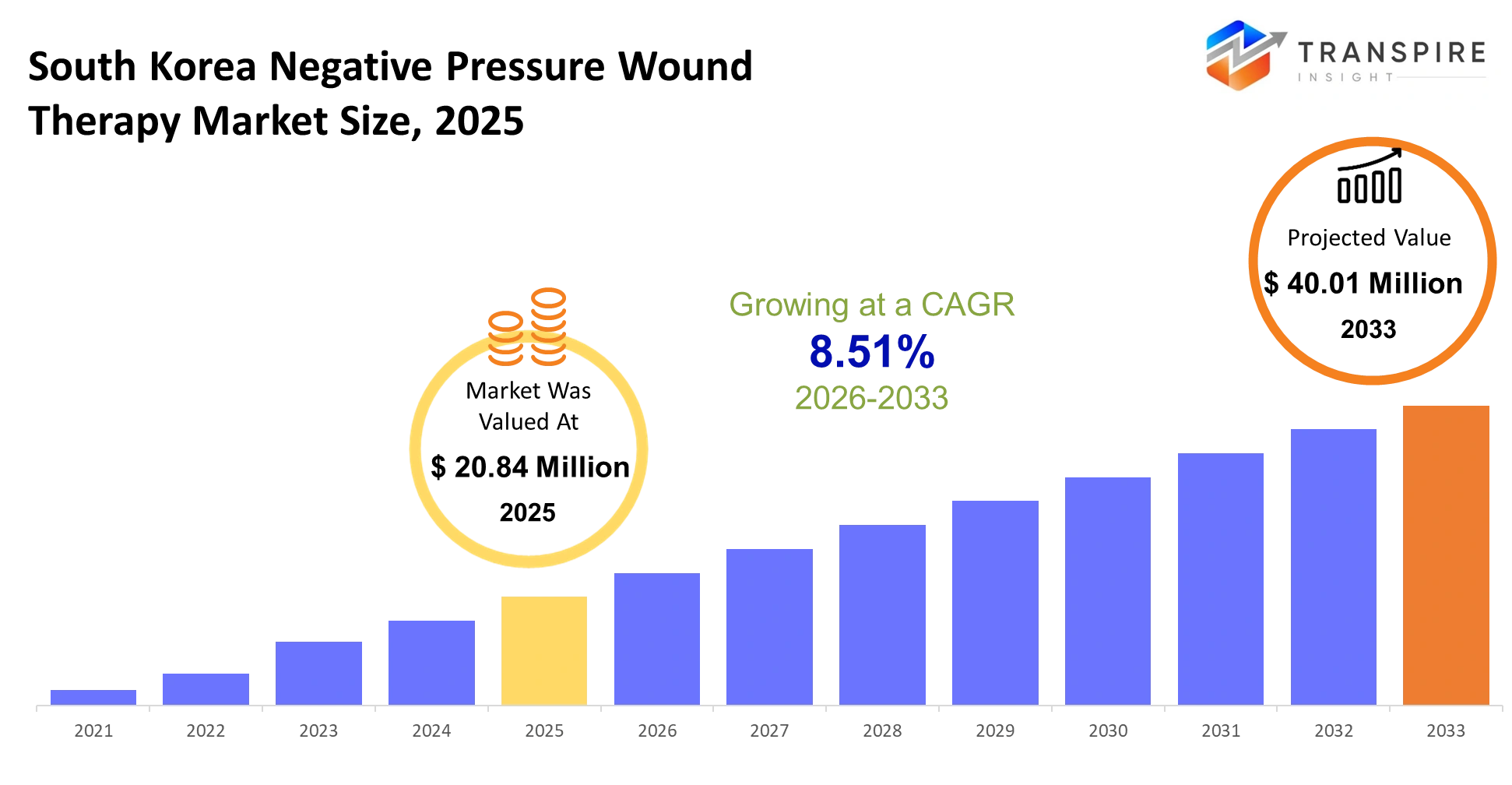
- South Korea Negative Pressure Wound Therapy Market Size 2025: USD 20.84 Million
- South Korea Negative Pressure Wound Therapy Market Size 2033: USD 40.01 Million
- South Korea Negative Pressure Wound Therapy Market CAGR: 8.51%
- South Korea Negative Pressure Wound Therapy Market Segments: By Product Type (Portable NPWT Devices, Conventional NPWT Devices, Disposable NPWT Systems, Others); By Application (Chronic Wounds, Surgical Wounds, Burn Care, Trauma Injuries, Others); By End User (Hospitals, Clinics, Home Healthcare, Others); By Technology (Single-use Systems, Reusable Systems, Smart NPWT Systems, Others)
To learn more about this report,  Download Free Sample Report
South Korea Negative Pressure Wound Therapy Market Summary
The South Korea Negative Pressure Wound Therapy Market was valued at USD 20.84 Million in 2025. It is forecast to reach USD 40.01 Million by 2033. That is a CAGR of 8.51% over the period.
In South Korea , the Negative Pressure Wound Therapy market is a pretty big deal when it comes to handling complicated wounds that need quicker healing, a lower chance of infection, and often shorter hospital time. You’ll see these systems used after surgery , for diabetic ulcers , in trauma care, and for long term chronic wound treatment, but especially in tertiary hospitals and in dedicated wound care centers where patient flow and infection control really, really steer day to day efficiency. Over the last few years , the market seems to move away from only inpatient solutions toward more portable, even home based NPWT setups , mainly because healthcare costs are being squeezed and hospitals are trying to use bed capacity more wisely after the COVID-19 pandemic. And yeah , the pandemic basically made the weak points in long term inpatient models more obvious, so remote wound monitoring got a faster push, along with disposable NPWT systems that are easier to deploy. On top of that, South Korea’s aging population plus a growing diabetic population means more chronic wound cases that need prolonged assistance. So when hospitals aim to cut down readmissions and improve post-surgery recovery results , adoption keeps spreading across both acute care and outpatient environments, step by step, but pretty steadily.
Key Market Insights
- South Korea Negative Pressure Wound Therapy Market, kind of reached USD 20.84 million in 2025 and it is expected to climb up to USD 40.01 million by 2033.
- In terms of applications, chronic wound management still leads the way, mostly because diabetic foot ulcer numbers, and pressure injury cases keep rising, plus there’s a lot of need for consistent care.
- Portable NPWT systems hold a meaningful portion of the pie, since more hospitals are backing home-based post-surgical recovery programs, and they want something easier to manage outside the hospital walls.
- When you look at regions, Seoul metropolitan healthcare facilities bring in the highest market revenue, with almost 48% share, supported by advanced surgical infrastructure ,and a dense network of specialty hospitals.
- On product types, single-use NPWT devices are moving fastest, this is linked to stricter infection-control protocols after the COVID-19 period, hospitals prefer safer and simpler handling workflows.
- Hospitals overall generate more than 60% of total demand, mainly because complicated wound care procedures need specialized clinical oversight and ongoing monitoring.
- Also AI-enabled wound assessment tools are getting traction, they help improve treatment accuracy via automated healing review, and remote patient monitoring functions that clinicians can actually use.
- Meanwhile post-operative wound care demand is expanding quickly as orthopedic, cardiovascular ,and trauma surgeries continue increasing across South Korea, and the number of follow-ups keeps stacking up.
- Finally, home healthcare and outpatient wound management are showing up as big growth opportunities for the South Korea Negative Pressure Wound Therapy Market through 2033.
What are the Key Drivers, Restraints, and Opportunities in the South Korea Negative Pressure Wound Therapy Market?
The main thing driving the market is basically the quick expansion of chronic wound and post operative care needs inside South Korea's aging healthcare system. You can see the numbers of diabetes prevalence are climbing, plus vascular disorders and more orthopedic surgeries are happening, so hospitals are now dealing with harder-to-heal wounds than before. On top of that, healthcare providers are getting squeezed to shorten inpatient stays, while at the same time they need to push down surgical site infection rates. So NPWT systems are getting rolled in faster, because they help with faster granulation, they do fluid removal more efficiently, and they keep the wound stable. And that kind of support tends to improve bed turnover efficiency, plus it lowers treatment complications. Also, reimbursement backing for advanced wound care in specialized setups has basically made big hospitals more willing to buy these solutions, procurement has picked up.
The biggest restraint is still the high procedural cost and the device ownership cost tied to advanced NPWT platforms. Portable systems, single-use devices, and those integrated monitoring technologies mean you have to keep spending capital, plus you need wound care personnel who are trained. Smaller regional hospitals, and even long term care facilities, often don’t have enough reimbursement flexibility, or they just don’t have specialist staffing ready for wide deployment. This ends up making adoption uneven across the healthcare system, and penetration outside metropolitan medical centers gets slowed down.
One more opportunity is showing up, and it’s coming mostly from home healthcare plus digitally connected wound management solutions. South Korea providers are putting more money into remote patient monitoring platforms that support outpatient recovery. If portable NPWT systems get integrated with telemedicine applications, clinicians can track wound progression from a distance, while also cutting down on unnecessary hospital visits.
What Has the Impact of Artificial Intelligence Been on the South Korea Negative Pressure Wound Therapy Market?
Artificial intelligence and digital health technologies are, over time, quietly reshaping wound management routines through South Korea’s advanced healthcare system. In more and more hospitals, AI-assisted wound assessment platforms are being paired with negative pressure wound therapy devices, kind of to sharpen treatment accuracy and make clinical choices feel more grounded. With computer vision algorithms, wound images can be analyzed, tissue granulation can be measured, infection risks can be flagged, and healing progression can be estimated in a more stable way than manual checks alone sometimes do. In practice, these systems let clinicians tweak pressure settings and rearrange dressing replacement timing, more efficiently, which tends to cut down on avoidable steps and makes patient monitoring feel more dependable.
Alongside that, machine learning models are also backing predictive care pathways by spotting patients who may be more likely to experience delayed wound healing or post-surgical problems. This is especially useful for diabetic ulcer care and orthopedic recovery programs, where lingering healing usually pushes costs upward, and not a little. Some electronically linked wound care solutions now support remote tracking of device performance and patient adherence, and that helps hospitals lower preventable readmissions while also balancing nursing workloads.
Day to day, providers tend to see shorter assessment time, higher quality documentation, and smoother continuity of care between inpatient units and outpatient clinics. Still, AI uptake has structural frictions. Many wound datasets remain scattered between institutions, and image standardization can differ a lot from one care environment to the next. Also, the implementation price for AI-enabled platforms stays high for mid-sized hospitals, so rollouts often don’t go far beyond big urban medical centers, even if the potential benefits are clear.
Key Market Trends
- Since 2022, South Korean hospitals have been swapping out the traditional, bulky NPWT systems for more portable devices which kind of helps with faster discharge and outpatient healing, so discharge day feels less complicated.
- AI assisted wound imaging platforms started to show real momentum after 2023 and clinicians used them to lessen manual assessment differences , which in turn improves treatment planning accuracy across multiple tertiary hospitals.
- After COVID, infection control expectations basically pushed single use NPWT devices higher than pre 2020 levels, especially in orthopedic and also cardiovascular surgical departments.
- Between 2022 and 2025, 3M and Smith+Nephew kept expanding their portable therapy lineups to catch the rising home care demand , you know the usual shift toward at home recovery.
- Diabetic wound treatment programs grew noticeably after 2021 , mainly because South Korea’s aging population increased the need for chronic ulcer care across long term care facilities.
- Hospitals also leaned into remote wound monitoring platforms after 2023 , aiming to cut down on unnecessary follow ups, and to make post surgical tracking run more efficiently.
- Procurement habits moved toward disposable dressing systems because providers wanted lower contamination risk and a simplified nursing routine after pandemic disruptions, it feels like less steps overall.
- Mid-sized regional hospitals sped up NPWT adoption from 2022 onward , partly because reimbursement support made advanced chronic wound procedures easier to justify.
- Competition stopped being only about pressure performance , manufacturers instead highlighted quieter pumps , lighter wearable units, and digital connectivity, like more than just the mechanics.
- Rehabilitation centers and home healthcare providers increased their NPWT use after 2024 as decentralized recovery models reduced the strain on urban hospital bed capacity.
South Korea Negative Pressure Wound Therapy Market Segmentation
By Product Type
Portable NPWT units are basically holding the top spot in the market because hospitals, and even rehab providers, keep putting more weight on mobility oriented wound care options. These lightweight setups let patients leave earlier from the hospital and also keep the therapy going in outpatient care , and even in home healthcare situations. The classic NPWT devices still sit as the second-largest part, mainly due to their steady use in larger tertiary hospitals that manage hard to treat post-surgical and trauma related wounds. Disposable NPWT systems keep picking up momentum especially in places that are more infection sensitive, while some other models stay mostly tied to specialized wound therapy configurations and a handful of niche clinical uses.
The pull for portable devices comes from healthcare decentralization, plus the growing strain on bed capacity across South Korea. Conventional systems stay relevant since high capacity wound drainage, along with continuous monitoring, is still a must for the most severe wound cases that need longer inpatient care. Disposable systems do well because of tighter infection prevention rules, and also because they simplify nursing workflows in busy surgical departments. During the forecast period, portable and disposable technologies are expected to grow faster, pushing makers to work on quieter pumps, wearable platforms and digitally connected monitoring functions for outpatient recovery pathways.
By Application
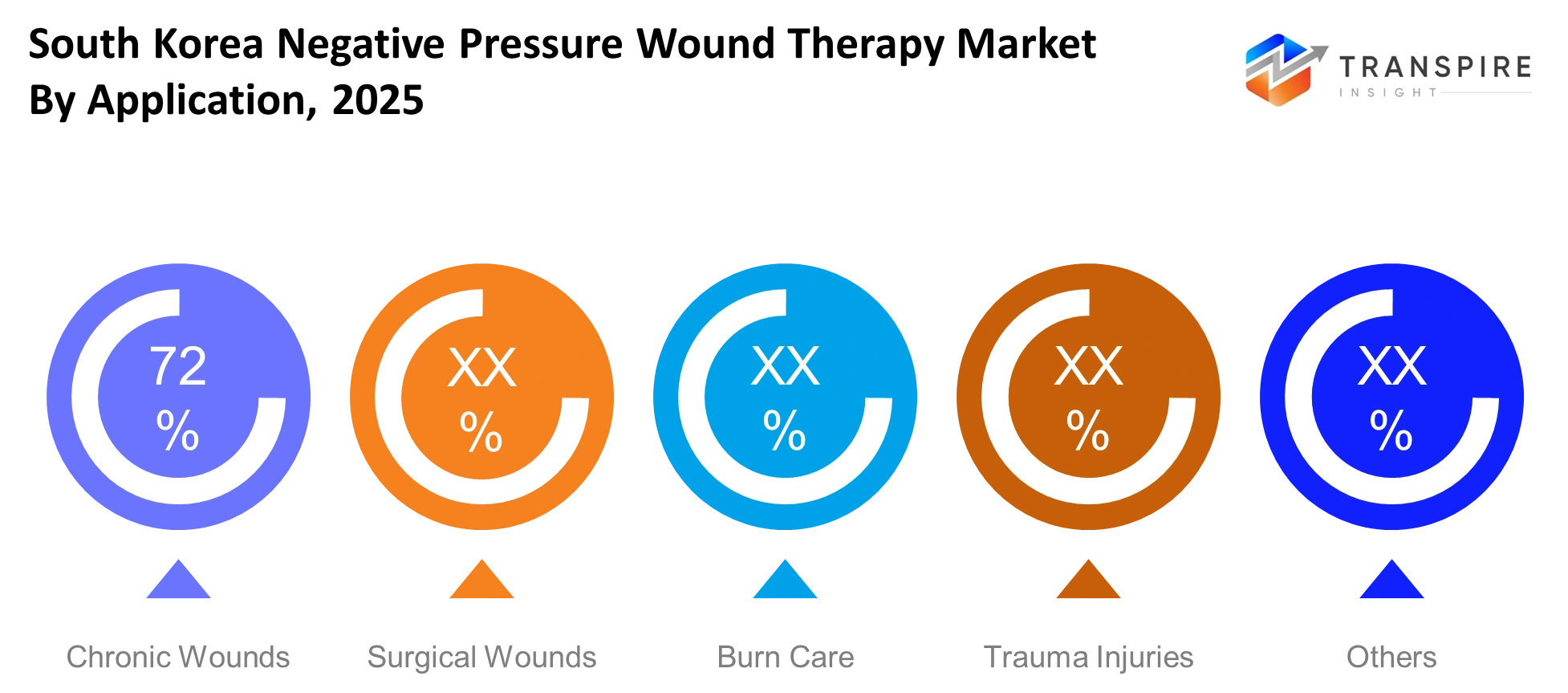
Chronic wounds kind of hold the lead position in the market, mainly since diabetic ulcers, pressure injuries, and vascular wounds really do need long-duration treatment plus ongoing wound management support and that sort of thing. On top of that, aging populations and the ongoing rise in diabetes prevalence keep pushing more patients into specialized wound care centers, and also into long term care facilities. Surgical wounds sit in the second-largest segment too, largely because orthopedic, cardiovascular, and abdominal surgeries keep growing across major hospitals. Meanwhile burn care and trauma injuries stay pretty steady in demand within emergency, and rehab settings, while the remaining categories stay linked to less frequent or more highly specialized wound scenarios, overall.
Demand for chronic wound solutions is basically fueled by the aim to reduce infection risks, cut down hospital readmissions, and support better tissue healing results for elderly patients. Surgical wound use also benefits from the growing emphasis on post operative recovery speed, and fewer inpatient complications inside big healthcare institutions. Burn care adoption tends to be tied to advanced dressing integration, along with fluid management capabilities that are required for treating severe skin injuries. Through the forecast period, chronic wound management should stay in the dominant spot, whereas surgical wound applications are expected to grow faster, as healthcare providers ramp up enhanced recovery protocols, and expand outpatient surgical programs.
To learn more about this report, Download Free Sample Report
By End User
Hospitals kinda dominate the market, because complex wound management procedures need specialized clinical oversight , surgical integration, and advanced monitoring infrastructure too. Big tertiary hospitals show up with a lot of procurement activity, due to higher surgical case volumes and also because demand keeps rising for infection control technologies. Clinics sit as the second largest slice, since outpatient wound treatment services keep expanding steadily across urban healthcare networks, or at least thats what it seems like in practice. Home healthcare is still emerging as a high-growth bucket, while the other routes stay tied to rehab centers and long term elderly care institutions in a more indirect way.
Hospital demand is fueled by the increasing chronic disease burden , higher trauma treatment volumes, and the push to improve post-surgical recovery outcomes. Clinic-based adoption gets an uplift from rising outpatient care delivery and shorter inpatient treatment cycles, encouraged by healthcare cost optimization strategies that are basically everywhere. Home healthcare growth is closely connected to portable NPWT systems that make it possible to deliver continuous wound treatment without keeping patients in hospital for too long. Over the forecast period, home healthcare should gather substantial momentum, so suppliers may want to prioritize easy-to-use wearable systems, and remote monitoring technologies , specifically built for decentralized care settings where clinicians can’t be on-site all the time.
By Technology
Reusable systems kinda keep the lead right now , mostly because big hospitals want long-term cost efficiency, plus bigger-capacity wound management platforms that can handle intensive clinical use day after day. Durable systems with more advanced pressure control features are still very common in surgical recovery units and also in trauma departments dealing with severe wound cases, you know, the heavy situations. Meanwhile, single-use systems are sitting as the second-largest segment , and that’s largely due to the growing focus on infection prevention along with easier disposal routines across healthcare facilities. Smart NPWT systems are slowly but steadily getting more traction too, mainly as they get wrapped into digital monitoring and AI-assisted wound evaluation technologies. The rest of the category stays more tied to smaller, limited experimental deployments , for now.
Reusable system demand is basically backed by the fact that hospitals already have the infrastructure in place, and teams also need uninterrupted therapy as part of broader complex wound treatment programs. Single-use tech keeps gaining momentum because clinicians want less contamination risk and fewer maintenance headaches, especially in outpatient services and home healthcare. Smart systems, on the other hand, are riding the wave of additional investment in connected healthcare platforms and remote patient monitoring features across South Korea’s increasingly digital healthcare ecosystem. Over the forecast period smart NPWT technologies are expected to grow the fastest, which should create real chances for developers working on AI-enabled wound analytics, cloud-based monitoring frameworks, and telemedicine integration.
What are the Key Use Cases Driving the South Korea Negative Pressure Wound Therapy Market?
Post-surgical wound management still ends up being the big dominant use case for NPWT systems in South Korea. I mean, large hospitals are leaning on these therapies more and more, especially after orthopedic, cardiovascular,and abdominal surgeries because they can help cut down surgical site infections, handle exudate in a better way, and also speed up tissue recovery a bit faster. The tech feels really worthwhile in higher risk procedures, particularly when elderly or diabetic patients are involved, since complications can end up dragging out hospitalization.
At the same time, adoption is widening for chronic wounds too, like diabetic foot ulcers , pressure ulcers,and traumatic injuries—mostly in rehab centers and long-term care facilities. Burn treatment units and trauma departments too are starting to use portable wound therapy systems, to keep patients more mobile during recovery while still keeping the treatment effectiveness steady, even when patients move around.
Newer and emerging use cases are popping up as well, such as home-based wound management and outpatient recovery programs that are supported by connected monitoring technologies. Doctors are also looking at ways to combine NPWT with biologic dressings and regenerative therapies for complex wounds that don’t really respond to the usual treatment pathways, like conventional steps.
|
Report Metrics |
Details |
|
Market size value in 2025 |
USD 20.84 Million |
|
Market size value in 2026 |
USD 22.59 Million |
|
Revenue forecast in 2033 |
USD 40.01 Million |
|
Growth rate |
CAGR of 8.51% from 2026 to 2033 |
|
Base year |
2025 |
|
Historical data |
2021 - 2024 |
|
Forecast period |
2026 - 2033 |
|
Report coverage |
Revenue forecast, competitive landscape, growth factors, and trends |
|
Regional scope |
South Korea |
|
Key company profiled |
3M, Smith & Nephew, Mölnlycke Health Care, ConvaTec, Cardinal Health, Medela, Talley Group, DeRoyal Industries, Genadyne Biotechnologies, Lohmann & Rauscher, B. Braun, Devon Medical, Carilex Medical, Paul Hartmann, Acelity |
|
Customization scope |
Free report customization (country, regional & segment scope). Avail customized purchase options to meet your exact research needs. |
|
Report Segmentation |
By Product Type (Portable NPWT Devices, Conventional NPWT Devices, Disposable NPWT Systems, Others); By Application (Chronic Wounds, Surgical Wounds, Burn Care, Trauma Injuries, Others); By End User (Hospitals, Clinics, Home Healthcare, Others); By Technology (Single-use Systems, Reusable Systems, Smart NPWT Systems, Others) |
Which Regions are Driving the South Korea Negative Pressure Wound Therapy Market Growth?
Seoul, and the wider Gyeonggi Province area, still seem to run the South Korea Negative Pressure Wound Therapy market, mostly because the big tertiary hospitals, trauma centers, and university medical networks are all kinda clustered there. It’s not just location either; the region also gets higher healthcare budgets, quicker purchasing turnarounds for advanced wound care kits, and better linkages between digital monitoring tools with surgical recovery pathways. After 2022, government-supported smart hospital programs basically helped speed up the rollout of portable NPWT systems, plus AI-assisted wound appraisal platforms. On top of that, there’s an active web of specialized surgeons, diabetes care programs, and medical technology resellers which keeps the whole place in a strong leadership position
Meanwhile, Busan and the southeastern healthcare corridor show up as the second biggest regional contributor, but their pace looks different compared to Seoul’s more tech-forward growth. In that corridor, hospitals lean more toward long-term chronic wound care connected to older age profiles and rehabilitation demand, rather than pushing high-volume surgical specialization. Municipal healthcare funding stays relatively steady, and regional infrastructure keeps expanding bit by bit, so procurement demand for standard and portable NPWT systems remains fairly consistent. Also, with big rehab facilities and elderly care networks in place, the corridor keeps feeding wound therapy revenues year after year
Then there is Incheon, along with a set of growing mid-sized urban areas, where growth looks like it’s picking up the quickest. Healthcare decentralization policies are reshaping how outpatient recovery works, and since 2023, spending on home healthcare services and digitally connected care platforms has boosted portable NPWT adoption outside the older, main metropolitan hospital ecosystems.
Who are the Key Players in the South Korea Negative Pressure Wound Therapy Market and How Do They Compete?
The competitive landscape for the South Korea Negative Pressure Wound Therapy market still looks moderately consolidated, like a few big names mostly hold things together. Multinational wound care companies control a noticeable share thanks to long standing hospital relationships and pretty broad product line ups. Lately, though, the fight feels more about portability with digital integration, dressing efficiency, and infection prevention, not only the basic pressure delivery part. Larger manufacturers try to protect their standing by rolling out lighter and quieter systems that fit outpatient workflows better. Meanwhile, smaller players show up with lower priced disposable devices and more specific wound applications. In practice, tech differentiation plus clinical support services have started to matter more than price, because hospitals are thinking about long term results and day to day workflow efficiency, not just immediate utilization.
Smith+Nephew keeps pressing its edge with portable RENASYS systems built for home healthcare and post surgical mobility. They stand out with light wearable platforms, integrated therapy modes, and solid clinician training assistance. 3M pushes forward using advanced closed incision wound therapy systems, and it also benefits from broad hospital procurement connections that it built across its surgical care portfolio. Their approach is drifting more toward pairing wound therapy with infection prevention solutions, especially for high volume surgical departments where throughput is everything.
Mölnlycke Health Care leans into premium dressing compatibility and chronic wound management solutions that suit long term care providers. ConvaTec, on the other hand, differentiates via a wound care ecosystem idea that links dressings, drainage systems, and portable NPWT devices so treatment continuity stays smooth in outpatient settings, even when care shifts between environments.
Company List
•3M
• Smith & Nephew
• Mölnlycke Health Care
• ConvaTec
• Cardinal Health
• Medela
• Talley Group
• DeRoyal Industries
• Genadyne Biotechnologies
• Lohmann & Rauscher
• B. Braun
• Devon Medical
• Carilex Medical
• Paul Hartmann
• Acelity
Recent Development News
In May 2026, Smith+Nephew launched the RENASYS EDGE Negative Pressure Wound Therapy System and ALLEVYN COMPLETE CARE Dressing at EWMA 2026. The launch strengthened portable wound therapy adoption and expanded advanced outpatient wound care capabilities across global healthcare markets.https://www.smith-nephew.com
In May 2025, Smith+Nephew secured a 10-year U.S. Department of Defense contract worth up to USD 75 million for RENASYS TOUCH NPWT systems. The agreement reinforced the company’s position in portable negative pressure wound therapy and expanded military healthcare deployment opportunities.https://markets.financialcontent.com
What Strategic Insights Define the Future of the South Korea Negative Pressure Wound Therapy Market?
South Korea's Negative Pressure Wound Therapy market is kind of moving, structurally, toward decentralized and digitally connected wound management models over the next five to seven years. The real pull here seems to be that mix of population aging, higher chronic wound incidence, and the healthcare system getting squeezed to cut inpatient treatment costs. Portable NPWT systems, tied with remote monitoring platforms, are expected to get more clinical liking especially as hospitals push for shorter recovery cycles and more home-based rehabilitation.
There is also a less talked about risk, which is a growing dependence on imported advanced wound care components and specialized dressings. That could leave manufacturers and providers exposed to supply chain weirdness and pricing pressure, even when demand stays steady.
At the same time, there is a fresh opening in AI-assisted wound assessment platforms that connect with outpatient NPWT devices, mainly across regional healthcare networks that are building telemedicine infrastructure. For companies that plan to enter this space, it might make more sense to focus on partnerships with rehabilitation centers and home healthcare providers, instead of just leaning on tertiary hospital procurement channels.
South Korea Negative Pressure Wound Therapy Market Report Segmentation
By Product Type
- Portable NPWT Devices
- Conventional NPWT Devices
- Disposable NPWT Systems
- Others
By Application
- Chronic Wounds
- Surgical Wounds
- Burn Care
- Trauma Injuries
- Others
By End User
- Hospitals
- Clinics
- Home Healthcare
- Others
By Technology
- Single-use Systems
- Reusable Systems
- Smart NPWT Systems
- Others
Frequently Asked Questions
Find quick answers to common questions.
The estimated South Korea Negative Pressure Wound Therapy Market size for the market will be USD 40.01 Million in 2033.
Key segments for the South Korea Negative Pressure Wound Therapy Market are By Product Type (Portable NPWT Devices, Conventional NPWT Devices, Disposable NPWT Systems, Others); By Application (Chronic Wounds, Surgical Wounds, Burn Care, Trauma Injuries, Others); By End User (Hospitals, Clinics, Home Healthcare, Others); By Technology (Single-use Systems, Reusable Systems, Smart NPWT Systems, Others).
Major South Korea Negative Pressure Wound Therapy Market players are 3M, Smith & Nephew, Mölnlycke Health Care, ConvaTec, Cardinal Health, Medela, Talley Group, DeRoyal Industries, Genadyne Biotechnologies, Lohmann & Rauscher, B. Braun, Devon Medical, Carilex Medical, Paul Hartmann, Acelity.
The South Korea Negative Pressure Wound Therapy Market size is USD 20.84 Million in 2025.
The South Korea Negative Pressure Wound Therapy Market CAGR is 8.51% from 2026 to 2033.
• 3M
• Smith & Nephew
• Mölnlycke Health Care
• ConvaTec
• Cardinal Health
• Medela
• Talley Group
• DeRoyal Industries
• Genadyne Biotechnologies
• Lohmann & Rauscher
• B. Braun
• Devon Medical
• Carilex Medical
• Paul Hartmann
• Acelity
Recently Published Reports
-
Apr 2026
AI in Diabetic Retinopathy Market
AI in Diabetic Retinopathy Market Size, Share & Analysis Report By Type (Screening AI Systems, Diagnostic AI Systems, and Predictive AI Models), By Application Segment (Hospitals, Ophthalmology Clinics, Diagnostic Centers, and Research and Development), and Geography (North America, Europe, Asia-Pacific, Middle East and Africa, South and Central America), 2021 - 2031
-
Apr 2026
Psychometric Tests Market
Psychometric Tests Market Size, Share & Analysis Report By Type (Personality Tests, Ability/Aptitude Tests, Skill/Knowledge Tests, and Others), By Application (Talent Acquisition and Talent Management), and Geography (North America, Europe, Asia-Pacific, Middle East and Africa, South and Central America), 2021 – 2031
-
Apr 2026
Rare Biological Sample Collection Market
Rare Biological Sample Collection Market Size, Share & Analysis Report By Type (Isolation Kits & Reagent, Blood Collection Tubes, and Others), By Application (Oncology, Transcriptomics, Pharmacogenomics, and Others), and Geography (North America, Europe, Asia-Pacific, Middle East and Africa, South and Central America), 2021 – 2031
-
May 2026
Patient Lift Pendant Market
Patient Lift Pendant Market By Product Type (Wired Pendants, Wireless, Programmable), By Operation Type(Manual, Electric), By End-Users (Healthcare Professionals, Patients), By Application (Hospitals, Homecare, Rehabilitation Centers, Others), By Industry Analysis, Size, Share, Growth, Trends, and Forecasts 2021-2033
Our Clients
.jpg)