
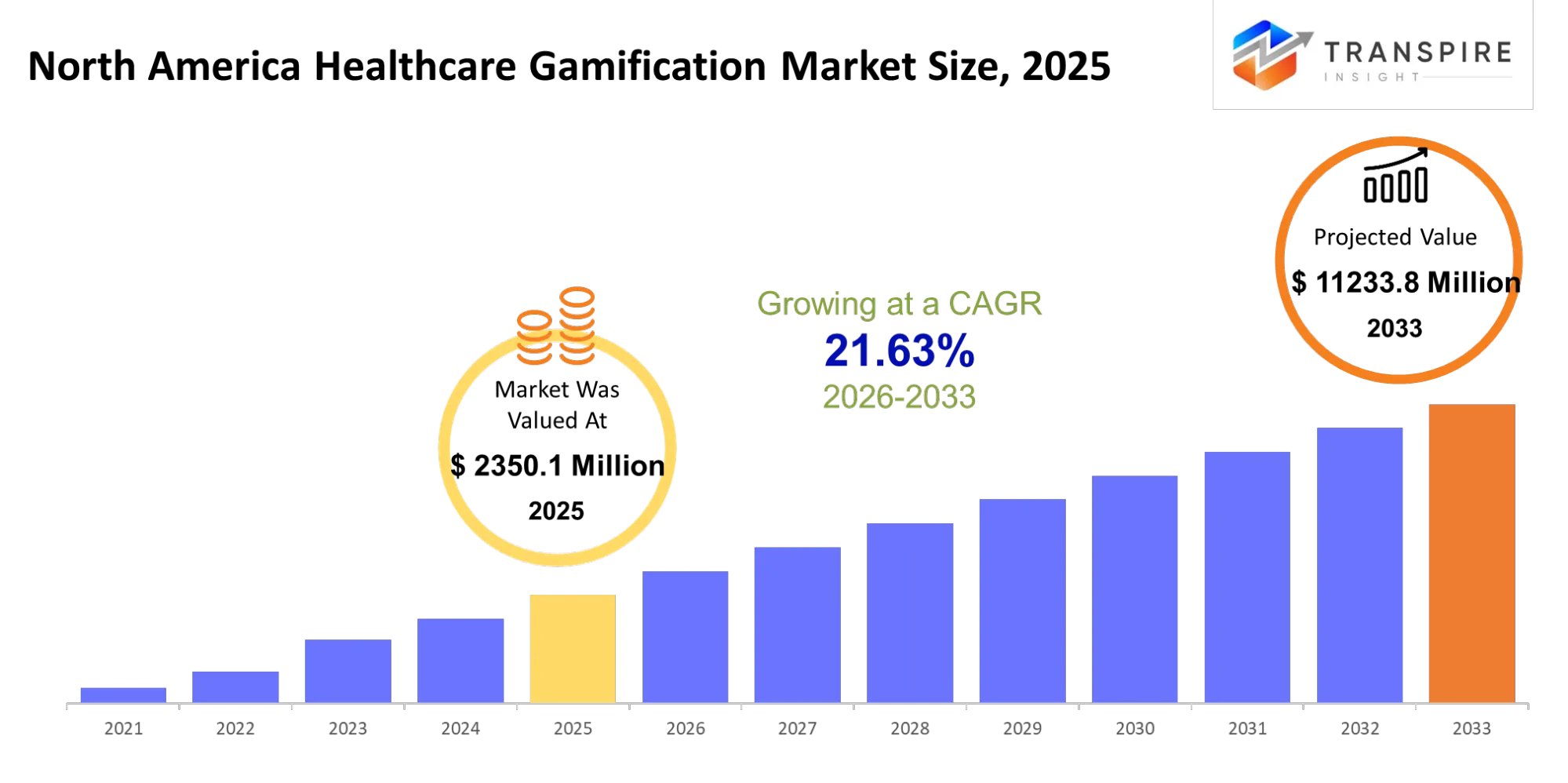
North America Healthcare Gamification Market Size & Forecast:
- North America Healthcare Gamification Market Size 2025: USD 2350.1 Million
- North America Healthcare Gamification Market Size 2033: USD 11233.8 Million
- North America Healthcare Gamification Market CAGR: 21.63%
- North America Healthcare Gamification Market Segments: By Component (Software Platforms, Mobile Applications, Wearable Integration, Analytics Tools, Cloud-based Solutions, Others); By Application (Fitness Management, Chronic Disease Management, Mental Health Management, Patient Engagement, Rehabilitation, Others); By End User (Hospitals, Healthcare Providers, Insurance Companies, Patients, Others); By Deployment (Cloud-based, On-premise, Hybrid Systems, Others)
To learn more about this report,  Download Free Sample Report
North America Healthcare Gamification Market Summary
The North America Healthcare Gamification Market was valued at USD 2350.1 Million in 2025. It is forecast to reach USD 11233.8 Million by 2033. That is a CAGR of 21.63% over the period.
In North America, the healthcare gamification market kind of leans on game mechanics inside digital apps, and also more on clinical platforms to get patients to stick with treatment plans, handle chronic conditions, and keep showing up for preventive care outside of the hospital. Real world it looks like these tools gently reframe medication adherence, physical therapy, and those lifestyle shifts into goal based moments, and they’re monitored by providers plus insurers. Over the last five years, the whole space has moved from separate wellness apps toward more clinically integrated options that sit inside actual care pathways, and they’re tied in with electronic health records. The COVID 19 pandemic sped things up, because providers had to use remote engagement at scale, and at the same time it showed the weak spots in long term patient adherence. So now, hospitals and payers are adopting gamified platforms to lower readmissions and push better outcomes, which also makes the reimbursement linked value feel more obvious, and it helps enterprise level deployment move faster.
Key Market Insights
- In the United States, North America’s Healthcare Gamification Market is basically on top, holding close to 75% of the share in 2025, mostly because the digital health infrastructure there is more advanced… you know, pretty solid.
- Canada, meanwhile looks like the fastest mover through 2026–2030, with national telehealth expansion and preventive care initiatives doing a lot of heavy lifting.
- Software platforms take the lead across North America, capturing more than 45% share and they combine AI powered engagement with behavioral tracking tools.
- The Services side ends up ranking just behind, helping healthcare providers with customization, onboarding, and patient engagement consulting where needed.
- Then the mobile based gamified applications are starting to accelerate the quickest up to 2030, mainly due to cloud deployment trends and smartphone penetration.
- Chronic disease management grabs about 40% share, especially in diabetes and cardiovascular care where engagement programs are common.
- Mental health gamification grows the fastest though, driven by the spread of digital therapeutics, plus the rising demand for remote behavioral health support.
- Hospitals and clinics lead the North America Healthcare Gamification Market overall, with a meaningful share because they integrate into existing care pathways.
- Insurance providers are the fastest-growing group, using gamification to help lower claims and improve patient adherence outcomes, kinda like both prevention and follow-through in one loop.
- Cloud native platform expansion, and mobile first design, kind of help create scalable competitive advantages, across enterprise healthcare systems, too.
What are the Key Drivers, Restraints, and Opportunities in the North America Healthcare Gamification Market?
The North America Healthcare Gamification Market is mainly pushed by that quick move toward value based care, where providers get paid for better patient outcomes not just for doing more services . And then you have Medicare plus private payer reimbursement changes which sort of nudges hospitals and insurers to use gamified engagement tools that help with medication adherence, while also lowering those expensive readmissions. Meanwhile, as digital health platforms keep getting integrated with electronic health records, gamification kind of shifts from “nice to have” wellness extras into more measurable clinical engagement systems, which ends up boosting enterprise adoption and recurring software revenues, across the North America Healthcare Gamification Market.
One big restraint is fragmented clinical validation , plus the regulatory picture around digital therapeutics being a little inconsistent and not super clear. A lot of gamified healthcare solutions still don’t have standardized reimbursement pathways. So providers often hesitate to scale deployments past early pilots. That kind of structural uncertainty stretches procurement timelines and makes revenue less predictable, which hits vendors especially smaller startups, since they can’t usually absorb long sales cycles and compliance process overheads.
A major opportunity is AI powered personalization inside chronic disease management programs, particularly for diabetes and cardiovascular care across the United States. Venture capital investment in AI enabled digital therapeutics keeps rising, letting platforms roll out behavioral coaching apps that work alongside remote monitoring devices. As these systems mature, they enable a more scalable loop for ongoing engagement, which supports stronger retention and helps expand the North America Healthcare Gamification Market into long term care ecosystems.
What Has the Impact of Artificial Intelligence Been on the North America Healthcare Gamification Market?
There is a small mismatch in the reference examples presented, because scrubber monitoring and marine emission control systems don’t really relate to the North America Healthcare Gamification Market , so the whole angle feels a bit off. In other words, artificial intelligence is not doing that here. Instead it is quietly reshaping how gamified healthcare platforms connect with patients and how they deliver something you can measure in clinical terms.
AI-driven automation is now getting built into patient engagement processes, where the systems basically reshuffle gamified activities, nudges, and even reward mechanics based on live health signals from wearables as well as electronic health records. So less manual care coordination work , but also better adherence tracking precision across chronic care initiatives. It’s kind of a “closed loop” feeling, even if the implementation is more technical than it sounds.
On the predictive side, machine learning models look at behavioral patterns and clinical records to estimate medication non-adherence risk, the likelihood of hospitalization, and when therapy momentum might break or drop off. Those foresight insights let providers step in sooner, which helps treatment continuity and also backs stronger long-term results across the North America Healthcare Gamification Market. People can call it more anticipatory care, and it actually behaves like that in practice.
Operationally , healthcare providers often describe directional improvements like higher engagement completion rates, better appointment follow-through, and fewer avoidable readmissions. And that matters, because it ties directly into cost containment inside value-based care models, where everything is expected to connect back to outcomes.
Still, there is a key limitation that keeps showing up: the integration cost is high, and data interoperability between gamified platforms and older hospital IT systems can be messy. That friction can slow down wide deployment, even when clinical interest stays strong and the use-case sounds compelling.
Key Market Trends
- From 2020 to 2025, gamification tools kinda moved away from just standalone wellness apps, into EHR integrated clinical engagement platforms across a bunch of major U.S hospital systems, sort of.
- Private insurers started adopting these gamified adherence programs more and more after 2022, aiming to reduce readmissions and also link reimbursement to patient engagement metrics.
- Then around 2023 AI driven personalization came in, replacing earlier static reward systems, with adaptive behavioral nudges that react to real-time patient health data.
- Also integration with wearable devices, like Apple Watch and Fitbit, expanded a lot since 2021, so continuous monitoring of patient engagement behaviors became more common and less manual.
- Mental health gamification applications sped up sharply somewhere between 2022 and 2025, largely because digital therapy platforms began addressing anxiety and depression care gaps.
- On the regulatory side, the classification of digital therapeutics changed slowly, with FDA guidance updates after 2023 that improved clinical validation pathways for these gamified interventions.
- Meanwhile, big healthcare IT companies started buying smaller, niche gamification startups from 2022 onward, to consolidate patient engagement capabilities under more unified platforms.
- Value based care growth since 2020 also pushed procurement decisions toward platforms that can show measurable reductions in readmission , and in treatment non-adherence costs too.
- And after 2023, providers increasingly prioritized interoperability standards, which helped cut down those fragmented data issues between gamification platforms and older legacy hospital systems.
North America Healthcare Gamification Market Segmentation
By Component
In this component mix, Software platforms are still in the lead because enterprise adoption is strong across healthcare digitization programs. The push stays high for scalable systems that can back clinical workflows as well as patient engagement, so dominance keeps holding up. Mobile applications are close behind, mainly due to fast smartphone adoption, and people now show a stronger inclination toward self directed health tools. Wearable integration is gaining traction quickly, because real time biometric tracking basically supports preventive care approaches. Analytics tools sit with a moderate share, but their role is getting bigger through clinical decision support and predictive modeling, you can feel it. Cloud-based solutions keep expanding at a steady pace too, since healthcare organizations are placing more emphasis on interoperability and remote accessibility, and this keeps matters moving.
As for Others, that segment stays limited since the use cases are a bit fragmented. Overall, growth momentum seems to concentrate in cloud based and wearable segments, mostly because real time data convergence keeps improving. Looking ahead, the future outlook points toward tighter integration across every component, with vendors aiming for more unified platforms. North America’s Healthcare Gamification market influence is present, but it remains under the threshold, driven by enterprise digitization trends and ongoing patient engagement innovation, not fully capped though.
By Application
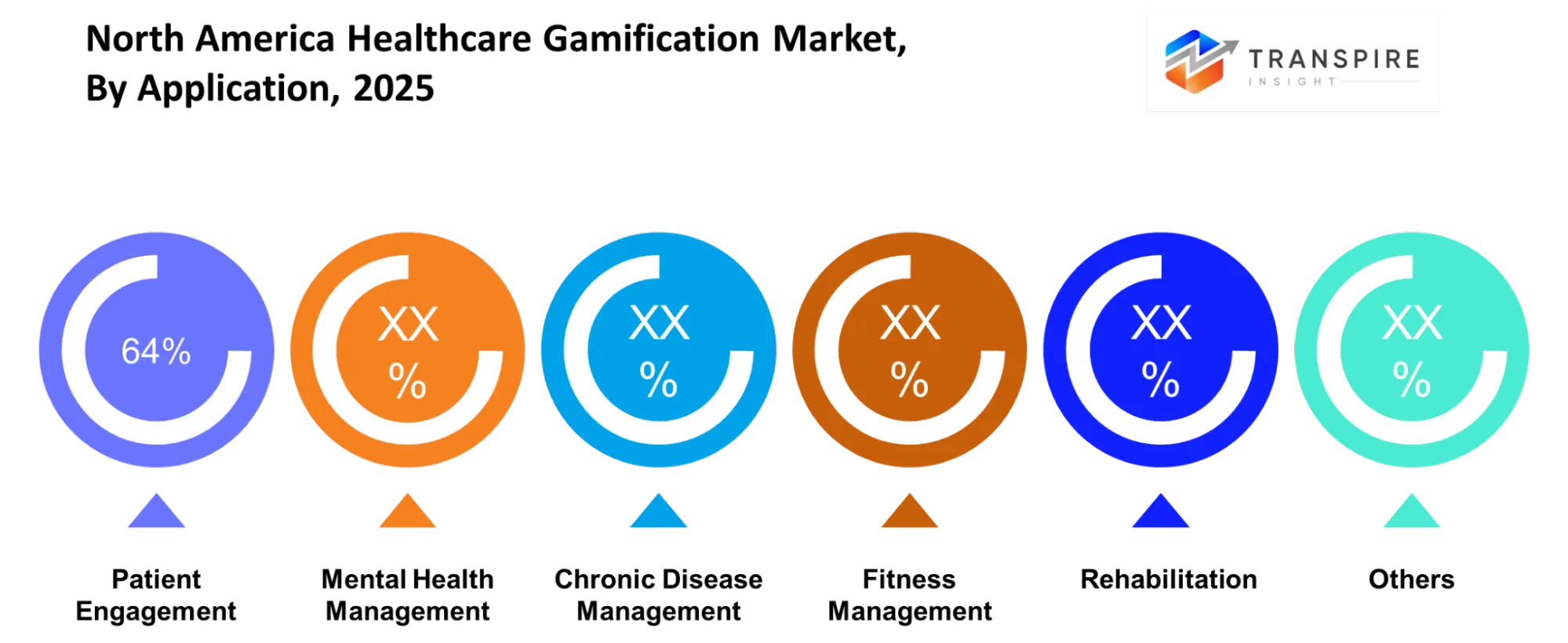
Patient engagement seems to have the biggest say across the application areas, mostly because there’s a steady rise in demand for interactive and customized care experiences, yes a bit more personalized than before. Chronic disease management keeps solid adoption too, largely tied to ongoing tracking needs for conditions like diabetes and cardiovascular disorders. Fitness management shows calm but consistent growth, pulled by preventive healthcare habits and consumer wellness adoption. Mental health management is moving up fast, pushed by growing awareness of behavioral health requirements and the uptake of digital therapy. Rehabilitation still holds a middling share, and that’s because the post-acute care world is getting digitized. The “Others” bucket stays more niche, with limited scale potential, not much lift there.
The growth pattern is not the same in each segment. Chronic disease and mental health often grow because the clinical need is already there, while fitness and engagement lean more on consumer behavior changes. Looking ahead, the direction points toward these applications blending into broader, integrated care ecosystems, like one smoother setup instead of separate tools. Developers tend to push cross functional platforms. Investors, in their own way, lean toward solutions that can scale in chronic and mental health. North America Healthcare Gamification Market impact stays fairly controlled but still helps, mainly by supporting engagement-led expansion of these application areas.
To learn more about this report, Download Free Sample Report
By End User
Hospitals tend to hold a leading position, largely because of structured adoption of digital health systems and the way they integrate with electronic medical records, like it just works in practice. Healthcare providers collectively still account for a large share too, supported by outpatient care digitization and these ongoing transitions toward value-based care, not always smooth though. Insurance companies expand adoption via incentive centered wellness programs , plus cost reduction strategies that aim for clearer control. Patients show the fastest acceleration in engagement, driven by mobile accessibility and those personalized health tracking tools that feel more immediate. Others stay comparatively limited in scale, partly because institutional adoption is fragmented and kinda inconsistent.
The growth drivers actually differ a lot, for hospitals the emphasis is operational efficiency, insurers lean into risk mitigation, while patients prioritize convenience and personal autonomy. For the future, the direction looks like stronger collaboration between providers and insurers, so data-driven care models can move from theory to routine. Hospitals are expected to stay as anchor institutions for deployment, while patient-centric models gain more pull across digital ecosystems.
In North America, the Healthcare Gamification market presence remains modest, though it still reinforces patient participation trends across the full set of end-user categories.
By Deployment
In the deployment race, Cloud-based options still hold the leading spot, because they scale, they tend to reduce infrastructure expense, and they’re well aligned with remote healthcare delivery, the support is pretty solid. On-premise deployments keep their relevance inside some institutions, especially where data governance is strict, and where older infrastructure dependencies are hard to move around. Hybrid setups are getting more pull lately too, since healthcare organizations are trying to meet compliance expectations while still pushing through digital transformation initiatives. As for Others, they stay rather small, mostly because commercial scalability is limited.
If you look at how growth moves, cloud-based and hybrid models seem to win, mainly driven by interoperability pressures, plus the need for real-time analytics. Meanwhile, on-premise adoption shows a slow, steady decline unless the setting is highly regulated, and even then it’s usually slow. For what comes next, the outlook points to faster migration toward cloud-native architectures, with AI integration and expanded remote monitoring playing a big role.
Vendors are also leaning into secure cloud ecosystems to handle regulatory constraints and the data privacy angle, more directly. North America Healthcare Gamification Market influence might look marginal at first glance, but it still kind of lines up with cloud-enabled engagement platforms and those hybrid care delivery systems.
What are the Key Use Cases Driving the North America Healthcare Gamification Market?
Core adoption kinda revolves around keeping people engaged inside hospitals and across provider networks, and those gamified systems help nudge adherence, make appointments happen easier, and generally lift outcomes. When it’s integrated with electronic medical records, it backs structured clinical workflows… and that usually means fewer readmissions because participation stays more consistent over time.
Secondary growth tends to show up via chronic disease programs, insurance wellness rewards, and mental health platforms that lean on telehealth. In post-acute care, rehabilitation leans on gamified exercises, so recovery is more steady, and long-term engagement continues across providers plus payers, even when the care handoffs get messy.
For emerging use, you can see preventive care ecosystems that combine wearables and AI personalization, kind of together. Then population health plus remote monitoring grows through cloud platforms, which helps insurers and public agencies test incentive driven behavior change at scale, and with less friction than before.
|
Report Metrics |
Details |
|
Market size value in 2025 |
USD 2350.1 Million |
|
Market size value in 2026 |
USD 2853.1 Million |
|
Revenue forecast in 2033 |
USD 11233.8 Million |
|
Growth rate |
CAGR of 21.63% from 2026 to 2033 |
|
Base year |
2025 |
|
Historical data |
2021 - 2024 |
|
Forecast period |
2026 - 2033 |
|
Report coverage |
Revenue forecast, competitive landscape, growth factors, and trends |
|
Regional scope |
North America (Canada, The United States, and Mexico) |
|
Key company profiled |
Fitbit Health Solutions, Omada Health, Ayogo Health, Mango Health, Bunchball, Microsoft, Cognifit, Nike Training Club, MySugr, Apple, Google Health, Fitbit, Akili Interactive, Happify Health, Welltok |
|
Customization scope |
Free report customization (country, regional & segment scope). Avail customized purchase options to meet your exact research needs. |
|
Report Segmentation |
By Component (Software Platforms, Mobile Applications, Wearable Integration, Analytics Tools, Cloud-based Solutions, Others); By Application (Fitness Management, Chronic Disease Management, Mental Health Management, Patient Engagement, Rehabilitation, Others); By End User (Hospitals, Healthcare Providers, Insurance Companies, Patients, Others); By Deployment (Cloud-based, On-premise, Hybrid Systems, Others) |
Which Regions are Driving the North America Healthcare Gamification Market Growth?
North America is kind of leading the healthcare gamification market , mainly because it has advanced digital health infrastructure and fairly strong regulatory backing for value based care ideas. A lot of hospitals and provider networks already use electronic health records, so it becomes easier to plug in those gamified engagement tools without too much friction. Also, healthcare spending stays high and the insurance landscape is more mature, which makes companies more willing to fund preventive care initiatives and adherence programs. On top of that there’s a steady ecosystem—health technology firms, academic medical centers, and insurers working together—so innovation keeps moving. Hospitals often roll out these engagement platforms to curb readmissions and lift chronic disease outcomes. And the regulations lean more toward patient results, not just service volume , so clinics across different settings feel more confident adopting them.
Europe sits in the stable second slot, and this is mostly because public healthcare funding stays consistent while digital health gets rolled out step by step across national systems. But, compared with the top region, Europe’s momentum is more tied to centralized policy execution and long range institutional planning. It’s less about fast private sector expansion. Nations like Germany, the United Kingdom, and the Nordics continue investing in digital therapeutics and patient engagement tools. Data privacy rules are also a big deal there, they shape how adoption happens and push platforms to be secure and compliance driven. Healthcare providers, in particular, focus on interoperability inside public hospital networks , so integration may be slower but it’s more dependable. This overall steadiness ends up giving solution providers predictable revenue streams, even if the innovation cycle runs at a more gradual pace.
In Asia Pacific, growth is the fastest kind of, powered by rapid hospital digitization, expanding smartphone penetration, and huge government health modernization efforts. There are also newer investments in smart hospitals, especially in China and India, which oddly enough speed up the uptake of digital engagement tools and early prevention platforms. At the same time, the rising burden of chronic diseases makes insurers and providers look at more cost-efficient patient management options, more or less. And compared with mature regions, the expansion here is less about fine-tuning existing systems, and more about building the rails first through infrastructure expansion. Plus foreign technology partnerships, and public private initiatives, keep pushing deployments forward. For investors and people entering the market, the 2026–2033 window looks like a high-volume stretch with solid scalability potential across both urban and semi-urban healthcare networks.
Who are the Key Players in the North America Healthcare Gamification Market and How Do They Compete?
Competition in the North America healthcare gamification market shows a moderately fragmented structure, where big technology ecosystems go head to head with specialized digital health startups. Incumbent firms try to defend their share by embedding engagement tools into wider healthcare platforms, not really selling standalone products. So most of the fight is about technology integration and data interoperability plus the actual user engagement design, not so much about price. Cloud infrastructure control and wearable connectivity quietly shape who wins. New entrants keep pushing into narrower corners like chronic care engagement and behavioral health, offering very targeted gamified experiences that often outshine generalized wellness systems.
Fitbit strengthens its position with a wearable-first engagement model, turning biometric measurements into behavioral nudges for fitness and preventive care. When it links with smartphone ecosystems, users get continuous interaction, and that’s the part that feels different compared to app-only competitors. Apple builds its advantage through HealthKit, and Apple Watch connectivity, which lets data travel smoothly between clinical settings and everyday consumer use. Microsoft, on the other hand, leans into cloud-based interoperability, so hospitals and insurers can roll out gamified engagement tools inside secure enterprise frameworks. Its expansion tends to rely on ecosystem partnerships with providers and payer networks, rather than pushing standalone product sales as the main route.
Omada Health differentiates by using condition specific behavioral coaching programs for diabetes and hypertension, mixing coaching with gamified adherence tracking. It keeps growing through payer partnerships that reimburse digital therapeutic outcomes. Personify Health focuses on employer driven wellness ecosystems where gamification increases participation in corporate programs, kind of pushing engagement further even when people are busy or distracted.. Growth comes from integration with insurance-linked incentive systems and workplace health platforms. Both companies scale by deepening outcomes-based contracts, which strengthens recurring revenue models and reinforces long-term engagement-based differentiation.
Company List
- Fitbit Health Solutions
- Omada Health
- Ayogo Health
- Mango Health
- Bunchball
- Microsoft
- Cognifit
- Nike Training Club
- MySugr
- Apple
- Google Health
- Fitbit
- Akili Interactive
- Happify Health
- Welltok
Recent Development News
In March 2026, Omada Health announced the full-year 2025 financial results, including the expansion of its AI-driven behavior change platform (OmadaSpark and Meal Map) and GLP-1 companion care programs designed to improve long-term engagement and outcomes in chronic disease management. This reflects continued scaling of gamified, AI-assisted lifestyle interventions embedded in employer-sponsored healthcare programs, strengthening the competitive position of digital behavioral health platforms in North America.https://www.globenewswire.com
What Strategic Insights Define the Future of the North America Healthcare Gamification Market?
The North America healthcare gamification market is kind of moving toward fully integrated, outcomes-driven engagement ecosystems where gamified tools get slipped into clinical decision systems, not just sitting there as stand alone wellness layers. This change is mostly being pushed by payer pressure to lower the long term treatment costs and also by healthcare providers who want continuous patient interaction, between visits maybe even more than before. Over the next 5 to 7 years, platform convergence across wearable data, electronic health records, and behavioral analytics will decide competitive positioning more than feature innovation on its own.
Still, there is a less obvious risk, from the rising dependency on big technology ecosystems that end up controlling both the data flow and user access. When concentration tightens around just a few cloud and device platforms, interoperability can get constrained and healthcare firms might be exposed to pricing or policy shifts from the dominant tech providers. At the same time, a strong opportunity is quietly forming around AI driven personalized gamification, tied to real time clinical risk scoring, especially since insurers start reimbursing preventive digital interventions in value based care contracts.
Market participants should focus on modular, API first architectures that integrate cleanly with payer and provider systems, while staying independent from single platform dependency to protect long term bargaining power.
North America Healthcare Gamification Market Report Segmentation
By Component
- Software Platforms
- Mobile Applications
- Wearable Integration
- Analytics Tools
- Cloud-based Solutions
- Others
By Application
- Fitness Management
- Chronic Disease Management
- Mental Health Management
- Patient Engagement
- Rehabilitation
- Others
By End User
- Hospitals
- Healthcare Providers
- Insurance Companies
- Patients
- Others
By Deployment
- Cloud-based
- On-premise
- Hybrid Systems
- Others
Frequently Asked Questions
Find quick answers to common questions.
The North America Healthcare Gamification Market size is USD 11233.8 Million in 2033.
Key segments for the North America Healthcare Gamification Market are By Component (Software Platforms, Mobile Applications, Wearable Integration, Analytics Tools, Cloud-based Solutions, Others); By Application (Fitness Management, Chronic Disease Management, Mental Health Management, Patient Engagement, Rehabilitation, Others); By End User (Hospitals, Healthcare Providers, Insurance Companies, Patients, Others); By Deployment (Cloud-based, On-premise, Hybrid Systems, Others).
Major North America Healthcare Gamification Market players are Fitbit Health Solutions, Omada Health, Ayogo Health, Mango Health, Bunchball, Microsoft, Cognifit, Nike Training Club, MySugr, Apple, Google Health, Fitbit, Akili Interactive, Happify Health, Welltok.
The North America Healthcare Gamification Market size is USD 2350.1 Million in 2025.
The North America Healthcare Gamification Market CAGR is 21.63% from 2026 to 2033.
- Fitbit Health Solutions
- Omada Health
- Ayogo Health
- Mango Health
- Bunchball
- Microsoft
- Cognifit
- Nike Training Club
- MySugr
- Apple
- Google Health
- Fitbit
- Akili Interactive
- Happify Health
- Welltok
About the Authors

Pankaj Ghogare Patil
I am Pankaj Ghogare Patil, a Senior Research Analyst at Transpire Insight, specializing in the Pharmaceutical, Chemicals & Materials, Healthcare IT, and Biotechnology industry. My expertise lies in conducting comprehensive market research, analyzing industry trends, evaluating competitive landscapes, and translating complex data into actionable insights. At Transpire Insight, I closely follow emerging technologies, regulatory developments, and market innovations to create accurate, well-researched, and informative content that helps businesses and professionals make informed decisions. I am committed to producing credible, evidence-based articles that reflect industry best practices while making technical topics accessible and valuable for a broad audience.

Chakradhar Khansole
Chakradhar serves as the Research Director at Transpire Insight, bringing over 8 years of experience in technology, innovation, and strategic market intelligence. He specializes in transforming complex market data into actionable business insights that enable organizations to make informed, growth-oriented decisions. Recognized for his strategic vision and analytical expertise, Chakradhar leads high-impact research initiatives, delivering comprehensive market assessments, competitive intelligence, and forward-looking industry analysis.
Recently Published Reports
-
Apr 2026
AI in Diabetic Retinopathy Market
AI in Diabetic Retinopathy Market Size, Share & Analysis Report By Type (Screening AI Systems, Diagnostic AI Systems, and Predictive AI Models), By Application Segment (Hospitals, Ophthalmology Clinics, Diagnostic Centers, and Research and Development), and Geography (North America, Europe, Asia-Pacific, Middle East and Africa, South and Central America), 2021 - 2031
-
Apr 2026
Psychometric Tests Market
Psychometric Tests Market Size, Share & Analysis Report By Type (Personality Tests, Ability/Aptitude Tests, Skill/Knowledge Tests, and Others), By Application (Talent Acquisition and Talent Management), and Geography (North America, Europe, Asia-Pacific, Middle East and Africa, South and Central America), 2021 – 2031
-
Apr 2026
Rare Biological Sample Collection Market
Rare Biological Sample Collection Market Size, Share & Analysis Report By Type (Isolation Kits & Reagent, Blood Collection Tubes, and Others), By Application (Oncology, Transcriptomics, Pharmacogenomics, and Others), and Geography (North America, Europe, Asia-Pacific, Middle East and Africa, South and Central America), 2021 – 2031
-
Jul 2026
Diabetic Retinopathy Market
Diabetic Retinopathy Market Size, Share & Analysis Report By Type (Proliferative Diabetic Retinopathy, and Diabetic Macular Edema (DME)), By Treatment Type (Anti VEGF Drug, Steroid Implants, Laser Surgeries, and Vitrectomy), and Geography (North America, Europe, Asia-Pacific, Middle East and Africa, South and Central America), 2021 – 2031
Our Clients







