North America Physical Rehabilitation Center Market Size & Forecast:
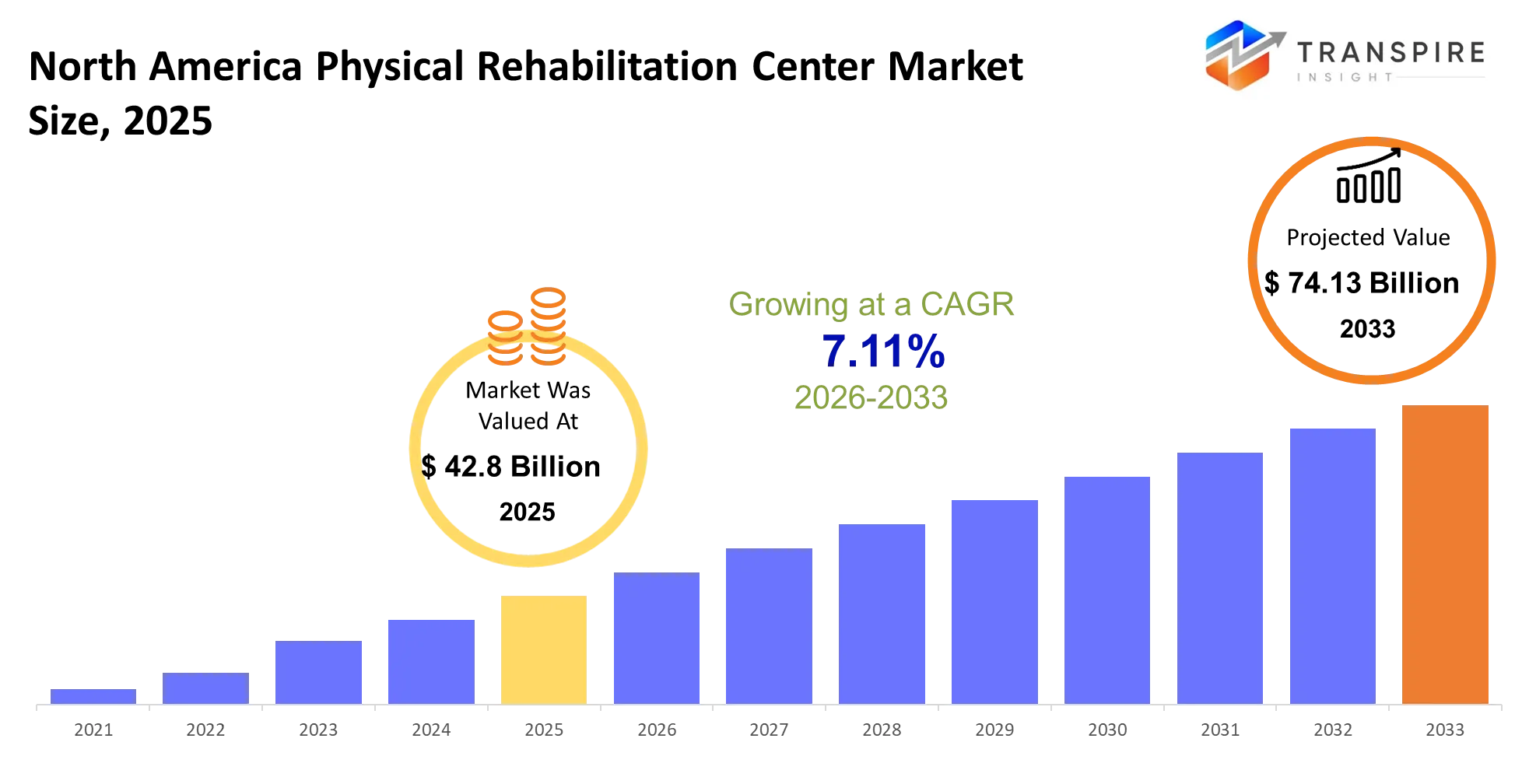
- North America Physical Rehabilitation Center Market Size 2025: USD 42.8 Billion
- North America Physical Rehabilitation Center Market Size 2033: USD 74.13 Billion
- North America Physical Rehabilitation Center Market CAGR: 7.11%
- North America Physical Rehabilitation Center Market Segments: By Type (Inpatient Rehab, Outpatient Rehab, Home-based Rehab, Others); By Application (Orthopedic, Neurological, Cardiopulmonary, Sports Rehab, Others); By End-User (Hospitals, Clinics, Rehab Centers, Others); By Service (Therapy, Equipment, Consultation, Others)
To learn more about this report,  Download Free Sample Report
North America Physical Rehabilitation Center Market Summary
The North America Physical Rehabilitation Center Market was valued at USD 42.8 Billion in 2025. It is forecast to reach USD 74.13 Billion by 2033. That is a CAGR of 7.11% over the period.
North America’s physical rehabilitation centers play a critical role in helping patients regain mobility, strength, and functional independence following orthopedic operations, sports injuries, strokes, spinal traumas and chronic musculoskeletal conditions. These places also lighten the long-run hospital load by moving recovery into more specialized outpatient or post-acute settings that concentrate on quicker reintegration back into daily routines and work.
In the last five years the market sort of changed, away from broad or generalized therapy approaches toward more data-led rehabilitation, backed by robotic assisted therapy, virtual care platforms and reimbursement models that depend on outcomes. The COVID-19 pandemic sped everything up, because access to in person treatment got interrupted so providers had to expand remote physiotherapy options, and run hybrid rehabilitation programs. And when hospitals hit capacity limits, referral streams started shifting toward dedicated rehabilitation centers with reduced operating expenses, plus recovery tracks that are more focused and cohesive.
The current growth looks linked to the expanding aging population, higher counts of joint replacement procedures, and payer pressure that pushes down the cost of long inpatient stays. That’s driving wider adoption of outpatient rehabilitation networks, digital therapy tools, and multidisciplinary recovery programs. In turn this supports better utilization rates and more stable revenue for the operators, even when care demand moves around a bit.
Key Market Insights
- The United States really dominated the North America Physical Rehabilitation Center Market with more than 82% share in 2025, mostly because of strong rehab infrastructure and what seems like better facilities overall.
- Meanwhile Canada is showing the fastest momentum through 2030, pushed by rising healthcare spend, plus a modernization push for post-acute care that keeps getting expanded.
- Also, cross border healthcare partnerships are steadily making rehabilitation access feel more available, improving treatment efficiency and bringing in new technologies across North America’s healthcare systems.
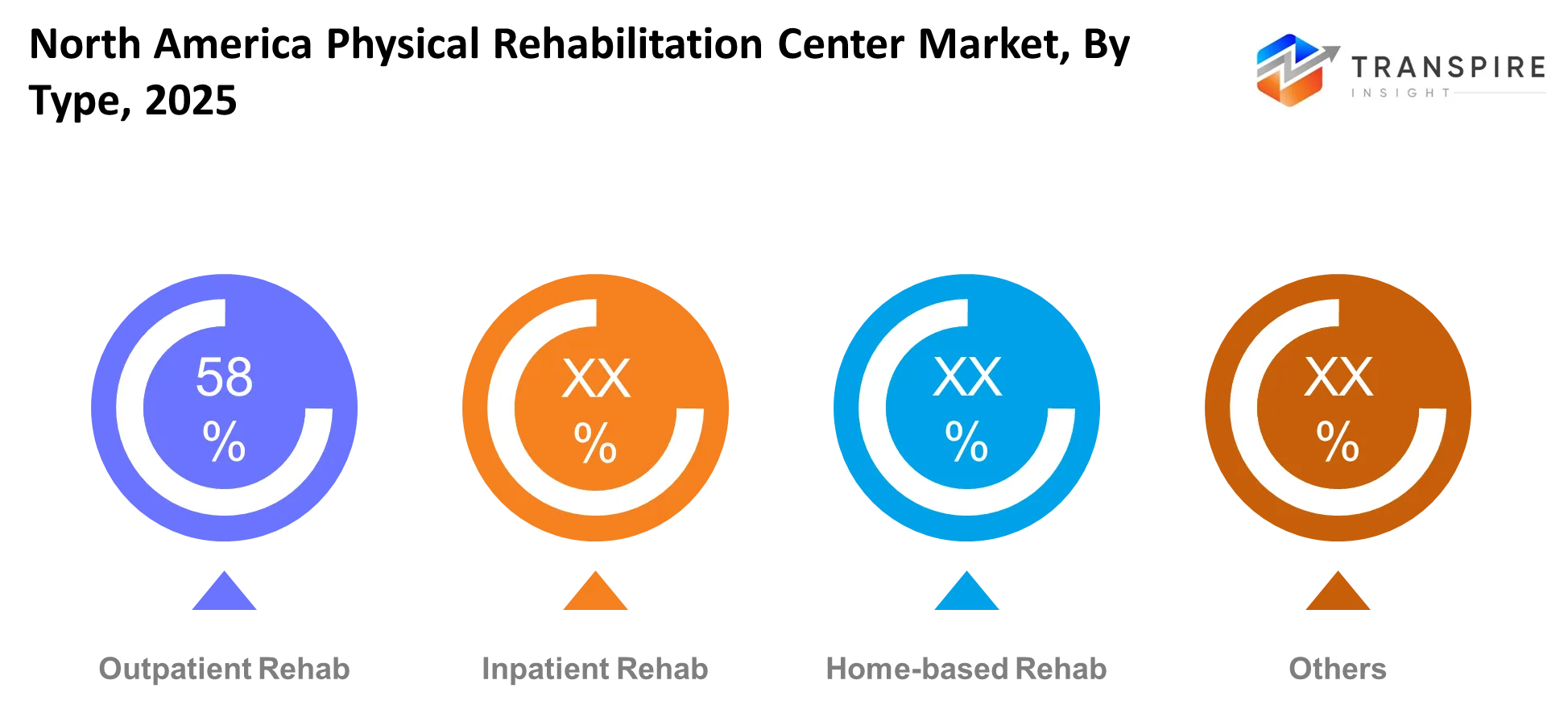
- On the service side, outpatient rehabilitation services took the lead, with nearly 58% of revenue in 2025, largely due to lower treatment costs compared to other settings, and just the general willingness of patients to use them.
- Neurological rehabilitation is still the second biggest segment, supported by stroke recovery programs that are growing and by the continuing demand for spinal injury recovery.
- Sports injury rehabilitation is projected to be the fastest-growing segment during the forecast window, because athletic participation keeps rising and fitness related injuries keep showing up more often.
- In terms of conditions, orthopedic rehabilitation was about 46% market share in 2025, driven by more joint replacement cases and musculoskeletal disorder treatment volumes.
- Post surgical rehabilitation applications continue seeing solid industry growth, mainly as hospital stays shorten and accelerated recovery protocols become more common.
- Hospitals and integrated healthcare systems led the market with almost 49% share in 2025, helped by broad referral networks and rehab partnerships that are already established, or at least are getting reinforced.
- At the same time, independent rehabilitation centers are also climbing quickly, since patients increasingly prefer specialized outpatient recovery spaces, not just the generic setups.
What are the Key Drivers, Restraints, and Opportunities in the North America Physical Rehabilitation Center Market?
Driver: The most powerful force pushing the North America Physical Rehabilitation Center Market forward is the healthcare system’s move toward value based care and, basically shorter inpatient stays. Hospitals across the United States and Canada face ongoing pressure from insurers and government reimbursement initiatives to cut down readmission rates and reduce the price of post surgical treatment. Because of that, patient recovery routes are shifting toward outpatient rehabilitation centers, where targeted therapy can be delivered with lower day to day operating costs. Also, the quick climb in joint replacement surgeries, sports injuries, and stroke rehabilitation cases keeps pushing referral numbers upward. As rehab organizations roll out multidisciplinary therapy programs and digital monitoring tools, they help improve results while also raising patient throughput and generating more recurring service income.
Restraint: The market’s largest structural snag is the lack of licensed physiotherapists, occupational therapists, and other rehabilitation specialists. Requirements for education still take a long time, licensing rules differ across states and provinces , and workforce burnout has been more severe since the pandemic. These issues can’t be fixed fast, since rehabilitation care still leans heavily on experienced human interaction, not automation only. When labor is tight, appointment slots shrink, patient onboarding gets delayed, and clinic expansion slows, especially in rural areas and secondary metropolitan zones.
Opportunity: Remote rehabilitation technology looks like the clearest long term opening. Providers are putting more money into AI supported motion tracking, wearable recovery devices, and tele rehabilitation platforms that let therapists watch progress outside the clinic environment.In Canada and a few underserved U.S. regions, these hybrid rehab models are, sort of steadily, improving access while also lowering per patient treatment costs, which then opens up scalable options for big rehabilitation networks to expand.
What Has the Impact of Artificial Intelligence Been on the North America Physical Rehabilitation Center Market?
Artificial intelligence and newer digital technologies are still reshaping the North America Physical Rehabilitation Center Market, kind of at a pace that makes things shift fast—mostly because they boost clinical efficiency, make therapy feel more tailored, and help with patient outcome tracking. A lot of rehabilitation providers are now leaning on AI-based motion analysis tools and computer vision platforms, to automate patient assessment, gait tracking, and the ongoing monitoring of therapy progress. In practice , these tools sort of reduce a lot of the manual admin work that therapists normally have, so rehabilitation centers can take on more people without going out to recruit extra staff in the same way. or at least not proportionally , which gets pretty important when the budgets start getting tight.
Beyond that, machine learning models are also assisting with predictive rehab scheduling. They scan patient mobility info, surgical background, and patterns of recovery behavior to signal who may have a lengthier climb ahead, or who could be more likely to bounce back with readmission. A number of rehab networks lean on wearable sensors and remote monitoring platforms to track exercise compliance and to approximate recovery milestones in almost real time. This usually helps with keeping patients engaged in therapy, while at the same time trimming down unnecessary in person appointments .Digital rehabilitation platforms have even helped some outpatient teams reduce admin overhead, and fine tune treatment scheduling, while tele-rehabilitation options have opened access for many patients across rural areas throughout the United States and Canada.
One big snag is that integration cost for AI-driven rehabilitation infrastructure is still high. Many mid sized rehabilitation centers do not yet have the capital, or the interoperable health data environments, needed to roll out advanced analytics platforms broadly. As a result, adoption is slower than it could be, and some providers wait until the systems fit their workflows cleanly.
Key Market Trends
- From 2020 to 2025, outpatient rehab networks sorta expanded quicker than inpatient facilities, mainly because insurers kept nudging providers to lower hospital recovery costs, and well it felt like everyone was reacting.
- Rehabilitation providers also began taking up AI motion tracking systems more often, after labor shortages kinda tightened therapist availability across U.S. metro healthcare markets.
- Since the pandemic tele-rehabilitation use went up quite a bit, because patients wanted flexible therapy access, and hospitals ended up redirecting non-critical recovery services.
- Big players, like Encompass Health Corporation and Select Medical Holdings Corporation, pushed ahead with regional acquisitions to strengthen their referral pipelines, and to grow outpatient market reach.
- Robotic assisted physiotherapy gained more momentum once orthopedic centers said patients were more engaged, plus monitoring their recovery felt more steady.
- With value based reimbursement models, the provider focus shifted away from treatment volume, toward recovery outcomes you can measure, which in turn reduced demand for scattered rehab services.
- Between 2021 and 2025, senior targeted rehabilitation programs grew, because aging populations drove higher needs for mobility restoration and chronic pain management therapies.
- Wearable rehabilitation devices became pretty mainstream, as providers wanted continuous patient monitoring outside classic clinical settings, rather than only short checkups.
- In Canada, rehab providers increased digital health investments after provincial modernization efforts, aimed at cutting surgical recovery backlogs.
- Independent rehabilitation centers got more competitive pressure over time, since integrated hospital networks consolidated referral channels and also expanded their branded outpatient recovery programs.
North America Physical Rehabilitation Center Market Segmentation
By Type
Outpatient rehabilitation still grabs the largest market share, mostly because healthcare systems are more often leaning toward lower cost recovery routes outside the hospital setting, you know sort of quieter and more efficient. After orthopedic surgeries and cardiovascular procedures, inpatient length of stays got shorter and patient flow shifted toward specific outpatient therapy networks. Insurer backing for cost efficient rehabilitation programs also helped push outpatient treatment adoption across the United States, and Canada. Even so, inpatient rehabilitation keeps being important for tougher situations like severe neurological trauma, spinal injuries and those complex post surgical recovery cases that really need ongoing supervision.
Home based rehabilitation picked up speed once digital health adoption, sped up during the pandemic period. Wearable monitoring systems plus tele rehabilitation platforms, and remote physiotherapy consultations made care easier to reach for older adults and for people with limited mobility. Looking ahead, expansion will probably prefer hybrid rehabilitation models, mixing in clinic oversight with remote therapy tracking. Investors and rehabilitation providers are expected to focus on scalable home care technologies, and equipment manufacturers may instead concentrate on portable therapy systems made for more decentralized recovery environments.
To learn more about this report, Download Free Sample Report
By Application
Orthopedic rehabilitation leads the application side because joint replacement procedures, musculoskeletal disorders and sports related injuries continue rising among both aging populations and the more active ones. The high procedure counts from knee, hip, and spinal surgeries are driving steady therapy referrals for outpatient recovery programs.Neurological rehabilitation keeps holding the second-largest slot, partly because stroke incidence keeps climbing, and also because spinal cord injury patients need long term treatment and neurodegenerative disorders keep showing up more often. Cardiopulmonary rehabilitation likewise grew in a pretty steady way, as healthcare systems started putting more emphasis on after cardiac surgery recovery and chronic respiratory disease management, even when resources are tight.
Sports rehabilitation is kind of the fastest-growing application, mainly due to more people joining athletics and higher fitness related injury rates among younger groups. Professional sports orgs and schools are investing more and more in performance recovery schemes, usually backed by motion analysis plus biomechanical assessment tools. What comes next in the market will probably lean toward personalized rehabilitation routines, supported by artificial intelligence and predictive recovery analytics. Product teams may also pour more effort into robotic therapy systems and digital performance tracking tools, aimed at specialized rehabilitation outcomes, not just general tracking.
By End-User
Hospitals take the top end user share because integrated healthcare systems control broad patient referral networks, and their post-acute recovery pathways tend to be more coordinated. With solid coordination between surgical departments and rehabilitation teams, hospitals can sustain higher patient throughput and smoother continuity of care. Rehabilitation centers keep expanding too, driven by specialized programs for orthopedic neurological, and sports injury recovery. Clinics also hold steady demand, because localized outpatient services make it easier for patients to keep appointments, and it reduces travel related treatment interruptions, that can derail recovery timelines.
Independent rehabilitation centers are projected to see quicker expansion during the forecast period, largely because healthcare systems tend to hand off “non critical” recovery services to specialized operators, you know, to keep things moving. There’s also a clear pull toward outpatient settings—places where wait times are shorter and therapy plans feel more personal. On top of that, investors seem to be zeroing in on regional rehab chains, mainly those that can scale their clinic models while also blending in digital therapy capabilities. In many deals, buyers and healthcare providers try to lean toward partnerships with operators who can show verifiable treatment results, plus operational efficiency improvements that are actually measurable.
By Service
Therapy services bring in most of the revenue, since rehabilitation results really hinge on physiotherapy, occupational therapy, and speech therapy interventions that usually run across longer recovery timelines. When patient retention stays high and sessions repeat regularly, rehabilitation providers get a steadier, more predictable income line. Consultation services have picked up too, since multidisciplinary treatment planning is becoming more typical in neurological rehabilitation and after surgery programs. Meanwhile equipment related services keep a steady climb, helped along by broader adoption of robotic rehabilitation systems, mobility support devices, and wearable monitoring technologies.
Technology enabled therapy services are likely to decide who wins the competition next, because more providers are weaving artificial intelligence, motion tracking, and remote monitoring into everyday rehab workflows. As the industry leans toward data driven treatment personalization, rehabilitation operators may push further into digital therapy ecosystems, and they could expand virtual consultation platforms as well.Equipment manufacturers are likely to put even more emphasis on compact robotic systems and connected rehab devices, that are built for outpatient plus home based recovery—kind of thing. Strategic investment will probably go into integrated service platforms where therapy delivery meets patient analytics and then long term recovery management too.
What are the Key Use Cases Driving the North America Physical Rehabilitation Center Market?
Orthopedic recovery is still kind of the main thing that’s pushing rehab center adoption in North America, like the primary use case. There’s this constant stream from high volumes of knee replacements, hip procedures, spinal interventions, and sports-related injuries, so outpatient physiotherapy and mobility restoration programs keep being needed. Also, hospitals are sending people home earlier after surgery , which means they lean more on specialized rehabilitation networks for organized post-operative recovery, pretty much right after discharge.
Neurological rehabilitation plus cardiopulmonary recovery programs are starting to get more attention too. You can see it with hospitals, senior care facilities, and regular outpatient therapy clinics. Stroke rehabilitation , post-cardiac surgery therapy and chronic respiratory treatment programs have grown, especially because healthcare systems are focusing on long-term functional restoration and they want fewer readmissions. On top of that, sports rehabilitation services have grown, with athletic training organizations and educational institutions asking for more support.
What’s coming next includes AI-assisted remote rehabilitation and home-based therapy monitoring, supported by wearable motion sensors and telehealth platforms. Some rehabilitation providers are also experimenting with virtual reality therapy for neurological recovery and chronic pain management. These tech options are still early-stage, but they look promising , and could expand rehab access across rural and underserved regions, assuming adoption keeps improving.
|
Report Metrics |
Details |
|
Market size value in 2025 |
USD 42.8 Billion |
|
Market size value in 2026 |
USD 45.84 Billion |
|
Revenue forecast in 2033 |
USD 74.13 Billion |
|
Growth rate |
CAGR of 7.11% from 2026 to 2033 |
|
Base year |
2025 |
|
Historical data |
2021 - 2024 |
|
Forecast period |
2026 - 2033 |
|
Report coverage |
Revenue forecast, competitive landscape, growth factors, and trends |
|
Regional scope |
North America (Canada, The United States, and Mexico) |
|
Key company profiled |
Select Medical, Kindred Healthcare, Encompass Health, Genesis Healthcare, RehabCare, ATI Physical Therapy, Athletico, U.S. Physical Therapy, HCR ManorCare, Amedisys, Brookdale, Sunrise Senior Living, Extendicare, Lifepoint Health, Vibra Healthcare |
|
Customization scope |
Free report customization (country, regional & segment scope). Avail customized purchase options to meet your exact research needs. |
|
Report Segmentation |
By Type (Inpatient Rehab, Outpatient Rehab, Home-based Rehab, Others); By Application (Orthopedic, Neurological, Cardiopulmonary, Sports Rehab, Others); By End-User (Hospitals, Clinics, Rehab Centers, Others); By Service (Therapy, Equipment, Consultation, Others) |
Which Regions are Driving the North America Physical Rehabilitation Center Market Growth?
The United States keeps leading the North America Physical Rehabilitation Center Market, mostly because it spends so much on healthcare, has relatively advanced outpatient care infrastructure, and also benefits from a pretty strong reimbursement ecosystem for post-acute recovery. At the federal level, healthcare programs and private insurers are supporting value-based rehabilitation models more and more, those models tend to reward quicker recovery outcomes and fewer hospital readmissions. Then, large hospital systems, orthopedic surgery networks and sports medicine organizations build a kind of integrated referral pipeline that basically keeps sending patient volume to rehab centers. On top of that, adoption keeps moving forward for robotic-assisted therapy, tele-rehabilitation platforms, and AI based monitoring of recovery progress ,which helps operational efficiency and supports long term market leadership too.
Canada lands as the second-largest regional contributor, yet the stability there doesn’t really come from aggressive private-sector expansion, it’s more tied to publicly funded healthcare modernization. Provincial healthcare systems have steadily pushed investment in rehabilitation access after surgical backlogs built up , and because aging demographics created extra strain on long-term care infrastructure. Rehab providers in Canada tend to lean into integrated community recovery programs, neurological rehabilitation, and rural telehealth access instead of trying to scale up high-volume outpatient commercialization. That more measured approach supports predictable revenue generation ,and it helps create stable demand over time for both rehabilitation technology providers and therapy service operators.
Mexico is starting to look like the fastest-growing regional market, since private healthcare investment is rising, and urban centers are getting broader access to specialized rehabilitation services.In the last five years, rising rates of workplace injuries, road incidents, and long term musculoskeletal issues really pushed the need for more structured physical recovery, programs started showing up faster and faster. Private hospital groups plus rehab chains then recently sped up investments into outpatient therapy clinics, digital physiotherapy tools, and sports recovery programs that aim at middle-income people. Looking at Mexico , from 2026 through 2033 , growth is expected to open up pretty attractive entry points for manufacturers of rehabilitation equipment, tele- rehabilitation providers, and regional healthcare investors who are trying to reach under served recovery care markets.
Who are the Key Players in the North America Physical Rehabilitation Center Market and How Do They Compete?
The competitive landscape of the North America Physical Rehabilitation Center Market is still kind of moderately fragmented, with big rehabilitation networks competing, along with local outpatient operators, and then speciality therapy clinics that are smaller but more focused. These days, competition seems to lean on treatment outcomes, the strength of the referral network, digital rehabilitation capabilities, and, basically, geographic coverage too, not just pricing alone. Large healthcare systems keep defending their market share through acquisitions, and vertically integrated recovery programs. At the same time, technology-focused rehabilitation providers disrupt the old care setup using tele-rehabilitation and AI-assisted therapy tracking, which kind of changes how follow ups get handled. So providers that blend outpatient scalability with proven recovery performance end up getting stronger insurer agreements and also better patient retention.
Encompass Health Corporation differentiates itself by operating a nationwide inpatient rehabilitation network and staying closely aligned with acute care hospitals and post-surgical recovery pathways. The company leans hard into neurological rehabilitation and stroke recovery programs, those areas need specialized clinical know-how, and a coordinated long term care approach that does not really fit a one size model. Select Medical Holdings Corporation competes with broad outpatient coverage and strategic joint ventures with hospital systems, those deals help secure steady referral pipelines. By expanding via regional acquisitions and partnerships, it can increase local market density while also boosting operational efficiency across its rehabilitation centers.
ATI Physical Therapy puts the spotlight on high volume outpatient musculoskeletal rehabilitation, backed by digital patient engagement tools and standardized therapy protocols.The company differentiates itself through strong employer relationships and workplace injury rehabilitation programs that generate recurring referral volumes. U.S. Physical Therapy, Inc. uses a partnership-based clinic ownership model that allows local therapists to retain operational involvement while benefiting from centralized administrative support. This structure supports faster regional expansion and stronger patient loyalty in suburban and secondary metropolitan markets.
Company List
- Select Medical
- Kindred Healthcare
- Encompass Health
- Genesis Healthcare
- RehabCare
- ATI Physical Therapy
- Athletico
- U.S. Physical Therapy
- HCR ManorCare
- Amedisys
- Brookdale
- Sunrise Senior Living
- Extendicare
- Lifepoint Health
- Vibra Healthcare
Recent Development News
In May 2026, Encompass Health Corporation announced plans to build a 50-bed inpatient rehabilitation hospital in Post Falls, Idaho. The expansion strengthens inpatient rehabilitation access in one of Idaho’s fastest-growing regions and increases Encompass Health’s regional treatment capacity. https://investor.encompasshealth.com
In January 2026, Select Medical Holdings Corporation and Vibra Healthcare formed a joint venture to operate Southern Kentucky Rehabilitation Hospital in Bowling Green, Kentucky. The agreement expands inpatient rehabilitation coverage for complex neurological and post-acute recovery cases while strengthening both companies’ presence in regional rehabilitation care markets. https://www.selectmedical.com
What Strategic Insights Define the Future of the North America Physical Rehabilitation Center Market?
The North America Physical Rehabilitation Center Market is starting to drift toward more decentralized, tech-enabled recovery ecosystems that depend less on long inpatient stays, and more on continuous outpatient, and also home based rehabilitation management thing. This whole structural move is pushed by reimbursement pressure, ageing populations, and healthcare systems that are trying to pay less for post acute recovery while still showing measurable clinical results. In the next five to seven years, it feels like providers who blend digital therapy platforms with data driven patient monitoring, will end up with better insurer partnerships and, oddly enough, more long term patient loyalty too.
One kinda underrecognized risk is how the market is becoming more concentrated with big hospital networks and rehabilitation chains. As referral channels get more and more consolidated, independent rehabilitation operators might see lower patient access ,and also less power when negotiating with insurers. Meanwhile, AI assisted remote rehabilitation, backed by wearable motion sensors, looks like a pretty substantial emerging opportunity especially across rural U.S. and Canadian areas where specialist access can be limited.
For market participants, it makes sense to prioritize investment in interoperable digital rehabilitation infrastructure, plus strategic partnerships with acute care hospitals. The goal is to lock in stable referral pathways, before reimbursement models shift even further toward outcome based care, and not just volume.
North America Physical Rehabilitation Center Market Report Segmentation
By Type
- Inpatient Rehab
- Outpatient Rehab
- Home-based Rehab
- Others
By Application
- Orthopedic
- Neurological
- Cardiopulmonary
- Sports Rehab
- Others
By End-User
- Hospitals
- Clinics
- Rehab Centers
- Others
By Service
- Therapy
- Equipment
- Consultation
- Others
Frequently Asked Questions
Find quick answers to common questions.
The expected North America Physical Rehabilitation Center Market size is USD 74.13 Billion in 2033.
Key segments for the North America Physical Rehabilitation Center Market are By Type (Inpatient Rehab, Outpatient Rehab, Home-based Rehab, Others); By Application (Orthopedic, Neurological, Cardiopulmonary, Sports Rehab, Others); By End-User (Hospitals, Clinics, Rehab Centers, Others); By Service (Therapy, Equipment, Consultation, Others).
Major North America Physical Rehabilitation Center Market players are Select Medical, Kindred Healthcare, Encompass Health, Genesis Healthcare, RehabCare, ATI Physical Therapy, Athletico, U.S. Physical Therapy, HCR ManorCare, Amedisys, Brookdale, Sunrise Senior Living, Extendicare, Lifepoint Health, Vibra Healthcare.
The North America Physical Rehabilitation Center Market size is USD 42.8 Billion in 2025.
The North America Physical Rehabilitation Center Market CAGR is 7.11% from 2026 to 2033.
- Select Medical
- Kindred Healthcare
- Encompass Health
- Genesis Healthcare
- RehabCare
- ATI Physical Therapy
- Athletico
- U.S. Physical Therapy
- HCR ManorCare
- Amedisys
- Brookdale
- Sunrise Senior Living
- Extendicare
- Lifepoint Health
- Vibra Healthcare
Recently Published Reports
-
Apr 2026
AI in Diabetic Retinopathy Market
AI in Diabetic Retinopathy Market Size, Share & Analysis Report By Type (Screening AI Systems, Diagnostic AI Systems, and Predictive AI Models), By Application Segment (Hospitals, Ophthalmology Clinics, Diagnostic Centers, and Research and Development), and Geography (North America, Europe, Asia-Pacific, Middle East and Africa, South and Central America), 2021 - 2031
-
Apr 2026
Psychometric Tests Market
Psychometric Tests Market Size, Share & Analysis Report By Type (Personality Tests, Ability/Aptitude Tests, Skill/Knowledge Tests, and Others), By Application (Talent Acquisition and Talent Management), and Geography (North America, Europe, Asia-Pacific, Middle East and Africa, South and Central America), 2021 – 2031
-
Apr 2026
Rare Biological Sample Collection Market
Rare Biological Sample Collection Market Size, Share & Analysis Report By Type (Isolation Kits & Reagent, Blood Collection Tubes, and Others), By Application (Oncology, Transcriptomics, Pharmacogenomics, and Others), and Geography (North America, Europe, Asia-Pacific, Middle East and Africa, South and Central America), 2021 – 2031
-
May 2026
Patient Lift Pendant Market
Patient Lift Pendant Market By Product Type (Wired Pendants, Wireless, Programmable), By Operation Type(Manual, Electric), By End-Users (Healthcare Professionals, Patients), By Application (Hospitals, Homecare, Rehabilitation Centers, Others), By Industry Analysis, Size, Share, Growth, Trends, and Forecasts 2021-2033
Our Clients
.jpg)