
Middle East and Africa Osteoarthritis Injectable Market Size & Forecast:
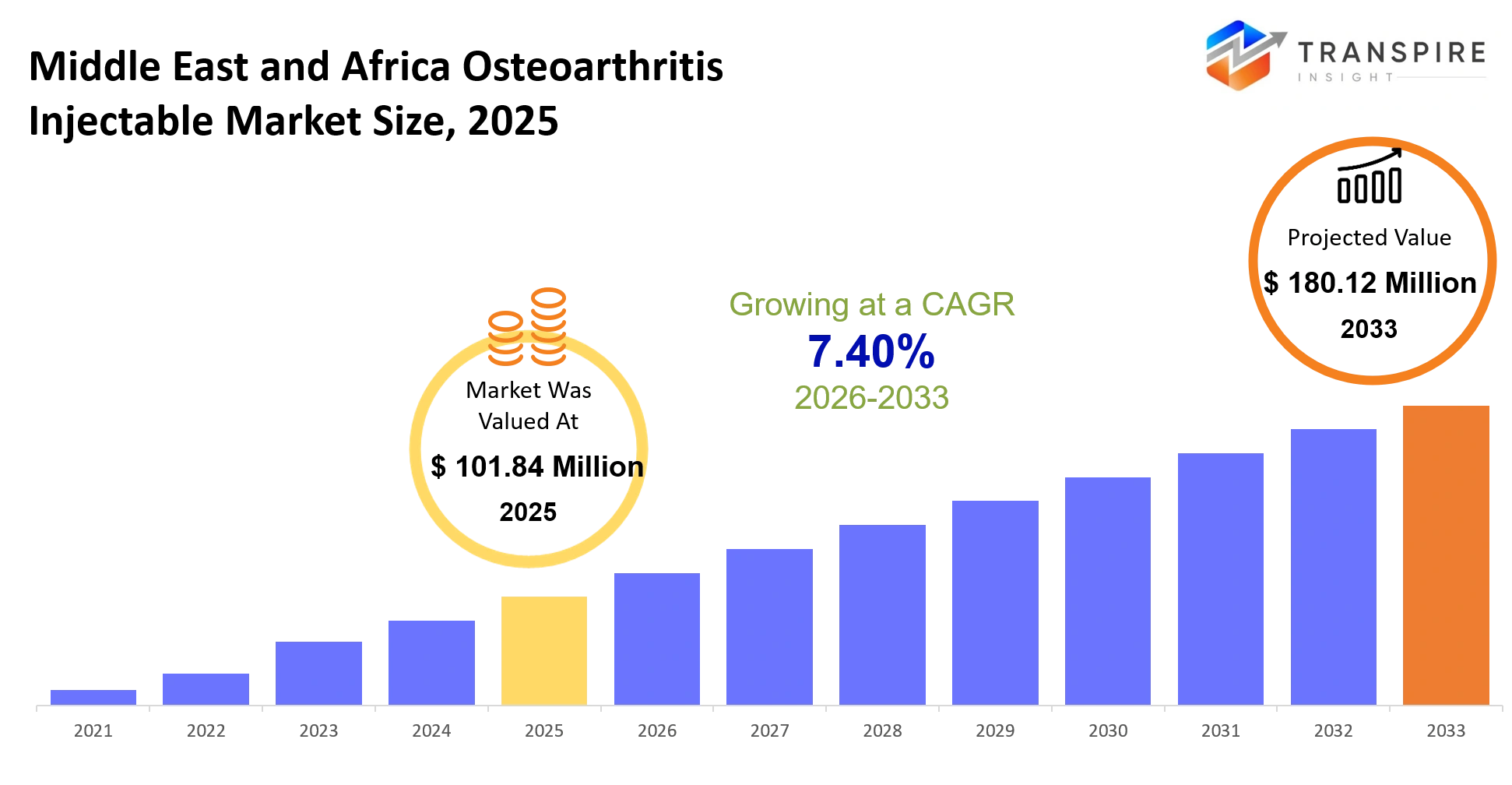
- Middle East and Africa Osteoarthritis Injectable Market Size 2025: USD 101.84 Million
- Middle East and Africa Osteoarthritis Injectable Market Size 2033: USD 180.12 Million
- Middle East and Africa Osteoarthritis Injectable Market CAGR: 7.40%
- Middle East and Africa Osteoarthritis Injectable Market Segments: By Product Type (Hyaluronic Acid Injections, Corticosteroid Injections, PRP Injections, Stem Cell Injections, Others); By Joint Type (Knee, Hip, Shoulder, Others); By End User (Hospitals, Clinics, Ambulatory Centers, Others); By Distribution Channel (Hospital Pharmacies, Retail Pharmacies, Others)
Middle East and Africa Osteoarthritis Injectable Market Summary
The Middle East and Africa Osteoarthritis Injectable Market was valued at USD 101.84 Million in 2025. It is forecast to reach USD 180.12 Million by 2033. That is a CAGR of 7.40% over the period.
The Middle East and Africa Osteoarthritis Injectable Market kinda backs pain management , and also joint function restoration for patients with degenerative knee, hip, and shoulder issues when oral therapies don’t really give adequate relief anymore. In day to day clinical practice, injectables like hyaluronic acid, corticosteroids, and regenerative biologics are used to help push back surgery timing and support mobility, especially for older people and for patients with sports-related or work-induced joint wear.
Over the last 3–5 years, there’s been a noticeable structural shift toward minimally invasive biologic injections. Because of that, reliance on steroid-only approaches has gone down a bit, mainly due to better clinical outcomes and effects that tend to last longer. At the same time, the post-pandemic orthopedic backlog recovery sort of acted like a trigger, and it pushed elective procedure volumes higher. That, in turn, accelerated injectable adoption across hospitals and specialty clinics. Supply chain stabilization also mattered, plus there’s more availability of advanced viscosupplementation products, which further supported uptake. Now, growth seems to reflect a more obvious move toward outpatient orthopedic care, where quicker recovery timelines and lower hospitalization costs help improve provider efficiency and overall revenue generation.
Key Market Insights
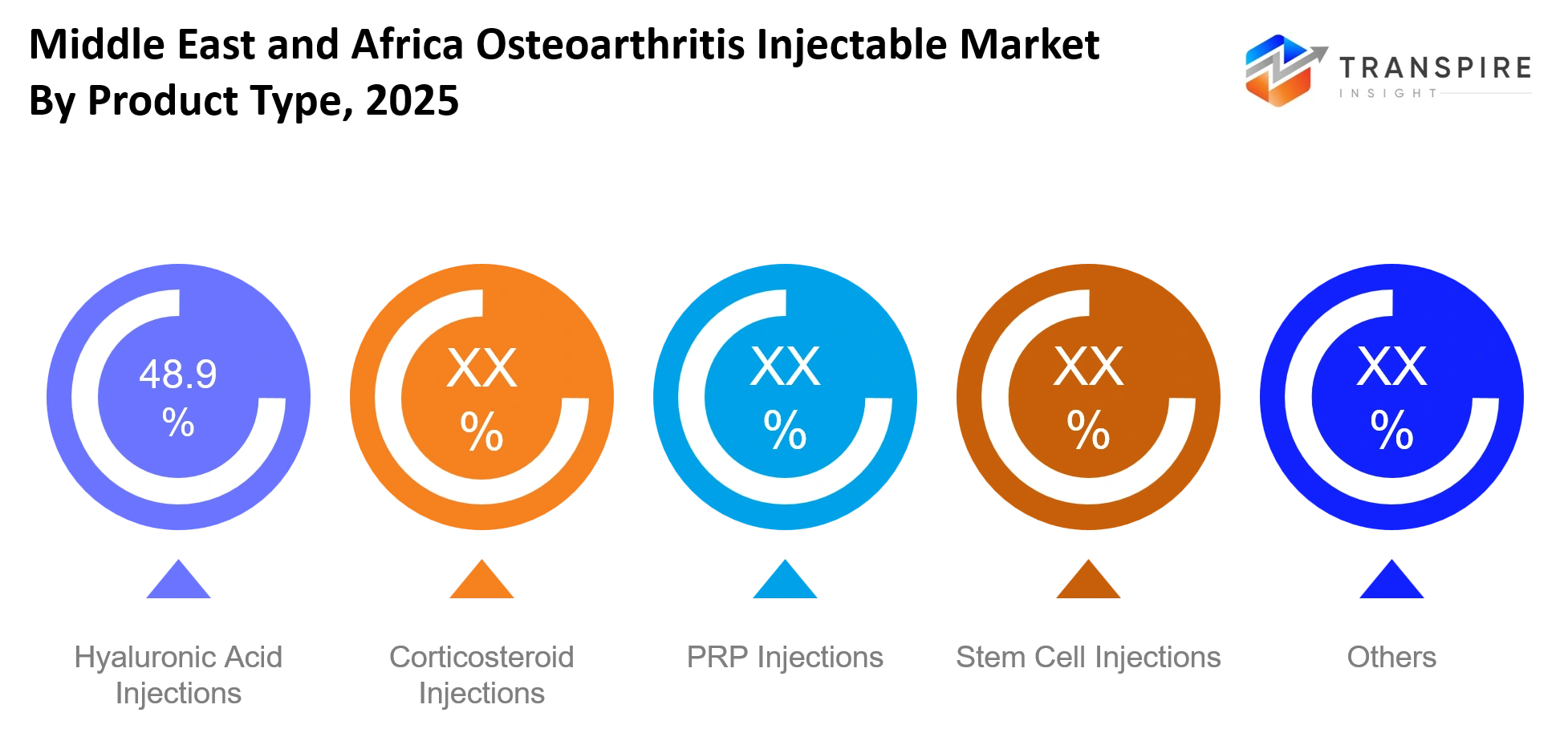
- The Middle East and Africa Osteoarthritis Injectable Market is kind of shifting toward biologics, with hyaluronic acid taking up nearly 38% share in 2025.
- There’s this knee joint angle that seems to dominate, roughly 52% share, mainly because osteoarthritis prevalence is high, plus those weight bearing stress conditions.
- In terms of who buys, hospitals lead the end user segment at almost 45% share, helped along by surgical infrastructure, and also injection based treatment protocols that are already in place.
- Clinics, however, are the fastest growing end user group, growing adoption by around 8–10% each year, mostly due to outpatient procedures that keep scaling.
- For product types, hyaluronic acid injections still sit in the lead, largely because symptom relief can last longer than corticosteroid alternatives, and that difference really matters.
- PRP injections meanwhile show the fastest growth momentum, as regenerative orthopedic therapies keep getting more mainstream.
- Looking at geography, Saudi Arabia and South Africa together make up more than 40% of the regional revenue share in 2025.
- The GCC region stays dominant too, thanks to advanced healthcare infrastructure, and a dense number of orthopedic specialists. Retail pharmacies also keep expanding distribution share, supported by post treatment pain management prescriptions and repeat therapies.
- Meanwhile, key players like Sanofi, Zimmer Biomet, and Smith & Nephew keep strengthening their market position through product innovation, and regional partnerships that help them reach more customers.
What are the Key Drivers, Restraints, and Opportunities in the Middle East and Africa Osteoarthritis Injectable Market?
The main driver is the rising burden of osteoarthritis that seems tied to obesity growth and also aging populations across Gulf countries, plus urban African regions too. As a result, hospitals are more and more leaning toward injectable therapies, to delay joint replacement surgeries, especially in places where surgical capacity is still limited. This change helps patient throughput , and it also cuts down long-term orthopedic spend, which then directly boosts injectable procedure volumes and keeps hospital revenue cycles moving forward.
But even with that momentum, limited reimbursement coverage across several African healthcare systems , makes access messy for many patients who want the advanced injectable options. On top of that, the high overall costs for biologics and PRP therapies create affordability gaps. This is worse in rural and semi-urban regions, where resources are tighter and options feel fewer. So adoption slows, mostly because patients sometimes pivot to low-cost painkillers , rather than staying with a consistent injectable treatment sequence, and that ends up suppressing long-term revenue expansion.
Meanwhile, expanding private orthopedic clinic networks in Saudi Arabia, UAE, and South Africa gives a pretty solid growth channel for premium injectable therapies. There’s also more investment going into regenerative medicine centers, particularly platelet-rich plasma platforms, which supports next-generation treatment uptake. For instance, hospital–clinic collaboration models in GCC areas are rolling viscosupplementation along with PRP into outpatient musculoskeletal care programs, and that’s opening new revenue corridors for manufacturers and distributors.
What Has the Impact of Artificial Intelligence Been on the Middle East and Africa Osteoarthritis Injectable Market?
Artificial intelligence is sort of reshaping orthopedic injectable treatment pathways across the Middle East and Africa, mostly by boosting diagnosis accuracy and also streamlining treatment planning for people with osteoarthritis. AI imaging systems help clinicians spot cartilage degeneration earlier, which means clinicians can start viscosupplementation, plus biologic injections , before surgery is actually required. In practice it can feel like a faster path to the right intervention.
Machine learning models are also being used in many hospital networks, to estimate how patients might respond to hyaluronic acid and PRP injections. They look at mobility scores , age, and comorbidity information. That kind of prediction supports more personalized treatment cycles, and it helps cut back on repeat procedures that don’t really work, so the overall cost efficiency tends to improve. Digital orthopedic platforms play a role too, optimizing appointment scheduling and post-injection monitoring, which reduces clinic wait times and makes patient flow smoother.
On the operations side , orthopedic departments are seeing better resource allocation. Some urban hospitals even report fewer follow-up inefficiencies and higher adherence to the plan. Still, AI adoption isn’t evenly spread, because structured patient datasets are limited and digital health infrastructure is inconsistent across several African healthcare systems. Integration costs can be high, and fragmented electronic medical record systems slow things down, especially for smaller orthopedic clinics. Even with all that, AI-driven predictive orthopedics is gradually improving clinical decision-making efficiency in more advanced healthcare hubs.
Key Market Trends
- Between 2022 and 2025 , hyaluronic acid injections kind of replaced steroid-heavy protocols, mostly because symptom control lasted longer and it felt more stable, overall .
- In GCC orthopedic clinics, PRP uptake went up almost 12% each year, not just because of trendiness but more regenerative treatment preference .
- South Africa meanwhile grew outpatient orthopedic injection centers about 18% from 2023 to 2025 .
- Saudi Arabia also pushed knee injection procedures up by roughly 20% after orthopedic backlog clearance programs kicked in during 2024, like a cleanup wave.
- Hospitals reduced inpatient orthopedic stays around 15% by leaning on injectable-first treatment pathways instead of keeping people in wards .
- Zimmer Biomet also expanded its viscosupplementation partnerships across UAE hospital chains in 2025, and clinics seemed to like that arrangement.
- In urban areas of Africa, 30% of osteoarthritis care moved away from surgery referrals, and toward injection-based management options .
- Since 2024 , premium orthopedic centers saw a big lift in demand for combination regimens like HA + PRP, with genuinely more people asking for both.
- Digital orthopedic platforms helped injection scheduling run smoother across Gulf hospitals , by 25% .
- And finally, competition got tighter as Smith & Nephew and Bioventus expanded their regenerative product portfolios at the same time.
Middle East and Africa Osteoarthritis Injectable Market Segmentation
By Product Type
The Hyaluronic Acid Injections segment show some real demand in Middle East and Africa Osteoarthritis Injectable Market, mainly because of longer lasting joint lubrication effects and less need for frequent hospital visits, you know. At the same time Corticosteroid Injections are still widely picked for acute pain management situations, when you need rapid inflammation control, kind of immediately. PRP Injections start getting more traction in regenerative therapy settings too, backed by orthopedic specialists in private hospitals who like the approach. Meanwhile Stem Cell Injections are still in early clinical adoption, mostly due to the high cost and limited standardization overall. The Others category covers combination therapies, and also those newer biologic formulations that appear in very specialized orthopedic centers.
Corticosteroid Injections maintain steady usage across emergency orthopedic cases in public hospitals, mostly because they are affordable and symptom relief is fast. Hyaluronic Acid Injections dominate elective treatment cycles, especially for knee osteoarthritis cases where long term outcomes are better. PRP Injections are showing the fastest growth in sports medicine and in premium orthopedic clinics across GCC countries. Stem Cell Injections, on the other hand, remain somewhat restricted to advanced research hospitals and a few selected private institutions that already have regenerative medicine capabilities.
By Joint Type
The knee segment kinda dominates the Middle East and Africa Osteoarthritis Injectable Market , because of the big weight bearing stress and the obesity linked osteoarthritis cases that keep rising. Hip segment seems to have a moderate demand, mostly among elderly patient groups needing mobility restoration. Shoulder segment reflects a growing uptake for sports injury therapies and also for occupational strain situations. Others include smaller joint treatments, done via specialized orthopedic procedures , more or less
Knee osteoarthritis therapy takes the biggest share, since clinical interventions happen quite often in hospitals and orthopedic clinics. Hip injections look pretty stable in geriatric care settings, with a gradual uptick in outpatient management. Shoulder injections keep expanding in sports medicine clinics especially across city centers. Others covers niche joint indications, like trauma related orthopedic care, where it gets more targeted
By End User
Hospitals are leading the Middle East and Africa Osteoarthritis Injectable market , mainly because of advanced orthopaedic infrastructure and a steady inflow of patients for injection-based therapies. In the meantime Clinics are becoming a rapidly growing slice, mostly driven by the preference for outpatient care , it just feels a bit more convenient. Ambulatory Centers also get momentum as cost-efficient treatment delivery models keep expanding. Then there are Others which can include rehabilitation centers and specialty care facilities , you know, the more focused sort of places.
Hospitals stay dominant thanks to integrated orthopaedic departments and better access to advanced biologic injectables. Clinics are the ones growing the fastest because lower treatment costs and more flexible appointment systems make it easier for patients to keep coming back. Ambulatory centers increase adoption through day-care type orthopaedic procedures. And the Others category supports post-treatment rehabilitation along with ongoing follow-ups, so patients don’t just disappear after the injection.
By Distribution Channel
Hospital pharmacies kind of dominate, because they handle direct injection administration and keep the controlled drug supply lines more contained. Retail pharmacies, meanwhile, support repeat prescription pain management therapies, so people can keep going without much interruption. Other channels include online and specialty distribution options that serve orthopedic clinics in a more tailored way.
Hospital pharmacies hold the lead due to procedural integration with orthopedic care. Retail pharmacies broaden their role for post-injection maintenance medication supply, and they do it pretty consistently. Meanwhile other channels grow gradually, tied to digital healthcare integration across urban regions.
What are the Key Use Cases Driving the Middle East and Africa Osteoarthritis Injectable Market?
Knee osteoarthritis pain management is still kind of the main thing driving the Middle East and Africa Osteoarthritis Injectable Market, mostly because degenerative joint problems are common and obesity related stress conditions keep adding pressure on the joints. In practice , hospitals and orthopedic clinics often lean on injectable therapies so they can push back surgery a bit, and also help patients move better.
Sports medicine plus post trauma recovery is also growing, especially in urban clinics where ligament injuries show up often and occupational strain cases keep coming through. At the same time, ambulatory surgical centers are more and more adopting injectable based protocols, mainly to lower the inpatient load and speed up patient turnaround, which sounds small but is really impactful.
Newer use cases are starting to show too, like regenerative orthopedic care with PRP and stem cell therapies being offered in premium private hospitals. This is looking promising in GCC countries, where musculoskeletal care infrastructure keeps expanding, and where patients are more willing to try advanced options sooner.
|
Report Metrics |
Details |
|
Market size value in 2025 |
USD 101.84 Million |
|
Market size value in 2026 |
USD 109.27 Million |
|
Revenue forecast in 2033 |
USD 180.12 Million |
|
Growth rate |
CAGR of 7.40% from 2026 to 2033 |
|
Base year |
2025 |
|
Historical data |
2021 - 2024 |
|
Forecast period |
2026 - 2033 |
|
Report coverage |
Revenue forecast, competitive landscape, growth factors, and trends |
|
Regional scope |
Middle East and Africa (Saudi Arabia, United Arab Emirates, South Africa, Rest of Middle East and Africa) |
|
Key company profiled |
Sanofi, Zimmer Biomet, Anika Therapeutics, Seikagaku, Ferring, Bioventus, Smith & Nephew, Pfizer, Teva, Viatris, LG Chem, Lifecore Biomedical, Chugai, Organon, GSK |
|
Customization scope |
Free report customization (country, regional & segment scope). Avail customized purchase options to meet your exact research needs. |
|
Report Segmentation |
By Product Type (Hyaluronic Acid Injections, Corticosteroid Injections, PRP Injections, Stem Cell Injections, Others); By Joint Type (Knee, Hip, Shoulder, Others); By End User (Hospitals, Clinics, Ambulatory Centers, Others); By Distribution Channel (Hospital Pharmacies, Retail Pharmacies, Others) |
Which Regions are Driving the Middle East and Africa Osteoarthritis Injectable Market Growth?
The Gulf Cooperation Council region sort of leads the Middle East and Africa Osteoarthritis Injectable Market because it has advanced healthcare infrastructure, more orthopedic specialists density, and strong take up of biologic therapies. Saudi Arabia and the UAE back big orthopedic treatment programs, through government supported healthcare modernization initiatives . Also, when patient awareness is higher, and insurance penetration stays solid, injectable adoption grows in both private and public hospitals, overall.
South Africa looks like a stable secondary market thanks to well established hospital networks and fairly consistent orthopedic care delivery systems. And unlike GCC markets, the growth rhythm here depends more on steady healthcare investment cycles, plus public–private hospital collaboration, rather than faster infrastructure expansion. In practice, predictable treatment demand in urban centers helps keep injectable usage consistent across hospitals and specialty clinics, too.
North and East Africa are showing the fastest growth momentum , mainly because healthcare access keeps widening and the orthopedic disease burden is rising. There were recent investments in hospital infrastructure and medical training programs, and these changes have improved the availability of injectable therapies. At the same time, higher import activity for advanced biologic injectables is reshaping treatment accessibility , which is basically creating real opportunities for market entrants across 2026–2033.
Who are the Key Players in the Middle East and Africa Osteoarthritis Injectable Market and How Do They Compete?
The competition in the Middle East and Africa Osteoarthritis Injectable Market is still kind of moderately fragmented, like global pharmaceutical and orthopedic companies are in the mix right next to regional distributors, so it feels competitive in a less tidy way. The main thing they push for is product innovation in viscosupplementation, some pricing flexibility, and then distribution reach across hospital and clinic networks. Meanwhile demand for regenerative therapies keeps getting louder, and that has intensified rivalry among the established injectable manufacturers too.
Sanofi leans into broad pharmaceutical distribution power, and it keeps a steady footing via hospital partnerships inside Gulf healthcare systems. Zimmer Biomet, in contrast, tries to strengthen its position through orthopedic device integration with injectable treatment pathways, especially when it comes to knee osteoarthritis care programs. Anika Therapeutics differentiates by using advanced hyaluronic acid formulations, and these show up in viscosupplementation therapies across specialty clinics.
Bioventus is expanding more aggressively in regenerative injection therapies such as PRP, aiming for fast-growing clinic networks across GCC and South Africa. Smith & Nephew uses orthopedic surgical ecosystem integration, and from there it promotes injectable solutions as part of a broader joint care pathway. Teva competes by offering cost-effective generic injectable formulations, which helps strengthen access in price-sensitive African healthcare markets, even when budgets are tight or purchasing is cautious.
Company List
- Sanofi
- Zimmer Biomet
- Anika Therapeutics
- Seikagaku
- Ferring
- Bioventus
- Smith & Nephew
- Pfizer
- Teva
- Viatris
- LG Chem
- Lifecore Biomedical
- Chugai
- Organon
- GSK
Recent Development News
In February 2025, Bioventus announced an agreement with IBSA for rights related to GELSYN-3. The transaction strengthened Bioventus' viscosupplementation portfolio and expanded access to hyaluronic acid injection therapies used in knee osteoarthritis treatment.https://firstwordpharma.com/story/3576736
In 2025, Anika Therapeutics advanced commercialization and market expansion activities for its hyaluronic acid-based osteoarthritis pain management portfolio, including products such as Monovisc and Orthovisc. Continued investment in regenerative and viscosupplementation technologies strengthened competitive positioning in osteoarthritis injectable therapies.https://anika.com/about/our-story/
What Strategic Insights Define the Future of the Middle East and Africa Osteoarthritis Injectable Market?
The Middle East and Africa Osteoarthritis Injectable Market is kind of moving toward biologic-dominant treatment models, backed by outpatient orthopedic care expansion and a steady upswing in demand for regenerative therapies. The next growth phase will likely be shaped by healthcare modernization in GCC countries and by slower but continued infrastructure scaling across African urban centers, which should improve injectable accessibility and the overall treatment cadence, a bit more often than before.
There’s also a risk that is less noticeable at first—reimbursement fragmentation, it can cap adoption of higher-cost biologics, even if clinical demand is actually strong. And on top of that, the supply chain still leans on imported injectable formulations, so it brings pricing volatility into the picture and makes forecasting harder.
At the same time, an emerging opportunity shows up with integrated orthopedic care platforms, pairing AI-based diagnostics with injectable treatment planning. This is especially relevant in places like Saudi Arabia and UAE hospital networks. Market players should aim to grow clinic partnerships and use localized distribution approaches, so they can catch the outpatient demand increase early, and build steadier long-term regional positioning.
Middle East and Africa Osteoarthritis Injectable Market Report Segmentation
By Product Type
- Hyaluronic Acid Injections
- Corticosteroid Injections
- PRP Injections
- Stem Cell Injections
- Others
By Joint Type
- Knee
- Hip
- Shoulder
- Others
By End User
- Hospitals
- Clinics
- Ambulatory Centers
- Others
By Distribution Channel
- Hospital Pharmacies
- Retail Pharmacies
- Others
Frequently Asked Questions
Find quick answers to common questions.
The expected Middle East and Africa Osteoarthritis Injectable Market size for the market will be USD 180.12 Million in 2033.
Key segments for the Middle East and Africa Osteoarthritis Injectable Market are By Product Type (Hyaluronic Acid Injections, Corticosteroid Injections, PRP Injections, Stem Cell Injections, Others); By Joint Type (Knee, Hip, Shoulder, Others); By End User (Hospitals, Clinics, Ambulatory Centers, Others); By Distribution Channel (Hospital Pharmacies, Retail Pharmacies, Others)
Major Middle East and Africa Osteoarthritis Injectable Market players are Sanofi, Zimmer Biomet, Anika Therapeutics, Seikagaku, Ferring, Bioventus, Smith & Nephew, Pfizer, Teva, Viatris, LG Chem, Lifecore Biomedical, Chugai, Organon, GSK
The Middle East and Africa Osteoarthritis Injectable Market size is USD 101.84 Million in 2025.
The Middle East and Africa Osteoarthritis Injectable Market CAGR is 7.40% from 2026 to 2033.
- Sanofi
- Zimmer Biomet
- Anika Therapeutics
- Seikagaku
- Ferring
- Bioventus
- Smith & Nephew
- Pfizer
- Teva
- Viatris
- LG Chem
- Lifecore Biomedical
- Chugai
- Organon
- GSK
About the Authors

Pankaj Ghogare Patil
I am Pankaj Ghogare Patil, a Senior Research Analyst at Transpire Insight, specializing in the Pharmaceutical, Chemicals & Materials, Healthcare IT, and Biotechnology industry. My expertise lies in conducting comprehensive market research, analyzing industry trends, evaluating competitive landscapes, and translating complex data into actionable insights. At Transpire Insight, I closely follow emerging technologies, regulatory developments, and market innovations to create accurate, well-researched, and informative content that helps businesses and professionals make informed decisions. I am committed to producing credible, evidence-based articles that reflect industry best practices while making technical topics accessible and valuable for a broad audience.

Chakradhar Khansole
Chakradhar serves as the Research Director at Transpire Insight, bringing over 8 years of experience in technology, innovation, and strategic market intelligence. He specializes in transforming complex market data into actionable business insights that enable organizations to make informed, growth-oriented decisions. Recognized for his strategic vision and analytical expertise, Chakradhar leads high-impact research initiatives, delivering comprehensive market assessments, competitive intelligence, and forward-looking industry analysis.
Recently Published Reports
-
Jul 2026
Alopecia Treatment Market
Alopecia Treatment Market Size, Share & Analysis Report By Disease Type (Alopecia Areata, Cicatricial Alopecia, Traction Alopecia, Alopecia Totalis, Androgenetic Alopecia, Alopecia Universalis, and Other Disease Types), By Treatment Type (Topical Treatments, Oral Medications, Injectable Therapies, and Hair Transplantation), By Gender (Male, and Female), By Distribution Channel (Hospitals and Clinics, Retail Pharmacies, and Online Retailers), and Geography (North America, Europe, Asia-Pacific, Middle East and Africa, South and Central America), 2021 - 2031
-
Jul 2026
Medical Ultrasound Probe Market
Medical Ultrasound Probe Market Size, Share & Analysis Report By Type (Linear Type, Convex Type, Endocavitary Probe, Phased Array/Cardiac Probe, Transesophageal (TEE) Probe, and Others), By Application (Ophthalmology, Cardiology, Musculoskeletal, Oncology, Obstetrics & Gynecology, General Imaging, and Others), By End User (Hospitals & Clinics, Diagnostic Centers, Ambulatory Surgical Centers, and Others), and Geography (North America, Europe, Asia-Pacific, Middle East and Africa, South and Central America), 2021 – 2031
-
May 2026
Biosimilars Market
Biosimilars Market By Product Type (Monoclonal Antibodies, Recombinant Hormones, Erythropoietin, G-CSF, Others), By Indication (Oncology, Autoimmune Diseases, Blood Disorders, Diabetes, Others), By Manufacturing Type (In-House Manufacturing, Contract Manufacturing), By Distribution Channel (Hospital Pharmacies, Retail Pharmacies, Online Pharmacies), By Industry Analysis, Size, Share, Growth, Trends, and Forecasts 2021-2033
-
Apr 2026
Gastrointestinal Endoscopy Market
Gastrointestinal Endoscopy Market By Type (Rigid Gastrointestinal Endoscope, Flexible Gastrointestinal Endoscopes, Disposable Gastrointestinal Endoscope), By Procedure Type (Colonoscopy, Gastroscopy, Duodenoscopy, Enteroscopy, Flexible Sigmoidoscopy, Others), By Application (Diagnosis, Treatment), By End-Users (Hospitals, Ambulatory Surgical Centers, Specialty Clinics, Laboratories, Others), By Industry Analysis, Size, Share, Growth, Trends, and Forecasts 2021-2033