
Middle East and Africa Clinical Decision Support Systems Market Size & Forecast:
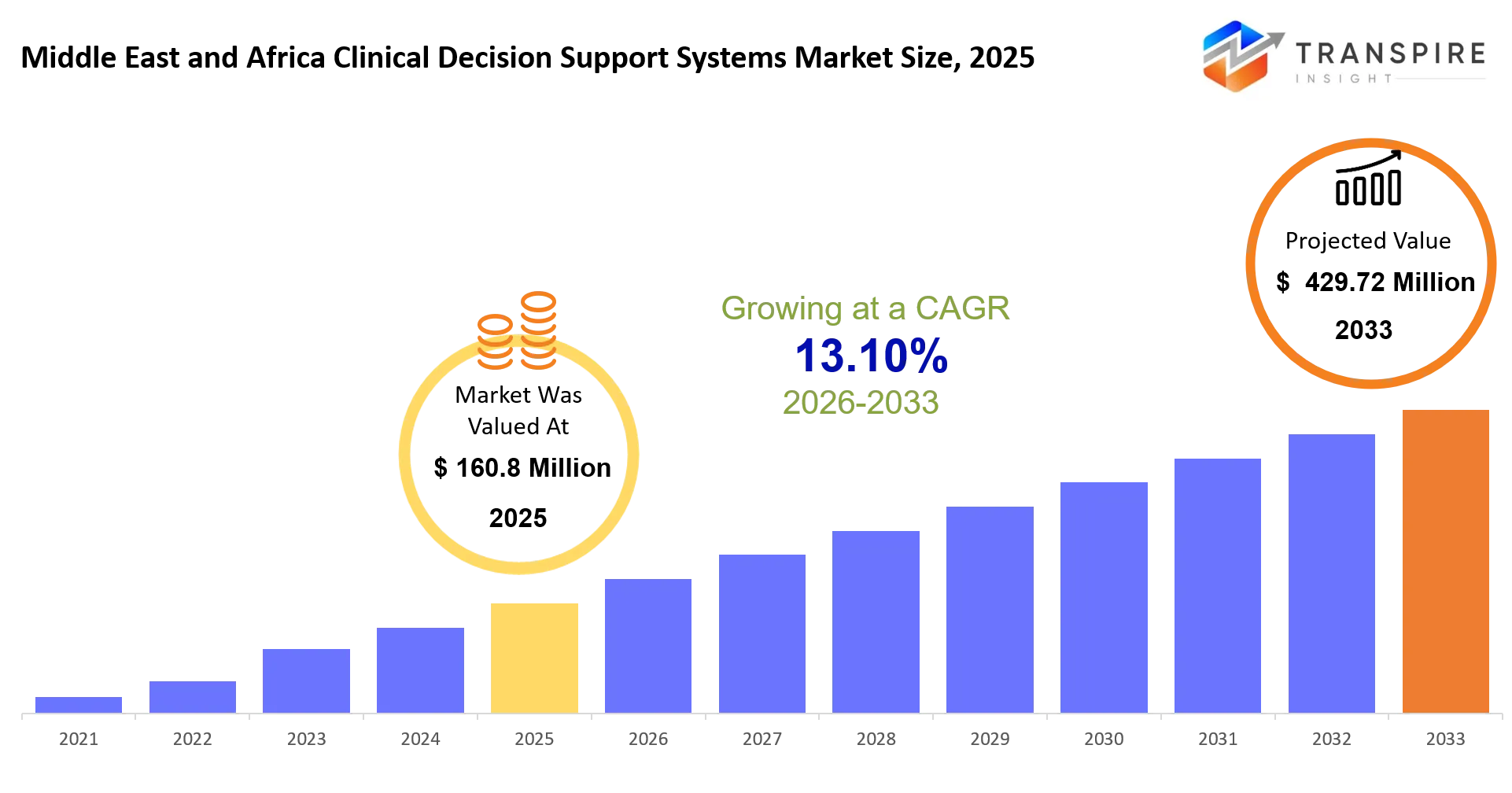
- Middle East and Africa Clinical Decision Support Systems Market Size 2025: USD 160.8 Million
- Middle East and Africa Clinical Decision Support Systems Market Size 2033: USD 429.72 Million
- Middle East and Africa Clinical Decision Support Systems Market CAGR: 13.10%
- Middle East and Africa Clinical Decision Support Systems Market Segments: By Component (Software, Services, Hardware, Others); By Deployment (Cloud-based, On-premise, Hybrid, Others); By Application (Diagnosis Support, Drug Alerts, Clinical Workflow, Treatment Planning, Others); By End User (Hospitals, Clinics, Research Centers, Others)
To learn more about this report,  Download Free Sample Report
Middle East and Africa Clinical Decision Support Systems Market Summary
The Middle East and Africa Clinical Decision Support Systems Market was valued at USD 160.8 Million in 2025. It is forecast to reach USD 429.72 Million by 2033. That is a CAGR of 13.10% over the period.
Clinical Decision Support Systems in the Middle East and Africa basically work like live digital sidekicks within hospitals. They help clinicians sort through patient information, highlight risks, and nudge toward evidence based care options while diagnosis is happening and treatment is being set. What tends to matter in real life is that these tools cut down the time it takes to make high stakes calls, particularly in emergency departments and in public hospitals with big patient flows, where small diagnostic slips can quickly turn into higher costs, and also worse outcomes.
Over the last 3 to 5 years, the market moved away from older, rule driven hospital software, and is now leaning into AI enabled, interoperable platforms that tie into electronic health records. One big structural change has been the move toward cloud hosted clinical systems, which lets staff access data across separate facilities, even when the healthcare networks are fragmented. And then the COVID-19 pandemic, it felt like a very direct trigger, it revealed weaknesses in clinical coordination, and pushed faster digital spending across both Gulf and African healthcare systems. So, in response, hospitals are more and more prioritizing decision automation and predictive diagnostics, which in turn supports higher adoption of advanced CDS platforms, and it also expands vendor revenue, kind of across the board.
Key Market Insights
- In the Middle East and Africa Clinical Decision Support Systems Market, there is this noticeable push for AI tools merging into tertiary hospitals and specialty care centers, kind of fast actually, not just slowly rolling in.
- Gulf Cooperation Council countries make up nearly 38% share in 2025, mainly because of more heavy digital health infrastructure investment.
- Meanwhile Africa looks like the fastest-growing sub-region, largely due to digital hospital modernization programs running through 2033.
- When it comes to offerings, software solutions are still the bigger chunk, taking over 55% share, helped by quick EHR integration plus AI model deployment.
- Cloud-based deployment is leading adoption too, since it supports scalable access across multi-hospital healthcare networks without too much friction.
- For applications, diagnosis support remains in front, it contributes more than 40% of total system utilization.
- Then clinical workflow optimization is showing the quickest growth, driven by hospital efficiency mandates and these ongoing operational targets.
- Hospitals stay the dominant end user, but clinics are also expanding, especially with telehealth integration becoming more common.
- On the company side, names like Oracle Health, Philips, and Siemens Healthineers are strengthening partnerships across the region for AI-enabled diagnostics.
- And overall, strategic expansion seems to revolve around cloud migration, plus interoperability with national health data platforms, so data can travel cleanly between systems.
What are the Key Drivers, Restraints, and Opportunities in the Middle East and Africa Clinical Decision Support Systems Market?
The main driver for the Middle East and Africa Clinical Decision Support Systems Market is really the fast digitization of hospital operations, kinda backed by national health modernization programs, yes. A lot of Governments in the Gulf region and some countries in Africa have already pushed electronic health record adoption and that kind of “forces” hospitals to plug in decision support capabilities for both compliance and operational speed. In practice it means less diagnostic waiting and more consistent treatment protocols, so deployment rises across public facilities, and also across private ones.
But there is a big restraint too: the digital maturity gap is not even, especially in lower income parts of Africa where paper driven workflows still basically run the day. When hospital systems can’t talk to each other smoothly, real time data exchange becomes weak, and then the whole value of decision support platforms takes a hit. Because of that, procurement and rollout timelines drag on, while implementation costs climb, so large scale adoption gets delayed, even when demand exists.
A noteworthy opportunity is AI enabled predictive diagnostics, especially when it’s blended into cloud healthcare ecosystems. As hospitals move toward more centralized data platforms, vendors can roll out machine learning models that flag disease risks earlier, and also help refine treatment routes in a more guided way. For example , places like Saudi Arabia and the UAE are already funding national AI healthcare frameworks. That tends to create scalable demand for advanced CDS solutions across the forecast window, not just in a small number of early adopter hospitals, but more broadly.
What Has the Impact of Artificial Intelligence Been on the Middle East and Africa Clinical Decision Support Systems Market?
Artificial intelligence is kinda reshaping clinical decision support systems, by letting them do real-time analysis of patient histories , lab outputs and imaging streams so clinicians can make quicker calls. In many hospitals , they’re now putting in AI powered modules that kinda automate risk scoring, notice weird abnormal patterns, and suggest treatment pathways inside emergency or intensive care rhythms. The result is less reliance on manual interpretation, and it tends to keep diagnosis more consistent even when things are high volume and fast moving.
Then there’s machine learning models too, which are being used for predictive workload management, infection risk forecasting, and alerts about patient deterioration. Basically these setups help operations run smoother by tuning bed allocation, lowering readmissions, and improving when treatment is started. Hospitals that use AI integrated CDS platforms have been reporting real, measurable gains in workflow speed and overall clinical coordination.
Still, there’s an important catch: the shortage of high-quality, region specific clinical datasets. A lot of AI models are trained on global corpuses that don’t always match local disease patterns in Middle Eastern and African populations. That mismatch can reduce predictive accuracy for certain conditions. On top of that, limited integration between legacy hospital systems and newer AI platforms can really slow down deployment when you try to scale things broadly.
Key Market Trends
- Cloud-first hospital IT strategies kinda jumped adoption of combined CDS platforms across GCC hospitals by more than 30% since 2022, not exactly “smooth” but measurable.
- In 2025, AI-enabled diagnostic tools got a real boost as hospitals shifted to predictive patient monitoring, and then the whole thing snowballed into other workflows.
- IBM and Microsoft also expanded healthcare cloud partnerships across Middle Eastern health ministries during 2024 to 2025, with more focus on scale and less friction at rollout.
- Meanwhile clinical workflow optimization tools are slowly replacing standalone diagnostic systems, which is helping hospitals improve efficiency metrics quite a bit.
- In the UAE and Saudi Arabia, data interoperability mandates sped up how CDS integrates with national health records systems, even when legacy setups were messy.
- Over in Africa, public hospital upgrades are pushing rapid deployment of mobile-based clinical decision platforms, mainly because budgets and connectivity realities make it practical.
- On top of that, pharmaceutical decision support integration has been linking drug alerts with electronic prescribing systems, so alerts arrive where clinicians actually act.
- Also demand for real-time predictive analytics tools rose fast in emergency and critical care departments, since timing matters more than before.
- And of course, cybersecurity investments went up right alongside CDS adoption, because digitizing sensitive patient data introduces serious risks.
- Finally, vendor consolidation is accelerating, as global firms buy regional health-tech startups to widen their market reach.
Middle East and Africa Clinical Decision Support Systems Market Segmentation
By Component
Software is dominating the Middle East and Africa Clinical Decision Support Systems market, mostly because there is this really strong uptake of AI based diagnostic platforms and workflow tools across hospitals. In practice, the software keeps running with things like real time clinical notifications and predictive analytics plus it ties in with electronic health records, not just as a standalone feature. The services side also keeps moving up at a steady pace, since facilities keep asking for implementation, ongoing upkeep, and customization work, you know, the usual real world needs. Hardware meanwhile is mostly servers and other medical IT infrastructure that allow CDS to be rolled out properly inside hospital settings. And then the “others” part covers integrated analytics modules, and also specialized decision engines that get used in more niche clinical scenarios.
The software pull gets even stronger when cloud migration strategies are used, alongside interoperability requirements that span multiple national health systems. Services gain momentum too, because hospitals want continuous updates and support for training AI models as clinical needs evolve over time. Hardware spending stays fairly steady, especially in big tertiary hospitals and government healthcare networks. Overall, the Middle East and Africa Clinical Decision Support Systems market shows a clear dependence on software led transformation, with services expanding to back it up, and that seems to be the main pattern.
By Deployment
Cloud based deployment is taking the lead in the Middle East and Africa Clinical Decision Support Systems Market, mainly because scalability just feels easier and because centralized data access works across multi hospital networks in a more direct way. Even so, on premise systems still matter a lot, especially in highly regulated government hospitals where teams want localized data control. Hybrid setups are also growing, because hospitals try to balance security expectations with digital accessibility, you know the practical side. Then there are other forms too, like edge based systems used in remote or mobile healthcare units where connectivity can be limited or kinda inconsistent.
Cloud adoption keeps speeding up thanks to national digital health transformation programs rolling out across the Gulf countries. Meanwhile on premise platforms continue to stay relevant in older or legacy hospital infrastructures across Africa, where replacement cycles can be slow. Hybrid models help hospitals move step by step, from traditional IT systems toward cloud ecosystems, without doing a big abrupt change. In general, this deployment diversity gives more flexibility across the healthcare ecosystems in the Middle East and Africa Clinical Decision Support Systems Market.
By Application
Diagnosis support leads application demand because it kinda directly reduces clinical errors and helps patient outcomes get better, mostly. Drug alert systems are used a lot to prevent medication mistakes inside hospital prescribing workflows, you know. Clinical workflow apps, well they optimize hospital operations and this improves efficiency in patient management and also helps care coordination. Treatment planning tools support physicians when they need to choose evidence based therapies across tricky, multiple conditions.
Diagnosis support adoption shows up strongest in emergency departments and intensive care units. Drug alert systems keep expanding as electronic prescribing gets integrated across hospitals. Clinical workflow solutions are growing fast due to efficiency mandates in hospitals. Treatment planning tools are gaining momentum with AI based precision medicine adoption.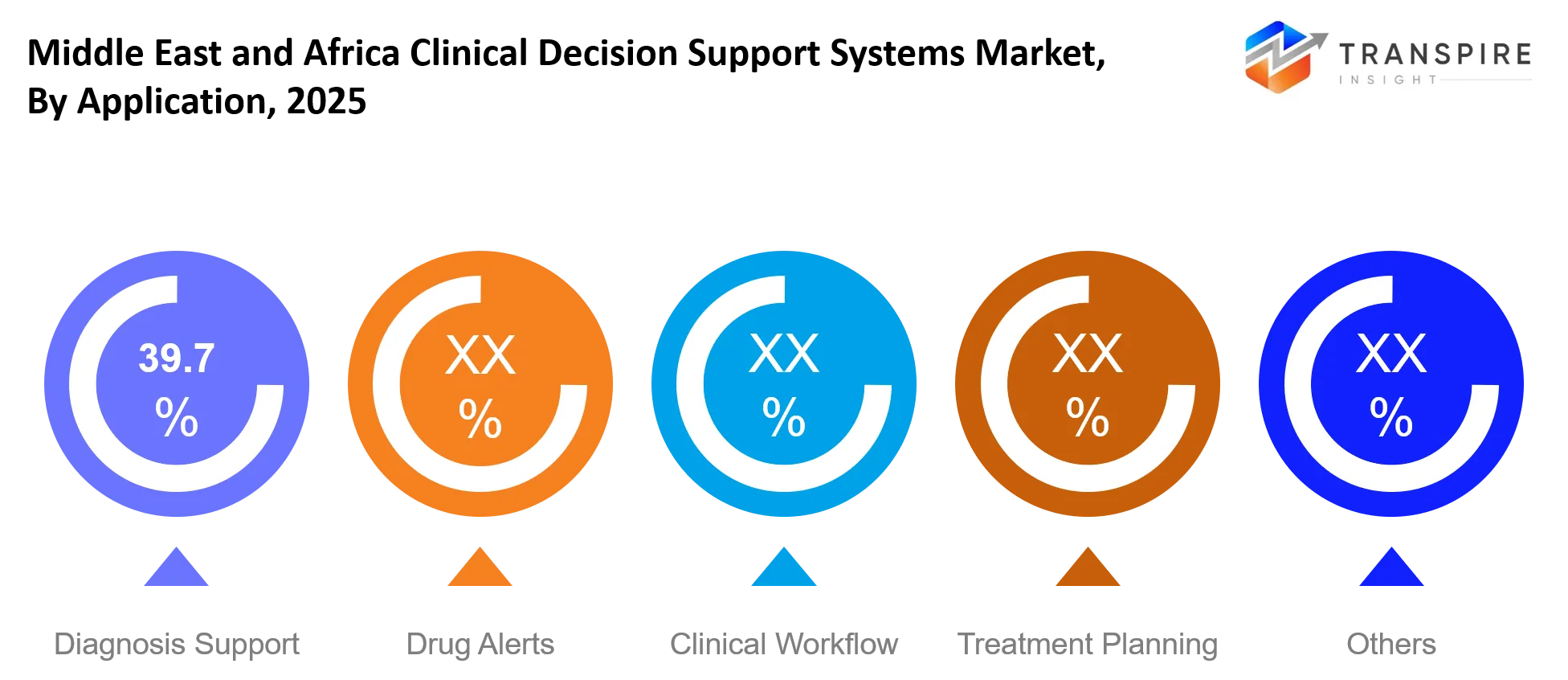
To learn more about this report, Download Free Sample Report
By End User
Hospitals end up dominating end user adoption because they see huge patient volumes, plus they tend to have advanced IT infrastructure, you know. Clinics, on the other hand are pushing ahead with telehealth link ups and digital consult platforms. Research centers are leaning on CDS platforms not just for clinical trials, but also for medical inquiry and predictive analytics building. Then there are others too, like diagnostic labs and specialty care facilities who are rolling out decision support tools, step by step.
Hospitals are still the big revenue drivers, largely due to large scale system integration. Clinics keep showing quick growth, especially as outpatient digitalization ramps up. Research centers help steer innovation in AI based healthcare analytics. And that whole end user variety, honestly, makes the market steadier and more resilient overall.
What are the Key Use Cases Driving the Middle East and Africa Clinical Decision Support Systems Market?
The main use case is real-time clinical decision support, especially inside hospital diagnosis routines, where these systems take in patient data and spit out treatment recommendations instantly. It helps a lot with faster diagnostic throughput in emergency departments, and also it cuts down on the usual variability in how physicians decide, even when things are messy.
Another related angle, more secondary I guess, shows up as medication safety monitoring inside pharmacy systems and clinical workflow optimization across inpatient care units. Hospitals and clinics basically rely on these tools so they can reduce prescription mistakes and keep a smoother operational coordination between departments, not just in theory but day to day.
Then there are newer, emerging use cases, like predictive alerts for patient deterioration and AI-driven population health analytics. These are starting to gather more momentum in more advanced hospital networks that are basically getting ready for precision medicine adoption, plus value-based care models, which sounds neat but also it changes how care is measured.
|
Report Metrics |
Details |
|
Market size value in 2025 |
USD 160.8 Million |
|
Market size value in 2026 |
USD 181.54 Million |
|
Revenue forecast in 2033 |
USD 429.72 Million |
|
Growth rate |
CAGR of13.10% from 2026 to 2033 |
|
Base year |
2025 |
|
Historical data |
2021 - 2024 |
|
Forecast period |
2026 - 2033 |
|
Report coverage |
Revenue forecast, competitive landscape, growth factors, and trends |
|
Regional scope |
Middle East and Africa (Saudi Arabia, United Arab Emirates, South Africa, Rest of Middle East and Africa) |
|
Key company profiled |
Oracle Health, Epic Systems, IBM, Microsoft, Philips, GE HealthCare, Siemens Healthineers, Wolters Kluwer, Veradigm, NextGen, Athenahealth, Meditech, NVIDIA, AWS, Google Cloud |
|
Customization scope |
Free report customization (country, regional & segment scope). Avail customized purchase options to meet your exact research needs. |
|
Report Segmentation |
By Component (Software, Services, Hardware, Others); By Deployment (Cloud-based, On-premise, Hybrid, Others); By Application (Diagnosis Support, Drug Alerts, Clinical Workflow, Treatment Planning, Others); By End User (Hospitals, Clinics, Research Centers, Others) |
Which Regions are Driving the Middle East and Africa Clinical Decision Support Systems Market Growth?
The Gulf Cooperation Council region seems to be in the lead in the Middle East and Africa Clinical Decision Support Systems Market, mainly because of those strong healthcare digitization rules and already well-built hospital infrastructure, in a kind of “ready-to-connect” way. Saudi Arabia and the UAE, for example, have pushed forward national electronic health record systems, and those setups practically need decision assistance tools that work together. Big spending on smart hospitals and AI enabled healthcare platforms also keeps the regional momentum strong.
Africa, meanwhile, looks more like a stable yet still developing contributor. It is being pushed along by the gradual upgrade of public healthcare frameworks. In South Africa and Kenya you can see hospital IT improvements tied to government support as well as donor funded programs. Adoption still moves slower than the GCC, mostly because of budget ceilings, but the steady investments should keep a reliable market presence in place over time.
North Africa is the fastest-growing slice, supported by newer healthcare modernization actions and heavier funding for digital hospital networks. Egypt and Morocco are upgrading clinical infrastructure, and at the same time folding in cloud based health systems. All of this hints at bigger chances for international vendors aiming at mid-tier hospital operations , not only the biggest facilities.
Who are the Key Players in the Middle East and Africa Clinical Decision Support Systems Market and How Do They Compete?
The Middle East and Africa Clinical Decision Support Systems Market still seems moderately consolidated, with a mix of global tech giants and healthcare IT specialists kind of fighting it out side by side. What really pushes competition forward is mainly AI strength, how well the systems talk with electronic health records, and how efficiently cloud deployment gets done, on real projects not just demos. The older players are leaning hard into regional collaborations, while newer companies try to stand out by targeting niche AI diagnostics or workflow optimization tools, sometimes in pretty specific care settings.
Oracle Health and Epic Systems, for example, keep going after integrated hospital information systems, and they pack in decision support features as part of the deal, which helps keep their edge in big hospital networks. Siemens Healthineers and GE HealthCare, meanwhile, are betting more on imaging-linked clinical decision platforms that aim to improve diagnostic precision in radiology and critical care. Philips is expanding through patient monitoring combined with AI enabled clinical analytics, rolling those capabilities out across broader hospital ecosystems.
Then you also have the cloud-and-AI crowd, like Microsoft, AWS, and Google Cloud, who shape the competitive scene by pushing platform based delivery—scalable CDS deployments across different healthcare organizations. Wolters Kluwer and IBM tend to emphasize evidence-led clinical intelligence along with predictive analytics, rather than only general-purpose tooling. Overall, competitive advantage is getting tied more and more to interoperability, AI accuracy, and the ability to plug into national healthcare data frameworks, with fewer friction points than before.
Company List
- Oracle Health
- Epic Systems
- IBM
- Microsoft
- Philips
- GE HealthCare
- Siemens Healthineers
- Wolters Kluwer
- Veradigm
- NextGen Healthcare
- athenahealth
- MEDITECH
- NVIDIA
- AWS (Amazon Web Services)
- Google Cloud
Recent Development News
In May 2025, Oracle Health entered a strategic partnership with Cleveland Clinic and G42. The collaboration focuses on building an AI-powered healthcare delivery platform that integrates clinical decision support, national-scale health data analytics, and predictive care models to improve treatment accuracy and system efficiency across Middle Eastern healthcare networks. [https://www.biospectrumasia.com
In April 2025, Epic Systems expanded its EHR and AI integration capabilities through deeper cloud and interoperability upgrades. The update strengthened embedded clinical decision support features within hospital workflows, enabling faster diagnostic assistance and improved care coordination across large healthcare systems, including adoption-linked expansion in international markets such as the Middle East.https://en.wikipedia.org/
In 2025, IBM expanded its Oracle cloud healthcare ecosystem partnerships focused on AI-driven clinical workflow automation. The initiative enhances decision support capabilities through hybrid cloud infrastructure, enabling hospitals to deploy predictive analytics tools for clinical risk detection and operational optimization across distributed healthcare environments in MEA regions.https://www.oracle.com
What Strategic Insights Define the Future of the Middle East and Africa Clinical Decision Support Systems Market?
The Middle East and Africa Clinical Decision Support Systems Market is clearly going somewhere: more and more toward fully stitched, AI-powered healthcare ecosystems, where decision support kind of gets glued into every step of patient care. Much of this is driven by national digital health strategies, and there is greater pressure on hospitals to shorten diagnostic delays and run treatment more efficiently, mainly through automation.
There is also a quieter risk that people do not talk about much, the overreliance on imported AI models that may not match regional disease patterns, which can lead to accuracy gaps in clinical guidance. And then there’s another limitation, uneven digital infrastructure maturity, which could widen adoption differences, between the more advanced hospitals in the Gulf and under-resourced facilities across parts of Africa.
On the opportunity side, something big is starting to show up: localized AI model development that is backed by national healthcare data platforms, especially around Saudi Arabia and the UAE. Players in the market that put money into region-specific clinical datasets , and build interoperable cloud architectures will likely lock in a more solid long-term edge, as healthcare systems keep moving toward predictive, and more precision-driven care approaches.
Middle East and Africa Clinical Decision Support Systems Market Report Segmentation
By Component
- Software
- Services
- Hardware
- Others
By Deployment
- Cloud-based
- On-premise
- Hybrid
- Others
By Application
- Diagnosis Support
- Drug Alerts
- Clinical Workflow
- Treatment Planning
- Others
By End User
- Hospitals
- Clinics
- Research Centers
- Others
Frequently Asked Questions
Find quick answers to common questions.
The Expected Middle East and Africa Clinical Decision Support Systems Market size for the Market will be USD 429.72 Million in 2033.
Key Segments for the Middle East and Africa Clinical Decision Support Systems Market are By Component (Software, Services, Hardware, Others); By Deployment (Cloud-based, On-premise, Hybrid, Others); By Application (Diagnosis Support, Drug Alerts, Clinical Workflow, Treatment Planning, Others); By End User (Hospitals, Clinics, Research Centers, Others).
Major Middle East and Africa Clinical Decision Support Systems Market Players are Oracle Health, Epic Systems, IBM, Microsoft, Philips, GE HealthCare, Siemens Healthineers, Wolters Kluwer, Veradigm, NextGen, Athenahealth, Meditech, NVIDIA, AWS, Google Cloud.
The Current Middle East and Africa Clinical Decision Support Systems Market size is USD 160.8 Million in 2025.
The Middle East and Africa Clinical Decision Support Systems Market CAGR is 13.10% from 2026 to 2033.
- Oracle Health
- Epic Systems
- IBM
- Microsoft
- Philips
- GE HealthCare
- Siemens Healthineers
- Wolters Kluwer
- Veradigm
- NextGen Healthcare
- athenahealth
- MEDITECH
- NVIDIA
- AWS (Amazon Web Services)
- Google Cloud
About the Authors

Mayur Shinde
I am Mayur Shinde, a Senior Research Analyst at Transpire Insight, specializing in the Automotive & Transportation and Information & Communication Technology (ICT) Industry. My work focuses on analyzing emerging market trends, technological advancements, competitive landscapes, and industry developments to deliver accurate, data-driven insights. I am passionate about transforming complex market information into clear, actionable content that helps businesses, professionals, and decision-makers stay informed and make confident strategic decisions.

Chakradhar Khansole
Chakradhar serves as the Research Director at Transpire Insight, bringing over 8 years of experience in technology, innovation, and strategic market intelligence. He specializes in transforming complex market data into actionable business insights that enable organizations to make informed, growth-oriented decisions. Recognized for his strategic vision and analytical expertise, Chakradhar leads high-impact research initiatives, delivering comprehensive market assessments, competitive intelligence, and forward-looking industry analysis.
Recently Published Reports
-
Apr 2026
3D Optical Profiler Market
3D Optical Profiler Market Size, Share & Analysis Report By Type (Desktop 3D Optical Profiler, and Portable 3D Optical Profiler), By Technology (Confocal Technology, and White Light Interference), By End-Use Industry (Manufacturing, Research Institutions, Automotive, Aerospace and Defense, Medical Devices, and Other), and Geography (North America, Europe, Asia-Pacific, Middle East and Africa, South and Central America), 2021 - 2031
-
Apr 2026
Depth Sensor Market
Depth Sensor Market Size, Share & Analysis Report By Type (Infrared Depth Sensors, Time-of-Flight (ToF) Sensors, Stereo Vision Sensors, Structured Light Sensors, Ultrasonic Depth Sensors), By Application (Automotive, Robotics, Gaming, Consumer Electronics, Industrial Automation, Healthcare, Security & Surveillance, Others), By End Users (Automotive Manufacturers, Consumer Electronics Companies, Healthcare Providers, Industrial Companies, Security Agencies, Gaming Companies, Robotics Companies, Others), and Geography (North America, Europe, Asia-Pacific, Middle East and Africa, South and Central America), 2021 – 2031
-
Apr 2026
Digital Manufacturing Market
Digital Manufacturing Market Size, Share & Analysis Report By Component (Hardware, Software, and Services), By Technology (Robotics, 3D Printing, Internet of Things (IoT), and Others), By Application (Automotive and Transportation, Aerospace and Defense, Consumer Electronics, Industrial Machinery, and Others), By Process Type (Computer-Based Designing, Computer-Based Simulation, Computer 3D Visualization, Analytics, and Others), and Geography (North America, Europe, Asia-Pacific, Middle East and Africa, South and Central America), 2021 – 2031
-
Apr 2026
Digital Visa Services Market
Digital Visa Services Market Size, Share & Analysis Report By Type (Individual Travelers, Group Travelers), By Application (Tourism, Business Travel, Others), and Geography (North America, Europe, Asia-Pacific, Middle East and Africa, South and Central America), 2021 – 2031