
United Kingdom Clinical Trial Ancillary Supplies Logistics Market Size & Forecast:
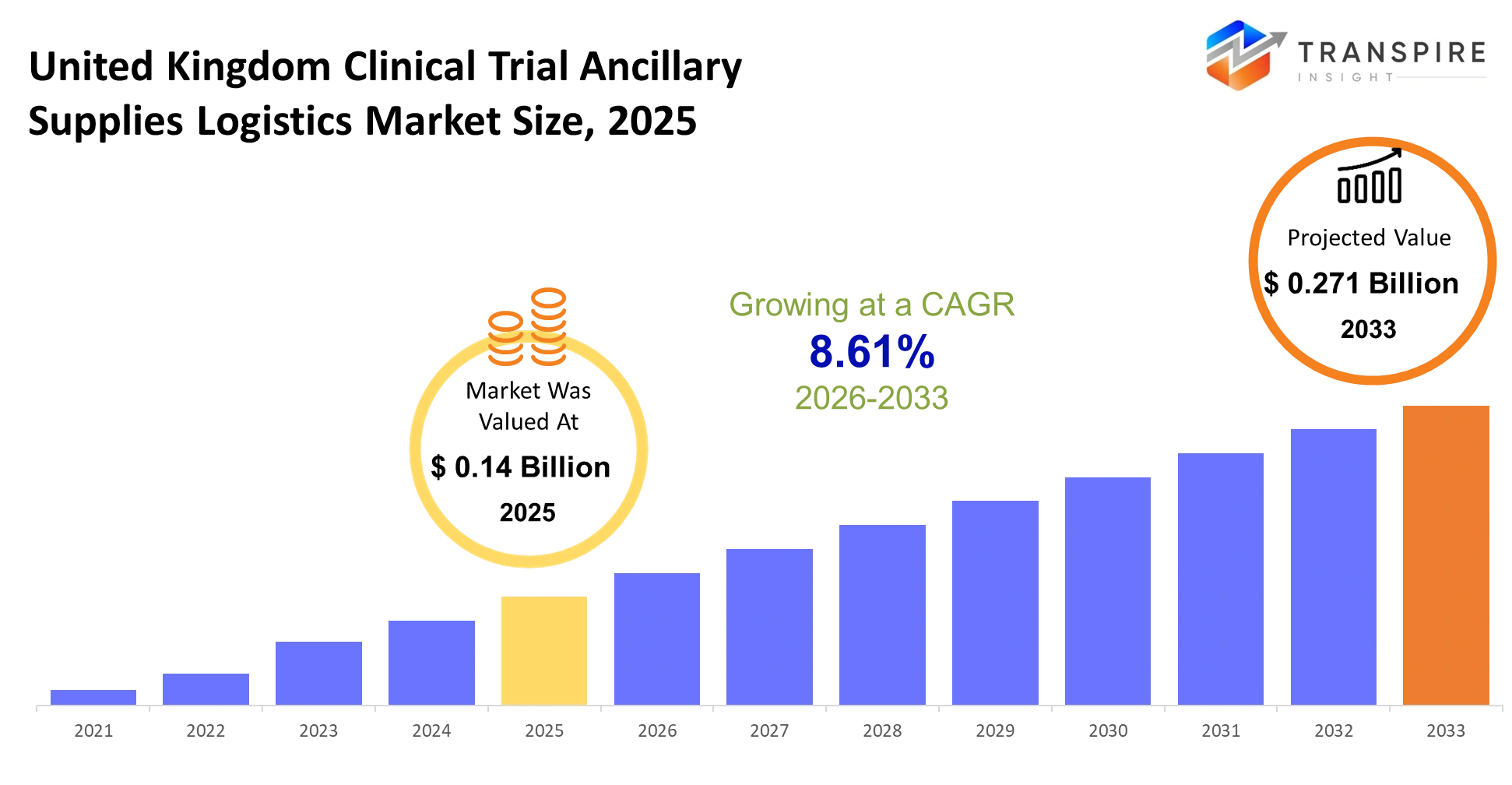
- United Kingdom Clinical Trial Ancillary Supplies Logistics Market Size 2025: USD 0.14 Billion
- United Kingdom Clinical Trial Ancillary Supplies Logistics Market Size 2033: USD 0.271 Billion
- United Kingdom Clinical Trial Ancillary Supplies Logistics Market CAGR: 8.61%
- United Kingdom Clinical Trial Ancillary Supplies Logistics Market Segments: By Service Type (Storage Services, Transportation Services, Packaging & Labeling Services, Inventory Management Services, Depot Services, Customs Clearance Services, Cold Chain Services, Others); By Application (Phase I Trials, Phase II Trials, Phase III Trials, Phase IV Trials, Vaccine Trials, Oncology Trials, Rare Disease Trials, Others); By End User (Pharmaceutical Companies, CROs, Biotechnology Companies, Research Institutes, Medical Device Companies, Academic Institutes, Others); By Temperature Type (Ambient Logistics, Cold Chain Logistics, Cryogenic Logistics, Controlled Room Temperature Logistics, Others); By Mode of Transport (Air Freight, Sea Freight, Road Transport, Rail Transport, Courier Services, Others)
To learn more about this report,  Download Free Sample Report
United Kingdom Clinical Trial Ancillary Supplies Logistics Market Summary
The United Kingdom Clinical Trial Ancillary Supplies Logistics Market was valued at USD 0.14 Billion in 2025. It is forecast to reach USD 0.271 Billion by 2033. That is a CAGR of 8.61% over the period.
In the United Kingdom , clinical trial ancillary supplies logistics kind of ensures that non-drug materials, like lab kits, diagnostic consumables, patient diaries, and temperature sensitive packaging components , actually move from suppliers to trial sites with precise timing and compliance controls. This way studies do not stall, because of missing or late inputs , which happens more often than people think.
A big structural shift has been happening, from the move toward decentralised and hybrid clinical trials . That change has increased reliance on digital inventory management systems, real time shipment tracking, and temperature monitoring technologies so distributed patient participation can continue without too many hiccups. Then the COVID-19 pandemic served as a real-world trigger, exposing fragility in global supply chains, and it pushed UK sponsors and contract research organizations to diversify their logistics networks , also to adopt more resilient distribution models.
So as a consequence, demand has grown for specialized providers that can handle end-to-end coordination, and that has encouraged investment in cold chain infrastructure plus integrated logistics platforms. Those platforms reduce trial delays and support protocol adherence across multicenter studies, even when operations are less centralized.
Key Market Insights
- England kind of dominates the United Kingdom Clinical Trial Ancillary Supplies Logistics Market, with almost 65–70% share in 2025 , mainly because there’s a dense clinical research infrastructure in place.
- Scotland is also emerging as the fastest growing region, pushed by more academic trials and this hybrid study adoption pattern, continuing through 2030.
- Wales is showing steady expansion, backed by regional hospital networks and cross-border trial collaborations that keep things moving.
- Meanwhile Northern UK hubs are gaining traction as decentralised trial models expand the logistics needs beyond the London clusters, more than before.
- When it comes to product mix, ancillary kits and consumables is the main winner, holding roughly 40% share in 2025.
- Cold chain logistics services come next, taking the second-largest share because temperature sensitive biologics and vaccine trials really rely on controlled conditions.
- In terms of therapeutic focus, oncology clinical trials lead the United Kingdom Clinical Trial Ancillary Supplies Logistics Market, around 35% share, largely due to the sheer trial volume involved.
- Rare disease and orphan drug trials are the fastest-growing application segment through 2030.
- Infectious disease studies keep demand stable, following that post-pandemic research surge but not fading too fast.
- And on the customer side, pharmaceutical companies lead overall with nearly 55% share in logistics demand across UK clinical trials.
What are the Key Drivers, Restraints, and Opportunities in the United Kingdom Clinical Trial Ancillary Supplies Logistics Market?
The main growth driver is the fast expansion of decentralized and hybrid clinical trials across the UK, reinforced after the COVID-19 disruption sort of exposed delays in the centralized supply models. Sponsors now want real time coordination of lab kits , temperature sensitive consumables, and patient centered trial materials across several home and site based locations. With that change in place, there’s a stronger reliance on digitally enabled logistics platforms, which boosts service penetration and opens revenue windows for integrated supply chain providers.
A major structural barrier remains the fragmented regulatory and compliance environment covering clinical trial materials, especially around temperature control validation, cross border shipment documentation, and GDPR aligned data handling for patient linked logistics. All those requirements, they add operational tangle and increase cost per shipment. That tends to cap scalability for smaller logistics providers. So adoption is slower among mid sized clinical sponsors, even if demand stays strong, and that suppresses the wider market expansion.
The most promising opportunity sits in AI driven predictive inventory and demand forecasting systems, tied into clinical trial management platforms. Early deployments by logistics partners working with multinational pharma companies in London and Cambridge clusters indicate fewer stockouts and quicker site activation timelines. As the digital clinical setup keeps maturing, this kind of integration should unlock efficiency-led growth and broaden the United Kingdom Clinical Trial Ancillary Supplies Logistics Market across multi-country trials.
What Has the Impact of Artificial Intelligence Been on the United Kingdom Clinical Trial Ancillary Supplies Logistics Market?
Artificial intelligence and advanced digital technologies are kind of reshaping the United Kingdom Clinical Trial Ancillary Supplies Logistics Market, by boosting precision, visibility and overall control through these pretty complex clinical supply chains. Now logistics providers are using AI powered automation tools to watch cold chain shipments in real time, along with IoT connected sensors that keep checking temperature, humidity, and handling conditions while materials are on vehicles or sitting in storage units. That tends to cut down manual back and forth for compliance tracking, and it also helps teams with more precise regulatory documentation, for the trial materials.
At the same time, machine learning models are being used more and more for predictive optimization, especially in route planning, demand forecasting, and equipment maintenance scheduling. In practice these systems look at historical shipment delays, site activation timelines, and environmental conditions in order to spot disruptions earlier, before they really happen. So operators often mention measurable outcomes like fewer cold chain excursion rates, better delivery reliability, and even lower fuel consumption, mostly because distribution routes get optimized across the United Kingdom Clinical Trial Ancillary Supplies Logistics Market.
Still, adoption isn’t fully smooth because the integration cost is high, and data systems are pretty fragmented across sponsors, CROs, and logistics providers. A lot of organizations keep running older inventory platforms that do not quite plug in with AI driven tools, and that kind of limits scale. Even so, some early deployments are already showing strong efficiency improvements, which puts digital logistics transformation on track as a major long term driver for performance gains and cost reduction across clinical trial supply operations.
Key Market Trends
- After 2021, decentralized clinical trials sort of expanded a lot, and that pushed logistics providers to redesign home delivery models for ancillary supplies across UK trial networks… not always in the same way, but you know, generally.
- Then, following 2022 regulatory updates, cold chain validation requirements got stricter, so operators had to upgrade temperature monitoring. Also compliance reporting systems, were basically improved.
- Around after 2023, AI-driven inventory forecasting was introduced, and it reduced stockout incidents in multi site trials, mainly because demand prediction got more accurate across UK facilities.
- Earlier in the decade, Brexit-related customs friction reshaped sourcing strategies, which meant more reliance on UK-based warehousing hubs for clinical trial supplies, not just one approach either.
- Between 2022 and 2025, DHL Supply Chain expanded real time tracking platforms, giving better shipment visibility across time sensitive oncology trials.
- After 2021, CRO outsourcing increased in a steady way, shifting logistics responsibility from sponsors to third party providers, who had more integrated supply chain capabilities.
- In 2024, World Courier deployed advanced temperature excursion detection systems, which cut compliance deviations in high value biologics trials.
- After 2023, digital trial management integration also improved, so coordination between clinical systems and logistics execution platforms became more seamless.
- From 2022 onward, sustainability-linked logistics practices gained traction. Optimized routing helped reduce unnecessary transport legs across UK clinical supply chains, kinda like trimming the waste routes.
- And post-pandemic, hybrid trial models expanded , which increased demand for flexible last mile delivery systems across patient centric study designs, yes, both sides mattered.
United Kingdom Clinical Trial Ancillary Supplies Logistics Market Segmentation
Market By Service Type:
Storage services help with safe holding of clinical trial materials like kits, consumables and biologics, under controlled conditions until the site demand shows up. In practice these services keep stability and regulatory compliance intact across the different trial phases, and that lowers the chance of material loss. Also it supports uninterrupted study execution across multiple UK clinical research locations, even when things get a bit hectic.
Transportation services along with cold chain services move both temperature sensitive and standard trial supplies in a timely manner between sponsors, depots and the trial sites. Inventory management plus depot services keep stock visibility correct, and enable quicker redistribution. Meanwhile packaging , labeling and customs clearance help make sure the regulatory alignment stays on track, so cross border movement of clinical materials stays smoother.
Market By Application:
For Phase I and Phase II trials, you often see smaller and highly controlled supply volumes with strict monitoring. In those early testing stages the whole point is precision and minimal wastage . That means these applications really lean on responsive logistics systems that can pivot quickly if the protocol changes, and still keep consistent delivery timelines across UK research centers.
Phase III and Phase IV trials usually bring higher volume demand, since patient groups expand and timelines run longer. Oncology, vaccine and rare disease trials also introduce extra complexity, especially with temperature sensitive needs and specialized handling requirements. Because of that, there is a bigger reliance on advanced logistics coordination and strict compliance systems, which is what helps keep trial continuity steady.
By End User:
Pharmaceutical companies tend to be the primary end users, because they run big clinical development programs, and they need supply chains that are quite structured, plus tight regulatory compliance. In practice, these companies rely on logistics partners for steady delivery results , lower operational exposure, and that smooth coordination across many trial locations, all within the United Kingdom.
CROs and biotechnology companies are leaning more and more on outsourced logistics services. Part of the reason is to get more flexibility, and also to reduce the internal workload. Research institutes, university centers, and medical device organizations use the same kind of services too, especially for smaller-scale trials, where precision, speed , and cost effectiveness really matter for finishing the study without hiccups.
By Temperature Type:
Ambient logistics covers non temperature sensitive clinical supplies , things like paperwork materials, packaging, and some consumables. Those shipments do not demand complicated handling conditions but they still depend on punctual delivery timing , so trial schedules stay intact and teams do not face operational delays across the different clinical sites that are spread around.
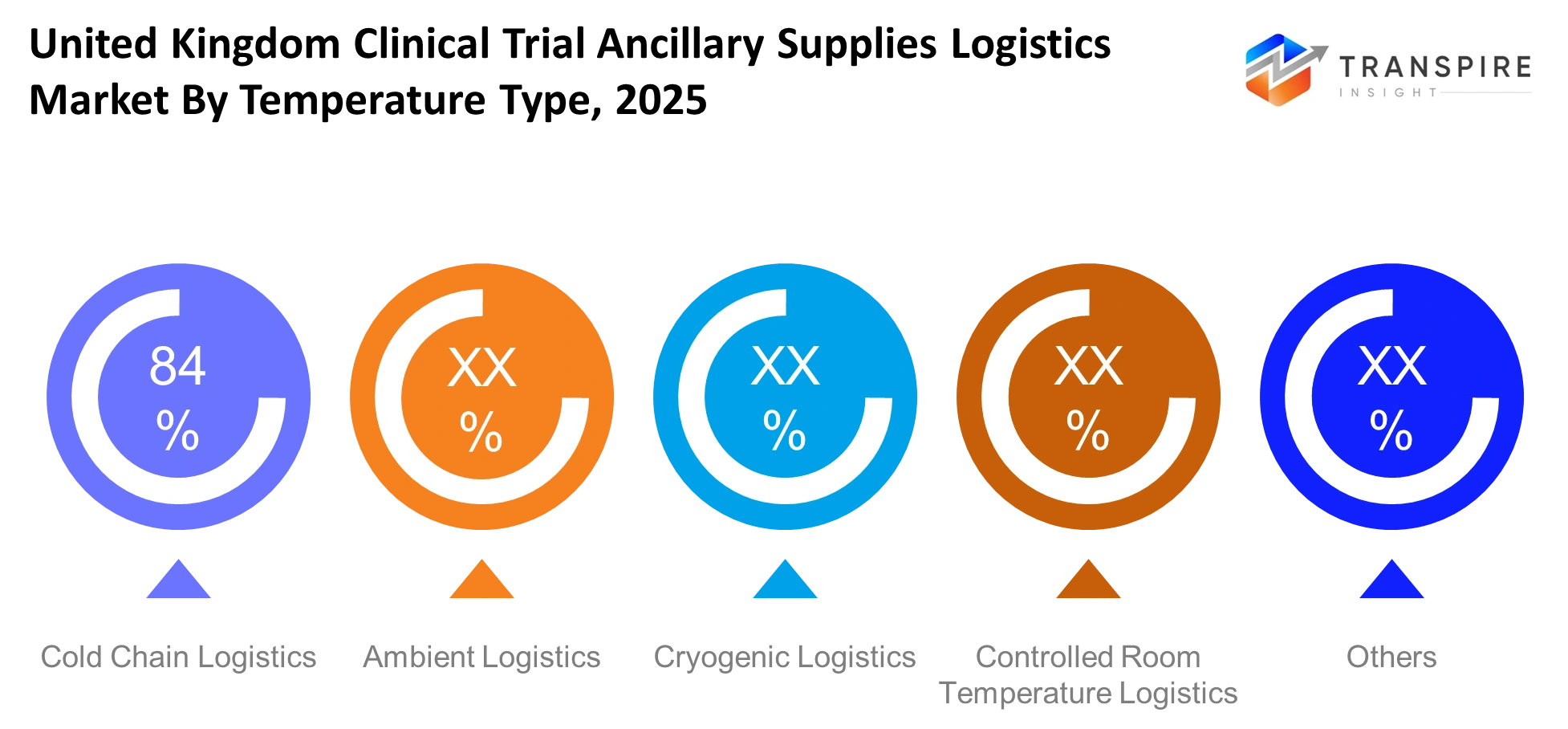
Cold chain logistics and cryogenic logistics back biologics, vaccines, and other delicate compounds that must stay within strict temperature limits. Controlled room temperature logistics, meanwhile, is used for intermediate-sensitive products, helping them keep stability in line with storage rules. This approach also cuts down the likelihood of degradation during transport across UK clinical trial networks.
To learn more about this report, Download Free Sample Report
By Mode of Transport:
Air freight is used when clinical trial shipments are urgent and also high value, so they basically need fast cross regional or international delivery, without much delay. Road transport, it sort of dominates for domestic moves between UK trial sites, mostly because it has flexibility and cost efficiency, which helps for frequent and scheduled deliveries between depots and hospitals.
Courier services handle the last mile for patient centered and decentralized trials, making sure kits can go direct to site, or even to a patient home address, depending on the setup. Sea freight and rail transport are used less often but they still matter, mainly for bulk shipments of non urgent supplies, and they can be a cost effective option for long distance distribution planning.
What are the Key Use Cases Driving the United Kingdom Clinical Trial Ancillary Supplies Logistics Market?
In the United Kingdom Clinical Trial Ancillary Supplies Logistics Market, the dominant use case kind of looks like this: supporting oncology and late-phase clinical trials, where you get high patient volumes and also very strict protocol adherence, so there's always a need for quick delivery of kits, biologics, and diagnostic materials. These programs need tight cold-chain handling and some synchronized distribution across several hospital sites, which means logistics reliability is a core enabler for whether the study actually succeeds or not, basically.
Beyond that, there is broader expansion coming from vaccine development initiatives and rare disease studies. Those efforts lean heavily on contract research organizations and pharmaceutical sponsors. In practice, they want logistics systems that are flexible and responsive, able to cope with shifting inventory levels, and they also need to handle rapid trial scaling across distributed UK research centers, plus specialist treatment hospitals.
For emerging use cases, the spotlight is moving toward decentralized and home-based clinical trials, where patient-focused delivery models are getting more traction. Digital health integration and remote monitoring are making it possible to ship ancillary supplies directly to patients, while adaptive trial designs are pushing the need for real-time logistics coordination and faster response cycles, so the whole operation stays aligned with what's happening in the study.
|
Report Metrics |
Details |
|
Market size value in 2025 |
USD 0.14 Billion |
|
Market size value in 2026 |
USD 0.152 Billion |
|
Revenue forecast in 2033 |
USD 0.271 Billion |
|
Growth rate |
CAGR of 8.61% from 2026 to 2033 |
|
Base year |
2025 |
|
Historical data |
2021 - 2024 |
|
Forecast period |
2026 - 2033 |
|
Report coverage |
Revenue forecast, competitive landscape, growth factors, and trends |
|
Regional scope |
Middle East and Africa (Saudi Arabia, United Arab Emirates, South Africa, Rest of Middle East and Africa) |
|
Key company profiled |
UPS Healthcare, DHL Supply Chain, FedEx Healthcare, Marken, World Courier, Almac Group, Parexel, Thermo Fisher Scientific, Movianto, Catalent, PCI Pharma Services, CEVA Logistics, Kuehne+Nagel, BioCare, Sharp Services |
|
Customization scope |
Free report customization (country, regional & segment scope). Avail customized purchase options to meet your exact research needs. |
|
Report Segmentation |
By Service Type (Storage Services, Transportation Services, Packaging & Labeling Services, Inventory Management Services, Depot Services, Customs Clearance Services, Cold Chain Services, Others); By Application (Phase I Trials, Phase II Trials, Phase III Trials, Phase IV Trials, Vaccine Trials, Oncology Trials, Rare Disease Trials, Others); By End User (Pharmaceutical Companies, CROs, Biotechnology Companies, Research Institutes, Medical Device Companies, Academic Institutes, Others); By Temperature Type (Ambient Logistics, Cold Chain Logistics, Cryogenic Logistics, Controlled Room Temperature Logistics, Others); By Mode of Transport (Air Freight, Sea Freight, Road Transport, Rail Transport, Courier Services, Others) |
Which Regions are Driving the United Kingdom Clinical Trial Ancillary Supplies Logistics Market Growth?
England seems to be leading the United Kingdom Clinical Trial Ancillary Supplies Logistics Market, mostly because it has a dense bunch of pharmaceutical headquarters , clusters of CROs, and those world-class research hospitals. London plus the South East really do benefit from being close to the MHRA regulatory framework , so approvals and compliance coordination for clinical trial work are kind of smoother. And then there’s connectivity, like through Heathrow Airport , plus the established freight corridors, which helps move temperature-sensitive trial materials fast. On top of that, Cambridge and Oxford have a mature biotech ecosystem, so the need for high frequency ancillary logistics services keeps getting reinforced, again and again , in a practical way.
Scotland, meanwhile, looks like a stable and fairly well organized contributor to the United Kingdom Clinical Trial Ancillary Supplies Logistics Market. It’s supported by solid academic medical research institutions and the NHS Scotland networks. Also, unlike England’s more commercial intensity, Scotland’s main edge is steady public research funding and the long running clinical programs, which keep logistics demand more predictable. Edinburgh and Glasgow then end up functioning as important coordination spots for multi site studies, especially around neurology and precision medicine. With steady institutional collaboration, the whole setting stays dependable for long term clinical supply chain planning, without too many surprises.
Northern England has become the fastest-growing area, mostly because the newer life sciences investment zones around Manchester, Leeds, and Newcastle, get backed by regional development funding so it’s kind of a domino effect. Meanwhile, new clinical research facilities, plus upgraded airport cargo capabilities at Manchester, have improved the way trial materials move around, in a cleaner distribution flow, which matters a lot. Also, devolved healthcare initiatives and university-industry partnerships seem to have sped up trial activity , well, beyond the usual southern clusters that used to dominate. So, all this growth, basically points to more open doors for logistics providers aiming to enter the United Kingdom Clinical Trial Ancillary Supplies Logistics Market from 2026 to 2033, especially where decentralized trial support networks are being set up and kept running.
Who are the Key Players in the United Kingdom Clinical Trial Ancillary Supplies Logistics Market and How Do They Compete?
The United Kingdom Clinical Trial Ancillary Supplies Logistics Market has a moderately consolidated look up top, with some global specialists running the higher-value clinical supply routes while regional providers trade places in mid-tier services. The competition feels driven less by plain pricing and more by cold-chain steadiness, regulatory compliance muscle, and the capacity to back decentralized trial models. Digital sightline and real-time monitoring now kind of set apart winners, because sponsors really want fewer trial pauses and sharper inventory control across multi-site programs.
DHL Supply Chain leans into scale driven efficiency, merging big UK warehousing coverage with AI enabled tracking systems that boost shipment transparency and trim handling delays. Its growth approach is basically about shoring up life sciences corridors around London and the Midlands while folding in automated inventory controls for clinical initiatives. Marken, on the other hand, builds leverage via decentralized trial logistics, teaming up tightly with CROs to run direct-to-patient deliveries and home based trial assistance models. That specialty, it sort of locks in a better spot in patient centric trial ecosystems.
World Courier plays on premium temperature controlled logistics, concentrating on biologics and higher-risk investigational items that demand strict excursion prevention. It pushes ahead through advanced packaging setups and global clinical distribution partnerships. Movianto adds regional strength with depot networks and healthcare focused warehousing, while Thermo Fisher Scientific ties logistics into clinical supply software platforms, aiming for end-to-end trial management visibility across UK and wider European studies.
Company List
- UPS Healthcare
- DHL Supply Chain
- FedEx Healthcare
- Marken
- World Courier
- Almac Group
- Parexel
- Thermo Fisher Scientific
- Movianto
- Catalent
- PCI Pharma Services
- CEVA Logistics
- Kuehne+Nagel
- BioCare
- Sharp Services
Recent Development News
In February 2026, Uniphar | Clinical announced a merger with BMclinical. The integration strengthens Uniphar’s clinical trial supply platform by combining comparator sourcing expertise with packaging, labeling, storage, and distribution services, improving end-to-end ancillary supply chain efficiency for global clinical studies. Source https://www.pharmiweb.com/
In January 2026, Antin Infrastructure Partners announced the acquisition of Emsere. The deal expands Empire's specialized clinical trial equipment and ancillary logistics capabilities, supporting pharmaceutical and CRO clients with mission-critical trial devices and improving access to integrated equipment infrastructure across global study sites, including the UK market. Sourcehttps://live.euronext.com/
What Strategic Insights Define the Future of the United Kingdom Clinical Trial Ancillary Supplies Logistics Market?
The United Kingdom Clinical Trial Ancillary Supplies Logistics Market is kind of slowly shifting toward fully digitized, patient focused supply environments where logistics is actually built into the trial design itself, not just treated as some downstream task. This change is being pushed by how decentralized trials are becoming more normal, and by the tighter linkage between sponsors, CROs, and logistics providers through real-time data platforms. In the next 5–7 years, the real competitive edge will likely come from predictive sight and automated choices more than from raw physical distribution strength.
There’s also a hidden risk in how technology dependence is clustering around a few big integrated logistics platforms. If that happens, then if software fails , or if a cybersecurity breach hits, it could mess up the whole synchronized trial supply flow, like system wide at once. This danger is sometimes covered by efficiency improvements, but it starts to matter a lot more once trial complexity grows and real time coordination becomes a must.
At the same time, there’s an emerging chance in adding AI driven adaptive supply forecasting inside modular trial setups. This seems especially relevant for rare disease and oncology studies, particularly around UK innovation hubs like Cambridge and Manchester. The point is to support changing resupply based on patient response patterns, not locked-in fixed calendars or static schedules.
Market participants should consider investing early in interoperable digital infrastructure, so clinical trial management systems can connect cleanly with logistics execution platforms. That way, they keep long term relevance and don’t get stuck later.
United Kingdom Clinical Trial Ancillary Supplies Logistics Market Report Segmentation
By Service Type
- Storage Services
- Transportation Services
- Packaging & Labeling Services
- Inventory Management Services
- Depot Services
- Customs Clearance Services
- Cold Chain Services
By Application
- Phase I Trials
- Phase II Trials
- Phase III Trials
- Phase IV Trials
- Vaccine Trials
- Oncology Trials
- Rare Disease Trials
By End User
- Pharmaceutical Companies
- CROs
- Biotechnology Companies
- Research Institutes
- Medical Device Companies
- Academic Institutes
By Temperature Type
- Ambient Logistics
- Cold Chain Logistics
- Cryogenic Logistics
- Controlled Room Temperature Logistics
By Mode of Transport
- Air Freight
- Sea Freight
- Road Transport
- Rail Transport
- Courier Services
Frequently Asked Questions
Find quick answers to common questions.
The United Kingdom Clinical Trial Ancillary Supplies Logistics Market size is USD 0.271 Billion in 2033.
Key segments for the United Kingdom Clinical Trial Ancillary Supplies Logistics Market are By Service Type (Storage Services, Transportation Services, Packaging & Labeling Services, Inventory Management Services, Depot Services, Customs Clearance Services, Cold Chain Services, Others); By Application (Phase I Trials, Phase II Trials, Phase III Trials, Phase IV Trials, Vaccine Trials, Oncology Trials, Rare Disease Trials, Others); By End User (Pharmaceutical Companies, CROs, Biotechnology Companies, Research Institutes, Medical Device Companies, Academic Institutes, Others); By Temperature Type (Ambient Logistics, Cold Chain Logistics, Cryogenic Logistics, Controlled Room Temperature Logistics, Others); By Mode of Transport (Air Freight, Sea Freight, Road Transport, Rail Transport, Courier Services, Others).
Major United Kingdom Clinical Trial Ancillary Supplies Logistics Market players are UPS Healthcare, DHL Supply Chain, FedEx Healthcare, Marken, World Courier, Almac Group, Parexel, Thermo Fisher Scientific, Movianto, Catalent, PCI Pharma Services, CEVA Logistics, Kuehne+Nagel, BioCare, Sharp Services.
The United Kingdom Clinical Trial Ancillary Supplies Logistics Market size is USD 0.14 Billion in 2025.
The United Kingdom Clinical Trial Ancillary Supplies Logistics Market CAGR is 8.61% from 2026 to 2033.
- UPS Healthcare
- DHL Supply Chain
- FedEx Healthcare
- Marken
- World Courier
- Almac Group
- Parexel
- Thermo Fisher Scientific
- Movianto
- Catalent
- PCI Pharma Services
- CEVA Logistics
- Kuehne+Nagel
- BioCare
- Sharp Services
Recently Published Reports
-
May 2026
Biosimilars Market
Biosimilars Market By Product Type (Monoclonal Antibodies, Recombinant Hormones, Erythropoietin, G-CSF, Others), By Indication (Oncology, Autoimmune Diseases, Blood Disorders, Diabetes, Others), By Manufacturing Type (In-House Manufacturing, Contract Manufacturing), By Distribution Channel (Hospital Pharmacies, Retail Pharmacies, Online Pharmacies), By Industry Analysis, Size, Share, Growth, Trends, and Forecasts 2021-2033
-
Apr 2026
Gastrointestinal Endoscopy Market
Gastrointestinal Endoscopy Market By Type (Rigid Gastrointestinal Endoscope, Flexible Gastrointestinal Endoscopes, Disposable Gastrointestinal Endoscope), By Procedure Type (Colonoscopy, Gastroscopy, Duodenoscopy, Enteroscopy, Flexible Sigmoidoscopy, Others), By Application (Diagnosis, Treatment), By End-Users (Hospitals, Ambulatory Surgical Centers, Specialty Clinics, Laboratories, Others), By Industry Analysis, Size, Share, Growth, Trends, and Forecasts 2021-2033
-
Apr 2026
Rare Inherited Metabolic Disorder Drug Market
Rare Inherited Metabolic Disorder Drug Market By Drug Class (Enzyme Replacement Drugs, Gene Therapy Drugs, Substrate Reduction Drugs, Small Module Drugs, Protein Drugs), By Route of Administration(Parenteral, Oral, Intrathecal), By Clinical Development (Marketed Drugs, Late Stage Clinical Phase III, Early Stage Clinical Phase I-II, Preclinical Candidates), By Indication (Lysosomal Storage Disorders, Urea Cycle Disorders, Amino Acid Metabolic Disorders, organic Acidemias, Peroximal Disorders), By Industry Analysis, Size, Share, Growth, Trends, and Forecasts 2021-2033
-
Jan 2026
Pharmaceutical Cleanroom Technology Market
Pharmaceutical Cleanroom Technology Market By Product (Equipment, Consumables, Services); By Cleanroom Type (Standard Cleanrooms, Modular Cleanrooms); By End Use (Pharmaceutical Companies, Biotechnology Companies), By Industry Analysis, Size, Share, Growth, Trends, and Forecasts 2021-2033