
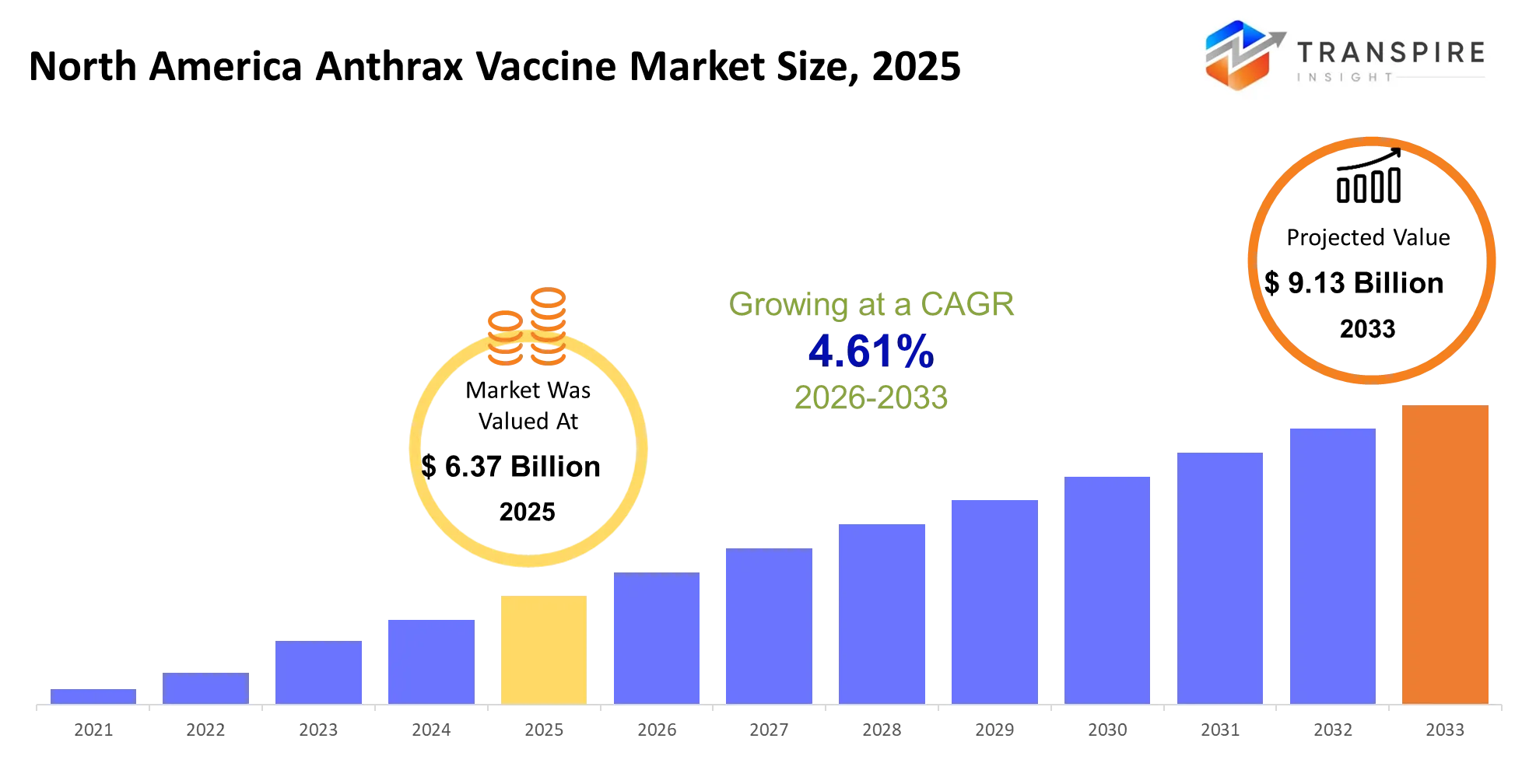
North America Anthrax Vaccine Market Size & Forecast:
- North America Anthrax Vaccine Market Size 2025: USD 6.37 Billion
- North America Anthrax Vaccine Market Size 2033: USD 9.13 Billion
- North America Anthrax Vaccine Market CAGR: 4.61%
- North America Anthrax Vaccine Market Segments: By Type (Cell-free Vaccines, Live Attenuated, Recombinant Vaccines, Others), By Application (Prevention, Post-exposure, Military Use, Research, Others), By End-User (Government, Military, Hospitals, Others), By Distribution (Government Supply, Hospitals, Clinics, Others).
To learn more about this report,  Download Free Sample Report
North America Anthrax Vaccine Market Summary:
The North America Anthrax Vaccine Market size is estimated at USD 6.37 Billion in 2025 and is anticipated to reach USD 9.13 Billion by 2033, growing at a CAGR of 4.61% from 2026 to 2033.The North America Anthrax Vaccine Market plays a real role in national biodefense, emergency preparedness and all that, even though it can look kind of abstract at first. In practice, these vaccines are used to help protect military personnel, lab workers, first responders and also certain strategic civilian groups from anthrax spores, the kind that could be released during biological attacks or messy high-risk industrial incidents. Because of that, the whole market works more like a security backbone than a standard immunization lane , its basically tied to government stockpiles and fast-response readiness, not just routine patient schedules.
Over the last five years, the market has been moving away from only legacy stockpile buying toward next-generation vaccine development. The newer efforts come with improved dosing schedules, better shelf life, and more scalable manufacturing. This change gathered momentum after renewed geopolitical tensions and biodefense reviews, especially during the COVID-19 pandemic , which made some public health readiness weak points feel more obvious. After that, governments expanded budgets for domestic vaccine production and signed longer procurement commitments. As a result, manufacturers are getting more stable revenue visibility while also pushing wider use of advanced recombinant platforms, plus adjuvant-based approaches across defense programs and public health agencies.
Key Market Insights
- In 2025, the United States held a bit over 85% market share, kind of backed by broad military immunization efforts, plus national biodefense funding, that kind of thing.
- Canada, meanwhile , shows up as the fastest-growing regional market through 2032 since emergency preparedness budgets keep getting bigger, along with tighter public health security programs.
- North America also keeps a strong grip on the global anthrax vaccine market size, mainly because its biotechnology infrastructure is more advanced and there’s solid regulatory support in place.
- In terms of product, cell-free protective antigen vaccines were the big leader across North America, with roughly 60% of the share in 2025, largely tied to government authorizations that are already in motion and procurement history that’s well established.
- Live attenuated anthrax vaccines landed in the second-largest position, mostly due to ongoing research uses and military readiness programs.
- Looking ahead , recombinant anthrax vaccines are expected to post the quickest growth between 2026 and 2032, driven by next generation biologics innovation.
- When it comes to applications, military biodefense use is basically dominated , taking around 70% revenue share in 2025, and that’s because vaccination is mandatory for personnel considered high risk.
- Civilian emergency preparedness programs are projected to grow the fastest too, as governments roll out wider national response frameworks against biological threats.
- For adoption patterns, laboratory and occupational exposure protection keeps bringing steady demand across pharmaceutical research, and also high-containment testing facilities.
- Finally , government defense agencies were the top end user segment, claiming more than 65% market share in 2025 thanks to large scale procurement agreements.
What are the Key Drivers, Restraints, and Opportunities in the North America Anthrax Vaccine Market?
The most powerful driver behind the North America Anthrax Vaccine Market, is kind of the expansion of federal biodefense funding after COVID-19 kinda revealed some cracks in emergency medical preparedness. In other words, governments moved away from just holding a few limited reserve inventories, and they leaned into longer-run domestic vaccine manufacturing capacity plus strategic stockpiles. That shift in approach, then basically set off bigger, multi-year purchasing agreements from defense and public health agencies especially across the United States. So the companies involved got steadier revenue visibility, and that made it easier to justify investment in recombinant vaccine platforms, ramping production scalability, and pushing clinical development programs forward. The direct result , is quicker commercialization timelines and wider uptake across military plus emergency preparedness systems.
Still, the market’s biggest structural obstacle stays tied to government procurement cycles and specialized regulatory routes. Anthrax vaccines aren’t really mass-market commercial products with consistent civilian pull, so private-sector purchasing is less flexible. Manufacturers have to keep funding expensive high-biosafety production facilities, while also dealing with long clinical validation periods and strict biodefense compliance duties. These limitations make it harder for smaller biotechnology firms to enter, and they also slow down competitive diversification, which in turn delays innovation-based pricing efficiency and caps near-term revenue growth.
A big future opportunity is sitting in next generation recombinant and heat- durable anthrax vaccines, built so they can be rolled out fast during biological emergencies, more or less. There’s also investment in advanced biologics manufacturing and mRNA related delivery approaches that seems to be pushing things toward shorter dosing cycles and less complicated storage logistics. Meanwhile, Canada’s growing biodefense preparedness programs, plus the public health collaborations across borders, really helps set up a good climate for scaling regional production. It also supports longer term buying arrangements, which is kind of the quiet part people don’t mention as much, but it matters.
What Has the Impact of Artificial Intelligence Been on the North America Anthrax Vaccine Market?
Artificial intelligence and advanced digital technologies are kind of re-shaping the North America Anthrax Vaccine Market, mainly because they make vaccine development more quick, manufacturing feels more dependable, and biodefense response coordination becomes smoother overall. A lot of pharmaceutical companies plus defense contractors are now leaning on AI driven bioinformatics platforms, to study antigen behavior, tune recombinant vaccine design, and in some cases shorten those preclinical screening timelines that used to drag on. Machine learning models also help with predictive quality control in biologics manufacturing, by flagging contamination risks, equipment deviations and production inconsistencies before a batch failure even shows up. Honestly this helps manufacturers cut production downtime and keep yield consistency steadier especially in high-containment vaccine facilities.
On the government side, advanced analytics platforms are making stockpile management and distribution planning feel more intentional. AI enabled forecasting systems can look at epidemiological risk scenarios, track inventory expiration timelines, and spot regional emergency preparedness gaps, so vaccine allocation decisions are more optimized. Some manufacturers have rolled in digital twin technologies into bioprocessing operations too, they basically simulate production performance and help with scale up efficiency. That reduces manufacturing variability, and over time it also lowers operational costs, though it’s not like it happens overnight.
Still, AI adoption has structural limitations across the anthrax vaccine ecosystem. The integration costs can be high , there are limited biodefense specific datasets, and regulatory validation requirements are strict enough that they slow down real-world deployment of machine learning systems in actual vaccine production. Also, many biodefense programs run inside classified or siloed data infrastructures, so it becomes difficult to train large scale AI models and share them across agencies. The cross agency interoperability part ends up being a real constraint, even when the tools themselves look promising.
Key Market Trends
- Since 2021, U.S. federal biodefense contracts have increasingly leaned toward multi-year procurement deals, rather than the usual quick-cycle emergency vaccine buying.
- Manufacturers started putting more resources into recombinant anthrax vaccines, after the clinical studies showed better storage stability, and also fewer booster requirements.
- Between 2020 and 2025 domestic vaccine manufacturing capacity has grown too, largely because governments loosened their dependence on foreign biologics supply chains.
- Emergent BioSolutions rolled out more automation across its biodefense production sites, aiming for steadier batches and less contamination- related manufacturing trouble.
- Public health agencies, then sort of expanded civilian preparedness stockpiles, after COVID-19 showed clear gaps in how emergency medical countermeasures get distributed and handled.
- Regulatory agencies also kind of pushed for quicker more collaborative review routes for biodefense vaccines, cutting down the development timelines for key national security programs from 2022.
- Meanwhile AI based quality monitoring tools started spreading across vaccine manufacturing lines, so firms can catch production deviations early before they become big batch failures, instead of letting it slide into late stage problems.
- Canada meanwhile increased cross border biodefense coordination efforts after 2023, which helped support regional procurement alignment and more coordinated emergency vaccine deployment planning.
- Finally manufacturers have been moving toward thermostable biologic formulations, kind of to make long-term storage logistics simpler and reduce how often strategic stockpiles have to be replaced.
North America Anthrax Vaccine Market Segmentation
By Type
Cell-free vaccines kinda hang near the front of the pack, mostly because federal agencies and military procurement teams bank on the well known efficacy history and the already approved stockpile blueprints. Live attenuated vaccines still sit a little lower, but they’re pretty consistent, largely due to ongoing use in carefully controlled research contexts and a few niche biodefense use cases.Recombinant vaccines though, seem to be moving the quickest, like the fastest growing segment you could say, because biotech firms are leaning into more potent immunogenicity profiles, less dosing routines, and improved storage robustness.
Demand for recombinant platforms really started picking up once public health authorities began pushing scalable production, especially after pandemic-era supply bottlenecks popped up again and again. The investment energy is increasingly leaning toward advanced biologics and adjuvant technologies that can help with rapid emergency rollout. Across manufacturers, production scalability and regulatory flexibility remain huge deal differentiators , and without that it’s hard to compete. Where things feel headed next is toward next-generation formulations, with thermostable characteristics and more straightforward administration routines. These shifts are expected to cut long-term storage expenses, while also strengthening preparedness planning for defense agencies and emergency response groups.
By Application
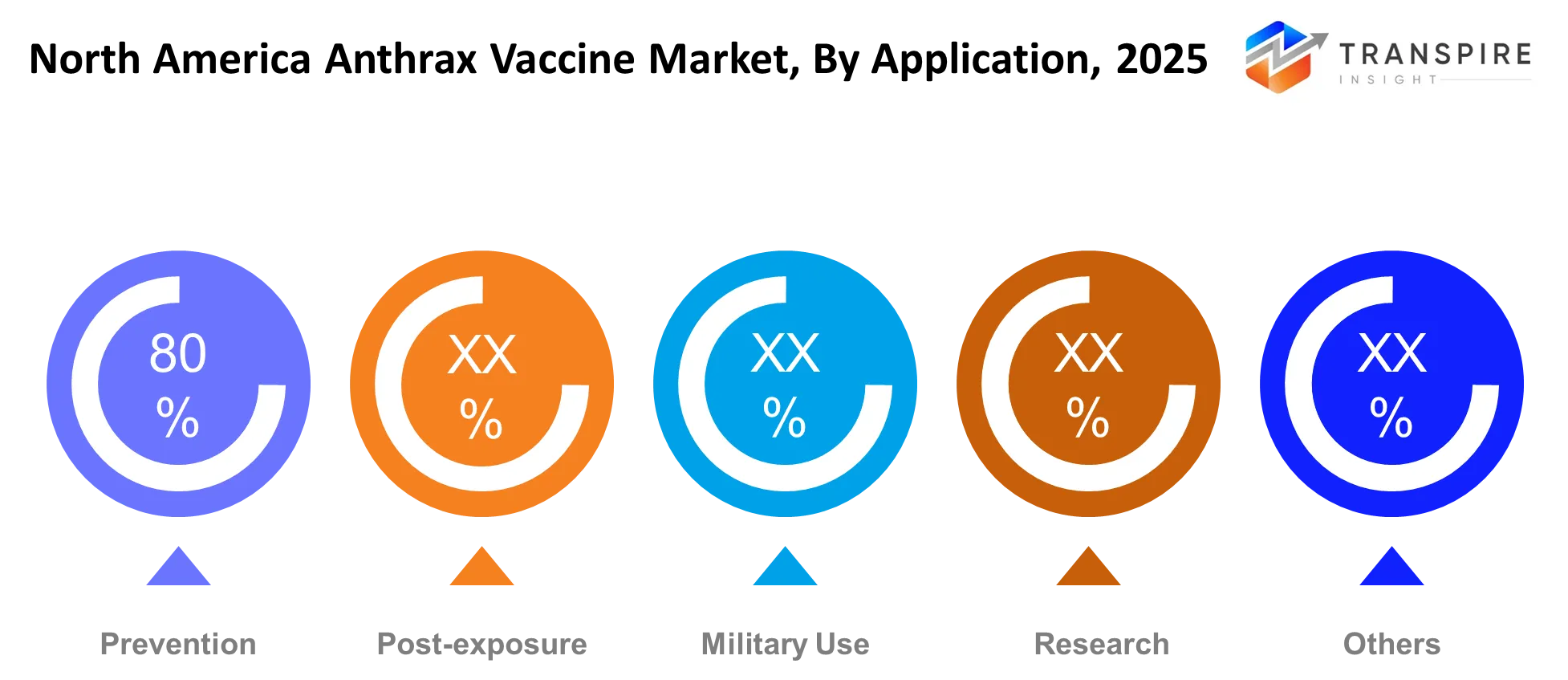
Military use is still the main application segment, kinda because anthrax vaccination programs are tied in with national biodefense preparedness and general force protection strategies, you know. Prevention use also stays pretty high , since governments keep stacking strategic vaccine reserves for emergency response moments. The post exposure treatment side got extra attention after public health agencies broadened their response frameworks for biological threat events and also occupational exposure management.
Research keeps running steady as well, especially inside pharmaceutical labs and biodefense institutions, more specifically around recombinant vaccine development and faster response technologies. When you look at purchasing behavior across these categories, it seems to lean more on long term contract clarity and “be ready for emergencies” requirements, rather than normal commercial healthcare demand. And funding availability from defense and homeland security agencies strongly steers adoption timing and what clinical development priorities rise first. Going forward, growth should focus on rapid deployment systems and combination countermeasure approaches, meant to strengthen emergency preparedness while also cutting down logistical headaches during large scale response operations.
To learn more about this report, Download Free Sample Report
By End-User
Governmental organizations make up the biggest chunk of the end-user segment, mainly because national stockpile plans and biodefense procurement frameworks keep pulling most of the buying. Then military institutions sit right behind them, partly due to compulsory immunization programs for high-risk staff , plus the usual operational readiness demands. Hospitals end up smaller, but it still feels strategically key, especially when it comes to post exposure treatment readiness and infectious disease response planning. Research organizations, along with biotechnology firms, add to the demand too , through clinical trials, vaccine testing, and biologics innovation initiatives. End user buying trends are also starting to mirror wider public health security priorities that were set after the COVID-19 pandemic.
More and more, budgets are tilting toward domestic manufacturing partnerships, supply continuity, and fast deployment muscle instead of just growing inventories for the short run. At the same time, longer approval timelines and very specific storage requirements keep most other institutions from adopting these capabilities outside government supported pathways. Looking ahead, opportunities will probably show up via connected public health preparedness networks, linking hospitals, laboratories, and defense agencies inside a coordinated emergency response approach.
By Distribution
Government supply channels dominate distribution and honestly they kind of drive the whole system, since federal agencies handle strategic vaccine stockpiles and run centralized procurement contracts that span defense and public health. Hospital distribution networks land as the second-largest slice, mainly because emergency preparedness programs are built around them, plus controlled administration rules for high-risk exposure cases, you know those scenarios that can’t really be improvised. Clinics end up with a smaller role, mostly because anthrax vaccination is still quite specialized, it stays concentrated in institutional settings rather than showing up as routine healthcare delivery.
All the while, distribution structures are kinda leaning more toward secure storage infrastructure, cold chain reliability, and rapid deployment capability when emergencies hit. Supply chain resilience became a major strategic priority after pandemic related disruptions, they made the vulnerabilities obvious in biologics transportation and inventory management systems. Manufacturers are now putting real money into domestic production facilities and regional warehousing capacity, trying to reduce dependence on international sourcing networks , even if that means rearranging operations a bit, or shifting whole routines.
Looking ahead, distribution models are expected to weave in digital inventory monitoring, predictive logistics systems, and coordinated emergency response frameworks, so vaccine accessibility improves while long term storage inefficiencies stay minimized.
What are the Key Use Cases Driving the North America Anthrax Vaccine Market?
Military biodefense programs still end up being the primary thing pushing vaccine adoption across North America, not really surprising if you think about it. Defense agencies keep mandatory immunization protocols in place for personnel sent into high-risk operational zones, and that generates pretty steady long term procurement needs. It also drives big strategic stockpile requirements, in a way that stays consistent year after year.
Secondary applications are getting broader too, especially in public health preparedness and lab safety initiatives. Government health agencies are buying vaccines for emergency response reserves more often now, and at the same time pharmaceutical research laboratories, along with biodefense testing facilities, rely on anthrax vaccines to protect staff who handle hazardous biological materials. They do this under strict containment regulations, so the whole process stays controlled and closely monitored.
On top of that, emerging use cases are starting to show up. There are rapid-response vaccination frameworks aimed at civilian critical infrastructure workers, and there are also cross-border biodefense coordination programs between the United States and Canada. Interest is rising around thermostable recombinant vaccines, too, basically to enable faster deployment during biological threat incidents and large-scale emergency preparedness operations.
|
Report Metrics |
Details |
|
Market size value in 2025 |
USD 6.37 Billion |
|
Market size value in 2026 |
USD 6.66 Billion |
|
Revenue forecast in 2033 |
USD 9.13 Billion |
|
Growth rate |
CAGR of 4.61% from 2026 to 2033 |
|
Base year |
2025 |
|
Historical data |
2021 - 2024 |
|
Forecast period |
2026 - 2033 |
|
Report coverage |
Revenue forecast, competitive landscape, growth factors, and trends |
|
Country scope |
North America (Canada, The United States, and Mexico) |
|
Key company profiled |
Emergent BioSolutions, Bavarian Nordic, Altimmune, DynPort Vaccine, Pfizer, GlaxoSmithKline, Sanofi, Merck, Johnson & Johnson, AstraZeneca, Serum Institute, CSL, Takeda, BioThrax, Panacea Biotec |
|
Customization scope |
Free report customization (country, regional & segment scope). Avail customized purchase options to meet your exact research needs. |
|
Report Segmentation |
By Type (Cell-free Vaccines, Live Attenuated, Recombinant Vaccines, Others), By Application (Prevention, Post-exposure, Military Use, Research, Others), By End-User (Government, Military, Hospitals, Others), By Distribution (Government Supply, Hospitals, Clinics, Others) |
Which Regions are Driving the North America Anthrax Vaccine Market Growth?
The United States basically leads the North America Anthrax Vaccine Market, mostly because federal biodefense policy keeps feeding large-scale buying, domestic production, and long-term vaccine stockpiling, in a kind of steady way. You’ll see agencies like the Department of Defense and the Biomedical Advanced Research and Development Authority, running pretty structured funding channels that keep purchasing moving without long pauses. On top of that, strong biotech infrastructure, advanced research institutions, and specialized biologics manufacturing facilities really help lock in that leadership position. There’s also long-running regulatory coordination between defense , public health , and the pharmaceutical industry, which makes the whole ecosystem feel pretty stable for vaccine development plus emergency readiness planning.
Canada comes in as the second-largest regional contributor, but the growth pattern doesn’t really match the U.S. , because the market leans more on synchronized public-health preparedness than on military procurement, at scale. Canadian authorities usually prioritize steady biodefense modernization, cross-border emergency response collaboration, and tougher healthcare infrastructure investments. With consistent government funding and a more measured approach to regulation, procurement cycles stay predictable instead of swinging around due to urgent, emergency-driven buying.With stable government funding and a more measured approach to regulation, procurement cycles stay predictable, instead of swinging around due to urgent, emergency-driven buying. And then you have solid academic research partnerships and biotechnology collaborations, which helps Canada stay reliable for long-term regional vaccine innovation and ongoing supply continuity.
Mexico is kind of coming up as the quickest-growing market, thanks to expanding biodefense awareness , better healthcare infrastructure upgrades , and also more involvement in regional public health security initiatives . Lately, there have been new investments aimed at infectious disease preparedness and lab modernization , these efforts have helped institutions handle vaccine storage with more confidence and coordinate emergency response in a smoother way . On top of that, government agencies are getting more serious about partnerships with North American healthcare and biotechnology organizations , so they can improve access to advanced biologics and preparedness technologies . With all this acceleration happening, there should be room for manufacturers , distributors, and investors who want early positioning, especially since the market is expected to pick up stronger procurement momentum between 2026 and 2033 .
Who are the Key Players in the North America Anthrax Vaccine Market and How Do They Compete?
The North America Anthrax Vaccine Market stays pretty consolidated , mostly because government purchasing programs lean toward companies that already show biodefense production know-how, solid regulatory compliance , and long term delivery reliability. So the real rivalry is less about cutting prices, and more about new platform progress , production scaling, and getting into contracts that actually matter. The main players keep holding ground via defense agency partnerships, plus investing in advanced biologics platforms. Meanwhile, new entrants get stuck with heavy hurdles , like pricey biosafety requirements, slow clinical proof cycles, and not much non-government demand beyond biodefense initiatives that are supported. Because of all that, where a firm lands competitively is tied to how ready their production is, how strong their research capability feels, and whether they can lock multi year procurement agreements.
Emergent BioSolutions sets itself apart through existing anthrax vaccine production facilities , plus long standing ties with U.S. biodefense agencies. The firm also pushes manufacturing scale , steady supply continuity, and stockpile delivery performance in a way that smaller biotech groups generally struggle to mirror. Altimmune, on the other hand, competes by leaning into technology specialization, working on next generation intranasal and recombinant vaccine approaches meant to boost immune response effectiveness and make administration logistics easier to run. This emphasis on alternative delivery pathways could help it fit into future rapid deployment preparedness programs.
Bavarian Nordic is extending its competitive reach via biodefense partnerships, plus all that infectious disease vaccine know-how, kind of across government-backed public health programs too. You can see the benefit of diversified biologics capabilities, they kinda help with wider emergency preparedness integration that goes beyond anthrax-only uses. Then Pfizer comes in, it leans hard on advanced biologics manufacturing capacity, a big batch of research resources, and that mRNA-related development familiarity, so it can stay involved in those strategic vaccine efforts. Meanwhile, Panacea Biotec emphasizes cost-efficient biologics production and works on international manufacturing collaboration, which opens doors for regional supply alliances, and maybe even future North American procurement expansion.
Company List
- Emergent BioSolutions
- Bavarian Nordic
- Altimmune
- DynPort Vaccine
- Pfizer
- GlaxoSmithKline
- Sanofi
- Merck
- Johnson & Johnson
- AstraZeneca
- Serum Institute
- CSL
- Takeda
- BioThrax
- Panacea Biotec
Recent Development News
In January 2026, Emergent BioSolutions Receives $21.5 Million U.S. Defense Order for BioThrax Vaccine: Emergent BioSolutions announced a delivery order worth up to $21.5 million from the U.S. Department of Defense to supply its BioThrax anthrax vaccine. The agreement strengthens U.S. biodefense preparedness and supports continued procurement of anthrax countermeasures for military stockpiles in North America.
Source: https://investors.emergentbiosolutions.com
In May 2026, Emergent Reports Decline in Anthrax Countermeasure Revenue in Q1 2026 Financial Results: Emergent BioSolutions disclosed that Q1 2026 anthrax medical countermeasure revenues declined due to lower CYFENDUS and ANTHRASIL sales volumes. The earnings update highlighted changing procurement timing from U.S. and Canadian government contracts, making it a significant financial development within the North American anthrax vaccine market.
Source: https://www.sec.gov
What Strategic Insights Define the Future of the North America Anthrax Vaccine Market?
The North America Anthrax Vaccine Market is sort of moving toward a smaller but more technologically advanced supplier network , kind of centered on recombinant biologics, fast-response manufacturing, and connected biodefense preparedness networks. Over the next five to seven years, procurement strategies are most likely going to favor platform flexibility and domestic production toughness, not just more stockpile volume for the sake of it . This change is being pushed by wider national security anxieties and the lessons that came out of pandemic-era supply chain disruptions, which basically revealed weak spots in emergency medical countermeasure readiness.
One less obvious risk is market concentration, meaning a limited set of federally approved manufacturers. If buyers lean heavily on a small supplier group, they end up with higher exposure to production stoppages, regulatory slowdowns, or biologics raw material constraints, and those can knock on national preparedness efforts. At the same time, an interesting opening is also forming around thermostable vaccine approaches and needle-free delivery formats, which can make deployment much easier during huge scale emergency response scenarios.
Market players should start investing early in expandable advanced manufacturing collaborations and AI-enabled quality systems, so they can improve procurement competitiveness and lock in longer-term government contracts , without getting stuck later on.
North America Anthrax Vaccine Market Report Segmentation
By Type
- Cell-free Vaccines
- Live Attenuated
- Recombinant Vaccines
- Others
By Application
- Prevention
- Post-exposure
- Military Use
- Research
- Others
By End-User
- Government
- Military
- Hospitals
- Others
By Distribution
- Government Supply
- Hospitals
- Clinics
- Others
Frequently Asked Questions
Find quick answers to common questions.
The approximate North America Anthrax Vaccine Market size for the market will be USD 9.13 Billion in 2033.
The key segments of the North America Anthrax Vaccine Market are By Type (Cell-free Vaccines, Live Attenuated, Recombinant Vaccines, Others), By Application (Prevention, Post-exposure, Military Use, Research, Others), By End-User (Government, Military, Hospitals, Others), By Distribution (Government Supply, Hospitals, Clinics, Others).
Major players in the North America Anthrax Vaccine Market are Emergent BioSolutions, Bavarian Nordic, Altimmune, DynPort Vaccine, Pfizer, GlaxoSmithKline, Sanofi, Merck, Johnson & Johnson, AstraZeneca, Serum Institute, CSL, Takeda, BioThrax, Panacea Biotec.
The current market size of the North America Anthrax Vaccine Market is USD 6.37 Billion in 2025.
The North America Anthrax Vaccine Market CAGR is 4.61%.
- Emergent BioSolutions
- Bavarian Nordic
- Altimmune
- DynPort Vaccine
- Pfizer
- GlaxoSmithKline
- Sanofi
- Merck
- Johnson & Johnson
- AstraZeneca
- Serum Institute
- CSL
- Takeda
- BioThrax
- Panacea Biotec
Recently Published Reports
-
May 2026
Biosimilars Market
Biosimilars Market By Product Type (Monoclonal Antibodies, Recombinant Hormones, Erythropoietin, G-CSF, Others), By Indication (Oncology, Autoimmune Diseases, Blood Disorders, Diabetes, Others), By Manufacturing Type (In-House Manufacturing, Contract Manufacturing), By Distribution Channel (Hospital Pharmacies, Retail Pharmacies, Online Pharmacies), By Industry Analysis, Size, Share, Growth, Trends, and Forecasts 2021-2033
-
Apr 2026
Gastrointestinal Endoscopy Market
Gastrointestinal Endoscopy Market By Type (Rigid Gastrointestinal Endoscope, Flexible Gastrointestinal Endoscopes, Disposable Gastrointestinal Endoscope), By Procedure Type (Colonoscopy, Gastroscopy, Duodenoscopy, Enteroscopy, Flexible Sigmoidoscopy, Others), By Application (Diagnosis, Treatment), By End-Users (Hospitals, Ambulatory Surgical Centers, Specialty Clinics, Laboratories, Others), By Industry Analysis, Size, Share, Growth, Trends, and Forecasts 2021-2033
-
Apr 2026
Rare Inherited Metabolic Disorder Drug Market
Rare Inherited Metabolic Disorder Drug Market By Drug Class (Enzyme Replacement Drugs, Gene Therapy Drugs, Substrate Reduction Drugs, Small Module Drugs, Protein Drugs), By Route of Administration(Parenteral, Oral, Intrathecal), By Clinical Development (Marketed Drugs, Late Stage Clinical Phase III, Early Stage Clinical Phase I-II, Preclinical Candidates), By Indication (Lysosomal Storage Disorders, Urea Cycle Disorders, Amino Acid Metabolic Disorders, organic Acidemias, Peroximal Disorders), By Industry Analysis, Size, Share, Growth, Trends, and Forecasts 2021-2033
-
Jan 2026
Pharmaceutical Cleanroom Technology Market
Pharmaceutical Cleanroom Technology Market By Product (Equipment, Consumables, Services); By Cleanroom Type (Standard Cleanrooms, Modular Cleanrooms); By End Use (Pharmaceutical Companies, Biotechnology Companies), By Industry Analysis, Size, Share, Growth, Trends, and Forecasts 2021-2033