
Middle East and Africa Meningococcal Vaccines Market Size & Forecast:
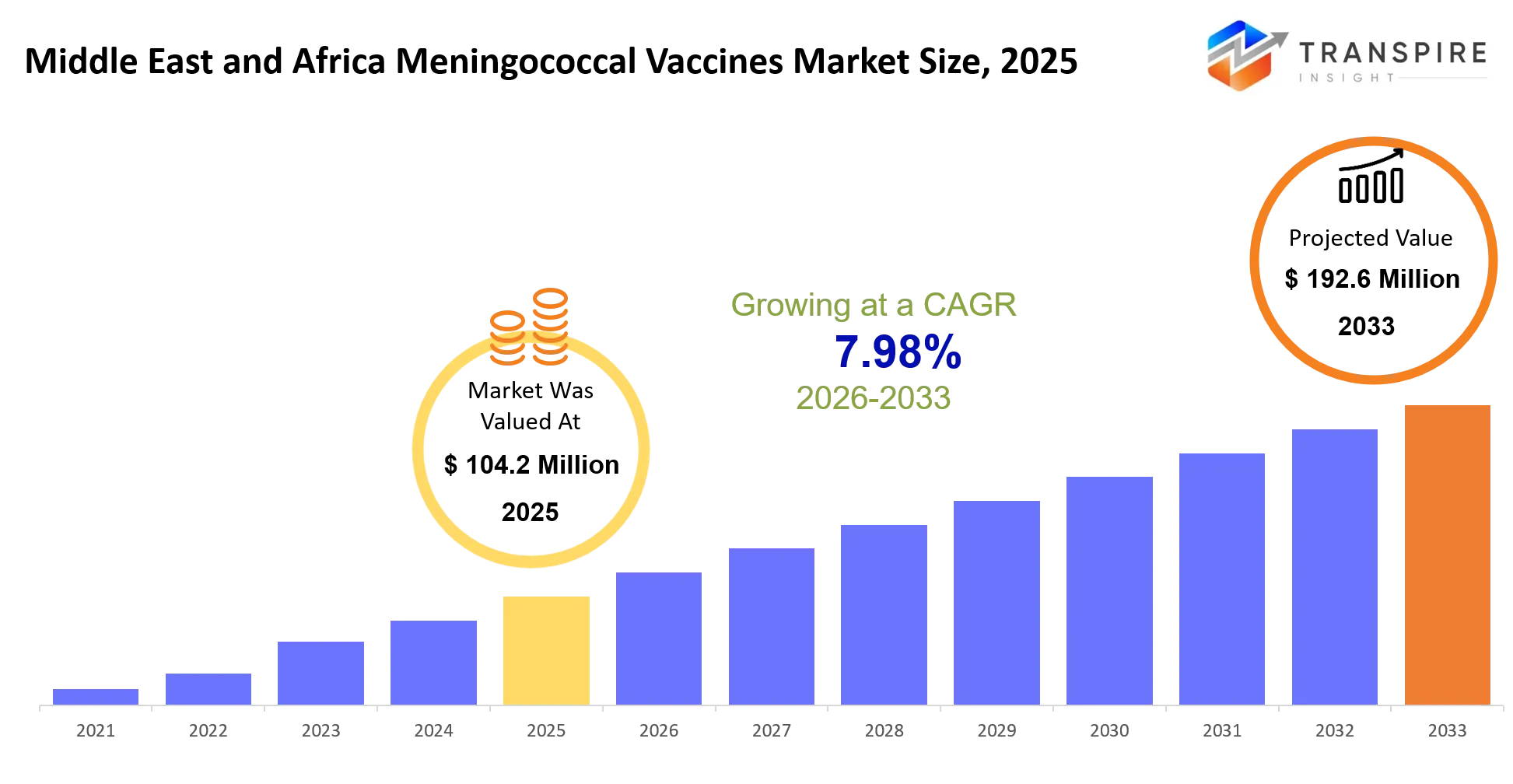
- Middle East and Africa Meningococcal Vaccines Market Size 2025: USD 104.2 Million
- Middle East and Africa Meningococcal Vaccines Market Size 2033: USD 192.6 Million
- Middle East and Africa Meningococcal Vaccines Market CAGR: 7.98%
- Middle East and Africa Meningococcal Vaccines Market Segments: By Vaccine Type (Conjugate Vaccines, Polysaccharide Vaccines, Combination Vaccines, Others); By Serogroup (A, B, C, W, Y, Others); By Distribution Channel (Government Programs, Hospitals, Clinics, Others); By End User (Children, Adolescents, Adults, Travelers, Others)
To learn more about this report,  Download Free Sample Report
Middle East and Africa Meningococcal Vaccines Market Summary
The Middle East and Africa Meningococcal Vaccines Market was valued at USD 104.2 Million in 2025. It is forecast to reach USD 192.6 Million by 2033. That is a CAGR of 7.98% over the period.
In the Middle East and Africa meningococcal vaccines market, it kind of plays this crucial part in stopping outbreaks of meningitis and bloodstream infections, which can move fast through densely populated communities, schools, military settings , and even pilgrimage related travel routes. When vaccination programs get traction , governments can lower the overall disease burden, dodge expensive emergency response efforts , and build stronger public health resilience in regions that are consistently high risk.
Over the last five years, the whole market vibe shifted away from reactive outbreak campaigns, toward more routine immunization approaches backed by multivalent conjugate vaccines. One big driver here has been the introduction and roll out of pentavalent meningococcal vaccines. These target multiple serogroups that show up commonly across Africa’s meningitis belt. At the same time, immunization recovery efforts after the pandemic pushed faster vaccine procurement and helped widen coverage in communities that were previously underserved. With surveillance getting better, and with governments increasingly preferring epidemic prevention rather than only emergency response , vaccine adoption is starting to look more steady and predictable. That steadiness helps support longer term procurement agreements, improves manufacturer revenue clarity, and also nudges investment toward next generation meningococcal vaccine technologies.
Key Market Insights
- The Middle East and Africa Meningococcal Vaccines Market is forecast to hit USD 192.6 million by 2033, from USD 104.2 million in 2025. Kinda steady growth, but still, the numbers matter.
- Africa takes the lead on regional revenue with an estimated 70%+ market share, backed by large-scale immunization efforts across the meningitis belt countries.
- The Gulf Cooperation Council area is showing the fastest growth through 2033 because travel vaccination requirements keep rising, along with more healthcare investment.
- Quadrivalent conjugate vaccines make up around 45% of market revenue, they do well due to wide serogroup coverage and practical protection.
- Pentavalent conjugate vaccines are the fastest growing product type, mostly after expanded deployment across African immunization programs.
- Public immunization programs contribute over 60% of vaccine procurement volumes in the region.
- Routine immunization uses still hold the biggest share, while preventive vaccination campaigns are expanding really quickly, almost everywhere.
- Government healthcare agencies are the leading end user segment, responsible for more than half of regional vaccine purchases.
- Right now, the Middle East and Africa Meningococcal Vaccines Market is seeing strategic expansion by GSK, Pfizer, Sanofi, Merck & Co., and Serum Institute of India.
- Meanwhile, manufacturers are pushing multivalent vaccine development, regional partnerships, and supply chain localization, to solidify their foothold and stay ahead.
What are the Key Drivers, Restraints, and Opportunities in the Middle East and Africa Meningococcal Vaccines Market?
The main reason for market growth is mostly because people are shifting towards more preventive immunization plans in several high risk African countries, like there is more emphasis now, and it kind of keeps going from there.Previously, governments usually leaned on emergency vaccination drives once outbreaks appeared, and it was kind of reactive in general. But repeated meningitis epidemics, together with the reality that broader spectrum conjugate vaccines are now available, has pushed health authorities to slot meningococcal vaccination into routine immunization schedules, more like a proactive move than before.With that change happening, procurement volumes tend to rise, vaccination coverage gets better and, for suppliers, it also helps form steadier revenue streams, not just short-term wins.
That said, the biggest pushback still comes from structural weak spots in healthcare
infrastructure across multiple low-income countries. A lot of areas still struggle with cold-chain management, uneven access to healthcare services, budget limitations, and even shortages of trained immunization personnel. These issues cannot be fixed quickly because they rely on long-term investments, especially for logistics networks and overall healthcare system upgrades. Because of this, many vaccination campaigns end up with delays , and that means vulnerable groups may stay unprotected longer, which in turn can lower the market revenue potential.
There is also a clear opportunity in wider uptake of pentavalent meningococcal conjugate vaccines.These cover serogroups A C W Y and X, so countries get a bit of a wider shield without needing separate strategies. Across the African meningitis belt, more nations are looking at these vaccines for routine immunization too, plus preventive outreach. And as international funding support starts to line up with national immunization targets, the manufacturers that can deliver cost-effective multivalent options they are in a strong place to benefit from the coming growth.
What Has the Impact of Artificial Intelligence Been on the Middle East and Africa Meningococcal Vaccines Market?
Artificial intelligence is steadily, kinda, changing vaccine development and how vaccine factories run, plus immunization planning, across the whole meningococcal vaccine ecosystem.Vaccine manufacturers are getting more and more into AI powered analytics to kind of judge antigen performance, tune clinical trial setups, and point at population groups with a better chance of an outbreak happening pretty soon. On top of that, advanced algorithms can also help public health agencies sift through surveillance information , predict how disease spread tendencies might go, and sharpen vaccine allocation choices.
Machine learning models can back demand forecasting by bringing together epidemiological movements, demographic details, vaccination coverage levels, and old outbreak notes. With these predictive abilities, manufacturers can help dodge odd inventory distortions, and also boost supply chain efficiency a bit more. There are also digital monitoring platforms that strengthen vaccine distribution by keeping tabs on cold chain performance, shipment conditions and inventory status in real time, so there is less wastage and better availability even in far away or remote regions .
From an operations angle, these tools end up supporting improved forecasting precision, faster reaction times during outbreaks, and more fluid procurement planning . Some organizations have said they saw measurable drops in stock shortages and wider campaign reach, when vaccination planning is steered by data rather than simple guesswork.
Still, uptake is not fully smooth, because health information systems are fragmented, and in several African countries the digital infrastructure is limited. Disease surveillance datasets also tend to be inconsistent, so the models lose accuracy and integration becomes more expensive, which then slows down broad deployment of advanced AI solutions across the regional meningococcal vaccine area .
Key Market Trends
- Since 2021, multiple African nations have been moving funds toward routine meningococcal immunization, not just “emergency, outbreak only” campaigns. In other words it’s a bit more day to day now, rather than only reacting when cases spike.
- Adoption of the pentavalent vaccine picked up speed after WHO backed deployment initiatives broadened protection against five major disease causing serogroups. It’s like, the coverage map got wider fairly fast.
- More than 4.8 million people received Men5CV during campaign work in Nigeria and Niger, which supports that big scale rollout can actually be done and managed. The logistics matter here and it shows.
- Governments are using surveillance driven procurement models more often too. This helps with vaccine stock planning , and also keeps outbreak readiness in better shape, before things get messy.
- International organizations have also expanded support for catch up vaccination efforts, so immunization coverage can recover from the disruptions that the pandemic caused. It’s an attempt to “repair the gap” so to speak.
- Manufacturers are investing in broader spectrum conjugate vaccines rather than sticking to single serogroup solutions. There’s more emphasis on wider coverage now, not just one target.
- Regional health authorities are increasingly putting weight on epidemic prevention, because treatment and outbreak control expenses stay notably higher. Preventing still costs less than responding , even if it takes planning.
- Strategic collaborations between global manufacturers and public health organizations have strengthened vaccine availability across underserved markets. So access becomes less hit and miss.
- Since 2022, digital immunization registries and electronic disease surveillance systems have become more common. People are tracking cases and doses in a more connected way.
- Finally, buyers are increasingly assessing suppliers based on long term supply reliability, affordability , and multivalent vaccine portfolios. The purchase decision is about durability, not only unit price.
Middle East and Africa Meningococcal Vaccines Market Segmentation
By Vaccine Type
The vaccine type segment shows the different technologies that are used to prevent meningococcal disease in diverse population groups. Conjugate Vaccines take up a big part because strong, and long lasting immune responses help routine immunization programs plus major public health campaigns. When these are broadly adopted across national vaccination schedules it keeps on boosting the need for this category.
Polysaccharide Vaccines still matter in certain immunization programs , especially where budget pressure and targeted protection are the key points. Combination Vaccines also keep getting attention as healthcare systems try to cover more disease prevention with fewer vaccination visits. There are others too, like specialized and emerging vaccine formulations made for specific public health needs, and shifts in disease patterns.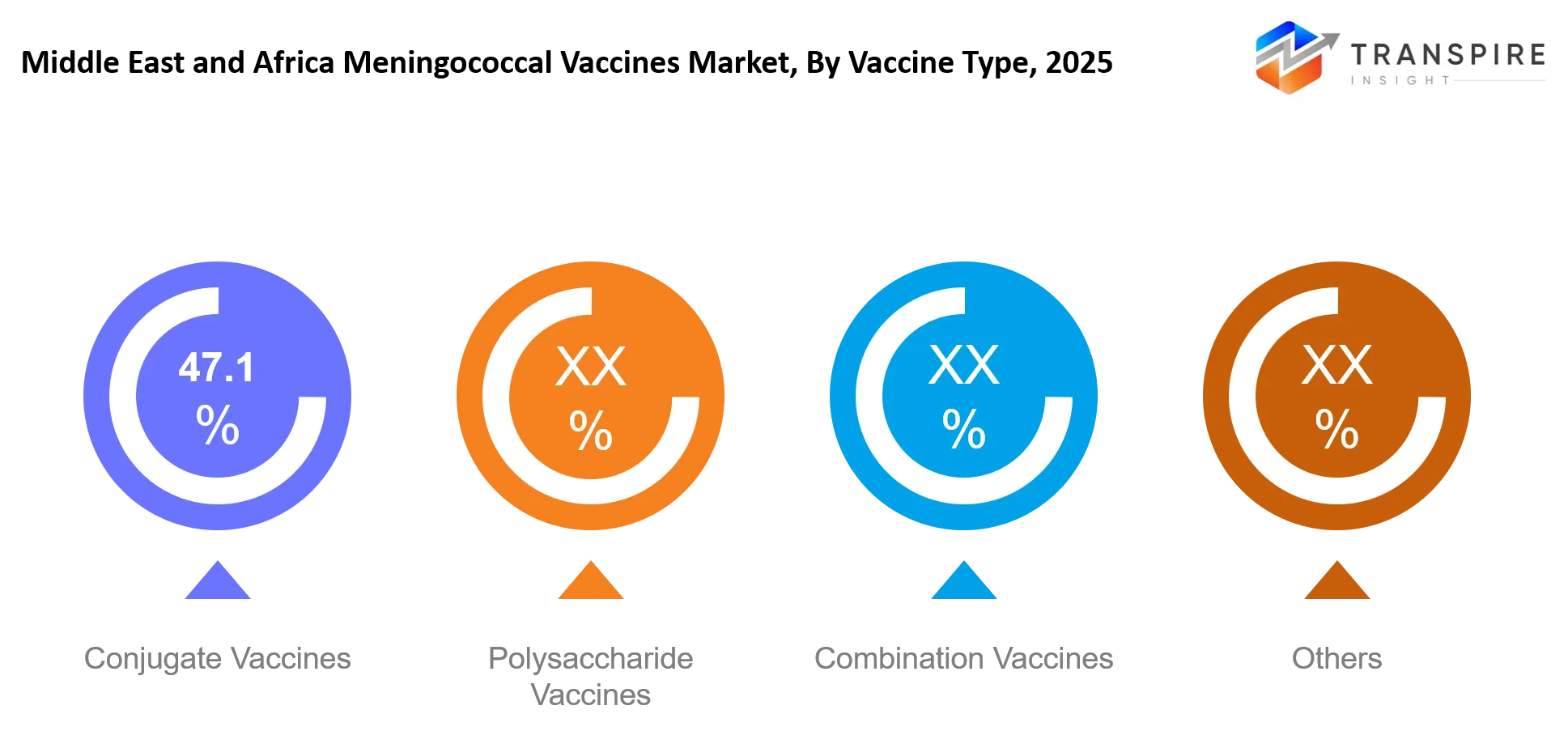
To learn more about this report, Download Free Sample Report
By Serogroup
The serogroup segment kinda underlines the various meningococcal strains that are being targeted by vaccination strategies, across the whole region. A feels like a big category because of the historical disease burden in several African countries, plus there have been extensive immunization efforts, meant for outbreak prevention. Ongoing surveillance activities then help keep that attention on defense against this particular strain.
B still matters a lot in some healthcare programs, where the occurrence of disease basically pushes a targeted vaccination approach. C and W also draw notable demand, because public health authorities keep dealing with risks linked to periodic outbreaks and local transmission patterns. Y, meanwhile, feeds into preventive vaccination efforts, while Others covers the less common serogroups that get tracked via disease surveillance and used for immunization planning.
By Distribution Channel
The distribution channel segment is basically about how vaccines move through those pathways that actually get them to target populations. Government Programs take up a pretty big chunk because national immunization initiatives, and public health campaigns buy large volumes of vaccines and back wide, population level coverage. Over time long term procurement strategies keep reinforcing how strong this channel is.
Hospitals also matter a lot because they provide the vaccination services inside organized healthcare environments, and they help with broader disease prevention efforts. Clinics add a significant contribution via community based immunization services, which makes access much easier across both urban and rural areas. Then there are others like private healthcare providers, vaccination centers, and specialized distribution networks that are meant for certain population groups or particular healthcare needs.
By End User
The end user segment shows the population groups getting meningococcal vaccination for disease prevention and public health protection. Children make up a leading share , mainly because early immunization helps lower the disease risk during more vulnerable developmental phases and it also backs long term community protection. Most national immunization schedules keep putting this group first, across many countries.
Adolescents drive a fair amount of vaccine utilization too, in part thanks to school based vaccination initiatives and age related prevention plans. Adults add to market demand through workplace health requirements , preventive healthcare steps and also more targeted immunization programs. Travelers are another key category because cross border movement, plus destination specific vaccination requirements, tends to increase uptake. Others includes people at higher risk and more specialized groups flagged through public health guidance and disease surveillance efforts.
What are the Key Use Cases Driving the Middle East and Africa Meningococcal Vaccines Market?
The largest use case still kind of sits in routine immunization programs in nations that keep dealing with a persistent meningitis risk. Governments tend to roll out meningococcal vaccines through national vaccination schedules, to safeguard infants, kids, and adolescents, before exposure really kicks in. This preventive angle seems to drive the highest demand since it reaches huge population groups, and also helps with long term disease control.
A second use case, which is just as important, is outbreak response campaigns in high risk districts across the African meningitis belt. Public health authorities quickly deploy vaccine stockpiles when surveillance systems notice elevated disease activity. And yes, travel related vaccination programs for pilgrims , students, and military personnel also add real demand in several Middle Eastern countries.
More emerging uses are showing up, like targeted immunization approaches based on predictive disease surveillance and the broader adoption of multivalent vaccines in routine prevention programs. The overall point here is to smooth down those epidemic cycles a bit, while also boosting protection across multiple meningococcal serogroups at the same time, you know.
|
Report Metrics |
Details |
|
Market size value in 2025 |
USD 104.2 Million |
|
Market size value in 2026 |
USD 112.5 Million |
|
Revenue forecast in 2033 |
USD 192.6 Million |
|
Growth rate |
CAGR of 7.98% from 2026 to 2033 |
|
Base year |
2025 |
|
Historical data |
2021 - 2024 |
|
Forecast period |
2026 - 2033 |
|
Report coverage |
Revenue forecast, competitive landscape, growth factors, and trends |
|
Regional scope |
Middle East and Africa (Saudi Arabia, United Arab Emirates, South Africa, Rest of Middle East and Africa) |
|
Key company profiled |
GSK, Pfizer, Sanofi, Merck & Co., CSL Seqirus, Serum Institute of India, Walvax, Hualan Biological, AstraZeneca, Bio-Manguinhos, Bharat Biotech, Emergent BioSolutions, Sinovac, Bio Farma, SK Bioscience |
|
Customization scope |
Free report customization (country, regional & segment scope). Avail customized purchase options to meet your exact research needs. |
|
Report Segmentation |
By Vaccine Type (Conjugate Vaccines, Polysaccharide Vaccines, Combination Vaccines, Others); By Serogroup (A, B, C, W, Y, Others); By Distribution Channel (Government Programs, Hospitals, Clinics, Others); By End User (Children, Adolescents, Adults, Travelers, Others) |
Which Regions are Driving the Middle East and Africa Meningococcal Vaccines Market Growth?
Africa still looks like the main regional market, mainly because the meningococcal disease situation keeps hanging around across the meningitis belt . In that context, governments, global health agencies, and vaccine suppliers have already built a pretty big vaccination setup to cope with those repeating outbreak waves. Regular immunization programs, along with prevention campaigns, also get solid backing from policy makers. Because of that whole ecosystem, vaccine purchasing stays consistent and coverage spreads across broad parts of the population.
The Middle East comes in as the second-largest contributor, but it is not quite the same story as Africa. Here, the demand feels more shaped by healthcare modernization, and by preventive healthcare policy choices, rather than just emergency epidemic control. Countries in the Gulf, broadly speaking, keep up relatively strong healthcare spending, and they show good vaccination compliance. On top of that, travel-related immunization requirements, plus dependable healthcare delivery, help keep vaccine uptake steady . Together, these drivers form a dependable revenue stream for manufacturers.
The Gulf Cooperation Council area is expected to show the quickest growth through 2033 . Lately, money has been put into healthcare infrastructure, disease surveillance platforms , and immunization initiatives, which in turn makes vaccine access easier. Governments are also increasingly treating preventive healthcare, and population health management as priorities. For investors and market entrants, this basically opens the door to introduce newer vaccine technologies and deepen regional partnerships sometime between 2026 and 2033 .
Who are the Key Players in the Middle East and Africa Meningococcal Vaccines Market and How Do They Compete?
Competition in the market is pretty much moderately concentrated , like you can see multinational vaccine manufacturers going head to head with newer suppliers from Asia and Latin America. The main things that really decide competitiveness are multivalent vaccine lineups, manufacturing scale and output, pricing flexibility too, regulatory approvals , and whether a company can win access to government procurement contracts. The well established firms keep trying to defend their share by pushing innovation forward and leaning on long-term public health agreements, kind of ongoing deals.
GSK keeps a solid place in the field thanks to its large vaccine portfolio and those older relationships with immunization programs across the world. Pfizer, on the other hand, leans into advanced vaccine technologies and it also benefits from broad global distribution capacity, which helps it get into markets faster. Sanofi strengthens its regional presence using its vaccine development know how along with international public health partnerships, so the reach feels wider.
Serum Institute of India shows up as different mainly because of high volume manufacturing and cost efficient vaccine production. Its role in developing affordable multivalent meningococcal vaccines has helped it reach more areas in lower income countries. Merck & Co. keeps putting money into vaccine innovation and global immunization initiatives. At the same time, companies are increasingly doing collaborations with governments, global health organizations and regional distributors , just to lock in longer term procurement arrangements and broaden where they operate geographically.
Company List
- GSK
- Pfizer
- Sanofi
- Merck & Co.
- CSL Seqirus
- Serum Institute of India
- Walvax
- Hualan Biological
- AstraZeneca
- Bio-Manguinhos
- Bharat Biotech
- Emergent BioSolutions
- Sinovac
- Bio Farma
- SK Bioscience
Recent Development News
In March 2026, Gavi highlighted the successful safety assessment of Men5CV vaccination campaigns in Nigeria and Niger. Analysis covering more than 4.8 million vaccinated individuals supported broader deployment of the pentavalent meningococcal vaccine across Africa's meningitis belt.https://www.gavi.org
In April 2026, WHO, UNICEF, and Gavi announced that the Big Catch-Up initiative had delivered over 100 million vaccine doses across 36 countries, strengthening immunization systems that support future meningococcal vaccine adoption and distribution.https://www.who.int
What Strategic Insights Define the Future of the Middle East and Africa Meningococcal Vaccines Market?
The market is kinda moving toward a more prevention-focused setup, sort of built around steady routine immunization , wider use of multivalent vaccine options, and tighter disease surveillance networks. There is this main driver behind the whole transition, which is basically the understanding that preventive vaccination tends to mean lower long-term healthcare costs and better control of epidemics, compared with waiting for outbreaks and then reacting. And once governments put these vaccination schemes into the system, procurement patterns are likely to look steadier and more biddable, more predictable than before
One risk that doesn’t get much attention is funding concentration. Quite a lot of vaccination initiatives still depend on international donors and public health organizations. If external financing gets smaller, even a bit, program growth can slow down and that can also cause procurement volatility especially in lower-income countries
There is also a real emerging opening, in the expansion of pentavalent meningococcal conjugate vaccines across the African meningitis belt. If countries slot these into routine schedules, they can cut outbreak risk quite a lot, while also building long-term demand for manufacturers. So, companies should really push local partnerships, use affordable pricing approaches, and develop regional manufacturing capabilities, to lock in more sustainable competitive advantages over the next ten years
Middle East and Africa Meningococcal Vaccines Market Report Segmentation
By Vaccine Type
- Conjugate Vaccines
- Polysaccharide Vaccines
- Combination Vaccines
- Others
By Serogroup
- A
- B
- C
- W
- Y
- Others
By Distribution Channel
- Government Programs
- Hospitals
- Clinics
- Others
By End User
- Children
- Adolescents
- Adults
- Travelers
- Others
Frequently Asked Questions
Find quick answers to common questions.
The Expected Middle East and Africa Meningococcal Vaccines Market size for the Market will be USD 192.6 Million in 2033.
Key Segments for the Middle East and Africa Meningococcal Vaccines Market are By Vaccine Type (Conjugate Vaccines, Polysaccharide Vaccines, Combination Vaccines, Others); By Serogroup (A, B, C, W, Y, Others); By Distribution Channel (Government Programs, Hospitals, Clinics, Others); By End User (Children, Adolescents, Adults, Travelers, Others).
Major Middle East and Africa Meningococcal Vaccines Market Players are GSK, Pfizer, Sanofi, Merck & Co., CSL Seqirus, Serum Institute of India, Walvax, Hualan Biological, AstraZeneca, Bio-Manguinhos, Bharat Biotech, Emergent BioSolutions, Sinovac, Bio Farma, SK Bioscience.
The Current Middle East and Africa Meningococcal Vaccines Market size is USD 104.2 Million in 2025.
The Middle East and Africa Meningococcal Vaccines Market CAGR is 7.98% from 2026 to 2033.
- GSK
- Pfizer
- Sanofi
- Merck & Co.
- CSL Seqirus
- Serum Institute of India
- Walvax
- Hualan Biological
- AstraZeneca
- Bio-Manguinhos
- Bharat Biotech
- Emergent BioSolutions
- Sinovac
- Bio Farma
- SK Bioscience
About the Authors

Pankaj Ghogare Patil
I am Pankaj Ghogare Patil, a Senior Research Analyst at Transpire Insight, specializing in the Pharmaceutical, Chemicals & Materials, Healthcare IT, and Biotechnology industry. My expertise lies in conducting comprehensive market research, analyzing industry trends, evaluating competitive landscapes, and translating complex data into actionable insights. At Transpire Insight, I closely follow emerging technologies, regulatory developments, and market innovations to create accurate, well-researched, and informative content that helps businesses and professionals make informed decisions. I am committed to producing credible, evidence-based articles that reflect industry best practices while making technical topics accessible and valuable for a broad audience.

Chakradhar Khansole
Chakradhar serves as the Research Director at Transpire Insight, bringing over 8 years of experience in technology, innovation, and strategic market intelligence. He specializes in transforming complex market data into actionable business insights that enable organizations to make informed, growth-oriented decisions. Recognized for his strategic vision and analytical expertise, Chakradhar leads high-impact research initiatives, delivering comprehensive market assessments, competitive intelligence, and forward-looking industry analysis.
Recently Published Reports
-
Jul 2026
Alopecia Treatment Market
Alopecia Treatment Market Size, Share & Analysis Report By Disease Type (Alopecia Areata, Cicatricial Alopecia, Traction Alopecia, Alopecia Totalis, Androgenetic Alopecia, Alopecia Universalis, and Other Disease Types), By Treatment Type (Topical Treatments, Oral Medications, Injectable Therapies, and Hair Transplantation), By Gender (Male, and Female), By Distribution Channel (Hospitals and Clinics, Retail Pharmacies, and Online Retailers), and Geography (North America, Europe, Asia-Pacific, Middle East and Africa, South and Central America), 2021 - 2031
-
Jul 2026
Medical Ultrasound Probe Market
Medical Ultrasound Probe Market Size, Share & Analysis Report By Type (Linear Type, Convex Type, Endocavitary Probe, Phased Array/Cardiac Probe, Transesophageal (TEE) Probe, and Others), By Application (Ophthalmology, Cardiology, Musculoskeletal, Oncology, Obstetrics & Gynecology, General Imaging, and Others), By End User (Hospitals & Clinics, Diagnostic Centers, Ambulatory Surgical Centers, and Others), and Geography (North America, Europe, Asia-Pacific, Middle East and Africa, South and Central America), 2021 – 2031
-
May 2026
Biosimilars Market
Biosimilars Market By Product Type (Monoclonal Antibodies, Recombinant Hormones, Erythropoietin, G-CSF, Others), By Indication (Oncology, Autoimmune Diseases, Blood Disorders, Diabetes, Others), By Manufacturing Type (In-House Manufacturing, Contract Manufacturing), By Distribution Channel (Hospital Pharmacies, Retail Pharmacies, Online Pharmacies), By Industry Analysis, Size, Share, Growth, Trends, and Forecasts 2021-2033
-
Apr 2026
Gastrointestinal Endoscopy Market
Gastrointestinal Endoscopy Market By Type (Rigid Gastrointestinal Endoscope, Flexible Gastrointestinal Endoscopes, Disposable Gastrointestinal Endoscope), By Procedure Type (Colonoscopy, Gastroscopy, Duodenoscopy, Enteroscopy, Flexible Sigmoidoscopy, Others), By Application (Diagnosis, Treatment), By End-Users (Hospitals, Ambulatory Surgical Centers, Specialty Clinics, Laboratories, Others), By Industry Analysis, Size, Share, Growth, Trends, and Forecasts 2021-2033