

North America Vaccine Technologies Market Size & Forecast:
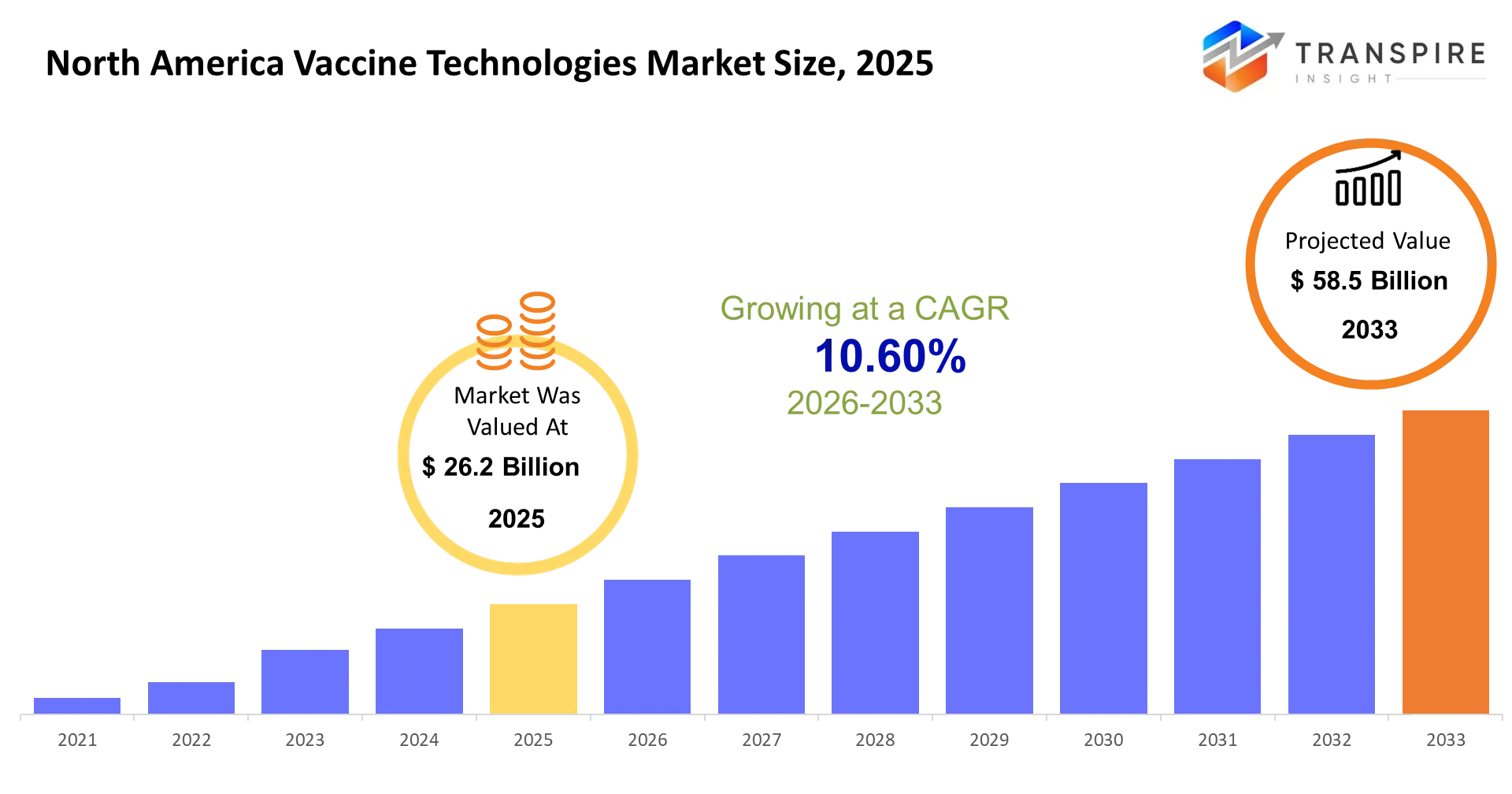
- North America Vaccine Technologies Market Size 2025: USD 26.2 Billion
- North America Vaccine Technologies Market Size 2033: USD 58.5 Billion
- North America Vaccine Technologies Market CAGR: 10.60%
- North America Vaccine Technologies Market Segments: By Technology (mRNA Vaccines, Viral Vector Vaccines, Protein Subunit Vaccines, DNA Vaccines, Live Attenuated Vaccines, Others), By Application (Infectious Diseases, Cancer Vaccines, Veterinary Vaccines, Pandemic Preparedness, Others), By End User (Pharmaceutical Companies, Biotechnology Companies, Research Institutes, Government Organizations, Others), By Route of Administration (Injectable Vaccines, Oral Vaccines, Nasal Vaccines, Others).
To learn more about this report,  Download Free Sample Report
North America Vaccine Technologies Market Summary:
The North America Vaccine Technologies Market size is estimated at USD 26.2 Billion in 2025 and is anticipated to reach USD 58.5 Billion by 2033, growing at a CAGR of 10.60% from 2026 to 2033. The North America Vaccine Technologies Market sort of underpins the region’s ability to stop infectious diseases, deal with new health threats, and back large scale immunization rollouts through public health systems, hospitals , pharmacies, and those community care networks. And it’s not only about prevention , because vaccine technologies also help lower healthcare costs, curb outbreaks, and improve pandemic readiness overall.
In the past three to five years, the market has basically shifted in structure , moving away from older vaccine platforms toward mRNA, recombinant, and other advanced technology approaches that give faster development cycles, plus more flexibility. The COVID-19 pandemic really became the key real world trigger , pushing funding for research infrastructure, manufacturing capacity, and regulatory routes. That change then built a technology ecosystem that keeps going beyond COVID-19, reaching into influenza, respiratory , oncology, and rare disease use cases. Growth is being pushed by commercializing next generation platforms and expanding vaccine pipelines, so manufacturers can tackle a wider set of illnesses while also creating fresh revenue pathways via platform based innovation and ongoing immunization programs.
Key Market Insights
- In North America, the United States kind of dominates the Vaccine Technologies Market, hitting roughly 82% of the regional market share in 2025 and it’s backed by really advanced biotechnology infrastructure, you know.
- Canada is showing up as the fastest-growing area during the forecast window, mainly because domestic vaccine production capacity keeps rising and public health investments also get more attention.
- At the same time, government funding initiatives and strategic stockpiling programs are still tightening the grip on the regional vaccine technology industry size and that long term growth outlook.
- When it comes to technology types, mRNA vaccine technologies lead the market , taking close to 38% share in 2025 and largely supported by proven efficacy , plus faster development capabilities.
- DNA-based vaccine technologies are expected to grow the quickest all the way through 2032, fueled by improvements in delivery systems and a broader clinical pipeline that keeps expanding over time.
- Platform diversification is becoming a key trend across the North America Vaccine Technologies Market, which basically helps reduce reliance on older, more traditional vaccine approaches.
- For applications, infectious disease prevention stays on top , contributing about 68% of market revenue in 2025 thanks to established immunization programs.
- Cancer immunotherapy vaccines are the fastest-growing application area, supported by personalized medicine trends and the ongoing increase in clinical trial activity.
- Also, the growing focus on respiratory diseases , influenza, and rarer infectious conditions continues to open up new vaccine technology market opportunities.
- Finally, pharmaceutical and biotechnology companies lead total demand, accounting for nearly 55% in 2025 through vaccine development and commercialization activities.
What are the Key Drivers, Restraints, and Opportunities in the North America Vaccine Technologies Market?
The strongest force pushing the North America Vaccine Technologies Market forward is a kind of change over from the usual vaccine development style to platform based technologies , especially mRNA and recombinant systems . This movement sort of got momentum after the COVID-19 vaccine efforts, because they proved that advanced platforms can go from genetic sequencing to commercial rollout in a matter of months, instead of years. After that , governments , healthcare systems and pharmaceutical companies put more money into manufacturing capacity , clinical trials , and pandemic readiness. So vaccine developers are able to aim at several diseases with the same technical backbone, which shortens timelines and boosts the return on their R&D spending . That kind of efficiency then also supports more product launches and stronger revenue growth across infectious disease programs , plus therapeutic vaccine portfolios.
The biggest holdback however is still the high cost and overall complexity behind vaccine development, manufacturing, and regulatory approval. This issue is more structural than just temporary, because advanced vaccine platforms need specialized facilities, highly trained staff, long clinical validation cycles, and tight quality controls . To build or even upgrade a production setup usually takes years of investment . Because of that, smaller companies have a harder time entering the market, and promising candidates take longer to reach commercialization, which leads to delayed adoption. In the end, this means lost revenue opportunities throughout the whole development pipeline.
A major growth opportunity sits in therapeutic and personalized vaccines, especially within oncology ,where it feels like things are finally clicking. The advances in genomic sequencing, finding biomarkers, and using AI to help pick antigens are making these individualized cancer vaccines more doable day by day. Because of that, bigger moves from biotech companies plus research institutions are speeding up clinical programs across North America . And as precision medicine keeps getting woven into routine healthcare delivery, these personalized vaccine platforms could end up generating pretty meaningful new revenue streams beyond the usual infectious disease prevention story.
What Has the Impact of Artificial Intelligence Been on the North America Vaccine Technologies Market?
Artificial intelligence and more advanced digital technologies are, kinda, changing the North America Vaccine Technologies Market in ways that touch vaccine discovery, clinical development, and manufacturing efficiency all at once. AI based platforms can automate the review of big genomic, proteomic, and epidemiological datasets, so scientists are able to spot better antigens and vaccine targets noticeably faster than the old school workflows. At the same time, many pharmaceutical firms are leaning more heavily on machine learning models to help steer vaccine design, anticipate immune reactions, and select candidates earlier before they jump into expensive laboratory testing.
Even the day to day plant operations are getting a boost, predictive analytics is playing a role there too. Machine learning models keep an eye on production variables in real time, estimate equipment problems before they happen, and also tune batch yields, which helps reduce stoppages and keeps product quality steadier. Digital twins along with upgraded process control systems make it possible to simulate different production conditions. That means scale up can happen sooner, and resources can be arranged more smartly. Overall, these tools tend to bring down manufacturing expenses, support stronger regulatory compliance, and shorten development timelines, not just slightly but in a meaningful way.
On the clinical side, AI is also sharpening how trials are set up. It can help match researchers to the right patient groups, and forecast how enrollment might behave which may speed up study completion and, in turn, regulatory filings. Still, there is a big snag that keeps showing up: the availability, and the overall quality of biological and clinical data. A lot of AI systems want large standardized datasets and if the way data is collected varies from place to place it can hurt predictive performance. That can slow wider use across vaccine research and development programs, even though the potential is pretty strong.
Key Market Trends
- Since 2020, mRNA platforms kinda moved from emergency pandemic tools to more central vaccine development approaches across infectious disease as well as oncology pipelines, it seems.
- Vaccine manufacturers also increased investments in domestic production facilities after pandemic related supply disruptions, sort of showed how much they were depending on global manufacturing networks.
- Between 2020 and 2025 , regulatory agencies adopted more flexible review pathways , and it helped speed up clinical evaluation for innovative vaccine technologies.
- Pharmaceutical companies increasingly use AI driven antigen discovery platforms, which in turn cuts down early stage candidate screening timeframes, compared with older traditional methods.
- Personalized cancer vaccine programs expanded a lot after advances in genomic sequencing helped improve identification of patient specific therapeutic targets , more clearly.
- Strategic collaborations between biotechnology firms and academic institutions became more frequent , letting research get translated into commercial products faster, than before.
- Companies like Pfizer, Moderna, Merck, and Novavax shifted capital allocation toward platform technologies that can support multiple vaccine candidates, at the same time.
- Vaccine developers are prioritizing respiratory viruses more and more, including influenza and RSV, and they lean on the infrastructure originally built for COVID-19 programs , basically.
- Contract development and manufacturing organizations gained influence because biotech firms outsourced specialized production to manage or limit capital expenditures, better.
- Governments across North America expanded long term pandemic preparedness funding , and this created steadier demand for flexible vaccine research plus manufacturing capabilities.
North America Vaccine Technologies Market Segmentation
By Technology
Technology segmentation seems to mirror how the market balances long-standing vaccine platforms with newer, sort of emerging ideas. At the moment, mRNA vaccines sit in the lead, mostly because development is fast, manufacturing can scale pretty well, and there’s solid validation coming from large commercial rollouts. Viral vector vaccines plus protein subunit options still keep a strong footprint, mainly due to proven effectiveness, a familiar regulatory path and use across several disease categories. Live attenuated vaccines are still, somehow, doing real work in ongoing public health programs, while DNA vaccines stay smaller but are quietly growing, helped by improvements in delivery methods and genetic engineering.
On the demand side, buyers appear to prefer platform technologies that are flexible enough to be repurposed for new pathogens, without a ton of rework. That’s why manufacturing investments are shifting toward modular production systems, able to handle multiple vaccine kinds, not just one. Looking ahead, the competition may revolve around how versatile the platforms are, how quickly teams can develop candidates, and how cost efficient the overall approach becomes. This should open up chances for technology providers that can push commercialization forward, and at the same time satisfy more and more strict quality controls and regulatory requirements.
To learn more about this report, Download Free Sample Report
By Application
Application trends are still, kind of heavily pushed by infectious disease prevention , and that part keeps steering industry revenue because routine immunization programs, government procurement contracts, and the ongoing appetite for seasonal plus outbreak-linked vaccines all stay in motion. More recently, pandemic preparedness has turned into a strategically important category, sort of like a direct result of lessons from the last global health emergencies , so companies keep putting money into stockpiles and fast response know-how. Cancer vaccines are the fastest moving application segment, largely because precision medicine is getting traction , alongside genomic sequencing and immunotherapy research that keeps widening what clinicians can realistically attempt.
For veterinary vaccines, the position looks steady , backed by livestock health management and companion animal care that doesn’t really slow down. There are also other niche applications, where research funding keeps flowing toward rare and newly emerging diseases, even if the adoption timelines vary. Overall growth is starting to lean toward use cases that can actually show measurable healthcare cost savings and better patient outcomes . And as therapeutic vaccine development matures, it’s likely manufacturers and investors will shift more resources toward high-value disease segments, with strong commercial pull and clear clinical promise.
By End-User
End-user dynamics really point to this big central role of pharmaceutical companies, they make up the largest share of market activity by leaning on extensive research abilities , big manufacturing infrastructure, and long established commercialization networks. Biotechnology companies are also becoming more influential, mostly because they’re so specialized in advanced platforms like mRNA , gene based vaccines, and personalized immunotherapies. Research institutes matter too, they contribute a lot to early stage innovation and translational science, and they often act as a source of novel vaccine candidates, plus breakthrough technologies too.
Government organizations stay essential participants as well, through funding programs, procurement initiatives, public health campaigns , and regulatory support. Then there are other end users, like nonprofit organizations and collaborative research groups, which help speed up innovation in areas where the needs are underserved. At the same time, the competitive landscape is increasingly shaped by partnerships among these stakeholder groups, more than it used to be. Looking ahead, future growth is expected to tilt toward organizations that can combine scientific expertise with manufacturing capacity, and regulatory execution, into smoother development pathways, even if the path is a little complex at first.
By Route of Administration
The route of administration segmentation stays mostly in the injectable vaccines lane, mostly because healthcare providers, regulators, and manufacturers already have a lot of know-how with the usual injection based delivery systems. Injectables usually give immune responses that are pretty predictable, they come with wide clinical validation, and they tend to mesh well with most existing vaccine technologies. Oral vaccines are a smaller slice but there’s growing interest, mainly because distribution can be simpler, the administration costs are often lower, and patient convenience is better.
Nasal vaccines are also picking up, and they seem like an important growth area because they could help with respiratory disease protection, plus they avoid needles, which is a big selling point. The other administration routes are still mostly experimental , but researchers keep looking at them for niche therapeutic use. Overall adoption patterns are starting to mirror attempts to improve patient compliance and to widen access across different healthcare settings. Going forward, development will most likely zero in on alternate delivery technologies that make things easier to use while still holding onto efficacy , and that should open room for manufacturers who can blend convenience, scalability, and solid clinical results.
What are the Key Use Cases Driving the North America Vaccine Technologies Market?
In North America the main use case for vaccine technologies is still basically infectious disease prevention through national immunization programs, the health care systems, and public health agencies. This kind of use case seems to create the biggest demand because it backs routine shots for influenza, RSV, HPV, and other infectious diseases, while also lowering hospitalization and the general health care costs which is kinda the key point.
Right now, extra applications are showing up more often in oncology and in pandemic preparedness. A lot of pharmaceutical and biotech companies are putting money into therapeutic cancer vaccines that use genomic data and more advanced vaccine platforms. Also government orgs are pushing faster response vaccine programs, so people can be better prepared for future outbreaks, instead of waiting.
More emerging use cases include personalized vaccines made around individual patient profiles ,and therapeutic vaccines aimed at chronic diseases beyond cancer. Research institutes, along with biotechnology firms are moving these ideas forward through precision medicine initiatives, which in turn creates fresh commercial opportunities that could end up changing what vaccine development focuses on during the whole forecast period.
|
Report Metrics |
Details |
|
Market size value in 2025 |
USD 26.2 Billion |
|
Market size value in 2026 |
USD 28.9 Billion |
|
Revenue forecast in 2033 |
USD 58.5 Billion |
|
Growth rate |
CAGR of 10.60% from 2026 to 2033 |
|
Base year |
2025 |
|
Historical data |
2021 - 2024 |
|
Forecast period |
2026 - 2033 |
|
Report coverage |
Revenue forecast, competitive landscape, growth factors, and trends |
|
Country scope |
North America (Canada, The United States, and Mexico) |
|
Key company profiled |
Pfizer, Moderna, Novavax, Johnson & Johnson, AstraZeneca, Sanofi, GSK, Merck & Co., BioNTech, CureVac, CSL Seqirus, Bavarian Nordic, Emergent BioSolutions, Dynavax Technologies, Inovio Pharmaceuticals |
|
Customization scope |
Free report customization (country, regional & segment scope). Avail customized purchase options to meet your exact research needs. |
|
Report Segmentation |
By Technology (mRNA Vaccines, Viral Vector Vaccines, Protein Subunit Vaccines, DNA Vaccines, Live Attenuated Vaccines, Others), By Application (Infectious Diseases, Cancer Vaccines, Veterinary Vaccines, Pandemic Preparedness, Others), By End User (Pharmaceutical Companies, Biotechnology Companies, Research Institutes, Government Organizations, Others), By Route of Administration (Injectable Vaccines, Oral Vaccines, Nasal Vaccines, Others) |
Which Regions are Driving the North America Vaccine Technologies Market Growth?
In North America Vaccine Technologies Market the United States still shows up as the most important region , mainly because it has a big biotechnology ecosystem , strong federal funding, and a really solid vaccine manufacturing capability. Also, regulatory agencies have created pathways that let innovators move ahead, but they still keep strict safety requirements. So it becomes easier to speed up the whole journey from research into commercialization. There’s also this fairly dense web of pharmaceutical companies, biotechnology firms , academic organizations, plus contract manufacturers, and they keep pushing product development without long pauses. Because of that, the country can stay at the front line for infectious disease work, pandemic preparedness, and therapeutic vaccine efforts.
Canada comes next and it’s the second-largest regional market , though its ranking feels driven more by policy stability and long-term public health planning than by pure size. The government has been putting money into domestic biomanufacturing, which helps with supply security and also reduces how much the country depends on outside production sources. With steady healthcare funding , and vaccine procurement programs that follow a predictable pattern, manufacturers get more reliable revenue visibility. All of this makes Canada a dependable part of the regional market, even if its commercialization volumes are still under the level seen in the United States.
Mexico looks like it is emerging as the fastest growing market, and a lot of that is backed up by more pharmaceutical manufacturing capability plus higher spending by the public sector on healthcare. There have been recent pushes to make domestic vaccine production stronger, as well as to upgrade healthcare infrastructure , and because of that, new chances are showing up around technology transfer and local partnerships. On the global side, international firms are taking a lot more interest in putting in place regional manufacturing and distribution operations, so they can serve Latin American demand a bit more efficiently . The expected growth in Mexico during 2026–2033 should translate into attractive opportunities for investors who want access to expanding production capacity and healthcare segments that are still underpenetrated.
Who are the Key Players in the North America Vaccine Technologies Market and How Do They Compete?
The competitive landscape of the North America Vaccine Technologies Market is moderately concentrated, with a small cluster of big pharmaceutical companies holding a lot of commercial revenue while biotechnology players push a large share of innovation. In general, competition is about technology platforms, how fast development moves, manufacturing reach , and pipeline variety more than it is about price by itself. Larger firms tend to defend their positions via platform growth and strategic alliances. At the same time, focused biotechnology firms are nipping at the incumbents with fresher vaccine technologies and rather targeted therapeutic uses. Lately, performance has been tied to moving candidates smoothly from research into commercialization while also keeping manufacturing flexibility and meeting regulatory compliance requirements.
Pfizer and Moderna compete heavily via technology innovation and their large scale manufacturing capabilities. Pfizer tends to stand out thanks to a worldwide commercialization network, plus a wide vaccine portfolio, which helps it achieve rapid market entry across multiple disease categories. Moderna, on the other hand, keeps trying to extend the uses of its mRNA platform beyond infectious diseases into oncology and rare conditions. That approach creates chances to use one technology foundation across many different products. Both firms keep funding next generation vaccine research and production infrastructure, basically to reinforce the platform value over the long run.
Merck & Co. kind of keeps a competitive edge by leaning hard on expertise in preventive vaccines and immunology driven research, with extra support from solid links to healthcare providers and public health agencies. Novavax, meanwhile, sets itself apart using protein based vaccine technology, so they give organizations a different option beyond mRNA approaches, which is kind of the point. Sanofi is also pushing forward via research collaborations , more manufacturing investments, and development programs that fold in newer vaccine technologies with its already established global vaccine distribution muscle. In the end, these moves put the companies in a better spot to grab what’s next in therapeutic vaccines, pandemic preparedness , and personalized immunization approaches.
Company List
- Pfizer
- Moderna
- Novavax
- Johnson & Johnson
- AstraZeneca
- Sanofi
- GSK
- Merck & Co.
- BioNTech
- CureVac
- CSL Seqirus
- Bavarian Nordic
- Emergent BioSolutions
- Dynavax Technologies
- Inovio Pharmaceuticals
Recent Development News
In May 2026, Lilly to Buy Three Vaccine Developers for Nearly $4 Billion in Infectious Disease Push: Eli Lilly announced agreements to acquire vaccine-focused biotechnology companies Curevo, LimmaTech Biologics, and Vaccine Company for a combined value of up to $3.8 billion. The move strengthens Lilly’s position in infectious disease prevention and expands its vaccine technology portfolio across shingles, bacterial infections, and Epstein-Barr virus research.
Source: https://www.reuters.com
In April 2026, Moderna Started Late-Stage Trial of Bird Flu Vaccine in US, UK: Moderna initiated a Phase 3 clinical trial for its mRNA-based bird flu vaccine candidate, mRNA-1018, across the United States and the United Kingdom. The study involves approximately 4,000 adults and marks one of the most advanced applications of mRNA vaccine technology beyond COVID-19.
Source: https://www.reuters.com
What Strategic Insights Define the Future of the North America Vaccine Technologies Market?
The North America Vaccine Technologies Market is kind of moving toward platform based vaccine development, where one core technology foundation can end up supporting multiple infectious disease and therapeutic uses at once. The thing pushing this change forward is the need for faster response , shorter development periods , and a more efficient way to place research capital. In the next five to seven years, the competitive edge will probably hinge less on individual vaccine products and more on who actually owns scalable technology platforms, strong manufacturing networks , and linked data abilities.
There’s also a less obvious concern, sort of in the background, about market concentration around a limited set of platform technologies and a handful of specialized raw material suppliers. If a company, or even the whole ecosystem, leans too heavily on a narrow innovation base it can bring supply bottlenecks, pricing pressure, and extra exposure if alternative platforms end up showing better clinical results or stronger economic value.
At the same time, an emerging opening is personalized cancer vaccines , enabled by improvements in genomic sequencing and AI based antigen selection. Market participants should focus on intentional partnerships that blend platform know-how, manufacturing capacity, and precision medicine strengths , so portfolios are set up for the next wave of high value therapeutic vaccine opportunities.
North America Vaccine Technologies Market Report Segmentation
By Technology
- RNA Vaccines
- Viral Vector Vaccines
- Protein Subunit Vaccines
- DNA Vaccines
- Live Attenuated Vaccines
- Others
By Application
- Infectious Diseases
- Cancer Vaccines
- Veterinary Vaccines
- Pandemic Preparedness
- Others
By End User
- Pharmaceutical Companies
- Biotechnology Companies
- Research Institutes
- Government Organizations
- Others
By Route of Administration
- Injectable Vaccines
- Oral Vaccines
- Nasal Vaccines
- Others
Frequently Asked Questions
Find quick answers to common questions.
The Approximate North America Vaccine Technologies Market size for the Market will be USD 58.5 Billion in 2033.
The key Segments of the North America Vaccine Technologies Market are By Technology (mRNA Vaccines, Viral Vector Vaccines, Protein Subunit Vaccines, DNA Vaccines, Live Attenuated Vaccines, Others), By Application (Infectious Diseases, Cancer Vaccines, Veterinary Vaccines, Pandemic Preparedness, Others), By End User (Pharmaceutical Companies, Biotechnology Companies, Research Institutes, Government Organizations, Others), By Route of Administration (Injectable Vaccines, Oral Vaccines, Nasal Vaccines, Others).
Major Players in the North America Vaccine Technologies Market are Pfizer, Moderna, Novavax, Johnson & Johnson, AstraZeneca, Sanofi, GSK, Merck & Co., BioNTech, CureVac, CSL Seqirus, Bavarian Nordic, Emergent BioSolutions, Dynavax Technologies, Inovio Pharmaceuticals.
The Current Market size of the North America Vaccine Technologies Market is USD 26.2 Billion in 2025.
The North America Vaccine Technologies Market CAGR is 10.60%.
- Pfizer
- Moderna
- Novavax
- Johnson & Johnson
- AstraZeneca
- Sanofi
- GSK
- Merck & Co.
- BioNTech
- CureVac
- CSL Seqirus
- Bavarian Nordic
- Emergent BioSolutions
- Dynavax Technologies
- Inovio Pharmaceuticals
About the Authors

Pankaj Ghogare Patil
I am Pankaj Ghogare Patil, a Senior Research Analyst at Transpire Insight, specializing in the Pharmaceutical, Chemicals & Materials, Healthcare IT, and Biotechnology industry. My expertise lies in conducting comprehensive market research, analyzing industry trends, evaluating competitive landscapes, and translating complex data into actionable insights. At Transpire Insight, I closely follow emerging technologies, regulatory developments, and market innovations to create accurate, well-researched, and informative content that helps businesses and professionals make informed decisions. I am committed to producing credible, evidence-based articles that reflect industry best practices while making technical topics accessible and valuable for a broad audience.

Chakradhar Khansole
Chakradhar serves as the Research Director at Transpire Insight, bringing over 8 years of experience in technology, innovation, and strategic market intelligence. He specializes in transforming complex market data into actionable business insights that enable organizations to make informed, growth-oriented decisions. Recognized for his strategic vision and analytical expertise, Chakradhar leads high-impact research initiatives, delivering comprehensive market assessments, competitive intelligence, and forward-looking industry analysis.
Recently Published Reports
-
Jul 2026
Alopecia Treatment Market
Alopecia Treatment Market Size, Share & Analysis Report By Disease Type (Alopecia Areata, Cicatricial Alopecia, Traction Alopecia, Alopecia Totalis, Androgenetic Alopecia, Alopecia Universalis, and Other Disease Types), By Treatment Type (Topical Treatments, Oral Medications, Injectable Therapies, and Hair Transplantation), By Gender (Male, and Female), By Distribution Channel (Hospitals and Clinics, Retail Pharmacies, and Online Retailers), and Geography (North America, Europe, Asia-Pacific, Middle East and Africa, South and Central America), 2021 - 2031
-
Jul 2026
Medical Ultrasound Probe Market
Medical Ultrasound Probe Market Size, Share & Analysis Report By Type (Linear Type, Convex Type, Endocavitary Probe, Phased Array/Cardiac Probe, Transesophageal (TEE) Probe, and Others), By Application (Ophthalmology, Cardiology, Musculoskeletal, Oncology, Obstetrics & Gynecology, General Imaging, and Others), By End User (Hospitals & Clinics, Diagnostic Centers, Ambulatory Surgical Centers, and Others), and Geography (North America, Europe, Asia-Pacific, Middle East and Africa, South and Central America), 2021 – 2031
-
May 2026
Biosimilars Market
Biosimilars Market By Product Type (Monoclonal Antibodies, Recombinant Hormones, Erythropoietin, G-CSF, Others), By Indication (Oncology, Autoimmune Diseases, Blood Disorders, Diabetes, Others), By Manufacturing Type (In-House Manufacturing, Contract Manufacturing), By Distribution Channel (Hospital Pharmacies, Retail Pharmacies, Online Pharmacies), By Industry Analysis, Size, Share, Growth, Trends, and Forecasts 2021-2033
-
Apr 2026
Gastrointestinal Endoscopy Market
Gastrointestinal Endoscopy Market By Type (Rigid Gastrointestinal Endoscope, Flexible Gastrointestinal Endoscopes, Disposable Gastrointestinal Endoscope), By Procedure Type (Colonoscopy, Gastroscopy, Duodenoscopy, Enteroscopy, Flexible Sigmoidoscopy, Others), By Application (Diagnosis, Treatment), By End-Users (Hospitals, Ambulatory Surgical Centers, Specialty Clinics, Laboratories, Others), By Industry Analysis, Size, Share, Growth, Trends, and Forecasts 2021-2033