

North America Canine Vaccines Market Size & Forecast:
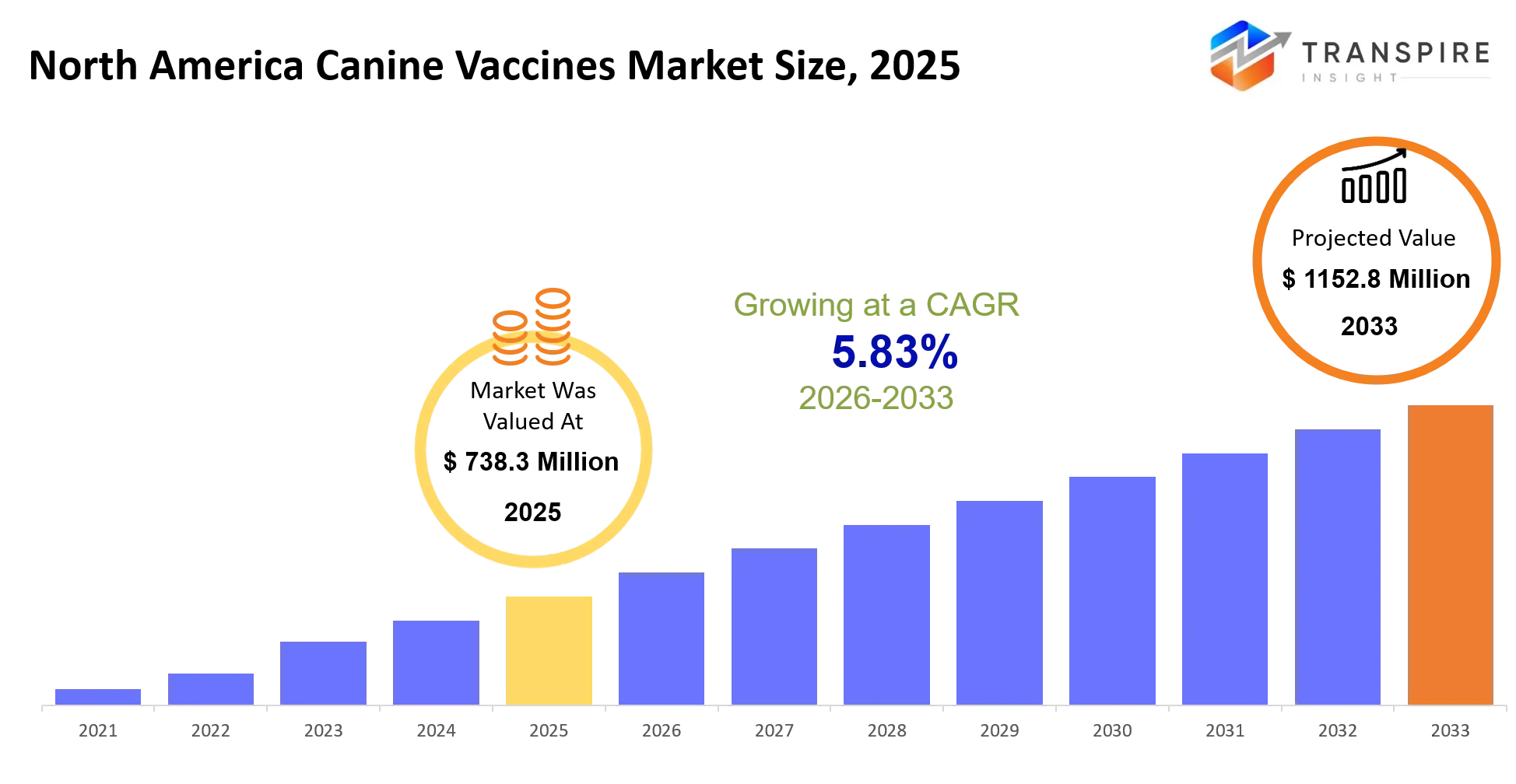
- North America Canine Vaccines Market Size 2025: USD 738.3 Million
- North America Canine Vaccines Market Size 2033: USD 1152.8 Million
- North America Canine Vaccines Market CAGR: 5.83%
- North America Canine Vaccines Market Segments: By Vaccine Type (Rabies Vaccines, Distemper Vaccines, Parvovirus Vaccines, Combination Vaccines, Others), By Application (Preventive Care, Infectious Disease Control, Travel Vaccination, Others), By End User (Veterinary Clinics, Animal Hospitals, Pet Care Centers, Others), By Route of Administration (Injectable Vaccines, Oral Vaccines, Intranasal Vaccines, Others).
To learn more about this report,  Download Free Sample Report
North America Canine Vaccines Market Summary:
The North America Canine Vaccines Market size is estimated at USD 738.3 Million in 2025 and is anticipated to reach USD 1152.8 Million by 2033, growing at a CAGR of 5.83% from 2026 to 2033. North America’s market for canine vaccines has a critical part in companion animal healthcare, basically aiding the prevention of contagious diseases that can zip through homes , veterinary networks, shelters breeding facilities and pet boarding spaces . Once vaccination programs are running, veterinarians can slow down outbreaks , lower total treatment costs, and back improved long run canine well being outcomes, so preventive care stays as a main plank in how pet health is overseen.
In the last three to five years, the whole market has started to shift in a more structural way toward comprehensive preventive healthcare models, where vaccination is more and more tied into wellness plans, digital health records , and regular veterinary check ups. One major push behind this change was the rise in pet ownership during and after the COVID-19 pandemic, which effectively grew the number of dogs that are now in need of routine veterinary attention. Since more pet owners want proactive health management and insurance providers increasingly back preventive services, veterinary clinics have been giving vaccines in a more consistent manner. That stability has supported repeat income for manufacturers and service providers, while also motivating wider use of advanced, or if you prefer, multi component vaccine formulations across the region.
Key Market Insights
- The United States kind of runs the North America Canine Vaccines Market , taking the biggest slice because of more evolved veterinary infrastructure and that pretty high pet insurance penetration, honestly.
- Canada meanwhile looks like the fastest mover through 2026, helped by broader access to companion animal healthcare and rural veterinary outreach programs that keep expanding, steadily
- When it comes to product type, core vaccines lead the whole market, grabbing the largest share since mandatory rabies, distemper, and parvovirus immunization protocols are basically required in practice.
- Non-core vaccines sit in the second spot, mainly because owners want prevention for lifestyle-linked diseases in companion dogs, especially across urban areas.
- Recombinant and combination vaccines are the quickest to grow, driven by stronger efficacy and the perks of fewer injections overall.
- By application, veterinary clinics dominate the North America Canine Vaccines Market, bringing in the majority share through structured immunization schedules and routine follow ups.
- Animal shelters and rescue centers are growing the fastest, as adoption levels climb and standardized vaccination requirements keep getting wider.
- For the end-user side, pet owners via veterinary service networks are the top segment, supported by preventive care adoption and insurance-linked coverage.
- Mobile veterinary services and home-care vaccination providers are growing the fastest too, because convenience matters a lot and demand is leaning that way.
What are the Key Drivers, Restraints, and Opportunities in the North America Canine Vaccines Market?
The strongest growth driver is basically the move toward organized preventive care models that get baked into veterinary clinic networks, plus pet insurance coverage that actually pays attention. This change really sped up after the COVID-19 era, when pet adoption surged and, in turn, it broadened the insured and regularly monitored dog population. Veterinary chains across the United States increasingly bundle vaccines with yearly wellness plans, which helps people stay on schedule, and it also creates those predictable recurring revenue streams for vaccine manufacturers like Zoetis and Merck Animal Health. so, adoption frequency has become more standardized, not exactly optional anymore, or at least not as discretionary as before.
The most stubborn constraint is fragmented vaccination adherence among independent pet owners who sit outside these structured veterinary systems. It is structural because it comes from uneven access to veterinary services in rural regions, and also from inconsistent follow-up behavior in households that do not have insurance. Even if advanced vaccines are available, missed booster cycles lower the real-world immunization coverage, and that pushes back full revenue realization for manufacturers. it also makes it harder to scale preventive programs, which then drags the whole thing down.
A big forward-looking opportunity is digital veterinary ecosystems, especially those that weave in AI-based vaccination reminders along with electronic pet health records. Platforms connected to insurers and clinic networks in Canada and the United States are enabling real-time immunization tracking. For instance, integrated pet health apps used by Banfield-style clinic networks are improving booster compliance rates. That in turn unlocks higher lifetime vaccine utilization and strengthens the long-term growth path of the North America Canine Vaccines Market.
What Has the Impact of Artificial Intelligence Been on the North America Canine Vaccines Market?
Artificial intelligence and advanced digital tech are, kind of slowly but surely, helping improve efficiency across the North America canine vaccine ecosystem, mainly in vaccine development, inventory management, and preventive care delivery, it’s like everything is getting a little smoother. More and more, veterinary networks plus animal health companies lean on AI powered analytics to handle the busy work, such as appointment scheduling, vaccination nudges and inventory forecasting. Then clinics can lower the number of missed vaccinations, fine tune stock levels, and trim vaccine wastage, which in turn boosts operational efficiency and revenue capture. It’s not always super obvious day to day, but the ripple effect is still there.
Machine learning models are also sharpening their predictive abilities a bit more. With AI platforms, they basically comb through electronic veterinary records , plus local disease incidence data, and vaccination histories, and then they can flag certain groups as being at elevated risk for contagious conditions like canine parvovirus or leptospirosis. After that, veterinary providers can aim preventive interventions in a more precise way , and they can route vaccine supplies based on expected demand. On the research and development side, AI-assisted modeling can back manufacturers by spotlighting promising vaccine candidates, and it also helps shorten the early-stage development timelines, which is kinda huge.
Overall these tools are pushing higher vaccination compliance, stronger inventory utilization, and improved clinic productivity. Digital reminder systems, for instance, help practices increase booster adherence and reinforce longer-term preventive care outcomes. Still, there’s a key snag that shows up again and again: the fragmented nature of veterinary data. Many clinics run on different software platforms, so interoperability problems appear. That limits the amount and consistency of data needed for highly accurate, AI-driven predictions and decision-making, and it makes things harder than they should be.
Key Market Trends
- Veterinary clinics across North America have been seeing Canine Vaccines Market growth, with bundled wellness-vaccine plans up by almost 30% since 2022, that part helps long term immunization adherence stay on track.
- Zoetis and Merck Animal Health also kept pushing recombinant plus combination vaccine portfolios after 2021, and that kind of changes the demand pattern toward longer duration immunity formulations, more or less.
- In the United States, pet insurance providers began covering preventive vaccinations in a more consistent way after 2023 , and that kind of then sped up structured vaccine adoption across insured groups, kind of overall.
- Independent vet practices rolled out digital vaccination tracking systems after 2022 , so fewer boosters end up missed , and compliance got better by something like 20–25% across several reports.
- At the same time , animal shelters started reinforcing mandatory vaccination protocols beginning 2021, which boosted baseline vaccine volumes and made repeat demand feel more steady across the region.
- Mobile veterinary services expanded really quickly between 2022 and 2025, so vaccination delivery shifted away from only clinic centered workflows toward more hybrid home-care models, especially in cities.
- Manufacturers then leaned harder on AI-enabled demand forecasting tools after 2023 , that helped them plan inventory more accurately while also lowering regional vaccine wastage rates.
- And because regulatory attention to zoonotic disease prevention got stronger after the pandemic, stricter vaccination documentation requirements were added across interstate animal movement frameworks, sort of.
- Finally, cold chain logistics providers upgraded temperature controlled distribution systems after 2022, which reduced the risk of vaccine degradation during long distance transport across North America.
North America Canine Vaccines Market Segmentation
By Vaccine Type
In the North America Canine Vaccines Market, the Vaccine Type segment is basically driven by rabies plus distemper vaccines, mostly because mandatory immunization laws and those long-established veterinary protocols are pretty much everywhere in the United States and Canada. Parvovirus and combination vaccines sit in a solid secondary role, since many clinics are now leaning toward multi-protection formulations that cut down on repeat visits, and help compliance in a more practical way. Meanwhile, recombinant approaches and more advanced combination vaccines are starting to gain traction, with manufacturers like Zoetis and Merck Animal Health pushing broader immune response while also aiming for longer protection cycles, which sounds almost simple but it matters a lot.
Growth here is shaped by the increasing desire for simplified vaccination timetables, and better disease prevention efficiency, like less hassle overall. Going forward, future development is expected to focus on next-generation combination platforms, so manufacturers can reinforce product differentiation, and then win a bigger share of the higher-value preventive care demand.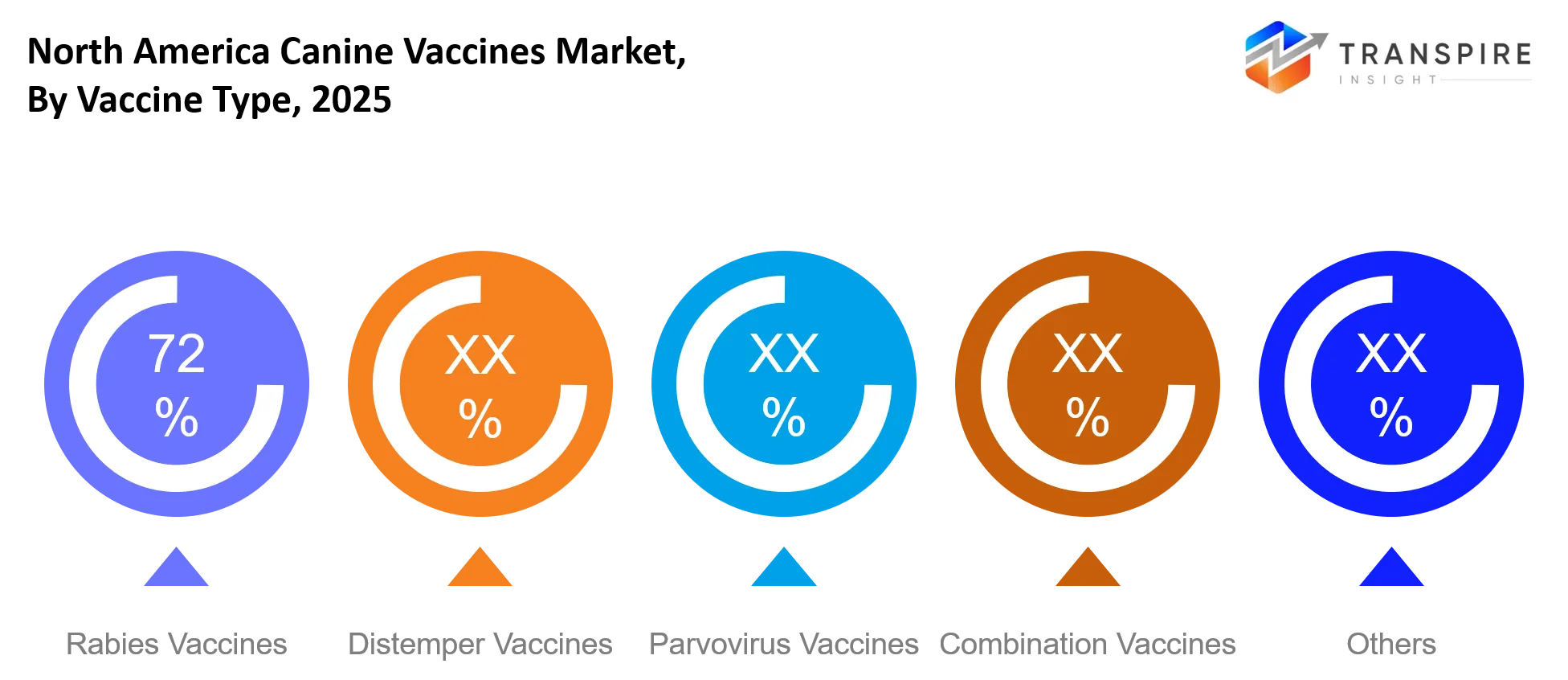
To learn more about this report, Download Free Sample Report
By Application
The Application segment kind of gets dominated by preventive care, it forms the core usage pattern across companion animal health systems across North America. Infectious disease control apps are right behind it, pushed by more pets moving between states and also the higher risk exposure you see in urban areas. Travel vaccination requirements add on top of that for steady demand, especially rabies certification tied to interstate and international pet relocation.
Growth in this part is shaped by stricter compliance frameworks in veterinary documentation, plus the fact that vaccination schedules are getting more and more integrated into annual wellness programs. Going forward the direction seems to point toward stronger alignment between preventive care and digital veterinary platforms, so that vaccination tracking becomes more structured, and coverage stays more consistent across pet populations.
By End-User
The End User segment is kinda led by veterinary clinics, which mostly serve as the primary distribution and vaccine administration path, because they already have the infrastructure and they can plug into routine wellness programs, pretty easily. Animal hospitals take a big slice too, especially when it comes to high risk cases and those complicated immunization schedules that really need medical oversight. Pet care centers, and shelters are showing more momentum lately, mostly because of adoption spikes, and also because there are mandatory vaccination requirements before an animal can be placed.
It looks like the overall growth is tied to the expansion of corporate veterinary networks, plus a wider consolidation of clinic chains in city areas. In the near term, the segment should drift toward more centralized care delivery models, where integrated veterinary systems help lift vaccine compliance rates, and they also let manufacturers predict revenue streams more steadily.
By Route of Administration
The Route of Administration segment kind of gets dominated by injectable vaccines, because they are still the most reliable and widely adopted way for core immunizations like rabies and distemper . Oral and intranasal vaccines are smaller, but they keep expanding , especially for respiratory or lifestyle related diseases, where “just easier to give” actually boosts compliance. The way this market grows is mostly pushed by innovation in non-invasive delivery methods, plus the growing emphasis on reducing stress during vaccination procedures, you know, less hassle, less worry.
Injectable formats still carry a lot of weight thanks to regulatory familiarity and strong clinical trust, while the alternative routes get more attention in preventive care innovation pipelines too. Looking ahead, future trends suggest a gradual diversification of how these vaccines are given, with manufacturers investing in user-friendly vaccine delivery systems so uptake goes up and veterinary workflow efficiency feels better .
What are the Key Use Cases Driving the North America Canine Vaccines Market?
Core adoption in the North America Canine Vaccines Market is pushed by routine preventive immunization in vet clinics and animal hospitals, where these kinds of wellness plans standardize rabies protection, distemper shielding and parvovirus safeguards. This use case ends up getting the strongest demand, because vaccination rules are often mandatory, and those yearly checkups make it feel predictable… at least predictable in a clinic setting, with routine vaccine administration for companion dogs.
There are also expanding applications you can see in animal shelters and pet adoption centers, where pre-adoption vaccination steps are becoming required, to curb disease transmission risk before a new dog even settles in. Pet boarding spaces and grooming services contribute too, since facility-based health certification keeps getting more strict, and the up-to-date vaccination documents start showing up more often.
More emerging use cases include mobile veterinary services that deliver at-home vaccination for senior pets and also for stressed animals, plus insurer-linked preventive care programs that basically trigger automated immunization reminders. Those models are still scaling, but they show solid promise as digital veterinary ecosystems and subscription-based pet healthcare keep spreading across North America.
|
Report Metrics |
Details |
|
Market size value in 2025 |
USD 738.3 Million |
|
Market size value in 2026 |
USD 780.5 Million |
|
Revenue forecast in 2033 |
USD 1152.8 Million |
|
Growth rate |
CAGR of 5.83% from 2026 to 2033 |
|
Base year |
2025 |
|
Historical data |
2021 - 2024 |
|
Forecast period |
2026 - 2033 |
|
Report coverage |
Revenue forecast, competitive landscape, growth factors, and trends |
|
Country scope |
North America (Canada, The United States, and Mexico) |
|
Key company profiled |
Zoetis, Merck Animal Health, Boehringer Ingelheim Animal Health, Elanco Animal Health, Virbac, Ceva Santé Animale, HIPRA, Vetoquinol, Biogenesis Bago, Neogen Corporation, Indian Immunologicals, Phibro Animal Health, Heska Corporation, IDEXX Laboratories, Dechra Pharmaceuticals |
|
Customization scope |
Free report customization (country, regional & segment scope). Avail customized purchase options to meet your exact research needs. |
|
Report Segmentation |
By Vaccine Type (Rabies Vaccines, Distemper Vaccines, Parvovirus Vaccines, Combination Vaccines, Others), By Application (Preventive Care, Infectious Disease Control, Travel Vaccination, Others), By End User (Veterinary Clinics, Animal Hospitals, Pet Care Centers, Others), By Route of Administration (Injectable Vaccines, Oral Vaccines, Intranasal Vaccines, Others) |
Which Regions are Driving the North America Canine Vaccines Market Growth?
The United States is basically the leading region in the North America Canine Vaccines Market, and it’s backed by a pretty structured veterinary care ecosystem plus strict rabies vaccination regulations across states. Also, large scale pet insurance penetration, helps routine immunization compliance a lot, because preventive care gets reimbursed. In the meantime there’s a dense network of corporate veterinary chains and animal hospitals that sort of makes sure vaccine delivery stays standardized across both urban and suburban areas. On top of that, strong R&D presence from companies like Zoetis and Merck Animal Health, keeps supply availability steadier and supports innovation leadership.
Canada looks more like a stable and mature regional contributor. This is mainly because of consistent public animal health policies and well regulated veterinary practices. But unlike the United States, growth there isn’t as insurance driven, and it leans more on government supported veterinary access programs, plus disciplined clinical adoption patterns. Rural veterinary outreach initiatives also matter, they help keep vaccination coverage steady even for dispersed populations. That overall stability keeps vaccine demand predictable, with gradual expansion of companion animal ownership rather than any wild structural change.
Mexico is, however, the fastest growing region. It’s supported by rising pet adoption rates and expanding urban veterinary infrastructure in major cities. More recently, investments in private veterinary clinics and better imported vaccine availability, have improved access to preventive immunization services. Pet owners are also becoming more aware of zoonotic disease risks, so compliance with vaccination schedules has strengthened. This momentum makes Mexico an emerging growth frontier, and it provides some pretty meaningful long term opportunities for manufacturers and distributors that want to enter the regional market.
Who are the Key Players in the North America Canine Vaccines Market and How Do They Compete?
The North America Canine Vaccines Market has a pretty moderately consolidated competitive structure, kinda like only a few large multinational animal health players control most of the supply. A lot of incumbents end up defending their spot through product innovation and distribution depth, not really through price fights. Veterinary clinic networks , and also integrated supply agreements, end up steering competition more than standalone retail channels do. The main competition idea has started to lean more toward technology differentiation in vaccine formulations, especially recombinant and multivalent platforms. At the same time cold-chain distribution reliability counts a lot, plus veterinary engagement programs that keep clinicians involved.
Zoetis holds its ground using high-volume recombinant vaccine platforms, and it keeps doing continuous upgrades in combination vaccines, which can cut dosing frequency in real clinical use. It grows via long term contracts with veterinary chains and integrated digital compliance tools that help with vaccination tracking. Merck Animal Health really leans into biologically advanced formulations,and it kind of separates itself more too with R&D partnerships involving veterinary research institutes across the United States. Their strategy also leans on portfolio depth across both core and non core vaccines, and they back that up by expanding production capacity so supply stays steadier when seasonal demand spikes show up out of nowhere.
Meanwhile Elanco Animal Health competes by diversifying its portfolio, and it uses targeted acquisitions to extend its companion animal immunization offerings, which is a bit more focused than it sounds at first. The company leans into cross-selling, basically tying vaccine plans into broader animal health products to strengthen relationships with clinics. Boehringer Ingelheim Animal Health differentiates with strong global vaccine research capabilities and very established regulatory expertise for biologics approval pathways.
Company List
- Zoetis
- Merck Animal Health
- Boehringer Ingelheim Animal Health
- Elanco Animal Health
- Virbac
- Ceva Santé Animale
- HIPRA
- Vetoquinol
- Biogenesis Bago
- Neogen Corporation
- Indian Immunologicals
- Phibro Animal Health
- Heska Corporation
- IDEXX Laboratories
- Dechra Pharmaceuticals
Recent Development News
In May 2026, Novavax Reports First Quarter 2026 Financial Results and Operational Highlights: Vaccine developer Novavax reported first-quarter 2026 revenue of $140 million and disclosed new licensing and research agreements involving its Matrix-M adjuvant technology. While not exclusively canine-focused, the development is relevant to the broader North American vaccine innovation ecosystem supporting animal and human vaccine platforms.
Source: https://www.prnewswire.com
In February 2026, Zoetis forecast upbeat 2026 results despite pressure in the companion-animal market: Zoetis, one of the largest suppliers of canine vaccines and companion-animal products in North America, issued a 2026 revenue and profit outlook above Wall Street expectations. The company highlighted continued investment in companion-animal health products while acknowledging increased competition across key veterinary categories.
Source: https://www.reuters.com
What Strategic Insights Define the Future of the North America Canine Vaccines Market?
The North America Canine Vaccines Market is kind of shifting over time toward integrated preventive care ecosystems, where vaccination gets embedded into digital veterinary platforms and insurance-linked wellness programs. This movement is pushed by pet insurance growth, plus corporate veterinary chain consolidation , and then the whole data based compliance monitoring piece, which ends up standardizing immunization habits across companion animal populations. Over the next 5 to 7 years, value creation will depend more on lifecycle vaccination management, not just on buying/selling standalone products.
There s also a risk that feels less obvious at first: the market is becoming more concentrated among a few big animal health manufacturers, and that could raise pricing pressure coming from large veterinary networks. It might also make dependency risks worse across supply chains. Another issue shows up in the form of cold chain vulnerabilities during peak demand periods, which can reduce vaccine availability, even if production capacity is strong.
On the opportunity side, there s room for AI driven predictive immunization scheduling inside insurer-veterinary platforms, especially in urban U.S. metro areas where digital pet health uptake is speeding up. Market players should focus on ecosystem partnerships with insurance providers and clinic software platforms, so they can secure recurring vaccine demand, and also tighten long term customer lock-in.
North America Canine Vaccines Market Report Segmentation
By Vaccine Type
- Rabies Vaccines
- Distemper Vaccines
- Parvovirus Vaccines
- Combination Vaccines
- Others
By Application
- Preventive Care
- Infectious Disease Control
- Travel Vaccination
- Others
By End User
- Veterinary Clinics
- Animal Hospitals
- Pet Care Centers
- Others
By Route of Administration
- Injectable Vaccines
- Oral Vaccines
- Intranasal Vaccines
- Others
Frequently Asked Questions
Find quick answers to common questions.
The Approximate North America Canine Vaccines Market size for the Market will be USD 1152.8 Million in 2033.
The key Segments of the North America Canine Vaccines Market are By Vaccine Type (Rabies Vaccines, Distemper Vaccines, Parvovirus Vaccines, Combination Vaccines, Others), By Application (Preventive Care, Infectious Disease Control, Travel Vaccination, Others), By End User (Veterinary Clinics, Animal Hospitals, Pet Care Centers, Others), By Route of Administration (Injectable Vaccines, Oral Vaccines, Intranasal Vaccines, Others).
Major Players in the North America Canine Vaccines Market are Zoetis, Merck Animal Health, Boehringer Ingelheim Animal Health, Elanco Animal Health, Virbac, Ceva Santé Animale, HIPRA, Vetoquinol, Biogenesis Bago, Neogen Corporation, Indian Immunologicals, Phibro Animal Health, Heska Corporation, IDEXX Laboratories, Dechra Pharmaceuticals.
The Current Market size of the North America Canine Vaccines Market is USD 738.3 Million in 2025.
The North America Canine Vaccines Market CAGR is 5.83%.
- Zoetis
- Merck Animal Health
- Boehringer Ingelheim Animal Health
- Elanco Animal Health
- Virbac
- Ceva Santé Animale
- HIPRA
- Vetoquinol
- Biogenesis Bago
- Neogen Corporation
- Indian Immunologicals
- Phibro Animal Health
- Heska Corporation
- IDEXX Laboratories
- Dechra Pharmaceuticals
About the Authors

Pankaj Ghogare Patil
I am Pankaj Ghogare Patil, a Senior Research Analyst at Transpire Insight, specializing in the Pharmaceutical, Chemicals & Materials, Healthcare IT, and Biotechnology industry. My expertise lies in conducting comprehensive market research, analyzing industry trends, evaluating competitive landscapes, and translating complex data into actionable insights. At Transpire Insight, I closely follow emerging technologies, regulatory developments, and market innovations to create accurate, well-researched, and informative content that helps businesses and professionals make informed decisions. I am committed to producing credible, evidence-based articles that reflect industry best practices while making technical topics accessible and valuable for a broad audience.

Chakradhar Khansole
Chakradhar serves as the Research Director at Transpire Insight, bringing over 8 years of experience in technology, innovation, and strategic market intelligence. He specializes in transforming complex market data into actionable business insights that enable organizations to make informed, growth-oriented decisions. Recognized for his strategic vision and analytical expertise, Chakradhar leads high-impact research initiatives, delivering comprehensive market assessments, competitive intelligence, and forward-looking industry analysis.
Recently Published Reports
-
Jul 2026
Alopecia Treatment Market
Alopecia Treatment Market Size, Share & Analysis Report By Disease Type (Alopecia Areata, Cicatricial Alopecia, Traction Alopecia, Alopecia Totalis, Androgenetic Alopecia, Alopecia Universalis, and Other Disease Types), By Treatment Type (Topical Treatments, Oral Medications, Injectable Therapies, and Hair Transplantation), By Gender (Male, and Female), By Distribution Channel (Hospitals and Clinics, Retail Pharmacies, and Online Retailers), and Geography (North America, Europe, Asia-Pacific, Middle East and Africa, South and Central America), 2021 - 2031
-
Jul 2026
Medical Ultrasound Probe Market
Medical Ultrasound Probe Market Size, Share & Analysis Report By Type (Linear Type, Convex Type, Endocavitary Probe, Phased Array/Cardiac Probe, Transesophageal (TEE) Probe, and Others), By Application (Ophthalmology, Cardiology, Musculoskeletal, Oncology, Obstetrics & Gynecology, General Imaging, and Others), By End User (Hospitals & Clinics, Diagnostic Centers, Ambulatory Surgical Centers, and Others), and Geography (North America, Europe, Asia-Pacific, Middle East and Africa, South and Central America), 2021 – 2031
-
May 2026
Biosimilars Market
Biosimilars Market By Product Type (Monoclonal Antibodies, Recombinant Hormones, Erythropoietin, G-CSF, Others), By Indication (Oncology, Autoimmune Diseases, Blood Disorders, Diabetes, Others), By Manufacturing Type (In-House Manufacturing, Contract Manufacturing), By Distribution Channel (Hospital Pharmacies, Retail Pharmacies, Online Pharmacies), By Industry Analysis, Size, Share, Growth, Trends, and Forecasts 2021-2033
-
Apr 2026
Gastrointestinal Endoscopy Market
Gastrointestinal Endoscopy Market By Type (Rigid Gastrointestinal Endoscope, Flexible Gastrointestinal Endoscopes, Disposable Gastrointestinal Endoscope), By Procedure Type (Colonoscopy, Gastroscopy, Duodenoscopy, Enteroscopy, Flexible Sigmoidoscopy, Others), By Application (Diagnosis, Treatment), By End-Users (Hospitals, Ambulatory Surgical Centers, Specialty Clinics, Laboratories, Others), By Industry Analysis, Size, Share, Growth, Trends, and Forecasts 2021-2033