
Asia Pacific Healthcare Software As A Service Market Size & Forecast:
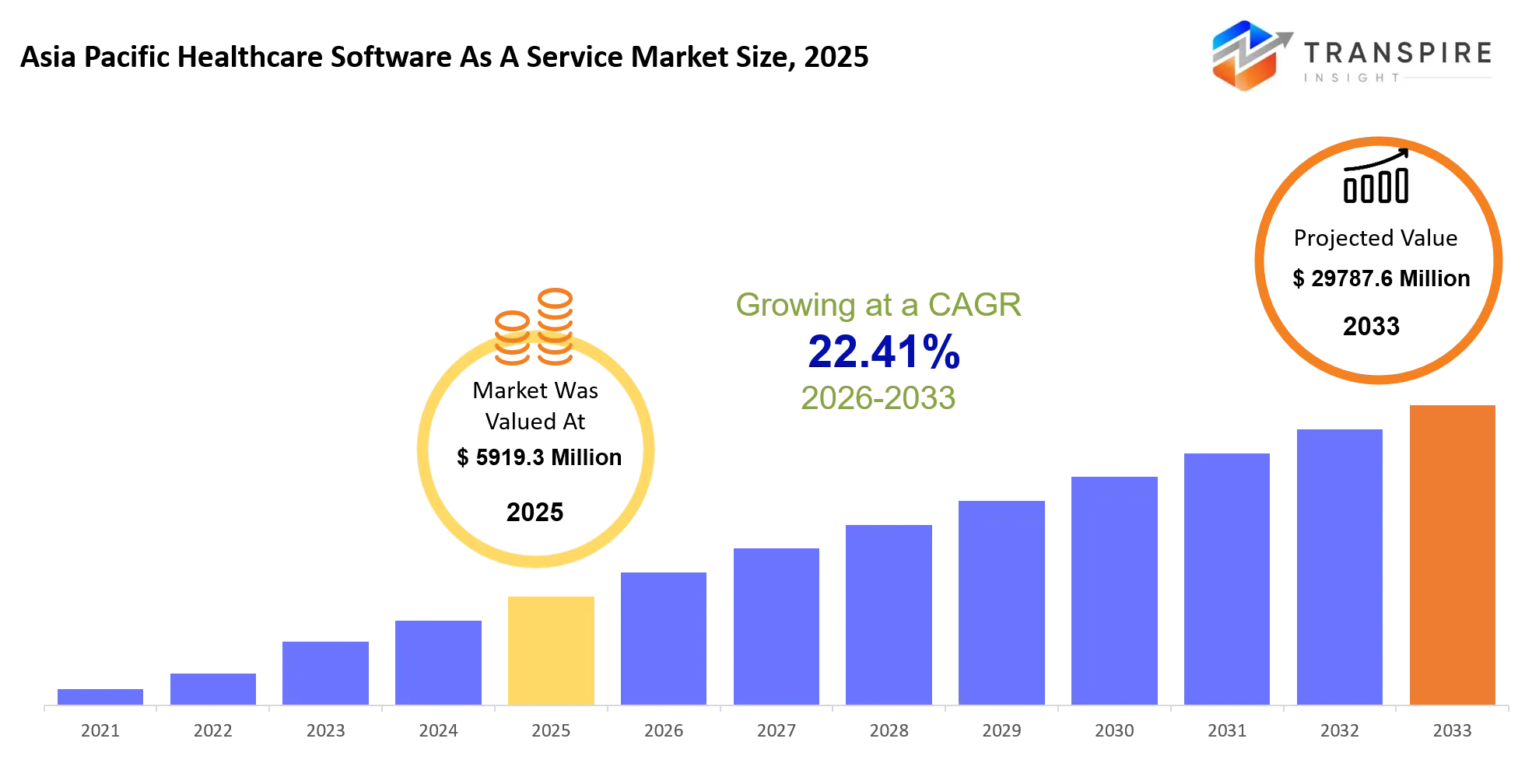
- Asia Pacific Healthcare Software As A Service Market Size 2025: USD 5919.3 Million
- Asia Pacific Healthcare Software As A Service Market Size 2033: USD 29787.6 Million
- Asia Pacific Healthcare Software As A Service Market CAGR: 22.41%
- Asia Pacific Healthcare Software As A Service Market Segments: By Solution Type (Electronic Health Records, Telehealth Software, Practice Management Software, Revenue Cycle Management, Healthcare Analytics, Others); By Deployment (Cloud-based SaaS, Hybrid SaaS, AI-enabled SaaS Platforms, Others); By End User (Hospitals, Clinics, Diagnostic Centers, Others)
To learn more about this report,  Download Free Sample Report
Asia Pacific Healthcare Software As A Service Market Summary
The Asia Pacific Healthcare Software As A Service Market was valued at USD 5919.3 Millionin 2025. It is forecast to reach USD 29787.6 Million by 2033. That is a CAGR of 22.41% over the period.
The Asia Pacific Healthcare Software as a Service (SaaS) market lets hospitals, clinics, diagnostic centers, and healthcare networks handle patient records, payments, appointments, telehealth capabilities, and day to day clinical processes using cloud platforms. Instead of keeping expensive on-premise systems in house, many providers switch to subscription based software so they can boost efficiency, improve data reach, and coordinate care better across several locations, at once.
In the last five years, this space has been moving away from stand alone hospital information systems, and toward more connected cloud ecosystems that blend electronic health records with analytics, revenue cycle management, and virtual care tools. Then COVID-19, kind of, became a big catalyst for that shift, because providers had to keep offering remote consultations, digital patient interactions, and clinical work that could be done from different places. On top of that, many governments across Asia Pacific pushed digital health programs and interoperability rules, so systems can talk with each other more smoothly. With healthcare organizations dealing with bigger administrative burdens and ongoing clinician shortages, cloud based solutions tend to lower infrastructure expenses, automate repetitive steps, and roll out new services faster. That kind of operational flexibility is now showing up as higher software uptake, steadier recurring subscription income, and continued long term market growth.
Key Market Insights
- East Asia basically dominates the Asia Pacific healthcare Software as a Service market, with an estimated 38% share in 2025, and it’s all backed by really advanced healthcare digitization, kind of like faster modernization cycles.
- Southeast Asia is also moving ahead as the fastest-growing regional market all the way through 2033, largely because of healthcare infrastructure spending and more people adopting cloud services, step by step.
- When you look at solution types, Electronic Health Records (EHR) software makes up about 32% of the industry revenue in 2025, so it stays the leading segment without much debate.
- After that, Revenue Cycle Management platforms rank as the second-largest segment, with nearly 22% market share, driven by reimbursement optimization needs and the constant pressure to manage costs better.
- AI-enabled clinical workflow software is expected to grow by more than 25% per year between 2026 and 2033, so it’s not just “steady”, it’s really climbing.
- In terms of applications, hospital apps hold the biggest slice at almost 48%, mainly because multi-site hospital networks want smoother integration and patient data handling.
- Telehealth and virtual care platforms are among the quicker risers too, since providers are expanding remote patient monitoring, which brings more flexibility to care delivery.
- On the customer side, large hospitals and healthcare networks bring in over 55% of market revenue, because they generally need enterprise-scale software deployment across locations.
- Meanwhile, small-to-mid sized clinics are picking up SaaS faster, mostly due to lower upfront investment and subscription-based pricing, which feels easier to budget.
- Major players—Oracle Health, Epic Systems, Microsoft, Salesforce, SAP, and Philips Healthcare—are expanding by weaving in AI integration, pushing cloud innovation, and building regional partnerships, bit by bit.
What are the Key Drivers, Restraints, and Opportunities in the Asia Pacific Healthcare Software As A Service Market?
The main thing that drives market growth is this big shift away from legacy healthcare IT systems towards cloud-based platforms, kind of generally speaking. Governments hospital groups, and private healthcare providers are asking more and more for interoperable digital infrastructure that actually supports electronic health records, telemedicine, claims processing, and patient engagement. After the pandemic happened, this move really sped up because traditional on-premise systems started showing their limits. With cloud deployment, organizations can reduce time to implement, reduce capital spending, and scale services more efficiently, which helps SaaS vendors grow their subscription revenue directly.
Still, the biggest restraint is healthcare data privacy plus this patchwork situation with regulations across Asia Pacific countries. Healthcare organizations handle very sensitive patient data, and the rules don’t line up well from place to place. For example, compliance expectations vary a lot between China, Japan, India, Australia, and Singapore. Those differences create implementation headaches, raise compliance costs, and also slow down the standardization of platforms across borders. And since healthcare regulations tend to change gradually, with lots of government stakeholders involved, this issue feels kind of structural, so it keeps postponing software deployment decisions.
One major opportunity is AI-powered healthcare SaaS platforms. Providers increasingly want tools that can automate documentation, assist in clinical decision-making, improve scheduling efficiency, and also strengthen population health management. Countries like India, Indonesia, and Vietnam are putting a lot of money into healthcare digitalization. That momentum forms a good environment for cloud-native solutions, especially those that rely on AI for more smarter workflows and analytics.
What Has the Impact of Artificial Intelligence Been on the Asia Pacific Healthcare Software As A Service Market?
Artificial intelligence is, in a pretty real way, shifting healthcare SaaS platforms away from merely keeping records and toward being sort of smart operational tools. More and more hospitals are leaning on AI, to automate clinical documentation, patient scheduling coding workflows, billing validation, and claims processing. Then, these changes cut down administrative pressure and let clinicians spend more time, really focusing on patient care, instead of being stuck on all the extra steps that pile up, day after day.
Alongside that, machine learning models are getting better at predicting outcomes across different healthcare organizations. SaaS platforms can ingest patient histories, diagnostic notes, and operational signals, to catch high-risk patients, estimate the chances of hospital readmissions, adjust staffing requirements, and support earlier intervention approaches. Providers use this predictive kind of analytics to make wiser decisions about resources, and also to reduce operational waste that sneaks in over time, quietly.
At the same time, advanced digital technologies are throwing off advantages that people can really measure. AI assisted documentation tools usually shave off charting time, and automated revenue cycle management keeps reimbursement more reliable, while also reducing the number of claim denials. Cloud based analytics platforms back population health management too, and they make evidence based decision making easier across larger healthcare networks, even if the teams are pretty spread out, or just not in the same building.
Still, AI adoption doesn’t really move ahead cleanly all the way, there’s friction. A lot of healthcare providers lean on fragmented legacy systems, and that can tangle up integration with modern AI tools, or at least make it slower than expected. Also inconsistent data quality, interoperability obstacles, and a restricted supply of specialized healthcare AI talent can quietly chip away at model accuracy, and that can delay rollout. Due to those issues, many organizations end up putting in substantial investment into data governance, plus infrastructure modernization, before the full benefits of AI driven healthcare software actually show up.
Key Market Trends
- Since 2021, healthcare providers have been kind of… speeding up the move from on-premise setups to subscription based cloud platforms, to boost scalability and that whole interoperability thing.
- AI-powered clinical documentation tools grew fast in 2024–2026, which in turn reduced physician administrative load and eased workflow slowdowns, or at least that’s what many teams reported.
- Multi-cloud healthcare deployments also went up, as hospitals wanted more flexibility, tighter security, and stronger disaster recovery options, without feeling locked into one environment.
- Telehealth platforms changed too, going from emergency pandemic stopgap solutions to more integrated care delivery channels across several Asia Pacific markets.
- At the same time, healthcare organizations kept leaning harder into interoperability standards, so they can enable data exchange between hospitals, insurers, laboratories,and pharmacies more reliably.
- More than 60% of larger healthcare providers in developed Asia Pacific markets now fold cloud transformation into their long term digital strategies.
- And during 2025–2026, strategic partnerships between healthcare software vendors and cloud providers got more intense, mainly to move AI deployment forward.
- Predictive analytics adoption expanded beyond population health management, and started showing up in operational planning, staffing optimization, and financial forecasting too.
- Cybersecurity spending climbed noticeably, because ransomware threats kept rising, and patient data protection became even more pressing.
- Meanwhile, SaaS vendors are shifting away from standalone applications toward unified healthcare platforms that bundle EHR, analytics, telehealth, and revenue management together, as one more cohesive offering.
Asia Pacific Healthcare Software As A Service Market Segmentation
By Solution Type
Electronic Health Records end up taking a pretty big slice of healthcare software adoption, not only because it sounds logical but because providers basically need one place to reach patient info, treatment history, prescriptions, and the whole clinical documentation trail. In hospitals, clinics, and across healthcare networks, these systems are used to smooth out workflow efficiency, cut down on paper work, and keep coordinated care moving between departments that would otherwise work a little separately. On top of that, regulatory requirements about how patient data is managed keep pushing investment into electronic record systems as well, even when budgets are tight.
Telehealth Software has picked up solid traction too, mostly because virtual consultations are now routine and remote patient engagement services are used more often than before. Practice Management Software meanwhile supports appointment scheduling, patient registration, billing, and the day to day administrative operations so things run more cleanly. Revenue Cycle Management solutions focus on claims processing and reimbursement performance, and Healthcare Analytics platforms help drive decisions using clinical plus operational insights, kind of like translating raw data into something actionable. There are also other options, including specialized software developed for particular healthcare functions, plus newer digital health requirements that keep showing up every year.
By Deployment
Cloud based SaaS really is the top deployment model, mostly because healthcare organizations want something that scales, cuts down on infrastructure costs, and makes software admin feel less complicated. In a cloud setup, providers can reach applications from multiple locations, and still handle data sharing along with that operational flexibility thing. The implementation goes quicker, plus subscription based pricing keeps looking attractive, so adoption keeps strengthening across a lot of healthcare systems.
Hybrid SaaS solutions still matter, especially for teams that need a sort of middle ground. Like they want the cloud functionality, but they also need on site data management, for particular reasons, or for stricter controls. And then there are AI enabled SaaS platforms that are growing fast, as healthcare providers weave in automation, predictive analytics, and intelligent workflow tools directly into day to day operations. Other deployment approaches exist too, and they’re basically designed around specific security, compliance, or operational requirements, depending on how each healthcare environment is set up.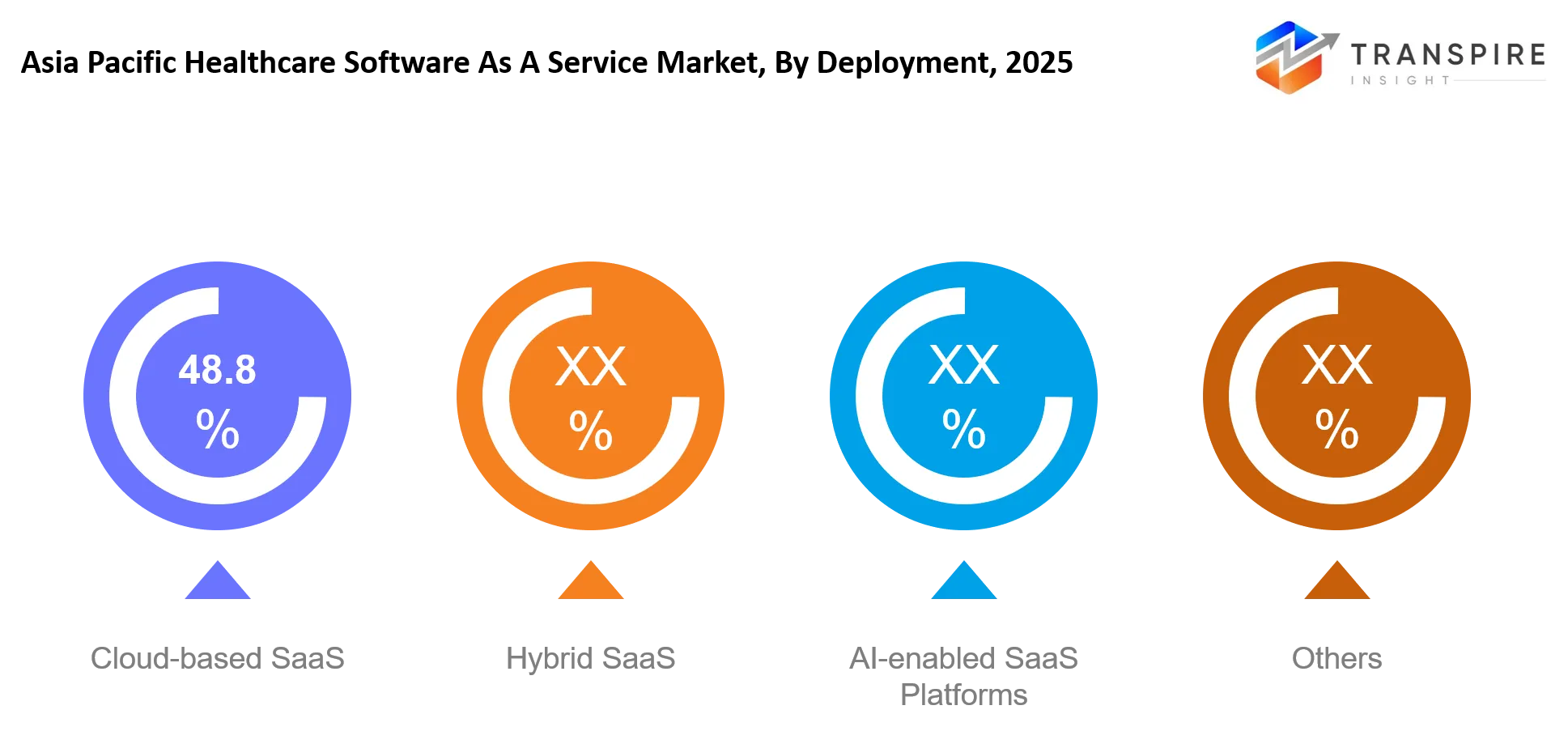
To learn more about this report, Download Free Sample Report
By End User
Hospitals, they’re basically the biggest end user group because big healthcare facilities deal with massive patient volumes, tangled clinical workflows and a lot of administrative stuff too. Digital platforms help with handling patient records, care coordination, the whole financial side, and keeping regulatory compliance in line, across several departments at once. And yeah, the ongoing investments in healthcare modernization keep pushing software adoption in this segment too, even when budgets move slow.
Clinics are using software more and more, mainly to boost scheduling, patient communication, billing, and day to day operational efficiency. Diagnostic centers lean on digital platforms for managing test data, making reporting workflows smoother, and supporting information sharing between healthcare providers and patients, so nobody loses context. Other examples are specialty care centers, rehabilitation facilities, ambulatory care providers and also newer healthcare organizations that are trying to get efficient digital management systems in place.
What are the Key Use Cases Driving the Asia Pacific Healthcare Software As A Service Market?
The biggest real world use case is tied to electronic health record management and, kind of, clinical workflow coordination. Hospitals, and even larger healthcare networks, end up depending on cloud based platforms to bring patient info together, make clinician access smoother, and help coordination across departments. This sort of application shows up with the highest demand because it hits care quality, operational efficiency, and regulatory compliance all at once, pretty directly.
Other common applications also show up around revenue cycle management, telehealth delivery, and patient engagement platforms. Private hospital groups, specialty clinics, and diagnostic centers are using SaaS solutions more often to automate billing, appointment scheduling, insurance verification, and those remote consultations. In practice, these functions allow healthcare organizations to handle more patients without needing to scale admin staff at the same pace.
More emerging use cases now include AI-assisted clinical decision support, population health analytics, and remote patient monitoring. As healthcare providers keep collecting larger volumes of patient data, cloud based software is turning into an important instrument for predictive care management and personalized treatment planning across chronic disease programs.
|
Report Metrics |
Details |
|
Market size value in 2025 |
USD 5919.3 Million |
|
Market size value in 2026 |
USD 7233.4 Million |
|
Revenue forecast in 2033 |
USD 29787.6 Million |
|
Growth rate |
CAGR of 22.41% from 2026 to 2033 |
|
Base year |
2025 |
|
Historical data |
2021 - 2024 |
|
Forecast period |
2026 - 2033 |
|
Report coverage |
Revenue forecast, competitive landscape, growth factors, and trends |
|
Regional scope |
Asia Pacific (India, China, Japan, Australia, South Korea, Rest of Asia Pacific) |
|
Key company profiled |
Oracle Health, Epic Systems, Cerner, Athenahealth, Salesforce Health Cloud, IBM, Microsoft, SAP, Allscripts, GE HealthCare, Meditech, eClinicalWorks, NextGen Healthcare, Veradigm, Philips Healthcare |
|
Customization scope |
Free report customization (country, regional & segment scope). Avail customized purchase options to meet your exact research needs. |
|
Report Segmentation |
By Solution Type (Electronic Health Records, Telehealth Software, Practice Management Software, Revenue Cycle Management, Healthcare Analytics, Others); By Deployment (Cloud-based SaaS, Hybrid SaaS, AI-enabled SaaS Platforms, Others); By End User (Hospitals, Clinics, Diagnostic Centers, Others) |
Which Regions are Driving the Asia Pacific Healthcare Software As A Service Market Growth?
East Asia still feels like the main regional market. Things like China, Japan, and South Korea have put serious effort into healthcare digitalization, cloud infrastructure, and various smart hospital schemes. On top of that there's a pretty strong government push behind electronic health records and healthcare modernization, so it’s easier to roll out software. Basically there’s a mature healthcare tech ecosystem around, and it keeps giving the region that top position.
Oceania comes in as the second biggest contributor, mainly driven by Australia and New Zealand. But unlike East Asia, a lot of the momentum here comes from healthcare quality improvement initiatives, and also from stable regulatory frameworks, not so much from huge infrastructure expansion. Healthcare providers tend to keep putting money into cloud-based platforms, mainly to strengthen interoperability and improve patient results. As a result software vendors can count on a dependable and resilient revenue stream.
Southeast Asia is expected to show the strongest growth all the way through 2033. Countries such as Indonesia, Vietnam, Thailand, and Malaysia are building out healthcare infrastructure and pushing digital transformation even faster. With more private healthcare investment coming in, and with cloud adoption widening, SaaS providers get opened up to new chances. For investors and new market entrants, this region really looks like it can deliver solid, long-term expansion as healthcare systems modernize, one step at a time.
Who are the Key Players in the Asia Pacific Healthcare Software As A Service Market and How Do They Compete?
Competition is kind of moderately concentrated, with large global healthcare technology firms rubbing shoulders with more specialized healthcare software providers. Over time, technology progress, interoperability strengths, cloud scalability, cybersecurity performance, and AI functionality have basically turned into the main “selling points”. Lately, vendors seem to compete more on platform coverage rather than just standalone applications, or at least that’s what it looks like.
Oracle Health, on the other hand, is all about tying clinical and enterprise healthcare operations together using cloud based healthcare infrastructure. They keep pushing their advantage by leaning into healthcare specific cloud platforms, plus big scale healthcare network deployments. Then in May 2026, Oracle backed healthcare digital transformation efforts by extending cloud implementation programs with some major healthcare providers .
Microsoft differentiates itself with AI driven healthcare productivity tools plus cloud infrastructure. Its Dragon Copilot platform bundles clinical documentation, workflow automation, and healthcare AI capabilities all together. Microsoft also continues to broaden its reach through healthcare focused AI collaborations and general ecosystem building.
Salesforce puts a lot of weight on patient engagement, care coordination, and workflow automation. Through Agentforce for Health, Salesforce folds agentic AI features into healthcare operations and helps reinforce its ecosystem via partnerships with healthcare technology providers. Epic Systems and athenahealth keep competing through electronic health record innovation, upgrades for interoperability, and moving further into cloud based healthcare management services.
Company List
- Oracle Health
- Epic Systems
- Cerner
- Athenahealth
- Salesforce Health Cloud
- IBM
- Microsoft
- SAP
- Allscripts
- GE HealthCare
- Meditech
- eClinicalWorks
- NextGen Healthcare
- Veradigm
- Philips Healthcare
Recent Development News
In May 2026, Microsoft and Mayo Clinic announced a strategic collaboration to develop a frontier AI model for healthcare. The initiative aims to improve clinical reasoning, personalized treatment decisions, and healthcare AI deployment through cloud-based platforms. https://news.microsoft.com
In May 2026, IHH Healthcare selected Oracle Fusion Cloud Applications to consolidate enterprise healthcare systems across multiple markets. The deployment is expected to improve operational efficiency, AI-driven decision-making, and healthcare service delivery. https://www.oracle.com
In February 2025, Salesforce launched Agentforce for Health, introducing pre-built AI capabilities for benefits verification, disease surveillance, and clinical trial recruitment. The launch expanded healthcare automation and strengthened Salesforce's healthcare SaaS portfolio. https://www.salesforce.com
What Strategic Insights Define the Future of the Asia Pacific Healthcare Software As A Service Market?
The Asia Pacific Healthcare Software As A Service Market is slowly moving toward these integrated, AI-enabled healthcare ecosystems where clinical, operational, and financial activities kind of run together on one unified cloud stack . The main push behind this change is that healthcare providers need to deliver more services, but without seeing workforce and infrastructure costs rise in the same way. And yeah, as these systems get more and more data heavy, cloud-native software ends up as the base layer for care delivery, analytics, plus patient engagement.
But there is this less obvious risk too, like market concentration around just a few big cloud and healthcare software vendors. If organizations lean too hard on a limited set of technology ecosystems, switching becomes expensive, and day to day operations can end up more fragile or vulnerable.
Still, there is a solid opportunity, especially with AI powered population health management platforms. This feels particularly relevant in emerging Southeast Asian healthcare environments where digital infrastructure is growing quickly. Market participants should focus hard on interoperability, localized compliance know-how, and AI features that are built for healthcare use. Firms that blend those strengths with scalable cloud architecture will likely be the ones that capture the longer-term growth chances across the entire region.
Asia Pacific Healthcare Software As A Service Market Report Segmentation
By Solution Type
- Electronic Health Records
- Telehealth Software
- Practice Management Software
- Revenue Cycle Management
- Healthcare Analytics
- Others
By Deployment
- Cloud-based SaaS
- Hybrid SaaS
- AI-enabled SaaS Platforms
- Others
By End User
- Hospitals
- Clinics
- Diagnostic Centers
- Others
Frequently Asked Questions
Find quick answers to common questions.
The Expected Asia Pacific Healthcare Software As A Service Market size for the Market will be USD 29787.6 Million in 2033.
Key Segments for the Asia Pacific Healthcare Software As A Service Market are By Solution Type (Electronic Health Records, Telehealth Software, Practice Management Software, Revenue Cycle Management, Healthcare Analytics, Others); By Deployment (Cloud-based SaaS, Hybrid SaaS, AI-enabled SaaS Platforms, Others); By End User (Hospitals, Clinics, Diagnostic Centers, Others).
Major Asia Pacific Healthcare Software As A Service Market Players are Oracle Health, Epic Systems, Cerner, Athenahealth, Salesforce Health Cloud, IBM, Microsoft, SAP, Allscripts, GE HealthCare, Meditech, eClinicalWorks, NextGen Healthcare, Veradigm, Philips Healthcare.
The Current Asia Pacific Healthcare Software As A Service Market size is USD 5919.3 Million in 2025.
The Asia Pacific Healthcare Software As A Service Market CAGR is 22.41% from 2026 to 2033.
- Oracle Health
- Epic Systems
- Cerner
- Athenahealth
- Salesforce Health Cloud
- IBM
- Microsoft
- SAP
- Allscripts
- GE HealthCare
- Meditech
- eClinicalWorks
- NextGen Healthcare
- Veradigm
- Philips Healthcare
About the Authors

Mayur Shinde
I am Mayur Shinde, a Senior Research Analyst at Transpire Insight, specializing in the Automotive & Transportation and Information & Communication Technology (ICT) Industry. My work focuses on analyzing emerging market trends, technological advancements, competitive landscapes, and industry developments to deliver accurate, data-driven insights. I am passionate about transforming complex market information into clear, actionable content that helps businesses, professionals, and decision-makers stay informed and make confident strategic decisions.

Chakradhar Khansole
Chakradhar serves as the Research Director at Transpire Insight, bringing over 8 years of experience in technology, innovation, and strategic market intelligence. He specializes in transforming complex market data into actionable business insights that enable organizations to make informed, growth-oriented decisions. Recognized for his strategic vision and analytical expertise, Chakradhar leads high-impact research initiatives, delivering comprehensive market assessments, competitive intelligence, and forward-looking industry analysis.
Recently Published Reports
-
Apr 2026
3D Optical Profiler Market
3D Optical Profiler Market Size, Share & Analysis Report By Type (Desktop 3D Optical Profiler, and Portable 3D Optical Profiler), By Technology (Confocal Technology, and White Light Interference), By End-Use Industry (Manufacturing, Research Institutions, Automotive, Aerospace and Defense, Medical Devices, and Other), and Geography (North America, Europe, Asia-Pacific, Middle East and Africa, South and Central America), 2021 - 2031
-
Apr 2026
Depth Sensor Market
Depth Sensor Market Size, Share & Analysis Report By Type (Infrared Depth Sensors, Time-of-Flight (ToF) Sensors, Stereo Vision Sensors, Structured Light Sensors, Ultrasonic Depth Sensors), By Application (Automotive, Robotics, Gaming, Consumer Electronics, Industrial Automation, Healthcare, Security & Surveillance, Others), By End Users (Automotive Manufacturers, Consumer Electronics Companies, Healthcare Providers, Industrial Companies, Security Agencies, Gaming Companies, Robotics Companies, Others), and Geography (North America, Europe, Asia-Pacific, Middle East and Africa, South and Central America), 2021 – 2031
-
Apr 2026
Digital Manufacturing Market
Digital Manufacturing Market Size, Share & Analysis Report By Component (Hardware, Software, and Services), By Technology (Robotics, 3D Printing, Internet of Things (IoT), and Others), By Application (Automotive and Transportation, Aerospace and Defense, Consumer Electronics, Industrial Machinery, and Others), By Process Type (Computer-Based Designing, Computer-Based Simulation, Computer 3D Visualization, Analytics, and Others), and Geography (North America, Europe, Asia-Pacific, Middle East and Africa, South and Central America), 2021 – 2031
-
Apr 2026
Digital Visa Services Market
Digital Visa Services Market Size, Share & Analysis Report By Type (Individual Travelers, Group Travelers), By Application (Tourism, Business Travel, Others), and Geography (North America, Europe, Asia-Pacific, Middle East and Africa, South and Central America), 2021 – 2031