

Middle East and Africa High-integrity Pressure Protection System Market Size & Forecast:
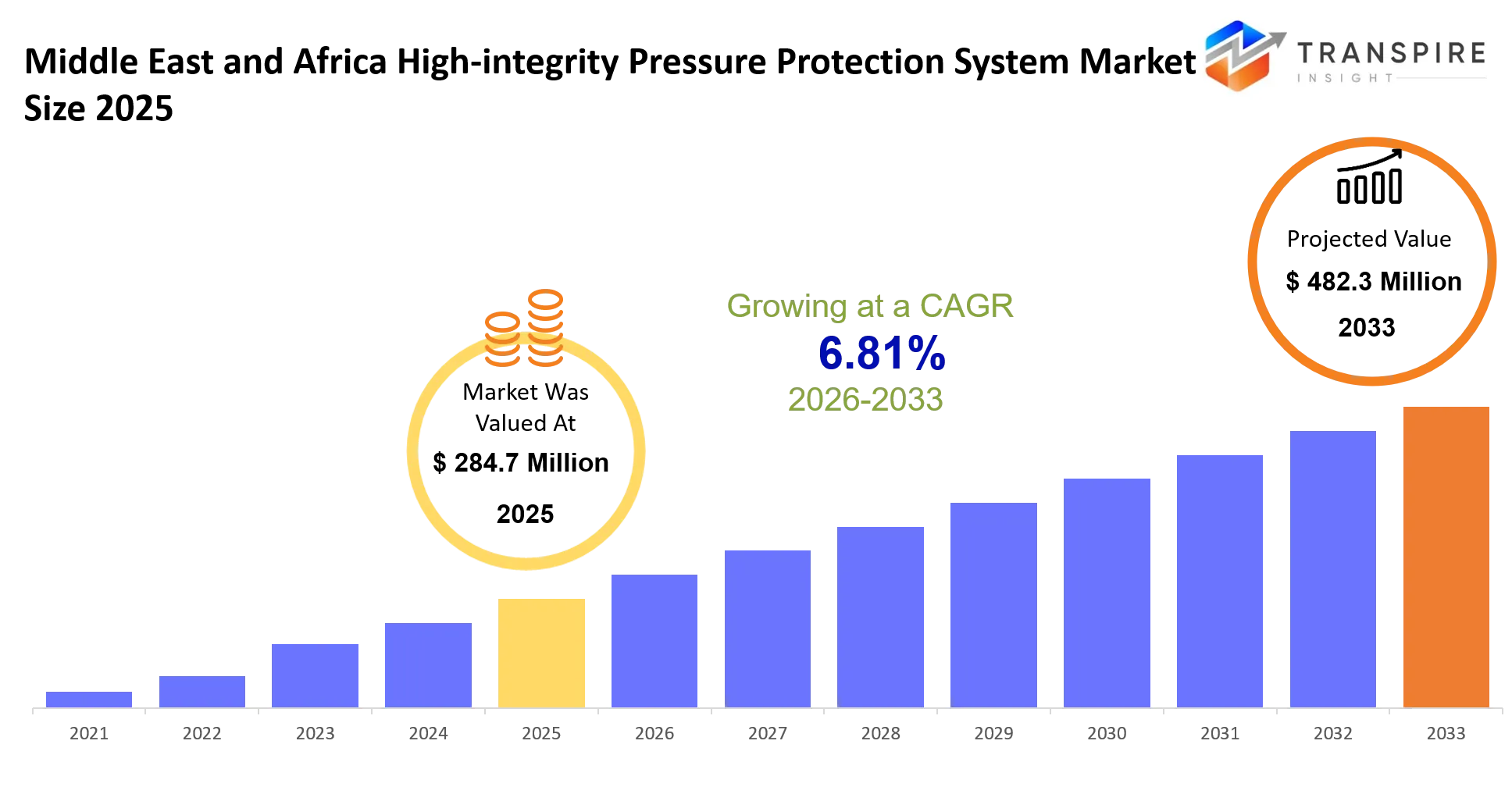
- Middle East and Africa High-integrity Pressure Protection System Market Size 2025: USD 284.7 Million
- Middle East and Africa High-integrity Pressure Protection System Market Size 2033: USD 482.3 Million
- Middle East and Africa High-integrity Pressure Protection System Market CAGR: 6.81%
- Middle East and Africa High-integrity Pressure Protection System Market Segments: By Component (Sensors, Logic Solvers, Valves, Actuators, Software, Others); By Service (Design, Installation, Testing, Maintenance, Consulting, Others); By Industry (Oil & Gas, Chemicals, Power, Mining, Marine, Others); By End User (Refineries, Petrochemicals, Utilities, Others)
Middle East and Africa High-integrity Pressure Protection System Market Summary
The Middle East and Africa High-integrity Pressure Protection System Market was valued at USD 284.7 Million in 2025. It is forecast to reach USD 482.3 Million by 2033. That is a CAGR of 6.81% over the period.
High-integrity pressure protection systems represent the last line of defense for oil and gas production and processing facilities in case the primary pressure control systems fail. These systems serve to ensure that in practice, there will be no overpressure accidents in refining facilities, offshore facilities, and petrochemicals because these systems provide rapid isolation and release of pressure. Over the past five years, there have been significant developments in safety systems, including the transition from hard-wired safety logic to safety instrumented systems featuring automation, remote diagnostics, and monitoring capabilities.
The most notable development has been the transition from isolated loop control to digital safety architecture. These trends were driven primarily by increased enforcement of process safety measures after serious accidents in refineries and offshore compliance requirements adopted in the energy sector in the Middle East. Another driving factor for modernization of legacy systems has been supply chain disruption caused by logistics problems on a global scale.
Key Market Insights
- MEA High-integrity Pressure Protection System Market is moving from standalone relay systems to safety instrumented systems as more than 35% of installations have been digitally upgraded after 2022.
- Oil & Gas is leading the industry with a share of almost 62% in 2025 because of expansions in refineries and offshore production facilities of GCC nations.
- The chemicals industry segment is the fastest-growing segment of the market owing to downstream diversification programs in Saudi Arabia and UAE industrial clusters.
- Hardware segment such as sensors and logic solvers has the maximum share of the MEA market, whereas software-based safety analytics is the fastest growing post-2023.
- The refiners are the largest end-user with over 45% market share owing to high-pressure operations and replacement cycles of older units.
- Utilities sector is becoming a second contributor to market growth owing to safety upgrades at gas-fired power plants.
- ABB, Emerson, Honeywell, and Siemens lead the competitive share because of their automation and safety system products.
- EPCs contractors collaborations with automation providers increased almost 28% during 2022 to 2025.
- Cyber-safe safety systems are becoming popular as operators are increasingly integrating IT and OT networks in their industrial plants.
What are the Key Drivers, Restraints, and Opportunities in the Middle East and Africa High-integrity Pressure Protection System Market?
So basically the Middle East and Africa High-integrity Pressure Protection System Market is moving mainly because the process safety rules are getting tighter, across both upstream and downstream oil and gas activities. Like, regulators in GCC countries and also in offshore parts of Africa have required more layered overpressure protection after several dangerous events tied to older refinery equipment. And that kind of pressure has pushed operators to trade mechanical safety valves for automated, quick-response HIPPS setups, the ones that kind of lower the need for people to step in. So money is shifting toward integrated safety frameworks that stitch together sensors, logic solvers, and automated shutoff valves, which helps keep operations steady and also cuts losses that come from unplanned shutdowns, and revenue related issues.
Still there is a restraint, and it’s pretty practical. The first big issue is the cost at the start, plus the long retrofitting cycle if a facility already exists. A lot of plants run on legacy infrastructure, so it can mean a partial rework before HIPPS can even be deployed, which adds engineering weight and stretches schedules. This often squeezes budgets, in particular for mid-sized operators, so even if the regulations say they should adopt it, adoption slows down.
On the opportunity side, the largest opening seems to sit with offshore deepwater projects and LNG expansion programs across Mozambique and West Africa. These kinds of builds need stronger pressure protection, because the extraction environment is high-pressure, and the operating conditions are remote, far away from easy maintenance. Vendors that deliver modular HIPPS solutions, digitally enabled and paired with predictive diagnostics, should be better placed for long-term agreements. Especially as new offshore platforms come online roughly between 2026 and 2033, they can ride that momentum.
What Has the Impact of Artificial Intelligence Been on the Middle East and Africa High-integrity Pressure Protection System Market?
Artificial intelligence is gradually reshaping pressure safety operations, by letting automated monitoring happen and also predictive intervention across high integrity pressure protection systems. In modern industrial setups, AI enabled control platforms keep analyzing pressure, temperature,and flow data, to catch abnormal patterns early before traditional safety thresholds get actually breached. That tends to improve response time in safety shutdown systems, and it also reduces those unnecessary plant trips that used to trigger production losses, quite often. In offshore facilities, machine learning models are increasingly applied to forecast equipment stress when loads change around, so operators can tune process parameters in real time rather than waiting.
Predictive maintenance is getting more relevant too, because AI models can detect early signals of valve degradation or sensor drift within exhaust gas cleaning, and pressure control systems. As a result, there are measurable gains in uptime. Some operators even mention double digit reductions in unplanned shutdown frequency, plus lower maintenance costs, because they move toward condition based servicing strategies, instead of pure calendar maintenance.
Still, adoption stays limited by inconsistent data quality from older industrial sensors, and also by connectivity gaps in offshore environments, where real time data transmission can be flaky. On top of that, the integration costs for AI enabled safety systems remain high, especially when retrofitting legacy HIPPS installations. Even with those constraints, digital optimization continues to pick up steam, since operators want both efficiency and compliance, in those high risk pressure management settings.
Key Market Trends
- After 2023, adoption of digitally integrated safety systems jumped pretty hard, swapping out the traditional hardwired pressure protection setups, for the most part.
- In the GCC refinery upgrades happening from 2024–2026, demand went up by nearly 40% for more advanced HIPPS configurations, you could say it just kept climbing.
- Meanwhile offshore African oil projects started bringing in tougher safety layers, which sped up take‑up of automated shutdown technologies.
- Emerson and Honeywell, in 2025 expanded their digital safety portfolios, leaning into cloud-enabled monitoring tools and similar things.
- Then, cybersecurity integration inside safety systems rose sharply after 2024, mainly because OT-IT convergence in refineries became more normal, not really optional.
- Valve automation demand also increased, as operators shifted toward faster isolation systems for high-pressure environments, and yeah it matters.
- Predictive maintenance adoption grew across major refineries, and that helped reduce unplanned downtime by catching early fault detection sooner than before.
- EPC contractors started increasingly bundling HIPPS together with full automation packages, changing how procurement works in MEA projects.
- Software based safety analytics platforms gained traction, especially across LNG, and petrochemical facilities.
- And regulatory enforcement in offshore Africa tightened between 2023–2025, which pushed compliance-driven retrofits forward.
Middle East and Africa High-integrity Pressure Protection System Market Segmentation
By Component
The Middle East and Africa High-Integrity Pressure Protection System Market by component, includes sensors, logic solvers, valves, actuators, software, and other related supporting elements. Sensors and logic solvers kind of become the central intelligence layer by catching real-time pressure differences and then pushing automated safety actions without operator delay. They are now more and more being placed inside digital safety frameworks that get used across refineries and offshore production areas. Valves plus actuators then do the hands-on execution job, isolating or releasing pressure when abnormal situations happen, to avoid equipment rupture and those ugly production shutdowns. Meanwhile software is taking a bigger part in the process, it supports remote monitoring and diagnostics, and it links into plant-wide control systems, which helps response teamwork, also lowers manual involvement mistakes.
Demand for each component is really shaped by the modernization of old refinery infrastructure, and by the continued expansion of offshore energy projects across the region. In many sites, operators are moving away from mechanical and analog safety systems, and swapping toward digitally connected setups that deliver better accuracy and stronger reliability under high-pressure scenarios. Sensors alongside software parts are being adopted faster, mainly because they enable predictive safety analytics and system optimization. At the same time, valves and actuators still matter a lot, because they remain the required physical response units in basically every safety arrangement. Growth across all component categories points to a wider movement toward automation driven safety ecosystems, especially in high-risk industrial settings.
By Service
The Middle East and Africa High-Integrity Pressure Protection System Market by service includes things like design, installation, testing, maintenance, consulting, and other lifecycle services that kinda stay around for the long run. Design services, typically, revolve around creating safety architectures that fit tricky pressure contexts in oil, gas and chemical processing facilities. These engineering activities make sure system sizing is correct, redundancy is planned properly, and the whole setup stays aligned with international safety standards .
Installation and testing services are essential during commissioning stages, particularly on offshore platforms and in high-risk refinery units, where the system’s reliability has to be validated before anything starts. Maintenance and consulting are also getting more attention as operators shift toward long-term asset safety optimization instead of doing a one-time deployment and then forgetting it. Maintenance covers continuous calibration of sensors, logic solvers, and shutdown mechanisms so performance doesn’t wander or drift as time passes, and consulting backs regulatory alignment, risk assessment, plus system upgrades when safety obligations change.
Overall demand for lifecycle services keeps climbing, since industrial operators across the Middle East and Africa focus on operational continuity, less downtime, and compliance with tighter process safety frameworks in energy and petrochemical sectors.
By Industry
In the Middle East and Africa, the High-Integrity Pressure Protection System Market by industry covers oil and gas , chemicals, power, mining, marine, and other industrial sectors. Oil and gas still leads, mostly because upstream exploration stays intense, offshore drilling remains active, and refinery operations keep running across GCC countries as well as in several African production zones. In practice, these sites deal with harsh pressure conditions all the time, so HIPPS installations become pretty much essential, preventing catastrophic failures while keeping production steady.
For chemicals, the adoption story is getting louder too, since production complexity is rising and safety rules are getting tighter in downstream processing lines. Meanwhile, power generation, mining, and marine sectors are taking HIPPS on more slowly but steadily , as operational hazards grow and compliance expectations become more strict. In power, gas-fired and thermal plants need stable pressure management, mainly to support grid reliability and protect the equipment, even during changing load conditions. Mining uses HIPPS for handling high-pressure processing systems, and marine setups tend to prioritize offshore vessel safety, plus cargo handling activities during voyages.
Overall, growth across the whole region is strongly tied to infrastructure modernization programs, and also to stricter enforcement of industrial safety standards throughout the Middle East and Africa.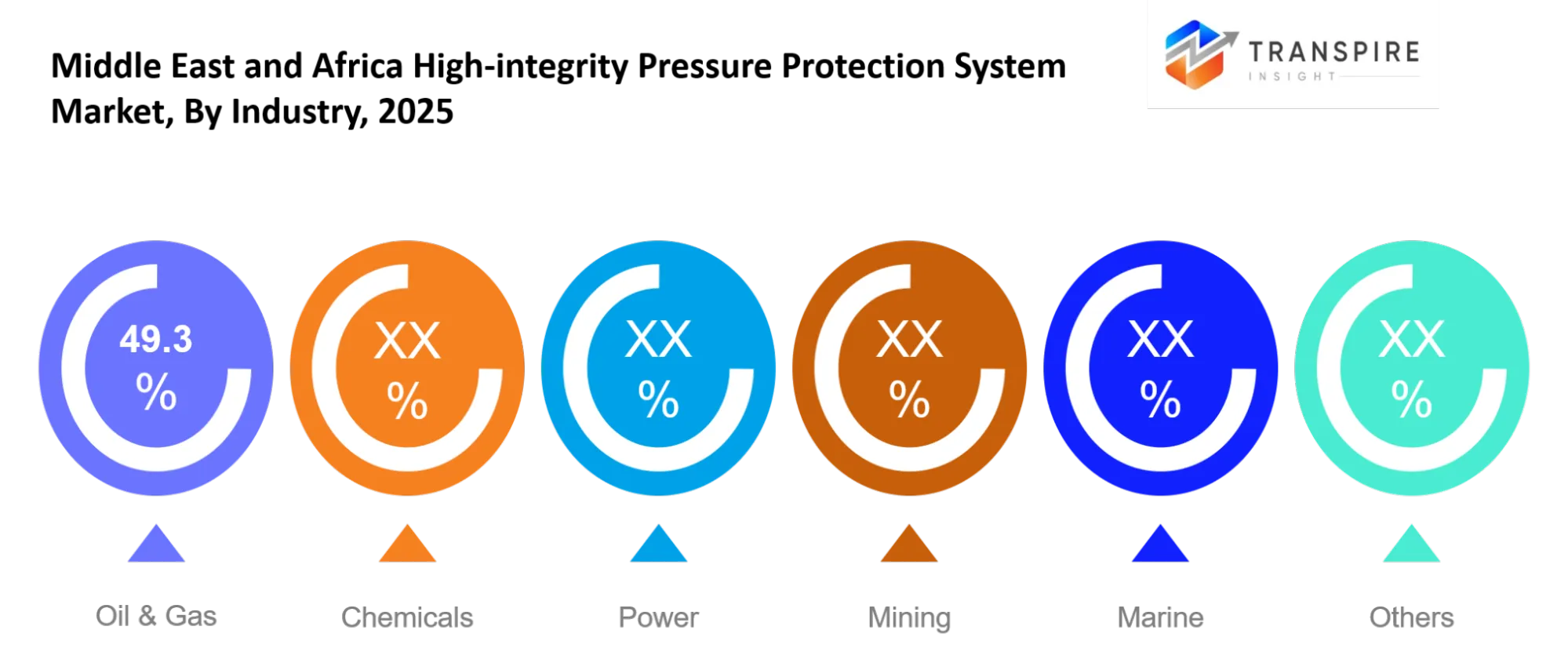
By End User
The Middle East and Africa High-Integrity Pressure Protection System Market by end user spans refineries, petrochemicals, utilities, and other industrial operators, kind of a broad mix. Refineries show up as the biggest end user portion, mainly because continuous upgrades keep happening in pressure control systems and because high risk refining operations are still very common, especially with volatile hydrocarbons around. In practice, these facilities want multilayer safety approaches, not just basic safeguards, to stop overpressure events from turning into something bigger and to keep operations running smoothly even when processing conditions get difficult and demanding. Petrochemical plants are also major users because they run complicated chemical reactions, so they need very exact pressure regulation, plus automated shutdown mechanisms, to avoid unwanted deviations.
Utilities and other industrial buyers are leaning more and more toward HIPPS solutions to improve infrastructure dependability and lower exposure to system failure in gas distribution as well as power networks. Utilities in particular gain from automated pressure protection inside high-capacity pipelines and energy transmission systems. Other end users, such as offshore operators and industrial manufacturing units, are taking on HIPPS technologies too, mainly for stronger safety compliance and better operational efficiency. Overall, growth across these end-user groups gets nudged forward by modernization of older legacy systems, rising safety requirements, and the stronger emphasis on risk control across important industrial assets throughout the region.
What are the Key Use Cases Driving the Middle East and Africa High-integrity Pressure Protection System Market?
The main use case for high integrity pressure protection systems is basically helping safeguard refinery and petrochemical processing units, where an uncontrolled pressure buildup can, in worst cases, turn into catastrophic equipment failure. You see these protections getting picked for high pressure separation and compression stages, because in that kind of work, the “normal” control valves are often not enough or not responsive in time.
There are also secondary applications that are slowly growing, especially across offshore drilling platforms and LNG facilities, where the pressure fluctuations feel more severe, partly due to deepwater extraction and also because the feed conditions vary. On top of that, utilities inside gas transmission networks are starting to adopt these same systems to stabilize high pressure pipelines, and to stop cascading failures from snowballing.
More recently, emerging use cases show up in hydrogen production facilities and carbon capture systems, where extreme pressure management requirements are becoming more and more critical for next generation energy infrastructure.
|
Report Metrics |
Details |
|
Market size value in 2025 |
USD 284.7 Million |
|
Market size value in 2026 |
USD 304.1 Million |
|
Revenue forecast in 2033 |
USD 482.3 Million |
|
Growth rate |
CAGR of 6.81% from 2026 to 2033 |
|
Base year |
2025 |
|
Historical data |
2021 - 2024 |
|
Forecast period |
2026 - 2033 |
|
Report coverage |
Revenue forecast, competitive landscape, growth factors, and trends |
|
Regional scope |
Middle East and Africa (Saudi Arabia, United Arab Emirates, South Africa, Rest of Middle East and Africa) |
|
Key company profiled |
Schneider Electric, Honeywell, Emerson, ABB, Siemens, Yokogawa, Rockwell, HIMA, Valmet, Baker Hughes, Endress+Hauser, WIKA, GE, Phoenix Contact, Rotork |
|
Customization scope |
Free report customization (country, regional & segment scope). Avail customized purchase options to meet your exact research needs. |
|
Report Segmentation |
By Component (Sensors, Logic Solvers, Valves, Actuators, Software, Others); By Service (Design, Installation, Testing, Maintenance, Consulting, Others); By Industry (Oil & Gas, Chemicals, Power, Mining, Marine, Others); By End User (Refineries, Petrochemicals, Utilities, Others) ) |
Which Regions are Driving the Middle East and Africa High-integrity Pressure Protection System Market Growth?
The Middle East still feels like the leading region, mainly because there is a dense concentration of oil refineries, offshore platforms, plus strong regulatory enforcement across GCC countries. Big scale investments in upstream and downstream oil infrastructure, along with strict process safety mandates keep pushing a broad rollout of advanced pressure protection systems . In the background, well established EPC networks and automation suppliers also make deployment quicker and more efficient across the main industrial hubs.
Africa is more like a stable, steady contributor. This is helped by offshore oil production in places like Nigeria and Angola. But, unlike the Middle East, the growth here comes less from refinery expansion on a huge scale and more from incremental modernization . Operators tend to lean into cost-effective safety upgrades, then they use phased implementation strategies, mostly because budgets are tighter . So demand stays consistent, just not overly aggressive.
North and West Africa is probably the fastest-growing region overall. There, new offshore discoveries and LNG development projects are quietly reshaping industrial safety requirements. The recent investments in deepwater exploration and export infrastructure are also speeding up demand for advanced HIPPS installations. Between 2026 and 2033, this region should attract a sizable amount of EPC and automation investment, and that makes it a real entry point for global safety system providers.
Who are the Key Players in the Middle East and Africa High-integrity Pressure Protection System Market and How Do They Compete?
The Middle East and Africa High-integrity Pressure Protection System Market is somewhat consolidated, like, global automation giants control a lot of the high-value work while regional EPC companies do the boots-on-the-ground implementation and system integration, sorta. Rivalry is mostly about how dependable the technology is, how clean the safety certification compliance looks, and how well the solution meshes with the industrial automation that is already there. The established players are pushing harder via digitalization, whereas the newer entrants tend to angle for specialized engineering support and deployments that are cost-optimized.
Schneider Electric and Honeywell seem to lean into integrated digital safety platforms, where HIPPS is bundled with industrial IoT ecosystems, which helps deliver predictive diagnostics and also centralized monitoring. Emerson, by contrast, differentiates using solid process automation know-how plus a deep safety instrumented system portfolio, designed for refinery operating conditions. ABB plays to its electrical and automation integration strengths to provide end to end safety architectures, especially for offshore and petrochemical use cases.
Siemens and Yokogawa emphasize advanced control system integration, and compliance-driven safety engineering, particularly in LNG deliveries and bigger refinery projects. Their growth plays include collaborations with EPC contractors, expansion of regional service centers across GCC nations, and ongoing improvements in software-based safety analytics. More and more, competitive edge is being defined by cybersecurity integration, real-time diagnostics, and the ability to retrofit older systems without a full plant shutdown.
Company List
- Schneider Electric
- Honeywell
- Emerson
- ABB
- Siemens
- Yokogawa
- Rockwell Automation
- HIMA
- Valmet
- Baker Hughes
- Endress+Hauser
- WIKA
- GE
- Phoenix Contact
- Rotork
Recent Development News
In February 2026, Honeywell entered into a strategic collaboration with Kortech (Hassan Allam Holding subsidiary). The partnership focuses on digitizing and automating critical infrastructure projects across the Middle East and North Africa, strengthening integrated automation ecosystems that support advanced industrial safety and pressure control systems.https://www.honeywell.com
In April 2026, Yokogawa Electric Corporation obtained certification to the O-PAS standard’s OPC UA profile. This milestone improves interoperability between industrial control and safety systems, enhancing integration efficiency for safety instrumented functions used in high-integrity pressure protection deployments across refineries and energy facilities.https://www.yokogawa.com
In February 2026, Yokogawa Electric Corporation signed a global sales and service agreement with CMC Solutions for predictive emission monitoring systems. The agreement strengthens advanced monitoring and control capabilities, supporting safer and more efficient industrial operations that indirectly enhance pressure protection system performance in high-risk plants.https://www.yokogawa.com
What Strategic Insights Define the Future of the Middle East and Africa High-integrity Pressure Protection System Market?
The Middle East and Africa High-integrity Pressure Protection System Market is kinda moving toward fully digital, predictive safety architectures, but in a way that feels more and more embedded within the wider industrial automation ecosystem. It’s happening because process safety enforcement is getting tighter, and operators really want to cut the chance of those unplanned shutdowns, especially in high-pressure oil and gas operations. There is also a quieter kind of risk that people mention less, which is the growing reliance on integrated digital platforms , and that can open the door to cybersecurity weak points, plus possible operational disruptions if the systems get compromised.
Meanwhile offshore hydrogen and LNG expansion is becoming a real, emerging chance. In those extreme pressure environments, you’ll need next-generation HIPPS designs with built-in analytics. Market players should really focus on modular, retrofit-friendly solutions, that can slot into older infrastructure without too much upheaval, while also enabling digital monitoring. The firms that manage to blend strong safety certification with cybersecurity resilience and predictive analytics will likely land the best long-term agreements across MEA industrial growth cycles.
Middle East and Africa High-integrity Pressure Protection System Market Report Segmentation
-
By Component
Sensors
Logic Solvers
Valves
Actuators
Software
Others -
By Service
Design
Installation
Testing
Maintenance
Consulting
Others -
By Industry
Oil & Gas
Chemicals
Power
Mining
Marine
Others -
By End User
Refineries
Petrochemicals
Utilities
Others
Frequently Asked Questions
Find quick answers to common questions.
The Expected Middle East and Africa High-integrity Pressure Protection System Market size for the Market will be USD 482.3 Million in 2033.
Key Segments for the Middle East and Africa High-integrity Pressure Protection System Market are By Component (Sensors, Logic Solvers, Valves, Actuators, Software, Others); By Service (Design, Installation, Testing, Maintenance, Consulting, Others); By Industry (Oil & Gas, Chemicals, Power, Mining, Marine, Others); By End User (Refineries, Petrochemicals, Utilities, Others).
Major Middle East and Africa High-integrity Pressure Protection System Market players are Schneider Electric, Honeywell, Emerson, ABB, Siemens, Yokogawa, Rockwell, HIMA, Valmet, Baker Hughes, Endress+Hauser, WIKA, GE, Phoenix Contact, Rotork.
The Current Middle East and Africa High-integrity Pressure Protection System Market size is USD 284.7 Million in 2025.
The Middle East and Africa High-integrity Pressure Protection System Market CAGR is 6.81% from 2026 to 2033.
- Schneider Electric
- Honeywell
- Emerson
- ABB
- Siemens
- Yokogawa
- Rockwell Automation
- HIMA
- Valmet
- Baker Hughes
- Endress+Hauser
- WIKA
- GE
- Phoenix Contact
- Rotork
About the Authors

Avinash Kumar
I’m Avinash Kumar, a Senior Research Analyst at Transpire Insight, with expertise in the Electronics and Semiconductor and Energy & Power industry. My work focuses on analyzing emerging technologies, market trends, industry developments, and innovation across these sectors. I specialize in transforming complex technical and market insights into clear, research-backed content that helps professionals, businesses, and decision-makers stay informed. Through continuous industry research and data-driven analysis, I strive to deliver accurate, reliable, and practical perspectives on the latest advancements shaping the semiconductor and energy landscape.

Chakradhar Khansole
Chakradhar serves as the Research Director at Transpire Insight, bringing over 8 years of experience in technology, innovation, and strategic market intelligence. He specializes in transforming complex market data into actionable business insights that enable organizations to make informed, growth-oriented decisions. Recognized for his strategic vision and analytical expertise, Chakradhar leads high-impact research initiatives, delivering comprehensive market assessments, competitive intelligence, and forward-looking industry analysis.
Recently Published Reports
-
Apr 2026
Active Power Filter Market
Active Power Filter Market Size, Share & Analysis Report By Type (Shunt Active Power Filters, Series Active Power Filter, Hybrid Active Power Filter), By Application (Harmonics Mitigation, Reactive Power Compensation, Voltage Regulation, Power Factor Correction), By Phase (Single Phase, Three Phase), By End-User Industry (Manufacturing, Healthcare, Commercial, Automotive, Oil and Gas, Others), and Geography (North America, Europe, Asia-Pacific, Middle East and Africa, South and Central America), 2021 - 2031
-
Apr 2026
Electrical Transformer Market
Electrical Transformer Market Size, Share & Analysis Report By Core (Closed, Shell, and Berry), By Insulation (Gas, Oil, Solid, Air, and Other), By Phase (Single, and Three), By Rating (100 MVA to 500 MVA, 501 MVA to 800 MVA, and 801 MVA to 1200 MVA), and Geography (North America, Europe, Asia-Pacific, Middle East and Africa, South and Central America), 2021 – 2031
-
Apr 2026
Hydraulic Piston Pumps Market
Hydraulic Piston Pumps Market Size, Share & Analysis Report By Type (Axial Piston Pumps, Radial Piston Pumps), By Operating Pressure (Low Pressure, Medium Pressure, High Pressure), By Application (Construction, Mining, Agriculture, Automotive, Oil & Gas, Industrial Machinery, Others), By End-User (OEMs, Aftermarket), and Geography (North America, Europe, Asia-Pacific, Middle East and Africa, South and Central America), 2021 – 2031
-
Apr 2026
Laboratory Gas Generators Market
Laboratory Gas Generators Market Size, Share & Analysis Report By Product (Nitrogen Gas Generator, Hydrogen Gas Generator, Zero Air Gas Generator, Purge Gas Generator, TOC Gas Generators, Others), By Application (Gas Chromatography, Liquid Chromatography-mass Spectrometry (LC-MS), Gas Analyzers, Others), By End-user (Life Science, Chemical & Petrochemical, Food & Beverage, Others), and Geography (North America, Europe, Asia-Pacific, Middle East and Africa, South and Central America), 2021 – 2031