
Asia Pacific Health Sensors Market Size & Forecast:
- Asia Pacific Health Sensors Market Size 2025: USD 12.7 Billion
- Asia Pacific Health Sensors Market Size 2033: USD 43.5 Billion
- Asia Pacific Health Sensors Market CAGR: 16.65%
- Asia Pacific Health Sensors Market Segments: By Sensor Type (Temperature Sensors, Pressure Sensors, Biosensors, Motion Sensors, ECG Sensors, Blood Oxygen Sensors, Others); By Application (Patient Monitoring, Diagnostics, Fitness Tracking, Wearables, Remote Healthcare, Others); By Technology (Wireless Sensors, MEMS Sensors, Smart Sensors, Others); By End User (Hospitals, Clinics, Homecare, Consumers, Others).
Asia Pacific Health Sensors Market Summary
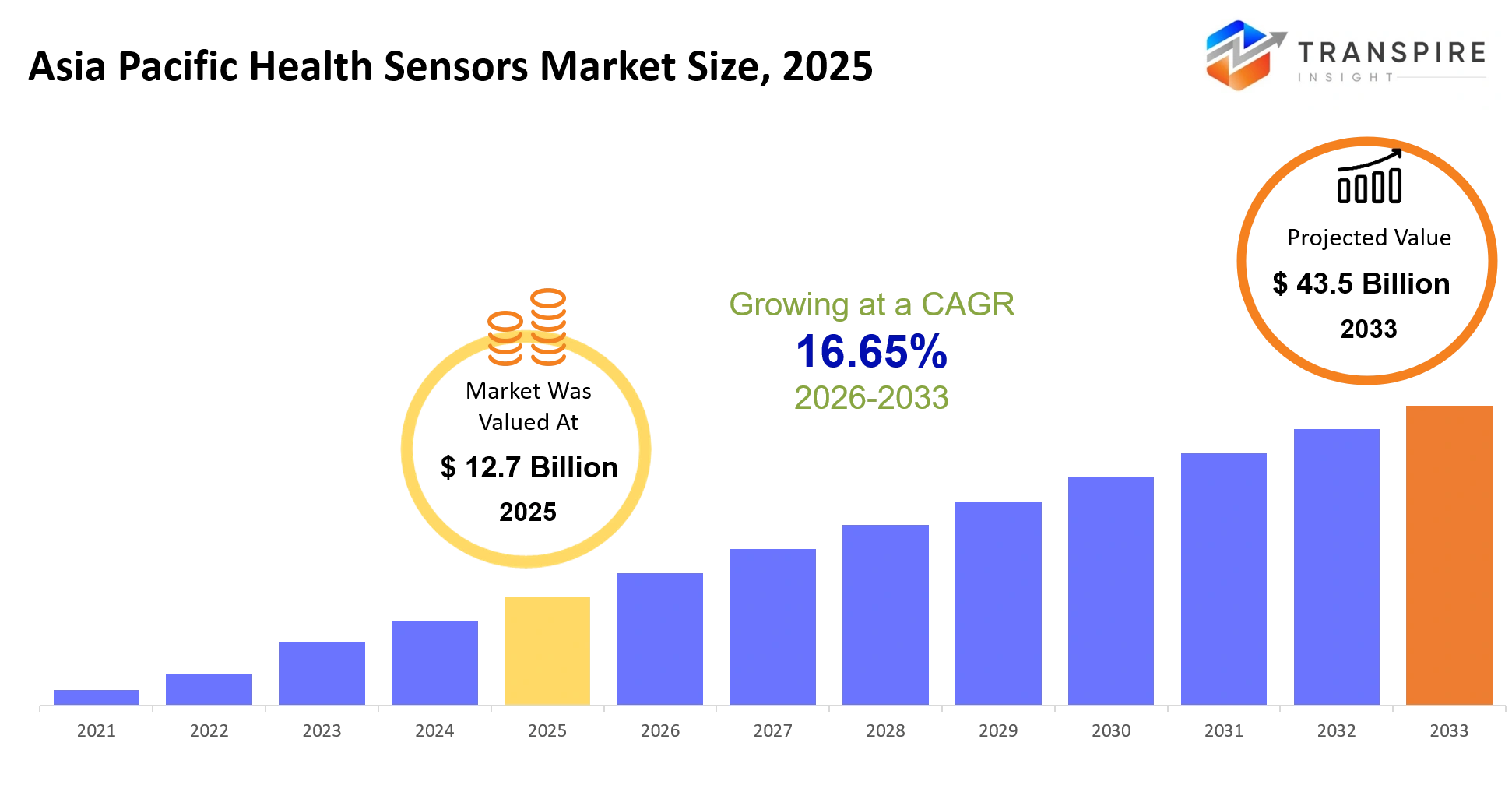
The Asia Pacific Health Sensors Market was valued at USD 12.7 Billion in 2025. It is forecast to reach USD 43.5 Billion by 2033. That is a CAGR of 16.65% over the period.
The Asia Pacific Health Sensors Market supports continuous tracking of vital physiological signals like heart rate, blood oxygen levels, blood glucose, temperature and even motion, so healthcare teams , patients, plus fitness users can make quicker choices from live health readouts. In other words, these sensors cut down on how often people need periodic clinical visits, and they back proactive observation across hospitals, home environments, and remote care scenarios.
Over the last five years, the market has gone through a sort of shift, from standalone devices that simply measure, toward connected sensor ecosystems that work with cloud platforms , mobile apps, and AI based analytics. The COVID-19 pandemic kind of pushed things forward, acting as a big catalyst for investment in remote patient monitoring and digital healthcare infrastructure throughout the region. When healthcare systems tried to handle patient flow outside the usual clinical rooms, sensor adoption grew really fast. And because of that, there is now a wider installed base of connected hardware which opens recurring revenue chances via software, data services, and longer-term monitoring programs, while also making care more reachable and improving day to day operational efficiency.
Key Market Insights
- China is leading the market with around 32 to 35 percent share in 2025. This is because China is investing a lot in healthcare digitization and medical technology.
- India is growing fast in this market from 2025 to 2030. The main reasons are that more people are using services wearing wearable devices and the government is modernizing healthcare.
- Japan is still a player in this market. One reason is that Japan has an aging population and people there use advanced monitoring technologies a lot.
- Southeast Asia is becoming an area for growth. This is because governments in Southeast Asia are making healthcare better.
- Wearable health sensors are the popular with almost 38 to 40 percent share in 2025. People like them because they can monitor health continuously and help with wellness.
- Biosensors are the biggest segment. They are used more and more for checking glucose levels and diagnostic testing.
- Wireless health sensors will grow the fastest by 2030. This is because more and more healthcare systems are becoming connected.
- People are using sensors more and more. This is because healthcare providers want to know more, about patients in time and work more efficiently.
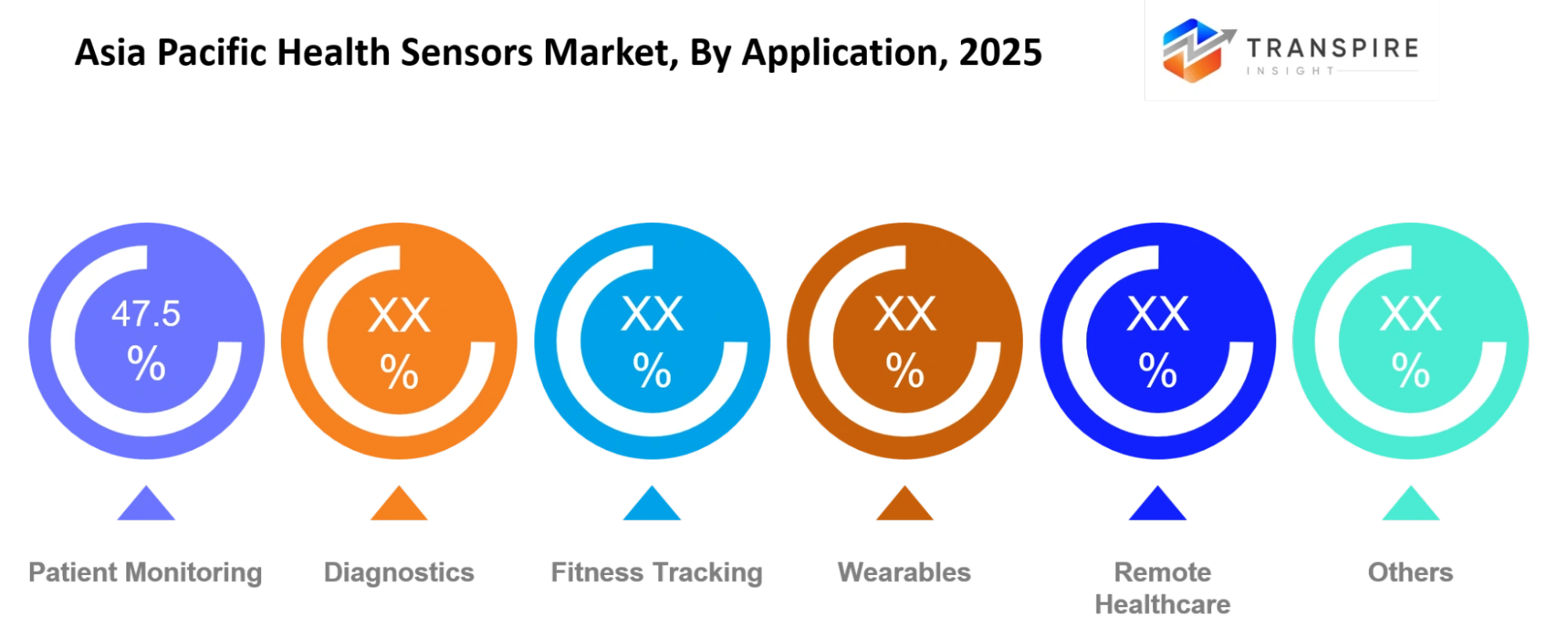
- Patient monitoring makes up about 42 to 45 percent of the market. This is the application segment.
- Remote healthcare is expected to grow the fastest during the forecast period.
What are the Key Drivers, Restraints, and Opportunities in the Asia Pacific Health Sensors Market?
The Asia Pacific Health Sensors Market is growing fast because of how quickly remote patient monitoring is becoming a normal part of healthcare. This started to happen a lot during the COVID-19 pandemic, when hospitals in China, India, Japan and Australia began using tools to take care of patients outside of the hospital. This was done to reduce the number of people in the hospital and to keep an eye on patients who were not in the hospital. At the time it became easier and cheaper to use these tools because of better wireless connections, smaller sensors and cloud-based health platforms. As doctors and hospitals start to use these tools often to help people with long-term health problems the companies that make these sensors will sell more of them and make more money from the software and data that comes with them.
There are still some problems that are slowing down the growth of the Asia Pacific Health Sensors Market. One of these problems is keeping information private and secure. This is hard because there are different devices, software programs and healthcare systems that need to be able to share information with each other. Different countries in the Asia Pacific region have rules and regulations which makes it hard for companies and hospitals to follow them. Because it takes a time to create rules and regulations for healthcare data and because many different people and organizations need to work together these problems are not going to be solved quickly. This means that it is going to take to get these tools to people who need them and it will be harder to sell them across different countries.
The use of intelligence in health sensors is a big opportunity for growth. If you combine sensors with artificial intelligence you can do more than just collect data. You can actually predict when someone might get sick and detect health problems early. Countries, like Singapore, South Korea and Japan are investing a lot of money in health tools, which will make it easier to use these intelligent monitoring solutions on a large scale. As doctors and hospitals start to look for ways to prevent health problems of just treating them artificial intelligence-powered sensors could lead to new ways of treating patients and could make more money for the companies that make them. The Asia Pacific Health Sensors Market is going to keep growing because of this.
What Has the Impact of Artificial Intelligence Been on the Asia Pacific Health Sensors Market?
The Asia Pacific Health Sensors Market is changing because of intelligence and new digital technologies. These technologies are making sensor networks smarter. They are no longer tools that monitor patients. Now they help doctors make decisions.
Healthcare providers are using intelligence to automate patient care. They use it to look at data and send alerts when something is wrong. This means doctors do not have to watch patients all the time. They can focus on patients who're very sick.
Machine learning is also helping doctors predict what will happen to patients. It looks at things, like heart rate and blood oxygen levels. It can tell when a patient might get sick before it happens. This helps doctors treat patients before they get very sick.
These new technologies are helping hospitals. They can monitor patients better. Respond faster. They can also take care of patients without needing more staff. People can also get care from home. This helps reduce costs and makes sure patients get the care they need.
There is a problem. Many hospitals are having trouble using data from devices. The data is not always quality. This makes it hard to use intelligence to help patients. The Asia Pacific Health Sensors Market is still growing because of intelligence and new digital technologies. Artificial intelligence is changing the Asia Pacific Health Sensors Market.
Key Market Trends
- Since 2020 healthcare providers have moved away from using monitoring devices. Now they use sensor ecosystems that are connected to cloud-based clinical platforms.
- This change happened because remote patient monitoring became more popular after the pandemic. Hospitals in China India and Australia started to expand their care programs.
- Wearable device manufacturers are now making devices with medical-grade sensing capabilities. This means that the difference between consumer wellness and clinical monitoring is getting smaller.
- Artificial intelligence enabled analytics are being used more and more. They help clinicians find health risks by looking at continuous sensor data.
- Sensor vendors have been working with platforms since 2021. They want to create digital healthcare solutions instead of just making separate hardware.
- People who buy healthcare products are now looking for things that can work together. So manufacturers are redesigning their products to work with health record systems.
- More people are using glucose monitoring. This is because the sensors are more accurate and the devices last longer.
- Governments in regions have been investing more in digital health since 2022. This has helped to get monitoring infrastructure to areas that need it.
- Companies like Medtronic, Abbott, Philips and Dexcom are investing more in software and analytics. They want to be different, from companies that just make sensor hardware.
- Battery efficiency and wireless connectivity are getting better. This means that devices can be used for periods of time. It also means that more people can use home-based and long-term care programs.
Asia Pacific Health Sensors Market Segmentation
By Sensor Type:
Temperature sensors kind of sit in a vital role inside healthcare monitoring, because continuous body temperature tracking helps catch infections early, and other health complications too, before they become a bigger thing. Pressure sensors are also widely used in medical devices that measure blood pressure plus respiratory activity, so healthcare professionals can keep patient assessments accurate and steady, even when conditions shift. Motion sensors have lately been taken up more broadly, especially as healthcare systems put extra emphasis on mobility tracking, fall detection and rehabilitation progress monitoring.
Biosensors keep moving up in market presence through uses like glucose monitoring, disease detection, and point-of-care diagnostic support. ECG sensors still matter a lot for cardiac monitoring, mainly in wearable and remote healthcare systems where continuous heart activity measurement is needed 24/7. Blood oxygen sensors have expanded in both clinical and homecare settings, partly because pulse oximetry is getting more common and connected monitoring solutions are spreading. There are other sensor types as well, supporting more specialized healthcare applications, which in turn contributes to wider adoption of digital health technologies overall.
By Application:
Patient monitoring stays one of the prime application areas, because care teams increasingly lean on continuous physiological data, to make quick medical calls. Connected monitoring systems really help with observation strength in hospitals, clinics, and homecare settings where you can’t just “wait and see”. Diagnostics is also a key segment, since sensor technologies allow quicker yet more accurate health-condition detection, which matters a lot.
Fitness tracking meanwhile keeps expanding, mainly after wearable devices became common. These wearables track activity levels, heart rate, and various wellness indicators, and they do it very reliably. Over time, wearables are going further than basic lifestyle monitoring, adding more advanced health measurement capabilities too, so it’s not only about movement metrics. Remote healthcare applications are growing just as well, especially as healthcare delivery shifts toward tele consults and home-based care models. There are also other use cases for specialized clinical and wellness needs, across many healthcare environments, where the requirements can differ.
By Technology:
Healthcare organizations prefer wireless sensors as they desire seamless data transmission and real-time monitoring capabilities. Better connectivity supports remote care programs and helps healthcare professionals get to patient information quickly. Connected healthcare infrastructure deployment further strengthens the adoption of wireless sensor solutions.
MEMS sensors are important due to their small size, low power consumption and suitability for wearable and portable medical devices.” With advanced processing capabilities data can be analyzed within the monitoring systems themselves, and consequently, smart sensors are gaining ground. Further, integration with artificial intelligence and cloud platforms enhances healthcare decision making. Other technologies enable niche applications and drive continued innovation across digital healthcare ecosystems.
By End User:
Hospitals represent a significant end user segment as continuous monitoring technologies aid in patient management, operational efficiency and clinical decision. Healthcare facilities continue to invest in connected sensor systems to enhance care quality and workflow effectiveness. The rising deployment of real-time monitoring solutions supports the deployment of sensors in inpatient and outpatient settings.
More and more, sensing capabilities are being built into medical equipment by manufacturers and digital health platform providers. There is a growing trend toward long-term disease management and remote monitoring in the region, which is broadening home healthcare settings. Research institutes & diagnostic centers also contribute in driving adoption through clinical studies and advanced testing applications. Other end users are contributing to market growth through the deployment of sensor-based solutions across various healthcare services.
What are the Key Use Cases Driving the Asia Pacific Health Sensors Market?
The key use case driving adoption across the Asia Pacific health sensor industry is continuous patient monitoring. Real-time tracking of vital signs such as heart rate, blood oxygen levels and body temperature is essential to hospitals and healthcare networks to enable faster clinical decisions, reduce monitoring gaps and improve patient outcomes. This application creates the greatest demand as it serves both acute care and long-term disease management.
Across healthcare systems, there is a growing traction for remote healthcare and home-based monitoring. Providers are increasingly leveraging connected sensors to manage chronic conditions, monitor recovery following hospital discharge, and support the elderly outside of traditional clinical settings. Fitness and wellness platforms are also expanding sensor deployment to provide personalized health insights.
New applications include AI based predictive health monitoring and continuous disease risk assessment based on advanced biosensing technologies. The data generated by sensors are also starting to be incorporated into digital therapeutics and preventive health care programs, paving the way for new and exciting opportunities for proactive intervention and personalized treatment strategies over the next few years.
|
Report Metrics |
Details |
|
Market size value in 2025 |
USD 12.7 Billion |
|
Market size value in 2026 |
USD 14.8 Billion |
|
Revenue forecast in 2033 |
USD 43.5 Billion |
|
Growth rate |
CAGR of 16.65% from 2026 to 2033 |
|
Base year |
2025 |
|
Historical data |
2021 - 2024 |
|
Forecast period |
2026 - 2033 |
|
Report coverage |
Revenue forecast, competitive landscape, growth factors, and trends |
|
Regional scope |
Asia Pacific (India, China, Japan, Australia, South Korea, Rest of Asia Pacific) |
|
Key company profiled |
Medtronic, Abbott, Philips, GE HealthCare, Siemens Healthineers, Honeywell, Bosch, STMicroelectronics, Omron, Masimo, Dexcom, Garmin, Fitbit, Samsung, Apple. |
|
Customization scope |
Free report customization (country, regional & segment scope). Avail customized purchase options to meet your exact research needs. |
|
Report Segmentation |
By Sensor Type (Temperature Sensors, Pressure Sensors, Biosensors, Motion Sensors, ECG Sensors, Blood Oxygen Sensors, Others); By Application (Patient Monitoring, Diagnostics, Fitness Tracking, Wearables, Remote Healthcare, Others); By Technology (Wireless Sensors, MEMS Sensors, Smart Sensors, Others); By End User (Hospitals, Clinics, Homecare, Consumers, Others). |
Which Regions are Driving the Asia Pacific Health Sensors Market Growth?
China is leading the Asia Pacific health sensors market, partly because of serious government support for healthcare digitization, plus the large, built-out healthcare infrastructure and that huge patient base. A bunch of national programs around digital health records, connected care, and smart hospitals have been pushing sensor deployment into a lot of clinical environments, kind of fast. On top of that, the local manufacturing know-how helps keep the supply chain steady and makes product availability a bit more reliable. There’s also a pretty mature network with healthcare providers, technology firms, research organizations, and device manufacturers all working together, which keeps the leadership position holding.
Japan, meanwhile, acts more like a steady and dependable contributor, but the growth reasons are not exactly the same as in China. The aging population has nudged clinics and healthcare providers to back long-term monitoring solutions that really help with chronic conditions, and elderly care. With reimbursement frameworks that are solid, and healthcare spending that stays consistent, companies get a more predictable situation for adopting new technology. There are also high expectations for medical device quality ,and patient safety, and that alone tends to keep investment flowing into more advanced sensing technologies over time.
India is coming up, like, as the fastest growing market, because healthcare access is going beyond the big urban centers. In recent times, there have been more investments in telehealth platforms, digital health infrastructure, and connected care programs, and this kind of stuff has built up good conditions for sensor adoption, more or less. Also, smartphone penetration is rising, and internet connectivity keeps getting broader, so remote monitoring solutions can be pushed out to larger groups of people. And all of that creates real opportunities for manufacturers, software providers, and investors who are looking for exposure to expanding healthcare technology markets, from 2026 to 2033.
Who are the Key Players in the Asia Pacific Health Sensors Market and How Do They Compete?
In the Asia Pacific health sensors market, competition is somewhat consolidated, but not totally. Big medical technology companies keep strong footholds, yet specialized sensor developers still bring out specific innovations, kinda aimed at certain use cases. In practice, the main thing people compete on is technology ability, especially the sensor accuracy, the way it connects, the whole data analytics piece and how well it integrates with digital health platforms. Older firms tend to fortify software ecosystems that sit around their sensor hardware, while newer players often chase niche areas, like continuous monitoring, and wearable diagnostics. And since healthcare providers are pushing more for connected , data-driven solutions, the competitive fight is starting to spread beyond the device itself, covering analytics, remote monitoring services, and interoperability features too.
Medtronic stands out with integrated monitoring platforms that link sensing technologies to clinical decision support tools. This style helps healthcare providers handle complex patient groups with connected care systems in a more coordinated way. Abbott, on the other hand, has reinforced its stance via continuous glucose monitoring technologies, giving near real-time insights and also lowering reliance on traditional testing. Product upgrades still keep coming, and broader rollout across Asia Pacific markets continues to back its growth.
Philips kind of leans into connecting health sensors with the way hospitals actually work, plus remote care platforms too, so there’s value in this seamless data sharing and ongoing patient monitoring. GE HealthCare, on the other hand, highlights advanced imaging and also monitoring integration which helps healthcare organizations tap into richer clinical insights coming from connected systems. Dexcom is centered on continuous glucose sensing and it sets itself apart with sensor accuracy, a more user friendly layout, and those digital connectivity features that feel easy to live with. Then, strategic partnerships with healthcare providers, digital health platforms and regional distributors kind of round it out—so these firms can stretch their market presence further and keep long term customer relationships stronger over time.
Company List
- Medtronic
- Abbott
- Philips
- GE HealthCare
- Siemens Healthineers
- Honeywell
- Bosch
- STMicroelectronics
- Omron
- Masimo
- Dexcom
- Garmin
- Fitbit
- Samsung
- Apple
Recent Development News
In May 2026, Philips unveiled an AI-enabled patient monitoring strategy at its Innovation Summit in Singapore. The new interoperable platform connects patient data across healthcare systems, helping hospitals improve care coordination and address workforce shortages across Asia Pacific. Source: Philips.
Source: https://www.philips.com
In April 2026, Philips introduced a new patient monitoring strategy focused on AI-driven clinical decision support and workflow optimization. The initiative aims to reduce operational burdens on healthcare providers while accelerating adoption of advanced monitoring technologies across regional hospitals. Source: The Jakarta Post.
Source: https://www.thejakartapost.com
In March 2026, Philips announced the integration of patient monitoring and diagnostic technologies to advance platform-based care intelligence at HIMSS26. The development strengthens connected healthcare ecosystems by enabling broader use of real-time patient data and predictive analytics. Source: Yahoo Finance.
Source: https://uk.finance.yahoo.com
What Strategic Insights Define the Future of the Asia Pacific Health Sensors Market?
The Asia Pacific Health Sensors Market is going towards a connected way of giving healthcare where sensors work together with other medical systems. Over the five to seven years the Asia Pacific Health Sensors Market will make money from services that use data and predict what will happen not just from selling equipment. The Asia Pacific Health Sensors Market is doing this because healthcare systems need to find ways to take care of people with long-term illnesses, older people and not having enough money, which the old way of doing things cannot handle.
One problem that is not easy to see is that different healthcare providers use systems and they do not always work well together. This can make it hard for the Asia Pacific Health Sensors Market to work properly. Can slow down the use of connected monitoring systems even though many people want them. This can be a problem for smaller companies that make technology because they do not have the money to make their systems work with all the different healthcare systems.
There is a chance for the Asia Pacific Health Sensors Market to make platforms that help prevent people from getting sick by using many sensors and smart computer programs to find health problems before they become serious. Companies in the Asia Pacific Health Sensors Market should work with healthcare providers and companies that make health platforms because being able to work with others will become more important than just making good sensors. The Asia Pacific Health Sensors Market will be important, for this.
Asia Pacific Health Sensors Market Report Segmentation
By Sensor Type
- Temperature Sensors
- Pressure Sensors
- Biosensors
- Motion Sensors
- ECG Sensors
- Blood Oxygen Sensors
- Others
By Application
- Patient Monitoring
- Diagnostics
- Fitness Tracking
- Wearables
- Remote Healthcare
- Others
By Technology
- Wireless Sensors
- MEMS Sensors
- Smart Sensors
- Others
By End User
- Hospitals
- Clinics
- Homecare
- Consumers
- Others
Frequently Asked Questions
Find quick answers to common questions.
The expected Asia Pacific Health Sensors Market size for the market will be USD 43.5 Billion in 2033.
Key segments for the Asia Pacific Health Sensors Market are By Sensor Type (Temperature Sensors, Pressure Sensors, Biosensors, Motion Sensors, ECG Sensors, Blood Oxygen Sensors, Others); By Application (Patient Monitoring, Diagnostics, Fitness Tracking, Wearables, Remote Healthcare, Others); By Technology (Wireless Sensors, MEMS Sensors, Smart Sensors, Others); By End User (Hospitals, Clinics, Homecare, Consumers, Others).
Major Asia Pacific Health Sensors Market players are Medtronic, Abbott, Philips, GE HealthCare, Siemens Healthineers, Honeywell, Bosch, STMicroelectronics, Omron, Masimo, Dexcom, Garmin, Fitbit, Samsung, Apple.
The Asia Pacific Health Sensors Market size is USD 12.7 Billion in 2025.
The Asia Pacific Health Sensors Market CAGR is 16.65 % from 2026 to 2033.
- Medtronic
- Abbott
- Philips
- GE HealthCare
- Siemens Healthineers
- Honeywell
- Bosch
- STMicroelectronics
- Omron
- Masimo
- Dexcom
- Garmin
- Fitbit
- Samsung
- Apple
About the Authors

Pankaj Ghogare Patil
I am Pankaj Ghogare Patil, a Senior Research Analyst at Transpire Insight, specializing in the Pharmaceutical, Chemicals & Materials, Healthcare IT, and Biotechnology industry. My expertise lies in conducting comprehensive market research, analyzing industry trends, evaluating competitive landscapes, and translating complex data into actionable insights. At Transpire Insight, I closely follow emerging technologies, regulatory developments, and market innovations to create accurate, well-researched, and informative content that helps businesses and professionals make informed decisions. I am committed to producing credible, evidence-based articles that reflect industry best practices while making technical topics accessible and valuable for a broad audience.

Chakradhar Khansole
Chakradhar serves as the Research Director at Transpire Insight, bringing over 8 years of experience in technology, innovation, and strategic market intelligence. He specializes in transforming complex market data into actionable business insights that enable organizations to make informed, growth-oriented decisions. Recognized for his strategic vision and analytical expertise, Chakradhar leads high-impact research initiatives, delivering comprehensive market assessments, competitive intelligence, and forward-looking industry analysis.
Recently Published Reports
-
Apr 2026
AI in Diabetic Retinopathy Market
AI in Diabetic Retinopathy Market Size, Share & Analysis Report By Type (Screening AI Systems, Diagnostic AI Systems, and Predictive AI Models), By Application Segment (Hospitals, Ophthalmology Clinics, Diagnostic Centers, and Research and Development), and Geography (North America, Europe, Asia-Pacific, Middle East and Africa, South and Central America), 2021 - 2031
-
Apr 2026
Psychometric Tests Market
Psychometric Tests Market Size, Share & Analysis Report By Type (Personality Tests, Ability/Aptitude Tests, Skill/Knowledge Tests, and Others), By Application (Talent Acquisition and Talent Management), and Geography (North America, Europe, Asia-Pacific, Middle East and Africa, South and Central America), 2021 – 2031
-
Apr 2026
Rare Biological Sample Collection Market
Rare Biological Sample Collection Market Size, Share & Analysis Report By Type (Isolation Kits & Reagent, Blood Collection Tubes, and Others), By Application (Oncology, Transcriptomics, Pharmacogenomics, and Others), and Geography (North America, Europe, Asia-Pacific, Middle East and Africa, South and Central America), 2021 – 2031
-
Jul 2026
Diabetic Retinopathy Market
Diabetic Retinopathy Market Size, Share & Analysis Report By Type (Proliferative Diabetic Retinopathy, and Diabetic Macular Edema (DME)), By Treatment Type (Anti VEGF Drug, Steroid Implants, Laser Surgeries, and Vitrectomy), and Geography (North America, Europe, Asia-Pacific, Middle East and Africa, South and Central America), 2021 – 2031
Our Clients







