
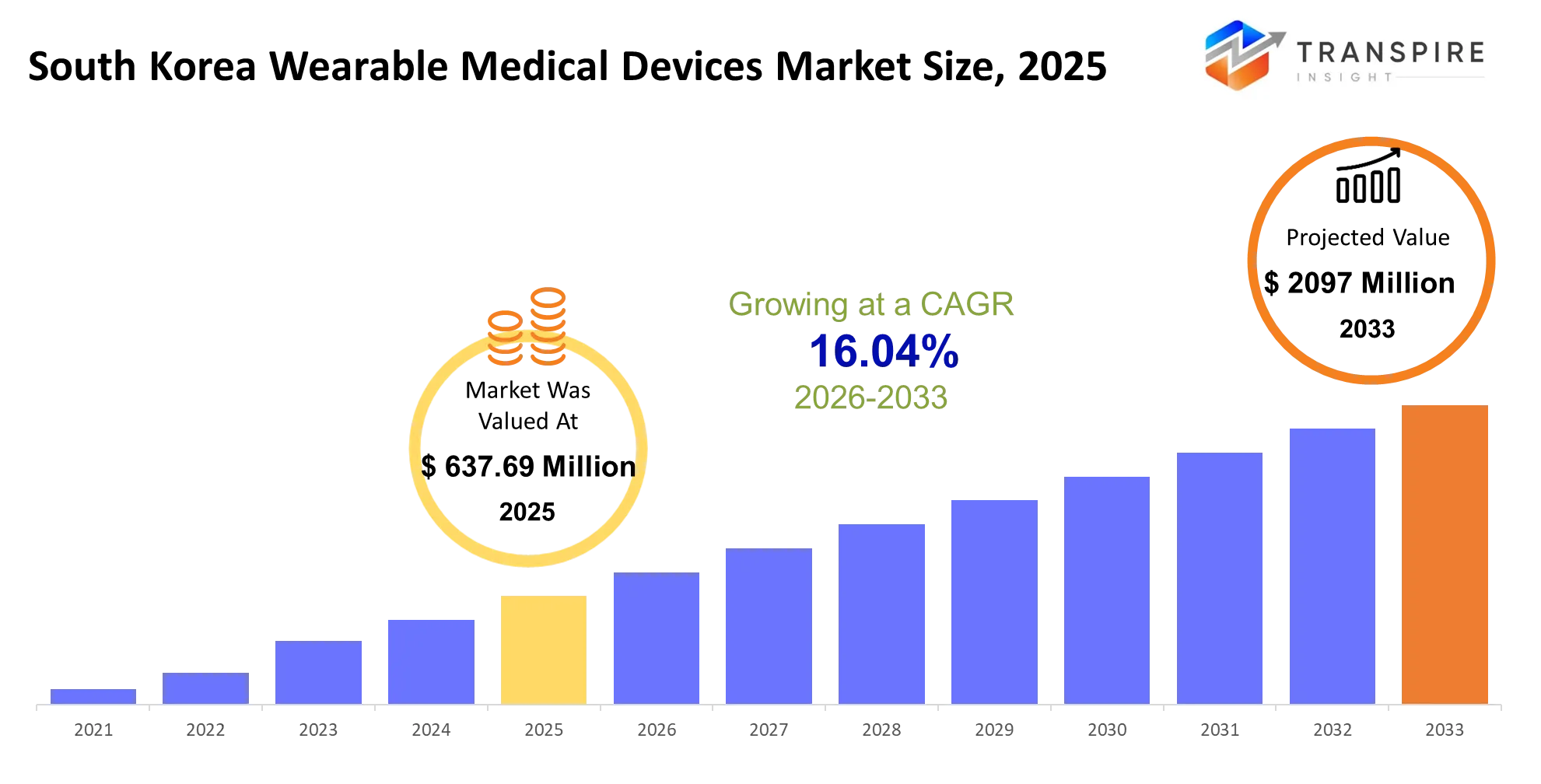
South Korea Wearable Medical Devices Market Size & Forecast:
- South Korea Wearable Medical Devices Market Size 2025: USD 637.69 Million
- South Korea Wearable Medical Devices Market Size 2033: USD 2097 Million
- South Korea Wearable Medical Devices Market CAGR: 16.04%
- South Korea Wearable Medical Devices Market Segments: By Product Type (Smartwatches, Fitness Bands, Wearable ECG Monitors, Wearable Blood Pressure Monitors, Others); By Application (Remote Patient Monitoring, Fitness & Wellness Tracking, Chronic Disease Management, Elderly Care, Others); By Technology (Bluetooth-enabled Devices, AI-powered Devices, IoT-connected Devices, Wireless Monitoring Devices, Others); By End User (Hospitals, Home Care Settings, Fitness Users, Elderly Population, Others); By Distribution Channel (Online Retail, Pharmacies, Specialty Medical Stores, Others)
To learn more about this report,  Download Free Sample Report
South Korea Wearable Medical Devices Market Summary
The South Korea Wearable Medical Devices Market was valued at USD 637.69 Million in 2025. It is forecast to reach USD 2097 Million by 2033. That is a CAGR of 16.04% over the period.
The South Korea Wearable Medical Devices Market seems to be doing a lot here, kind of pushing healthcare away from those one time, hospital-only checkups and more toward continuous monitoring that is happening in real time. With these devices, patients and clinicians can keep track of things like heart rhythm, glucose numbers, sleep quality, oxygen saturation, and physical movement when they are not actually inside a clinic. It matters though, because it can help reduce late detection of issues and it also makes it simpler to respond earlier when chronic illnesses start showing up. In daily life, these wearable medical technologies are also sliding into South Korea’s wider digital health ecosystem, especially with older people, and also with higher-risk patients who are dealing with diabetes or cardiovascular conditions.
Over the last five years, the market has been drifting from fitness-first consumer wearables, to more clinically verified medical-grade monitoring systems. One big structural turn came with South Korea’s Digital Medical Products Act, which sped up certification routes for connected health platforms and AI-enabled monitoring solutions. Meanwhile, the COVID-19 pandemic kind of made remote patient monitoring and telehealth feel normal, both across hospitals , and in everyday households. Together, that whole story has fueled reimbursement talk, boosted physician buy in, and motivated tech companies to shove AI diagnostics into these wearable setups, so they can build better ongoing revenue models through subscription-based health analytics and linked care services.
Key Market Insights
- The Seoul metropolitan region basically accounted for over 45% of South Korea Wearable Medical Devices Market revenue in 2025, because hospitals got more digitized ,and wearables penetration went up, quite a bit.
- Busan and Incheon are showing the quickest rise as regional clusters, since smart hospital investments picked up after 2024, and tied in with the newer healthcare modernization programs.
- Smartwatches still lead product demand with more than 40% market share, mainly from ECG, blood oxygen, and sleep apnea monitoring working together in one setup.
- Continuous glucose monitoring devices are the second-largest segment, as diabetes management is moving toward real-time remote monitoring models rather than older approaches.
- Smart rings and AI-powered biosensors are predicted to expand the fastest between 2026 and 2033, following the premium consumer adoption trend, and overall lifestyle tech appetite.
- In 2025 remote cardiac monitoring stayed on top as the dominant application, largely because hospitals focused on post-discharge patient surveillance , plus preventive cardiology programs.
- Chronic disease management platforms linking diabetes and hypertension are gaining quick adoption across home healthcare services, and elderly patient monitoring too.
- Hospitals and specialty clinics make up the biggest end-user share, as medical-grade wearable integration spreads across tertiary healthcare networks.
- Home healthcare providers are sort of becoming the fastest growing end user group, mostly because telemedicine is expanding, and also because healthcare workforce constraints are tightening too.
- Companies are now trying to stand out more and more with subscription based health platforms, predictive analytics engines, and some added collaborations with hospitals for clinical validation studies, not just one method, but several at the same time.
- Overall, the South Korea Wearable Medical Devices Market is pushing toward strategic growth in preventive wellness, cognitive monitoring, and AI-assisted support for elderly care solutions.
What are the Key Drivers, Restraints, and Opportunities in the South Korea Wearable Medical Devices Market?
The most powerful growth driver inside the South Korea Wearable Medical Devices Market is basically the integration of wearable technologies into regulated digital health systems. In South Korea, the Digital Medical Products Act set up a more legible structure for approving AI-enabled health monitoring platforms, so tech firms and hospitals could commercialize wearable products that are clinically validated. This shift in policy happened alongside climbing healthcare spending tied to diabetes, hypertension, and cardiovascular diseases. So, hospitals are increasingly leaning on connected monitoring devices to cut down on avoidable admissions, and also to keep watching patients continuously beyond the usual care rooms. The commercial effect looks very tangible, since recurring software subscriptions, remote diagnostics, and cloud-based analytics tend to bring in more durable income over time than just one-time hardware sales.
The largest drag, though, is the clinical validation gap between consumer-grade wearables and regulated medical devices. A lot of wearable platforms still find it hard to reach hospital-level diagnostic reliability across different patient conditions, and over long-term real-world use. This is kind of structural, because regulatory trials sensor calibration, and interoperability certification are not fast tasks, they demand years of clinical evidence plus heavy spending. As a consequence, reimbursement adoption moves slower, physician buy-in gets delayed, and integration into national healthcare workflows stays limited, which then suppresses wider market reach.
A big future opportunity is in AI-powered preventive healthcare ecosystems, where wearable sensors, remote monitoring, and predictive analytics are bundled together.
What Has the Impact of Artificial Intelligence Been on the South Korea Wearable Medical Devices Market?
Artificial intelligence has reshaped wearable medical devices in South Korea from mostly passive tracking tools into something more predictive, and maybe even a bit proactive, healthcare systems that can deliver real time clinical signals. The AI models are now busy examining biometric streams like heart rate variability, oxygen saturation, sleep behavior, and glucose swings , to spot unusual patterns well before symptoms start to look obvious. More and more companies are also dropping machine learning into the wearable processors themselves, so the device can handle health data right on site with lower latency, plus a stronger privacy stance.
In South Korean hospitals, AI enabled wearable systems are being used to tidy up patient monitoring workflows, too. Samsung Medical Centre’s Smart Ward program, for instance, relies on wearable sensors and AI monitoring to continuously track blood pressure, ECG traces, oxygen saturation, and even patient motion, often without requiring staff to monitor every single screen directly. Beyond that, these approaches reduce the “blind” zones in monitoring, and they support safer inpatient care management in general.
Predictive analytics is turning into a real market differentiator. Samsung showed an AI based fainting prediction capability on Galaxy Watch units, with reported predictive accuracy above 80%, which means early warnings can appear before vasovagal episodes kick in. AI monitoring is also showing up, in a kind of preventive way for heart care, sleep apnea screening and even a personalized wellness score, really depending on the program and the person’s context. Even so, adoption still hits constraints that are attached to clinical grade data reliability, interoperability, and then those integration costs. A bunch of wearable systems can produce inconsistent measurements in day-to-day life, like when motion interferes or routines start getting a bit irregular. On top of that, clinical teams often struggle to connect wearable data to older hospital information systems. That tends to slow down broader rollout, at scale.
Key Market Trends
- Since 2023, smart rings have sort of showed up as a premium wearable category, and biometric tracking has started spilling past the usual smartwatch ecosystem.
- In South Korea, hospitals have been leaning more on AI-enabled wearable monitoring setups during 2024 to 2026, mainly to shrink inpatient observation gaps, or at least make them less obvious.
- Continuous glucose monitoring usage picked up speed after insurers and healthcare providers widened remote chronic condition management programs.
- Manufacturers moved away from purely fitness-oriented devices toward FDA-cleared and clinically validated monitoring platforms, with diagnostic-grade precision.
- AI-powered predictive health add-ons spread pretty fast after Samsung demonstrated fainting prediction, with more than 84% reported accuracy, though the wording varied across reports.
- Wearable device ecosystems started tying themselves more often into cloud-based telemedicine platforms, for remote consults and physician dashboards.
- Starting in 2025, semiconductor companies and wearable manufacturers intensified their joint work around low-power AI chipsets, basically for edge health analytics.
- Multi-sensor wearables gained more traction as buyers wanted a mix of ECG, oxygen saturation, sleep tracking and temperature monitoring, all in one go.
- Smart hospital investment programs also accelerated the demand for enterprise-grade wearable monitoring platforms across major tertiary healthcare centers.
- More companies began using subscription-based health analytics services, to keep revenue coming in repeatedly, beyond the first hardware sale.
South Korea Wearable Medical Devices Market Segmentation
By Product Type
Smartwatches currently account for the largest market share, partly because integrated ECG tracking, sleep analysis blood oxygen monitoring and smartphone connectivity support both wellness and medical use cases, even if people don’t always think of it that way. Major electronics companies keep expanding what these devices can do with AI-assisted diagnostics and cloud-connected healthcare functions, and you can see the direction pretty clearly. Wearable ECG Monitors also maintain solid commercial adoption, as hospitals and cardiology clinics increasingly use continuous cardiac monitoring systems for preventive healthcare and post-treatment observation. Fitness Bands still serve price-sensitive consumers who want affordable health tracking gadgets, with basic biometric monitoring features, nothing too complicated.
Smartwatches are expected to keep strengthening market leadership as healthcare providers integrate wearable data into digital patient monitoring systems and insurance-supported wellness programs. Wearable Blood Pressure Monitors may grow faster, because hypertension management remains a national healthcare priority, tied to an aging population demographics. Fitness Bands could face moderate pricing pressure, too, as consumers drift toward multifunctional medical-grade wearables with advanced sensor capabilities. Other categories include smart rings, biosensor patches, and wearable temperature monitoring devices moving into more specialized remote healthcare and preventive monitoring applications during the forecast period, quietly but steadily.
By Application
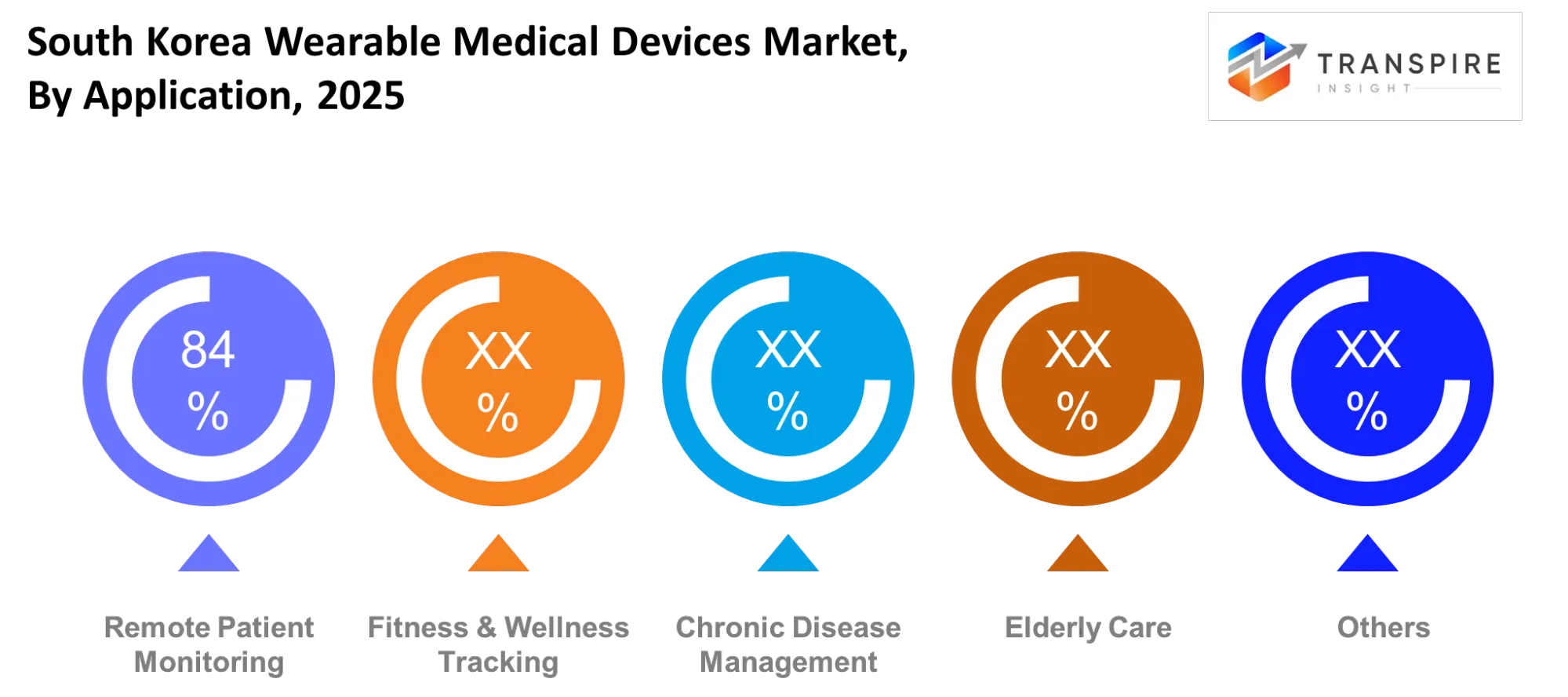
Fitness & Wellness Tracking now kinda counts as a major application segment, because people increasingly use wearable devices to track physical activity, sleep quality, calorie burn, and stress indicators. There is also strong consumer electronics penetration and the mobile health application ecosystems keep backing broad adoption, especially among younger audiences and middle-income groups. Then there’s Remote Patient Monitoring, which still holds a pretty big position, since hospitals and healthcare providers use connected wearables to keep an eye on chronic patients outside the clinic setting. Chronic Disease Management keeps expanding too, largely because healthcare expenses rise along with diabetes, cardiovascular disorders, and hypertension.
Remote Patient Monitoring is projected to gain even more commercial traction, as healthcare institutions look for cost-efficient alternatives to long inpatient observation. Chronic Disease Management might emerge as the fastest-growing segment because ongoing monitoring can reduce emergency visits and support better long-term treatment adherence. Elderly Care is expected to grow at a steadier pace, since wearable fall detection heart monitoring, and mobility tracking systems are getting more embedded in assisted living programs. Other sub areas include rehabilitation monitoring, maternal health tracking, and occupational wellness programs, which help widen the whole digital healthcare expansion picture.
To learn more about this report, Download Free Sample Report
By Technology
Bluetooth-enabled Devices are kinda currently dominating the market, mostly because low-power wireless connectivity lets everything just slide together with smartphones , tablets, and even hospital monitoring systems. The most popular wearable devices still lean on Bluetooth tech, not just for cost efficiency but because the connection tends to stay stable, and it matches up well with consumer electronics ecosystems. AI-powered Devices also keep showing up more in the market, since predictive health analytics, automated anomaly detection, and personalized wellness recommendations add real clinical value, and help with user engagement too. Meanwhile IoT-connected Devices keep expanding, as healthcare providers put more money into cloud-based patient monitoring infrastructure.
Looking ahead, AI-powered Devices are expected to see the strongest growth through 2033, largely because healthcare systems are increasingly prioritizing predictive diagnostics and preventive care management. IoT-connected Devices may get wider adoption too, especially as hospitals and home healthcare providers roll out centralized monitoring platforms that can handle real-time patient data streams. Wireless Monitoring Devices are projected to benefit from rising demand for mobility-focused healthcare services and plus non-invasive patient observation systems. “Others” here could include edge-computing wearables and hybrid sensor platforms, moving into specialized neurological and rehabilitation monitoring scenarios.
By End User
Hospitals are currently the main end-user segment because tertiary care centers and specialty clinics are , more and more, folding wearable monitoring devices into cardiology, diabetes care, and remote patient observation programs. There’s also strong spend in smart hospital infrastructure and AI-enabled healthcare systems which keeps pushing procurement of clinically validated wearables. At the same time, Home Care Settings keep a big slice of the market, since aging demographics and limited healthcare workforce capacity make it easier to adopt remote monitoring systems outside the usual hospital walls. Fitness Users still bring steady demand for wellness oriented wearable devices that plug into lifestyle management apps.
Hospitals should stay on top for revenue since clinical-grade wearable integration keeps spreading across digital health ecosystems and telemedicine services. Home Care Settings could even see the quickest expansion, because healthcare providers are prioritizing decentralized patient management and longer term elderly monitoring programs. The Elderly Population segment is projected to open meaningful commercial chances, especially with fall detection systems, chronic disease tracking, and emergency response monitoring technologies. “Others” covers rehabilitation centers, sports performance facilities, and corporate wellness programs, which use wearable monitoring platforms for more specialized day-to-day operational needs.
By Distribution Channel
Online Retail holds the largest slice of the market right now , mainly because shoppers like being able to compare products side by side, enjoy subscription bundling options, and get to newly released wearable technologies much faster. Also, most e-commerce platforms run very aggressive promotional activities and they make device customization feel simpler, so it kinda boosts digital buying habits overall. Pharmacies still keep a meaningful position too , since medically certified wearable products often depend on consumer trust, plus they usually need healthcare professional guidance before someone actually buys. Specialty Medical Stores continue to matter as well, especially for clinical or more premium healthcare device categories where customers expect solid technical consultation and after sales assistance.
Online Retail should keep its commercial lead, since digital health ecosystems are increasingly blending wearable hardware, software subscriptions, and remote onboarding services, all via connected online platforms. Specialty Medical Stores may see firmer growth in medical grade monitoring devices, because healthcare providers are leaning toward wearable tech that’s clinically validated. Pharmacies are projected to gain momentum from the growing consumer focus on preventive healthcare and the everyday self management of chronic conditions. Other channels include hospital procurement routes , insurance linked healthcare providers, and corporate wellness distributors, together they help widen access to wearable healthcare solutions across the forecast period.
What are the Key Use Cases Driving the South Korea Wearable Medical Devices Market?
The biggest use case in the South Korea Wearable Medical Devices Market is basically nonstop cardiovascular plus long term chronic disease monitoring, through smartwatches and connected biosensors. Hospitals and outpatient clinics use these kind of devices to watch ECG signals, blood pressure trends, oxygen saturation, and irregular heart rhythms in real time. For that reason this kind of setup creates the most solid demand, since cardiovascular disease management needs ongoing observation, not those periodic clinical tests.
Second tier applications are also growing fast in diabetes care and after discharge remote patient monitoring. Continuous glucose monitoring systems are getting more and more common among diabetic patients who manage insulin levels outside the hospital setting. At the same time home healthcare providers use wearable monitoring platforms to follow elderly patients at a distance, cutting down on unneeded hospital trips, and improving long term care efficiency.
Newer directions include AI assisted cognitive health monitoring, fall prediction systems, and smart rehabilitation wearables. Healthcare providers in South Korea are now testing wearable platforms that can spot neurological decline, stress related disorders, and mobility deterioration before severe symptoms start showing up. In practice the idea is to catch changes earlier rather than react late.
|
Report Metrics |
Details |
|
Market size value in 2025 |
USD 637.69 Million |
|
Market size value in 2026 |
USD 740 Million |
|
Revenue forecast in 2033 |
USD 2097 Million |
|
Growth rate |
CAGR of 16.04% from 2026 to 2033 |
|
Base year |
2025 |
|
Historical data |
2021 - 2024 |
|
Forecast period |
2026 - 2033 |
|
Report coverage |
Revenue forecast, competitive landscape, growth factors, and trends |
|
Regional scope |
South Korea |
|
Key company profiled |
Samsung Electronics, Apple, Fitbit, Garmin, Medtronic, Omron Healthcare, Philips Healthcare, Abbott Laboratories, Dexcom, GE HealthCare, Xiaomi, Huawei, Polar Electro, Biotronik, AliveCor |
|
Customization scope |
Free report customization (country, regional & segment scope). Avail customized purchase options to meet your exact research needs. |
|
Report Segmentation |
By Product Type (Smartwatches, Fitness Bands, Wearable ECG Monitors, Wearable Blood Pressure Monitors, Others); By Application (Remote Patient Monitoring, Fitness & Wellness Tracking, Chronic Disease Management, Elderly Care, Others); By Technology (Bluetooth-enabled Devices, AI-powered Devices, IoT-connected Devices, Wireless Monitoring Devices, Others); By End User (Hospitals, Home Care Settings, Fitness Users, Elderly Population, Others); By Distribution Channel (Online Retail, Pharmacies, Specialty Medical Stores, Others) |
Which Regions are Driving the South Korea Wearable Medical Devices Market Growth?
Seoul Capital Area still feels like the main regional hub for wearable medical device adoption, mainly because it manages to mix advanced hospital infrastructure, solid digital connectivity and also high consumer purchasing power. In practice, Seoul-based tertiary hospitals have brought wearable monitoring into cardiology, endocrinology, and remote patient management programs earlier than most other regions, and it kinda compounds quickly. The area also has this dense cluster of technology giants, semiconductor suppliers, AI developers, and digital health startups. That whole setup helps commercialization move quicker for AI-powered wearable platforms, and it even speeds up clinical validation partnerships ,or at least that’s how it plays out.
Busan meanwhile is the second-biggest contributor, but the momentum there is not the same, it’s more like growth with different cues. The region tends to rely on steady healthcare infrastructure expansion, older age demographics, and fairly consistent investment in regional medical centers. Local healthcare providers are leaning into wearable monitoring for chronic disease management and elder care, more like care delivery efficiency than premium consumer wellness applications. Because of that, demand looks long-term and steady, but it’s tied closer to population health management than consumer trend cycles.
Incheon is starting to look like the fastest-growing market, and that seems connected to smart city development initiatives plus healthcare digitization efforts that rolled out after 2024. Regional authorities have pushed more support for AI-enabled healthcare infrastructure ,especially remote monitoring and connected patient care systems. On top of that, new hospital modernization projects sped up wearable monitoring adoption, particularly where the platforms are integrated with telemedicine services.
Who are the Key Players in the South Korea Wearable Medical Devices Market and How Do They Compete?
Competition in the South Korea Wearable Medical Devices Market is moderately consolidated, mostly around global electronics firms, medical device manufacturers, and digital health specialists. In practice they do not compete so much on hardware pricing, and instead they push ecosystem integration, AI analytics that feel more predictive, clinical validation, and subscription-based health services. Consumer electronics players are leaning hard on their large installed user bases, while medical device specialists try to stand out via regulatory-grade monitoring accuracy , and also by earning physician trust.
Samsung Electronics differentiates itself with a pretty tight fit between Galaxy wearables, Samsung Health, and AI-driven preventive monitoring systems. It has moved further into medical-grade health monitoring and it secured South Korea’s first digital medical device system certification for Samsung Health. The approach is basically centered on creating a connected healthcare ecosystem across smartwatches, smart rings, smartphones, and AI analytics platforms.
Apple competes by controlling the premium ecosystem end, using advanced health sensors, and offering physician-recognized cardiac monitoring features that sit inside Apple Watch devices. Dexcom and Abbott Laboratories take the lead in continuous glucose monitoring, largely because their biosensor platforms are highly accurate and they connect smoothly to mobile health applications. Medtronic is more focused on clinical-grade chronic disease management and remote patient monitoring, often integrated with hospital systems. At the same time, Huawei and Xiaomi are moving aggressively in the mid-priced wearable segments, expanding sensor capabilities and AI health analytics while keeping device costs lower.
Company List
- Samsung Electronics
- Apple
- Fitbit
- Garmin
- Medtronic
- Omron Healthcare
- Philips Healthcare
- Abbott Laboratories
- Dexcom
- GE HealthCare
- Xiaomi
- Huawei
- Polar Electro
- Biotronik
- AliveCor
Recent Development News
In January 2026, Samsung Electronics secured South Korea’s first certification under the Digital Medical and Health Support Device system for Samsung Health. The certification expanded regulatory recognition for AI-enabled wearable health monitoring functions including heart rate and blood oxygen tracking, strengthening Samsung’s position in the South Korea wearable medical devices ecosystem.http://https://www.sammobile.com
In April 2026, Samsung Medical Center launched an AI-powered Smart Ward equipped with ultra-miniature wearable monitoring devices. The deployment enabled continuous real-time monitoring of blood pressure, ECG, and oxygen saturation, accelerating hospital adoption of connected wearable healthcare infrastructure in South Korea.http://https://www.asiae.co.kr
In January 2026, Samsung Electronics unveiled expanded AI-driven wearable healthcare capabilities during CES 2026 under its “Care Companion” initiative. The launch highlighted the company’s strategy to integrate preventive healthcare analytics and connected wearable monitoring into its broader AI ecosystem, increasing competitive pressure across digital health platforms.http://https://news.samsung.com
What Strategic Insights Define the Future of the South Korea Wearable Medical Devices Market?
The South Korea Wearable Medical Devices Market is sort of moving, in a structural way, toward integrated preventive healthcare ecosystems where wearable sensors, AI analytics, and telemedicine platforms start to work like a constant care network, not really like standalone consumer electronics. The basic nudge behind this shift is basically the meeting point of aging demographics, the rising costs for chronic disease management, and South Korea’s strong semiconductor plus digital infrastructure capabilities. Over the next five to seven years, you can expect the space to drift further into clinically regulated monitoring platforms that link right into hospital systems and insurer-backed remote care programs.
One underappreciated risk, though, is ecosystem concentration. A small set of dominant platform providers may end up controlling patient data environments, which can narrow interoperability, and also increase switching costs for healthcare institutions. Meanwhile AI powered predictive monitoring for elderly care and neurological health is a big emerging opportunity, but it still feels underdeveloped in practice.
Market players should put clinical partnerships and regulatory grade validation at the front, instead of racing only on consumer device features. Companies that blend medical accuracy with scalable AI driven analytics platforms are more likely to earn stronger long-term healthcare contracts, and keep building recurring service revenue streams.
South Korea Wearable Medical Devices Market Report Segmentation
By Product Type
- Smartwatches
- Fitness Bands
- Wearable ECG Monitors
- Wearable Blood Pressure Monitors
- Others
By Application
- Remote Patient Monitoring
- Fitness & Wellness Tracking
- Chronic Disease Management
- Elderly Care
- Others
By Technology
- Bluetooth-enabled Devices
- AI-powered Devices
- IoT-connected Devices
- Wireless Monitoring Devices
- Others
By End User
- Hospitals
- Home Care Settings
- Fitness Users
- Elderly Population
- Others
By Distribution Channel
- Online Retail
- Pharmacies
- Specialty Medical Stores
- Others
Frequently Asked Questions
Find quick answers to common questions.
The estimated South Korea Wearable Medical Devices Market size for the market will be USD 2097 Million in 2033.
Key segments for the South Korea Wearable Medical Devices Market are By Product Type (Smartwatches, Fitness Bands, Wearable ECG Monitors, Wearable Blood Pressure Monitors, Others); By Application (Remote Patient Monitoring, Fitness & Wellness Tracking, Chronic Disease Management, Elderly Care, Others); By Technology (Bluetooth-enabled Devices, AI-powered Devices, IoT-connected Devices, Wireless Monitoring Devices, Others); By End User (Hospitals, Home Care Settings, Fitness Users, Elderly Population, Others); By Distribution Channel (Online Retail, Pharmacies, Specialty Medical Stores, Others).
Major South Korea Wearable Medical Devices Market players are Samsung Electronics, Apple, Fitbit, Garmin, Medtronic, Omron Healthcare, Philips Healthcare, Abbott Laboratories, Dexcom, GE HealthCare, Xiaomi, Huawei, Polar Electro, Biotronik, AliveCor.
The South Korea Wearable Medical Devices Market size is USD 637.69 Million in 2025.
The South Korea Wearable Medical Devices Market CAGR is 16.04% from 2026 to 2033.
- Samsung Electronics
- Apple
- Fitbit
- Garmin
- Medtronic
- Omron Healthcare
- Philips Healthcare
- Abbott Laboratories
- Dexcom
- GE HealthCare
- Xiaomi
- Huawei
- Polar Electro
- Biotronik
- AliveCor
Recently Published Reports
-
Apr 2026
Fiber Optic Faceplates Market
Fiber Optic Faceplates Market Size, Share & Analysis Report By Type (< 300 mm2, 300-350 mm2, and > 350 mm2, By Application (Night Vision, Holographic Imaging, Medical, and Others), and Geography (North America, Europe, Asia-Pacific, Middle East and Africa, South and Central America), 2021 - 2031
-
Apr 2026
High Temperature Superconductors Market
High Temperature Superconductors Market Size, Share & Analysis Report By Type (1G HTS, and 2G HTS), By Application (Power Cable, Fault Current Limiter, and Transformer), and Geography (North America, Europe, Asia-Pacific, Middle East and Africa, South and Central America), 2021 - 2031
-
Apr 2026
Industrial Plugs and Socket Market
Industrial Plugs and Socket Market Size, Share & Analysis Report By Type (Industrial Plugs, Industrial Sockets), By Current (Up to 32 A, 32 to 125 A, Above 125 A), By Protection (Dustproof and Splash Proof, Waterproof, Explosion Proof), By End User (Heavy Industries, Oil and Gas, Chemicals and Pharmaceuticals, Power Generation, Others), and Geography (North America, Europe, Asia-Pacific, Middle East and Africa, South and Central America), 2021 - 2031
-
Apr 2026
InGaAs Avalanche Photodiodes Market
InGaAs Avalanche Photodiodes Market Size, Share & Analysis Report By Type (1100 - 1700 nm, and 1000 - 1600 nm), By Application (Missile Warning System, Muzzle Flash Detection, Wafer Defect Inspection, Laser Rangefinders, and Others), and Geography (North America, Europe, Asia-Pacific, Middle East and Africa, South and Central America), 2021 - 2031