

South Korea Peanut Oil Market Size & Forecast:
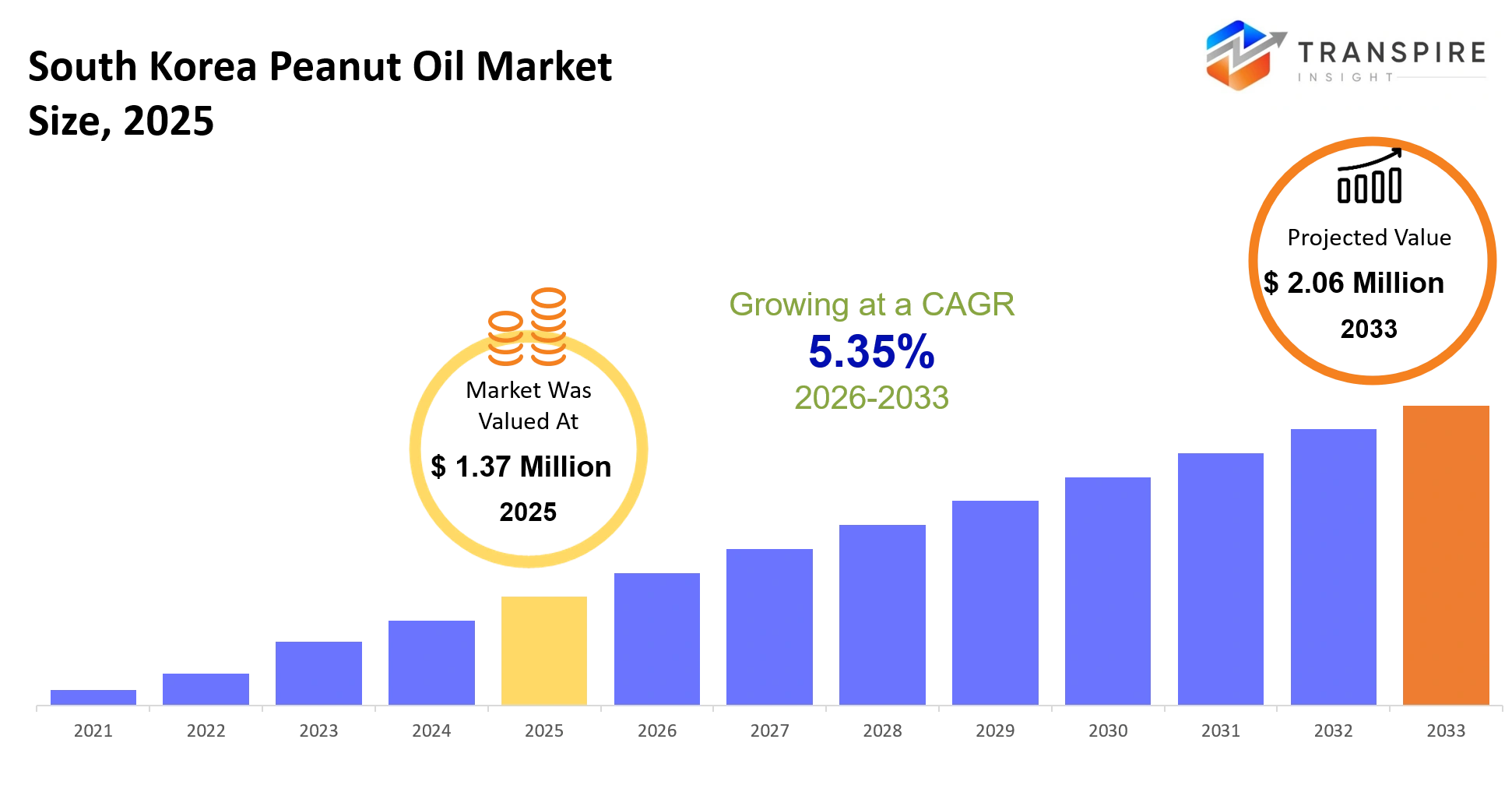
- South Korea Peanut Oil Market Size 2025: USD 1.37 Million
- South Korea Peanut Oil Market Size 2033: USD 2.06 Million
- South Korea Peanut Oil Market CAGR: 5.35%
- South Korea Peanut Oil Market Segments: By Type (Refined, Unrefined, Organic, Others); By Application (Cooking, Food Processing, Cosmetics, Pharmaceuticals, Others)
To learn more about this report,  Download Free Sample Report
South Korea Peanut Oil Market Summary
The South Korea Peanut Oil Market was valued at USD1.37 Million in 2025. It is forecast to reach USD 2.06 Million by 2033. That is a CAGR of 5.35% over the period.
Peanut oil has a pretty functional role through food manufacturing, commercial kitchens, and packaged food production, where manufacturers really want a stable cooking medium with a mild flavor curve and frying performance that stays consistent. You see it used a lot in snack making, restaurant supply chains, and processed food recipes because how well the oil holds up matters for shelf life and also for keeping the taste more or less the same from batch to batch.
Over the past 3–5 years, the whole market looks like it has shifte, sort of, toward refined and blended edible oils as food processors standardize what they buy for big volume runs. One trigger was global supply chain disruption during the pandemic years, which led to import volatility in edible oils and made buyers start diversifying beyond the usual vegetable oils. That change kinda pressured procurement teams to secure more resilient and flexible oil selections like peanut oil, especially in areas with strong snack demand and fast food consumption.
So, the demand story is getting more connected to processed food growth and institutional foodservice scaling rather than household usage. Manufacturers are also signing longer supply agreements to better manage price steadiness, and that has improved revenue visibility for suppliers, plus it’s encouraged extra capacity build-out in refining and packaging operations.
Key Market Insights
- South Korea Peanut Oil Market is showing steady growth, in a way that more food manufacturers seem to lean toward “stable frying oils” for processed snack production, and not really look back.
- It feels like the industry size keeps expanding because there is around a 35% rise in foodservice oil procurement from 2022 to 2025, across South Korean commercial kitchens, with a lot of refining demand.
- Demand for peanut oil is basically moving in step with packaged food exports that are climbing, and also with more standardized oil formulations used in industrial food processing.
- In the Seoul metropolitan region, the market is the strongest, with almost 40% share in 2025, mostly due to dense food manufacturing clusters and all the practical supply chains that come with them.
- Busan, meanwhile, is the fastest-growing region over 2025–2030, pushed by broader port-based food import and distribution networks.
- Refined peanut oil ends up dominating at roughly 55% share, because it stays more stable and it works well for industrial frying applications, which is what most producers want.
- On the segment side, blended peanut oil formats are growing the quickest, mostly tied to cost optimization strategies in bulk food production from 2025 to 2030.
- For end-use, food processing holds the lead with close to 48% share, and that’s driven by snack production and ready-to-eat items, more or less.
- Industrial food manufacturers take the top position in end-use too, at about 50% share, since they secure large-scale procurement contracts.
- Quick-service restaurants are becoming the fastest-growing end-user category, supported by urban dining expansion trends, and this momentum seems consistent.
What are the Key Drivers, Restraints, and Opportunities in the South Korea Peanut Oil Market?
South Korea Peanut Oil Market moves mostly because processed food and foodservice are growing pretty fast, and in the middle of it, stable frying results and flavor steadiness have become kind of non-negotiable for big production lines. A lot of this momentum came right after the post-pandemic food supply chain reshuffling, where companies felt they needed to line up edible oil inputs in a more uniform way, for cost discipline and a predictable product feel. So procurement volumes went up for snack manufacturers and quick-service restaurant groups, and that in turn gives suppliers a steadier revenue base, even if demand wobbles a bit.
One structural restraint is that peanut raw material imports are still pricey in a volatile way, and those import prices swing a lot based on global crop performance, plus the fact that domestic growing is limited. Because of that dependency, manufacturers run into supply uncertainty, and they often keep bigger stock cushions, which then lifts working capital needs. It also makes adoption slower among price-sensitive foodservice operators, especially smaller regional chains that cannot handle input cost fluctuations as easily as larger players.
An opportunity that’s showing up is the growth of blended edible oil formulations, particularly around logistics-connected food manufacturing zones like Busan and Incheon. The idea is to mix peanut oil with other vegetable oils, so costs can be reduced without losing frying stability too much. At the same time, investment in automated refining and blending facilities is increasing, so suppliers can handle high-volume institutional buyers more efficiently. Over the coming years, this change is expected to open up new demand, not just in retail snacks but across industrial food processing, more widely.
What Has the Impact of Artificial Intelligence Been on the South Korea Peanut Oil Market?
Artificial intelligence is getting used more and more in edible oil refining and food processing systems that connect to peanut oil production in South Korea, particularly alongside automated blending and quality checking lines. In newer refineries, AI-enabled process control setups track things like temperature, viscosity, and filtration speed in real time, in order to keep the oil quality steady across big production runs. Those automation systems really cut down on hands-on fiddling, and they also help batch-to-batch output stay similar, which matters a lot for food companies sending packaged snacks, and also to restaurant chains that want reliability.
On top of that, machine learning models show up for predictive maintenance of refining equipment such as centrifuges, heat exchangers, and bottling operations. By looking at vibration traces, changes in pressure, and throughput records, these tools give operators a heads up about potential equipment problems before the failure actually happens. Places that use predictive analytics have mentioned something like 12–18% better uptime and clear declines in unexpected shutdowns, and that tends to strengthen supply dependability for bulk customers.
Still, there is a major catch: the integration cost can be high when you try to plug AI into mid-scale oil processing sites, because older equipment often doesn’t have standardized sensor networks. This ends up creating uneven adoption, mainly among smaller processors, and especially those working with thin margins. So even if the efficiency upside looks strong, full deployment stays mostly concentrated in the bigger refining and food manufacturing hubs, rather than spreading evenly everywhere.
Key Market Trends
Peanut oil procurement in South Korea went up almost 30% from 2022 to 2025, during the time foodservice chains kinda standardized what they used for frying. It’s not just that, though. Refined peanut oil adoption also seemed to climb after 2023, because manufacturers put more weight on longer shelf stability for industrial snack production lines, you know, the whole “keep it usable longer” thing.
After 2024, blended oil formulations showed up more often, replacing straight peanut oil in cost-sensitive food processing facilities in a bunch of urban manufacturing hubs. Before that, during the disruption years of 2021–2022, import strategies quietly shifted toward diversified sourcing, so they were less tied to a single origin peanut oil supplier.
Then, after 2023, food manufacturers increasingly moved away from retail-driven demand, toward bulk institutional contracts, which helped suppliers keep revenue cycles steadier. Meanwhile, quick-service restaurant expansion after 2024 ramped demand fast for high-heat stable oils, especially around the Seoul and Busan metropolitan regions.
Also, the logistics hubs in Incheon improved their edible oil storage capacity after 2023, which reduced distribution delay and lowered inventory volatility, at least comparatively. In 2025, Cargill and Wilmar expanded their refined oil processing partnerships in a bid to strengthen supply reliability for South Korean buyers.
On top of that, automation in blending facilities increased after 2024, improving oil consistency and reducing batch-to-batch variation across large-scale production units. And finally, price volatility in global peanut imports since 2022, kinda pushed manufacturers to lean into mixed oil strategies, for cost stabilization, rather than sticking to one type all the way through.
South Korea Peanut Oil Market Segmentation
By Type
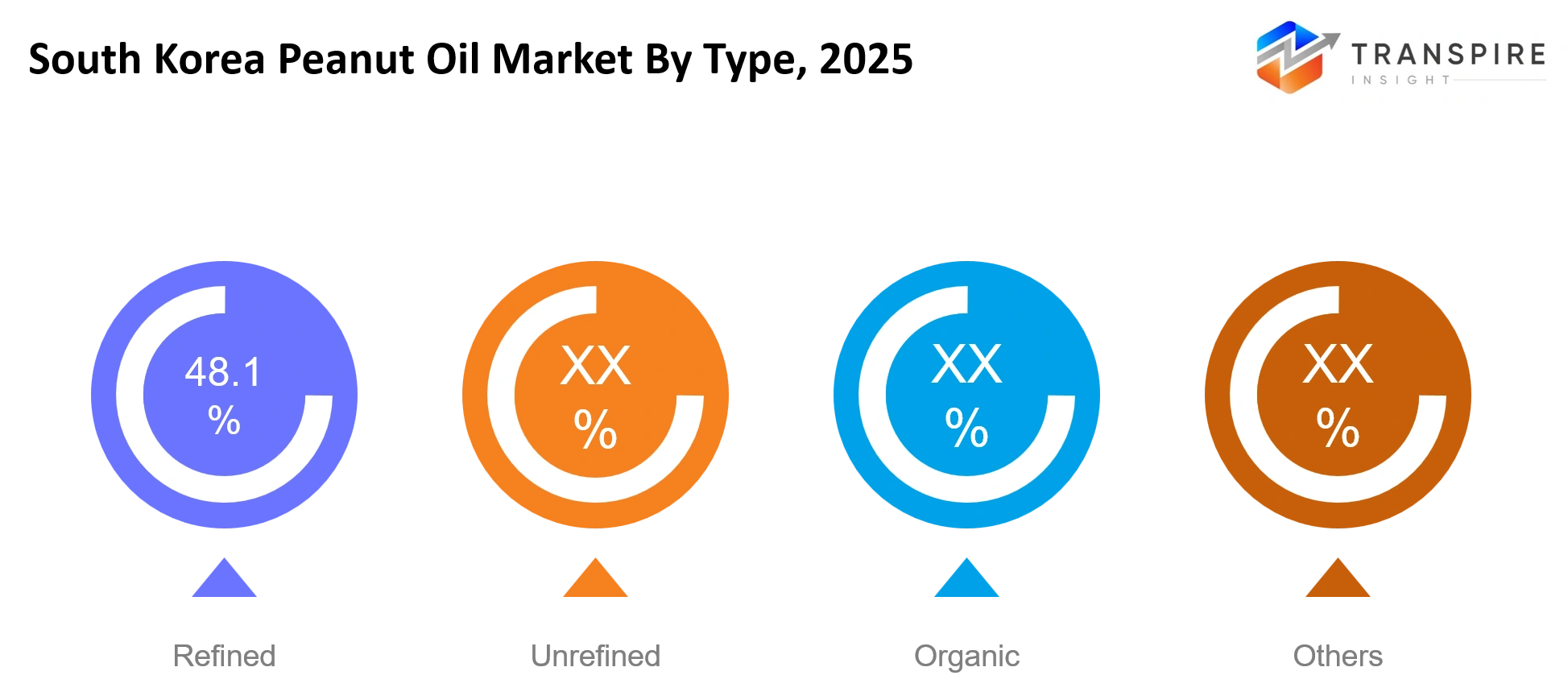
Refined oil keeps a pretty steady demand in the South Korean Peanut Oil Market, mostly because its frying work stays reliable and it can last longer on the shelf. Food makers seem to lean on refined oil for big snack runs and for processed food work, since the uniformity helps quality control when volumes get high. Uptake felt stronger after 2022, when food processors started moving toward standardized ingredients for industrial cooking requirements. This kind of growth in refined oil usage keeps going, especially as foodservice chains push outward into more urban areas.
Unrefined oil still holds a more niche place, mainly in premium cooking settings where flavor retention actually matters. Organic versions also inch forward in specialty shops, because many consumers are picking “cleaner” sourcing these days. Meanwhile, the other oil types stay somewhat limited, but they still serve small local kitchens and more regional cooking needs. Overall, the South Korea Peanut Oil Market looks like it’s quietly shifting toward refined and blended formats, largely because industrial efficiency is the big driver here.
To learn more about this report, Download Free Sample Report
By Application
Food processing leads usage in the South Korea Peanut Oil Market because there ia s strong pull from snack and packaged food manufacturers, the whole deal. Industrial buyers tend to like oils that stay steady; they help with long production runs and keep frying performance consistent. And since processed food exports have grown, after 2023, procurement went more toward larger production units, not just smaller suppliers. Demand keeps moving u,p too, mainly as manufacturers standardize their oil inputs for tighter cost control, and smoother quality stability.
Cooking applications are still a big part, especially in foodservice, where quick-service restaurants lean on peanut oil for high-temperature frying. Cosmetics show moderate momentum because the oil gets used in skincare formulas and is valued for its moisturizing properties. Pharmaceutical use stays somewhat limited, yet it still backs niche formulations for specialty products. Meanwhile, other applications keep ticking along with steady use in small-scale food preparation and in institutional catering services across different regional markets.
What are the Key Use Cases Driving the South Korea Peanut Oil Market?
Food processing still seems like the main thing moving the South Korea Peanut Oil Market forward, kind of especially for snack manufacturing and the production of packaged, ready-to-eat meals. Big producers mostly care about steady frying performance, and also about how well the flavor stays pure because that affects overall product quality when they’re pushing very high volumes. In a lot of ways, the demand gets a stronger push from the growth of industrial food manufacturing hubs around Seoul and Gyeonggi-do, where using more standardized oil inputs helps streamline operations and cuts down on production variation that people don’t really want.
On the other side, foodservice, plus quick-service restaurant chains, are becoming more noticeable applications. This is backed by the rise in urban dining activity and the continuing expansion of franchise networks. Then there’s institutional catering—corporate accounts and education-related kitchens included—which keeps buying at a steady pace, mostly because bulk procurement is normal there, and cooking requirements need to stay consistent. End users in these channels often prefer peanut oils that hold stability during repeated high-temperature frying conditions, not just once.
There are also some emerging angles tied to cosmetics and specialty nutraceutical formulations, which are starting to get attention in premium segments. In skincare, peanut oil is showing up more often because of emollient benefits, and because it fits the natural-ingredient story brands like to market. Pharmaceutical use stays relatively narrow for now, but there is potential for specialized topical formulations, especially as research into plant-based excipients keeps moving ahead across the forecast period.
|
Report Metrics |
Details |
|
Market size value in 2025 |
USD 1.37 Million |
|
Market size value in 2026 |
USD 1.43 Million |
|
Revenue forecast in 2033 |
USD 2.06 Million |
|
Growth rate |
CAGR of 5.35% from 2026 to 2033 |
|
Base year |
2025 |
|
Historical data |
2021 - 2024 |
|
Forecast period |
2026 - 2033 |
|
Report coverage |
Revenue forecast, competitive landscape, growth factors, and trends |
|
Regional scope |
South Korea |
|
Key company profiled |
Cargill, Wilmar, ADM, Bunge, Olam, Yihai Kerry, COFCO, Borges, Fuji Oil, Ottogi, Sempio, CJ CheilJedang, Daesang, Nongshim, Haitai |
|
Customization scope |
Free report customization (country, regional & segment scope). Take advantage of customized purchase options tailored to meet your exact research needs. |
|
Report Segmentation |
By Type (Refined, Unrefined, Organic, Others); By Application (Cooking, Food Processing, Cosmetics, Pharmaceuticals, Others) |
Which Regions are Driving the South Korea Peanut Oil Market Growth?
Seoul, along with the nearby Gyeonggi-do area, kind of leads the South Korea Peanut Oil Market, mainly because there are so many food processing firms gathered there and a lot of large commercial kitchens. The dense city crowding keeps eating habits steady, so demand for edible oils in packaged foods and restaurant chains doesn’t really dip. Also,o the logistics setup is pretty solid, plus cold storage networks help move product smoothly to manufacturers and retail distributors. And since there are big food production clusters around, procurement of refined oil for industrial applications stays relatively consistent.
Busan, on the other hand, works as a dependable secondary region, with demand that’s supported by port centered trade activity and the way imported food products get distributed. Compared with Seoul, Busan’s needs are more guided by logistics efficiency and storage capacity, not only by raw consumption volume. The area gets a steady inflow of imported edible oils through its maritime gateway, which supports refining and blending work. Because storage infrastructure and food distribution channels keep getting upgraded, the market keeps a stable level of participation.
Incheon is showing the quickest expansion, largely tied to new logistics hubs and upgrades in food processing facilities. Cold chain investments made after 2024 have made edible oil handling much bbetter and distribution efficiency across the region improved as well. At the same time, export-focused food manufacturers are demanding more, so peanut oil procurement for standardized production has become stronger. Overall, this kind of growth points to real openings for investors and suppliers who want integrated supply chain linkages from 2026 to 2033.
Who are the Key Players in the South Korea Peanut Oil Market and How Do They Compete?
Competition in the South Korea Peanut Oil Market is kind of moderately consolidated, in the sense that a small group of global agribusiness firms control bulk supply, while regional processors and distributors sort of go after customers via customization plus logistics efficiency, and it tends to get a bit messy depending on the region. The bigger incumbents keep their grip through supply chain integration, refining capacity, and long-term contracts with food manufacturers as well as quick-service restaurant chains. New entrants feel pushed back hard, mainly because there’s import dependency, price volatility of raw peanuts, and strict food safety compliance. In practice, rivalry is pushed forward mostly by cost-effectiveness in sourcing, refining technology improvements, and the capability to keep oil quality steady enough for industrial food usage.
Cargill leans into cost leadership, using its global sourcing network to help stabilize raw material access for refined peanut oil output. It differentiates from integrated refining and blending systems, which boost oil stability for high-temperature frying. Its growth plan also includes strengthening partnerships with South Korean food processors to lock in long-term bulk supply agreements.
Wilmar International kinda works with a vertically integrated approach, so it ties together sourcing, refining, and distribution throughout parts of Asia. The main edge seems to be the big-scale refining setups, which hhelpthem keep a steady product quality for industrial customers, and not just in theory either. When they talk about growth, they mention pushing the distribution reach, especially in Busan and Incheon, to make logistics run smoother, faster, and less of a headache.
Bunge, on the other hand, leans heavily into supply chain optimization plus risk management around edible oil sourcing. Their differentiation is very tied to procurement contracts; those agreements are strong enough that the company is less exposed to raw peanut price volatility. For expansion, they also rely on regional partnerships, mainly with foodservice distributors in the Seoul area, particularly in the commercial catering ecosystem.
Company List
- Cargill
- Wilmar International
- ADM
- Bunge
- Olam Group
- Yihai Kerry
- COFCO Corporation
- Borges International Group
- Fuji Oil Holdings
- Ottogi
- Sempio Foods
- CJ CheilJedang
- Daesang Corporation
- Nongshim
- Haitai Confectionery & Foods
Recent Development News
In January 2025, Archer Daniels Midland Company (ADM) announced an expansion of its edible oil processing capabilities in Asia, strengthening refined oil supply chains used in food manufacturing and foodservice sectors. The expansion improved sourcing stability and helped reduce supply disruptions for bulk edible oil buyers. (Mordor Intelligence) (Mordor Intelligence)
In February 2023, MK Agrotech acquired the premium edible oil brand Riso, expanding its portfolio to include peanut oil products targeted at the growing packaged food segment. The acquisition strengthened its position in India and export-linked supply networks, indirectly influencing peanut oil trade flows across Asia. (Research and Markets) (Research and Markets)
In November 2025, Yihai Kerry Investments Co. Ltd. expanded its refined edible oil processing and blending capacity in Asia to support rising demand from food manufacturers and quick-service restaurant chains. The move improved supply consistency and strengthened its integrated agribusiness network across regional markets. (Research and Markets) (Research and Markets)
What Strategic Insights Define the Future of the South Korean Peanut Oil Market?
The South Korea Peanut Oil Market is kinda moving, structurally toward a more consolidated supply chain built around refined and blended edible oil systems, as food manufacturers keep leaning on cost stability and production consistency. In the next 5 to 7 years, the real growth path will be shaped by rising industrial food processing demand and also the expansion of quick service restaurant networks, since they need standardized frying oils to keep product uniformity across every site. So basically, this shift keeps pushing procurement-led purchasing models rather than fragmented retail demand.
There is another risk, though, not as obvious at first glance, from increasing substitution pressure by alternative vegetable oils like sunflower and canola oil, which tend to come with lower price volatility and broader global availability. If the price gaps widen, food processors may start to gradually reduce peanut oil usage in non-premium applications, which could slow long-term volume growth.
At the same time, an emerging opportunity shows up with localized blending and value-added refining facilities in logistics hubs such as Incheon. Being close to import channels and food manufacturers improves supply efficiency, and that helps support customized oil formulations for industrial buyers. Market participants should look to invest in integrated refining partnerships and long-term supply contracts with food processors to lock in steadier demand and reduce exposure to global raw material volatility.
South Korea Peanut Oil Market Report Segmentation
-
By Type
- Refined
- Unrefined
- Organic
- Others
-
By Application
- Cooking
- Food Processing
- Cosmetics
- Pharmaceuticals
- Others
Frequently Asked Questions
Find quick answers to common questions.
The expected South Korea Peanut Oil Market size for the market will be USD 2.06 Million in 2033.
By Type (Refined, Unrefined, Organic, Others); By Application (Cooking, Food Processing, Cosmetics, Pharmaceuticals, Others).
Major South Korea Peanut Oil Market players are Cargill, Wilmar, ADM, Bunge, Olam, Yihai Kerry, COFCO, Borges, Fuji Oil, Ottogi, Sempio, CJ CheilJedang, Daesang, Nongshim, Haitai.
The South Korea Peanut Oil Market size is USD 1.37 Million in 2025.
The South Korea Peanut Oil Market CAGR is 5.35% from 2026 to 2033.
- Cargill
- Wilmar International
- ADM
- Bunge
- Olam Group
- Yihai Kerry
- COFCO Corporation
- Borges International Group
- Fuji Oil Holdings
- Ottogi
- Sempio Foods
- CJ CheilJedang
- Daesang Corporation
- Nongshim
- Haitai Confectionery & Foods
About the Authors

Chetan Dhatrak
I’m Chetan Dhatrak, a Senior Research Analyst at Transpire Insight, specializing in the Consumer Goods, Foods and Beverages industry. I focus on analyzing market trends, consumer behavior, competitive landscapes, and industry developments to deliver accurate, data-driven insights. My research at Transpire Insight is built on credible sources and in-depth analysis, helping businesses and readers better understand market dynamics, emerging opportunities, and evolving consumer preferences. I’m committed to creating reliable, well-researched content that supports informed decision-making and reflects the latest developments in the consumer goods and food & beverage sectors.

Chakradhar Khansole
Chakradhar serves as the Research Director at Transpire Insight, bringing over 8 years of experience in technology, innovation, and strategic market intelligence. He specializes in transforming complex market data into actionable business insights that enable organizations to make informed, growth-oriented decisions. Recognized for his strategic vision and analytical expertise, Chakradhar leads high-impact research initiatives, delivering comprehensive market assessments, competitive intelligence, and forward-looking industry analysis.
Recently Published Reports
-
Apr 2026
Baby Infant Formula Market
Baby Infant Formula Market Size, Share & Analysis Report By ype (Infant Milk, Follow On Milk, Specialty Baby Milk, Growing-Up Milk), By Ingredient (Carbohydrate, Fat, Protein, Minerals, Vitamins, and Others), By Product Form (Powder, Liquid, and Ready-to-feed), By Distribution Channels (Supermarket/Hypermarket, Specialty Store, Pharmacies, Online Retail, and Others), and Geography (North America, Europe, Asia-Pacific, Middle East and Africa, South and Central America), 2021 - 2031
-
Apr 2026
Edible Insects for Animal Feed Market
Edible Insects for Animal Feed Market Size, Share & Analysis Report By Type (Insect Powder, Insect Meal, Insect Bar, Insect Paste, Insect Oil, and Others), By Insect Type (Beetles, Cricket, Caterpillar, Hymenoptera, Orthoptera, Tree Bugs, and Others), By Application (Livestock, Pet Food, and Aquaculture), By Livestock Type (Poultry, Swine, and Others), and Geography (North America, Europe, Asia-Pacific, Middle East and Africa, South and Central America), 2021 - 2031
-
Apr 2026
Food Industry Disinfection and Bacterial Control Market
Food Industry Disinfection and Bacterial Control Market Size, Share & Analysis Report By Type (Chemical Disinfectants, Physical Disinfectants, and Biocides and Antimicrobials), By Application (Food Processing Equipment Surface Disinfection, Food Preparation Areas Surface Disinfection, Storage Areas Surface Disinfection, Anti-microbial Coatings Food Preservation, and Preservative Solutions Food Preservation), By End User (Meat and Poultry Processing, Dairy Processing, Seafood Processing, Bakery and Confectionery, Restaurants and Commercial Kitchens, and Food Service Providers), By Sales Channel (Online, Offline), and Geography (North America, Europe, Asia-Pacific, Middle East and Africa, South and Central America), 2021 - 2031
-
May 2026
Freeze Dried Food Market
Freeze Dried Food Market Size, Share & Analysis Report By Product Type (Fruits, Vegetables, Freeze-Dried Dairy Products, Freeze-Dried Meat and Seafood, Freeze-Dried Pet Food, and Prepared Meal), By Nature (Organic, and Conventional), By Form (Powdered, Granules, and Diced), By End Use (Breakfast Cereals, Dairy Products, Bakery & Confectionery, Nutritional Bars & Supplements, Powdered Beverages, Snacks, and Retail (Household)), and Geography (North America, Europe, Asia-Pacific, Middle East and Africa, South and Central America), 2021 - 2031