
United Kingdom Azelaic Acid Cosmetics Market Size & Forecast:
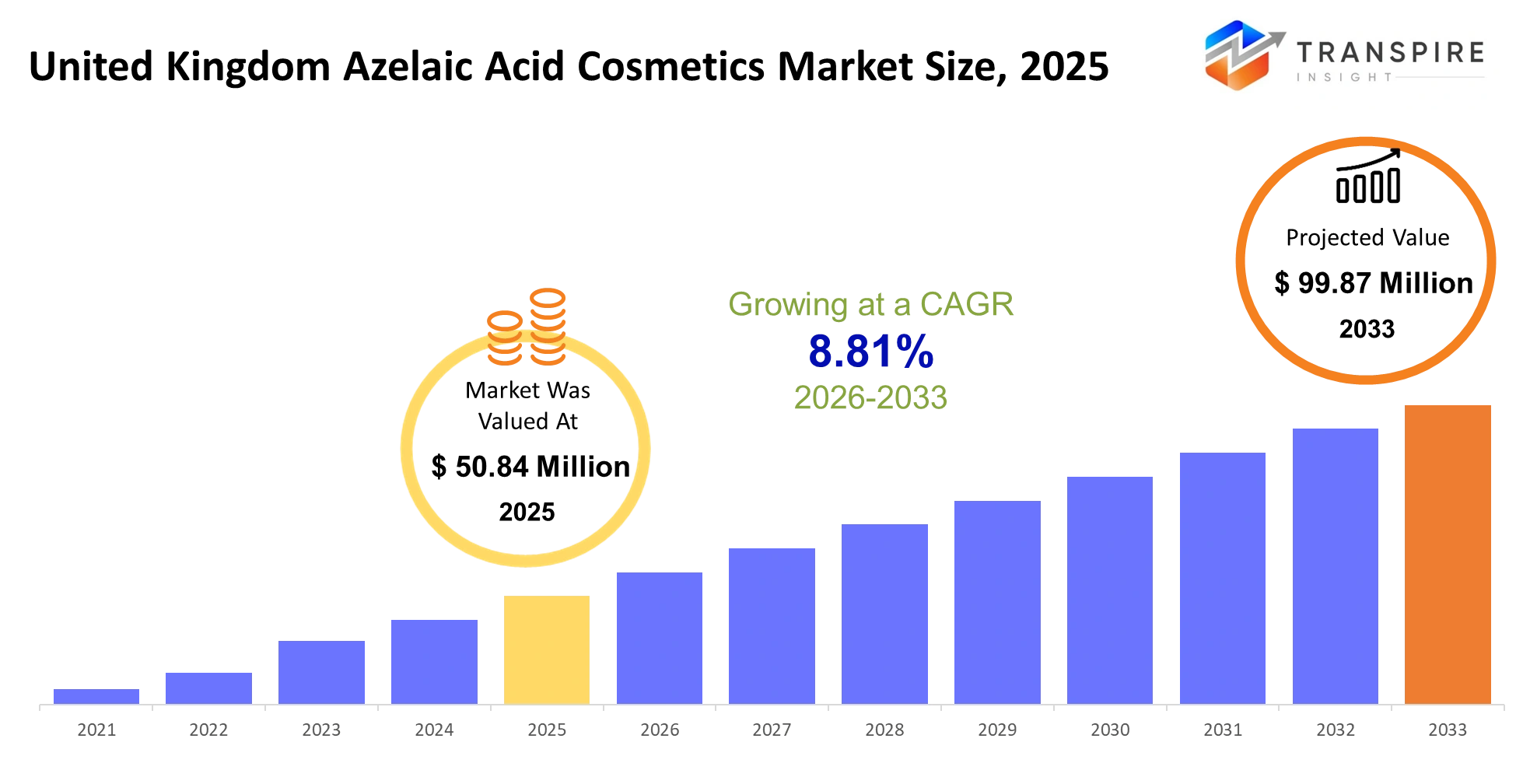
- United Kingdom Azelaic Acid Cosmetics Market Size 2025: USD 50.84 Million
- United Kingdom Azelaic Acid Cosmetics Market Size 2033: USD 99.87 Million
- United Kingdom Azelaic Acid Cosmetics Market CAGR: 8.81%
- United Kingdom Azelaic Acid Cosmetics Market Segments: By Product Type (Creams, Serums, Lotions, Gels, Face Masks, Cleansers, Spot Treatments, Others); By Application (Acne Treatment, Skin Brightening, Anti-aging, Rosacea Treatment, Hyperpigmentation Reduction, Others); By Distribution Channel (Pharmacies, Online Retail, Supermarkets, Specialty Beauty Stores, Dermatology Clinics, Others); By Ingredient Type (Natural Azelaic Acid Products, Synthetic Azelaic Acid Products, Vegan Formulations, Others).
To learn more about this report,  Download Free Sample Report
United Kingdom Azelaic Acid Cosmetics Market Summary
The United Kingdom Azelaic Acid Cosmetics Market was valued at USD 50.84 Million in 2025. It is forecast to reach USD 99.87 Million by 2033. That is a CAGR of 8.81% over the period.
Azelaic acid cosmetics kinda end up playing a practical role in the United Kingdom’s skincare market, by helping people handle those stubborn concerns like acne, rosacea , post-inflammatory hyperpigmentation, and uneven skin tone, instead of jumping straight to harsher treatment routines. Since dermatology-led skincare has become more mainstream, azelaic acid has really shifted from being a more niche active ingredient into something like a daily face care staple in many formulations.
Over the last few years, roughly three to five, the whole market seems to have shifted structurally toward skincare that’s clinically validated , and also ingredient-focused, where consumers and retailers care more about efficacy transparency and that dermatological credibility angle. One of the biggest drivers behind this change was the post-pandemic boost in skin health issues, tied to prolonged mask wearing , plus people doing more digital skincare consultations. In that kind of environment, there’s more demand for multifunctional actives that tackle several issues at the same time. So brands have expanded their azelaic acid lineups across serums , creams, and mixed or combination formulations, which helps them reach more shoppers and support revenue growth through premium positioning, repeat buys , and stronger presence through pharmacy shelves as well as e-commerce distribution.
Key Market Insights
- It kind of feels like Azelaic acid serums are still the front-runners, taking in almost 42% of the market share in 2025, mainly because the formula strength is higher and the outcomes feel more focused for treatment.
- Meanwhile, Azelaic acid creams sit as the second-largest segment, they do so with support from lots of dermatologist recommendations and that simple daily use convenience which people like.
- Then there’s the multi-ingredient side—multi active formulations that pair azelaic acid with niacinamide and hyaluronic acid. Those seem to be the fastest-growing part through 2030, largely from demand for more than one benefit in the same routine.
- And product innovation that keeps going on about sensitive-skin compatibility keeps pushing segment growth and market penetration, not just in a small way but pretty steadily.
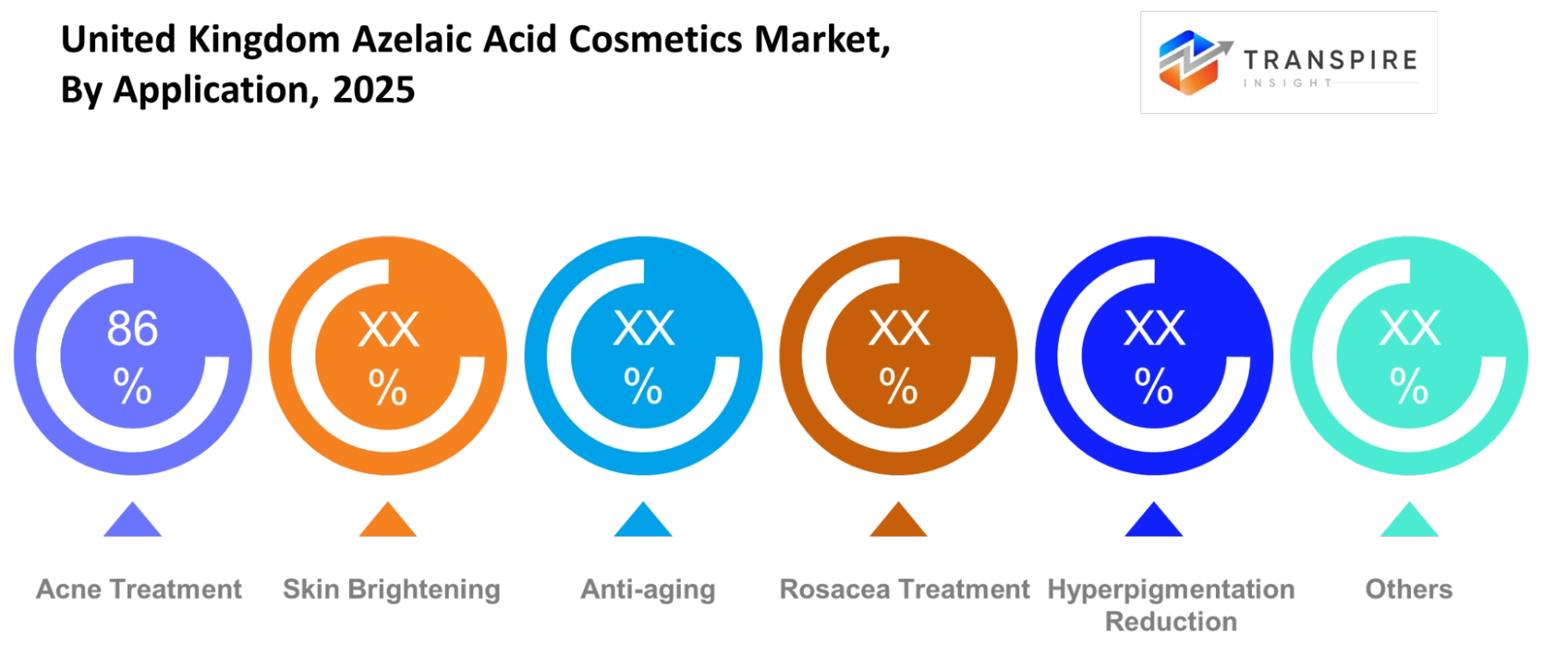
- When it comes to uses, acne treatment is leading the way, about 45% of market demand in 2025, backed by consumers who really prefer non-antibiotic skincare solutions, for whatever reason it feels safer to them.
- Hyperpigmentation and dark spot correction are also very significant, landing as the second-biggest application category across the UK skincare market.
- On the customer side women make up nearly 68% of total market consumption in 2025, so they are basically the leading end-user group in the United Kingdom Azelaic Acid Cosmetics Market.
- Adults aged 25–44 generate the largest slice of industry revenue too, because their skincare spending patterns stay consistent.
- Male skincare users are growing faster, helped by expanding grooming routines and better access to products in general.
- Lastly, younger consumers are showing a clear shift toward ingredient-led skincare products, and they want clinically validated efficacy claims, which sounds kind of picky but it’s what they ask for.
What are the Key Drivers, Restraints, and Opportunities in the United Kingdom Azelaic Acid Cosmetics Market?
The strongest growth driver in the United Kingdom Azelaic Acid Cosmetics Market is basically the shift toward skincare that’s clinically validated, sort of supported by dermatological evidence. In the last several years, consumers have gotten a bit more selective about how well ingredients actually perform, and that change is mostly driven by digital dermatology platforms , plus teleconsultations and ingredient-focused retail strategies. Azelaic acid has quietly gained from this whole transition because it can tackle several skin conditions at once, like acne, rosacea , and hyperpigmentation, inside one formulation. That multipurpose profile lets brands ask for premium pricing, while also getting more repeat purchases which in turn supports revenue expansion across pharmacy, specialty retail, and e-commerce channels.
Now the main restraint is the limited availability of high-concentration azelaic acid options within the cosmetics category. There are regulatory differences between cosmetic and therapeutic products, and those differences restrict how brands can formulate and especially how they can advertise the stronger treatments. This kind of structural problem can’t be fixed fast, because it’s tied to product classification rules, safety expectations, and compliance expenses. So some consumers who have more severe skin concerns keep leaning on prescription alternatives, which narrows the addressable market and can reduce the revenue capture for cosmetic manufacturers.
A big opportunity, meanwhile, sits in advanced combination formulations, where azelaic acid is paired with ingredients like niacinamide, ceramides , and hyaluronic acid. Those products handle multiple skin issues in one go, and they also help improve tolerability. As premium skincare collections keep expanding across the UK , brands that invest in these multi-need formulations are well placed to unlock what comes next for market growth
What Has the Impact of Artificial Intelligence Been on the United Kingdom Azelaic Acid Cosmetics Market?
Artificial intelligence and newer digital technologies are slowly but steadily changing the United Kingdom Azelaic Acid Cosmetics Market , mainly by making formulation work faster , boosting manufacturing efficiency, and sharpening how companies reach specific consumers. For example cosmetic producers are now leaning on AI driven analytics platforms to sort out ingredient screening, stability trials, and formulation optimization in a more automated way. In practice these systems help research teams figure out which azelaic acid pairings work best with things like niacinamide and ceramides, and they do it while trimming the overall time needed to bring a product to market, sometimes quite a lot.
Along the same lines, machine learning models add predictive power through different parts of the value chain. Brands watch consumer buying patterns, online reviews , and even dermatology related search behavior to estimate product demand, then adjust inventory levels so there’s less idle stock and fewer shortages. In factories, predictive maintenance setups keep an eye on production equipment and highlight potential failures before they become real problems. That means fewer stoppages and steadier output which is kind of the whole goal.
Overall advanced digital tools are bringing real operational gains. Automated quality control systems that use computer vision can flag issues in packaging and labeling with better accuracy than older manual checks , so companies waste less material and lower production expenses. Also AI powered personalization engines can raise conversion rates by suggesting skincare products based on individual skin worries. This sort of targeted recommendation tends to support stronger retention and more repeat purchases, because customers feel understood, even if the experience is mostly delivered through a screen.
Despite those benefits, there’s still this big limitation, like the cost is high when it comes to integrating AI platforms with older manufacturing and retail systems. Smaller cosmetic brands often have budget constraints and limited access to top tier consumer datasets, which can end up lowering model accuracy. And that can also slow down adoption across the wider market, overall.
Key Market Trends
- Since 2021 ingredient-led skincare buying has kind of taken off ,and people are more often picking activities with clinical backing instead of just going by the old brand story ,you know.
- From 2020 to 2025, azelaic acid moved from those more specialized treatment items into everyday skincare routines, handling several concerns at the same time, which is nice I guess.
- After the pandemic digital dermatology consults grew a lot, and that pushed more customers toward targeted formulas for acne, rosacea, and pigmentation control.
- Manufacturers started pairing azelaic acid with niacinamide and hyaluronic acid more frequently after 2022, making multi purpose products that often sell for noticeably higher retail prices.
- Direct-to-consumer sales picked up serious momentum since 2021, as brands depended less on physical retail, and leaned harder into online education stuff.
- Brands like The Ordinary, Paula's Choice, and FaceTheory really stepped up ingredient transparency, so concentration levels, plus efficacy claims became way more visible.
- Newer product launches also kept aiming at people with sensitive skin, suggesting a move away from the harsher exfoliation-focused routines that were popular a few years back.
- AI driven consumer insights showed up more often after 2023, which helps companies spot buying habits and steer product development choices.
- Premium skincare areas also got stronger, because shoppers increasingly traded up to dermatologist recommended options with clinically tested ingredients.
- And in the UK, regulatory review of cosmetic claims tightened overall, so brands had to put more effort into scientific support and compliance documentation.
United Kingdom Azelaic Acid Cosmetics Market Segmentation
By Product Type :
Creams, serums, lotions, gels, face masks , cleansers, spot treatments, and other formats basically cover the big product categories in the United Kingdom Azelaic Acid Cosmetics Market. Each format tries to deliver azelaic acid in a way that fits different skincare routines, skin types, and those treatment goals people keep talking about. At the same time, product development keeps steering toward convenience, comfort, and real effectiveness for day-to-day use, not just “theoretical results”.
Creams tend to get chosen for hydration and longer wear, while serums feel lighter and usually give a more concentrated approach. Gels and spot treatments are often picked when someone wants something more pointed, for specific issues. Meanwhile cleansers and face masks help people stay consistent with regular routines. Other product formats, too , give brands room to react to shifting consumer preferences and widen options across more price tiers, which is kinda important.
By Application :
Then there’s application based segmentation, which shows the different skincare worries addressed by azelaic acid cosmetic products. Acne treatment still matters a lot because azelaic acid can help reduce visible breakouts and make skin look better overall. Skin brightening, anti-aging, rosacea treatment, hyperpigmentation reduction, and other uses also keep pushing market growth.
For example, skin brightening products are usually used to support an even tone, while anti-aging lines aim to keep skin looking smoother. Rosacea treatment applications focus on redness related issues, and hyperpigmentation reduction products target uneven patches of color. Beyond that, more “multi need” solutions keep appearing as cosmetic companies launch formulas meant to cover several concerns at once, even if it’s just in one bottle or tube.
To learn more about this report, Download Free Sample Report
By Distribution Channel :
Distribution channels kinda matter a lot when it comes to making azelaic acid cosmetics reachable for consumers. Pharmacies, online retail platforms, supermarkets, specialty beauty stores, dermatology clinics, and a bunch of other sales routes all do their own thing for purchasing preferences. When a brand shows up in multiple channels, product availability becomes more stable and the market reach gets broader plus brand visibility gets a bit stronger too.
Online retail has become more important recently, partly because shoppers can weigh ingredients, see reviews, and check claimed benefits before they actually buy. Pharmacies and dermatology clinics still feel like trusted spaces for purchasing. Meanwhile specialty beauty stores usually give a wider range of products, so that feels helpful for people browsing more deeply. Supermarkets and other channels also keep accessibility high, because skincare items can show up during everyday shopping and not only as a dedicated beauty stop.
By Ingredient Type :
Ingredient type segmentation mirrors the different formulation approaches cosmetic manufacturers choose in practice. Natural azelaic acid products, synthetic azelaic acid products, vegan formulations, and other ingredient categories respond to consumer expectations about sourcing, how the formula is made, and where the product sits in the market. Product differentiation within this area helps brands aim for distinct customer groups, in a more straightforward way.
Natural formulations appeal to people who prefer ingredients linked to naturally derived sources, while synthetic formulations offer consistency and tighter controlled production standards. Vegan formulations keep getting attention since ingredient limits and lifestyle preferences often overlap there. Other ingredient categories also support innovation, because manufacturers can bring in new formulations that match shifting skincare trends, as well as regulatory needs.
What are the Key Use Cases Driving the United Kingdom Azelaic Acid Cosmetics Market?
In the United Kingdom , the primary use case pushing people to adopt Azelaic Acid Cosmetics is acne management , in a way that feels almost obvious once you look at routine choices. More consumers are opting for azelaic acid creams, serums, and targeted spot treatments because these help reduce blemishes , calm inflamed areas, and nudge the skin toward a clearer look. Because teenagers and adults tend to keep using it consistently, this category is responsible for the largest chunk of overall demand, it stays steady rather than spiking.
Past breakout control, applications tied to skin brightening and hyperpigmentation reduction are also picking up momentum. People especially like these options when they shop through online retail platforms, specialty beauty stores, or dermatology clinics. Formulations that aim at patchy tone and post-acne marks are broadening the customer base, so it’s not only the traditional acne-focused users anymore.
Some of the more emerging directions include rosacea-focused skincare, plus multifunctional anti-aging products where azelaic acid is paired with other supportive activities. Premium skincare brands are starting to explore these categories to address redness, skin texture worries, and early aging signals. With continued innovation in more advanced formulations, wider adoption is expected to grow over the forecast period , even if the pace varies by segment.
|
Report Metrics |
Details |
|
Market size value in 2025 |
USD 50.84 Million |
|
Market size value in 2026 |
USD 55.32 Million |
|
Revenue forecast in 2033 |
USD 99.87 Million |
|
Growth rate |
CAGR of 8.81% from 2026 to 2033 |
|
Base year |
2025 |
|
Historical data |
2021 - 2024 |
|
Forecast period |
2026 - 2033 |
|
Report coverage |
Revenue forecast, competitive landscape, growth factors, and trends |
|
Regional scope |
Middle East and Africa (Saudi Arabia, United Arab Emirates, South Africa, Rest of Middle East and Africa) |
|
Key company profiled |
The Ordinary, Paula’s Choice, Sesderma, Bayer, Galderma, L'Oréal, La Roche-Posay, SkinCeuticals, Cos De BAHA, FaceTheory, Neutrogena, Drunk Elephant, Obagi Medical, Murad, CeraVe. |
|
Customization scope |
Free report customization (country, regional & segment scope). Avail customized purchase options to meet your exact research needs. |
|
Report Segmentation |
By Product Type (Creams, Serums, Lotions, Gels, Face Masks, Cleansers, Spot Treatments, Others); By Application (Acne Treatment, Skin Brightening, Anti-aging, Rosacea Treatment, Hyperpigmentation Reduction, Others); By Distribution Channel (Pharmacies, Online Retail, Supermarkets, Specialty Beauty Stores, Dermatology Clinics, Others); By Ingredient Type (Natural Azelaic Acid Products, Synthetic Azelaic Acid Products, Vegan Formulations, Others). |
Which Regions are Driving the United Kingdom Azelaic Acid Cosmetics Market Growth?
England still feels like the top region in the United Kingdom Azelaic Acid Cosmetics Market, mostly because it has such a big audience, a dense cluster of premium skincare brands, and a pretty solid retail setup. You can see it in places like London, Manchester, and Birmingham where sales stay strong through pharmacies, beauty chains, and also e-commerce networks. There’s also the factor of easier reach to dermatology services and aesthetic skincare clinics, that kind of guidance really helps people try ingredient based products. So the mix of retail coverage, professional support, and people willing to spend on skincare keeps England in the lead , more or less.
Scotland is smaller than England, but it still has its own role and the market looks steadier there. The momentum comes from a fairly balanced blend of pharmacy presence, online shopping, and established healthcare access, nothing too wild but dependable. When you compare it with England, it leans less on luxury cosmetics spending and more toward straightforward skincare solutions that are known to work. That consistent demand pattern makes Scotland a dependable part of overall market revenue, even if it’s not grabbing the spotlight as much.
Wales on the other hand looks like it’s gaining speed the fastest. Digital commerce keeps expanding access to specialized skincare, including in areas outside the biggest cities. Plus, brands that are often dermatologist recommended are showing up more through online platforms, and that has shifted how customers buy over the last few years. Interest is rising in more focused options for acne, rosacea, and pigmentation issues, so manufacturers and retailers are getting fresh openings. During the 2026–2033 window, this momentum should bring even more product launches , extra distribution investment, and stronger marketing activity across the region.
Who are the Key Players in the United Kingdom Azelaic Acid Cosmetics Market and How Do They Compete?
In the United Kingdom , the Azelaic Acid Cosmetics Market competitive landscape looks sort of moderately fragmented, and the rivalry is more about formulation quality, clinical credibility, ingredient transparency, plus digital consumer engagement, not only about price. Still, most established skincare brands try to hold their share via new product ideas and solid retail partnerships, while newer digitally native brands sort of pressure the system with direct-to-consumer models. Lately, competition is leaning toward showing measurable skincare gains, and offering products tuned to specific issues like acne, rosacea, and hyperpigmentation.
The Ordinary stands out with a transparent, ingredient-first strategy that clearly explains active concentrations and formulation specifics. That method resonates with people who want efficacy but do n’t necessarily want premium pricing. The brand keeps expanding through wider global retail partnerships, and it keeps moving product development forward around scientifically supported skincare ingredients. Paula’s Choice uses a research-led setup, built on evidence based formulations and educational content. Their strong consumer confidence and dermatologist-backed positioning give it solid competitive durability, while expansion stays supported through online channels and international distribution networks.
FaceTheory kind of competes by leaning into vegan formulations , a sustainability focused vibe, and then direct customer engagement via e-commerce platforms. It is this specialization that pulls in people who are looking for ethical skincare choices, plus clinical effectiveness at the same time . Sesderma on the other hand differentiates itself with advanced formulation technologies, aimed at helping ingredient delivery and overall product performance work better. Ongoing investment into dermatology driven product development , along with wider international market penetration, backs up growth chances and helps reinforce brand visibility across the UK skincare sector, which is pretty important , honestly.
Company List
- The Ordinary
- Paula’s Choice
- Sesderma
- Bayer
- Galderma
- L'Oréal
- La Roche-Posay
- SkinCeuticals
- Cos De BAHA
- FaceTheory
- Neutrogena
- Drunk Elephant
- Obagi Medical
- Murad
- CeraVe
Recent Development News
In August 2025, entered a retail partnership with . Anua expanded into 650 Boots stores across the United Kingdom and promoted key products including its Azelaic Acid Serum, strengthening the visibility of azelaic-acid-based skincare products in the UK cosmetics market.
Source: https://www.prnewswire.co.uk/
In May 2026, showcased Azepur99, a high-purity azelaic acid ingredient for skincare and haircare applications. The launch highlighted increasing investment in premium cosmetic-grade azelaic acid technologies, supporting future product development across the UK cosmetics sector. Source: https://cosmeticsbusiness.com/
What Strategic Insights Define the Future of the United Kingdom Azelaic Acid Cosmetics Market?
The United Kingdom Azelaic Acid Cosmetics Market is sort of moving toward a more clinic based and personalized skincare model over the next five to seven years. The main push behind this change is the growing overlap between dermatology, digital health platforms, and ingredient-first beauty buying. As people start judging products by documented performance, not just name familiarity , companies that can show measurable results should end up capturing more of the value.
There’s also a less obvious risk that doesn’t get talked about much, market concentration around a relatively small set of highly recognized active ingredients. When more brands crowd into similar formulation setups, it can become harder to stand out, and then pricing pressure tends to show up, along with slower premiumization. Meanwhile, if cosmetic claim rules get stricter , compliance expenses could rise and product launches may take longer.
Still, there’s a real opening that looks promising, personalized skincare systems that blend AI skin assessment tools with targeted azelaic acid formulations. This area is still fairly early but it is starting to gain commercial momentum. Market players should put money into clinical validation, digital diagnostic strength, and multifunctional formulas so they can build clearer differentiation, before personalized skincare turns into a normal must-have rather than just a niche requirement.
United Kingdom Azelaic Acid Cosmetics Market Report Segmentation
By Product Type
- Creams
- Serums
- Lotions
- Gels
- Face Masks
- Cleansers
- Spot Treatments
By Application
- Acne Treatment
- Skin Brightening
- Anti-aging
- Rosacea Treatment
- Hyperpigmentation Reduction
By Distribution Channel
- Pharmacies
- Online Retail
- Supermarkets
- Specialty Beauty Stores
- Dermatology Clinics
By Ingredient Type
- Natural Azelaic Acid Products
- Synthetic Azelaic Acid Products
- Vegan Formulations
Frequently Asked Questions
Find quick answers to common questions.
The United Kingdom Azelaic Acid Cosmetics Market size is USD 99.87 Million in 2033.
Key segments for the United Kingdom Azelaic Acid Cosmetics Market are By Product Type (Creams, Serums, Lotions, Gels, Face Masks, Cleansers, Spot Treatments, Others); By Application (Acne Treatment, Skin Brightening, Anti-aging, Rosacea Treatment, Hyperpigmentation Reduction, Others); By Distribution Channel (Pharmacies, Online Retail, Supermarkets, Specialty Beauty Stores, Dermatology Clinics, Others); By Ingredient Type (Natural Azelaic Acid Products, Synthetic Azelaic Acid Products, Vegan Formulations, Others).
Major United Kingdom Azelaic Acid Cosmetics Market players are The Ordinary, Paula’s Choice, Sesderma, Bayer, Galderma, L'Oréal, La Roche-Posay, SkinCeuticals, Cos De BAHA, FaceTheory, Neutrogena, Drunk Elephant, Obagi Medical, Murad, CeraVe.
The United Kingdom Azelaic Acid Cosmetics Market size is USD 50.84 Million in 2025.
The United Kingdom Azelaic Acid Cosmetics Market CAGR is 8.81% from 2026 to 2033.
- The Ordinary
- Paula’s Choice
- Sesderma
- Bayer
- Galderma
- L'Oréal
- La Roche-Posay
- SkinCeuticals
- Cos De BAHA
- FaceTheory
- Neutrogena
- Drunk Elephant
- Obagi Medical
- Murad
- CeraVe
About the Authors

Chetan Dhatrak
I’m Chetan Dhatrak, a Senior Research Analyst at Transpire Insight, specializing in the Consumer Goods, Foods and Beverages industry. I focus on analyzing market trends, consumer behavior, competitive landscapes, and industry developments to deliver accurate, data-driven insights. My research at Transpire Insight is built on credible sources and in-depth analysis, helping businesses and readers better understand market dynamics, emerging opportunities, and evolving consumer preferences. I’m committed to creating reliable, well-researched content that supports informed decision-making and reflects the latest developments in the consumer goods and food & beverage sectors.

Chakradhar Khansole
Chakradhar serves as the Research Director at Transpire Insight, bringing over 8 years of experience in technology, innovation, and strategic market intelligence. He specializes in transforming complex market data into actionable business insights that enable organizations to make informed, growth-oriented decisions. Recognized for his strategic vision and analytical expertise, Chakradhar leads high-impact research initiatives, delivering comprehensive market assessments, competitive intelligence, and forward-looking industry analysis.
Recently Published Reports
-
Apr 2026
Bottled Water Market
Bottled Water Market Size, Share & Analysis Report By Product Type (Still Bottled Water, Carbonated Bottled Water, Functional Bottled Water, and Others), By Packaging (PET, Cans, and Others), By Sales Channel (Supermarkets/Hypermarkets, Convenience Stores/Drug Stores, Grocery Stores/Club Stores, Foodservice, and Others) and Geography (North America, Europe, Asia-Pacific, Middle East and Africa, South and Central America), 2021 - 2032
-
Apr 2026
Color Cosmetic Packaging Market
Color Cosmetic Packaging Market Size, Share & Analysis Report By Application (Mascara Packaging, Liquid Packaging, and Liquid Face), By Type (Tubes & Bottles, Pens & Markers, Compacts & Containers, and Droppers & Pumps), and Geography (North America, Europe, Asia-Pacific, Middle East and Africa, South and Central America), 2021 - 2031
-
Apr 2026
External Microphone For Camera Market
External Microphone For Camera Market Size, Share & Analysis Report By Type (Shotgun Microphone, Lavalier Microphone, and Others), By Application (Digital Camera, Professional Video Camera, and Others), and Geography (North America, Europe, Asia-Pacific, Middle East and Africa, South and Central America), 2021 - 2031
-
Apr 2026
Foot Orthotic Insoles Market
Foot Orthotic Insoles Market Size, Share & Analysis Report By Type (Pre-fabricated, and Custom-made), By Material (Thermoplastic, Composite Carbon Fiber, and Others), By Distribution Channel (Drug Stores, Hospitals & Clinics, and Others), and Geography (North America, Europe, Asia-Pacific, Middle East and Africa, South and Central America), 2021 - 2031