
France Cosmetics Market Size & Forecast
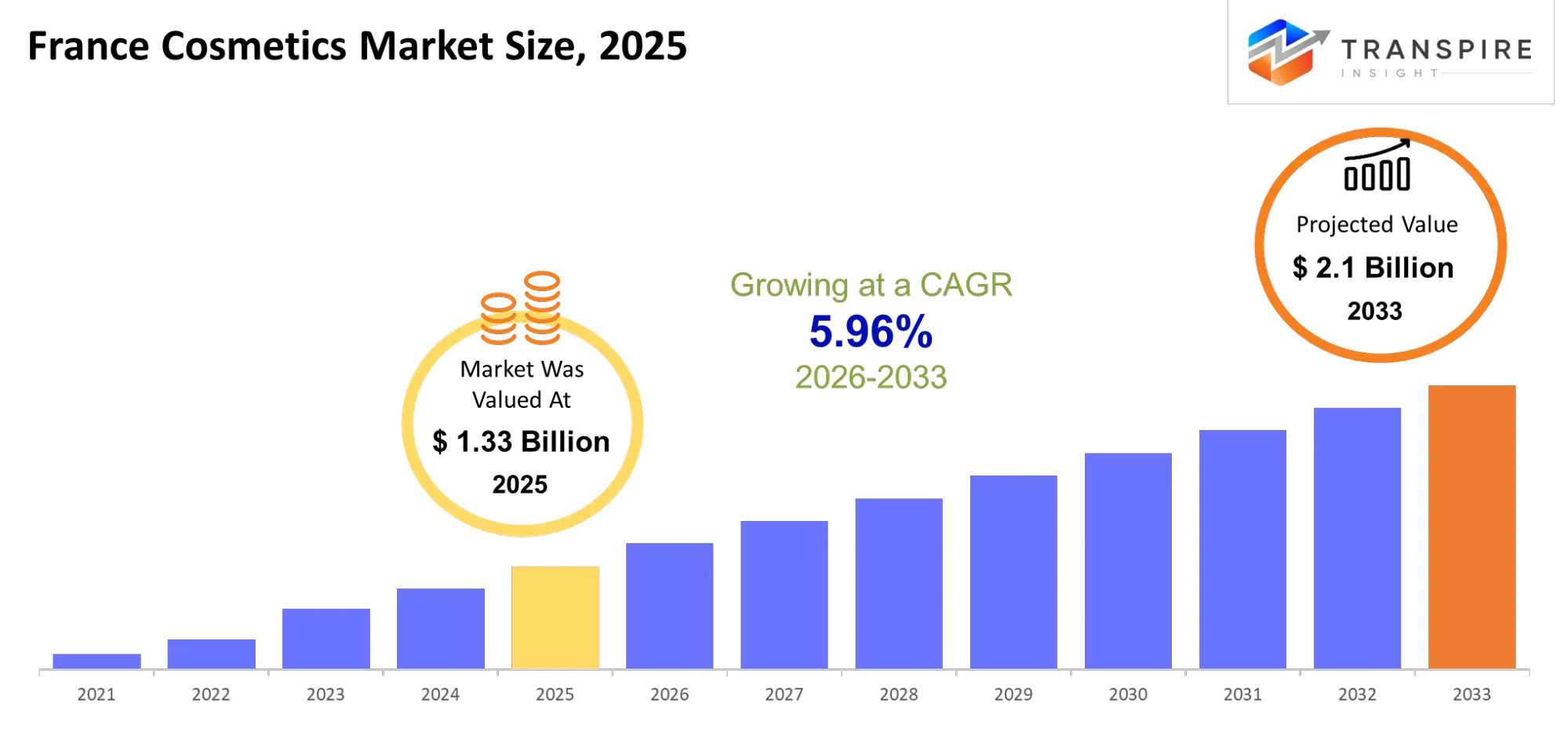
- France Cosmetics Market Size 2025: USD 1.33 Billion
- France Cosmetics Market Size 2033: USD 2.1 Billion
- France Cosmetics Market CAGR: 5.96%
- France Cosmetics Market Segments: By Type (Skincare, Haircare, Makeup, Fragrances, Others), By Application (Personal Care, Beauty Enhancement, Anti-aging, Grooming, Others), By End-User (Women, Men, Unisex, Others), By Distribution (Online, Retail Stores, Specialty Stores, Pharmacies, Others)
To learn more about this report,  Download Free Sample Report
France Cosmetics Market Summary
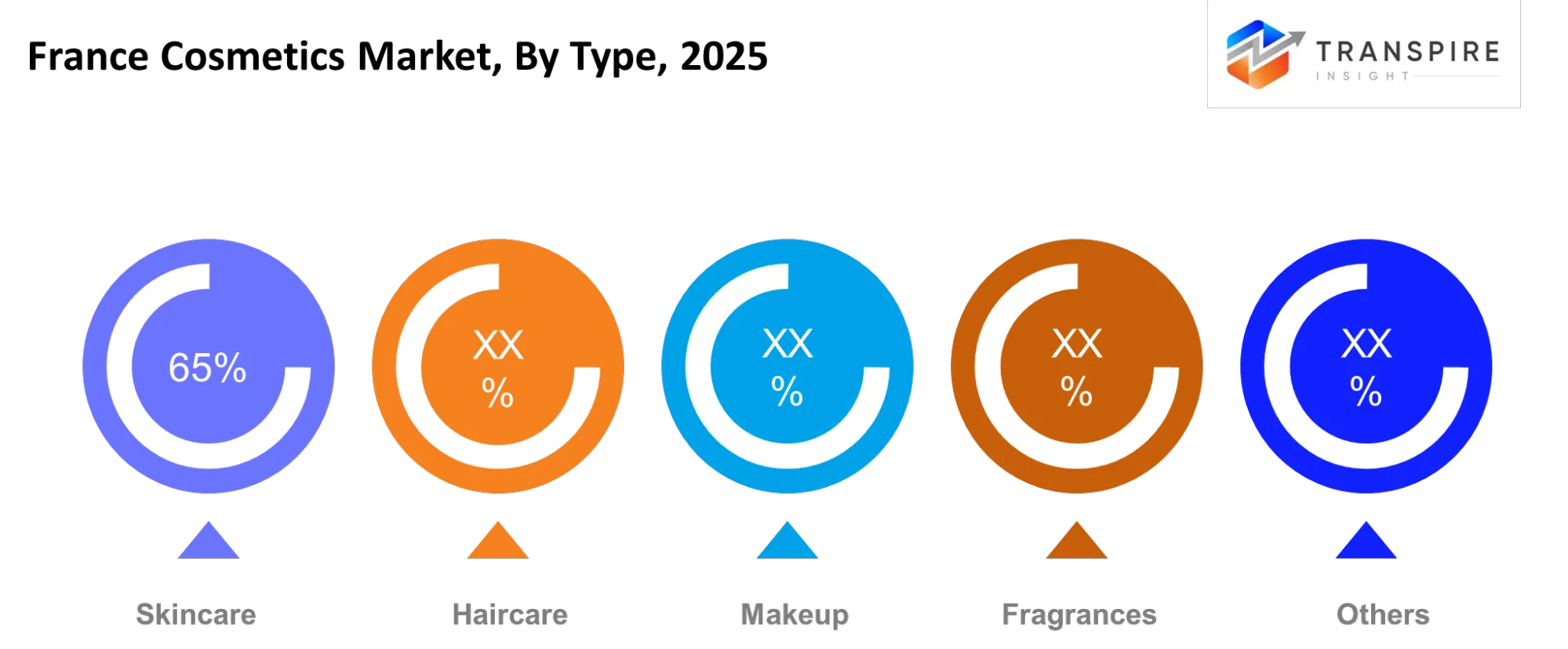
The market reached USD 1.33 Billion in 2025 and is projected to grow to USD 2.1 Billion by 2033, expanding at a 5.96% CAGR. The French cosmetics market represents luxury beauty consumption and innovation leadership in skincare, fragrance, and personal care products. Skincare accounts for 65% of market revenue in 2025, driven by French consumers' emphasis on dermatological efficacy and anti-aging formulations.
Luxury skincare really dominates French consumer preferences - with premium brands commanding quite a price premium over their mass-market counterparts. The market also benefits greatly from some really well-known heritage brands such as L'Oréal, Clarins, and Chanel - all of which originated in France and are globally recognized. The rise of online retail channels has made it much easier to get your hands on international beauty brands while local specialty stores still manage to capture consumers looking for personalized beauty advice.
Market growth is limited by an extremely sensitive economy in the mass-market sector and quite competitive retail environments that put a lot of pressure on brand profits. However, trends like premiumisation and more interest in natural and sustainable cosmetics products give opportunities to brands prepared to really innovate their products and make a bigger investment in digital marketing.
Key France Cosmetics Market Insights
- Skincare dominates the French cosmetics market with 65% of total revenue in 2025, supported by national emphasis on anti-aging formulations, dermatological efficacy, and luxury brand positioning.
- Women represent 72% of end-user spending in the France cosmetics market, though men's grooming is the fastest-growing segment, expanding at 12.5% CAGR through 2033.
- Online distribution channels captured 28% of France cosmetics market revenue in 2025, growing 18% year-over-year as digital-native beauty brands and e-commerce platforms expanded market accessibility.
- L'Oréal and Estée Lauder collectively control approximately 24% of France cosmetics market revenue through portfolio brands spanning mass-market and luxury segments.
- Specialty stores maintain the largest distribution share at 35% of market revenue in 2025, though this share declined 4.2% year-over-year as online channels accelerated.
- Anti-aging applications represent the highest-value segment, accounting for 38% of skincare revenue, driven by aging demographics and rising spending among affluent consumers aged 40 and above.
- Natural and organic cosmetics gained 15% market share over the past three years as French consumers increasingly prioritized sustainability and clean beauty formulations.
- Pharmacy distribution channels account for 22% of market revenue, serving as primary channel for pharmaceutical-grade skincare and anti-aging treatments.
- Fragrance represents the second-largest product category at 18% of market revenue, anchored by luxury French perfume houses with multi-decade heritage.
- Direct-to-consumer skincare brands captured approximately 12% of market share, disrupting traditional distribution relationships and forcing brand consolidators to accelerate digital acquisition strategies.
What are the Key Drivers, Restraints, and Opportunities in the France Cosmetics Market?
The primary expansion force is aging demographics and rising spending on anti-aging and skin restoration products. France's population aged 50 and above represents 32% of total population in 2025 and is growing at 1.8% annually. This demographic cohort spends 3 to 4 times more per capita on premium skincare than younger age groups, creating structural demand for high-value formulations addressing wrinkles, skin texture, and age-related concerns. Luxury brands including Estée Lauder, Chanel, and Dior have concentrated product development and marketing spend on premium anti-aging serums and treatments selling at USD 120 to USD 400 per unit.
The most significant barrier is regulatory complexity around ingredients and marketing claims. The European Union's strict regulations on cosmetic ingredient restrictions and advertising substantiation require lengthy compliance processes that delay product launches and compress margins for smaller indie brands attempting to enter premium segments.
The clearest opportunity is personalized skincare and AI-driven beauty recommendations. French consumers show high receptiveness to technology-enabled beauty solutions where AI chatbots analyze skin conditions and recommend targeted product regimens. Brands integrating skin analysis technology with e-commerce platforms reduce return rates and increase average order values by 35 to 45 percent through precision product recommendation.
What Has the Impact of Artificial Intelligence Been on the France Cosmetics Market?
Machine learning algorithms now drive skincare recommendations and product discovery across digital platforms. AI skin analysis tools allow consumers to upload selfies, and algorithms assess skin tone, texture, wrinkles, and sensitivity to recommend targeted product combinations. This capability reduces product discovery friction and increases consumer confidence in online beauty purchases, which traditionally suffered from high return rates due to color matching and skin type mismatch problems.
Personalized beauty subscription boxes powered by AI recommendation engines now represent a distinct market segment worth approximately USD 85 Million in annual subscriptions. Providers including FaceGym and Beautyboxes use machine learning to tailor monthly product selections to individual skin profiles, creating recurring revenue models that shift cosmetics marketing from one-time transactions to subscription relationships. Constraints to broader adoption include data privacy regulations limiting AI model training on skin image datasets and consumer hesitancy to share biometric skincare data with third parties.
Key Market Trends
- Skincare accounts for 65% of France cosmetics market revenue, with anti-aging serums and eye creams driving the highest per-unit price realization.
- Online distribution grew 18% year-over-year in 2024, capturing 28% of market revenue and establishing itself as the fastest-growing channel.
- Women's skincare remains the largest segment by end-user, but men's grooming expanded 12.5% annually as masculine beauty routines normalized.
- Natural and organic cosmetics achieved 18% market share growth over three years, reflecting consumer demand for clean beauty and sustainable sourcing.
- Specialty stores declined 4.2% in market share but maintain 35% of total revenue through premium positioning and expert consultation services.
- Fragrance category stabilized at 18% of market revenue after declining 2% in 2023, supported by niche perfume houses and gender-neutral fragrance launches.
- Pharmacy channels account for 22% of revenue, serving as primary distribution for pharmaceutical-grade skincare and prescription-strength treatments.
- Direct-to-consumer skincare brands grew to 12% market share by expanding digital advertising and influencer partnerships targeting younger demographics.
- Subscription beauty boxes generated USD 85 Million in annual revenue, representing 6.4% of online cosmetics sales through personalized AI recommendations.
- Luxury brand consolidation accelerated, with LVMH and Estée Lauder expanding portfolio acquisitions targeting niche indie skincare brands for younger consumer segments.
France Cosmetics Market Segmentation
By Type
Skincare dominates the France cosmetics market with 65% of total product category revenue in 2025. This segment spans cleansers, moisturizers, serums, masks, and targeted treatments addressing specific skin concerns from acne to aging. French consumers prioritize skincare formulation quality and dermatological efficacy over packaging or marketing claims, creating strong preference for pharmaceutical-grade brands with clinical substantiation. Premium skincare products command retail prices exceeding USD 100 per 50-milliliter unit, with luxury brands achieving gross margins of 75% to 85%. Skincare growth is anchored by aging demographics purchasing anti-aging treatments and younger consumers adopting multi-step skincare routines influenced by Korean beauty trends that gained adoption in France starting in 2018.
Makeup represents 12% of France cosmetics market revenue, with color cosmetics concentrated in premium positioning. French makeup consumers emphasize natural finishes and minimal-coverage formulations that enhance rather than transform appearance. This cultural preference limits volume growth compared to US and Asian markets where full-coverage makeup represents mainstream positioning. Foundation and concealer dominate makeup category revenue, while specialty products including contouring palettes and highlight powders remain niche compared to core complexion products.
Haircare accounts for 10% of market revenue, serving as secondary care category complementing skincare spending. Shampoos, conditioners, and hair treatments with anti-aging or damage-repair positioning command premium pricing and appeal to aging demographics prioritizing hair maintenance. Men's grooming haircare expanded as beard care and male hair loss prevention products gained adoption.
To learn more about this report, Download Free Sample Report
By Application
Anti-aging applications represent 38% of skincare market value, with products addressing fine lines, wrinkles, and skin elasticity. This segment commands the highest per-unit pricing and appeals to affluent consumers aged 40 and above. Serums infused with retinol, vitamin C, and peptides retail for USD 120 to USD 350 per unit, with annual per-customer spending exceeding USD 800 among engaged users in this category.
Personal care applications span daily cleansing and maintenance products, accounting for 35% of skincare revenue. This segment includes facial cleansers, toners, and daily moisturizers with broader consumer appeal and lower price points compared to anti-aging treatments. Volume in this category supports margin expansion for mass-market brands competing on value and accessibility.
By End-User
Women represent 72% of France cosmetics market end-user revenue in 2025, with spending concentrated in skincare and makeup categories. Female consumers aged 25-54 constitute the core target market for luxury brands, with this demographic accounting for 58% of total women's cosmetics spending. Men's cosmetics spending grew to 18% of total market revenue, driven by men's grooming adoption and acceptance of male skincare routines previously stigmatized in French culture.
By Distribution
Specialty beauty stores command 35% of France cosmetics market revenue, serving as primary distribution channel for premium and mid-tier brands. These independent and chain specialty retailers provide expert consultation services that justify premium pricing and reduce consumer purchase hesitation for high-value skincare products. Online distribution captured 28% of market revenue in 2025, growing 18% annually and establishing itself as the fastest-growing channel through digital-native brands and expanded e-commerce capabilities of legacy beauty companies.
Report Overview Table
|
Report Metrics |
Details |
|
Market size value in 2025 |
USD 1.33 Billion |
|
Market size value in 2026 |
USD 1.4 Billion |
|
Revenue forecast in 2033 |
USD 2.1 Billion |
|
Growth rate |
CAGR of 5.96% from 2026 to 2033 |
|
Base year |
2025 |
|
Historical data |
2021 - 2024 |
|
Forecast period |
2026 - 2033 |
|
Report coverage |
Revenue forecast, competitive landscape, growth factors, and trends |
|
Regional scope |
France |
|
Key companies profiled |
L'Oréal, Estée Lauder, Procter & Gamble, Unilever, Coty, Shiseido, Beiersdorf, Chanel, Dior, Revlon, Amorepacific, Avon, Clarins, Natura, Oriflame |
|
Customization scope |
Free report customization (segment scope, distribution channels). Avail customized purchase options to meet your exact research needs. |
|
Report Segmentation |
By Type (Skincare, Haircare, Makeup, Fragrances, Others), By Application (Personal Care, Beauty Enhancement, Anti-aging, Grooming, Others), By End-User (Women, Men, Unisex, Others), By Distribution (Online, Retail Stores, Specialty Stores, Pharmacies, Others) |
Which Distribution Channels are Driving the France Cosmetics Market Growth?
Specialty stores maintain the largest market share with 35% of total revenue in 2025, serving as primary distribution channel for premium skincare and makeup brands. These retailers provide expert consultation, product demonstrations, and sampling experiences that justify premium pricing and reduce consumer purchase risk for high-value items. Independent beauty retailers and regional chains maintain strong positions through personalized service and curated brand selections aligned with local preferences.
Online distribution channels achieved 28% of market revenue in 2025, growing at 18% annually and emerging as the fastest-growing segment. Digital-native skincare brands leveraging social media marketing and influencer partnerships captured significant share among consumers under 40. Established beauty retailers accelerated omnichannel strategies, expanding e-commerce capabilities and integrating online and offline experiences through click-and-collect services and virtual consultations.
Pharmacy channels maintained 22% of market share, serving as specialized distribution for pharmaceutical-grade skincare and treatments requiring professional guidance. Major pharmacy chains positioned themselves as dermatological beauty destinations, employing pharmacists trained in skincare consultation and recommending prescription-strength treatments for specific skin conditions. This channel attracted affluent consumers seeking clinical validation and professional oversight for skincare investments.
Who are the Key Players in the France Cosmetics Market and How Do They Compete?
L'Oréal leads the France cosmetics market through portfolio brands spanning mass-market to luxury segments, including L'Oréal Paris, Lancôme, Helena Rubinstein, and Giorgio Armani Beauty. The company competes through brand diversification, innovation in skincare technology, and distribution breadth across specialty stores, pharmacies, and online channels. Estée Lauder operates through portfolio brands including Estée Lauder, Clinique, and MAC, competing on premium positioning and direct-to-consumer digital capabilities.
Luxury French heritage brands including Chanel and Dior compete on brand prestige and exclusive positioning, with limited distribution through specialty boutiques and flagship stores. These brands command premium pricing through heritage storytelling and limited-edition product launches that create scarcity perception. Direct-to-consumer skincare brands disrupted traditional distribution through digital marketing and influencer partnerships, capturing younger consumers and forcing legacy brands to accelerate digital transformation.
France Cosmetics Market Companies
- L'Oréal
- Estée Lauder
- Procter & Gamble
- Unilever
- Coty
- Shiseido
- Beiersdorf
- Chanel
- Dior
- Revlon
- Amorepacific
- Avon
- Clarins
- Natura
- Oriflame
Recent Developments
In March 2026, L'Oréal completed the acquisition of Kering Beauté. The transaction expanded L’Oréal’s luxury fragrance and cosmetics portfolio through the addition of Creed and long-term beauty licenses for Balenciaga and Bottega Veneta, reinforcing France’s position in the global premium cosmetics market.https://www.loreal.com
In March 2026, L'Oréal expanded its strategic partnership with NVIDIA to accelerate AI-powered beauty discovery. The initiative integrated predictive AI and computational chemistry into L’Oréal’s research ecosystem, enhancing innovation capabilities in cosmetic formulation and personalized beauty solutions.https://www.loreal.com
What Strategic Insights Define the Future of the France Cosmetics Market?
Over the next five to seven years, the France cosmetics market will consolidate around personalized skincare solutions enabled by AI technology and direct-to-consumer digital channels. The underlying force is consumer demand for customized formulations addressing individual skin conditions, replacing one-size-fits-all product strategies. Brands that successfully integrate skin analysis technology with personalized product recommendations will capture disproportionate share of younger demographics while legacy brands retain aging consumer bases through premium positioning and pharmaceutical-grade credibility.
The hidden risk is regulatory complexity around AI-driven beauty recommendations and biometric data privacy. The European Union's expanding AI regulation framework and strict data protection rules limit brand ability to collect skin image data for algorithm training, constraining competitive advantage of personalization strategies. This regulatory environment may privilege legacy brands with established clinical study databases over digital-native competitors dependent on algorithmic innovation.
The clearest opportunity is geographic expansion of French beauty brands into Asia-Pacific markets where French premium positioning and heritage storytelling command price premiums among affluent consumers. French skincare brands leveraging patrimoine and luxury heritage positioning could capture significant share in China and Southeast Asia where French beauty carries cultural prestige. The strategic recommendation is to prioritize direct-to-consumer expansion into Asia-Pacific through digital platforms while maintaining premium positioning and brand exclusivity that justify price premiums over local competitors.
Frequently Asked Questions
Find quick answers to common questions.
The France Cosmetics Market size is expected to reach USD 2.1 Billion by 2033.
The key segments of the France Cosmetics Market are By Type (Skincare, Haircare, Makeup, Fragrances, Others), By Application (Personal Care, Beauty Enhancement, Anti-aging, Grooming, Others), By End-User (Women, Men, Unisex, Others), and By Distribution (Online, Retail Stores, Specialty Stores, Pharmacies, Others).
Major players in the France Cosmetics Market include L'Oréal, Estée Lauder, Procter & Gamble, Unilever, Coty, Shiseido, Beiersdorf, Chanel, Dior, Revlon, Amorepacific, Avon, Clarins, Natura, and Oriflame.
The France Cosmetics Market size is USD 1.33 Billion in 2025.
The France Cosmetics Market CAGR is 5.96% from 2026 to 2033.
- L'Oréal
- Estée Lauder
- Procter & Gamble
- Unilever
- Coty
- Shiseido
- Beiersdorf
- Chanel
- Dior
- Revlon
- Amorepacific
- Avon
- Clarins
- Natura
- Oriflame
Recently Published Reports
-
Apr 2026
Bottled Water Market
Bottled Water Market Size, Share & Analysis Report By Product Type (Still Bottled Water, Carbonated Bottled Water, Functional Bottled Water, and Others), By Packaging (PET, Cans, and Others), By Sales Channel (Supermarkets/Hypermarkets, Convenience Stores/Drug Stores, Grocery Stores/Club Stores, Foodservice, and Others) and Geography (North America, Europe, Asia-Pacific, Middle East and Africa, South and Central America), 2021 - 2032
-
Apr 2026
Color Cosmetic Packaging Market
Color Cosmetic Packaging Market Size, Share & Analysis Report By Application (Mascara Packaging, Liquid Packaging, and Liquid Face), By Type (Tubes & Bottles, Pens & Markers, Compacts & Containers, and Droppers & Pumps), and Geography (North America, Europe, Asia-Pacific, Middle East and Africa, South and Central America), 2021 - 2031
-
Apr 2026
External Microphone For Camera Market
External Microphone For Camera Market Size, Share & Analysis Report By Type (Shotgun Microphone, Lavalier Microphone, and Others), By Application (Digital Camera, Professional Video Camera, and Others), and Geography (North America, Europe, Asia-Pacific, Middle East and Africa, South and Central America), 2021 - 2031
-
Apr 2026
Foot Orthotic Insoles Market
Foot Orthotic Insoles Market Size, Share & Analysis Report By Type (Pre-fabricated, and Custom-made), By Material (Thermoplastic, Composite Carbon Fiber, and Others), By Distribution Channel (Drug Stores, Hospitals & Clinics, and Others), and Geography (North America, Europe, Asia-Pacific, Middle East and Africa, South and Central America), 2021 - 2031