
Europe Halal Cosmetics Market Size & Forecast:
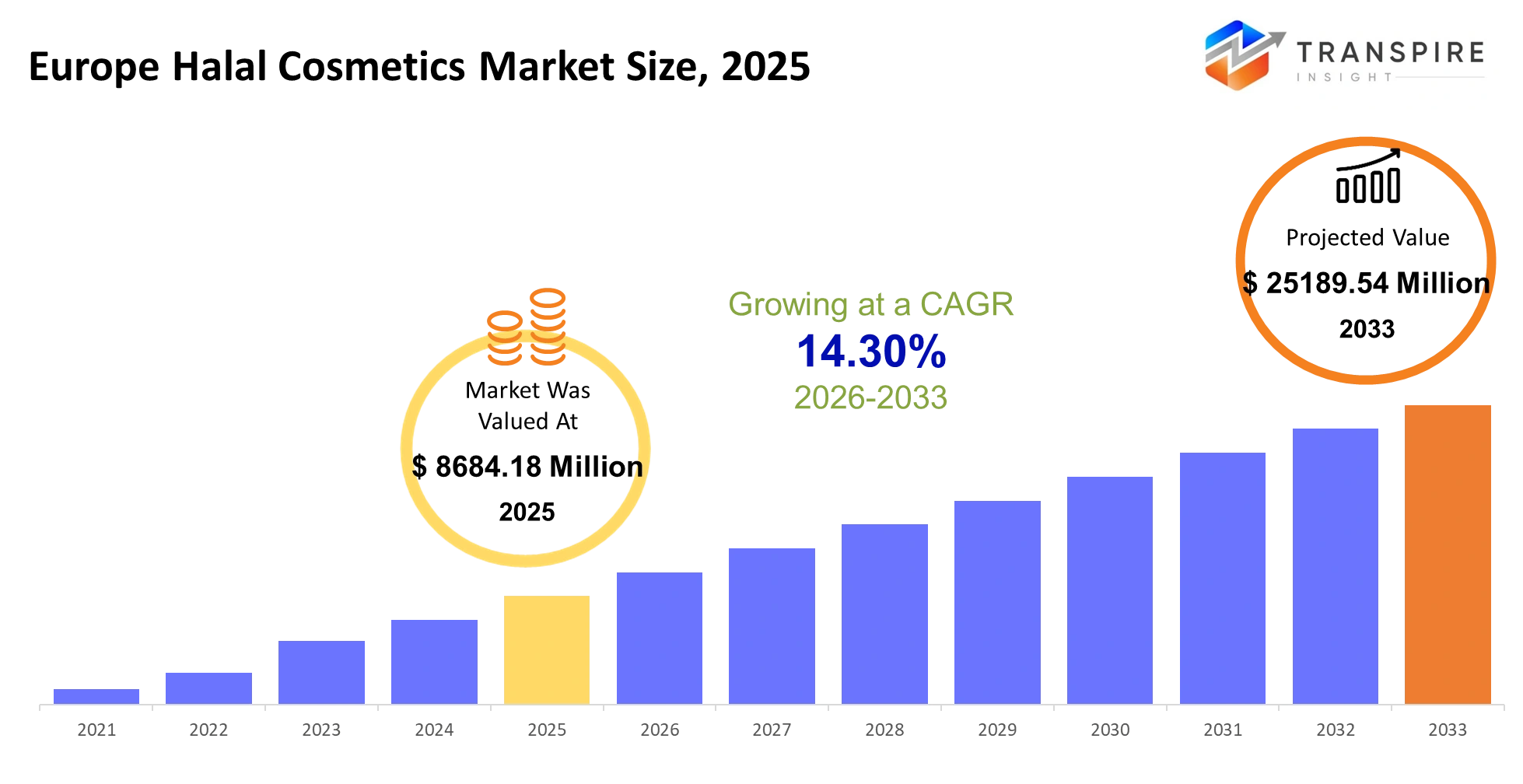
- Europe Halal Cosmetics Market Size 2025: USD 8684.18 Million
- Europe Halal Cosmetics Market Size 2033: USD 25189.54 Million
- Europe Halal Cosmetics Market CAGR: 14.30%
- Europe Halal Cosmetics Market Segments: By Type (Skincare, Haircare, Makeup, Fragrances, Others), By Application (Personal Care, Beauty, Grooming, Others), By End-User (Men, Women, Unisex, Others), By Distribution (Online, Retail Stores, Specialty Stores, Others).
To learn more about this report,  Download Free Sample Report
Europe Halal Cosmetics Market Summary:
The Europe Halal Cosmetics Market size is estimated at USD 8684.18 Million in 2025 and is anticipated to reach USD 25189.54 Million by 2033, growing at a CAGR of 14.30% from 2026 to 2033. The Europe halal cosmetics market has expanded from its original religious focus to provide products which meet customer demand for transparent product details and verified product origins and alcohol-free products which do not contain animal-based materials or dangerous substances. The halal-certified skincare and haircare and personal care products enable brands to satisfy their ethical obligations while delivering clean label products through multiple retail channels and pharmacy locations and online shopping platforms.
The market has shifted during the past five years from specialty retail distribution to mainstream beauty distribution. Halal certification now operates as an essential component of ESG and ingredient management frameworks which large cosmetics companies employ instead of viewing it as a distinct religious category. COVID-19 supply chain disruptions revealed raw material traceability problems which led manufacturers to adopt audited sourcing systems and regional supplier networks.
The current growth pattern results from three main factors which include increasing regulatory scrutiny and premium beauty branding and the growing diversity of European demographics. The increased shelf space retailers provide for certified products which have undergone ethical screening enables halal cosmetics to gain better pricing power which results in wider market acceptance beyond Muslim consumers and higher profits for multinational companies and independent brands.
Key Market Insights
- Germany controlled almost 24% of the Europe Halal Cosmetics Market during 2025 because its retail networks reached Deep European markets and showed success with diverse customer bases.
- France represents the fastest-growing regional market through 2032 because of its premium halal skincare launchings and its developing organic beauty retail business.
- The Europe halal beauty industry earned more than 38% of its total revenue through skincare products during 2025 because consumers showed preference for alcohol-free vegan-friendly product options.
- The haircare market maintained its position as the second-biggest segment because more salons partnered with businesses that required halal-certified shampoos and conditioners which did not contain sulfates.
- Between 2026 and 2032 color cosmetics will achieve the highest market expansion because young consumers search for ethical premium beauty alternatives.
- The personal care application segment dominated with approximately 42% market share in 2025 because daily-use demand extended to all hygiene and grooming products.
- Online retail developed into the most rapidly expanding application channel because direct-to-consumer halal beauty brands and cross-border e-commerce growth supported its development.
- Women accounted for the biggest user group with almost 64% share during 2025 because they selected premium skincare products and made purchasing decisions based on ingredients.
- European markets for halal cosmetics now face rising demand for male grooming products which includes beard care and sensitive-skin product categories that show growth across the entire region.
- The European halal cosmetics market is expanding while product development approaches of the industry are changing due to clean-label beauty movements and European Union regulations that require better ingredient disclosure.
- Manufacturers use halal certification together with vegan and cruelty-free and sustainable packaging claims to enhance their market presence and ability to charge higher prices.
What are the Key Drivers, Restraints, and Opportunities in the Europe Halal Cosmetics Market?
The primary force which drives growth in the European halal cosmetics market exists through the increasing demand for companies to disclose their product ingredients according to premium beauty retail standards which require complete ingredient disclosure. Over the last five years EU cosmetic compliance frameworks and retailer-led ingredient disclosure policies pushed manufacturers to adopt traceable sourcing systems and reformulate products with alcohol-free animal-free and contamination-controlled ingredients. Halal cosmetics gained entry into mainstream pharmacy chains beauty retailers and e-commerce platforms after this transformation from specialty ethnic retail. The certification process created links between product purity and supply chain responsibility which enabled brands to enter premium skincare markets that appealed to non-Muslim customers thus increasing their average selling prices and retail market reach.
The market’s largest structural barrier remains the fragmented halal certification ecosystem across Europe. Each country and Islamic authority establishes its own certification standards which manufacturers must comply with through multiple audits and ingredient validations and packaging reviews for all their products that will be sold across borders. The solution to this problem requires extended time because it necessitates handling multiple aspects including religious governance and regulatory interpretation and supply chain documentation across different jurisdictions. Mid-sized cosmetic brands that enter European markets face three major challenges which include product launch delays and increased compliance expenses and decreased growth capacity.
The biotechnology industry establishes its growth potential through halal-certified products that use biotech-derived components and through its development of laboratory-created substitutes for animal-derived cosmetic ingredients. The manufacturers in Germany and the Netherlands use their investments in precision fermentation and plant-cell cultivation technologies to produce active ingredients which meet certification standards and deliver better product purity and traceability. The technologies make it possible to reduce the risks of raw material procurement while they enable European premium halal skincare products to develop.
What Has the Impact of Artificial Intelligence Been on the Europe Halal Cosmetics Market?
The European Halal Cosmetics Market experiences transformation through artificial intelligence together with advanced digital technologies which enhance ingredient traceability and speed up product development while improving retail predictive accuracy. Cosmetic manufacturers are increasingly using AI-driven compliance platforms to automate halal certification checks across raw material sourcing, production batches, and supplier documentation. The systems enable brands to maintain consistent compliance with halal standards and EU cosmetic regulations through their automatic verification process which decreases manual checking requirements.
Researchers employ machine learning models to analyze consumer behavior patterns and to enhance product development methods. Beauty companies employ predictive analytics to detect new skincare trends and to predict regional buying behavior and to optimize their inventory distribution between online and physical stores. Several premium halal beauty brands now use AI-supported skin diagnostics and recommendation engines to create customized skincare routines, which help them retain customers and increase their online sales. The implementation of automated demand forecasting systems has led to decreased excess inventory problems and enhanced product restocking processes in fast-moving e-commerce operations.
Digital manufacturing systems enhance operational efficiency by delivering better batch consistency results and decreasing ingredient waste production while enabling quicker product introduction processes. Yet the halal cosmetics sector encounters major challenges for AI adoption because certification data remains scattered among different suppliers and certifying organizations and international boundaries. The absence of standardized datasets in many mid-sized manufacturing companies creates difficulties for algorithm training which leads to higher costs during cross-border integration processes.
Key Market Trends
- German and French retailers expanded their halal skincare product range by more than 30 percent since 2021 in their pharmacy and beauty store networks.
- L'Oréal and Unilever developed their vegan and halal certification programs because EU ingredient transparency regulations became more stringent during the period from 2020 to 2024.
- The e-commerce sales channels experienced substantial growth in halal beauty products because customers began purchasing directly from cosmetic websites after the pandemic.
- Between 2022 and 2025 manufacturers reduced their need for animal-based ingredients by using biotechnology solutions and plant-cell cultivation technologies.
- The TikTok and Instagram creators who promoted certified products to younger non-Muslim audiences helped independent halal beauty brands build greater market recognition.
- The different halal standards established by multiple regulatory bodies created certification challenges which postponed multiple European product launches.
- The AI-based ingredient traceability systems which cosmetic manufacturers implemented since 2023 enabled them to complete supplier audits faster while decreasing their needs for manual certification processes.
- Premium skincare products which use alcohol-free active ingredients generate higher pricing power in Western Europe than mass-market personal care items.
- The introduction of halal-certified beard oils and sulfate-free shampoos and sensitive-skin grooming products by regional brands drove steady growth in male grooming product markets.
- Sustainability requirements transformed packaging methods since companies began using refillable containers and biodegradable cosmetic materials as methods for establishing market differentiation after 2022.
Europe Halal Cosmetics Market Segmentation
By Type
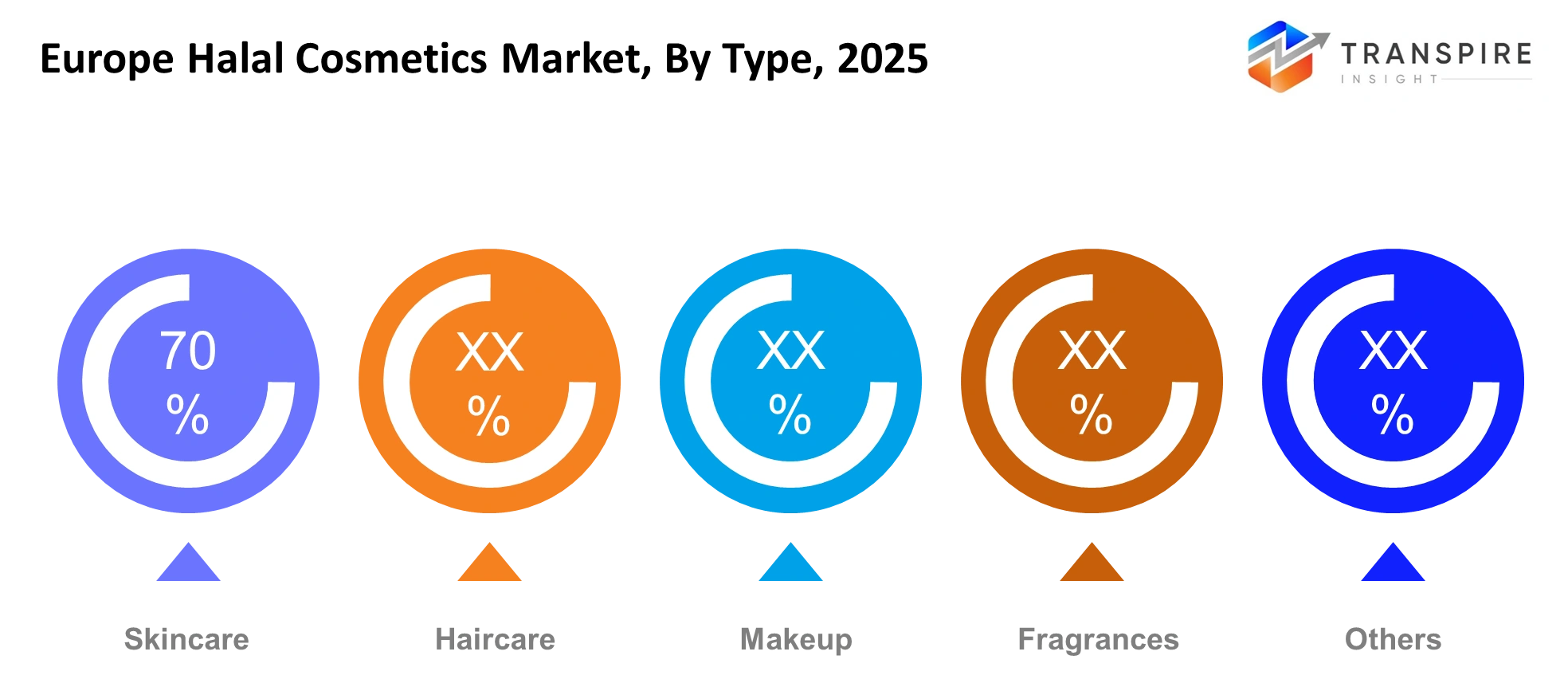
The skincare segment dominates the category because all premium facial creams and serums and all cleansers and moisturizers fulfill both halal ingredient requirements and clean-label beauty standards. The German and French and British markets show consumer preferences for skincare products which do not contain alcohol and do not use animal testing and provide customers with complete ingredient information. The haircare category stands as the second biggest market after skincare because customers demand sulfate-free shampoos and scalp treatments and products which are safe for sensitive skin. Makeup and fragrances continue to increase their market presence while fragrance formulations experience development restrictions which stem from their need to meet alcohol-free standards and certification requirements.
Product development now focuses on biotechnology-based ingredients and botanical extracts and dermatologist-approved products which meet halal standards and position products as high-end items. The upcoming competition in this segment will focus on three main areas which include ingredient transparency and refillable packaging and multifunctional skincare solutions. Retail and e-commerce distribution networks in Europe will benefit manufacturers who gain halal certification together with vegan and sustainable beauty practices because these certifications will help them obtain better shelf space and improve customer loyalty.
To learn more about this report, Download Free Sample Report
By Application
The personal care market reaches its highest usage level because people continually purchase daily products which include soaps and body washes and oral care items and hygiene solutions. Beauty applications which include anti-aging skincare products and high-end cosmetics continue to grow because manufacturers obtain certification for their products which they distribute through luxury retail stores and pharmacy networks. The demand for grooming products has increased during the past three years because men currently invest in products which help them maintain beard and scalp and sensitive skin care routines.
The product positioning approach now targets urban multicultural markets which demand ingredient-based products instead of products that only meet religious requirements. Retail strategies which focus on specific application growth have led beauty stores to dedicate additional space for certified products which meet ethical standards. The upcoming application growth period will support hybrid cosmetic products which offer both skin care advantages and makeup application features. Personal care products that wellness consumers buy again will attract both investors and manufacturers because these products provide high-value returns and premium pricing opportunities.
By End-User
The primary purchasers of premium skincare products are women who spend the most on cosmetics while using beauty products more than any other group in Western Europe. The market segment displays three principal product categories which create its product needs through anti-aging solutions and sensitive skin treatment products and cosmetics which disclose their ingredient sources and secure ethical product validation. The most rapidly expanding segment in the men's grooming market originates from young urban consumers who now prefer halal-certified beard oils and face cleansers and sulfate-free shampoos. The demand for unisex products continues to increase because all social groups prefer minimalistic beauty solutions and basic skincare routines.
Consumers now select products according to their lifestyle needs which require both safety evaluations and sustainability certifications and standard certifications. The combination of personalized beauty technology with AI skincare recommendation systems and targeted digital marketing efforts will accelerate future growth in the end-user market. The customer retention rates of businesses will increase when they design branding methods and product development practices to match the particular lifestyles of their target customers.
By Distribution
The current distribution market share reaches its highest point through retail stores because pharmacies and supermarkets and beauty chains offer customers the chance to physically check certified cosmetic products while they verify product ingredients and display multiple brand options. Premium beauty consumers prefer specialty stores because they offer both dedicated skincare products and exclusive organic halal-certified collections. The most important online distribution changes since 2020 have emerged through direct-to-consumer platforms which drive digital purchasing growth across Europe through their social commerce channels.
Smaller halal beauty brands used e-commerce growth to reach international markets while they developed their business through traditional retail restrictions and influencer marketing and subscription-based skincare models. The current distribution environment supports omnichannel distribution methods which combine physical store operations with personalized online customer service. The company will focus its future investments on developing AI recommendation systems and virtual skincare consultation tools and supply chain visibility solutions which will help establish customer trust while reducing inventory management expenses. The competitive distribution landscape will rely more on digital system responsiveness and delivery efficiency and the ability to obtain regional certification for products.
What are the Key Use Cases Driving the Europe Halal Cosmetics Market?
The primary use case which drives halal cosmetic adoption across Europe consists of daily skincare products and personal hygiene products. Consumers conduct detailed ingredient investigations which include alcohol levels and animal-derived components to decide their preferred facial cleansers and body moisturizers and their daily beauty products.
Premium men’s grooming products and salon-based haircare services now offer additional uses through their current applications. The younger urban market demands certified beard oils and sulfate-free shampoos and scalp treatments which barbershops and multicultural beauty salons now provide through their halal certification.
Halal-certified dermocosmetics and AI-personalized skincare solutions emerge as new applications which retail through pharmacies and digital beauty platforms. European regulators will require expanded traceability and sustainability standards for cosmetic manufacturing so biotechnology-derived active ingredients and refillable halal beauty packaging become essential for compliance.
|
Report Metrics |
Details |
|
Market size value in 2025 |
USD 8684.18 Million |
|
Market size value in 2026 |
USD 9882.47 Million |
|
Revenue forecast in 2033 |
USD 25189.54 Million |
|
Growth rate |
CAGR of 14.30% from 2026 to 2033 |
|
Base year |
2025 |
|
Historical data |
2021 - 2024 |
|
Forecast period |
2026 - 2033 |
|
Report coverage |
Revenue forecast, competitive landscape, growth factors, and trends |
|
Regional scope |
Europe (Germany, United Kingdom, France, Italy, Spain and Rest of Europe) |
|
Key company profiled |
Amara Cosmetics, Inika Organic, Iba Cosmetics, Sampure Minerals, Wardah, Halal Beauty, Clara International, Ivy Beauty, PHB Ethical Beauty, Saaf Skincare, Martha Tilaar, Zahra Rose, One Pure, Tuesday in Love, Flora & Noor. |
|
Customization scope |
Free report customization (country, regional & segment scope). Avail customized purchase options to meet your exact research needs. |
|
Report Segmentation |
By Type (Skincare, Haircare, Makeup, Fragrances, Others), By Application (Personal Care, Beauty, Grooming, Others), By End-User (Men, Women, Unisex, Others), By Distribution (Online, Retail Stores, Specialty Stores, Others). |
Which Regions are Driving the Europe Halal Cosmetics Market Growth?
The halal cosmetics market in Western Europe dominates the market because consumers have high purchasing power and the beauty retail sector operates at full capacity and the countries of Germany France and the United Kingdom require complete ingredient disclosure. The combination of major pharmacy chains and high-end beauty shops and sophisticated online shopping systems creates widespread distribution points for products that have received certification in skincare and personal care. The regulatory requirements that govern cosmetic product labeling and ingredients traceability have prompted international companies to develop halal-compliant products which they sell as part of their regular offerings. The local market maintains its dominant position because certification bodies and contract production facilities and dermatology research centers and online advertising networks create a strong operational framework.
The market in Northern Europe serves as the second most important regional market while its consumer preferences and buying habits show distinct differences from Western European market trends. Swedish, Danish, and Dutch consumers give higher importance to sustainable packaging and vegan products and ingredients with low carbon emissions while they expect halal certification to be present. The premium ethical beauty sector has experienced stable development because consumers maintain their retail spending power while inflation affects other European market segments. The regional manufacturing industry benefits from continuous government funding support which develops white biotechnology research and clean production technologies to establish a dependable environment that enables product development and supply chain progress.
The Eastern European market demonstrates rapid growth because retail operations undergo modernization while multicultural customer bases expand throughout Poland and Hungary and Romania.
Who are the Key Players in the Europe Halal Cosmetics Market and How Do They Compete?
The Europe halal cosmetics market maintains a moderate level of fragmentation because multinational beauty companies compete with both specialized halal-certified brands and digital skincare brands. The competition now focuses on four main areas: ingredient traceability, certification credibility, premium skincare effectiveness and product development speed which extends beyond price competition. Large cosmetic manufacturers protect their market position by adding halal-compliant products to their current clean beauty lines while new companies enter the market through direct-to-consumer sales and targeted market efforts. The competition now focuses on supply chain documentation solutions which comply with regulatory transparency standards and sustainable packaging materials and biotechnology-based ingredient sourcing methods because retailers conduct more thorough evaluations of products.
Unilever uses portfolio diversification and large-scale retail partnerships to strengthen shelf access across European pharmacy and supermarket channels. The company distinguishes itself by using vegan and cruelty-free and halal-compliant formulas in its mass-market personal care products. L'Oréal Group competes through advanced dermatological research, AI-supported skincare personalization, and premium product development targeted at multicultural urban consumers. The current focus of expansion strategies emphasizes e-commerce partnerships and digital beauty diagnostics and ingredient transparency technologies which enable companies to gain consumer trust and achieve repeat purchases.
The company PHB Ethical Beauty operates its business through a specialized approach which focuses on vegan and halal skincare products that have received certification. The company establishes its competitive edge through its practice of disclosing ingredient sources and its development of refillable packaging solutions and its ability to connect directly with customers who prioritize sustainable practices. INIKA Organic establishes its market distinction through its combination of organic certification with halal-approved cosmetic products which it offers in its high-end makeup and skincare lines. The Martha Tilaar Group uses its extensive knowledge of halal beauty product manufacturing and botanical ingredient formulation to establish new distribution agreements throughout Europe which will improve access to specialty retail and multicultural beauty markets.
Company List
- Amara Cosmetics
- Inika Organic
- Iba Cosmetics
- Sampure Minerals
- Wardah
- Halal Beauty
- Clara International
- Ivy Beauty
- PHB Ethical Beauty
- Saaf Skincare
- Martha Tilaar
- Zahra Rose
- One Pure
- Tuesday in Love
- Flora & Noor
Recent Development News
In April 2026, L’Oréal Reports Strong Q1 2026 Sales Growth Amid Rising Demand for Ethical Beauty Products in Europe: French beauty giant L'Oréal announced its fastest quarterly sales growth in two years during April 2026. The company highlighted resilient demand across emerging beauty categories, including clean-label and ethically positioned cosmetics, which continue to support Europe’s halal and vegan beauty segments. The development reinforces premium beauty investment momentum across European markets.
Source: https://www.reuters.com
In April 2026, Unilever Expands Wellbeing and Personal Care Portfolio Through Grüns Acquisition: Unilever confirmed the acquisition of supplements brand Grüns in April 2026 as part of its broader wellbeing and personal care expansion strategy. Industry analysts noted the move strengthens Unilever’s positioning in health-conscious and ethically driven consumer segments, including halal-aligned beauty and wellness categories increasingly popular in Europe.
Source: https://www.reuters.com
What Strategic Insights Define the Future of the Europe Halal Cosmetics Market?
The Europe halal cosmetics market will develop its certified halal beauty products through biotechnology ingredient production which uses certified halal components and digital supply chain verification systems within a five to seven year period. Premium beauty consumers who want traceable products with low risk and ethically tested formulas will drive market growth for halal products beyond religious consumers. Halal certification will extend into clean-label products and dermatological skincare items which are sold through pharmacy retail and AI-powered e-commerce platforms.
The danger of raw material concentration exists because specialized botanical and biotech ingredient supply chains contain limited sources. The increasing number of manufacturers who seek certified plant-based actives together with fermentation-based alternatives will lead to higher sourcing expenses and certification delays which will negatively impact profit margins and slow down product development across Europe. The Eastern European market provides new possibilities because its retail sector adopts digital technology and its diverse consumer base expands while its market remains underdeveloped.
Market participants should establish vertically integrated sourcing relationships and digital certification systems to streamline compliance processes while enhancing their pricing authority in international distribution channels.
Europe Halal Cosmetics Market Report Segmentation
By Type
- Skincare
- Haircare
- Makeup
- Fragrances
- Others
By Application
- Personal Care
- Beauty
- Grooming
- Others
By End-User
- Men
- Women
- Unisex
- Others
By Distribution
- Online
- Retail Stores
- Specialty Stores
- Others
Frequently Asked Questions
Find quick answers to common questions.
The approximate Europe Halal Cosmetics Market size for the market will be USD 25189.54 Million in 2033.
The key segments of the Europe Halal Cosmetics Market are By Type (Skincare, Haircare, Makeup, Fragrances, Others), By Application (Personal Care, Beauty, Grooming, Others), By End-User (Men, Women, Unisex, Others), By Distribution (Online, Retail Stores, Specialty Stores, Others).
Major players in the Europe Halal Cosmetics Market are Amara Cosmetics, Inika Organic, Iba Cosmetics, Sampure Minerals, Wardah, Halal Beauty, Clara International, Ivy Beauty, PHB Ethical Beauty, Saaf Skincare, Martha Tilaar, Zahra Rose, One Pure, Tuesday in Love, Flora & Noor.
The current market size of the Europe Halal Cosmetics Market is USD 8684.18 Million in 2025.
The Europe Halal Cosmetics Market CAGR is 14.30%.
- Amara Cosmetics
- Inika Organic
- Iba Cosmetics
- Sampure Minerals
- Wardah
- Halal Beauty
- Clara International
- Ivy Beauty
- PHB Ethical Beauty
- Saaf Skincare
- Martha Tilaar
- Zahra Rose
- One Pure
- Tuesday in Love
- Flora & Noor
Recently Published Reports
-
Apr 2026
Bottled Water Market
Bottled Water Market Size, Share & Analysis Report By Product Type (Still Bottled Water, Carbonated Bottled Water, Functional Bottled Water, and Others), By Packaging (PET, Cans, and Others), By Sales Channel (Supermarkets/Hypermarkets, Convenience Stores/Drug Stores, Grocery Stores/Club Stores, Foodservice, and Others) and Geography (North America, Europe, Asia-Pacific, Middle East and Africa, South and Central America), 2021 - 2032
-
Apr 2026
Color Cosmetic Packaging Market
Color Cosmetic Packaging Market Size, Share & Analysis Report By Application (Mascara Packaging, Liquid Packaging, and Liquid Face), By Type (Tubes & Bottles, Pens & Markers, Compacts & Containers, and Droppers & Pumps), and Geography (North America, Europe, Asia-Pacific, Middle East and Africa, South and Central America), 2021 - 2031
-
Apr 2026
External Microphone For Camera Market
External Microphone For Camera Market Size, Share & Analysis Report By Type (Shotgun Microphone, Lavalier Microphone, and Others), By Application (Digital Camera, Professional Video Camera, and Others), and Geography (North America, Europe, Asia-Pacific, Middle East and Africa, South and Central America), 2021 - 2031
-
Apr 2026
Foot Orthotic Insoles Market
Foot Orthotic Insoles Market Size, Share & Analysis Report By Type (Pre-fabricated, and Custom-made), By Material (Thermoplastic, Composite Carbon Fiber, and Others), By Distribution Channel (Drug Stores, Hospitals & Clinics, and Others), and Geography (North America, Europe, Asia-Pacific, Middle East and Africa, South and Central America), 2021 - 2031