

Japan Clean Beauty Market Size & Forecast:
- Japan Clean Beauty Market Size 2025: USD 505.7 Million
- Japan Clean Beauty Market Size 2033: USD 1687.9 Million
- Japan Clean Beauty Market CAGR: 16.30%
- Japan Clean Beauty Market Segments:By Product Type (Skincare, Haircare, Cosmetics, Personal Care), By Distribution Channel (Online Retail, Specialty Stores, Supermarkets/Hypermarkets)
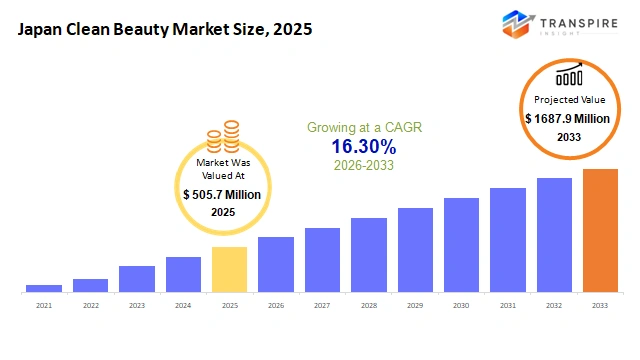
To learn more about this report,  Download Free Sample Report
Japan Clean Beauty Market Summary:
The Japan Clean Beauty Market size is estimated at USD 505.7 million in 2025 and is anticipated to reach USD 1687.9 million by 2033, growing at a CAGR of 16.30% from 2026 to 2033. The Japan clean beauty market is experiencing rapid growth because consumers now pay more attention to the ingredients present in their personal care products. People today prefer products that contain only natural and safe ingredients which do not harm the environment. Consumers now base their buying choices on three major factors, which include product transparency and sustainable practices and ethical sourcing methods. Brands from both domestic and international markets develop products with cleaner formulas and sustainable packaging solutions. The market will experience continuous growth because people now understand skin health and environmental effects better than ever before.
Key Market Trends & Insights:
- Japanese consumers now exercise greater control over their skincare product selection. Plant-based organic products and minimally processed items have emerged as popular beauty alternatives because consumers seek products which provide safe and mild effects.
- Shoppers now study product labels more than before because they want to obtain detailed information about product components and their origin. Customers develop better trust toward brands which share their product formulas and do not use dangerous substances in their products.
- The beauty sector selects its packaging materials based on current environmental sustainability trends. Brands are launching recyclable and refillable and biodegradable packaging systems which help them decrease waste while attracting environmentally aware customers.
- The market for skincare products which protect delicate skin exists in Japan because of the country's large population of consumers who need such products. Clean beauty products which use light formulations without dangerous ingredients are gaining popularity because they deliver gentle and skin-friendly results.
- The practice of clean beauty in Japan has become closely associated with complete personal wellbeing. Customers prefer products which help them achieve healthy skin while maintaining their daily self-care practices.
Japan Clean Beauty Market Segmentation
By Product Type
- Skincare: The skincare market in Japan has a strong preference for clean beauty products because users want skincare formulas that have gentle effects and provide nourishing benefits and product information. Natural ingredient-based cleansers and moisturizers and serums have become more popular among consumers. Customers want products that deliver healthy skin appearance and radiant skin effects while using safe and essential components.
- Haircare: Japanese customers who seek healthier solutions for their scalp and hair care needs are turning to clean hair care products which now enjoy growing popularity. The market attracts customers who need safe hair care products which contain botanical extracts and mild ingredients in their shampoos and conditioners and treatment options. The products receive their worth because they help preserve hair health while protecting users from synthetic chemical exposure.
- Cosmetics: The clean cosmetics market receives growth because beauty enthusiasts search for makeup products that contain skin-friendly components. Customers who desire beauty products that improve their looks yet maintain skin vitality and comfort choose foundations and lip products and eye makeup that contain no dangerous substances.
- Personal Care: Japanese consumers are increasingly interested in clean personal care products, which include deodorants and body lotions and soaps. Consumers prefer natural ingredient products which do not contain harsh chemical substances. People now select their daily hygiene products based on their need for health benefits and their desire for sustainable products.

To learn more about this report, Download Free Sample Report
By Distribution Channel
- Online Retail: The Japanese market for clean beauty products uses online retail as its primary distribution method. Consumers enjoy the simple process which lets them examine multiple brands and study product ingredients while they make comparisons. Digital platforms enable new clean beauty brands to reach larger audiences, which include various customer segments.
- Speciality Stores: Speciality beauty stores play an important role in promoting clean beauty products. These stores maintain their operations through their selected product range, which includes expert staff and high-quality product lines. Consumers prefer shopping experiences which provide them with personalised service and which allow them to research product ingredients and product advantages before making their buying decisions.
- Supermarkets/Hypermarkets: Supermarkets and hypermarkets provide access to clean beauty products for their daily customers. The retailers increase their product range by adding natural and environmentally friendly personal care products. The presence of clean beauty products in stores leads shoppers to test these products during their regular shopping activities.
Country Insights
Japan experiences continuous growth in its clean beauty industry because customers now prefer to track the components in their cosmetics and body care items. Japanese people have long believed that essential products should only contain effective components which match the principles of clean beauty. More people now choose products which contain natural plant-based ingredients that provide gentle skin benefits while protecting their skin from harmful chemicals. Customers now show increased interest in product labels combined with sustainability efforts and ethical sourcing methods.
Japanese consumers maintain a strong commitment to beauty products, which represents their dedication to skincare, yet they demand that brands disclose their environmental impact through sustainable product development. Environmental protection awareness now shapes packaging decisions because businesses prefer to use recyclable materials and refillable products. Clean and sustainable beauty products attract more interest from younger people than any other demographic group. Japan's clean beauty market will continue to grow because new developments and increasing consumer knowledge will drive this trend while people use traditional techniques together with modern technology and responsible spending.
Recent Development News
Natural Japanese Ingredients Gain Global Skincare Attention
Clean Beauty and Wellness Trends Driving Global Skincare Growth
|
Report Metrics |
Details |
|
Market size value in 2025 |
USD 505.7 Million |
|
Market size value in 2026 |
USD 586.6 Million |
|
Revenue forecast in 2033 |
USD 1,687.9 Million |
|
Growth rate |
CAGR of 16.30% from 2026 to 2033 |
|
Base year |
2025 |
|
Historical data |
2021 – 2024 |
|
Forecast period |
2026 – 2033 |
|
Report coverage |
Revenue forecast, competitive landscape, growth factors, and trends |
|
Country scope |
Japan |
|
Key company profiled |
Shiseido Company Ltd., Kao Corporation, Kosé Corporation, FANCL Corporation, L’Oréal SA, Estée Lauder Companies, Unilever PLC, Procter & Gamble, Amorepacific Corporation, Johnson & Johnson, Beiersdorf AG, Natura & Co., Tata Harper Skincare, Herbivore Botanicals, and Drunk Elephant. |
|
Customization scope |
Free report customization (country, regional & segment scope). Avail customized purchase options to meet your exact research needs. |
|
Report Segmentation |
By Product Type (Skincare, Haircare, Cosmetics, Personal Care) and By Distribution Channel (Online Retail, Speciality Stores, Supermarkets/Hypermarkets). |
Key Japan Clean Beauty Company Insights
The Japan clean beauty market is witnessing growing participation from both established beauty brands and emerging niche companies. Many businesses are developing gentle formulations which use safe ingredients to meet consumer demands for safe products with transparent information. Companies allocate funding toward research efforts which develop products that combine natural ingredients with advanced skincare technology. The sustainable practices, which include eco-friendly packaging and responsible sourcing, have emerged as essential requirements for businesses. The clean beauty market in Japan is growing in size, and companies strengthen their market position by adapting to new consumer trends while showing their product authenticity.
Company List
- Shiseido Company Ltd.
- Kao Corporation
- Kosé Corporation
- FANCL Corporation
- L’Oréal SA
- Estée Lauder Companies
- Unilever PLC
- Procter & Gamble
- Amorepacific Corporation
- Johnson & Johnson
- Beiersdorf AG
- Natura & Co.
- Tata Harper Skincare
- Herbivore Botanicals
- Drunk Elephant
Japan Clean Beauty Market Report Segmentation
By Product Type
- Skincare
- Haircare
- Cosmetics
- Personal Care
By Distribution Channel
- Online Retail
- Specialty Stores
- Supermarkets/Hypermarkets.
Frequently Asked Questions
Find quick answers to common questions.
The approximate Japan Clean Beauty Market size for the market will be USD 1687.9 million in 2033.
The key segments of the Japan Clean Beauty Market are By Product Type (Skincare, Haircare, Cosmetics, Personal Care), By Distribution Channel (Online Retail, Specialty Stores, Supermarkets/Hypermarkets).
Major players in the Japan Clean Beauty Market are Shiseido Company Ltd., Kao Corporation, Kosé Corporation, FANCL Corporation, L’Oréal SA, Estée Lauder Companies, Unilever PLC, and Procter & Gamble.
The current market size of the Japan Clean Beauty Market is USD 505.7 million in 2025.
The Japan Clean Beauty Market CAGR is 16.30%.
- Shiseido Company Ltd.
- Kao Corporation
- Kosé Corporation
- FANCL Corporation
- L’Oréal SA
- Estée Lauder Companies
- Unilever PLC
- Procter & Gamble
- Amorepacific Corporation
- Johnson & Johnson
- Beiersdorf AG
- Natura & Co.
- Tata Harper Skincare
- Herbivore Botanicals
- Drunk Elephant
Recently Published Reports
-
Apr 2026
Bottled Water Market
Bottled Water Market Size, Share & Analysis Report By Product Type (Still Bottled Water, Carbonated Bottled Water, Functional Bottled Water, and Others), By Packaging (PET, Cans, and Others), By Sales Channel (Supermarkets/Hypermarkets, Convenience Stores/Drug Stores, Grocery Stores/Club Stores, Foodservice, and Others) and Geography (North America, Europe, Asia-Pacific, Middle East and Africa, South and Central America), 2021 - 2032
-
Apr 2026
Color Cosmetic Packaging Market
Color Cosmetic Packaging Market Size, Share & Analysis Report By Application (Mascara Packaging, Liquid Packaging, and Liquid Face), By Type (Tubes & Bottles, Pens & Markers, Compacts & Containers, and Droppers & Pumps), and Geography (North America, Europe, Asia-Pacific, Middle East and Africa, South and Central America), 2021 - 2031
-
Apr 2026
External Microphone For Camera Market
External Microphone For Camera Market Size, Share & Analysis Report By Type (Shotgun Microphone, Lavalier Microphone, and Others), By Application (Digital Camera, Professional Video Camera, and Others), and Geography (North America, Europe, Asia-Pacific, Middle East and Africa, South and Central America), 2021 - 2031
-
Apr 2026
Foot Orthotic Insoles Market
Foot Orthotic Insoles Market Size, Share & Analysis Report By Type (Pre-fabricated, and Custom-made), By Material (Thermoplastic, Composite Carbon Fiber, and Others), By Distribution Channel (Drug Stores, Hospitals & Clinics, and Others), and Geography (North America, Europe, Asia-Pacific, Middle East and Africa, South and Central America), 2021 - 2031