
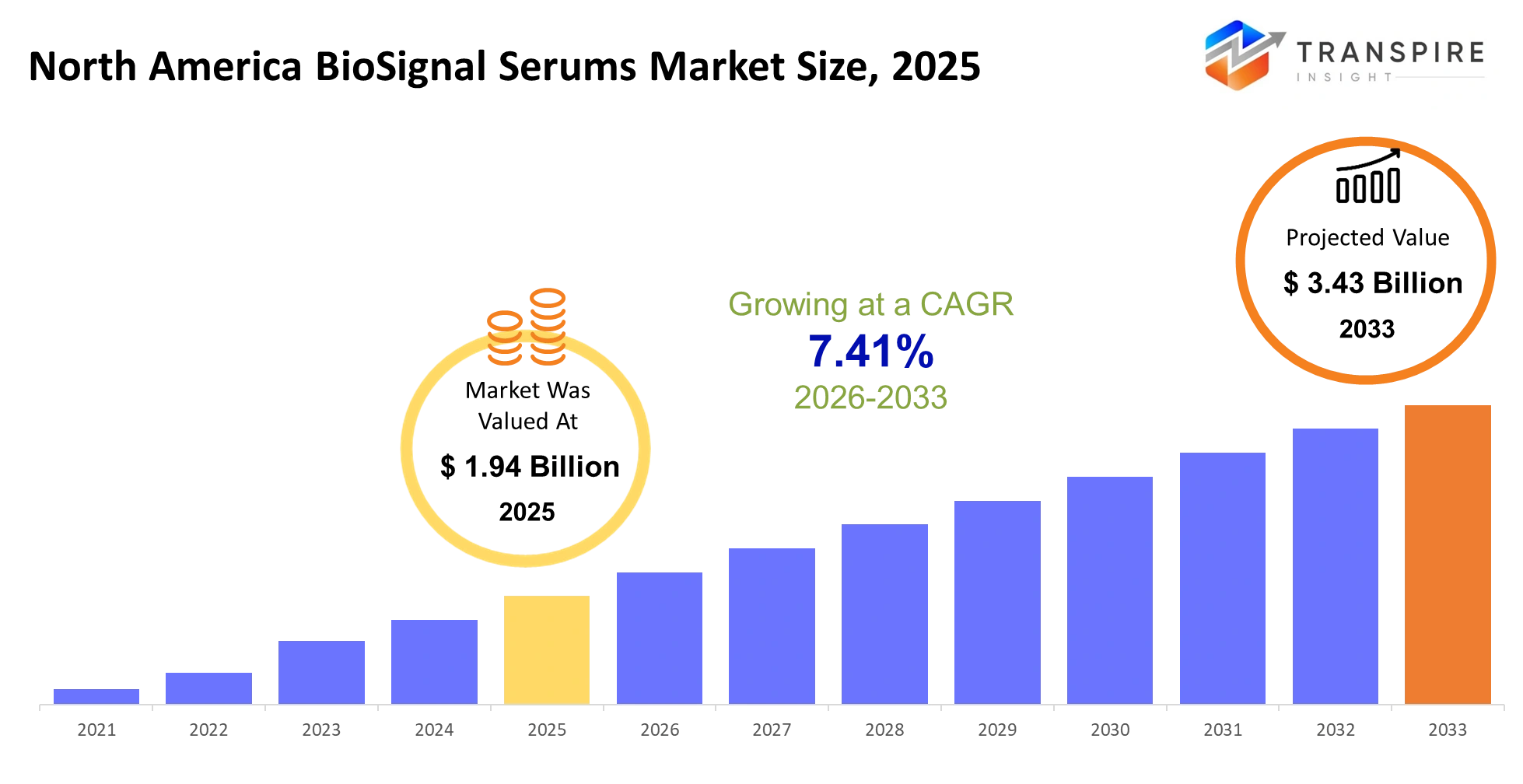
North America BioSignal Serums Market Size & Forecast:
- North America BioSignal Serums Market Size 2025: USD 1.94 Billion
- North America BioSignal Serums Market Size 2033: USD 3.43 Billion
- North America BioSignal Serums Market CAGR: 7.41%
- North America BioSignal Serums Market Segments: By Type (Anti-aging Serums, Hydration Serums, Repair Serums, Brightening Serums, Others), By Application (Skincare, Dermatology, Cosmetics, Others), By End-User (Consumers, Clinics, Salons, Others), By Distribution (Online, Retail, Specialty Stores, Others).
To learn more about this report,  Download Free Sample Report
North America BioSignal Serums Market Summary:
The North America BioSignal Serums Market size is estimated at USD 1.94 Billion in 2025 and is anticipated to reach USD 3.43 Billion by 2033, growing at a CAGR of 7.41% from 2026 to 2033.The North America BioSignal Serums Market is kind of evolving around a practical need in regenerative skincare and aesthetic medicine, like helping clinicians speed up skin recovery, improve how patients do after a procedure, and strengthen cellular signaling in things linked to anti-aging , wound repair and dermatological restoration. You can also see these serums getting rolled into medspa routines, cosmetic dermatology protocols, and more advanced facial therapies where people really expect visible results, with faster downtime, or shorter recovery windows.
Over the last three to five years, the whole market vibe moved from mostly cosmetic enhancement toward biologically active formulations built around peptides, exosomes , and growth-factor signaling technologies. That shift changed how buyers choose, so clinics tend to focus on efficacy evidence and how well the serum fits into the treatment plan , rather than leaning on traditional beauty branding. A big reason for this came after the pandemic, with growth in minimally invasive aesthetic procedures, which pulled demand upward for recovery-focused add-ons. And as more providers bundle biosignal serums into premium treatment packages, revenue growth is starting to depend more on recurring procedural ecosystems than on standalone skincare retail sales alone .
Key Market Insights
- In 2025 The United States pretty much dominates the North America BioSignal Serums Market, with almost 72% market share because of stronger aesthetic infrastructure—like, you know, the whole ecosystem is more mature.
- Canada meanwhile shows the quickest momentum through 2031. This is mainly tied to more cosmetic dermatology clinics opening up, plus that continued premium skincare spend.
- Urban treatment hubs keep picking up extra share too, since customers are leaning more toward physician-led regenerative skincare workflows instead of doing things solo at home.
- Also cross border commercialization between the United States and Canada is speeding up, so products are becoming easier to access and penetration is getting better, faster
- Peptide based biosignal serums lead the overall industry picture, holding around 46% revenue share in 2025. The reason is their skin regeneration performance already looks “proven” in real use and studies.
- Growth factor serums stay in the number 2 spot, supported by how widely they’re being used in post-laser and post-microneedling recovery protocols
- Exosome based formulations are set to grow the quickest from 2026 to 2031, mainly because of rising interest in cell signaling regenerative therapies, the demand is just emerging more and more.
- Clinical grade serum formulations continue to dominate the higher price tiers across North America too, so premium pricing stays locked in
- As for applications, anti aging and skin rejuvenation take nearly 51% market share in 2025 across the region.
- For growth rate specifically, post procedure recovery applications look strongest , mostly due to the rise in minimally invasive cosmetic treatments
- Scar reduction and inflammatory skin repair therapies are also becoming noticeable demand drivers across dermatology oriented treatment centers
- And combination therapy protocols are expanding, when biosignal serums get layered with RF microneedling, and laser resurfacing, adoption is going up pretty fast
What are the Key Drivers, Restraints, and Opportunities in the North America BioSignal Serums Market?
Honestly, the strongest force driving the North America BioSignal Serums Market feels like this fast move toward regenerative adjunct products that get folded into minimally invasive aesthetic procedures. You see clinics doing it more and more… they tend to bundle biosignal serums with microneedling , laser resurfacing, and radiofrequency sessions, mostly because patients now want shorter downtime and like, visibly quicker skin repair. It really picked up after the post-2020 rebound in cosmetic procedure volumes, when medspas and dermatology groups started chasing high-margin treatment ecosystems instead of selling standalone skincare products. And so biosignal serums sort of shifted from being “nice to have” add-ons into more of a repeating procedural component which lifts per-patient revenue, plus it helps keep patients returning for follow ups.
That said, the biggest structural hurdle is the regulatory ambiguity around biologically active skincare ingredients. Exosome-derived formulas , growth-factor tech, and stem cell-linked components can end up in this gray area between what counts as cosmetics and what looks more therapeutic. Because of that, manufacturers have to deal with uneven clinical substantiation expectations, complicated labeling rules , and also a real risk of liability issues. All of this tends to delay commercialization, pushes compliance spending up, and makes large-scale retail growth harder. Smaller players, in particular, struggle to fund long clinical evaluation pathways, which basically reduces product variety and also slows down wider physician uptake.
Looking ahead, the next growth phase might come from AI-assisted personalized skincare diagnostics that plug directly into regenerative serum platforms. Newer imaging setups can measure inflammation, hydration, collagen breakdown, and even post-procedure healing patterns in real time , which makes the treatment approach feel much more targeted.
What Has the Impact of Artificial Intelligence Been on the North America BioSignal Serums Market?
Artificial intelligence plus advanced digital tech are kind of reshaping the North America BioSignal Serums Market, not just in some vague way, but in more practical terms like better formulation accuracy , sharper patient targeting, and also treatment optimization across dermatology clinics and medical spas. With AI driven skin analysis tools hydration levels get checked, collagen degradation is mapped, pigmentation patterns are observed and inflammatory markers are reviewed even before the clinicians start talking about which biosignal serum protocol to recommend. It feels like this sort of automation trims down the consultation time a little, and it tends to make the personalization more stronger, so premium aesthetic providers can often lift patient conversion rates, and keep recurring procedure revenue more stable.
Also, machine learning models are increasingly used for predictive planning, like forecasting what might happen later. Clinics will use algorithm based imaging setups to estimate post procedure healing results after microneedling, laser resurfacing, or radiofrequency treatments. These predictive functions can guide practitioners toward the most fitting peptide, exosome, or growth factor serum combinations for particular skin issues. Practitioners say this can lead to better treatment consistency, fewer “just in case” corrective sessions , and in general stronger patient retention, even when the skin types vary.
On the manufacturing side, digital R&D platforms are being adopted to speed up bioactive ingredient screening and stability testing. AI assisted formulation systems may cut product development timelines because they can spot compatible molecular pairings quicker than older lab workflows. Still, there is this big catch, which is the absence of standardized clinical datasets for biologically active skincare ingredients. Many AI approaches continue to lean on scattered patient imaging information and treatment protocols that are not uniform, and that gap in evidence reduces predictive accuracy across different skin types, plus it also struggles in real world clinical settings, where things rarely match the ideal data.
Key Market Trends
- From 2021 to 2025, lots of dermatology clinics started bundling biosignal serums with micro-needling and laser stuff, sort of to push recovery faster and keep patients coming back, yeah a bit more retention oriented.
- Exosome based formulations kinda slid out of the “only niche regenerative” lane and into mainstream, more expensive skincare protocols, after clinical efficacy results got more visible around 2023.
- Some companies, like SkinMedica and AnteAGE , reportedly moved more of the R&D money toward bioactive peptides and post-procedure recovery systems after 2022.
- Since 2020, medical spas expanded those subscription style treatment memberships, so people buy the serum repeatedly over time instead of just one time skincare purchases, or whatever.
- After 2022, regulatory attention got tighter too, because biologically active ingredients can blur the line between cosmetic formulations and therapeutic dermatology uses, it was kind of messy.
- Between 2023 and 2025, AI driven skin imaging platforms showed up across clinics in North America, and that helped with serum personalization , while also reducing treatment choice errors in the process.
- In 2021, supply chain disruptions basically revealed how dependent many manufacturers were on imported bioactive ingredients, which led to regional sourcing partnerships and more domestic formulation facilities, rather than relying on far away inputs.
- Adoption of growth factor serums eased a little after exosome technologies started showing stronger cellular signaling results in those premium regenerative treatment protocols.
- More physicians began swapping out retail skincare advice for clinically dispensed serum setups, because those can make higher margins and stronger long term patient engagement, not just lower cost routines.
- By 2025, combo therapy is kind of the norm, with radiofrequency microneedling paired with biosignal serums showing up as standard practice across many high end aesthetic centers in North America.
North America BioSignal Serums Market Segmentation
By Type
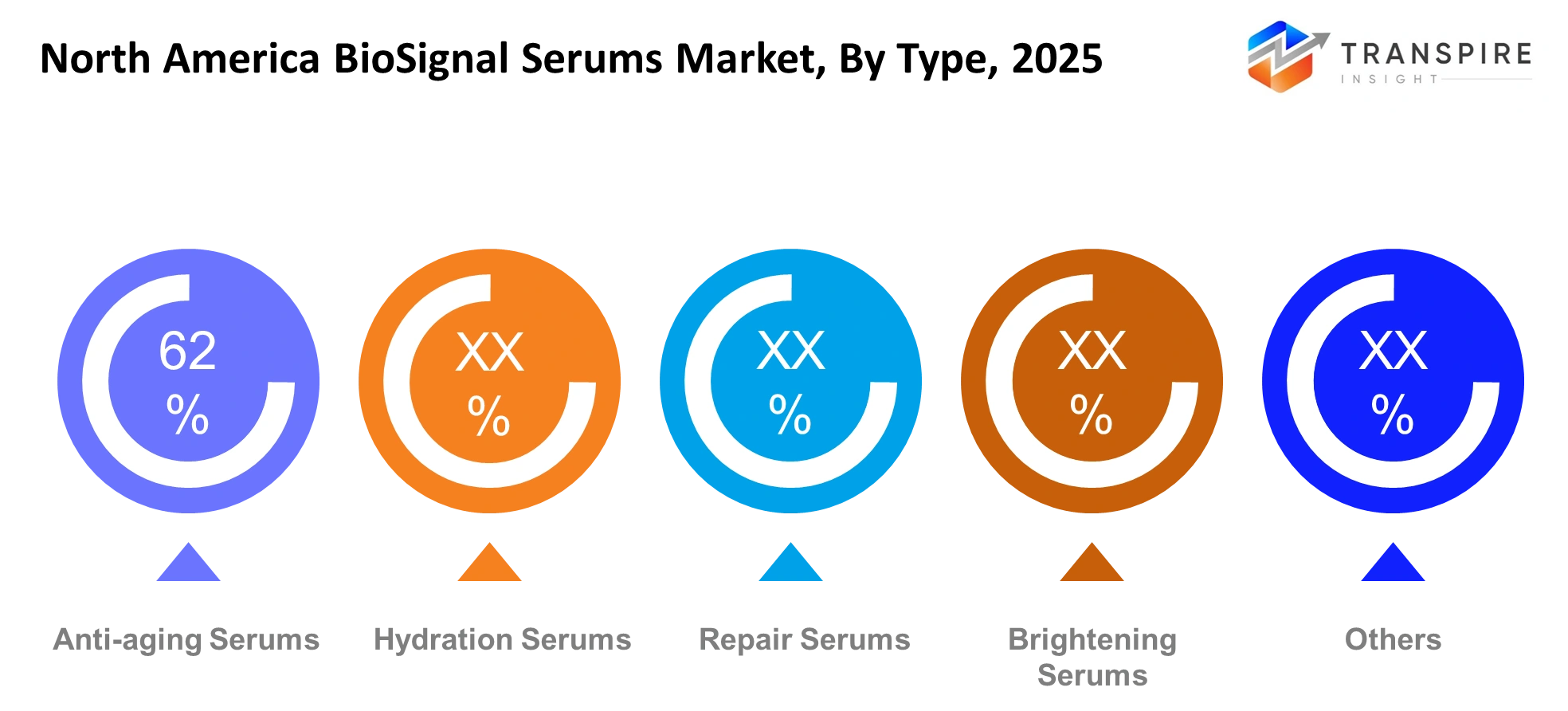
Anti-aging serums kind of still stay in the leading position in the type segment, mostly because dermatology clinics and medical spas keep leaning into what people can see—less wrinkle look, collagen stimulation, and even help with post procedure recovery, sort of like a “get back to normal” support. Peptide based and growth factor formulas usually get the premium pricing tag, not just because they sound fancy, but because they’re backed by stronger clinical positioning and shoppers tend to repurchase more often. Hydration serums keep steady demand through everyday skincare routines, especially with younger consumers moving into preventive skincare categories.
Repair serums actually picked up momentum after 2021, since minimally invasive aesthetic procedures spread across North America, and that created a bigger need for recovery focused products. Brightening serums still pull interest from people aiming for pigmentation correction and an overall skin tone upgrade, although the regulatory checks on active ingredients mean brands can’t push the most aggressive claims, even if they want to.Looking ahead, future growth in the type segment will probably lean toward more multifunctional bioactive formulations that bundle hydration, anti aging, and regenerative benefits into one single product. Manufacturers putting money into exosome technologies and AI assisted formulation development are expected to end up with better pricing power and tighter physician partnerships over the next ten years or so.
To learn more about this report, Download Free Sample Report
By Application
Skincare applications end up dominating the whole segment because biosignal serums are more and more being used as clinically backed daily treatment stuff, not really as normal cosmetic “extras” anymore. So premium skincare brands are still folding peptide signaling technologies into those preventative aging routines, which is what keeps pulling in repeat purchases, especially through physician-dispensed routes. Dermatology applications sit as the second-largest slice, mostly because they get strong traction in laser recovery , inflammatory skin healing, and also microneedling support protocols, where the approach feels very practical. For cosmetic applications, things kept moving upward from 2021 to 2025, and that seems tied to non-surgical facial treatments getting more widely accepted by middle-income consumers. Then there are the other categories, like scar management and post-acne restoration, they’re smaller but they’re also getting solid uptake in specialty clinics.
At this point, clinical evidence plus treatment personalization is steering buying choices more than brand visibility alone. Going forward, the market direction will probably lean toward medically integrated applications, where providers can show measurable treatment outcomes, not just marketing claims and all that. Investors and manufacturers are increasingly looking for partnerships with dermatology networks and aesthetic clinics, mostly to lock in long-term recurring treatment revenue, rather than depending only on retail skincare distribution. It’s kinda like everyone wants the same assurance, you know, that results are proven, not merely promised, so the whole ecosystem becomes a bit more steady.
By End-User
Consumers are still the biggest end user group , mainly because preventive skincare habits and those premium anti-aging solutions keep spreading among middle-aged, and even younger, demographics. Spending by consumers on biologically active serums went up quite a lot after 2020, partly because at home skincare programs got more detailed and also more heavily shaped by online content, influencers, you know. Clinics sit in the next major spot , since more practitioners are leaning into regenerative add ons during minimally invasive procedures. When treatment plans are guided by physicians, people tend to trust the products more and the average purchase size is usually higher than what you see in standard retail channels.
Salons are still involved with entry-level serum uptake, especially hydration and brightening options, but there’s only so much they can do since clinical infrastructure is limited , so they can’t really push into advanced regenerative formulations as easily. Then there are the other end users, like cosmetic surgery centers and wellness studios, which are increasingly tucking post treatment serum systems into their recovery packages. Looking ahead, competition will probably center on clinically supervised personalization, and those subscription style treatment ecosystems. Buyers are also becoming more ready to pay premium pricing when the products are tied to visible, measurable performance during treatments , which creates incentives for providers to hook in diagnostic tools and more data driven skincare planning.
By Distribution
After 2020 online distribution channels kinda gained a big chunk of the market, mainly because premium skincare brands started pushing direct-to-consumer pretty hard, along with digital consultations that feel more instant. E-commerce platforms now often offer subscription programs, AI skin analysis tools, and even physician-linked product suggestions, which tends to help with customer staying power and more repeat buying. That said, retail channels still keep a solid share, especially pharmacy chains and department stores, they’re often the go-to for hydration stuff and the more entry-level anti aging items. Specialty stores also stay relevant in the premium skincare lane, mostly because the staff is trained, and the product mix is curated, so shoppers feel more confident about the biologically active formulations.
There are other routes too—like clinic dispensing or medspa-only sales—those are growing fast, partly because the margins look stronger and there’s more professional credibility. Distribution strategies are also leaning more toward tightly managed clinical settings instead of broad mass-market visibility, especially when the products are advanced regenerative treatments, for example those involving exosomes or growth factors. Going forward, channel development will probably move toward hybrid arrangements, mixing digital diagnostics, subscription replenishment systems, and clinic based consultations. This can let manufacturers reinforce loyalty while also collecting useful data about treatments and purchasing patterns, all in one place.
What are the Key Use Cases Driving the North America BioSignal Serums Market?
Anti aging and skin rejuvenation type treatments are still the main use case that is pushing biosignal serum adoption across dermatology clinics and med spas. Providers more and more fold peptide-and growth factor serums into microneedling, laser resurfacing,and radiofrequency sessions, mostly because quicker visible recovery makes patients happier and they rebook more often.
Post procedure repair, plus that inflammatory skin recovery angle, is also growing pretty steadily in cosmetic dermatology and in physician dispensed skincare. A lot of clinics are now leaning on regenerative serum systems to help bring down redness, speed healing, and generally support collagen restoration after those minimally invasive facial treatments. Scar management and pigmentation correction stuff is picking up traction too, especially at specialty aesthetic centers.
Newer use cases are showing up as well, like AI guided personalized serum protocols and exosome based regenerative skincare programs that get tuned to a person's own skin biomarker profile. You can even see early stage adoption in wellness longevity clinics where bioactive formulations aim at preventive skin maintenance and longer term cellular repair strategies.
|
Report Metrics |
Details |
|
Market size value in 2025 |
USD 1.94 Billion |
|
Market size value in 2026 |
USD 2.08 Billion |
|
Revenue forecast in 2033 |
USD 3.43 Billion |
|
Growth rate |
CAGR of 7.41% from 2026 to 2033 |
|
Base year |
2025 |
|
Historical data |
2021 - 2024 |
|
Forecast period |
2026 - 2033 |
|
Report coverage |
Revenue forecast, competitive landscape, growth factors, and trends |
|
Country scope |
North America (Canada, The United States, and Mexico) |
|
Key company profiled |
L'Oréal, Estée Lauder, Shiseido, Procter & Gamble, Unilever, Johnson & Johnson, Amorepacific, Beiersdorf, Coty, Revlon, Avon, Mary Kay, Oriflame, Natura, Clarins. |
|
Customization scope |
Free report customization (country, regional & segment scope). Avail customized purchase options to meet your exact research needs. |
|
Report Segmentation |
By Type (Anti-aging Serums, Hydration Serums, Repair Serums, Brightening Serums, Others), By Application (Skincare, Dermatology, Cosmetics, Others), By End-User (Consumers, Clinics, Salons, Others), By Distribution (Online, Retail, Specialty Stores, Others). |
Which Regions are Driving the North America BioSignal Serums Market Growth?
The United States is still kind of the big, main region in the North America BioSignal Serums Market , mainly because it has a very developed aesthetic medicine scene , strong physician dispensing networks , and a high concentration of upscale dermatology clinics. Also, the country has this kind of advanced reimbursement flexibility for elective cosmetic work, so clinics and medical spas can roll out high-margin regenerative skincare programs sooner than some nearby markets. And it helps that there is already a mature ecosystem around it, with biotechnology companies, cosmetic dermatology research centers, AI-driven skin diagnostic tools, plus bigger medspa chains that operate at scale. Consumer spending on prevention oriented anti-aging treatments stays solid, so product teams keep innovating and commercializing peptide, growth-factor, and exosome-based serum technologies at a pretty fast pace.
Canada comes next as the second-largest regional contributor, but the growth path looks notably different from the United States. In Canada, expansion tends to lean less on aggressive aesthetic marketing and more on a calmer , clinical adoption curve, supported by ongoing healthcare oversight and a preference for medically supervised skincare. Dermatology practices and wellness oriented treatment centers keep investing steadily in regenerative skincare protocols, especially in cities like Toronto and Vancouver. That steadier investment vibe creates a more predictable long-term revenue situation for manufacturers , they can stay premium and clinical minded instead of pushing mass-market retail expansion.
Mexico is coming up as a fastest-growing regional market, kinda because there’s more medical tourism infrastructure showing up and also there’s increased investment in private cosmetic treatment centers. Since 2022, aesthetic clinics in major cities like Mexico City and Monterrey have been speeding up the use of minimally invasive facial treatments, paired up with regenerative serum systems ,so it all moves together. For international patients who are looking for lower-cost cosmetic procedures, they’re increasingly shaping how clinics decide what to buy, especially for products used during post-procedure recovery, these help with visible results and they also make the overall treatment workflow more efficient. During the 2026–2033 timeframe, this momentum should translate into solid entry points for manufacturers, distributors and investors, aiming at rapidly expanding aesthetic healthcare networks along the Latin American medical tourism corridors.
Who are the Key Players in the North America BioSignal Serums Market and How Do They Compete?
The North America BioSignal Serums Market is still somewhat moderately fragmented, and the fight between players kinda stays on formulation tech, clinical trust, and how well they integrate with physicians, not just on price. Big skincare brands keep defending their share via proprietary peptide systems, patented growth-factor approaches, and direct ties with dermatology clinics. Meanwhile, smaller biotech entrants start bending the usual cosmetic skincare path, they push exosome-based regenerative products and also AI supported personalization tools, so the whole “traditional model” feels less rigid. Lately, advantage really leans on clinical validation, whether the serum can be used after procedures, and on building repeat purchases through medical spas plus physician-dispensed skincare ecosystems.
SkinMedica sets itself apart with clinically framed formulations that connect pretty tightly to dermatology workflows, and physician led treatment plans. They also try to keep people coming back by folding the serum lines into laser resurfacing and microneedling recovery protocols , which are pretty common in higher end aesthetic clinics. AnteAGE tends to lean hard on stem cell-conditioned media, plus growth-factor signaling technologies. That lets the brand attract consumers who want regenerative options, not only the usual conventional anti aging products. Their strong partnerships with medspas and training style practitioner networks help product adoption spread, while also supporting the clinical credibility theme across North America.
AQ Skin Solutions kind of competes by using biotech- driven formulations made for that after-procedure recovery period and also for inflammatory skin repair . They basically stress scientifically crafted growth- factor pairings that feel really attractive to cosmetic surgery centers as well as specialty dermatology providers . Calecim leans into exosome inspired regenerative technologies and keeps a premium market stance , so it stands out compared with the more generic mass-market skincare brands. For growth, the expansion playbook is starting to lean heavier on partnerships with aesthetic clinics, digital skin analysis platforms, and subscription based treatment programs, which then leads to recurring buying behavior , and it also helps keep those long term relationships with practitioners stronger .
Company List
- L'Oréal
- Estée Lauder
- Shiseido
- Procter & Gamble
- Unilever
- Johnson & Johnson
- Amorepacific
- Beiersdorf
- Coty
- Revlon
- Avon
- Mary Kay
- Oriflame
- Natura
- Clarins
Recent Development News
In May 2026, Bio-Techne Reports Revenue Miss Amid U.S. Research Funding Pressure: Bio-Techne announced weaker-than-expected quarterly revenue after reduced U.S. academic funding affected demand for life-science and biomarker research products. The update is significant for the serum and biosignal ecosystem because Bio-Techne supplies reagents and analytical technologies widely used in biomarker and diagnostic development across North America.
Source: https://www.reuters.com
In May 2026, Commure Raises $70 Million to Expand AI-Driven Healthcare Signal Analytics: Commure secured $70 million in financing at a $7 billion valuation to accelerate deployment of AI-powered healthcare workflow and clinical data solutions. The funding highlights increasing North American investment in biosignal-driven healthcare analytics and patient monitoring technologies tied to precision diagnostics and biomarker ecosystems.
Source: https://www.reuters.com
What Strategic Insights Define the Future of the North America BioSignal Serums Market?
The North America BioSignal Serums Market is sort of shifting, structurally, toward clinically integrated regenerative skincare ecosystems where biologically active formulations become recurring therapeutic adjuncts not just standalone cosmetic products. Over the next five to seven years, growth is likely going to be pulled by the overlap between aesthetic medicine, AI assisted diagnostics, and personalized treatment planning. Providers are starting to focus on trackable recovery outcomes and long term patient retention, which tends to reward companies that can stitch serum technologies together with data driven skin analysis tools and physician supervised treatment models.
There’s also a risk that feels a bit underrecognized, mostly around how concentrated the raw materials are and how the biologically derived ingredients are sourced. A lot of advanced peptide, exosome, and growth factor approaches still lean on tight biotechnology supply networks. That creates a real chance of production delays, more regulatory attention, and pricing swings that can end up squeezing margins, especially as competition ramps up. Meanwhile, personalized regenerative skincare tied to genomic and biomarker testing is getting attention too. It’s a noticeable emerging opportunity, particularly in premium wellness clinics, and longevity focused treatment centers where people expect more tailored protocols.
Market players should push hard for clinical validation collaborations and vertically integrated formulation capability now, before regulatory standards get tighter and differentiation based only on cosmetic branding starts to stop working, or at least feels weaker.
North America BioSignal Serums Market Report Segmentation
By Type
- Anti-aging Serums
- Hydration Serums
- Repair Serums
- Brightening Serums
- Others
By Application
- Skincare
- Dermatology
- Cosmetics
- Others
By End-User
- Consumers
- Clinics
- Salons
- Others
By Distribution
- Online
- Retail
- Specialty Stores
- Others
Frequently Asked Questions
Find quick answers to common questions.
The approximate North America BioSignal Serums Market size for the market will be USD 3.43 Billion in 2033.
The key segments of the North America BioSignal Serums Market are By Type (Anti-aging Serums, Hydration Serums, Repair Serums, Brightening Serums, Others), By Application (Skincare, Dermatology, Cosmetics, Others), By End-User (Consumers, Clinics, Salons, Others), By Distribution (Online, Retail, Specialty Stores, Others).
Major players in the North America BioSignal Serums Market are L'Oréal, Estée Lauder, Shiseido, Procter & Gamble, Unilever, Johnson & Johnson, Amorepacific, Beiersdorf, Coty, Revlon, Avon, Mary Kay, Oriflame, Natura, Clarins.
The current market size of the North America BioSignal Serums Market is USD 1.94 Billion in 2025.
The North America BioSignal Serums Market CAGR is 7.41%.
- L'Oréal
- Estée Lauder
- Shiseido
- Procter & Gamble
- Unilever
- Johnson & Johnson
- Amorepacific
- Beiersdorf
- Coty
- Revlon
- Avon
- Mary Kay
- Oriflame
- Natura
- Clarins
Recently Published Reports
-
Apr 2026
Bottled Water Market
Bottled Water Market Size, Share & Analysis Report By Product Type (Still Bottled Water, Carbonated Bottled Water, Functional Bottled Water, and Others), By Packaging (PET, Cans, and Others), By Sales Channel (Supermarkets/Hypermarkets, Convenience Stores/Drug Stores, Grocery Stores/Club Stores, Foodservice, and Others) and Geography (North America, Europe, Asia-Pacific, Middle East and Africa, South and Central America), 2021 - 2032
-
Apr 2026
Color Cosmetic Packaging Market
Color Cosmetic Packaging Market Size, Share & Analysis Report By Application (Mascara Packaging, Liquid Packaging, and Liquid Face), By Type (Tubes & Bottles, Pens & Markers, Compacts & Containers, and Droppers & Pumps), and Geography (North America, Europe, Asia-Pacific, Middle East and Africa, South and Central America), 2021 - 2031
-
Apr 2026
External Microphone For Camera Market
External Microphone For Camera Market Size, Share & Analysis Report By Type (Shotgun Microphone, Lavalier Microphone, and Others), By Application (Digital Camera, Professional Video Camera, and Others), and Geography (North America, Europe, Asia-Pacific, Middle East and Africa, South and Central America), 2021 - 2031
-
Apr 2026
Foot Orthotic Insoles Market
Foot Orthotic Insoles Market Size, Share & Analysis Report By Type (Pre-fabricated, and Custom-made), By Material (Thermoplastic, Composite Carbon Fiber, and Others), By Distribution Channel (Drug Stores, Hospitals & Clinics, and Others), and Geography (North America, Europe, Asia-Pacific, Middle East and Africa, South and Central America), 2021 - 2031