United States Surgical Cosmetic Procedures Market Size & Forecast:
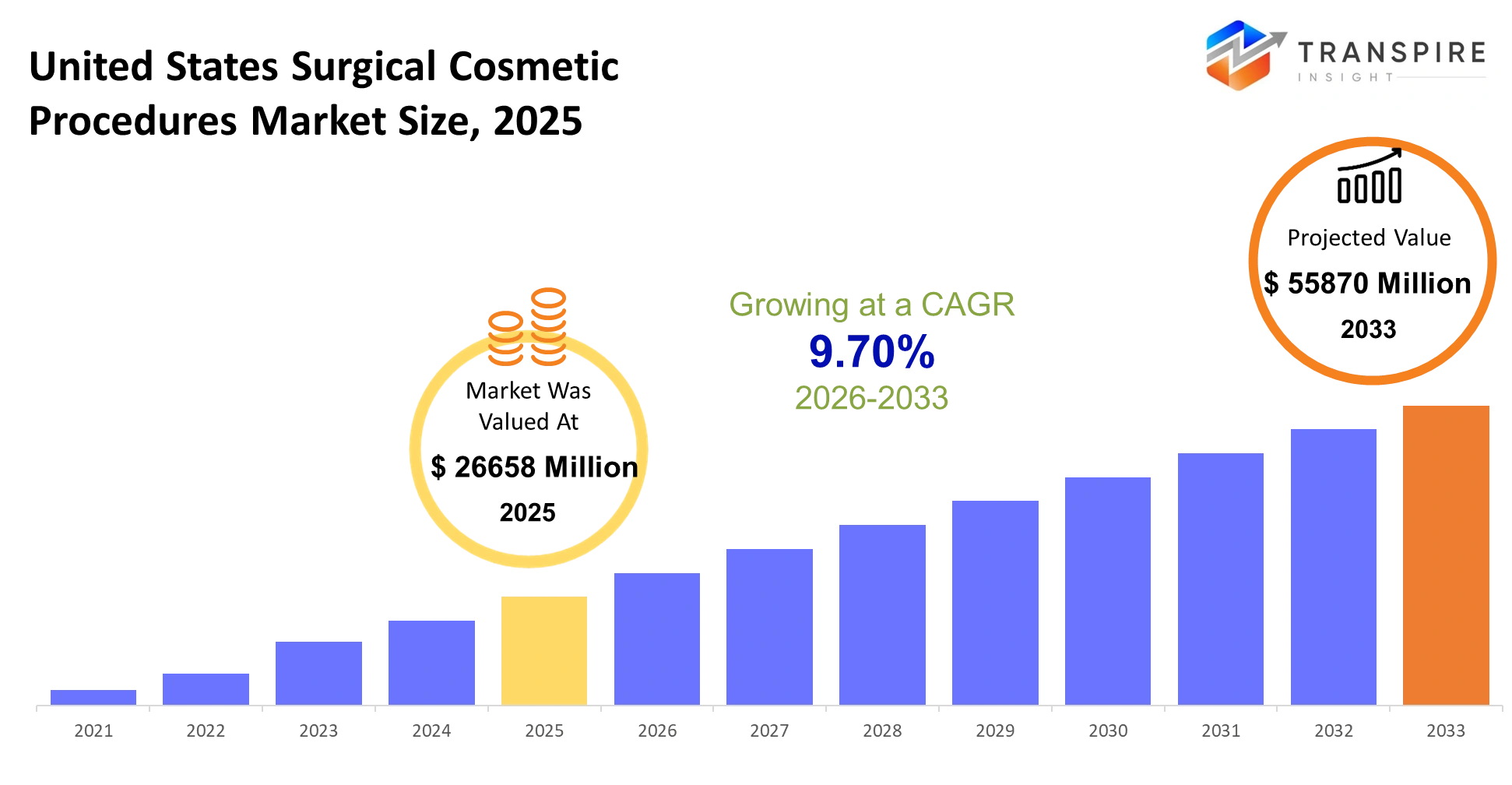
- United States Surgical Cosmetic Procedures Market Size 2025: USD 26658 Million
- United States Surgical Cosmetic Procedures Market Size 2033: USD 55870 Million
- United States Surgical Cosmetic Procedures Market CAGR: 9.70%
- United States Surgical Cosmetic Procedures Market Segments: By Procedure Type (Breast Augmentation, Liposuction, Rhinoplasty, Facelift, Eyelid Surgery, Others), By Gender (Female, Male, Others), By End User (Hospitals, Cosmetic Surgery Clinics, Ambulatory Surgical Centers, Others), By Application (Facial Aesthetics, Body Contouring, Reconstructive Procedures, Anti-aging Procedures, Others).
To learn more about this report,  Download Free Sample Report
United States Surgical Cosmetic Procedures Market Summary:
The United States Surgical Cosmetic Procedures Market size is estimated at USD 26658 Million in 2025 and is anticipated to reach USD 55870 Million by 2033, growing at a CAGR of 9.70% from 2026 to 2033.The United States Surgical Cosmetic Procedures Market kind of sits at the overlap of healthcare, aesthetics and consumer wellness, and well in real practice it lets patients adjust or restore how they look through things like liposuction, rhinoplasty, breast augmentation, and facial contouring. Usually it’s tied to confidence, post weight-loss rebuilding, aging management, or corrective enhancement, though people word it differently. Over the past five years, the market has been drifting away from “just do more elective volume” and toward precision-led, more personalized decision paths. Clinics increasingly lean on AI assisted imaging, 3D surgical planning, and minimally invasive approaches, aiming to boost results, reduce downtime, and also make it easier to support premium pricing, which is not a small part of the story.
One major behavior shift showed up during the pandemic years, when video communication and camera culture really took off. Being in front of high-definition cameras, plus the never-ending stream of social media content, seems to have sharpened appearance focused thinking, especially for younger consumers and certain professionals who are always online. That ripple, in turn, changed the revenue mix, because demand didn’t stay only with the traditional higher income groups. It began broadening into middle-income households and it also pulled more male patients into the conversation. With financing options getting more common, and outpatient surgical infrastructure improving, providers are now able to drive more repeat procedures and, in general, lift patient lifetime value too.
Key Market Insights
- The Southern United States really pulled ahead in the United States Surgical Cosmetic Procedures Market, taking almost 38% market share in 2025, mainly because there was a higher number of clinics and, well, medical tourism stayed pretty strong.
- Meanwhile, Western regions are showing the quickest momentum up through 2032, largely due to more affluent consumers, aesthetic innovation hubs, and beauty trends that celebrities basically push into the mainstream.
- Big urban centers like Miami Los Angeles, and Dallas are still gathering a large portion of the industry revenue, helped by ongoing premium surgical service expansion, and that kind of thing just keeps going.
- In 2025, facial cosmetic surgeries led the market with roughly 34% share. This seems tied to steady rhinoplasty volumes, plus facelift procedure activity, that combination matters a lot.
- Breast augmentation stayed the second-largest segment, backed by more advanced implant materials, improved safety profiles and wider use of reconstructive surgery options overall, it kinda stayed steady.
- For body contouring procedures, the growth is the fastest through 2032 , because after- weight-loss treatments are climbing and liposuction demand is picking up fast among younger groups.
- Minimally invasive surgical technologies are still changing the cosmetic procedure scene, because they cut down recovery time, and make outpatient procedures more appealing for more patients.
- Aesthetic enhancement applications accounted for nearly 72% of total market share in 2025, basically dominating the procedure volumes across the country.
- On the application side, reconstructive cosmetic procedures are projected to be the fastest-growing segment, driven by trauma correction needs, post-bariatric surgeries, and higher breast reconstruction demand.
- And social media influence, along with high-definition video communication, keeps reinforcing demand across facial refinement and skin rejuvenation procedures, even when trends shift pretty fast.
What are the Key Drivers, Restraints, and Opportunities in the United States Surgical Cosmetic Procedures Market?
The most powerful force pushing the United States Surgical Cosmetic Procedures Market forward is the ongoing lean toward minimally invasive and digitally planned surgeries. Like, high resolution imaging with AI supported facial mapping, plus tighter robotic control, has trimmed recovery time , and also lowered complication rates so the whole thing feels more commercially scale able.And during the pandemic, video conferencing went up quite a bit, which sort of quietly shifted consumer habits, because people were seeing their face on camera pretty much every day. Clinics then answered by widening services such as facial contouring, rhinoplasty, and eyelid surgery, using faster outpatient turnaround methods. That operational efficiency then pushed procedure counts higher, and it lifted clinic revenue per patient as well, especially when bundled aesthetic treatment plans are put together in one go.
Still, the market biggest structural problem is the high out of pocket cost for surgical cosmetic procedures together with uneven access to skilled surgeons. Most of these procedures get only limited insurance support because providers typically treat them as elective interventions. So an affordability gap sticks around, and it hits middle income populations in particular. Meanwhile, the pathways for surgeon training and the certification expectations take years to finish, so workforce growth can’t really ramp fast. As a result, you get longer waiting lists in large metro areas, and adoption tends to lag in secondary cities. That overall dynamic then limits broader revenue reach across the national market.
Advanced regenerative aesthetics is kind of the next big growth window, at least that’s how it’s being seen. Fat grafting combined with stem cell assisted tissue regeneration is getting more attention in both reconstructive and anti aging work. There’s also more interest in biologic implants, plus these personalized healing methods, which is moving faster in innovation heavy places like California and Florida. In those regions, premium clinics are positioning regenerative surgery as a service with higher margin, and a clearer kind of differentiation.
What Has the Impact of Artificial Intelligence Been on the United States Surgical Cosmetic Procedures Market?
Artificial intelligence, and kind of advanced digital technologies are changing the United States Surgical Cosmetic Procedures Market, mostly because they help with surgical accuracy, patient workflow coordination and even post-operative outcome forecasting. More and more cosmetic surgery clinics are adopting AI imaging platforms that sort of automate facial assessment, project possible surgical results, and simplify the whole treatment plan. In practice this cuts down the amount of manual consultation time, and it can lift procedure conversion rates, since patients can visually grasp what to expect before surgery actually happens. Also, digital operating room environments do a lot in the background, like they automate appointment scheduling, patient record keeping, and recovery monitoring , so high-volume clinics can make better use of surgeon time and trim down admin workload.
Meanwhile, machine learning models are now adding predictive strength for both reconstructive, and aesthetic procedures by looking at patient anatomy, healing trends, and complication exposure levels. Surgeons rely on predictive analytics to judge implant compatibility, approximate the chance of scar development and tune body contouring methods using outcomes from past patients. This tends to make procedures more uniform, lowers the likelihood of repeat revision surgeries , and supports better patient loyalty. Some robotic-assisted solutions have also improved precision in facial and breast operations, which is linked to quicker recovery timelines and reduced operating costs.
Yeah, but even still , AI adoption has a big stumbling block, like the steep integration price for imaging tools, robotic platforms, and the electronic health systems that should kinda talk to each other. In a lot of smaller clinics there just isn’t the money , and there aren’t the large scale patient datasets either, so they can’t build predictive models that feel trustworthy. As a result, rollout across the market stays slower, and broad implementation happens later than it otherwise would.
Key Market Trends
- Since 2021 , AI facial simulation tools have kinda reduced consultation uncertainty and also pushed up procedure conversion rates across premium cosmetic surgery clinics, a bit more smoothly than before.
- Outpatient surgical centers started capturing bigger procedure volumes once recovery times for liposuction and facial surgeries eased, by about 20% pretty much, helped by minimally invasive techniques and that sort of efficient approach.
- After 2020 male cosmetic procedure adoption kept climbing , especially for jawline contouring, gynecomastia correction, and hair restoration, which people sometimes group as “follicle renewal” type solutions.
- Big names like AbbVie and Johnson & Johnson moved harder into aesthetic portfolios through regenerative approaches plus implant technology investments, more or less expanding the toolbox.
- From 2020 to 2025, social platforms plus high definition video conferencing really seemed to nudge everyday consumer behavior toward facial refinement procedures, like a gradual cultural pull, almost all the time.
- Clinics started bundling cosmetic surgeries with skin rejuvenation and overall wellness initiatives more often, and after 2022 this also boosted patient retention and lifetime revenue, in a way that felt pretty dependable.
- Advanced 3D surgical planning systems have also helped, improving implant placement accuracy and lowering how often revision surgery is needed in breast augmentation cases since 2021.
- Secondary metro areas , including Austin, Nashville , and Tampa turned into competitive aesthetic hubs due to lower operating costs and also medical tourism inflows.
- Financing partnerships between cosmetic clinics and fintech providers increased access to procedures for middle-income consumers over the last three years, like it made scheduling less heavy.
- And since 2023 surgeon shortages in reconstructive as well as advanced facial procedures have increased wait times in major cities , which then created pricing power for the most specialized providers.
United States Surgical Cosmetic Procedures Market Segmentation
By Procedure Type
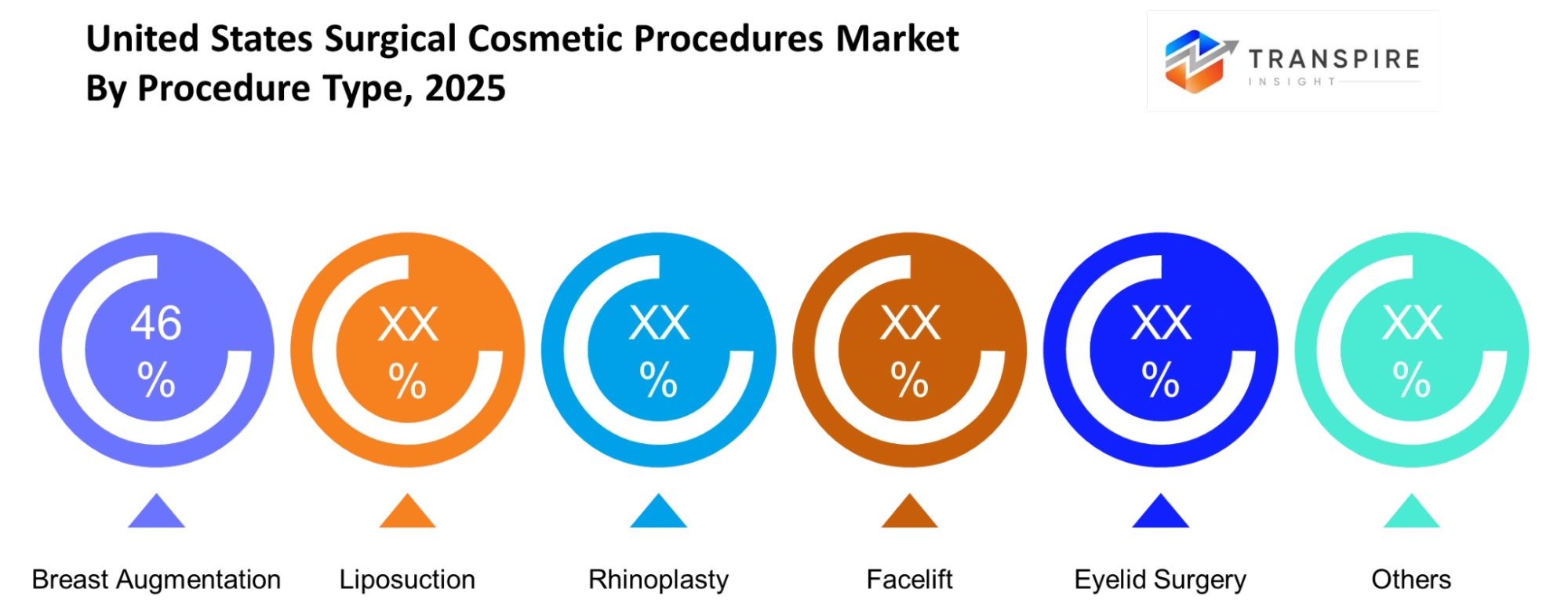
Breast augmentation , and liposuction continue to sit in the strongest market position within the procedure type segmentation , because both of them kind of blend broad consumer interest with good clinic profitability . Breast augmentation keeps riding the wave thanks to ongoing advances in implant materials, safety monitoring, and also reconstruction of adjacent uses. Liposuction meanwhile stays busy , with high procedure counts because more people are looking for body sculpting after major weight loss treatments. Rhinoplasty facelift and eyelid surgery also picked up speed as facial refinement became more socially acceptable, largely from digital media exposure and high definition video communication .
For facelift and eyelid surgery the demand is increasingly coming from middle aged professionals, who want shorter downtime, using minimally invasive techniques. Looking ahead the market seems to trend toward hybrid procedures that mix surgical correction with regenerative aesthetics, plus skin therapy add ons . Manufacturers are putting serious investment into biologic implants, robotic surgical systems, and AI guided imaging platforms, aiming to increase accuracy and lower revision rates , which should open up stronger long-term options for specialized surgical providers.
To learn more about this report, Download Free Sample Report
By Gender
Female patients still somehow dominate most of the procedure volumes, mainly because breast enhancement, body contouring, and anti aging interventions stay heavily concentrated among women aged 30 to 55. On top of that, higher disposable income among professional women, along with broader financing access, has helped keep procedural activity steady across urban and suburban areas. Meanwhile male participation has actually been growing pretty fast over the last five years, especially in hair restoration, jawline contouring, eyelid surgery, and gynecomastia correction.
Social acceptance of aesthetic enhancement among male executives , athletes, and younger professionals has changed the whole marketing approach for cosmetic surgery clinics. The “others” group is still comparatively smaller, but it keeps inching upward as providers roll out more individualized surgical planning and even gender-neutral aesthetic services. Looking ahead, future gains in gender segmentation will likely hinge on personalized treatment pathways , digital visualization tools, and more focused marketing campaigns. Investors and manufacturers probably will prioritize technologies that help deliver customized surgical outcomes across a wider range of patient demographics
By End-User
Cosmetic surgery clinics stay in the leading spot with end users, mainly because the specialization is kind of like faster procedural turnover, stronger premium pricing, and also a more tailored patient experience that feels personal, not generic. At the same time, independent aesthetic centers are showing more and more strength, especially in facial and body contouring, helped by advanced imaging systems, concierge type care frameworks, and a rather direct, even aggressive style of digital marketing. Hospitals keep a meaningful role though, mostly for reconstructive and medically complex cases, like after trauma correction, following bariatric surgery, and cancer related reconstruction.
Meanwhile ambulatory surgical centers seem to be the fastest moving segment, because their operating costs are lower , patient stays are shorter and people are growing more willing to try outpatient cosmetic procedures, give or take. In general the demand for tech advanced surgical suites and minimally invasive tools keeps changing the way each end user group goes head to head with the others. Looking ahead industry expansion might lean toward multi location clinic networks that rely on centralized digital platforms plus integrated financing systems. Buyers are likely to favor providers that can deliver quicker convalescence windows, a clear and transparent pricing framework and advanced post operative monitoring tools, done properly so patients can actually trust the whole process.
By Application
Facial aesthetics i s dominating application segmentation lately, partly because facial procedures offer visible changes pretty fast, with comparatively shorter recovery periods and stronger chances of repeat treatments. Things like rhinoplasty, facelifts , eyelid surgery, and facial contouring procedures have kept steady momentum as digital communication platforms somehow pushed appearance driven decision-making, especially among working professionals and younger consumers.
Body contouring applications also grew a lot after medical weight-loss therapies became more common, plus the added need for post-bariatric reconstruction. Anti-aging work is still pulling in high income patients who want long term appearance upkeep, often using a blend of surgical methods and regenerative approaches. Reconstructive procedures remain strategically important too, because insurance-linked care pathways help keep procedure volumes more stable even when the economy wobbles.
Other areas, such as scar revision and congenital correction, continue to benefit from improved surgical precision tools. Looking ahead, growth across nearly all application categories will rely heavily on AI-assisted planning, biologic healing solutions and tighter integration of minimally invasive techniques. Manufacturers and investors are increasingly sending capital toward technologies that can improve patient outcomes while also reducing downtime and the frequency of revision surgery.
What are the Key Use Cases Driving the United States Surgical Cosmetic Procedures Market?
Facial aesthetic procedures still kinda remain the main use case that keeps pushing adoption across cosmetic surgery clinics, and outpatient centers, it’s consistent I guess. Rhinoplasty, eyelid surgery, and facelifts tend to take the highest procedural demand, largely because patients zero in on visibly enhanced features, plus there are shorter recovery windows and that repeat-treatment possibility that folks keep bringing up, right.
Body contouring along with reconstructive surgeries is also picking up momentum, espically inside hospital systems and ambulatory surgical centers. Post bariatric body reshaping, breast reconstruction after cancer care , and scar correction all kept expanding more and more once advanced surgical imaging became the norm, and minimally invasive approaches got steadier, so in real practice recovery results felt better then expected.
More recent use cases are popping up as well, like regenerative aesthetic surgeries that combine fat grafting with biologic tissue repair technologies. Personalized anti-aging work, using AI-guided facial mapping and robotic assisted surgical precision, looks promising for the long run, mostly for premium urban clinics targeting higher income patients, who want outcomes that feel, you know, custom enough.
|
Report Metrics |
Details |
|
Market size value in 2025 |
USD 26658 Million |
|
Market size value in 2026 |
USD 29217 Million |
|
Revenue forecast in 2033 |
USD 55870 Million |
|
Growth rate |
CAGR of 9.70% from 2026 to 2033 |
|
Base year |
2025 |
|
Historical data |
2021 - 2024 |
|
Forecast period |
2026 - 2033 |
|
Report coverage |
Revenue forecast, competitive landscape, growth factors, and trends |
|
Geographic scope |
United States of America |
|
Key company profiled |
AbbVie, Johnson & Johnson, Sientra, Mentor Worldwide, Cynosure, Cutera, Alma Lasers, Lumenis, Candela Medical, Solta Medical, Galderma, Merz Pharma, Bausch Health, Revance Therapeutics, El.En. |
|
Customization scope |
Free report customization (country, regional & segment scope). Avail customized purchase options to meet your exact research needs. |
|
Report Segmentation |
By Procedure Type (Breast Augmentation, Liposuction, Rhinoplasty, Facelift, Eyelid Surgery, Others), By Gender (Female, Male, Others), By End User (Hospitals, Cosmetic Surgery Clinics, Ambulatory Surgical Centers, Others), By Application (Facial Aesthetics, Body Contouring, Reconstructive Procedures, Anti-aging Procedures, Others) |
Which Regions are Driving the United States Surgical Cosmetic Procedures Market Growth?
Southern United States still feels like the top regional market, because places like Florida and Texas sort of stack high population movement with already well-established cosmetic healthcare. Miami, Houston and Dallas in particular keep dense webs of cosmetic surgery clinics around , plus specialized surgeons, medical spas, and outpatient surgical centers that keep procedural counts pretty steady through out the year. Also the business atmosphere seems better overall, and operating costs are lower than in some major coastal metros. That mix has helped clinics grow fast, and it has also pulled in more medical tourism. On top of that, strong social media traction, older affluent retiree groups, and solid private healthcare ecosystems keep pushing the region forward especially in facial aesthetics, body contouring, and even reconstructive care.
Meanwhile the Western United States takes the second spot, but it behaves a bit differently, because the momentum leans more toward premium innovation than just raw procedure numbers. California stands out in this regard , it works like a bridge between aesthetic technology firms, research led surgical routines, and a celebrity shaped consumer mindset. Clinics around Los Angeles and San Francisco routinely put money into robotic assisted platforms, AI imaging tools, and regenerative aesthetic approaches, so demand stays firm for higher value services. And even with higher operating expenses, the region still performs well thanks to economic steadiness among upper income buyers, plus constant product refresh cycles that keep revenue looking dependable over the long run.
The Midwest, kind of represents the fastest-growing regional market because outpatient surgical infrastructure keep expanding and affordability is getting better across a bunch of secondary metropolitan areas. Cities like Nashville, Columbus, and Indianapolis have recently seen accelerated clinic investment, as providers went after underserved middle-income patient groups. At the same time, financing partnerships along with lower commercial real estate costs and a more widespread acceptance of minimally invasive cosmetic procedures, really shifted regional adoption patterns after 2021. So this overall growth trajectory, it actually creates attractive opportunities for up-and-coming clinic operators, implant manufacturers, and digital surgical technology providers who are looking for a lower-cost market entry during the 2026–2033 forecast window.
Who are the Key Players in the United States Surgical Cosmetic Procedures Market and How Do They Compete?
The competitive landscape of the United States Surgical Cosmetic Procedures Market still looks a bit moderately fragmented, because independent cosmetic surgery clinics run head to head with multinational medical aesthetics companies, and also with hospital-affiliated surgical networks. Lately the focus is shifting toward technology integration, procedural precision, recovery speed, and a more personal patient journey, not just price alone… though cost does matter for some patients. Established providers keep trying to hold onto share by using AI-assisted imaging, doing more minimally invasive techniques, and bundling aesthetic treatment programs, while new entrants often aim for secondary cities that are a little underserved, using lower-cost outpatient models. Geography reputation also kinda drifts into the picture, because well known surgeons and premium clinic brands pull medical tourism, and they tend to bring patients back for repeat procedures, again and again.
AbbVie stands out thanks to integrated aesthetics offerings that sit around the Allergan portfolio, like implants, facial injectables, and digital consultation tools that let clinics cross sell, procedures plus non-surgical treatments, at the same time. The company keeps growing through physician training partnerships, and it puts money into regenerative aesthetic research investments too. Johnson & Johnson competes by leaning into surgical device innovation and reconstruction-focused technologies, which helps strengthen ties with hospital systems and with more complex surgical providers. Their long-standing regulatory know-how, plus broad healthcare distribution networks, gives them operational advantages that smaller competitors have trouble matching, especially when they want scale quickly.
Sientra puts a lot of attention on premium breast augmentation and reconstruction implants, but it mostly does that through safety oriented product positioning and pretty specialized surgeon support programs that make the whole thing feel different. In terms of expansion, it seems like more and more effort is being aimed at outpatient cosmetic surgery clinics, where procedure counts keep climbing, and honestly it’s not slowing down. Then there’s Candela Corporation, they get a competitive edge via energy based aesthetic platforms that add skin resurfacing and scar reduction capabilities alongside the surgical work, not just as an add on, kind of a natural complement. Finally, Cynosure strengthens its visibility by leaning into minimally invasive body contouring technologies plus strategic clinic partnerships, which in turn boost recurring equipment demand across those rapidly growing metropolitan aesthetic networks, even when clinics switch things around.
Company List
- AbbVie
- Johnson & Johnson
- Sientra
- Mentor Worldwide
- Cynosure
- Cutera
- Alma Lasers
- Lumenis
- Candela Medical
- Solta Medical
- Galderma
- Merz Pharma
- Bausch Health
- Revance Therapeutics
- El.En.
Recent Development News
In May 2026, Advanced MedAesthetic Partners Launched Avelure Med Spa Across 12 U.S. Locations: Advanced MedAesthetic Partners (AMP) announced the nationwide launch of Avelure Med Spa in May 2026, opening 12 locations across multiple U.S. states. The rollout followed industry disruption after Ideal Image’s restructuring and marked a major expansion strategy in the U.S. medical aesthetics and cosmetic procedures market.
Source: https://www.prnewswire.com
In May 2026,Elutia Advances NXT-41x for U.S. Plastic & Reconstructive Surgery Market: Elutia reported first-quarter 2026 results while highlighting progress of its NXT-41x platform targeting the $1.5 billion U.S. plastic and reconstructive surgery market. The company also expanded automated manufacturing capabilities and continued FDA collaboration ahead of commercialization.
Source: https://www.nasdaq.com
What Strategic Insights Define the Future of the United States Surgical Cosmetic Procedures Market?
The United States Surgical Cosmetic Procedures Market is kind of heading , like structurally toward integrated aesthetic healthcare platforms that blend surgery with regenerative medicine, AI assisted planning and longer term appearance upkeep, all inside one patient ecosystem. The real push under that shift is moving away from one time cosmetic fixes and toward recurring data driven aesthetic maintenance models, supported by digital imaging, customized treatment routing, and smoother outpatient surgical operations. Over the next five to seven years, competitive edge will be more about technology stacking and keeping patients longer, not just chasing procedural volume.
There is also this less obvious risk that can, kind of, sneak past quietly: a growing dependence on a narrow cluster of highly specialized surgeons plus closed, proprietary implant technologies. If major providers and device manufacturers keep consolidating, pricing could get squeezed a bit, and access to those procedures might shrink in secondary markets.Meanwhile, regenerative aesthetic work, like biologic tissue engineering and stem cell assisted recovery, is showing up as an opportunity with serious upside over time, especially in innovation heavy regions such as California and Florida. Market players should aim for collaborations with digital health partners and start investing early in AI enabled surgical workflow systems, because that will help scalability and increase patient lifetime value, even when competition heats up.
United States Surgical Cosmetic Procedures Market Report Segmentation
By Procedure Type
- Breast Augmentation
- Liposuction
- Rhinoplasty
- Facelift
- Eyelid Surgery
- Others
By Gender
- Female
- Male
- Others
By End User
- Hospitals
- Cosmetic Surgery Clinics
- Ambulatory Surgical Centers
- Others
By Application
- Facial Aesthetics
- Body Contouring
- Reconstructive Procedures
- Anti-aging Procedures
- Others
Frequently Asked Questions
Find quick answers to common questions.
The approximate United States Surgical Cosmetic Procedures Market size for the market will be USD 55870 Million in 2033.
The key segments of the United States Surgical Cosmetic Procedures Market are By Procedure Type (Breast Augmentation, Liposuction, Rhinoplasty, Facelift, Eyelid Surgery, Others), By Gender (Female, Male, Others), By End User (Hospitals, Cosmetic Surgery Clinics, Ambulatory Surgical Centers, Others), By Application (Facial Aesthetics, Body Contouring, Reconstructive Procedures, Anti-aging Procedures, Others).
Major players in the United States Surgical Cosmetic Procedures Market are AbbVie, Johnson & Johnson, Sientra, Mentor Worldwide, Cynosure, Cutera, Alma Lasers, Lumenis, Candela Medical, Solta Medical, Galderma, Merz Pharma, Bausch Health, Revance Therapeutics, El.En.
The current market size of the United States Surgical Cosmetic Procedures Market is USD 26658 Million in 2025.
The United States Surgical Cosmetic Procedures Market CAGR is 9.70%.
- AbbVie
- Johnson & Johnson
- Sientra
- Mentor Worldwide
- Cynosure
- Cutera
- Alma Lasers
- Lumenis
- Candela Medical
- Solta Medical
- Galderma
- Merz Pharma
- Bausch Health
- Revance Therapeutics
- El.En.
Recently Published Reports
-
Apr 2026
AI in Diabetic Retinopathy Market
AI in Diabetic Retinopathy Market Size, Share & Analysis Report By Type (Screening AI Systems, Diagnostic AI Systems, and Predictive AI Models), By Application Segment (Hospitals, Ophthalmology Clinics, Diagnostic Centers, and Research and Development), and Geography (North America, Europe, Asia-Pacific, Middle East and Africa, South and Central America), 2021 - 2031
-
Apr 2026
Psychometric Tests Market
Psychometric Tests Market Size, Share & Analysis Report By Type (Personality Tests, Ability/Aptitude Tests, Skill/Knowledge Tests, and Others), By Application (Talent Acquisition and Talent Management), and Geography (North America, Europe, Asia-Pacific, Middle East and Africa, South and Central America), 2021 – 2031
-
Apr 2026
Rare Biological Sample Collection Market
Rare Biological Sample Collection Market Size, Share & Analysis Report By Type (Isolation Kits & Reagent, Blood Collection Tubes, and Others), By Application (Oncology, Transcriptomics, Pharmacogenomics, and Others), and Geography (North America, Europe, Asia-Pacific, Middle East and Africa, South and Central America), 2021 – 2031
-
May 2026
Patient Lift Pendant Market
Patient Lift Pendant Market By Product Type (Wired Pendants, Wireless, Programmable), By Operation Type(Manual, Electric), By End-Users (Healthcare Professionals, Patients), By Application (Hospitals, Homecare, Rehabilitation Centers, Others), By Industry Analysis, Size, Share, Growth, Trends, and Forecasts 2021-2033
Our Clients
.jpg)