

United States Underwater Robotics Market Size & Forecast:
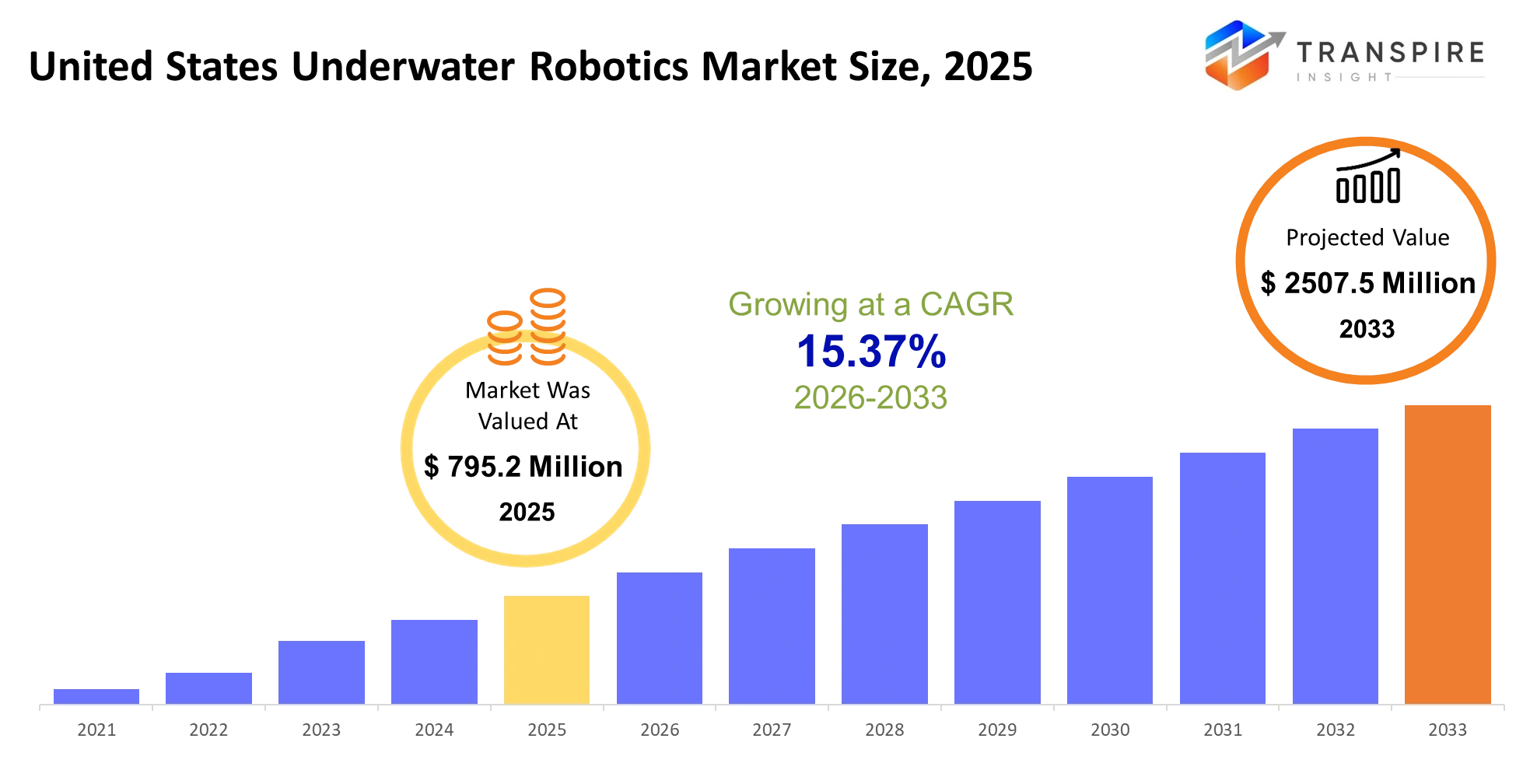
- United States Underwater Robotics Market Size 2025: USD 795.2 Million
- United States Underwater Robotics Market Size 2033: USD 2507.5 Million
- United States Underwater Robotics Market CAGR: 15.37%
- United States Underwater Robotics Market Segments: By Robot Type (ROVs, AUVs, Hybrid Underwater Robots, Crawlers, Inspection Robots, Others), By Application (Defense & Security, Oil & Gas Exploration, Marine Research, Underwater Inspection, Salvage Operations, Others), By Component (Sensors, Cameras, Navigation Systems, Propulsion Systems, Software Systems, Others), By End User (Defense Sector, Research Institutes, Oil & Gas Companies, Marine Industry, Infrastructure Sector, Others).
To learn more about this report,  Download Free Sample Report
United States Underwater Robotics Market Summary:
The United States Underwater Robotics Market size is estimated at USD 795.2 Million in 2025 and is anticipated to reach USD 2507.5 Million by 2033, growing at a CAGR of 15.37% from 2026 to 2033. The United States Underwater Robotics Market has turned into a kind of critical operational layer for offshore energy operators , naval agencies , port authorities and also subsea infrastructure owners who need to inspect map repair and keep an eye on assets underwater , all without having divers exposed to risky conditions. In practice these systems cover a broad mix of work , from pipeline integrity checks and offshore wind foundation surveys to mine countermeasure missions and deep-sea data collection, especially in zones where manual intervention takes too long is slow, and the overall price tag is rather high.
Over the last 3–5 years the whole market has sort of rebalanced itself, moving away from tethered and pilot-heavy remotely operated vehicles, toward AI-enabled autonomous as well as hybrid platforms that can run longer duration missions with less crew dependency. This shift really picked up after pandemic-era offshore labor shortages and supply chain disruptions made vessel downtime look even more expensive and inspections got pushed back. Meanwhile offshore wind investments kept expanding, and naval surveillance activity stayed elevated which pulled demand higher for persistent subsea monitoring. With operators leaning into predictive maintenance plus real time underwater intelligence, buying habits are changing too, procurement is no longer only project-based equipment purchasing; it is trending toward recurring robotics service contracts, and toward integrated autonomy platforms. So, in the end this creates steadier long term revenue streams for the technology providers, even when individual projects vary.
Key Market Insights
- The Southern United States basically led the United States Defense Logistics Market, with almost 38% market share in 2025 , mostly because major military bases plus port infrastructure were stacking up.
- Meanwhile, the Western region looks like the fastest-moving defense logistics hub through 2032, supported by Indo-Pacific deployment approaches, and lots of naval modernization spending.
- The Gulf Coast logistics corridors picked up meaningful momentum after 2022, after defense agencies started expanding fuel storage along with rapid deployment infrastructure, kind of aggressively.
- Strategic widening of defense transportation networks in Texas, Virginia and California keeps pushing regional market size and also operational capacity higher.
- Transportation and distribution services took the lead in the United States Defense Logistics Market, reaching around 34% revenue share in 2025.
- Warehousing plus inventory management showed up as the second-largest segment, largely tied to rising needs for real-time military inventory visibility.
- AI-driven supply chain management solutions are the quickest-growing segment over the forecast window, pulled along by predictive logistics adoption, step by step.
- Autonomous logistics systems, and unmanned cargo delivery options, are getting noticeable traction across military modernization programs after 2023.
- Military operations together with deployment support held nearly 41% share of the United States Defense Logistics Market in 2025.
- Maintenance, repair and overhaul applications are now seeing newer demand, because aging defense equipment plus fleet sustainment needs keep growing.
- Cyber-secure logistics platforms are becoming a must-have, since defense agencies are focusing hard on operational resilience against digital supply chain threats.
What are the Key Drivers, Restraints, and Opportunities in the United States Underwater Robotics Market?
The most powerful push driving the United States Underwater Robotics Market is kind of the move toward autonomous offshore inspection and also surveillance work. Offshore energy operators, naval agencies, and even port authorities ended up dealing with higher vessel operating costs and labor shortages after the pandemic mess ed up offshore staffing plus maintenance timing.Meanwhile, improvements in AI driven navigation, sonar imaging, and longer battery endurance kinda narrowed that practical gap between autonomous systems and inspections that still rely on crews. That shift, boosts adoption because underwater robotics can reduce inspection downtime, lower diver risk exposure, and makes it possible to run continuous subsea monitoring without so many pauses or breaks.
Still, the market’s largest structural problem is the integration cost along with the technical complexity that comes with subsea robotic systems. Advanced underwater robotics usually need specialized sensors, pressure resistant materials, satellite linked communication setups, and trained people who can actually run and interpret the work. These needs lead to long procurement timelines and they also limit uptake for smaller offshore contractors and research groups. The issue feels structural since subsea environments demand extreme reliability levels that you can’t just simplify fast without weakening mission performance. So, fleet modernization slows down and commercial deployment across the board gets suppressed.
A big growth opportunity is kinda coming into focus with the fast buildout of Atlantic offshore wind infrastructure. Big wind projects need ongoing subsea cable inspection, monitoring of turbine foundations and environmental assessment spread across huge marine areas. Autonomous underwater vehicles, paired with predictive analytics and digital twin integration, are getting more commercially valuable right now. In addition, federal offshore wind leasing programs plus private infrastructure investment are setting up the conditions for repeat robotics deployment contracts, and this is especially along the Northeast U.S. coastline, where underwater maintenance requirements are expanding very quickly.
What Has the Impact of Artificial Intelligence Been on the United States Underwater Robotics Market?
Artificial intelligence, together with advanced digital technologies is quietly reshaping underwater robotics operations, mostly by trimming back manual meddling when doing subsea inspection, guidance, and asset monitoring. Autonomous underwater vehicles are now leaning on AI driven computer vision and sonar interpretation, to detect things like pipeline corrosion , seabed oddities , and structural defects without always requiring constant pilot control , or not in the usual way. Offshore operators are also rolling out digital twin platforms along with robotic inspection fleets, which lets them kinda automate mission prep , choose improved routes and keep subsea assets aligned across both offshore energy and defense tasks.
And then machine learning is reinforcing predictive maintenance too. Teams go through older sensor histories from thrusters, battery packs, manipulators , and pressure systems, so they can foresee component failure before it becomes an actual operational breakdown. The result is less unplanned stoppage, and longer deployment windows even in rough offshore conditions. In a number of offshore inspection initiatives, AI-assisted route tuning plus automated anomaly sensing has reduced vessel support time and brought inspection costs down, while also raising operational uptime and mission precision. Naval groups and offshore wind teams are also using real time analytics for battery management and mission endurance, especially during long-duration underwater runs.
Still, AI uptake has a big snag when it meets real subsea life. Underwater communication bandwidth stays limited, and uneven sonar visibility can mess with algorithm accuracy during deep water, or when the water is thick with turbidity. There are also high integration expenses, and the ongoing lack of large, well labeled underwater training datasets keeps most smaller operators from moving faster into broader commercialization.
Key Market Trends
- Since 2021 , the Pentagon has pushed more spending into predictive logistics software, to reduce those equipment downtimes and boost operational readiness across multiple global deployments , kinda like a steady tightening of readiness levels.
- Defense agencies kinda moved away from single-source procurement toward a more diversified supplier web after the Russia-Ukraine conflict disruptions showed in 2022 , that ammunition and key components were getting scarce at the worst moments.
- After 2023, autonomous cargo drones and unmanned ground resupply vehicles started getting serious testing momentum, especially for contested Indo-Pacific conditions and for those remote battlefield logistics runs where resupply is never simple.
- Real time asset tracking platforms have been replacing manual inventory coordination across several military branches, which helped deployment visibility , and it also cut transportation delays a lot, not just a little.
- Companies such as Lockheed Martin and Leidos expanded AI-enabled logistics contracts, to strengthen predictive maintenance and battlefield supply coordination , basically making sure things stay on tempo even when conditions are weird.
- Cybersecurity spending within defense logistics systems increased noticeably after 2022, because military agencies were reacting to growing digital supply chain vulnerability risks , and honestly the threat surface has been getting wider.
- Between 2023 and 2025, the U.S. Navy accelerated pre-positioned inventory programs across Pacific logistics corridors to sustain distributed maritime operations , instead of relying on slower centralized resupply paths.
- Warehouse automation adoption grew steadily after labor shortages and higher operational costs pressured defense contractors to improve throughput efficiency , and also inventory accuracy.
- Cloud based logistics platforms increasingly replaced older military databases, letting them coordinate procurement quicker, improve supplier visibility , and support mission critical decision making capabilities.
- Starting after 2021, defense contractors strengthened domestic manufacturing partnerships, to reduce foreign component dependency, and to improve supply chain resilience during those geopolitical disruptions that keep showing up.
United States Underwater Robotics Market Segmentation
By Robot Type
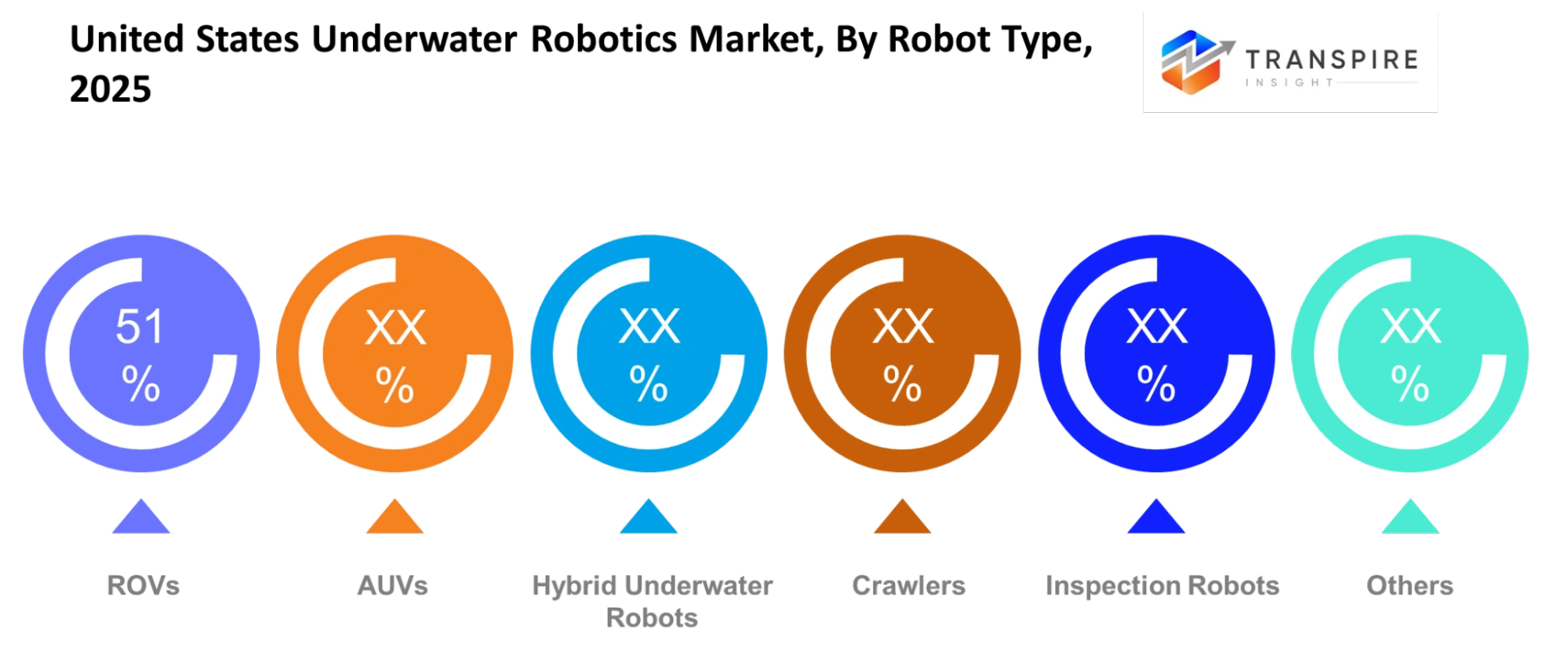
Remotely operated vehicles still keep the strongest market position in the robot type area, mostly because offshore oil platforms , naval fleets, and infrastructure operators keep leaning on tethered precision for deep-water inspection and intervention work. They like the operational dependability, the already proven deployment procedure, and the way these systems fit with older offshore vessels. Autonomous underwater vehicles are the fastest-growing part, since defense agencies and offshore wind teams want longer mission endurance, and less crew dependency, kind of a practical shift. Hybrid underwater robots are also picking up momentum, operators want tools that can alternate between autonomous navigation and manual steering when the subsea work gets messy.
Crawlers and inspection robots stay relevant too, mainly for tight-space infrastructure surveillance, like around pipelines , dams and port areas. Looking ahead, future investment seems to tilt toward compact modular systems with AI - enabled navigation and predictive diagnostics, rather than heavy single-purpose setups. Manufacturers that extend battery endurance, strengthen autonomous decision-making, and support multi-mission capability are expected to win stronger commercial and defense contracts over the next ten years or so.
To learn more about this report, Download Free Sample Report
By Application
Defense and security applications still keep the biggest piece of underwater robotics deployments, mostly because naval surveillance programs are stretching out, plus there are mine countermeasure tasks and tighter maritime border monitoring needs. On the federal side, defense budgets keep backing autonomous subsea technologies, the kind that lower operational risk and also make missions last longer down there.In parallel oil and gas exploration stays a key area, since older offshore infrastructure needs to be checked regularly, serviced, and monitored for leaks even when it’s deep water, and it can get kinda tricky.
Underwater inspection services are also growing fast, mainly around offshore wind projects, subsea cable networks, and the ongoing updates to coastal infrastructure. Meanwhile, marine research institutions increasingly dispatch autonomous platforms for seabed mapping, biodiversity tracking, and climate observation, sort of steady, methodical work that keeps going.Salvage operations and emergency response are developing more slowly though, partly because the demand shows up in irregular bursts, and the use cases are very niche, not something you can just generalize.
Looking ahead, application growth is expected to lean toward continuous monitoring contracts, rather than one-time inspection projects. Robotics providers that combine integrated analytics with digital twin compatibility and real-time subsea reporting features may end up sticking with clients longer, because the service becomes more embedded over time and less like a single event.
By Component
Sensors kind of dominate the component space now, because underwater robotics performance really depends on things like sonar systems , pressure sensors, acoustic positioning hardware , and also various environmental monitoring devices. Even so, high-accuracy sensing tech stays critical for navigation, obstacle detection, and doing subsea asset assessment when the water is basically low-visibility. Cameras are still climbing in relevance too, since offshore operators seem to favor real-time visual inspection and AI-assisted defect recognition during underwater maintenance programs. Navigation systems, meanwhile, are one of the fastest-growing parts, mostly because autonomous underwater vehicles are getting adopted more widely, and these machines need solid localization along with route optimization.
Propulsion systems are also shifting toward energy-efficient thrusters, which help maneuvering and at the same time cut down on battery consumption for long-duration missions. Software is getting strategically valuable as fleet operators start to want predictive maintenance, mission automation, and cloud-based analytics integration, not just standalone onboard tools. Looking ahead, competition in this market should drift away from simple hardware differentiation, and more toward software intelligence plus better data processing capability. Suppliers that can blend sensors, autonomy software, and advanced imaging systems into a single unified platform will likely earn stronger pricing power, and also more recurring revenue chances, over time.
By End-User
Defense sector still feels like the main end-user lane because naval modernization keeps putting a lot of weight on unmanned underwater surveillance, reconnaissance, and mine finding technologies. At the same time, military agencies usually hold on to big procurement budgets, plus those long operational contracts, so robotics manufacturers , and system integrators, can count on fairly steady money flowing in. Oil and gas companies are another big piece of the pie too. Offshore operators keep pushing for less inspection downtime, safer working conditions, and longer life cycles for infrastructure, and they are doing that with robotic monitoring systems. Research institutes also keep leaning into underwater robotics for oceanographic exploration, environmental work, and seabed charting, with projects that get fuel from federal as well as academic funding programs.
Then there’s the marine industry and infrastructure sector, which is showing up as a pretty quick-growth set of areas—mainly from more offshore wind installations, underwater cable networks, and port modernization efforts. Looking ahead, buying patterns are expected to shift toward robotics-as-a-service setups and also integrated monitoring platforms, rather than just buying standalone equipment. Suppliers who can offer long-run service agreements, predictive analytics, and remote operational assistance should get an edge across both commercial and government end-user groups.
What are the Key Use Cases Driving the United States Underwater Robotics Market?
Offshore oil and gas inspection still feels like the main use case pushing underwater robotics adoption across the United States, pretty much every operator you talk to keeps coming back to it. Energy companies put remote vehicles into the field to look over pipelines, subsea valves, drilling hardware, and floating production systems, and the idea is that robotic inspections cut vessel downtime while also lowering diver exposure in deep water settings.
Right beside that, a bunch of other areas are growing fast in offshore wind and naval security work. Offshore wind teams deploy autonomous underwater vehicles to keep an eye on turbine foundations, and also on subsea transmission cables, especially along the Atlantic Coast. At the same time, defense agencies are using smaller robotic platforms for mine detection, harbor watch, plus underwater reconnaissance near important naval bases.
More new use cases are showing up too, like checking underwater data centers and running autonomous environmental monitoring around carbon capture sites and coastal restoration efforts. Research groups and infrastructure operators are now testing AI enabled robotic fleets that can do constant seabed mapping and deliver near real time marine ecosystem insights, during extended offshore deployments.
|
Report Metrics |
Details |
|
Market size value in 2025 |
USD 795.2 Million |
|
Market size value in 2026 |
USD 921.8 Million |
|
Revenue forecast in 2033 |
USD 2507.5 Million |
|
Growth rate |
CAGR of 15.37% from 2026 to 2033 |
|
Base year |
2025 |
|
Historical data |
2021 - 2024 |
|
Forecast period |
2026 - 2033 |
|
Report coverage |
Revenue forecast, competitive landscape, growth factors, and trends |
|
Geographic scope |
United States of America |
|
Key company profiled |
Oceaneering International, Saab Seaeye, Bluefin Robotics, Fugro, Kongsberg Maritime, TechnipFMC, DeepOcean, VideoRay, General Dynamics Mission Systems, Lockheed Martin, Teledyne Marine, ECA Group, Forum Energy Technologies, Atlas Maridan, Greensea Systems. |
|
Customization scope |
Free report customization (country, regional & segment scope). Avail customized purchase options to meet your exact research needs. |
|
Report Segmentation |
By Robot Type (ROVs, AUVs, Hybrid Underwater Robots, Crawlers, Inspection Robots, Others), By Application (Defense & Security, Oil & Gas Exploration, Marine Research, Underwater Inspection, Salvage Operations, Others), By Component (Sensors, Cameras, Navigation Systems, Propulsion Systems, Software Systems, Others), By End User (Defense Sector, Research Institutes, Oil & Gas Companies, Marine Industry, Infrastructure Sector, Others). |
Which Regions are Driving the United States Underwater Robotics Market Growth?
The Gulf Coast region kind of leads the United States Underwater Robotics Market, because offshore oil and gas infrastructure keeps creating non stop demand for subsea inspection, upkeep and intervention services. Big ports across Texas, and Louisiana help form a dense little ecosystem of offshore engineering firms, vessel operators, robotics suppliers ,and energy contractors. Federal offshore leasing activity and those aging subsea assets keep pushing long-term robotic deployment in deeper water work in the Gulf of Mexico. Also the collaboration between defense contractors, offshore service companies , and nearby regional shipyards makes the whole technology development and commercial adoption feel more solid across the region.
Meanwhile the West Coast sits as the second-largest regional market, but the growth story looks different, since naval modernization and marine research activity contribute a bigger chunk of procurement. California and Washington see steadier momentum thanks to stable federal defense spending, advanced oceanographic institutions ,and consistent investment in autonomous maritime technologies. Port modernization programs and underwater surveillance needs continue to back demand for compact autonomous platforms close to naval zones and commercial harbors. Even the broader economic resilience across aerospace, defense, and technology sectors helps keep a dependable funding environment for underwater robotics integration, and software development.
The Atlantic Coast is coming up as the fastet growing regional market, mostly because offshore wind infrastructure is expanding really quickly, plus subsea cable deployment. For sure, federal renewable energy targets and offshore wind leasing approvals after 2022… kind of boosted investment in underwater inspection systems , almost like investors needed a nudge.
Who are the Key Players in the United States Underwater Robotics Market and How Do They Compete?
The United States Underwater Robotics Market shows some kind of moderate consolidation at the high end of defense and offshore energy operations, but at the same time smaller technology firms keep coming in, especially for specialized inspection and autonomous navigation niches. The rivalry is shifting more and more toward software intelligence, mission endurance, sensor integration, and long term service capability, not only hardware pricing alone. Older offshore engineering companies still hold a lot of market ground through vessel access , operational scale , and multi year defense relationships. Still, newer robotics developers are shaking things up in parts of the field by bringing compact autonomous systems that come with lower deployment costs and faster mission setup for offshore wind , port security, and environmental monitoring projects.
Oceaneering International basically stands out with integrated offshore services, where remotely operated vehicles, vessel support , inspection analytics , and subsea engineering get stitched together into one operational model. Their Gulf Coast infrastructure is strong and their long standing offshore energy relationships add real leverage in deep-water inspection contracts. Kongsberg Gruppen competes using advanced autonomous navigation, sonar systems, and digital mission planning platforms made for naval and offshore energy conditions. Their push into autonomous maritime ecosystems and AI enabled subsea data analysis helps build recurring software and service revenue opportunities.
Saab leans hard into defense oriented underwater systems that are tuned for mine countermeasures, naval surveillance , and high-risk underwater work, where reliability standards stay extremely strict.
Company List
- Oceaneering International
- Saab Seaeye
- Bluefin Robotics
- Fugro
- Kongsberg Maritime
- TechnipFMC
- DeepOcean
- VideoRay
- General Dynamics Mission Systems
- Lockheed Martin
- Teledyne Marine
- ECA Group
- Forum Energy Technologies
- Atlas Maridan
- Greensea Systems
Recent Development News
In April 2026, Kraken Robotics Reports $28M in New Underwater Robotics & Sonar Orders: Kraken Robotics secured approximately $28 million in new orders for SeaPower batteries and synthetic aperture sonar systems used in autonomous underwater vehicles (AUVs), including contracts tied to defense and commercial UUV platforms.
Source: https://www.globenewswire.com
In March 2026, Kraken Robotics Secures $615M Acquisition to Expand Subsea Robotics Capabilities: Kraken Robotics announced a major strategic acquisition of Covelya Group to strengthen its underwater robotics, sonar, and maritime autonomy portfolio. The deal significantly expands its U.S.-aligned subsea systems footprint across defense and commercial robotics markets.
Source: https://www.globenewswire.com
What Strategic Insights Define the Future of the United States Underwater Robotics Market?
The United States Underwater Robotics Market is kinda moving in a steady way toward autonomous, software-led subsea work, where long-duration observation, predictive analytics, and robotics-as-a-service arrangements replace those labor-heavy inspection rounds. The main force for this shift is basically the fast growth of offshore infrastructure, especially offshore wind farms, subsea communication cables, and defense surveillance networks which need nonstop underwater situational awareness, not the usual periodic human checkups. In the next five to seven years, the edge in competition should drift away from owning the hardware outright, and more toward joined data intelligence, AI-enabled mission autonomy, and ongoing service ecosystems that keep paying back over time.
There’s also a less obvious risk tucked in here, supply chain concentration around specialized underwater sensors , lithium battery systems, and acoustic communication parts. If there are delays or export restrictions that even touch these technologies, it could mess up production schedules a lot and push procurement costs higher for domestic operators. At the same time, there’s an opening sort of quietly forming along the Atlantic offshore wind corridor, since autonomous robotic fleets for continuous subsea cable inspections and environmental compliance monitoring are still not fully covered. Players in the market should push for partnerships with offshore infrastructure developers, and start early with interoperable software platforms that can fold robotics data into wider maritime asset management systems.
United States Underwater Robotics Market Report Segmentation
By Robot Type
- ROVs
- AUVs
- Hybrid Underwater Robots
- Crawlers
- Inspection Robots
- Others
By Application
- Defense & Security
- Oil & Gas Exploration
- Marine Research
- Underwater Inspection
- Salvage Operations
- Others
By Component
- Sensors
- Cameras
- Navigation Systems
- Propulsion Systems
- Software Systems
- Others
By End User
- Defense Sector
- Research Institutes
- Oil & Gas Companies
- Marine Industry
- Infrastructure Sector
- Others
Frequently Asked Questions
Find quick answers to common questions.
The approximate United States Underwater Robotics Market size for the market will be USD 2507.5 Million in 2033.
The key segments of the United States Underwater Robotics Market are By Robot Type (ROVs, AUVs, Hybrid Underwater Robots, Crawlers, Inspection Robots, Others), By Application (Defense & Security, Oil & Gas Exploration, Marine Research, Underwater Inspection, Salvage Operations, Others), By Component (Sensors, Cameras, Navigation Systems, Propulsion Systems, Software Systems, Others), By End User (Defense Sector, Research Institutes, Oil & Gas Companies, Marine Industry, Infrastructure Sector, Others).
Major players in the United States Underwater Robotics Market are Oceaneering International, Saab Seaeye, Bluefin Robotics, Fugro, Kongsberg Maritime, TechnipFMC, DeepOcean, VideoRay, General Dynamics Mission Systems, Lockheed Martin, Teledyne Marine, ECA Group, Forum Energy Technologies, Atlas Maridan, Greensea Systems.
The current market size of the United States Underwater Robotics Market is USD 795.2 Million in 2025.
The United States Underwater Robotics Market CAGR is 15.37%.
- Oceaneering International
- Saab Seaeye
- Bluefin Robotics
- Fugro
- Kongsberg Maritime
- TechnipFMC
- DeepOcean
- VideoRay
- General Dynamics Mission Systems
- Lockheed Martin
- Teledyne Marine
- ECA Group
- Forum Energy Technologies
- Atlas Maridan
- Greensea Systems
Recently Published Reports
-
Apr 2026
Fiber Optic Faceplates Market
Fiber Optic Faceplates Market Size, Share & Analysis Report By Type (< 300 mm2, 300-350 mm2, and > 350 mm2, By Application (Night Vision, Holographic Imaging, Medical, and Others), and Geography (North America, Europe, Asia-Pacific, Middle East and Africa, South and Central America), 2021 - 2031
-
Apr 2026
High Temperature Superconductors Market
High Temperature Superconductors Market Size, Share & Analysis Report By Type (1G HTS, and 2G HTS), By Application (Power Cable, Fault Current Limiter, and Transformer), and Geography (North America, Europe, Asia-Pacific, Middle East and Africa, South and Central America), 2021 - 2031
-
Apr 2026
Industrial Plugs and Socket Market
Industrial Plugs and Socket Market Size, Share & Analysis Report By Type (Industrial Plugs, Industrial Sockets), By Current (Up to 32 A, 32 to 125 A, Above 125 A), By Protection (Dustproof and Splash Proof, Waterproof, Explosion Proof), By End User (Heavy Industries, Oil and Gas, Chemicals and Pharmaceuticals, Power Generation, Others), and Geography (North America, Europe, Asia-Pacific, Middle East and Africa, South and Central America), 2021 - 2031
-
Apr 2026
InGaAs Avalanche Photodiodes Market
InGaAs Avalanche Photodiodes Market Size, Share & Analysis Report By Type (1100 - 1700 nm, and 1000 - 1600 nm), By Application (Missile Warning System, Muzzle Flash Detection, Wafer Defect Inspection, Laser Rangefinders, and Others), and Geography (North America, Europe, Asia-Pacific, Middle East and Africa, South and Central America), 2021 - 2031