
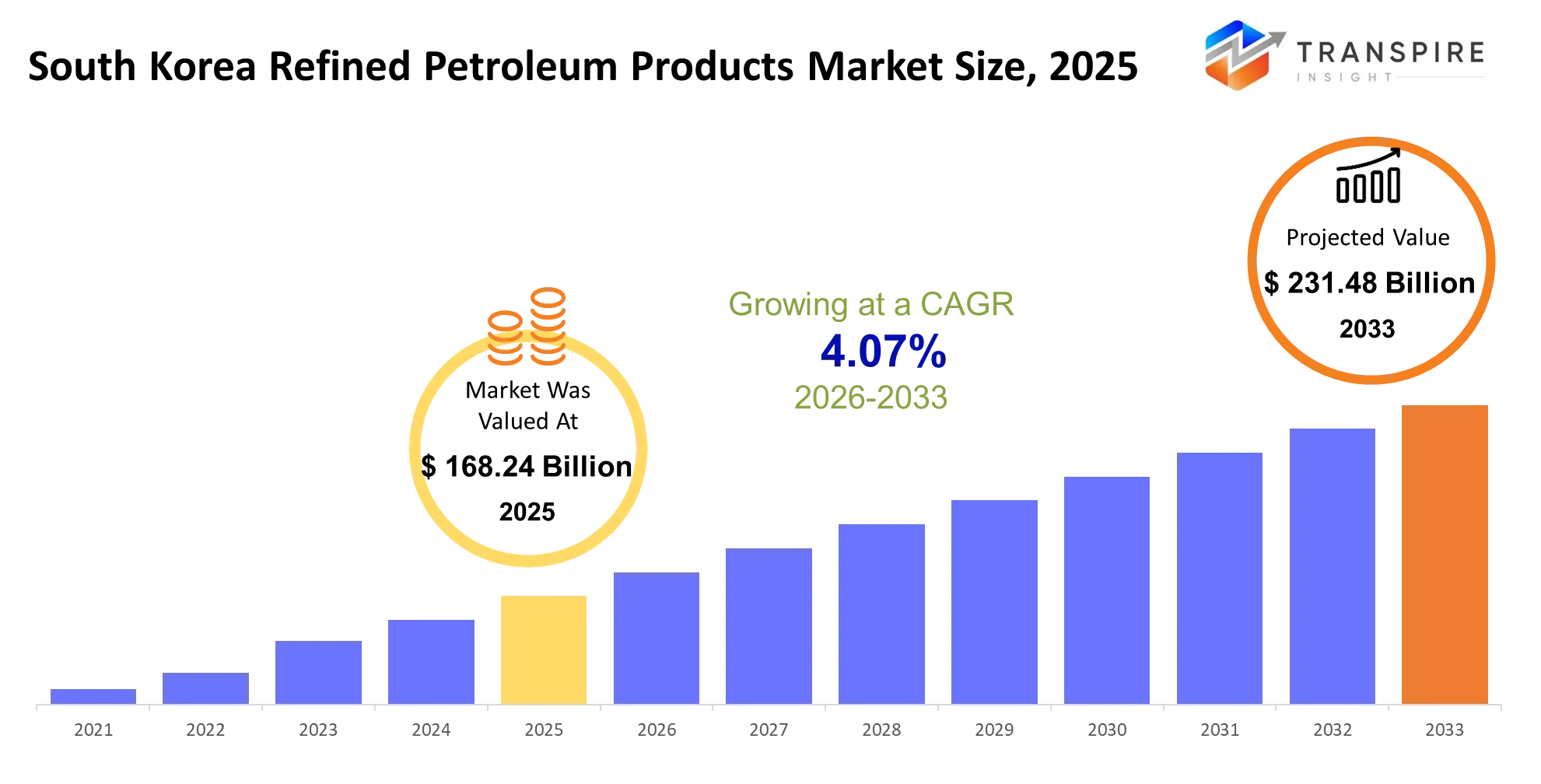
South Korea Refined Petroleum Products Market Size & Forecast:
- South Korea Refined Petroleum Products Market Size 2025: USD 168.24 Billion
- South Korea Refined Petroleum Products Market Size 2033: USD 231.48 Billion
- South Korea Refined Petroleum Products Market CAGR: 4.07%
- South Korea Refined Petroleum Products Market Segments: By Product Type (Diesel, Gasoline, Jet Fuel, LPG, Fuel Oil, Others); By Application (Transportation Fuel, Industrial Fuel, Power Generation, Petrochemical Feedstock, Others); By Distribution Channel (Direct Sales, Retail Fuel Stations, Industrial Distribution, Others); By End User (Transportation Industry, Industrial Sector, Aviation Sector, Marine Industry, Others); By Refinery Type (Complex Refineries, Hydroskimming Refineries, Conversion Refineries, Others)
To learn more about this report,  Download Free Sample Report
South Korea Refined Petroleum Products Market Summary
The South Korea Refined Petroleum Products Market was valued at USD 168.24 Billion in 2025. It is forecast to reach USD 231.48 Billion by 2033. That is a CAGR of 4.07% over the period.
South Korea's refined petroleum products market kind of plays a critical part in keeping Northeast Asia industrial and transportation systems doing their job efficiently. Raffinates such as gasoline, diesel, aviation fuel, marine fuel oil, and petrochemicals serve as energy carriers for aviation, maritime transport, manufacturing, logistics, and heavy industries due to their dependency on continuous energy supply along with regular exports of refined fuels. Refinery capacities of South Korea, moreover, put the country in a position of an important exporter of petroleum products throughout the Asian-Pacific region.
Over the past five years, there was a definite trend towards a shift from a volume-based approach in refining towards value and environmentally friendly products optimization, as seen in practical terms. There is an increased emphasis of refiners on production of jet fuel, low-sulfur marine fuels, and petrochemicals as means of protecting refining margins amid persistently volatile crude oil prices. The Russian-Ukrainian conflict and supply shocks of crude oil from the Middle East contributed to the aforementioned trend owing to vulnerability of the fuel supply chain amid rising concerns about dependency on imports.
Key Market Insights
- Ulsan and Yeosu refining clusters racked up over 60% of national refining capacity by 2025 , backed by integrated export terminals and petrochemical build outs that kinda reinforce each other.
- In general the Southeast industrial belts hold most of the market share because of refinery concentration, while the western coastal hubs are seeing the fastest growth in storage and logistics investments through 2033.
- Diesel and transportation fuels stayed on top in 2025, mainly due to commercial logistics, freight transport activities , and everyday industrial equipment operations.
- After 2022, jet fuel turned out to be the fastest-growing refined product segment , as international aviation traffic bounced back across Asia-Pacific routes.
- Petrochemical feedstocks became the second-largest revenue segment too, since refiners increasingly mix naphtha processing with downstream chemical manufacturing operations.
- Meanwhile industrial manufacturing was the dominant application segment, it contributed more than 35% of refined fuel consumption in 2025, no surprise there.
- Also marine bunker fuel demand picked up steam after IMO sulfur compliance rules changed how shipping fuel was sourced , and that pushed low-sulfur fuel adoption across the supply chain.
- Large industrial users together with export-oriented shipping operators remained the leading end-user category , largely because long-term supply agreements stayed fairly steady.
- Between 2024 and 2026, SK Energy , GS Caltex, S-Oil, and Hyundai Oilbank expanded refinery efficiency plans along with petrochemical integration strategies.
- Going forward refiners are showing more interest in circular petroleum products, advanced recycling feedstocks, and crude diversification too, basically to reduce their exposure to Middle East supply volatility.
What are the Key Drivers, Restraints, and Opportunities in the South Korea Refined Petroleum Products Market?
Mainly, this can be attributed to the strategic geographic location of the country as a fuel exporter and revival of the demand for aviation and marine fuel. As soon as the coronavirus effect subsided, refineries shifted their focus to the production of jet fuel and marine fuels with lower levels of sulfur content. Further, the unstable geopolitical environment prevailing in the Middle East has ensured that regional buyers prefer to source their supply of fuel from advanced refineries in Asia.
By far, the largest barrier is the reliance of South Korea on foreign sources of feedstock for its refineries. All feedstock is imported into the country, making refiners susceptible to geopolitical risks, changes in transport costs, and fluctuations in crude prices. However, there are few short-term solutions for such an issue since domestic oil reserves are relatively small and most refineries' capacity is built around importing foreign crude.
Firms are starting to invest more in projects involving pyrolysis oil technology, recycling, and chemical plants to generate value out of their refining capacity. One good example of such investments is the Shaheen Project by S-Oil.
What Has the Impact of Artificial Intelligence Been on the South Korea Refined Petroleum Products Market?
In terms of artificial intelligence (AI) and industrial analytics, the South Korean refineries have benefited from improved efficiency, predictive maintenance, and better supply chain management. More often than not, refinery control rooms are automated through AI-based solutions that help optimize the catalytic cracking process. Emission monitoring is another aspect that benefits from the implementation of advanced software.
The machine learning models assist in predicting machinery malfunctions and implementing preventive measures. The platforms provide insights into the pump vibration, heat exchanger performance, and corrosion patterns of the equipment used at the facilities to prevent unexpected outages and extend the life cycle of the assets. Some operators leverage the digital twins and predictive tools to blend fuel optimally, maximize jet fuel yields, and position inventories when oil prices fluctuate.
AI technologies have helped refiners with monitoring compliance with maritime fuels standards and forecast emissions as regulations tighten. Yet, the integration of the new solutions remains costly due to the lack of digital architecture in existing refineries. Moreover, fragmented data collected from various operational systems affects the accuracy of forecasts under volatile circumstances.
Key Market Trends
- Low-sulfur marine fuel production rose significantly from 2022 to 2026 due to enhanced international emission regulations for shipping companies.
- Jet fuel exports saw increased momentum in 2024 and 2025 following a strong recovery of international aviation across Northeast Asia and trans-Pacific flights.
- South Korean refiners broadened their crude supply sources after disruptions in Middle Eastern geopolitics made South Korea vulnerable in 2025 and 2026.
- S-Oil continued with its $6.4 billion Shaheen project, making it a downstream chemicals company rather than an oil refinery.
- SK Innovation expanded its energy business and overseas resources integration, especially liquefied natural gas, following disruptions that began in 2025.
- The concept of circular petroleum products gained attention as refiners developed plastics-to-fuel feedstock technology in 2026.
- Price intervention in government-led fuel pricing became evident due to increasing concern about energy price inflation in 2026.
- There was heightened restructuring of petrochemical operations due to oversupply leading to declining margins for naphtha cracking plants in South Korea.
- Artificial intelligence predictive maintenance became commonplace in refineries from 2024 to 2026 as a strategy to increase efficiency.
- Exports-focused refineries flourished as South Korean refiners targeted almost 400 million barrels of export capacity in 2026.
South Korea Refined Petroleum Products Market Segmentation
By Product Type
Diesel is in a strong leadership position owing to widespread consumption in freight transportation, industrial machineries, construction machinery, and commercial logistics channels. High dependency on heavy transport usage and export-based manufacturing activities sustains the steady demand for diesel in the industrial belt and supply chain associated with port facilities. Continuous commercial fleet activity and cargo flows sustain the leading role of diesel in providing revenue contributions to refinery product sales portfolio.
Jet Fuel saw fast growth following the recovery of international aviation activities in the Asia Pacific air travel lanes and cargo flights. Airlines have been seeking long-term contracts with suppliers to ensure fuel supply in times of volatile crude oil prices. Gasoline enjoys strong market penetration due to private automotive use and transportation needs, though increasing electric vehicles will constrain future consumption. LPG enjoys stable consumption for home heating, food preparation, and other industrial fuel alternatives due to reduced emission rates compared to other heavier fuels. Fuel Oil finds application in marine bunkering and industrial heating despite growing restrictions on sulfur-heavy fuels.
By Application
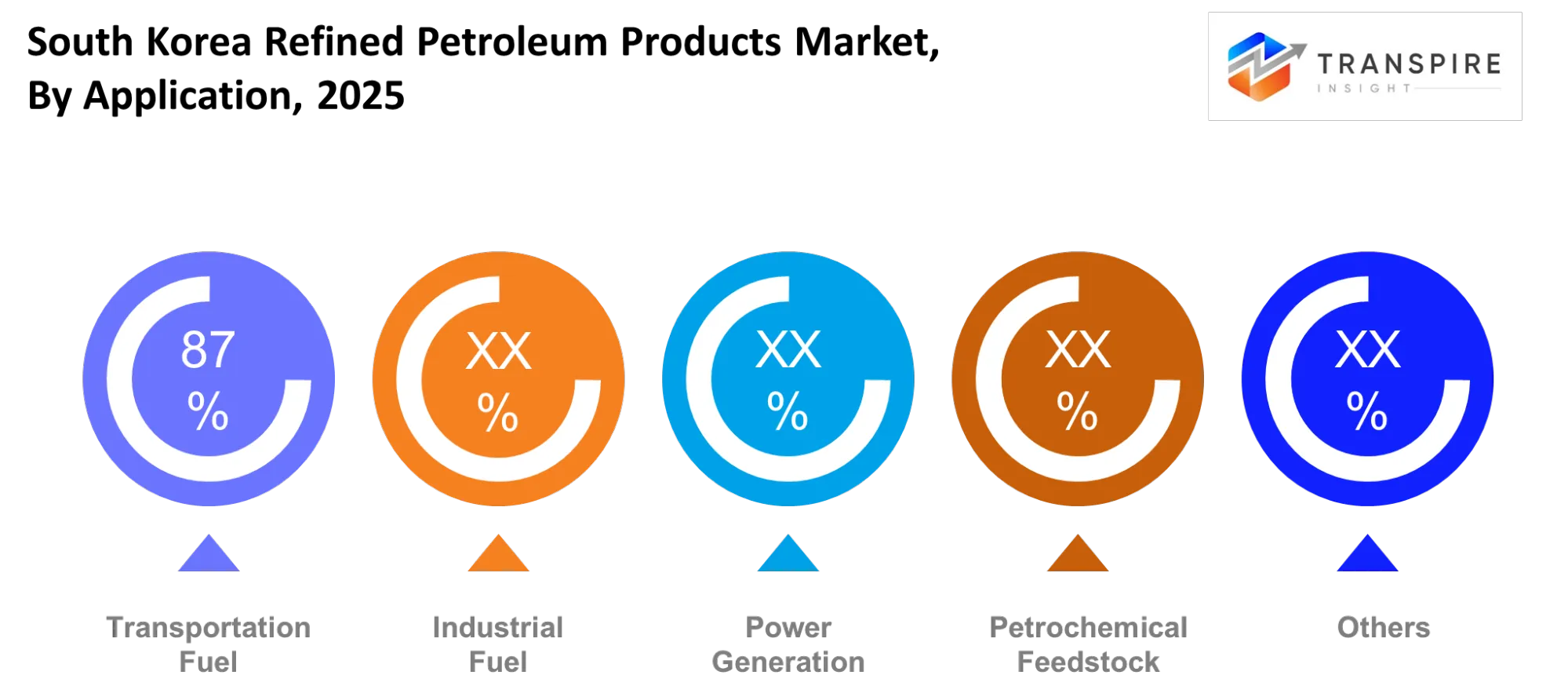
The Transportation Fuel holds the largest share among all other applications as there is an incessant need for fuel in road freight transport, air freight logistics, passenger travel, and maritime freight shipping services in the economy both domestically and as a result of export-oriented economic activity. Commercial trucking fleets, aviation operations, and maritime shipping services maintain considerable volumes of fuel consumption in order to cater to industrial productions and international trade activities. Robust refinery operations and logistics networks make the transportation fuel application the most dominant application across various national energy distribution networks.
Petrochemical Feedstock makes the second largest application as refineries integrate with their chemical processing units. Naphtha and intermediate streams are now converted into petrochemical feedstocks by refiners as a means of generating profits when the margin in transportation fuel applications is weak. Industrial fuel application sees steady demand from the manufacturing industry, steel plants, and heavy industries owing to thermal energy needs. The Power Generation application caters to the generation of electricity during peak demand in industrial areas. Other applications are agricultural and specialty industrial fuels. The petrochemical feedstock application would see the fastest growth in the future.
To learn more about this report, Download Free Sample Report
By Distribution Channel
The Direct Sales segment enjoys dominance because large industrial consumers, airlines, shipping and logistics services tend to engage in long-term fuel procurement deals with refiners and distributors. Bulk purchase arrangement ensures that there is price stability and supply security for high volume commercial consumers working in both transportation and manufacturing industries. Refiners have solid contract arrangements with their industrial consumers and thus minimize the intermediary cost of distribution.
Retail Fuel Stations occupy an important share of the fuel market based on its role in supplying fuels such as gas and diesel to passenger and light commercial transportation means. The high mobility demand and national fueling stations have maintained the revenue stream from the retail channel despite slow but steady penetration of electric cars. Industrial Distribution grew gradually because of increase in demand for fuel by the industrial consumers such as the construction, manufacturing and petrochemical industries, which rely on industrial fueling arrangement. Other channels of fuel sales include marine terminals and commercial distributors.
By End User
The Transportation Industry is regarded as the largest end-user industry as it involves the usage of huge amounts of fuels for freight transportation, mass transit systems, commercial logistics firms, and passenger mobility operations on a daily basis. Export-oriented manufacturing industries and increased trade movements ensure steady fuel consumption in sectors like transport, rail, and logistics operations. High use of diesel-fueled vehicles ensures sustained fuel consumption in the transportation industry.
The Industrial sector ensures significant consumption of fuels for steel manufacturing, petrochemicals, constructions, and heavy industrial facilities. The Aviation Sector registered substantial growth as the recovery of international travel has resulted in improved passenger movement and cargo aircraft operations. The Marine Industry has registered steady growth because of rising use of low-sulfur fuel in the wake of more stringent international maritime fuel emission standards. These include agriculture, military, and institutional fuel users. In the coming years, the aviation and marine sectors are expected to grow at a much faster pace because of changing trade dynamics and environmental fuel standards.
By Refinery Type
Complex refineries have taken over the market as a result of their sophisticated refining processes that enable them to produce premium quality refined fuels, petrochemicals, and low-sulfur fuels. Modern refining companies have begun to invest in hydro-cracking, reforming, and residue upgrading systems to achieve greater fuel production flexibility and increase their margins amid fluctuating crude prices. Competitiveness in export fuel supplies and petrochemical production capabilities are among the reasons behind the market dominance of complex refineries.
Conversion refineries became popular because of the rising need for refined fuels with reduced sulfur levels and increased efficiency. The application of modern conversion techniques improves crude oil efficiency, while at the same time, helps to produce environmentally-friendly fuels that comply with international standards. Hydroskimming refineries continue to enjoy steady demand in fuel refining applications that involve smaller investments compared to other categories of refineries. Specialty refineries and other types of refineries are the remaining categories of refineries. Complex and conversion refineries are expected to see increased investments over the forecast period.
What are the Key Use Cases Driving the South Korea Refined Petroleum Products Market?
The South Korean market for transportation fuels remains the key application in the market of refined petroleum products. Diesel, gasoline, and kerosene provide the foundation for transport logistics, industrial transportation networks, and airline activities. Export-oriented industries require a constant supply of refined fuel in order to ensure manufacturing efficiency and trade effectiveness.
\The use of marine fuels is developing rapidly due to the introduction of low-sulfur marine fuels that are required by international maritime organizations to reduce pollution. The petrochemicals sector is another important application in view of the growing trend among refiners to use naphtha and other intermediate products as feedstock for chemical manufacturing plants.
The use of recycled feedstock and the development of circular petroleum products are some of the emerging application areas. The technology of refining pyrolysis oil and sustainable aviation fuels is gaining popularity.
|
Report Metrics |
Details |
|
Market size value in 2025 |
USD 168.24 Billion |
|
Market size value in 2026 |
USD 175.09 Billion |
|
Revenue forecast in 2033 |
USD 231.48 Billion |
|
Growth rate |
CAGR of4.07% from 2026 to 2033 |
|
Base year |
2025 |
|
Historical data |
2021 - 2024 |
|
Forecast period |
2026 - 2033 |
|
Report coverage |
Revenue forecast, competitive landscape, growth factors, and trends |
|
Regional scope |
South Korea |
|
Key company profiled |
SK Energy, GS Caltex, S-Oil, Hyundai Oilbank, ExxonMobil, Shell, BP, Chevron, TotalEnergies, PetroChina, Sinopec, Indian Oil Corporation, Reliance Industries, Phillips 66, Marathon Petroleum |
|
Customization scope |
Free report customization (country, regional & segment scope). Avail customized purchase options to meet your exact research needs. |
|
Report Segmentation |
By Product Type (Diesel, Gasoline, Jet Fuel, LPG, Fuel Oil, Others); By Application (Transportation Fuel, Industrial Fuel, Power Generation, Petrochemical Feedstock, Others); By Distribution Channel (Direct Sales, Retail Fuel Stations, Industrial Distribution, Others); By End User (Transportation Industry, Industrial Sector, Aviation Sector, Marine Industry, Others); By Refinery Type (Complex Refineries, Hydroskimming Refineries, Conversion Refineries, Others) |
Which Regions are Driving the South Korea Refined Petroleum Products Market Growth?
Asia-Pacific still feels like the dominant region within the refined petroleum products web connected to South Korea, mainly due to strong regional fuel trade flows , high density shipping activity, and sort of integrated industrial supply chains. South Korea gets a real advantage from world scale refining complexes sitting close to major export ports like Ulsan and Yeosu. Meanwhile governments across Northeast Asia keep tightening fuel quality and marine emission standards , and that in turn supports demand for cleaner refined products. Also the region’s manufacturing intensity and very large aviation network help keep demand steady for diesel, jet fuel, and petrochemical feedstocks.
North America comes next as the second-largest regional opportunity , driven by steady jet fuel demand, petrochemical trading links, and long term supply agreements involving Asian refiners. But unlike Asia-Pacific, North America's growth is less about industrial expansion and more about refining reliability and even the product specification quality. South Korean refiners have been leaning into their role as dependable exporters during refinery maintenance windows or when supply disruptions hit Western markets. That pattern produces steadier revenue generation through export diversification rather than relying on rapid consumption growth.
Then there’s the Middle East-linked Asia corridor which is emerging as the fastest growing strategic zone for investment and supply chain repositioning. Recent geopolitical disruptions, along with crude supply risks, have pushed refiners to diversify sourcing strategies and improve regional storage capabilities between 2025 and 2026. After energy security concerns intensified, governments and refiners accelerated investments in strategic reserves, LNG infrastructure, and alternative feedstock procurement. This shift opens long-run opportunities for traders, infrastructure planning, and logistics optimization as companies try to reduce exposure to sudden supply shocks.
Who are the Key Players in the South Korea Refined Petroleum Products Market and How Do They Compete?
Competition in the South Korea refined petroleum products market stays kind of consolidated, mostly because only a handful of large refiners control most of the local refining capacity and export related infrastructure. In practice, rivals tend to compete less on a plain production scale , and more on things like refining efficiency, petrochemical tie-ups, how far exports can reach, and how well they can access advanced upgrading technologies. Lately, market participants seem more intent on margin resilience too, since refining cycles get more erratic from geopolitical disruptions and from fuel demand patterns that keep shifting around.
SK Energy, however , stands out with integrated energy operations. It blends refining, LNG sourcing, petrochemicals, and even battery linked energy investments into one approach. The firm also pushed further into operational optimization and expanded its overseas LNG sourcing ability ,aiming to keep supply steadier and improve profitability even when oil cycles get volatile.
S-Oil competes using refinery petrochemical integration plus heavy upgrading investments. Its Shaheen initiative is meant to support stronger downstream chemical output ,while also lowering reliance on transportation fuel margins as the main profit driver.
GS Caltex puts emphasis on circular petroleum products and advanced recycling technologies. This lets it position itself around feedstock diversification and sustainability linked refining. On the other hand, Hyundai Oilbank continues to expand its industrial fuel supply networks while also working on refining efficiency improvements to protect its domestic commercial market share.
Company List
- SK Energy
- GS Caltex
- S-Oil
- Hyundai Oilbank
- ExxonMobil
- Shell
- BP
- Chevron
- TotalEnergies
- PetroChina
- Sinopec
- Indian Oil Corporation
- Reliance Industries
- Phillips 66
- Marathon Petroleum
Recent Development News
“In May 2026, SK Innovation reported strong Q1 refining earnings driven by higher export margins and operational optimization. The development highlighted how geopolitical oil price volatility strengthened refining profitability across South Korea’s export-focused energy sector. [https://www.gulfoilandgas.com
“In February 2026, SK Group entered a partnership with KKR to establish a renewable energy joint venture. The agreement supports long-term refinery transition strategies and improves capital efficiency across integrated energy operations. [https://www.hankyung.com
“In February 2025, S-Oil advanced construction of its Aramco-funded Shaheen petrochemical project. The investment strengthened South Korea’s refinery-to-petrochemical integration strategy and expanded future high-value chemical output capacity. [https://www.spglobal.com
What Strategic Insights Define the Future of the South Korea Refined Petroleum Products Market?
The South Korea refined petroleum products market is kind of structurally drifting toward integrated energy and petrochemical optimization rather than a simple transportation fuel expansion. Refiners are more and more focusing on high-margin specialty fuels, petrochemical conversion, and export flexibility, because in the long run domestic fuel consumption growth may slow a bit as electrification keeps rolling out across transportation segments. Firms that can blend refining, chemicals, LNG, and recycling technologies, will likely build better margin resilience over the next decade or so.
There is also a hidden risk nobody talks about enough, margin compression from simultaneous petrochemical oversupply and energy transition pressure. Big refining investments can end up generating excess downstream capacity if the regional industrial demand cools down, or if electric vehicle adoption ramps up faster than expected. And at the same time geopolitical supply shocks might keep showing up, continuing to stress refiners with crude sourcing instability.
At the same time, an emerging opportunity is starting to look real in circular petroleum products and sustainable feedstock integration. Investing early in recycled oil processing, sustainable aviation fuel blending, and AI driven refinery optimization might unlock premium export lanes. Market participants should keep flexible refining capability and diversify feedstock sourcing, so they can stay competitive when global energy cycles get even more unstable.
South Korea Refined Petroleum Products Market Report Segmentation
By Product Type
- Diesel
- Gasoline
- Jet Fuel
- LPG
- Fuel Oil
- Others
By Application
- Transportation Fuel
- Industrial Fuel
- Power Generation
- Petrochemical Feedstock
- Others
By Distribution Channel
- Direct Sales
- Retail Fuel Stations
- Industrial Distribution
- Others
By End User
- Transportation Industry
- Industrial Sector
- Aviation Sector
- Marine Industry
- Others
By Refinery Type
- Complex Refineries
- Hydroskimming Refineries
- Conversion Refineries
- Others
Frequently Asked Questions
Find quick answers to common questions.
The estimated South Korea Refined Petroleum Products Market size for the market will be USD 231.48 Billion in 2033.
Key segments for the South Korea Refined Petroleum Products Market are By Product Type (Diesel, Gasoline, Jet Fuel, LPG, Fuel Oil, Others); By Application (Transportation Fuel, Industrial Fuel, Power Generation, Petrochemical Feedstock, Others); By Distribution Channel (Direct Sales, Retail Fuel Stations, Industrial Distribution, Others); By End User (Transportation Industry, Industrial Sector, Aviation Sector, Marine Industry, Others); By Refinery Type (Complex Refineries, Hydroskimming Refineries, Conversion Refineries, Others).
Major South Korea Refined Petroleum Products Market players are SK Energy, GS Caltex, S-Oil, Hyundai Oilbank, ExxonMobil, Shell, BP, Chevron, TotalEnergies, PetroChina, Sinopec, Indian Oil Corporation, Reliance Industries, Phillips 66, Marathon Petroleum.
The South Korea Refined Petroleum Products Market size is USD 168.24 Billion in 2025.
The South Korea Refined Petroleum Products Market CAGR is 4.07% from 2026 to 2033.
- SK Energy
- GS Caltex
- S-Oil
- Hyundai Oilbank
- ExxonMobil
- Shell
- BP
- Chevron
- TotalEnergies
- PetroChina
- Sinopec
- Indian Oil Corporation
- Reliance Industries
- Phillips 66
- Marathon Petroleum
Recently Published Reports
-
Apr 2026
Active Power Filter Market
Active Power Filter Market Size, Share & Analysis Report By Type (Shunt Active Power Filters, Series Active Power Filter, Hybrid Active Power Filter), By Application (Harmonics Mitigation, Reactive Power Compensation, Voltage Regulation, Power Factor Correction), By Phase (Single Phase, Three Phase), By End-User Industry (Manufacturing, Healthcare, Commercial, Automotive, Oil and Gas, Others), and Geography (North America, Europe, Asia-Pacific, Middle East and Africa, South and Central America), 2021 - 2031
-
Apr 2026
Electrical Transformer Market
Electrical Transformer Market Size, Share & Analysis Report By Core (Closed, Shell, and Berry), By Insulation (Gas, Oil, Solid, Air, and Other), By Phase (Single, and Three), By Rating (100 MVA to 500 MVA, 501 MVA to 800 MVA, and 801 MVA to 1200 MVA), and Geography (North America, Europe, Asia-Pacific, Middle East and Africa, South and Central America), 2021 – 2031
-
Apr 2026
Hydraulic Piston Pumps Market
Hydraulic Piston Pumps Market Size, Share & Analysis Report By Type (Axial Piston Pumps, Radial Piston Pumps), By Operating Pressure (Low Pressure, Medium Pressure, High Pressure), By Application (Construction, Mining, Agriculture, Automotive, Oil & Gas, Industrial Machinery, Others), By End-User (OEMs, Aftermarket), and Geography (North America, Europe, Asia-Pacific, Middle East and Africa, South and Central America), 2021 – 2031
-
Apr 2026
Laboratory Gas Generators Market
Laboratory Gas Generators Market Size, Share & Analysis Report By Product (Nitrogen Gas Generator, Hydrogen Gas Generator, Zero Air Gas Generator, Purge Gas Generator, TOC Gas Generators, Others), By Application (Gas Chromatography, Liquid Chromatography-mass Spectrometry (LC-MS), Gas Analyzers, Others), By End-user (Life Science, Chemical & Petrochemical, Food & Beverage, Others), and Geography (North America, Europe, Asia-Pacific, Middle East and Africa, South and Central America), 2021 – 2031