Europe Freight Transport Market Size & Forecast:
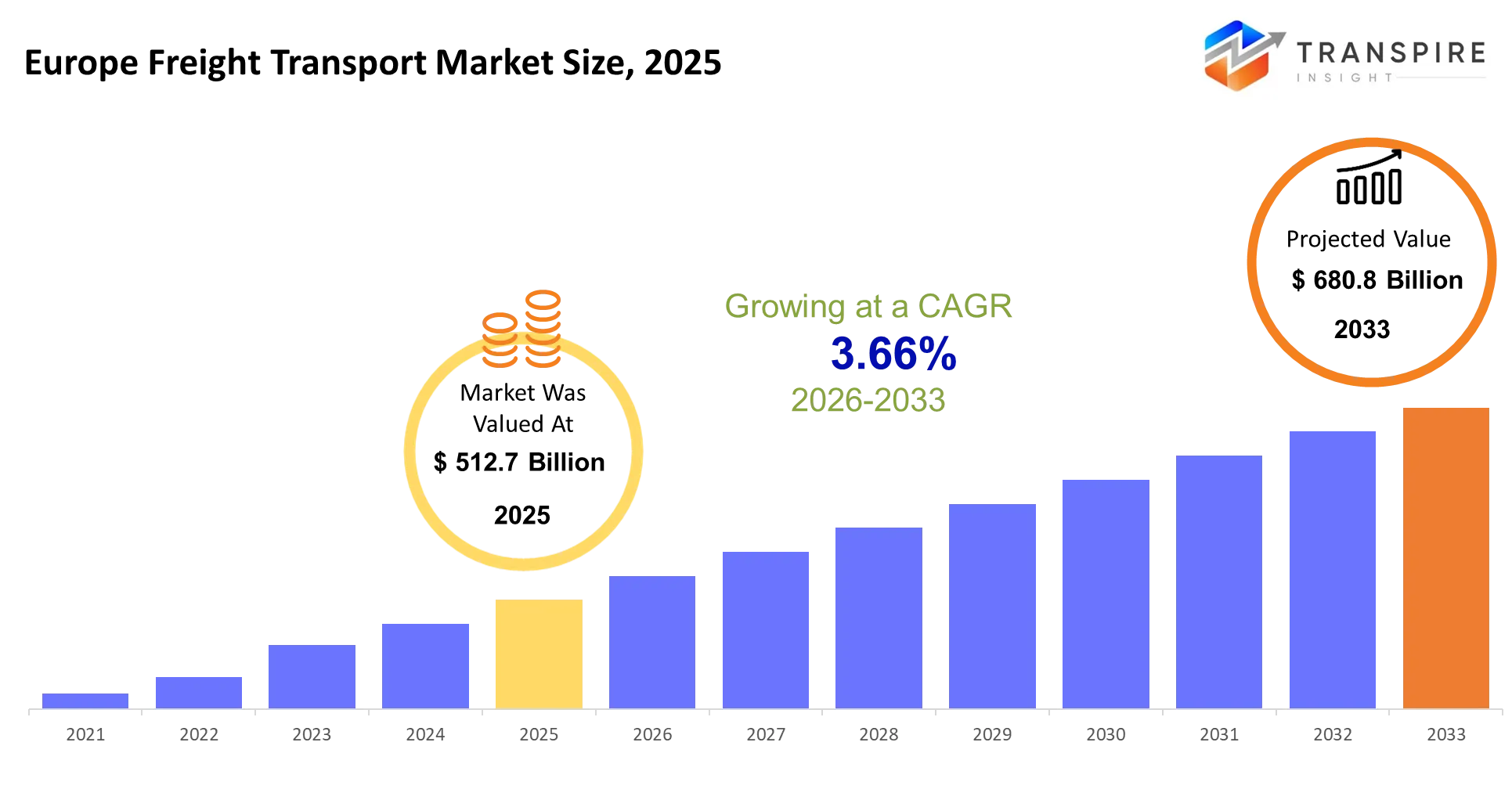
- Europe Freight Transport Market Size 2025: USD 512.7 Billion
- Europe Freight Transport Market Size 2033: USD 680.8 Billion
- Europe Freight Transport Market CAGR: 3.66%
- Europe Freight Transport Market Segments: By Type (Road Transport, Rail Transport, Air Freight, Sea Freight, Others); By Application (Domestic Transport, International Trade, Logistics, Supply Chain, Others); By End-User (Manufacturing, Retail, E-commerce, Automotive, Industrial Sector, Others); By Service (Full Truckload, Less than Truckload, Intermodal, Others)
To learn more about this report,  Download Free Sample Report
Europe Freight Transport Market Summary
The Europe Freight Transport Market was valued at USD 512.7 Billion in 2025. It is forecast to reach USD 680.8 B9 by 2033. That is a CAGR of 3.66% over the period.
The freight transport system of Europe functions through its three main networks which distribute products to manufacturers and retailers and energy providers who need operational supplies. It serves as the main distribution system which connects all European ports and inland terminals and distribution centers.
The sector has experienced a complete structural transformation during the last three to five years because of the growing adoption of intermodal logistics and digital freight management platforms which enhance routing and capacity utilization and emissions tracking capabilities. The Russia-Ukraine conflict disrupted energy corridors which led to rising transport charges and required all main trade routes to be redirected while post-pandemic supply chain problems continued to build up. The operators developed their investment strategies through rail freight and data-driven planning tools which provided them with better protection against fuel price fluctuations and border delay issues.
Shippers create new revenue streams through network redesigns which generate persistent income growth because of their need to enhance operational efficiency in their systems.
Key Market Insights
- Western Europe occupies the leading position in the European Freight Transport Market which will reach its 2025 market share of 38% because of its extensive industrial corridors and developed logistics systems.
- Eastern Europe will experience its most rapid growth during the period from 2025 to 2030 because of increasing cross-border trade and European Union-funded transport improvement initiatives.
- The Europe Freight Transport Market identifies road freight as its primary mode which accounts for approximately 45% of market share because of its ability to deliver goods at their final destination and its ability to meet domestic delivery needs.
- Rail freight operates as the second biggest segment because it gains advantages from decarbonization initiatives and efficient methods of transporting goods over extensive distances.
- The intermodal freight segment will experience its fastest growth between 2025 and 2032 because companies will implement their logistics systems and utilize digital tracking technologies.
- The manufacturing logistics sector controls the market with almost 40% share which demonstrates the European manufacturing industries including automotive and machinery and industrial sectors.
- The retail and e-commerce logistics sector currently experiences the most rapid expansion because of increasing online shopping between countries and rising customer requirements for same-day product delivery.
- Energy and chemical transportation functions as an essential stable-demand market segment within the Europe Freight Transport Market.
- The manufacturing sector stands as the main customer group which requires significant freight services for its operations across European Union supply networks.
- E-commerce businesses constitute the most rapidly expanding customer group which drives increased requirements for flexible and expandable freight transportation services.
What are the Key Drivers, Restraints, and Opportunities in the Europe Freight Transport Market?
The Europe Freight Transport Market is being transformed by three interrelated factors which affect both expense management and operational capacity assessment and their impact on future planning throughout transportation networks.
The main force driving change in the freight industry relies on the adoption of multimodal transportation systems which use environmentally friendly methods for freight delivery. The European Union climate regulations established more stringent requirements for carbon dioxide emissions reporting and vehicle emission limitations which compelled shippers to seek alternatives to their existing single-mode road transportation practice. The industry has responded by implementing rail freight corridors together with digital freight platforms which enhance route selection and load optimization. The Europe Freight Transport Market operators achieve revenue growth by using their operational efficiency improvements to deliver increased asset utilization and premium green logistics services.
The main obstacle prevents people from moving between different countries because it creates a security breach that affects both Western and Eastern European regions. The existence of different rail gauges together with multiple digital customs systems and busy port terminals creates continuous transportation challenges that require extensive time for both financial investments and operational systems shared by different jurisdictions. This structural inefficiency leads to unpredictable delivery times and higher operational expenses which prevent logistics providers from introducing new transportation methods and growing their profit margins.
Digital freight orchestration platforms which use AI and IoT tracking technology create new business opportunities for companies in the logistics industry. Kuehne+Nagel has implemented predictive routing systems across Central European corridors which enable them to manage capacity while decreasing their need for empty return journeys. The Europe Freight Transport Market will achieve a new stage of operational efficiency and complete network optimization through enhanced data sharing between its rail and road and maritime transportation systems.
What Has the Impact of Artificial Intelligence Been on the Europe Freight Transport Market?
The Europe Freight Transport Market experiences transformation through artificial intelligence and advanced digital systems which implement automated systems and intelligent data processing directly into fleet management and cargo operations. AI-enabled scrubber monitoring systems in exhaust gas cleaning technology now track sulfur output and fuel sulfur compliance in real time which leads to decreased need for manual inspection cycles and better accuracy in regulatory reporting for shipping operators. Rail and road freight fleets now adopt similar control systems which enable automated compliance documentation according to EU emissions frameworks.
Predictive maintenance for logistics assets now uses machine learning models which assess vibration and engine temperature and fuel burn patterns to predict component failures before they occur. Predictive algorithms in marine emission control systems enable optimization of fuel blending and route selection which results in a fuel efficiency improvement of 5 to 12 percent for digitally managed fleets while decreasing unplanned downtime.
The technologies function to enhance asset utilization through two methods which involve decreasing empty runs and improving schedule reliability for intermodal freight corridors. The companies experience decreased compliance penalties because they use automated emissions tracking and maintain readiness for real-time audits.
The maritime industry faces challenges with technology deployment because of unstable internet connections which prevent ships from sending data to land-based artificial intelligence systems. The model accuracy suffers from environmental and operational data gaps which occur during long-haul shipping routes when real-time data becomes unavailable. The Europe Freight Transport Market experiences delays in its complete adoption of the new system.
Key Market Trends
- Rail freight adoption increased after 2021 EU carbon targets pushed shippers away from road-heavy logistics networks which they had previously used.
- Intermodal transport usage increased every year because companies started using rail and road and sea routes to decrease their expenses and operational delays starting from 2022.
- The digital freight platforms experienced rapid growth because pandemic disruptions showed that manual scheduling and fragmented carrier coordination systems operated inefficiently.
- The Western European freight networks had to redesign their last-mile operations because e-commerce logistics volumes increased dramatically after 2020.
- The fuel price fluctuations which started in 2022 pushed logistics companies to implement route optimization tools as a means to decrease their expenses during extended trucking operations.
- The period between 2021 and 2023 showed port congestion issues which created new cargo transportation routes toward secondary European ports and inland rail hubs that provided quicker cargo clearance.
- The implementation of EU digital trade reforms led to increased automation of customs documentation processes which resulted in shorter border clearance times for major freight routes.
- Kuehne+Nagel and DB Schenker expanded AI-driven logistics platforms after 2023 to improve predictive routing and capacity utilization efficiency.
- The 2024 sustainability reporting mandates required large freight operators to implement emissions tracking systems in order to comply with new regulations.
- The road freight driver shortages which began in 2020 drove companies to invest in systems for semi-autonomous fleet management and warehouse automation.
Europe Freight Transport Market Segmentation
By Type:
The complete metal structure of the document requires execution through the Internet by submitting it for online processing. The approximate share of freight transported through European highways reaches 40 to 45 percent because of the region's extensive road network and its efficient system for delivering goods to their final destinations. The rule continues to shape business operations because companies today prefer quick delivery and easy access to their products instead of choosing cost-effective solutions for their intermediate shipping requirements. The existing carbon emission regulations have begun to redirect certain long-distance freight operations toward rail transport systems.
The European Union's decarbonization initiatives together with increasing fuel prices create a situation where rail transportation becomes more affordable than long-distance trucking. Northern European port networks depend heavily on sea freight for both bulk and cross-border shipping operations while air freight remains important for transporting high-value shipments that require urgent delivery. The system achieves better operational performance through intermodal integration, which connects all transportation modes.
European cross-border corridors will see an increase in rail and intermodal systems during the forecast period. Logistics providers and fleet operators are likely to invest in hybrid routing strategies that balance cost, speed, and emissions compliance.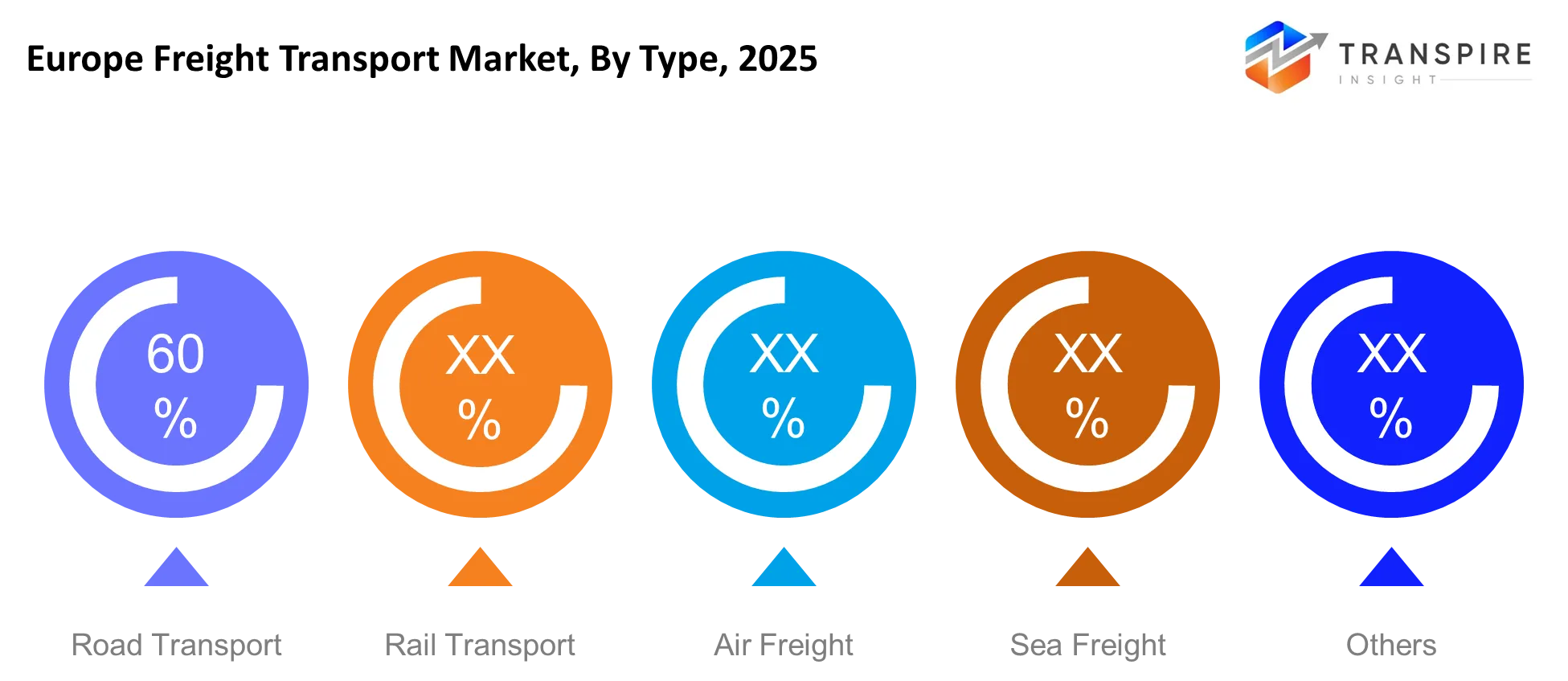
To learn more about this report, Download Free Sample Report
By Application:
The domestic transportation sector currently dominates the market because of its strong support from intra-European trade and its established road and rail connections which link industrial centers. The segment achieves operational benefits through its predictable regulations and its short transit distances which help decrease both operational difficulties and cost fluctuations.
European exporters are implementing new international trade solutions because they need to adapt to changing global supply chains and the emergence of new trade routes which resulted from recent geopolitical events. Companies are transforming their supply chain operations because they need to establish multiple procurement routes which will help them create resilient systems that do not rely on one transportation path.
The upcoming digital development will establish connections between domestic freight systems and international freight systems through digital platforms. Logistics providers and technology companies will develop integrated systems which will connect customs operations with routing management and inventory tracking for different regions.
By End-User:
The manufacturing sector remains the primary user category because it needs uninterrupted access to raw materials and components and finished products which it distributes throughout European industrial zones. The automotive and industrial sectors depend on just-in-time logistics which maintains consistent freight operations through both road and rail systems.
The retail and e-commerce sectors have emerged as rapidly growing user segments because people now prefer online shopping and they expect quick delivery services in urban areas. The industrial sector maintains its demand for energy-related freight and machinery shipments which support production operations.
Freight planning systems will undergo transformation as e-commerce and manufacturing industries continue to merge together. Logistics providers will increasingly prioritize flexible capacity allocation systems and automated warehouse integration to support fluctuating demand patterns.
By Service:
The European freight industry uses full truckload services as its primary method of transportation because they enable high-volume shipments which connect manufacturing hubs and distribution centers. The segment achieves cost savings for major shipping companies through its long-distance transportation efficiency and its ability to minimize freight handling needs.
The demand for less than truckload services continues to increase because small and medium enterprises now require adaptable shipment solutions which enable them to conduct international business operations. Companies are embracing intermodal services because they help lower expenses while enabling compliance with emissions standards for their long-distance shipments.
The future of development will support intermodal transportation and digitally optimized service models which connect road and rail and sea freight operations. The logistics industry and technology developers will focus on creating platform-based systems which enable better load management and decrease the number of empty return trips.
What are the Key Use Cases Driving the Europe Freight Transport Market?
The Europe Freight Transport Market uses Manufacturing and industrial distribution as its primary application because factories need continuous inbound raw materials and they depend on their just-in-time outbound shipment networks. The automotive and machinery production facilities in Germany France and Italy create a stable requirement for both road and rail freight to support their assembly operations.
The e-commerce fulfillment industry and cross-border retail logistics sector are experiencing rapid growth because more people shop online and they expect faster delivery times. Retailers increasingly depend on integrated warehousing and last-mile distribution networks while the chemical and energy sectors utilize dedicated freight services to ensure ongoing supply chain operation throughout European transportation routes.
The development of new applications shows low-emission corridor logistics which follow EU carbon reporting rules because shippers use rail and intermodal routes as their primary transportation method to achieve compliance. Pilot programs are testing autonomous fleet coordination systems and AI load balancing systems which major logistics companies use to handle their high-volume trans-European shipments.
|
Report Metrics |
Details |
|
Market size value in 2025 |
USD 512.7 Billion |
|
Market size value in 2026 |
USD 529.5 Billion |
|
Revenue forecast in 2033 |
USD 680.8 Billion |
|
Growth rate |
CAGR of 3.66% from 2026 to 2033 |
|
Base year |
2025 |
|
Historical data |
2021 - 2024 |
|
Forecast period |
2026 - 2033 |
|
Report coverage |
Revenue forecast, competitive landscape, growth factors, and trends |
|
Regional scope |
Europe (Germany, United Kingdom, France, Italy, Spain, Rest of Europe) |
|
Key company profiled |
DHL, FedEx, UPS, Maersk, DB Schenker, Kuehne+Nagel, DSV, Nippon Express, XPO Logistics, CEVA Logistics, CMA CGM, Hapag-Lloyd, SNCF Logistics, Expeditors, Yusen Logistics |
|
Customization scope |
Free report customization (country, regional & segment scope). Avail customized purchase options to meet your exact research needs. |
|
Report Segmentation |
By Type (Road Transport, Rail Transport, Air Freight, Sea Freight, Others); By Application (Domestic Transport, International Trade, Logistics, Supply Chain, Others); By End-User (Manufacturing, Retail, E-commerce, Automotive, Industrial Sector, Others); By Service (Full Truckload, Less than Truckload, Intermodal, Others) |
Which Regions are Driving the Europe Freight Transport Market Growth?
The Europe Freight Transport Market designates Western Europe as its market leader because of the region's extensive industrial network and its advanced logistical system. The three countries Germany France and the Netherlands maintain their market dominance through their comprehensive road networks and their extensive rail systems and their top-tier ports which include Rotterdam and Hamburg. The European Union has established strict emission and safety standards which require enforcement that drives companies to implement efficient standardized freight systems. The mature logistics ecosystem which includes warehousing centers and intermodal terminals and logistics service providers enables manufacturing companies and export-oriented businesses to maintain constant cargo operations.
Southern Europe establishes an essential and stable market presence which maintains its economic significance while Western European countries operate across different trade patterns and maritime shipping routes. The port-based freight systems in Italy and Spain connect Mediterranean shipping routes with Spain's inland industrial centers. The shipping industry shows consistent freight demand patterns which result from the economic cycles that affect tourism and agriculture and light manufacturing. The regional shipping industry has established strong partnerships with local port authorities which create stable operations that make this area a reliable yet less advanced technology area for global freight operations.
The Eastern European region experiences the fastest growth rate because it builds modern infrastructure and increases its cross-border trade with European Union markets. The European Union's cohesion funding program has financed multiple rail improvements and logistics park developments and highway enhancement projects since 2022, which resulted in greater freight operational effectiveness. Poland, Romania, and the Czech Republic are emerging as strategic transit hubs between Western Europe and Eurasian supply routes.The momentum leads to better business chances for logistics operators and their investors during the period from 2026 to 2033. The intermodal infrastructure and warehousing expansion and digital freight coordination platforms present the most promising business opportunities.
Who are the Key Players in the Europe Freight Transport Market and How Do They Compete?
The European freight transport market has established multiple competing companies which operate at different regional markets and niche segments. The logistics industry features large companies which handle international operations through their extensive networks while smaller businesses provide services for specific regional road freight markets and unique transportation routes. Companies now compete through service delivery dependability which enables customers to track their shipments and meet environmental regulations. Customers increasingly prefer providers that can manage multimodal networks and meet strict EU sustainability reporting requirements.
The Deutsche Post DHL Group uses technology-based logistics systems to develop its business position by connecting road and air and warehouse networks to its advanced tracking system. The company establishes itself as a unique player in contract logistics through its carbon-neutral delivery operations and complete shipment tracking capabilities. DB Schenker operates its Central European rail and road network by using its extensive terminal system to increase operational efficiency for long-distance transportation. The company expands its operations by establishing intermodal capacity partnerships with rail companies.
Kuehne+Nagel develops a competitive edge through its digital freight platforms which enhance transportation efficiency while diminishing empty truck operations throughout sea and ground transport routes. DSV uses acquisitions to speed up its business expansion while building its presence in European markets and enhancing its air and sea transportation services. Maersk combines its ocean transportation services with its inland logistics operations to develop door-to-door delivery solutions which eliminate transfer process delays. The current business strategies lead to heightened competition about network integration operations while decreasing emphasis on conventional pricing methods.
Company List
- DHL
- FedEx
- UPS
- Maersk
- DB Schenker
- Kuehne+Nagel
- DSV
- Nippon Express
- XPO Logistics
- CEVA Logistics
- CMA CGM
- Hapag-Lloyd
- SNCF Logistics
- Expeditors
- Yusen Logistics
Recent Development News
In January 2026, Kuehne+Nagel announced acquisition of LSL-Lohmöller Spedition und Logistik GmbH’s road logistics activities in Germany. The transaction strengthens its European road freight network by expanding groupage, LTL, and FTL capacity. The move enhances operational density in Germany’s industrial corridors and improves cross-border distribution efficiency across Central Europe. https://newsroom.kuehne-nagel.com
In 2024, CMA CGM completed the acquisition of Bolloré Logistics, marking a major diversification into European contract logistics. The integration adds warehousing capacity and strengthens end-to-end maritime-to-inland freight connectivity. This expansion reduces reliance on volatile ocean freight cycles and enhances service bundling across global trade lanes. https://www.lemonde.fr
What Strategic Insights Define the Future of the Europe Freight Transport Market?
The Europe Freight Transport Market develops into a logistics system which uses digital coordination and operates with reduced emissions while multimodal systems become its standard method of operation. EU carbon enforcement combined with increasing fuel price fluctuations and highway system capacity limitations drives freight traffic to use rail-connected routes which operate on data-driven networks. The current shift focuses on changing existing systems from their current state to new efficient systems which operate across multiple national networks.
The member states face hidden dangers because their infrastructure and data systems remain divided, which will impede progress toward full digital interoperability despite increasing investments. The inconsistent adoption of standardized freight data systems creates duplicate operational networks, which will result in higher coordination expenses that will hinder digital freight platforms from expanding their operations.
The development of AI-controlled intermodal freight corridors creates new business opportunities, especially in Central and Eastern Europe, where rail system improvements are occurring at the same time as logistics park development. The companies that enter the market first through their investments in unified digital control towers will gain routing intelligence benefits until common standards reach their complete development.
The market participants need to implement platform-based integration methods which connect all road, rail, and maritime data operations instead of focusing on improving the efficiency of each transportation mode.
Europe Freight Transport Market Report Segmentation
By Type
- Road Transport
- Rail Transport
- Air Freight
- Sea Freight
- Others
By Application
- Domestic Transport
- International Trade
- Logistics
- Supply Chain
- Others
By End-User
- Manufacturing
- Retail
- E-commerce
- Automotive
- Industrial Sector
- Others
By Service
- Full Truckload
- Less than Truckload
- Intermodal
- Others
Frequently Asked Questions
Find quick answers to common questions.
The Europe Freight Transport Market size is USD 680.8 Billion in 2033.
Key segments for the Europe Freight Transport Market are By Type (Road Transport, Rail Transport, Air Freight, Sea Freight, Others); By Application (Domestic Transport, International Trade, Logistics, Supply Chain, Others); By End-User (Manufacturing, Retail, E-commerce, Automotive, Industrial Sector, Others); By Service (Full Truckload, Less than Truckload, Intermodal, Others).
Major Europe Freight Transport Market Players are DHL, FedEx, UPS, Maersk, DB Schenker, Kuehne+Nagel, DSV, Nippon Express, XPO Logistics, CEVA Logistics, CMA CGM, Hapag-Lloyd, SNCF Logistics, Expeditors, Yusen Logistics.
The Current Europe Freight Transport Market size is USD 512.7 Billion in 2025.
The Europe Freight Transport Market CAGR is 3.66% from 2026 to 2033.
- DHL
- FedEx
- UPS
- Maersk
- DB Schenker
- Kuehne+Nagel
- DSV
- Nippon Express
- XPO Logistics
- CEVA Logistics
- CMA CGM
- Hapag-Lloyd
- SNCF Logistics
- Expeditors
- Yusen Logistics
Recently Published Reports
-
Apr 2026
ATV & UTV Market
ATV & UTV Market Size, Share & Analysis Report By Type (ATV, and UTV), By Variants (Less Than 400 CC, 400 CC To 800 CC, and More Than 800 CC), and Geography (North America, Europe, Asia-Pacific, Middle East and Africa, South and Central America), 2021 - 2031
-
Apr 2026
Automotive Central Gateway Module Market
Automotive Central Gateway Module Market Size, Share & Analysis Report By Type (Ethernet Central Gateway Module, CAN Central Gateway Module, LIN Central Gateway Module, and FlexRay), By Application (Powertrain Control, Body Control, Infotainment System, Advanced Driver Assistance Systems (ADAS), and Others), By End User (Passenger Vehicles, and Commercial Vehicles), and Geography (North America, Europe, Asia-Pacific, Middle East and Africa, South and Central America), 2021 - 2031
-
Apr 2026
Automotive Engine Oil Filter Market
Automotive Engine Oil Filter Market Size, Share & Analysis Report By Filter Type (Fuel Filter, Engine Oil Filter, Hydraulic Oil Filter, and Others), By Filter Media (Cellulose, Synthetic, and Micro), By Sales Channel (OEMs, and Aftermarket), By Vehicle Type (Passenger Cars, Light Commercial Vehicles, Heavy Duty Trucks, Buses and Coaches, and Off-road Vehicles), and Geography (North America, Europe, Asia-Pacific, Middle East and Africa, South and Central America), 2021 - 2031
-
Apr 2026
Automotive Parts Aluminium Die Casting Market
Automotive Parts Aluminium Die Casting Market Size, Share & Analysis Report By Production Process (Pressure Die Casting, Vacuum Die Casting, Squeeze Die Casting, Gravity Die Casting), By Application (Body Parts, Engine Parts, Transmission Parts, Battery And Related Components, Other Application Types), and Geography (North America, Europe, Asia-Pacific, Middle East and Africa, South and Central America), 2021 - 2031
Our Clients