
Europe Logistics Robotics Market Size & Forecast:
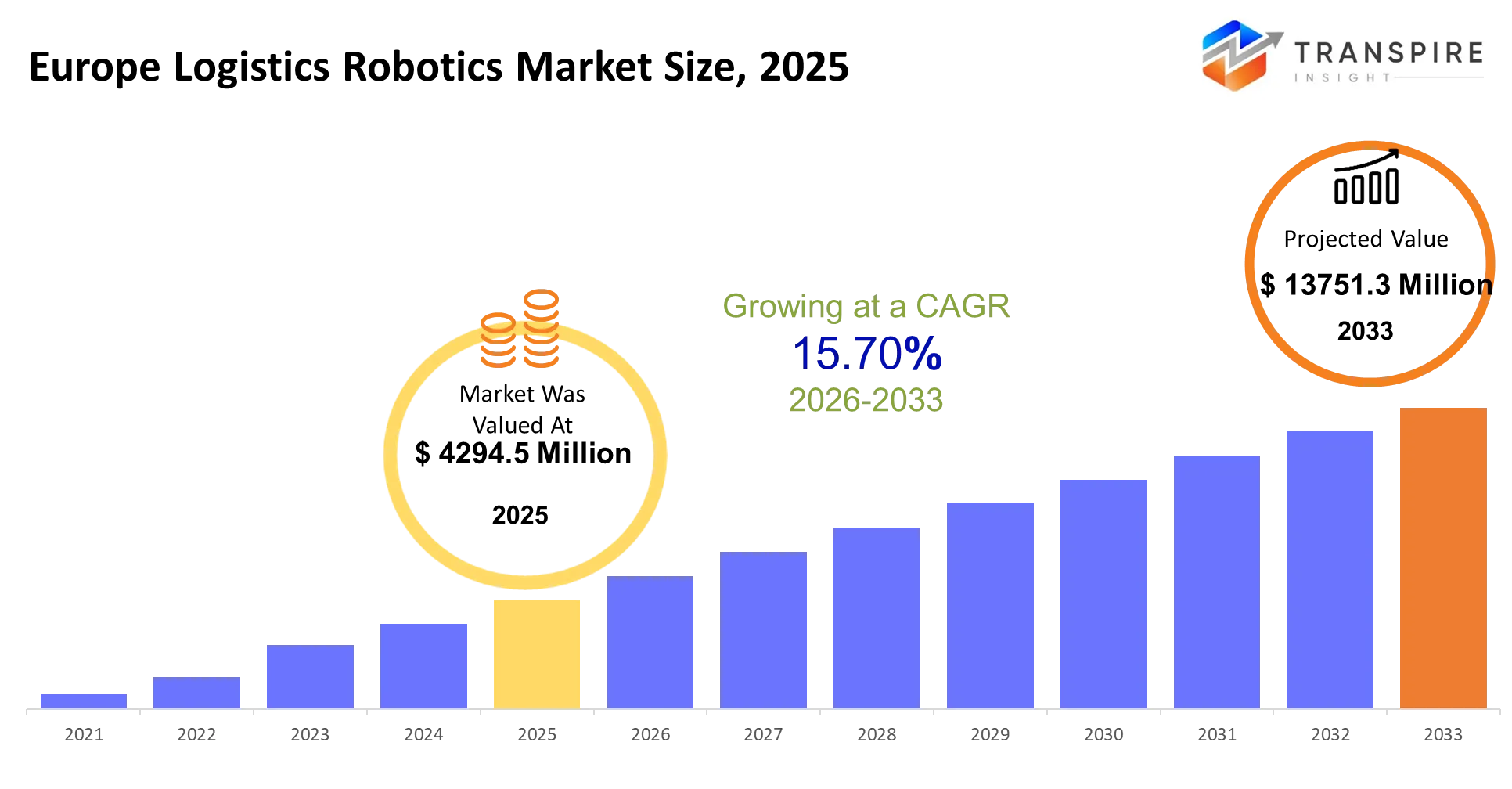
- Europe Logistics Robotics Market Size 2025: USD 4294.5 Million
- Europe Logistics Robotics Market Size 2033: USD 13751.3 Million
- Europe Logistics Robotics Market CAGR: 15.70%
- Europe Logistics Robotics Market Segments: By Type (Autonomous Mobile Robots, Automated Guided Vehicles, Robotic Arms, Others); By Application (Warehousing, Sorting, Picking, Packaging, Transportation, Others); By End-User (E-commerce, Retail, Manufacturing, Logistics Companies, 3PL Providers, Others); By Deployment (On-premise, Cloud, Hybrid, Others)
To learn more about this report,  Download Free Sample Report
Europe Logistics Robotics Market Summary
The Europe Logistics Robotics Market was valued at USD 4294.5 Million 2025. It is forecast to reach USD 13751.3 Million by 2033. That is a CAGR of 15.70% over the period.
The Europe logistics robotics market enables automated movement, sorting, and fulfillment of goods across warehouses, distribution centers, and industrial logistics hubs. The system uses autonomous mobile robots and robotic arms together with AI-powered systems to perform tasks that would require human workers to do manual labor. This solution eliminates operational delays which affect supply chains that handle high volumes of goods because it optimizes the three critical factors that drive service delivery.
In the past three to five years, the market has transitioned from permanent automation systems toward adaptable robotics platforms that use software for their operation. The European supply chain changes after 2022 have led to e-commerce growth becoming the main force that drives this transition because traditional warehouse systems cannot handle modern operational demands. The energy price shock and ongoing shortage of workers drive companies to invest in automation because they need to achieve operational effectiveness while maintaining their expenses.
The adoption process has expanded beyond major organizations because mid-sized logistics companies now use modular robotics systems to compete in the market. The company generates revenue by selling cloud-enabled solutions that allow clients to expand their operations while achieving faster deployment and enhanced monitoring capabilities across multiple logistics locations.
Key Market Insights
- Western Europe controls 42 percent of the European Logistics Robotics Market in 2025 because Germany and Netherlands have strong logistics systems to support their operations.
- The fastest growth in Eastern Europe will occur until 2033 because Poland expands its warehouse operations and Western European companies establish nearshoring facilities.
- Autonomous Mobile Robots lead the product segment with over 45% share, outperforming AGVs because of their ability to operate in different environments without needing fixed station infrastructure.
- Robotic arms represent the second-largest segment, which manufacturers use for exact picking work in the automotive and electronics fields.
- The Europe Logistics Robotics Market shows high demand for warehousing applications because it accounts for 48% market share through its ability to handle complex stock keeping units and the rising demand from e-commerce operations.
- Picking automation has become the most rapidly expanding application because retailers are adopting AI-driven order fulfillment technology in their distribution centers that operate at maximum capacity.
- The e-commerce sector maintains its position as the top end-user market which accounts for 40% of total revenue because customers demand same-day delivery services and return policies that allow product returns.
- The end-user group that requires third-party logistics services currently shows the highest growth rate because European companies increase their logistics outsourcing operations throughout their various supply chain networks.
- Geekplus speeds up AMR implementation in e-commerce warehouses while its partnerships with integrators help the company establish a stronger presence throughout Europe.
- Companies now achieve competitive advantage through their ability to manage software systems which allow them to deploy their operations quickly across various logistics networks that use different vendor systems.
What are the Key Drivers, Restraints, and Opportunities in the Europe Logistics Robotics Market?
The Europe logistics robotics market depends on two main factors which are ongoing workforce shortages and increased operational requirements of e-commerce. The situation became more severe after 2023 because wage increases for warehouse workers in Germany and France and the UK created longer hiring processes. The operators started using autonomous mobile robots with integrated warehouse systems which decrease their need for human workers who handle product selection and organization tasks. The system requires more spending on robotic systems while it boosts operational productivity which establishes automation as a fundamental business requirement.
The most significant restraint is integration complexity within fragmented legacy warehouse environments across Europe. Many distribution centers still rely on outdated warehouse management systems that are not natively compatible with modern robotics platforms. The process requires businesses to spend large amounts of money for system changes which result in extended periods until they reach return on investment. The mid-sized companies in this market tend to delay their complete automation which results in lost business opportunities for robotics companies despite existing market demand.
A key opportunity exists in Southern and Eastern Europe, especially Poland and Italy, because brownfield warehouses are rapidly adopting retrofit automation. Global retailers are investing in these regions to set up fulfillment centers that will operate nearer to their service areas. Modular robotics platforms enable businesses to implement their systems through incremental steps because they do not require complete infrastructure changes, which results in faster adoption and expanded access to a previously unserved market.
What Has the Impact of Artificial Intelligence Been on the Europe Logistics Robotics Market?
European logistics organizations are beginning to use artificial intelligence technology through their implementation of warehouse automation systems which manage their autonomous mobile robots and robotic arms and automated guided vehicles. The AI-based control systems enable distribution centers to achieve better fleet performance through their ability to distribute work tasks throughout the day while minimizing downtime for operations. The advanced facilities use machine vision systems to conduct automated inspections and monitoring of industrial floor scrubber robots which maintain warehouse operations through their use of scheduled cleaning cycles and safety standard procedures.
Predictive models are now widely applied to maintenance scheduling, where machine learning analyzes vibration, battery health, and motor performance data to prevent unplanned downtime. The systems help to increase machinery availability while they decrease repair expenses by moving from emergency maintenance to maintenance based on equipment condition. AI-based optimization software helps electric robotics fleets to accurately forecast their energy needs which enables businesses to achieve their sustainability targets and operational cost savings in large-scale logistics operations.
High-volume warehouses achieve better operational results through their ability to create orders more quickly and their increased accuracy in product selection and their ability to decrease operational delays. The implementation of AI systems with existing warehouse systems in European logistics centers that use older technology remains expensive because of the high costs associated with full system integration. The restricted availability of standardized training data across multiple warehouse environments hinders model performance when different facility layouts and operational conditions need to be tested.
Key Market Trends
- The European warehousing industry started to use autonomous mobile robots instead of fixed conveyor systems which allowed them to operate more flexibly in high-SKU product fulfillment centers since 2024.
- The cloud-enabled robotics platforms became more popular among retailers and third-party logistics providers during 2025 because they allowed companies to manage their delivery vehicles across different countries in their logistics operations.
- The automotive and electronics assembly lines in manufacturing facilities adopted robotic arms as their primary handling equipment for intralogistics operations after 2024.
- The distribution centers in Germany and France for e-commerce companies started using AI-based robotic picking systems because they wanted to decrease their dependence on traditional manual picking methods.
- The cold chain logistics companies used robots to automate temperature-sensitive processes which handle pharmaceutical and food products, which helped them meet EU regulations for product handling.
- The partnership between warehouse management software and robotic systems experienced rapid growth during 2025 because businesses needed complete digital management solutions that covered their operational procedures from start to finish.
- The logistics hubs in Eastern Europe started using more robotic systems after 2025 because of both nearshoring practices and the European Union's financial support for warehouse infrastructure development.
- The market between vendors became more competitive because new companies like Geekplus and Sereact started to challenge established firms such as Swisslog and ABB through their quick implementation methods.
- The year 2026 saw companies implement hybrid deployment models which allowed them to manage their operations through on-site systems while accessing their cloud-based analytics for European logistics management across multiple locations.
Europe Logistics Robotics Market Segmentation
By Type:
The European logistics robotics market recognizes Autonomous Mobile Robots as its leading technology because these robots can operate in various warehouse environments while being deployed. E-commerce and retail operators exhibit strong system adoption because they require flexible systems which can operate without permanent infrastructure modifications. Automated Guided Vehicles operate continuously in manufacturing facilities and distribution centers because their systems use defined paths to achieve operational efficiency. The market share of robotic arms and specialized systems remains small yet they deliver essential functions which require precise outcomes that must be achieved repeatedly.
The demand for warehouse management system-compatible modular automation solutions drives the market growth of Autonomous Mobile Robots. Operators prefer flexible fleet systems because they need to respond to increasing labor shortages and shortened order fulfillment times. The use of Automated Guided Vehicles continues to expand throughout the automotive and heavy manufacturing sectors although fixed-path logistics systems remain the primary method of operation. Robotic arms are increasingly used in hybrid picking environments which require both human and machine collaboration.
The development of software orchestration systems will enable Autonomous Mobile Robots to enhance their fleet coordination capabilities while improving their ability to work with other systems. Automated Guided Vehicles will maintain their usefulness in industrial settings but their primary function will shift to specific applications which require high production capacity. Robotic arms will evolve through AI-enabled vision systems that improve picking accuracy. Equipment providers will establish modular system designs that enable them to implement their solutions in various warehouse environments.
By Application:
The utilization of warehousing systems stands as the primary use case for European logistics robotics which receives backing from the operational needs of high-density fulfillment centers that serve both retail and e-commerce industries. The second most important system after warehousing exists to support cross-border logistics operations which require fast parcel movement through their processing centers. The packaging operations throughout our facilities provide essential support to our main automated system but function as a secondary activity.
European markets for consumer products experience rising growth in picking and sorting operations because businesses now need to handle a bigger number of stock-keeping units while delivering products more quickly. The warehousing industry in various locations operates automated systems because businesses want to make their storage spaces more efficient through better use of their costly distribution paths. The use of transportation robotics systems develops in a steady manner as distribution centers handle their internal material distribution needs. Packaging automation benefits from sustainability regulations that encourage standardized and reduced material use.
The future of warehousing automation will progress toward smart fulfillment centers that use complete robotic systems to operate their entire warehouse operations. The sorting systems of tomorrow will depend more on artificial intelligence-based systems which will enhance their ability to process items through better throughput management. Vision-guided robotics will become more popular in picking operations that handle multiple product categories. Application integration , which provides complete system solutions, will become the primary focus for technology providers instead of selling individual products.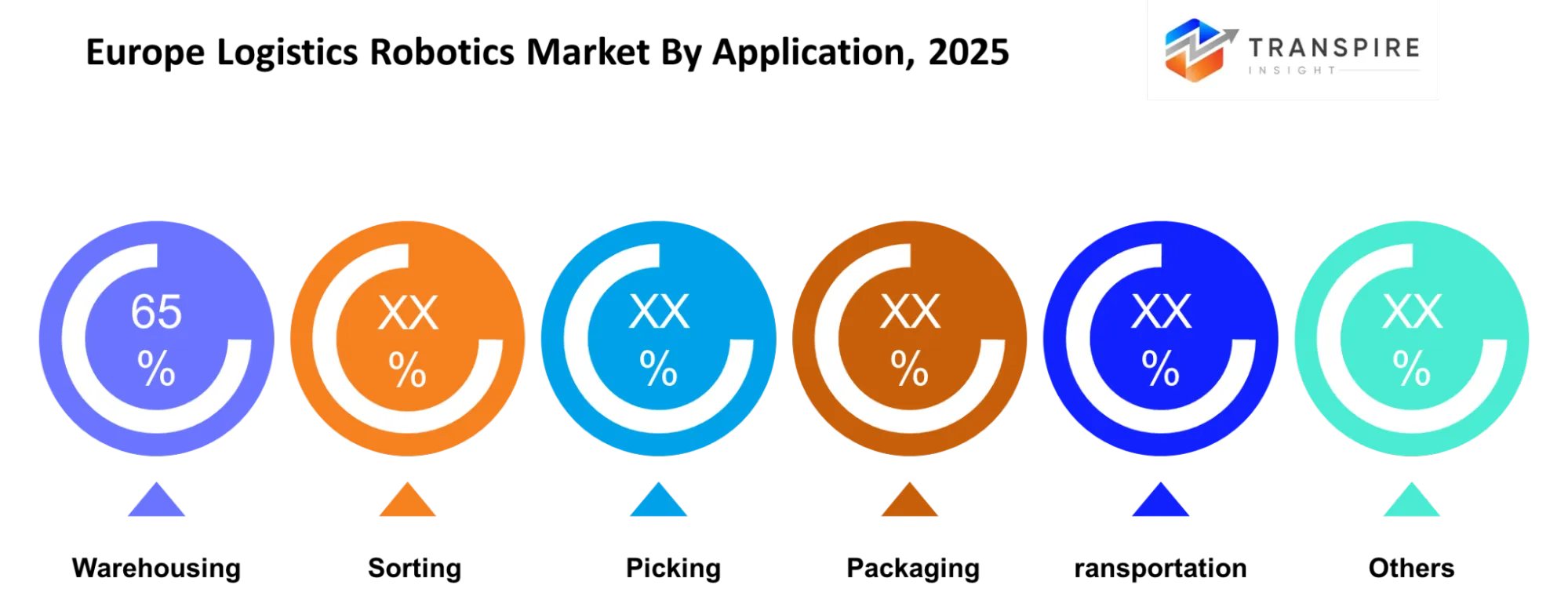
To learn more about this report, Download Free Sample Report
By End-User:
The primary end-user segment for e-commerce exists because European customers place high order volumes while demanding next-day delivery service. The retail industry needs automated fulfillment systems to implement omnichannel storefront operations. Businesses in manufacturing use robotics technology to enhance their internal logistics operations especially in automotive and electronics manufacturing facilities. The logistics industry and third-party logistics providers are using robotics technology to enhance their ability to deliver services to multiple customers.
The combination of e-commerce growth and 3PL provider expansion results from businesses needing flexible automation solutions to handle their unpredictable demand patterns. Retail adoption increases due to store-to-warehouse integration models that require real-time inventory movement. Manufacturing companies maintain consistent production output because they use organized production systems. Logistics providers use robotics technology to create unique service options that separate their business from rivals in the contracted market.
E-commerce will maintain its role as the main driver of demand because digital retail continues to expand. The 3PL industry will develop into primary centers for automation systems that multiple clients use. Manufacturing will adopt hybrid robotics models that integrate both mobile and fixed robotic systems. The investors will select platforms which enable organizations to operate across various industry sectors.
By Deployment:
The European logistics robotics sector functions through on-premise systems because organizations need to maintain data control while they connect to their existing warehouse technology. Operators are expanding their use of cloud-based systems because they require centralized fleet management together with predictive analytics solutions. Enterprises which operate multiple sites through different levels of automation power their operations through hybrid models which serve as better than complete automated systems. Other deployment types remain limited to niche or experimental implementations.
Growth in cloud and hybrid deployment is driven by the need for real-time optimization across distributed logistics networks. On-premise systems persist in regulated industries such as pharmaceuticals and defense logistics where data security is critical. Hybrid models gain traction in large retail and logistics networks that require both local control and centralized oversight. Cloud adoption also increases with improvements in edge computing reliability.
Cloud-based robotics platforms will expand as AI-driven orchestration becomes central to warehouse efficiency. Hybrid systems will become the standard for multi-site operators balancing control and scalability. The adoption of on-premise deployments will continue within high-security areas but their market share will decrease. Technology providers will increasingly design deployment-agnostic solutions to capture broader enterprise demand.
What are the Key Use Cases Driving the Europe Logistics Robotics Market?
The main application of order fulfillment between e-commerce and retail distribution shows dominance because European warehouses face challenges with complex stock-keeping units and customers require rapid delivery times and the industry encounters persistent shortages of warehouse workers. Robotics systems optimize the processes of picking and sorting and packing which leads to faster operational cycles and increased productivity in high-volume fulfillment centers.
The use cases of cold chain logistics and manufacturing intralogistics have expanded particularly within the pharmaceutical and automotive and food and beverage industries. The sectors demonstrate their dependence on robotics through their need for temperature-controlled handling and precision part movement and just-in-time production support which requires consistent operations and complete tracking.
The emerging applications of returns processing and micro-fulfillment in urban logistics are starting to gain popularity. Retailers use reverse logistics automation to control their increasing e-commerce returns while compact robotic systems support last-mile delivery operations in crowded urban areas. The upcoming use cases will grow in size because urban delivery regulations will become more strict while delivery speed requirements will become more demanding.
|
Report Metrics |
Details |
|
Market size value in 2025 |
USD 4294.5 Million |
|
Market size value in 2026 |
USD 4955.9 Million |
|
Revenue forecast in 2033 |
USD 13751.3 Million |
|
Growth rate |
CAGR of 15.70% from 2026 to 2033 |
|
Base year |
2025 |
|
Historical data |
2021 - 2024 |
|
Forecast period |
2026 - 2033 |
|
Report coverage |
Revenue forecast, competitive landscape, growth factors, and trends |
|
Regional scope |
Europe (Germany, United Kingdom, France, Italy, Spain, Rest of Europe) |
|
Key company profiled |
Amazon Robotics, ABB, KUKA, FANUC, Yaskawa, Dematic, Daifuku, SSI Schaefer, Vanderlande, Honeywell, Knapp, Murata, Geek+, GreyOrange, Locus Robotics |
|
Customization scope |
Free report customization (country, regional & segment scope). Avail customized purchase options to meet your exact research needs. |
|
Report Segmentation |
By Type (Autonomous Mobile Robots, Automated Guided Vehicles, Robotic Arms, Others); By Application (Warehousing, Sorting, Picking, Packaging, Transportation, Others); By End-User (E-commerce, Retail, Manufacturing, Logistics Companies, 3PL Providers, Others); By Deployment (On-premise, Cloud, Hybrid, Others) |
Which Regions are Driving the Europe Logistics Robotics Market Growth?
The three countries of Germany the Netherlands and France together with other Western European nations control the European logistics robotics market. The region operates advanced port facilities which include Rotterdam and Hamburg that manage heavy shipping traffic through their automated freight handling systems. The increasing need to meet labor productivity standards together with environmental regulations has pushed e-commerce and manufacturing supply chains to implement warehouse automation technology. The established network of system integrators and robotics vendors together with logistics companies creates a framework which enables organizations to adopt advanced robotics solutions at large scale operations.
The northern part of Europe together with the southern regions of the United Kingdom exhibits stable economic growth patterns instead of showing rapid development. The retail networks of Sweden Denmark and the United Kingdom together with their digital logistics plans are responsible for the continuous warehouse automation investments which these countries make. Infrastructure congestion does not affect this region's growth because distribution systems undergo continuous improvement through modernization efforts. The combination of stable regulations and high costs for labor will lead to a slow but continuous process of robotics implementation in both fulfillment centers and cold chain logistics operations.
The eastern European region experiences its fastest growth rate because Western Europe increasingly moves its manufacturing and logistics operations to nearby locations. The warehouse construction industry in Poland Romania and the Czech Republic sees rapid growth because EU funding supports the development of cross-border e-commerce operations between these countries. Global retailers now expand their fulfillment center operations to develop large-scale facilities which help them save costs while being located close to European demand centers.The current momentum creates excellent business prospects for robotics vendors and their investors because these investors will gain from 2026 to 2033 through automation systems which can be built at a lower cost and which can serve increasing market demands.
Who are the Key Players in the Europe Logistics Robotics Market and How Do They Compete?
The logistics robotics market in Europe displays a moderate level of market fragmentation which currently shows a trend toward consolidation through platform-based ecosystem development. The battle between industrial leaders ABB and KUKA against agile AMR companies and warehouse automation startups defines the current competitive landscape. Today companies compete based on their software orchestration abilities and system integration skills and their ability to deliver actual throughput improvements in real-world warehouse operations. Vendors that can unify fleets, data, and warehouse control systems gain advantage as operators prioritize ROI certainty.
Exotec establishes its unique market position through its Skypod system which uses mobile robots to create vertical storage solutions that enhance space efficiency in high-density warehouse environments. The company develops its business through partnerships with integrators between Europe and North America while pursuing scalable deployment solutions. AutoStore competes through its cube storage automation system which operates under a partner ecosystem that allows for efficient high-density fulfillment using minimal energy and works with multiple system interfaces.
Ocado Technology builds its complete grocery automation system through CFC systems which combine robotics with proprietary software to create integrated systems which expand through retailer partnerships. Geekplus enables e-commerce companies to build AMR fleets through its fast deployment method and its software-based coordination system which operates in multiple European locations. Swisslog which operates under KUKA develops enterprise warehouse modernization solutions through its robotics systems that work together with warehouse management systems to operate in large logistics facilities.
Company List
- Amazon Robotics
- ABB
- KUKA
- FANUC
- Yaskawa
- Dematic
- Daifuku
- SSI Schaefer
- Vanderlande
- Honeywell
- Knapp
- Murata
- Geek+
- GreyOrange
- Locus Robotics
Recent Development News
In April 2026, KUKA AG announced acquisition of a European warehouse automation startup to expand its logistics robotics portfolio. The deal strengthens KUKA’s position in autonomous intralogistics systems across e-commerce fulfillment centers. https://www.kuka.com
"In March 2026, Dematic (a subsidiary of KION Group) acquired a robotics software firm specializing in AI-driven picking solutions. The acquisition enhances Dematic’s intelligent automation capabilities for high-throughput warehouses. https://www.dematic.com
What Strategic Insights Define the Future of the Europe Logistics Robotics Market?
The Europe logistics robotics market is moving away from its current state of implementing separate automation systems to establish complete warehouse systems controlled by artificial intelligence. The upcoming five to seven years will see market expansion through integrated autonomous systems which companies will select because they need systems that function with multiple systems and can handle real-time supply chain management. The supply chain for essential semiconductor and sensor components faces hidden dangers since its current weaknesses will limit the ability to expand operations despite high demand. The Southern and Eastern European market for retrofit automation systems presents an unrecognized opportunity because mid-sized operators in this region begin their journey toward automated operations. The modular software-based robotics systems which market participants should use will allow them to build their systems gradually throughout existing facilities which will result in faster returns on investment while protecting their operations from market changes and future energy expenses in European Union countries.
Europe Logistics Robotics Market Report Segmentation
By Type
- Autonomous Mobile Robots
- Automated Guided Vehicles
- Robotic Arms
- Others
By Application
- Warehousing
- Sorting, Picking
- Packaging
- Transportation
- Others
By End-User
- E-commerce
- Retail
- Manufacturing
- Logistics Companies
- 3PL Providers
- Others
By Deployment
- On-premise
- Cloud
- Hybrid
- Others
Frequently Asked Questions
Find quick answers to common questions.
The Europe Logistics Robotics Market size is USD 13751.3 Million in 2033.
Key segments for the Europe Logistics Robotics Market are By Type (Autonomous Mobile Robots, Automated Guided Vehicles, Robotic Arms, Others); By Application (Warehousing, Sorting, Picking, Packaging, Transportation, Others); By End-User (E-commerce, Retail, Manufacturing, Logistics Companies, 3PL Providers, Others); By Deployment (On-premise, Cloud, Hybrid, Others).
Major Europe Logistics Robotics Market players are Amazon Robotics, ABB, KUKA, FANUC, Yaskawa, Dematic, Daifuku, SSI Schaefer, Vanderlande, Honeywell, Knapp, Murata, Geek+, GreyOrange, Locus Robotics.
The Europe Logistics Robotics Market size is USD 4294.5 Million in 2025.
The Europe Logistics Robotics Market CAGR is 15.70% from 2026 to 2033.
- Amazon Robotics
- ABB
- KUKA
- FANUC
- Yaskawa
- Dematic
- Daifuku
- SSI Schaefer
- Vanderlande
- Honeywell
- Knapp
- Murata
- Geek+
- GreyOrange
- Locus Robotics
Recently Published Reports
-
Apr 2026
ATV & UTV Market
ATV & UTV Market Size, Share & Analysis Report By Type (ATV, and UTV), By Variants (Less Than 400 CC, 400 CC To 800 CC, and More Than 800 CC), and Geography (North America, Europe, Asia-Pacific, Middle East and Africa, South and Central America), 2021 - 2031
-
Apr 2026
Automotive Central Gateway Module Market
Automotive Central Gateway Module Market Size, Share & Analysis Report By Type (Ethernet Central Gateway Module, CAN Central Gateway Module, LIN Central Gateway Module, and FlexRay), By Application (Powertrain Control, Body Control, Infotainment System, Advanced Driver Assistance Systems (ADAS), and Others), By End User (Passenger Vehicles, and Commercial Vehicles), and Geography (North America, Europe, Asia-Pacific, Middle East and Africa, South and Central America), 2021 - 2031
-
Apr 2026
Automotive Engine Oil Filter Market
Automotive Engine Oil Filter Market Size, Share & Analysis Report By Filter Type (Fuel Filter, Engine Oil Filter, Hydraulic Oil Filter, and Others), By Filter Media (Cellulose, Synthetic, and Micro), By Sales Channel (OEMs, and Aftermarket), By Vehicle Type (Passenger Cars, Light Commercial Vehicles, Heavy Duty Trucks, Buses and Coaches, and Off-road Vehicles), and Geography (North America, Europe, Asia-Pacific, Middle East and Africa, South and Central America), 2021 - 2031
-
Apr 2026
Automotive Parts Aluminium Die Casting Market
Automotive Parts Aluminium Die Casting Market Size, Share & Analysis Report By Production Process (Pressure Die Casting, Vacuum Die Casting, Squeeze Die Casting, Gravity Die Casting), By Application (Body Parts, Engine Parts, Transmission Parts, Battery And Related Components, Other Application Types), and Geography (North America, Europe, Asia-Pacific, Middle East and Africa, South and Central America), 2021 - 2031
Our Clients