Europe Automotive Disc Brake Market Size & Forecast:
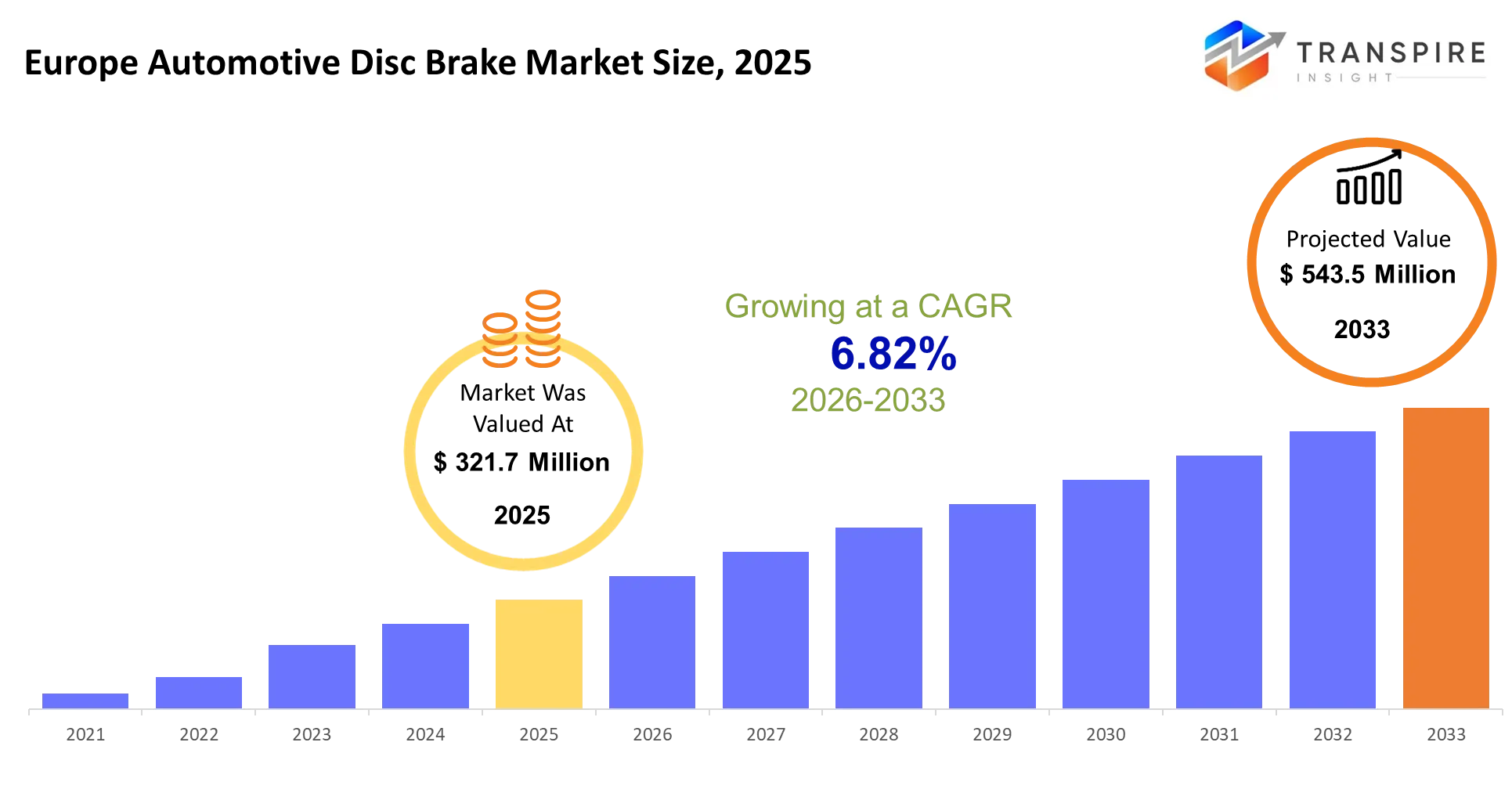
- Europe Automotive Disc Brake Market Size 2025: USD 321.7 Million
- Europe Automotive Disc Brake Market Size 2033: USD 543.5 Million
- Europe Automotive Disc Brake Market CAGR: 6.82%
- Europe Automotive Disc Brake Market Segments: By Type (Single Disc Brakes, Dual Disc Brakes, Ventilated Disc Brakes, Others), By Application (Passenger Vehicles, Commercial Vehicles, Electric Vehicles, Performance Vehicles, Others), By End-User (OEMs, Aftermarket, Automotive Manufacturers, Fleet Operators, Others), By Material (Cast Iron, Carbon Ceramic, Steel, Others).
To learn more about this report,  Download Free Sample Report
Europe Automotive Disc Brake Market Summary:
The Europe Automotive Disc Brake Market size is estimated at USD 321.7 Million in 2025 and is anticipated to reach USD 543.5 Million by 2033, growing at a CAGR of 6.82% from 2026 to 2033. Automotive disc brakes in Europe transform kinetic energy into stopping force which determines vehicle safety and handling abilities and thermal performance when vehicles operate in actual driving situations. They solve a practical problem: maintaining consistent braking efficiency across varying speeds, loads, and weather, especially as vehicles become heavier and faster.
The market has undergone structural changes during the last three to five years which favor electrified and lightweight platform development. Electric vehicles require braking systems which resist corrosion and produce low noise while supporting regenerative braking to decrease standard wear patterns. The EU emissions and particulate regulations required stricter controls which included brake dust monitoring, thus prompting OEMs to develop advanced materials and coated discs.
This combination has changed revenue dynamics. Suppliers no longer sell basic components because they provide high-margin engineered systems. The first OEMs who develop electric vehicle braking systems will establish new technical standards which will lead to extended replacement cycles and increased product value.
Key Market Insights
- Western Europe dominates the Europe Automotive Disc Brake Market, holding over 55% share in 2025 because there exists strong OEM presence together with multiple EV production centers.
- Central and Eastern Europe is the fastest-growing region, expected to expand at over 6% CAGR through 2030, because manufacturing operations are moving to cheaper locations which provide cost savings.
- The market share of ventilated disc brakes reaches nearly 60% in 2025 because they provide better heat dissipation for high-performance and electric vehicles.
- Solid disc brakes maintain their position as the second largest segment which manufacturers use for entry-level and compact vehicles throughout Europe.
- Carbon-ceramic disc brakes establish themselves as the fastest-growing segment which will experience expansion between 2025 and 2030 because premium vehicle demand and durability benefits drive market growth.
- Passenger vehicles represent more than 70% of total demand in the Europe Automotive Disc Brake Market because people own more vehicles and electric vehicles become more popular.
- Electric vehicles serve as the fastest-expanding application segment which develops quickly because manufacturers need regenerative braking systems and corrosion-resistant components.
- OEMs control about 65% of the market in 2025 because automakers implement new braking technologies into their upcoming vehicle designs.
- The aftermarket segment experiences stable growth because vehicles now last longer which creates a need to replace valuable disc parts.
What are the Key Drivers, Restraints, and Opportunities in the Europe Automotive Disc Brake Market?
The main element driving the European automotive disc brake market forward exists because vehicle platforms undergo electric system upgrades which electric vehicle platforms must implement to meet European Union CO2 emission standards and Euro 7 particulate matter control requirements established between 2020 and 2024. The regulations required original equipment manufacturers to develop new braking systems which would reduce brake wear particulate matter emissions while their systems would work properly with regenerative braking technology. The market now requires suppliers to create electric vehicle compatible products which include coated discs and lightweight composite materials and low-corrosion components. The shift results in higher system value because original equipment manufacturers now select durable products which enhance performance instead of making cost-based decisions. The result shows revenue growth which technology upgrades bring instead of depending on vehicle output.
The advanced braking materials which include carbon-ceramic and coated discs create a major structural obstacle because they need high expenses and complicated manufacturing methods. The technologies require special manufacturing methods, they depend on a small number of suppliers, and they need manufacturers to spend large amounts of money before they can start production. The limitation requires a long time to solve because production expansion needs multiple years for process improvements and supplier approval. The current situation results in adoption being restricted to premium products and electric vehicles which prevents mass-market cars from entering the market and reduces potential revenue during the upcoming period.
Brake-by-wire systems which connect to vehicle electrification systems present a significant opportunity for business expansion. European OEMs and Tier 1 suppliers currently invest in complete electronic brake control systems which have developed increased interest across Germany and Nordic countries. The systems simplify mechanical structures and enhance response accuracy and they permit performance enhancement through software updates. The development of EV platforms will enable brake-by-wire systems to create new revenue opportunities through their software capabilities and distinct operational features.
What Has the Impact of Artificial Intelligence Been on the Europe Automotive Disc Brake Market?
Artificial intelligence has become essential for braking system development and production and operational control throughout European countries. The AI-based quality inspection systems in production environments use computer vision technology to identify micro-defects present in brake discs and pads which results in decreased rejection rates while maintaining consistent product output. Machine learning models on the vehicle side assess braking behavior and temperature fluctuations and wear rate data to support predictive maintenance operations. This system enables fleet managers to conduct preemptive component replacements which results in greater operational availability and decreased expenses for equipment maintenance.
AI enables better performance optimization through its ability to change braking force distribution between different components while working together with regenerative systems which leads to higher energy recovery rates in electric vehicles. Initial implementations demonstrate that optimized braking procedures can enhance both component durability and decrease particulate matter emissions.
The main obstacle to progress lies in combining AI technology with existing vehicle systems and uncoordinated data management systems. The absence of unified data systems in numerous vehicles prevents learning to occur in real time while driving multiple different scenarios which leads to decreased model performance. The organization faces delayed massive implementation because the advantages of operations remain obvious to observe.
Key Market Trends
- The EU particulate emission regulations which began in 2020 have compelled OEMs to switch to coated brake discs because this change minimizes brake wear emissions and drives suppliers to develop new materials.
- The European electric vehicle market reached a 20% share by 2024 which required manufacturers to create new braking systems that would resist corrosion and produce less noise during operation.
- Brembo S.p.A. and Robert Bosch GmbH which are major industry players have increased their research and development budgets for lightweight and coated disc technologies since 2021.
- Brake-by-wire systems have progressed from their initial concept stage to operational use because they now enable software-based braking methods which decrease dependency on conventional hydraulic systems.
- Supply chains moved to Eastern Europe between 2021 and 2024 because OEMs required budget-friendly solutions which protected their business operations from pandemic disruptions.
- After 2022 customers began using carbon-ceramic brakes in premium electric vehicles because they needed parts that could handle severe operating conditions and heavy vehicle weights.
- The aftermarket industry experienced changes because EV regenerative braking systems decreased wear rates which resulted in longer replacement intervals and higher sales of premium long-lasting parts.
- Since 2023 tier 1 suppliers have established partnerships with electric vehicle startups to create complete braking systems which they design specifically for electric vehicle applications.
- The implementation of digital manufacturing technologies experienced rapid growth after 2021 because artificial intelligence inspection systems enabled European plants to achieve higher defect detection efficiency while decreasing their manufacturing waste.
Europe Automotive Disc Brake Market Segmentation
By Type
The most effective braking system for high-speed driving and heavy vehicle operation uses ventilated disc brakes because they dissipate heat better than other systems. The thermal management needs of electric vehicles and passenger cars make ventilated braking systems essential for maintaining their braking performance. Entry-level vehicles use solid disc brakes because price constraints determine which products customers will buy.
Compact vehicles use single disc systems as their primary brake configuration while performance applications require dual disc brake systems. This market segment will develop linked electric vehicle technology and increased vehicle weight requirements which need improved thermal control solutions. Manufacturers will develop advanced ventilated systems with coating technologies while consumers choose products that provide both long-lasting performance and reduced operational sound.
By Application
The primary application of passenger vehicles exists because European markets have high vehicle ownership and manufacturers establish ongoing vehicle model updates throughout the continent. The electric vehicle market segment grows at its fastest rate because of the introduction of braking systems that combine with regenerative braking technology and their impact on reducing mechanical damage. The market for commercial vehicles shows constant growth because of logistical industry development and the implementation of new safety regulations.
The market for performance vehicles exists at a lower volume yet drives innovation because customers demand advanced braking technology. The different applications develop their own unique adoption processes which depend on how users utilize the product and the existing regulations and their price limits. The development process for future projects will focus on electric and hybrid platforms because they need braking systems that deliver both operational efficiency and protection, which will require suppliers to develop products that work in all driving situations.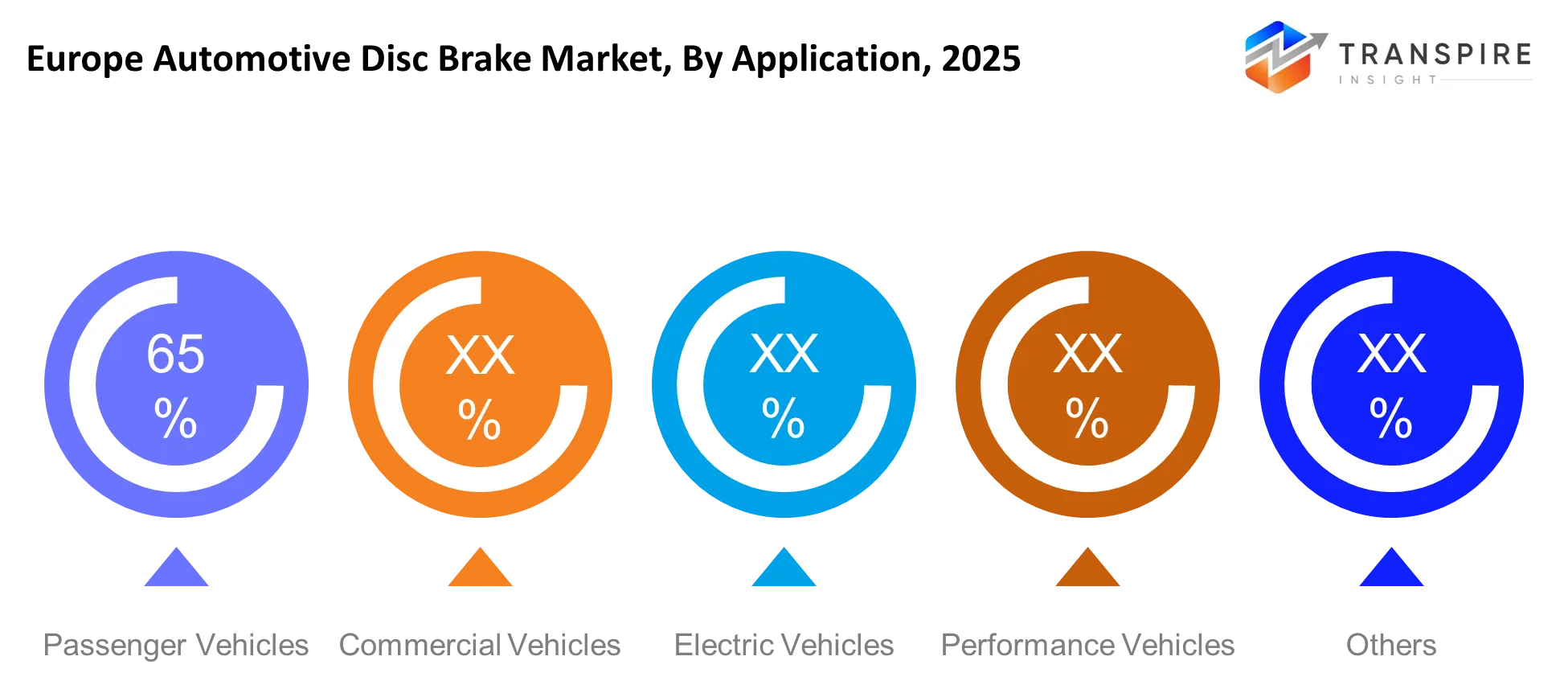
To learn more about this report, Download Free Sample Report
By End-User
The primary market demand for disc brake systems comes from original equipment manufacturers because they produce new vehicles for end-user customers. Automotive manufacturers integrate braking technologies early in the design phase to meet regulatory and performance benchmarks. The aftermarket segment maintains its growth because vehicle fleets require replacement parts while vehicle lifespans have extended through electric vehicle technology.
Fleet operators represent a growing segment as logistics and mobility services scale operations and seek predictive maintenance solutions. Each group exhibits different purchasing behavior because OEMs prioritize integration and innovation while aftermarket buyers value cost and reliability. The segment will advance toward maintenance practices based on data analytics and the use of more valuable replacement parts.
By Material
Cast iron remains the primary material choice because it provides both manufacturing ease and cheaper costs and has existing supply networks throughout Europe. Carbon ceramic materials occupy a premium position because they provide superior durability and heat resistance which benefits high-performance vehicles and luxury vehicles. Steel and other composite materials serve niche applications where weight reduction or corrosion resistance is critical.
The selection of materials requires organizations to balance their expenses with performance needs and compliance with regulatory requirements because brake dust emissions have become a significant concern. The manufacturing industry will adopt coated cast iron and hybrid material solutions because they enable organizations to meet environmental standards while they achieve cost-effective production capabilities for their products.
What are the Key Use Cases Driving the Europe Automotive Disc Brake Market?
Automakers use disc brake systems in their main production vehicles to achieve safety requirements and emission standards. The need for constant braking performance in city driving conditions creates a continuous requirement for this technology.
The two markets for bus and truck fleets together with electric vehicle charging networks show growing potential. The logistics industry needs robust braking solutions that withstand extreme operation conditions, while electric vehicle manufacturers use corrosion-proof brake discs to solve problems with decreased braking power during vehicle downtime.
The three startup companies work on developing brake-by-wire technology to be used in new electric vehicle systems and self-driving cars. The current systems depend on software-based brake control, which works together with built-in sensors to provide data for mobility programs in Western European cities.
|
Report Metrics |
Details |
|
Market size value in 2025 |
USD 321.7 Million |
|
Market size value in 2026 |
USD 342.5 Million |
|
Revenue forecast in 2033 |
USD 543.5 Million |
|
Growth rate |
CAGR of 6.82% from 2026 to 2033 |
|
Base year |
2025 |
|
Historical data |
2021 - 2024 |
|
Forecast period |
2026 - 2033 |
|
Report coverage |
Revenue forecast, competitive landscape, growth factors, and trends |
|
Regional scope |
Europe (Germany, United Kingdom, France, Italy, Spain and Rest of Europe) |
|
Key company profiled |
Brembo, Bosch, Continental, ZF Friedrichshafen, Aisin, Akebono, Mando, Nissin Kogyo, TRW Automotive, Hitachi Automotive, Delphi, Valeo, SKF, Knorr-Bremse, ADVICS |
|
Customization scope |
Free report customization (country, regional & segment scope). Avail customized purchase options to meet your exact research needs. |
|
Report Segmentation |
By Type (Single Disc Brakes, Dual Disc Brakes, Ventilated Disc Brakes, Others), By Application (Passenger Vehicles, Commercial Vehicles, Electric Vehicles, Performance Vehicles, Others), By End-User (OEMs, Aftermarket, Automotive Manufacturers, Fleet Operators, Others), By Material (Cast Iron, Carbon Ceramic, Steel, Others) |
Which Regions are Driving the Europe Automotive Disc Brake Market Growth?
The market in Western Europe operates with Germany France and Italy as its core countries which implement strict EU safety regulations and particulate regulations to determine their braking system design and implementation. The strong presence of original equipment manufacturers including Continental AG and Brembo S.p.A. enables the industry to develop new products while producing high quantities of goods. The advanced manufacturing systems and extensive supplier relationships of the company allow it to quickly implement new coated discs and electric vehicle braking solutions. The present system enables the area to sustain its technological supremacy while acquiring the maximum proportion of specialized building components.
Southern Europe plays a different role because both Spain and Italy maintain their vehicle production capacity while domestic and export markets continue to demand vehicles. The region maintains its industrial base through economical manufacturing practices and its original equipment manufacturers establish their operational schedule through consistent manufacturing equipment investments. The suppliers in this region focus on creating efficient systems which can expand their operations to serve customers in the mid-range and entry-level vehicle markets. Southern Europe develops into a dependable market which helps drive total industry revenue because economic strength and increasing regulatory compliance create market demand stability.
Central and Eastern Europe has become the fastest expanding area in the world because industrial operations shifted and supply chains transformed since 2021. The automotive manufacturing sector and component production sector in Poland Hungary and the Czech Republic serve as new investment destinations. Companies have increased their manufacturing facilities and market entry because they can access EU markets at lower labor expenses. The period between 2026 and 2033 will create new market possibilities for investors because brake system production centers will establish their presence.
Who are the Key Players in the Europe Automotive Disc Brake Market and How Do They Compete?
The Europe automotive disc brake market shows its competitive landscape through two main elements. Incumbents defend share through deep OEM relationships and integrated system capabilities that extend beyond price competition. The competition now centers on technology innovations which include coated discs and lightweight materials and EV-compatible braking architectures. New entrants face high barriers because they must meet certification standards and complete extended validation processes and work closely with automakers during platform development.
Robert Bosch GmbH focuses on system-level integration which combines braking hardware with electronic control units to enable brake-by-wire and advanced driver assistance systems. Continental AG differentiates itself by using software-based braking solutions which enhance electric vehicle response time and energy recovery capabilities. Brembo S.p.A. uses its proprietary coatings and carbon-ceramic expertise to deliver high-performance products for premium market segments which provide long-lasting durability and lower particulate emissions.
ZF Friedrichshafen AG develops its business through modular braking platforms which connect to safety systems and chassis solutions to help automakers create efficient vehicle designs. Aisin Corporation uses its affordable production methods and strong relationships with international OEMs to increase manufacturing capacity throughout Europe. These companies develop their market presence through partnerships with electric vehicle manufacturers and their expansion of regional production facilities and ongoing research in material science and digital braking solutions.
Company List
- Brembo
- Bosch
- Continental
- ZF Friedrichshafen
- Aisin
- Akebono
- Mando
- Nissin Kogyo
- TRW Automotive
- Hitachi Automotive
- Delphi
- Valeo
- SKF
- Knorr-Bremse
- ADVICS
Recent Development News
In April 2026, AUMOVIO sells German brake caliper plant to Falkensteg-backed RHB-Industries: AUMOVIO has agreed to divest its Rheinböllen, Germany facility, which produces disc brake calipers and electric parking brake systems. The deal transfers around 320 employees and strengthens consolidation in European brake manufacturing.
Source: https://thebrakereport.com
In September 2025, the Brembo SGL joint venture boosts high-performance disc brake output in Germany & Italy: Brembo SGL Carbon Ceramic Brakes increased production capacity in Italy and Germany by 50% to meet rising demand from European luxury automakers. The expansion supports carbon-ceramic disc brake systems used in high-performance and premium vehicles.
Source: https://www.reuters.com
What Strategic Insights Define the Future of the Europe Automotive Disc Brake Market?
The Europe automotive disc brake market is moving toward software-defined, low-emission braking architectures integrated with electrified platforms. The value of Euro 7 particulate rules and EV design priorities has shifted from mechanical components to coated materials and sensors and control software. The revenue distribution for the next 5 to 7 years will focus on systems that integrate wear and noise and energy recovery functions instead of existing hardware solutions.
Companies face a hidden danger because of their risk of losing existing technologies to new ones. The increased efficiency of regenerative braking systems reduces the need for friction brakes in urban driving situations which results in decreased aftermarket demand and shifts future revenue sources even when vehicle production remains stable.
The development of intelligent brake monitoring systems presents new possibilities which use built-in sensors and predictive analytics to support fleet operators and shared mobility service providers. The systems enable businesses to establish continuous income streams through their data service offerings.
The immediate recommendation requires companies to start investing in brake-by-wire systems and sensor-based platforms while establishing partnerships with EV manufacturers to secure future contract agreements.
Europe Automotive Disc Brake Market Report Segmentation
By Type
- Single Disc Brakes
- Dual Disc Brakes
- Ventilated Disc Brakes
- Others
By Application
- Passenger Vehicles
- Commercial Vehicles
- Electric Vehicles
- Performance Vehicles
- Others
By End-User
- OEMs
- Aftermarket
- Automotive Manufacturers
- Fleet Operators
- Others
By Material
- Cast Iron
- Carbon Ceramic
- Steel
- Others
Frequently Asked Questions
Find quick answers to common questions.
The Approximate Europe Automotive Disc Brake Market size for the Market will be USD 543.5 Million in 2033.
The key Segments of the Europe Automotive Disc Brake Market are By Type (Single Disc Brakes, Dual Disc Brakes, Ventilated Disc Brakes, Others), By Application (Passenger Vehicles, Commercial Vehicles, Electric Vehicles, Performance Vehicles, Others), By End-User (OEMs, Aftermarket, Automotive Manufacturers, Fleet Operators, Others), By Material (Cast Iron, Carbon Ceramic, Steel, Others).
Major Players in the Europe Automotive Disc Brake Market are Brembo, Bosch, Continental, ZF Friedrichshafen, Aisin, Akebono, Mando, Nissin Kogyo, TRW Automotive, Hitachi Automotive, Delphi, Valeo, SKF, Knorr-Bremse, ADVICS.
The Current Market size of the Europe Automotive Disc Brake Market is USD 321.7 Million in 2025.
The Europe Automotive Disc Brake Market CAGR is 6.82%.
- Brembo
- Bosch
- Continental
- ZF Friedrichshafen
- Aisin
- Akebono
- Mando
- Nissin Kogyo
- TRW Automotive
- Hitachi Automotive
- Delphi
- Valeo
- SKF
- Knorr-Bremse
- ADVICS
Recently Published Reports
-
Apr 2026
ATV & UTV Market
ATV & UTV Market Size, Share & Analysis Report By Type (ATV, and UTV), By Variants (Less Than 400 CC, 400 CC To 800 CC, and More Than 800 CC), and Geography (North America, Europe, Asia-Pacific, Middle East and Africa, South and Central America), 2021 - 2031
-
Apr 2026
Automotive Central Gateway Module Market
Automotive Central Gateway Module Market Size, Share & Analysis Report By Type (Ethernet Central Gateway Module, CAN Central Gateway Module, LIN Central Gateway Module, and FlexRay), By Application (Powertrain Control, Body Control, Infotainment System, Advanced Driver Assistance Systems (ADAS), and Others), By End User (Passenger Vehicles, and Commercial Vehicles), and Geography (North America, Europe, Asia-Pacific, Middle East and Africa, South and Central America), 2021 - 2031
-
Apr 2026
Automotive Engine Oil Filter Market
Automotive Engine Oil Filter Market Size, Share & Analysis Report By Filter Type (Fuel Filter, Engine Oil Filter, Hydraulic Oil Filter, and Others), By Filter Media (Cellulose, Synthetic, and Micro), By Sales Channel (OEMs, and Aftermarket), By Vehicle Type (Passenger Cars, Light Commercial Vehicles, Heavy Duty Trucks, Buses and Coaches, and Off-road Vehicles), and Geography (North America, Europe, Asia-Pacific, Middle East and Africa, South and Central America), 2021 - 2031
-
Apr 2026
Automotive Parts Aluminium Die Casting Market
Automotive Parts Aluminium Die Casting Market Size, Share & Analysis Report By Production Process (Pressure Die Casting, Vacuum Die Casting, Squeeze Die Casting, Gravity Die Casting), By Application (Body Parts, Engine Parts, Transmission Parts, Battery And Related Components, Other Application Types), and Geography (North America, Europe, Asia-Pacific, Middle East and Africa, South and Central America), 2021 - 2031
Our Clients