
Middle East and Africa Fuels Lubes and Petrochemicals Market Size & Forecast:
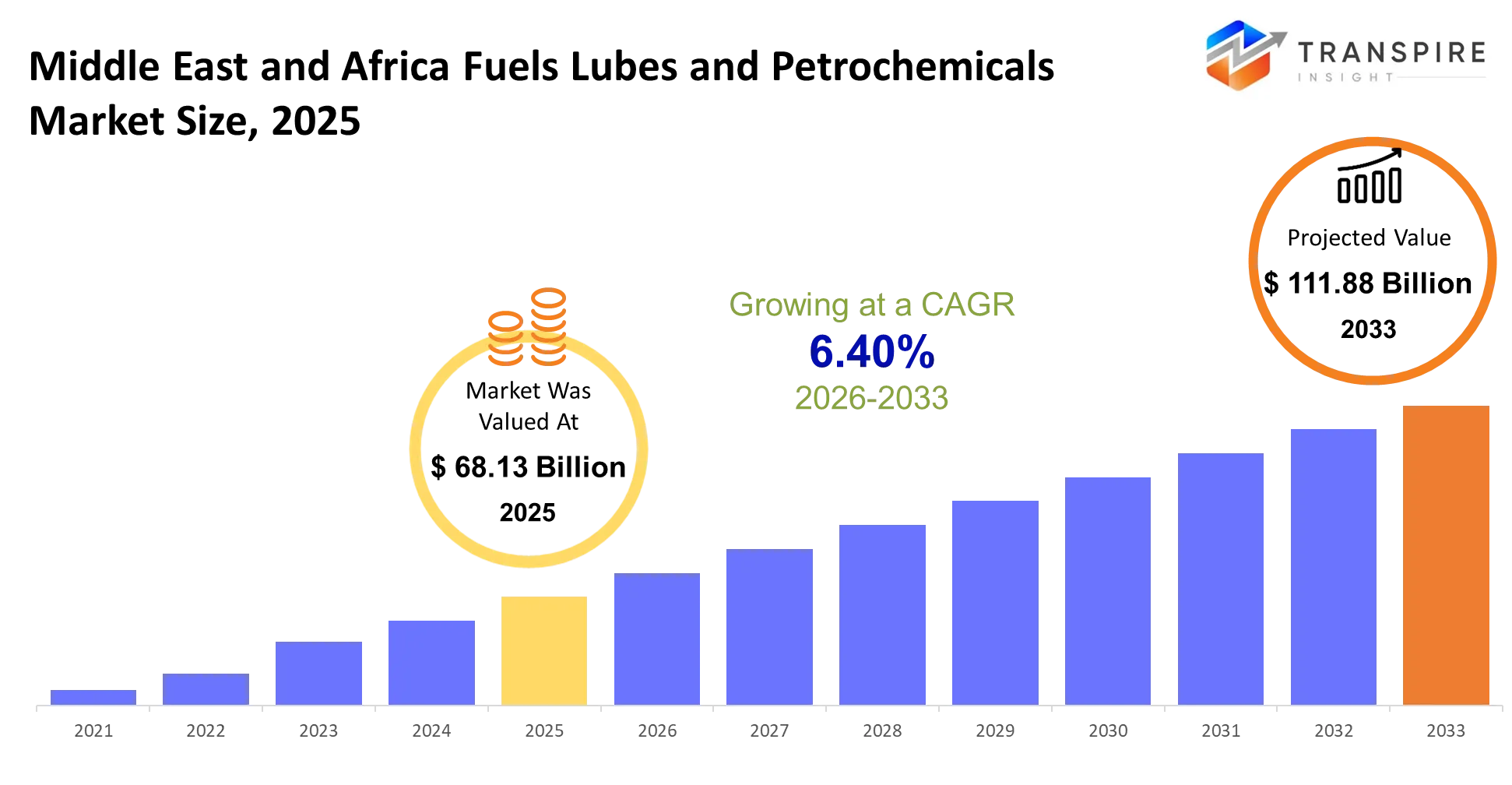
- Middle East and Africa Fuels Lubes and Petrochemicals Market Size 2025: USD 68.13 Billion
- Middle East and Africa Fuels Lubes and Petrochemicals Market Size 2033: USD 111.88 Billion
- Middle East and Africa Fuels Lubes and Petrochemicals Market CAGR: 6.40%
- Middle East and Africa Fuels Lubes and Petrochemicals Market Segments: By Type (Fuels, Lubricants, Petrochemicals, Specialty Chemicals, Refinery Products, Others); By Application (Transportation, Industrial Use, Power Generation, Chemicals Production, Manufacturing, Others); By End-User (Oil & Gas Companies, Industrial Firms, Automotive Sector, Power Utilities, Chemical Industry, Others); By Product (Diesel, Petrol, Engine Oils, Polymers, Greases, Others)
To learn more about this report,  Download Free Sample Report
Middle East and Africa Fuels Lubes and Petrochemicals Market Summary
The Middle East and Africa Fuels Lubes and Petrochemicals Market was valued at USD 68.13 Billion in 2025. It is forecast to reach USD 111.88 Billion by 2033. That is a CAGR of 6.40% over the period.
The Middle East and Africa fuels, lubes, and petrochemicals market keeps ports, refineries, mining operations, power plants, and industrial fleets going without pause, kind of straight through. It provides marine fuels that helps move cargo across strategic shipping corridors , plus lubricants that guard heavy equipment during rough working conditions. It also delivers petrochemical feedstocks for packaging, building, and manufacturing. In the last five years , the whole market has started sliding toward cleaner marine fuels and more advanced lubricants , since operators are reacting to stricter emissions rules and longer equipment life expectations. The rollout of the International Maritime Organization sulfur cap sped up refinery modernization and it really shifted bunker fuel demand at big regional ports. Meanwhile supply disruptions tied to the Russia-Ukraine War tweaked global trade patterns and pricing frameworks. Because of that, companies are pushing investment into refining capacity, storage infrastructure, and specialty lubricant product lines, and this is building better margins for suppliers that can promise fuel availability , regulatory compliance, and day-to-day operational efficiency.
Key Market Insights
- Saudi Arabia, kind of dominated the Middle East and Africa Fuels Lubes and Petrochemicals market , holding roughly 32% market share in 2025 , mostly because of its big scale refining capacity.
- The United Arab Emirates still acts as a key petrochemical hub, pushed by downstream diversification programs and export-driven production facilities.
- South Africa looks like the fastest-growing regional market across 2025–2030, supported by fuel needs from industry plus the mining sector is expanding too, not small.
- Meanwhile, many emerging African economies are quietly increasing lubricant consumption , helped by more vehicle ownership and infrastructure development investments going on at the same time.
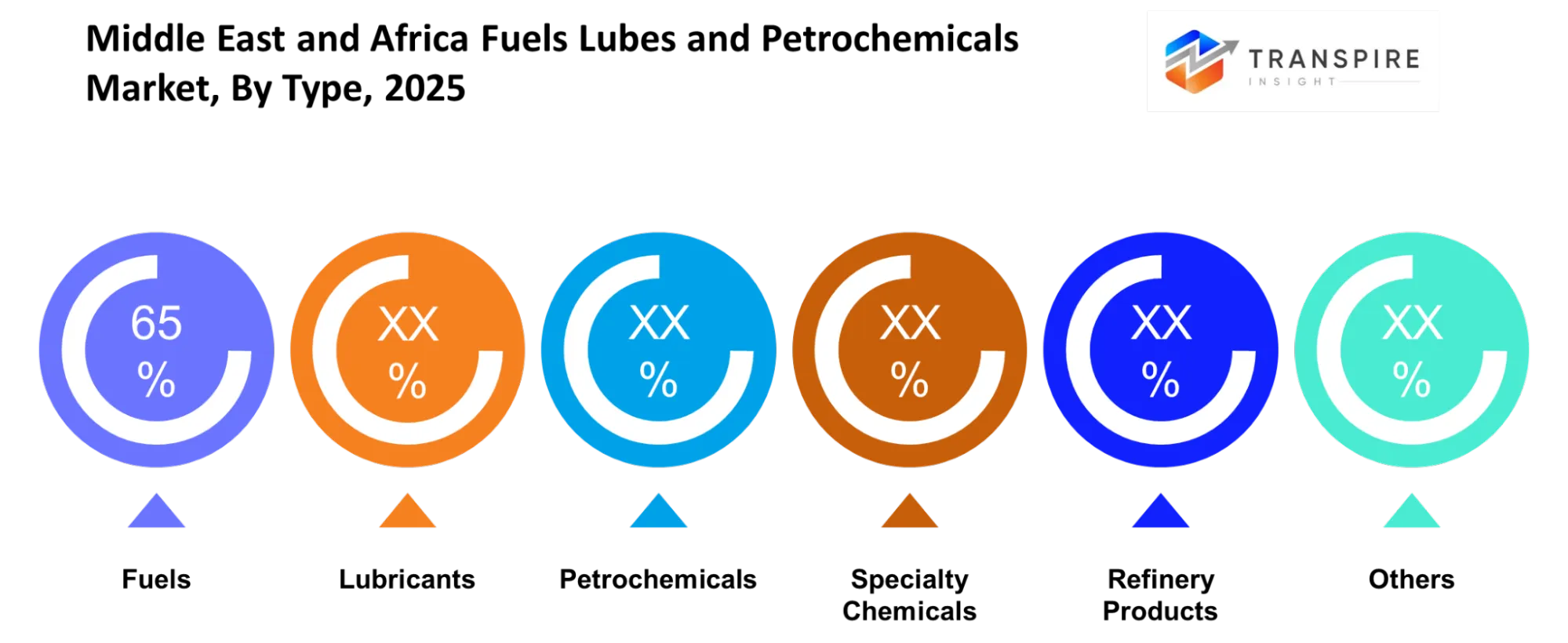
- On the market split side , the Fuels segment leads the Middle East and Africa Fuels Lubes and Petrochemicals market , with around 46% revenue share in 2025 .
- Petrochemicals follows as the second-largest portion , because demand is rising for plastics, packaging, and specialty chemicals , it’s pretty noticeable.
- Lubricants are expected to show the quickest growth through 2030, thanks to industrial automation and wider adoption of premium synthetic lubricants.
- At the same time, the push for low-sulfur fuels and environmentally compliant lubricants is accelerating across both transportation and industrial lines.
- For applications, Transportation accounted for nearly 41% market share in 2025 , driven by expanded logistics, aviation, and the commercial vehicle space.
- Industrial, overall dominated with about 38% share in 2025, largely due to heavy machinery, mining activities, and manufacturing fuel requirements.
What are the Key Drivers, Restraints, and Opportunities in the Middle East and Africa Fuels Lubes and Petrochemicals Market?
The main driver pushing the Middle East and Africa Fuels Lubes and Petrochemicals Market forward is, basically, the bold downstream growth approach used by Gulf states, especially Saudi Arabia, and United Arab Emirates. National diversification roadmaps like Vision 2030 brought in multibillion-dollar funding for integrated refining setups and petrochemical complexes, so they can reduce reliance on crude exports. Because of this, the region has seen a notable jump in production capability for transport fuels, industrial lubricants, and specialty petrochemical inputs. When new refineries, plus conversion units, start running, suppliers tend to earn stronger export income while also pulling in rising local pull from logistics, aviation, and manufacturing.
The biggest hold back still looks like insufficient refining and distribution infrastructure in multiple African economies. A lot of these countries keep depending heavily on imported refined fuels because local processing capacity stays limited or, well, aging and not modern enough. That underlying mismatch cannot be fixed quickly either, since refinery builds are capital hungry, there are regulatory delays too, and energy financing keeps being difficult. So the knock on effects show up as higher operating expenses, unstable supply networks, and slower industrial momentum, and all that together dampens lubricant and petrochemical use across developing markets.
At the same time, a solid opportunity is taking shape through gas powered petrochemical manufacturing across the Gulf. Firms are increasingly leaning on lower cost natural gas feedstreams to produce better value specialty chemicals and performance polymer materials. In places like Qatar and Saudi Arabia, these initiatives are positioning the region as a serious export base for advanced petrochemical derivatives, aimed at Asian and African manufacturing customers.
What Has the Impact of Artificial Intelligence Been on the Middle East and Africa Fuels Lubes and Petrochemicals Market?
Artificial intelligence along with more advanced digital technologies is in the middle of transforming operational efficiency across the Middle East and Africa, especially inside the Fuels Lubes and Petrochemicals Market, and it shows up most clearly in refinery management, marine fuel systems, and emission control work. Basically energy operators are rolling out AI driven monitoring platforms that try to automate scrubber performance systems and fine tune the exhaust gas cleaning technology, mainly for shipping fleets moving through key trade corridors like the Red Sea ,and the Arabian Gulf. These platforms keep watching sulfur oxide emissions, fuel consumption rhythms and onboard compliance signals, so operators can react earlier when environmental rules start shifting.
On top of that machine learning models are getting really good at predictive maintenance across refining and lubricant production settings. In practice, sensors paired with AI analytics can spot pressure fluctuations, unusual vibration signatures and heat irregularities before any equipment failure actually happens. A number of regional operators have said they see clear improvements, like less unplanned downtime and lower maintenance spend, once they bring in predictive asset management platforms. Also AI powered process optimization tools are supporting refineries to raise fuel yield efficiency, while cutting energy usage during catalytic cracking, plus blending activities that can be pretty demanding.
Still, AI adoption hits a noticeable wall in remote marine and industrial environments, where limited connectivity and scattered operational data can weaken forecasting reliability. There are also big integration expenses tied to older infrastructure, and this slows the broader rollout across smaller regional plants or smaller facilities with tighter budgets.
Key Market Trends
- Since 2021 Saudi Aramco has been pushing downstream investments, to grow petrochemical synergy and lower reliance on raw crude export revenue . It’s kind of a two birds one stone thing, you know.
- African fuel importers moved more toward long term supply agreements after 2022, when price volatility sort of revealed weak points in spot based purchasing playbooks.
- Lubricant manufacturers over 2020 to 2025 increasingly used synthetic base oils, because industrial operators asked for longer equipment upkeep cycles, not just quick replacements.
- Regional refiners also sped up AI based predictive maintenance rollouts, cutting down the surprise shutdowns and lifting asset utilization in older infrastructure that was already getting tired.
- Marine fuel suppliers expanded low sulfur bunker fuel capacity after IMO sulfur compliance rules, changed how shipping buyers decide what to buy across Gulf ports .
- Since 2023, petrochemical producers have redirected exports more often to Asian manufacturing hubs, driven by stronger demand for polymers and specialty chemistry.
- Across GCC governments , refinery plans have shifted toward integrated chemical complexes rather than solo fuel processing units, especially after 2020 when the landscape looked different.
- Industrial buyers have leaned more into performance lubricants with thermal stability monitoring features, as mining and heavy manufacturing activity kept expanding through Africa.
- Logistics operators adopted digital fuel management systems to measure fleet efficiency and emissions compliance, while diesel prices kept fluctuating since 2022 .
- Companies like Shell plc and TotalEnergies expanded regional storage and blending infrastructure, to reinforce supply chain endurance after pandemic era disruptions , which was kind of messy at the time.
Middle East and Africa Fuels Lubes and Petrochemicals Market Segmentation
By Type:
Fuels held the lead in regional hydrocarbon trade kind of overall, mostly because transportation demand stayed firm, aviation kept expanding , and industrial energy use kept rising. Diesel and gasoline still drove most refinery output , since commercial logistics networks and public infrastructure programs needed steady fuel access across Gulf regions and African economies. After the crude pricing went up and down, and export economics started to shift, refinery operators leaned more on fuel optimization approaches, that basically reshaped how downstream profitability looked.
Lubricants picked up even more traction thanks to industrial automation, mining activity , and the steady growth of vehicle fleets across emerging African markets. Industrial buyers started choosing synthetic and semi synthetic formulations more often, aiming to stretch machinery life cycles and cut down maintenance pauses , especially under high temperature working conditions. At the same time, petrochemicals and specialty chemicals saw additional investment momentum as producers tilted toward higher margin derivative goods, connected with plastics, packaging, and other specialty industrial uses.
Looking ahead, future growth will likely lean toward integrated refining and petrochemical production, not standalone fuel processing operations. Product teams are expected to concentrate on cleaner burning fuels, high performance lubricants, and advanced polymers that fit the export demand coming from Asian manufacturing hubs. Investors are also moving capital into specialty chemical plants, since these can deliver steadier margins than classic commodity fuel businesses.
To learn more about this report, Download Free Sample Report
By Application:
Transportation applications held the largest share because freight movement kept expanding, aviation traffic, and general commercial vehicle activity across trade heavy economies. Road logistics networks across Saudi Arabia, United Arab Emirates, and Africa growth corridors kept pushing fuel along, and lubricant consumption too. At the same time increasing marine shipping moving through the Red Sea and Gulf trade routes, made bunker fuel demand stronger and marine lubricant usage more consistent.
Industrial use plus chemicals production picked up momentum from refinery expansion, broader manufacturing growth, and an overall higher need for process efficiency solutions. Manufacturing sites more often consumed specialty lubricants and petrochemical feedstocks, in order to support plastics, packaging, and construction material output. Power generation applications also continued to widen at a steady pace, where urbanization and population growth raised electricity needs across developing regions.
During the forecast period , growth is likely to speed up more in industrial manufacturing and chemicals production, rather than the older transportation focused demand areas. Buyers are expected to favor energy efficient products, with predictive maintenance compatibility and lower total operating costs. Suppliers that put money into process optimization technologies and specialty formulations are positioned to win more durable industrial contracts over the long run.
By End-User:
Oil and gas companies made up the largest end user segment, mostly because upstream extraction , refining , and downstream distribution still needed steady fuel and lubricant supply. National energy producers held on to high purchasing levels for industrial oils, specialty greases, and process fuels that support heavy operational infrastructure. Big refinery modernization efforts also pushed demand higher for maintenance lubricants that perform well under stress , plus specialty petrochemical additives.
Industrial firms, as well as automotive sector participants, kept widening their consumption trends on the back of manufacturing expansion, construction activity, and more commercial vehicles on the road. Mining operators across multiple African economies increased take of thermal-resistant lubricants, the kind that can endure extreme environmental conditions without dropping efficiency. Chemical industry players likewise boosted procurement volumes for feedstocks and specialty derivatives that feed plastics production and other industrial materials outputs.
Looking ahead, future demand signals point toward stronger diversification away from the usual oil and gas purchasing routes. Automotive fleet operators are expected to move toward advanced engine oils with longer drain intervals, and added digital performance monitoring compatibility. Investors, meanwhile, are likely to prefer suppliers able to deliver customized lubrication approaches for industry, and specialty chemical formulations tailored to sector-specific operational needs.
By Product:
Diesel kinda held the lead in the market, mainly because freight transportation industrial machinery, and even power backup systems kept relying on diesel-powered infrastructure. At the same time, Government backed infrastructure programs across the GCC plus various African economies kept diesel consumption volumes looking steady, even while diversification initiatives were trying to move the needle elsewhere. Petrol demand still mattered quite a lot too, mostly due to rising passenger vehicle ownership and the ongoing expansion of urban mobility.
Meanwhile engine oils and greases saw a bit more growth pace, fueled by industrial machinery upgrades and the steady growth of automotive service networks. Fleet operators more and more leaned into synthetic engine oils, after maintenance optimization became a priority during stretches of fuel price volatility. On the polymers side, they gained strategic weight as regional petrochemical producers increased exports toward packaging, automotive, and consumer goods manufacturing, so the whole supply chain had more reasons to pull them in.
Looking further out, the long term direction points to higher demand for performance minded lubricant products and specialty petrochemical derivatives, not only commodity based fuel products. Product developers are expected to put more money into advanced polymer technologies and fuel efficient lubricant formulations. Buyers will also likely favor operational durability, fewer maintenance cycles, and adherence to the changing industrial performance standards.
What are the Key Use Cases Driving the Middle East and Africa Fuels Lubes and Petrochemicals Market?
Transportation still kinda ends up being the main use case pushing fuel and lubricant consumption across the Middle East and Africa, you know, Fuels Lubes and Petrochemicals Market overall. Commercial trucking fleets, aviation operators and marine shipping companies need big diesel and bunker fuel volumes, in order to back regional trade corridors that link Gulf ports with African logistics networks. When freight movement stays high and airport infrastructure keeps expanding, it keeps downstream demand fairly steady too.
Also, industrial manufacturing and mining are opening more growth spots for specialty lubricants and petrochemical derivatives. Heavy equipment teams are increasingly leaning on synthetic engine oils plus industrial greases, to squeeze out better machinery reliability in high-temperature situations. At the same time, chemical producers are broadening polymer use for packaging, automotive parts and construction materials across those fast-growing urban markets, which is basically where the demand thickens.
More emerging use cases show up too, like AI-enabled refinery optimization systems and low-sulfur marine fuel applications that match international emission compliance requirements. Hydrogen-based petrochemical feedstocks and carbon capture integration efforts, in Saudi Arabia and United Arab Emirates, are also pulling in long-term investor focus.
|
Report Metrics |
Details |
|
Market size value in 2025 |
USD 68.13 Billion |
|
Market size value in 2026 |
USD 72.49 Billion |
|
Revenue forecast in 2033 |
USD 111.88 Billion |
|
Growth rate |
CAGR of 6.40% from 2026 to 2033 |
|
Base year |
2025 |
|
Historical data |
2021 - 2024 |
|
Forecast period |
2026 - 2033 |
|
Report coverage |
Revenue forecast, competitive landscape, growth factors, and trends |
|
Regional scope |
Middle East and Africa (Saudi Arabia, United Arab Emirates, South Africa, Rest of Middle East and Africa) |
|
Key company profiled |
Saudi Aramco, ADNOC, Shell, BP, ExxonMobil, TotalEnergies, Chevron, Petronas, Sinopec, Reliance, ENOC, Q8, Sasol, Lukoil, Gazprom |
|
Customization scope |
Free report customization (country, regional & segment scope). Avail customized purchase options to meet your exact research needs. |
|
Report Segmentation |
By Type (Fuels, Lubricants, Petrochemicals, Specialty Chemicals, Refinery Products, Others); By Application (Transportation, Industrial Use, Power Generation, Chemicals Production, Manufacturing, Others); By End-User (Oil & Gas Companies, Industrial Firms, Automotive Sector, Power Utilities, Chemical Industry, Others); By Product (Diesel, Petrol, Engine Oils, Polymers, Greases, Others) |
Which Regions are Driving the Middle East and Africa Fuels Lubes and Petrochemicals Market Growth?
The Gulf region keeps sort of leading the Middle East and Africa Fuels Lubes and Petrochemicals Market, mostly because of integrated refining setups, export oriented energy policies, and that very strategic maritime positioning. Places like Saudi Arabia and United Arab Emirates can lean on big refining complexes that are directly linked to major ports, which manage global crude as well as petrochemical trade flows without much delay. Also, government backed industrial diversification programs go on supporting more downstream outlays, for example specialty chemicals, synthetic lubricants, and advanced fuel processing facilities. With a mature logistics web, steady feedstock availability, and dependable international shipping lanes, the region stays in the lead across fuels, lubricants and petrochemical exports.
South Africa meanwhile looks like a stable secondary market, driven less by pure export dominance and more by ongoing industrial continuity plus domestic consumption resilience. Mining activity, manufacturing operations, and established transportation infrastructure keep generating fairly consistent fuel and lubricant requirements, even when the world energy situation gets shaky. Regulatory rollout is slower than in the Gulf economies, and that means industrial operators and fleet owners can adjust their investment cycles more predictably, almost step by step. Fuel distributors, industrial buyers, and logistics operators also have strong working relationships, so downstream revenue tends to remain reliable across the southern African footprint.
West and East African economies are showing up as the fastest growing regional markets, helped by port modernization work, new refining investment plans, and expanded transportation corridors.Countries like Nigeria and Kenya kinda accelerated fuel infrastructure rollouts, after long-running reliance on imported product showed up those supply chain weak points during big global energy disruptions. At the same time, fleet modernization efforts plus industrial expansion initiatives are pushing demand higher for cleaner fuels, industrial lubricants, and petrochemical inputs. The build-up momentum across these areas should, in general, translate into solid openings for storage operators, niche lubricant suppliers, and integrated downstream investors, roughly between 2026 and 2033.
Who are the Key Players in the Middle East and Africa Fuels Lubes and Petrochemicals Market and How Do They Compete?
Across the Middle East and Africa, the Fuels Lubes and Petrochemicals Market stays somewhat moderately consolidated, where bigger, integrated energy firms kind of dominate refining capacity, export logistics, and feedstock access . Competitive pressure is shifting more toward day to day operational efficiency, specialty product creation, and regional supply chain dependability, not just raw production volume. The incumbents still try to protect market share via downstream integration plus longer duration industrial supply contracts , while local refiners and lubricant specialists go after the less served African growth areas. In practice, technology led refinery tuning, higher end lubricant performance, and logistics reach are now what really separates players across key trading routes.
Saudi Aramco leans into vertical integration by pairing upstream crude supply with large scale petrochemical conversion capabilities. By growing integrated refinery and chemical hubs, it can collect better margins from specialty derivative streams , rather than depending only on crude exports. Shell plc stands out through premium lubricant know how and predictive maintenance systems , aimed at mining, marine, and industrial fleets that operate in high temperature conditions. Digital monitoring features and more advanced synthetic formulations help cut equipment downtime too , which ends up supporting stickier long term industrial customer relationships.
TotalEnergies keeps building out African storage, blending , and distribution infrastructure to improve downstream fuel availability in fast urbanizing economies. Its robust retail fuel footprint and localized supply options create resilience when global energy disruptions happen, more or less steadily.ExxonMobil tends to focus on high-performance petrochemical mixes and lubricant formulations, mostly made for heavy industrial operations and manufacturing uses. They keep forming strategic alliances with regional distributors, and also sink money into more advanced refining technologies, which is gradually pushing the company to grow deeper into specialty product markets across both industrial systems and transportation sectors.
Company List
- Saudi Aramco
- ADNOC
- Shell
- BP
- ExxonMobil
- TotalEnergies
- Chevron
- Petronas
- Sinopec
- Reliance
- ENOC
- Q8
- Sasol
- Lukoil
- Gazprom
Recent Development News
“In April 2026, Saudi Aramco and TotalEnergies advanced the Amiral petrochemical project through a new investment agreement signed by SATORP and Saudi Arabia’s Ministry of Investment. The agreement supports downstream chemical manufacturing expansion and aims to improve local industrial supply chains linked to automotive and construction sectors.”https://www.spa.gov.sa
“In May 2026, ExxonMobil, Saudi Aramco, and Samref entered a partnership agreement to modernize the Samref refinery in Yanbu into an integrated petrochemical complex. The modernization program focuses on advanced chemical production, refinery efficiency upgrades, and emissions reduction technologies to improve long-term downstream competitiveness.”https://www.akm.ru
What Strategic Insights Define the Future of the Middle East and Africa Fuels Lubes and Petrochemicals Market?
The Middle East and Africa Fuels Lubes and Petrochemicals Market is shifting, kinda toward integrated downstream ecosystems, with specialty chemicals at the middle, performance lubricants nearby, and refining operations that are more digitally tuned… not just selling fuel by the sheer ton. The big push is coming from national diversification programs, more industrial consumption, and Asia connected export corridors getting bigger. In the next five to seven years, whoever wins more, will likely do it through advanced conversion capacity, supply chain resilience, and tech enabled operational efficiency, rather than leaning on crude production scale.
A less talked about hazard here is how concentrated the market is becoming around a few integrated Gulf producers, they can control feedstock access, export infrastructure, and petrochemical conversion assets. That kind of clumping could end up squeezing smaller refiners and independent distributors when crude prices swing around, or when exports get disrupted. Meanwhile, hydrogen linked petrochemical feedstocks and carbon integrated refining projects in Saudi Arabia and United Arab Emirates are also starting to look like longer-term openings, with real industrial export potential. Market players should focus on investing in specialty downstream products, AI based refinery optimization, and more localized distribution infrastructure across Africa, so they can lock in stronger positioning going forward.
Middle East and Africa Fuels Lubes and Petrochemicals Market Report Segmentation
By Type
- Fuels
- Lubricants
- Petrochemicals
- Specialty Chemicals
- Refinery Products
- Others
By Application
- Transportation, Industrial Use
- Power Generation
- Chemicals Production
- Manufacturing
- Others
By End-User
- Oil & Gas Companies
- Industrial Firms
- Automotive Sector
- Power Utilities
- Chemical Industry
- Others
By Product
- Diesel
- Petrol
- Engine Oils
- Polymers
- Greases
- Others
Frequently Asked Questions
Find quick answers to common questions.
The estimated Middle East and Africa Fuels Lubes and Petrochemicals Market size is USD 111.88 Billion in 2033.
Key segments for the Middle East and Africa Fuels Lubes and Petrochemicals Market are By Type (Fuels, Lubricants, Petrochemicals, Specialty Chemicals, Refinery Products, Others); By Application (Transportation, Industrial Use, Power Generation, Chemicals Production, Manufacturing, Others); By End-User (Oil & Gas Companies, Industrial Firms, Automotive Sector, Power Utilities, Chemical Industry, Others); By Product (Diesel, Petrol, Engine Oils, Polymers, Greases, Others).
Major Middle East and Africa Fuels Lubes and Petrochemicals Market players are Saudi Aramco, ADNOC, Shell, BP, ExxonMobil, TotalEnergies, Chevron, Petronas, Sinopec, Reliance, ENOC, Q8, Sasol, Lukoil, Gazprom.
The Middle East and Africa Fuels Lubes and Petrochemicals Market size is USD 68.13 Billion in 2025.
The Middle East and Africa Fuels Lubes and Petrochemicals Market CAGR is 6.40% from 2026 to 2033.
- Saudi Aramco
- ADNOC
- Shell
- BP
- ExxonMobil
- TotalEnergies
- Chevron
- Petronas
- Sinopec
- Reliance
- ENOC
- Q8
- Sasol
- Lukoil
- Gazprom
Recently Published Reports
-
Apr 2026
Healthcare Polymer Packaging Market
Healthcare Polymer Packaging Market Size, Share & Analysis Report By Packaging Type (Syringes, IV Bottles and Pouches, Clamshells, Blisters, Bottles & Jars, Containers, Tubes, IV Parental Packaging, Others), By Type (Regulated, Non-regulated), By Polymer Type (LDPE (Low-Density Polyethylene), HDPE (High-Density Polyethylene), Homo-polymer (Homo), Random Copolymer (Random), Block Copolymer (Block), PET, Polystyrene, Polyvinyl Chloride, Polyamide/EVOH, Others), and Geography (North America, Europe, Asia-Pacific, Middle East and Africa, South and Central America), 2021 - 2031
-
Apr 2026
Hydrophilic Tape (Waterstop) Market
Hydrophilic Tape (Waterstop) Market Size, Share & Analysis Report By Type (Bentonite-Based Hydrophilic Tape, Rubber-Based Hydrophilic Tape), By Application (Residential Buildings, Commercial Buildings, Infrastructure Projects), and Geography (North America, Europe, Asia-Pacific, Middle East and Africa, South and Central America), 2021 - 2031
-
Apr 2026
Metalens Market
Metalens Market Size, Share & Analysis Report By Type (Visible Light Metalens, and Infrared Metalens), By Application (Consumer Electronics, Automotive Electronics, Industrial, Medical, and Others), and Geography (North America, Europe, Asia-Pacific, Middle East and Africa, South and Central America), 2021 - 2031
-
Apr 2026
PBT Resin Market
PBT Resin Market Size, Share & Analysis Report By Type (Reinforced PBT Resin, Unreinforced PBT Resin), By Processing Method (Injection Molding, Extrusion, Blow Molding, Others), By End-User (Automotive, Electrical & Electronics, Consumer Appliances, Industrial Machinery, Medical Devices, Packaging, Others), and Geography (North America, Europe, Asia-Pacific, Middle East and Africa, South and Central America), 2021 - 2031