

United Kingdom Petrochemical Market Size & Forecast:
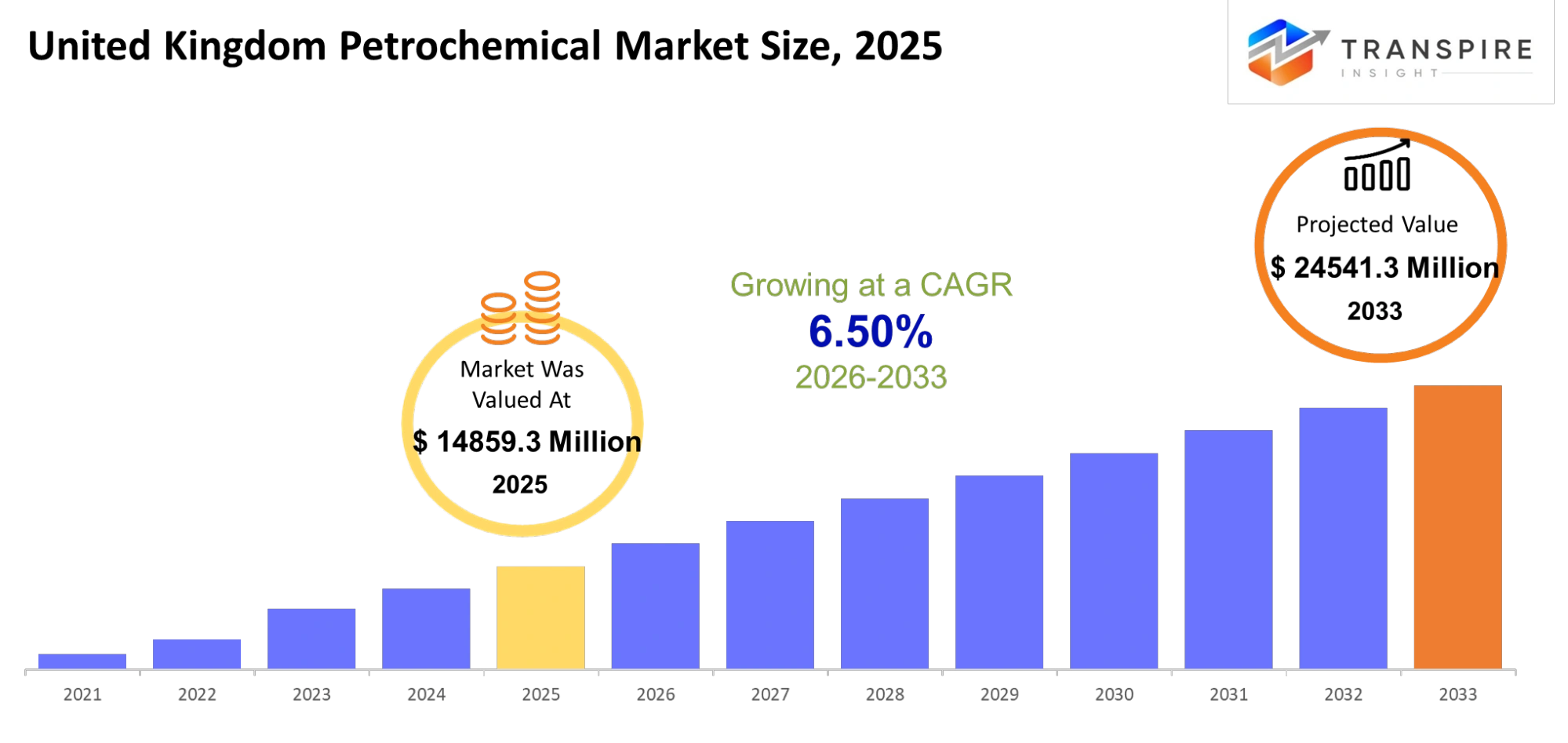
- United Kingdom Petrochemical Market Size 2025: USD 14859.3 Million
- United Kingdom Petrochemical Market Size 2033: USD 24541.3 Million
- United Kingdom Petrochemical Market CAGR: 6.50%
- United Kingdom Petrochemical Market Segments: By Product Type (Ethylene, Propylene, Benzene, Xylene, Methanol), By Application (Plastics, Chemicals, Synthetic Fibers, Rubber), By End-User (Automotive, Construction, Packaging, Textiles).
To learn more about this report,  Download Free Sample Report
United Kingdom Petrochemical Market Summary:
The United Kingdom Petrochemical Market size is estimated at USD 14859.3 Million in 2025 and is anticipated to reach USD 24541.3 Million by 2033, growing at a CAGR of 6.50% from 2026 to 2033. The petrochemical market of the United Kingdom provides essential support to major sectors which include packaging automotive construction and consumer goods. The manufacturing sector of the country depends on petrochemicals which are produced from crude oil and natural gas because these substances serve as essential materials for creating plastics and synthetic fibers and industrial chemicals. The market experiences expansion because downstream industries maintain constant demand and industrial operations continue their activities.
The market grows at a moderate pace because production technology improvements and the rising need for lightweight but strong and affordable materials drive demand. The industry faces three major problems which include unstable crude oil prices and expensive energy expenses and rigorous environmental laws that control emissions and plastic waste. The UK market will experience sustained growth because businesses are moving toward eco-friendly bio-based products and new recycling technologies are being developed.
Key Market Trends & Insights:
- The rising demand from end-use industries drives market growth. The need for petrochemical products in packaging and automotive and construction and consumer goods sectors will create market growth. The market demand increases because people use more plastic and synthetic materials which provide durable and cost-effective solutions.
- The industry is moving toward environmentally friendly solutions that include bio-based petrochemicals and materials which can be recycled. Businesses are developing environmentally friendly technologies to meet stringent environmental standards while they work to decrease their carbon emissions.
- Raw material expenses experience direct impact from changing crude oil and natural gas prices which create cost challenges for production and profitability. The instability of feedstock prices poses a significant obstacle which impacts both market development and investment choices.
- The production process becomes more advanced through technological progress in production methods. New refining and chemical processing technologies enable operational efficiency improvements through waste reduction and cost reductions. The digitalization of advanced catalytic processes enables petrochemical plants to achieve higher productivity levels.
- The UK government implements strict environmental regulations through its emission control and plastic waste management and waste disposal regulations, which create new market opportunities. The need for compliance drives businesses to transition toward environmentally friendly production techniques while they develop their recycling and circular economy programs.
United Kingdom Petrochemical Market Segmentation
By Product Type
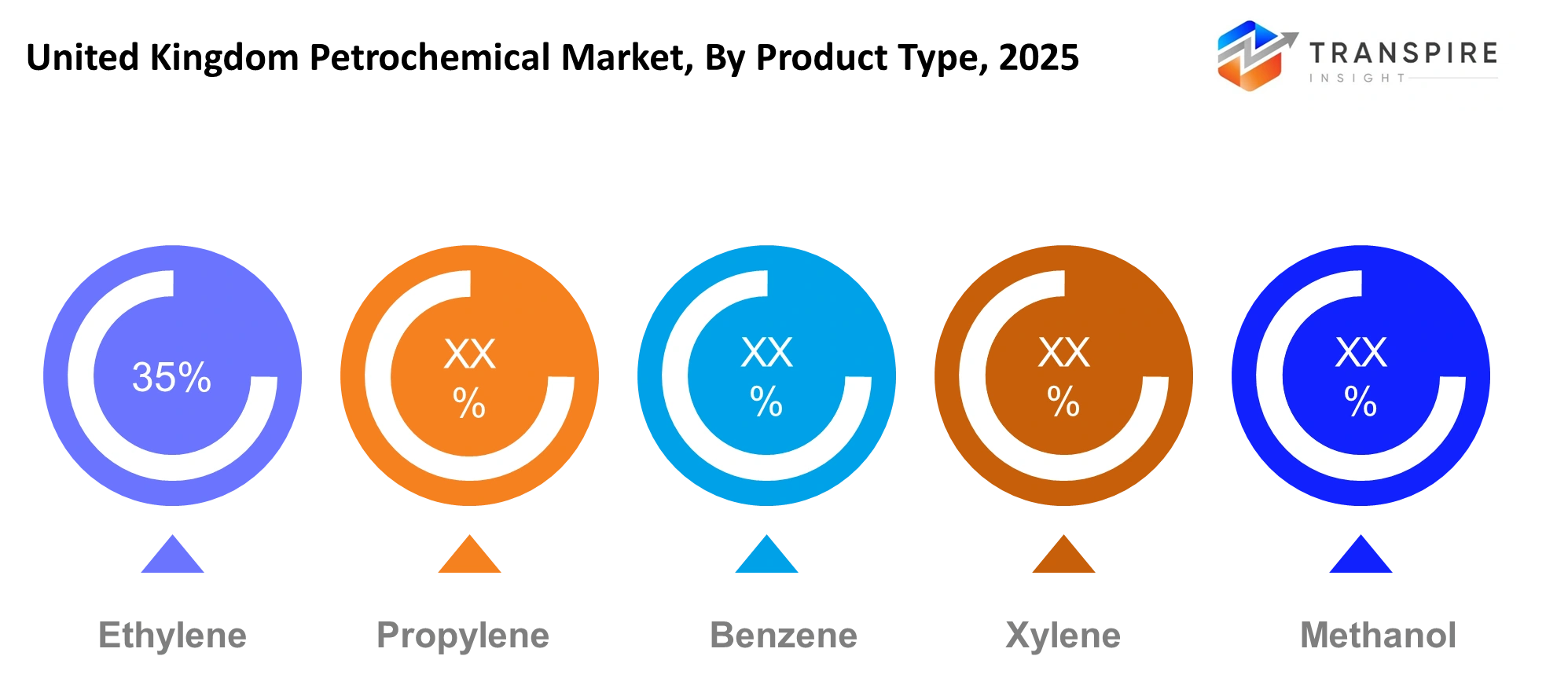
- Ethylene:The UK market uses ethylene as its most common petrochemical which establishes polyethylene and PVC plastic materials through its essential role as a basic component. Its high demand across packaging, construction, and consumer goods industries makes it a dominant segment which drives the entire market to grow.
- Propylene:The production of polypropylene and acrylonitrile plus other chemicals essential for automotive parts and packaging and textiles depends on propylene as a vital component. The UK market experiences steady growth in its propylene segment because manufacturers need lightweight yet strong materials.
- Benzene:Benzene serves as the primary material for producing styrene and phenol plus other intermediates which manufacturers use to create plastics and resins and synthetic fibers. The benzene market segment expands because both the automotive industry and construction sector experience growth while durable material demand increases.
- Xylene:Xylene functions as a key material for creating polyester fibers and films and resins. The textile and packaging industries require xylene which results in ongoing demand for this product. The segment grows because people increasingly use PET bottles and synthetic fabrics.
- Methanol:The chemical industry recognizes methanol as a valuable compound which produces formaldehyde and acetic acid and serves as a fuel alternative. The UK petrochemical market will experience rapid growth in methanol which becomes the most popular segment because people prefer sustainable chemical production and cleaner fuel alternatives.
To learn more about this report, Download Free Sample Report
By Application
- Plastics:The plastics industry maintains its position as the largest sector in the petrochemical market because various industries use plastics for packaging and automotive parts and consumer products. People prefer lightweight materials that last long and cost less because current sustainability practices lead to recycling and companies developing new materials.
- Chemicals:Petrochemical products serve as essential starting materials for creating industrial chemicals and solvents and production intermediates. The segment provides essential support to agriculture and pharmaceuticals and manufacturing sectors which makes it important for driving total petrochemical market expansion throughout the UK.
- Synthetic Fibers:Petrochemical products serve as the base material for creating synthetic fibers which include polyester and nylon that manufacturers use in textile and clothing production. The segment experiences growth because people increasingly seek budget-friendly materials that offer long-lasting performance and simple upkeep across industrial and consumer markets.
- Rubber:Synthetic rubber made from petrochemical products serves as the primary material for manufacturing tires and equipment used in industrial settings. The automotive and transportation industries drive market expansion while manufacturers require rubber products that offer exceptional durability and performance for their diverse industrial applications.
By End-User
- Automotive:The automotive industry relies on petrochemical substances to produce lightweight automotive parts and vehicle interiors and synthetic rubber materials used in tire production. The automotive industry requires advanced plastic and polymer materials because consumers show increasing interest in electric vehicles and fuel-efficient vehicles.
- Construction:The construction industry depends on petrochemical products to create insulation materials and piping systems and coating substances and adhesive products and sealant solutions. The growing need for infrastructure development and building renovation work in the UK creates a demand for petrochemical-derived construction materials that provide long-lasting performance and energy efficiency and cost savings.
- Packaging:The packaging industry represents the largest market segment because plastic packaging products are essential to the packaging needs of food and beverages and e-commerce businesses. The packaging industry experiences growth due to the demand for lightweight and flexible and durable packaging solutions but sustainability issues drive the development of recyclable and biodegradable packaging materials.
- Textiles:The textile industry uses petrochemical production methods to create synthetic fibers which include polyester and nylon. The fast fashion trend and need for performance fabrics and cheap clothing drive market growth but sustainability trends promote the creation of environmentally friendly textile production alternatives.
Country Insights
The petrochemical market in the United Kingdom develops through three main factors which include its established industrial base and its effective regulatory system and its operational links to European supply networks. The country combines its domestic production capacity with its feedstock imports which include crude oil and natural gas to supply its main petrochemical centers found in Scotland and Northern England. The UK maintains consistent petrochemical production because of its existing infrastructure and experienced workforce although its refining capacity has decreased in recent years.
The UK develops its sustainable practices through dedicated environmental policies and its commitment to achieving net-zero carbon emissions. Government regulations on plastic usage, emissions, and waste management are encouraging companies to invest in recycling technologies and bio-based alternatives. The UK petrochemical sector faces two main obstacles which include high energy costs and geopolitical uncertainties, yet keeps its competitive position in the European market because of its ongoing innovative work and strategic investments.
Recent Development News
In April 2026, Cashco announced acquisition of 3B Controls. The company acquired the UK-based tank safety and storage solutions manufacturer to expand its portfolio serving petrochemical and related industrial applications.
In January 2026 (ongoing into 2026 market developments), Phillips 66 Limited announced acquisition of Lindsey Oil Refinery assets. The deal aims to integrate infrastructure into its Humber Refinery to strengthen UK fuel and petrochemical feedstock supply and energy security.
|
Report Metrics |
Details |
|
Market size value in 2025 |
USD 14859.3 Million |
|
Market size value in 2026 |
USD 15795.7 Million |
|
Revenue forecast in 2033 |
USD 24541.3 Million |
|
Growth rate |
CAGR of 6.50% from 2026 to 2033 |
|
Base year |
2025 |
|
Historical data |
2021 – 2024 |
|
Forecast period |
2026 – 2033 |
|
Report coverage |
Revenue forecast, competitive landscape, growth factors, and trends |
|
Country scope |
United Kingdom |
|
Key company profiled |
ExxonMobil Corporation, Royal Dutch Shell plc, BP plc, TotalEnergies SE, SABIC, Dow Inc., LyondellBasell Industries N.V., INEOS Group Holdings S.A., Chevron Phillips Chemical Company LLC, Formosa Plastics Corporation, Reliance Industries Ltd., Sinopec Group, PetroChina Company Ltd., Braskem S.A., Borealis AG. |
|
Customization scope |
Free report customization (country, regional & segment scope). Avail customized purchase options to meet your exact research needs. |
|
Report Segmentation |
By Product Type (Ethylene, Propylene, Benzene, Xylene, Methanol), By Application (Plastics, Chemicals, Synthetic Fibers, Rubber), By End-User (Automotive, Construction, Packaging, Textiles). |
Key United Kingdom Petrochemical Market Company Insights
The petrochemical market in the United Kingdom exists as a highly competitive field that major international energy companies together with chemical corporations, control through their ability to produce goods using modern technology and their extensive manufacturing capacity and their complete control over their distribution networks. ExxonMobil Corporation, Shell plc, and BP plc function as essential suppliers of vital petrochemical materials which include ethylene and propylene and aromatics.
The worldwide companies TotalEnergies SE and SABIC and Dow Inc. achieve major market contributions through their development of specialized chemical products and environmentally sustainable material solutions. The market competition develops through three main factors which include companies forming strategic partnerships and increasing their recycling programs and exploring renewable petroleum-based fuel alternatives. The companies in question operate their businesses while facing two primary obstacles which include rising costs for feedstock materials and changing regulations that affect both the United Kingdom and European Union markets.
Company List
- ExxonMobil Corporation
- Royal Dutch Shell plc
- BP plc
- TotalEnergies SE
- SABIC, Dow Inc.
- LyondellBasell Industries N.V.
- INEOS Group Holdings S.A.
- Chevron Phillips Chemical Company LLC
- Formosa Plastics Corporation
- Reliance Industries Ltd., Sinopec Group
- PetroChina Company Ltd.
- Braskem S.A.
- Borealis AG.
United Kingdom Petrochemical Market Report Segmentation
By Product Type
- Ethylene
- Propylene
- Benzene
- Xylene
- Methanol
By Application
- Plastics
- Chemicals
- Synthetic Fibers
- Rubber
By End-User
- Automotive
- Construction
- Packaging
- Textiles
Frequently Asked Questions
Find quick answers to common questions.
The approximate United Kingdom Petrochemical Market size for the market will be USD 24541.3 Million in 2033.
Key segments for the United Kingdom Petrochemical Market are By Product Type (Ethylene, Propylene, Benzene, Xylene, Methanol), By Application (Plastics, Chemicals, Synthetic Fibers, Rubber), By End-User (Automotive, Construction, Packaging, Textiles).
Major United Kingdom Petrochemical Market players are ExxonMobil Corporation, Royal Dutch Shell plc, BP plc, TotalEnergies SE, SABIC, Dow Inc., LyondellBasell Industries N.V., INEOS Group Holdings S.A., Chevron Phillips Chemical Company LLC, Formosa Plastics Corporation, Reliance Industries Ltd., Sinopec Group, PetroChina Company Ltd., Braskem S.A., Borealis AG.
The United Kingdom Petrochemical Market size is USD 14859.3 Million in 2025.
The United Kingdom Petrochemical Market CAGR is 6.50%
- ExxonMobil Corporation
- Royal Dutch Shell plc
- BP plc
- TotalEnergies SE
- SABIC, Dow Inc.
- LyondellBasell Industries N.V.
- INEOS Group Holdings S.A.
- Chevron Phillips Chemical Company LLC
- Formosa Plastics Corporation
- Reliance Industries Ltd., Sinopec Group
- PetroChina Company Ltd.
- Braskem S.A.
- Borealis AG.
Recently Published Reports
-
Dec 2024
Healthcare Polymer Packaging Market
Healthcare Polymer Packaging Market Size, Share & Analysis Report By Packaging Type (Syringes, IV Bottles and Pouches, Clamshells, Blisters, Bottles & Jars, Containers, Tubes, IV Parental Packaging, Others), By Type (Regulated, Non-regulated), By Polymer Type (LDPE (Low-Density Polyethylene), HDPE (High-Density Polyethylene), Homo-polymer (Homo), Random Copolymer (Random), Block Copolymer (Block), PET, Polystyrene, Polyvinyl Chloride, Polyamide/EVOH, Others), and Geography (North America, Europe, Asia-Pacific, Middle East and Africa, South and Central America), 2021 - 2031
-
Jan 2025
Hydrophilic Tape (Waterstop) Market
Hydrophilic Tape (Waterstop) Market Size, Share & Analysis Report By Type (Bentonite-Based Hydrophilic Tape, Rubber-Based Hydrophilic Tape), By Application (Residential Buildings, Commercial Buildings, Infrastructure Projects), and Geography (North America, Europe, Asia-Pacific, Middle East and Africa, South and Central America), 2021 - 2031
-
Jan 2025
Metalens Market
Metalens Market Size, Share & Analysis Report By Type (Visible Light Metalens, and Infrared Metalens), By Application (Consumer Electronics, Automotive Electronics, Industrial, Medical, and Others), and Geography (North America, Europe, Asia-Pacific, Middle East and Africa, South and Central America), 2021 - 2031
-
Jan 2025
PBT Resin Market
PBT Resin Market Size, Share & Analysis Report By Type (Reinforced PBT Resin, Unreinforced PBT Resin), By Processing Method (Injection Molding, Extrusion, Blow Molding, Others), By End-User (Automotive, Electrical & Electronics, Consumer Appliances, Industrial Machinery, Medical Devices, Packaging, Others), and Geography (North America, Europe, Asia-Pacific, Middle East and Africa, South and Central America), 2021 - 2031