
Middle East and Africa Construction Chemicals Market Size & Forecast:
- Middle East and Africa Construction Chemicals Market Size 2025: USD 5.74 Billion
- Middle East and Africa Construction Chemicals Market Size 2033: USD 9.21 Billion
- Middle East and Africa Construction Chemicals Market CAGR: 6.11%
- Middle East and Africa Construction Chemicals Market Segments: By Product Type (Concrete Admixtures, Waterproofing Chemicals, Adhesives & Sealants, Protective Coatings, Flooring Chemicals, Repair & Rehabilitation Chemicals, Grouts & Anchors, Others); By Application (Residential, Commercial, Industrial, Infrastructure, Marine, Others); By End User (Contractors, Builders, Infrastructure Developers, Government Projects, Others); By Form (Liquid, Powder, Paste, Others).
Middle East and Africa Construction Chemicals Market Summary
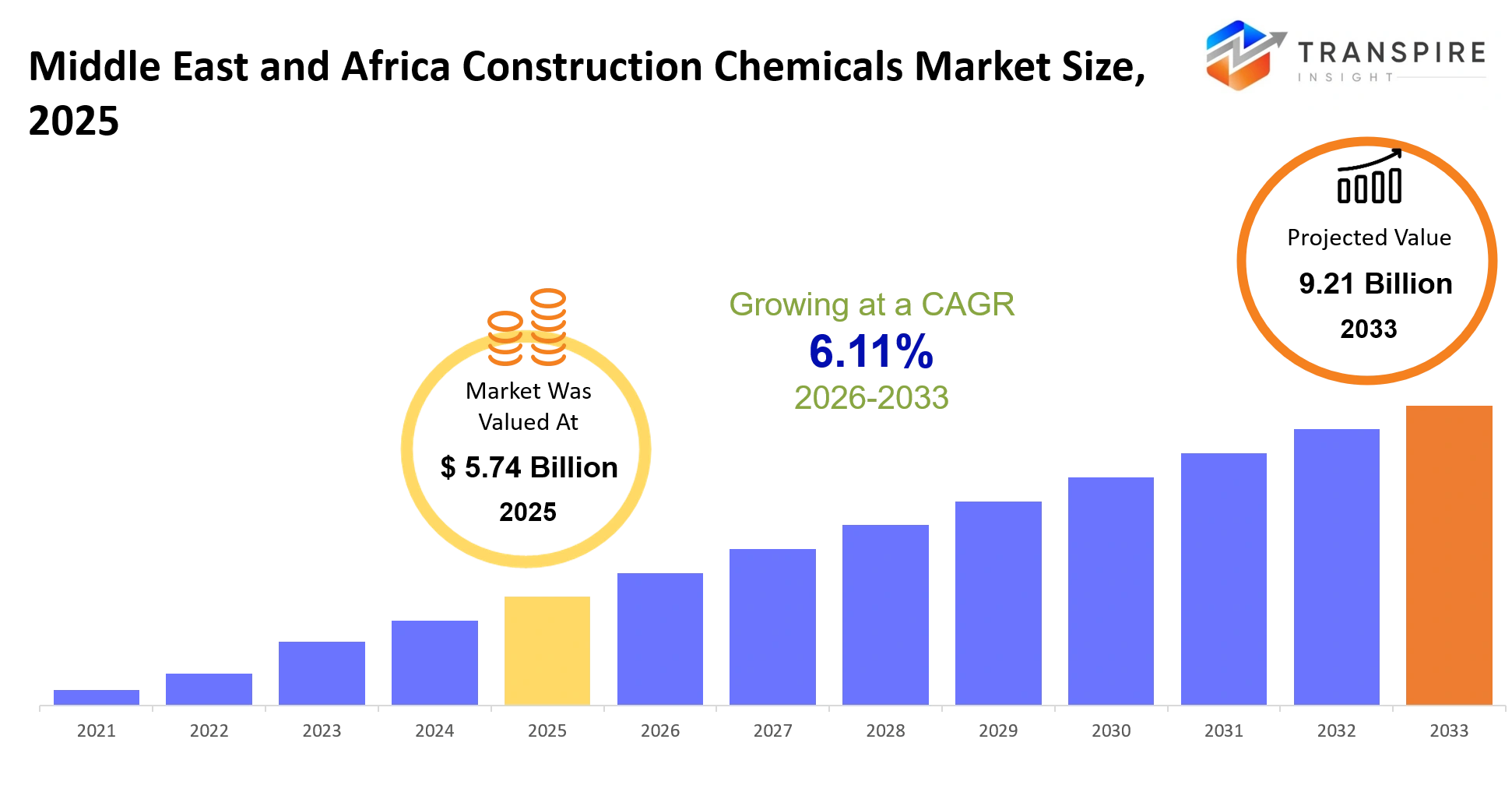
The Middle East and Africa Construction Chemicals Market was valued at USD 5.74 Billion in 2025. It is forecast to reach USD 9.21 Billion by 2033. That is a CAGR of 6.11% over the period.
Construction chemicals , kinda a big deal for prolonging the life of buildings, road links , industrial sites, and also the public infrastructure across the Middle East and Africa. Basically these products help concrete stay more durable, boost the load-bearing behavior, stop water from getting in, guard exterior surfaces against corrosion, and lower the whole long run upkeep spend even when the weather is rough and unpredictable.
Over the past five years, the market seems to have moved away from the usual construction inputs , toward more performance driven chemical solutions. This is done so assets last longer through their life span and projects can get wrapped up faster. One visible shift is the increased use of advanced admixtures, waterproofing systems and repair materials in big infrastructure pushes across Gulf economies.
At the same time , disruptions in the supply chain, caused by global raw material scarcity and logistics slowdowns, tweaked how buyers procure. In a way, it also pushed faster localization, like sourcing more locally instead of waiting for shipments. And since governments are investing heavily into transportation corridors, smart cities, industrial clusters and housing developments, contractors are leaning more and more on specialized construction chemicals. The aim is to satisfy durability expectations, raise execution efficiency , and cut lifecycle costs , which then opens up more steady revenue opportunities across the regional market.
Key Market Insights
- The Middle East and Africa Construction Chemicals Market is expected to reach USD 9.21 billion by 2033, kind of showing how infrastructure-led expansion is really pulling it forward.
- In 2025, the Gulf Cooperation Council countries hold an estimated 45–50% market share, basically driven by mega-project investments that keep stacking up.
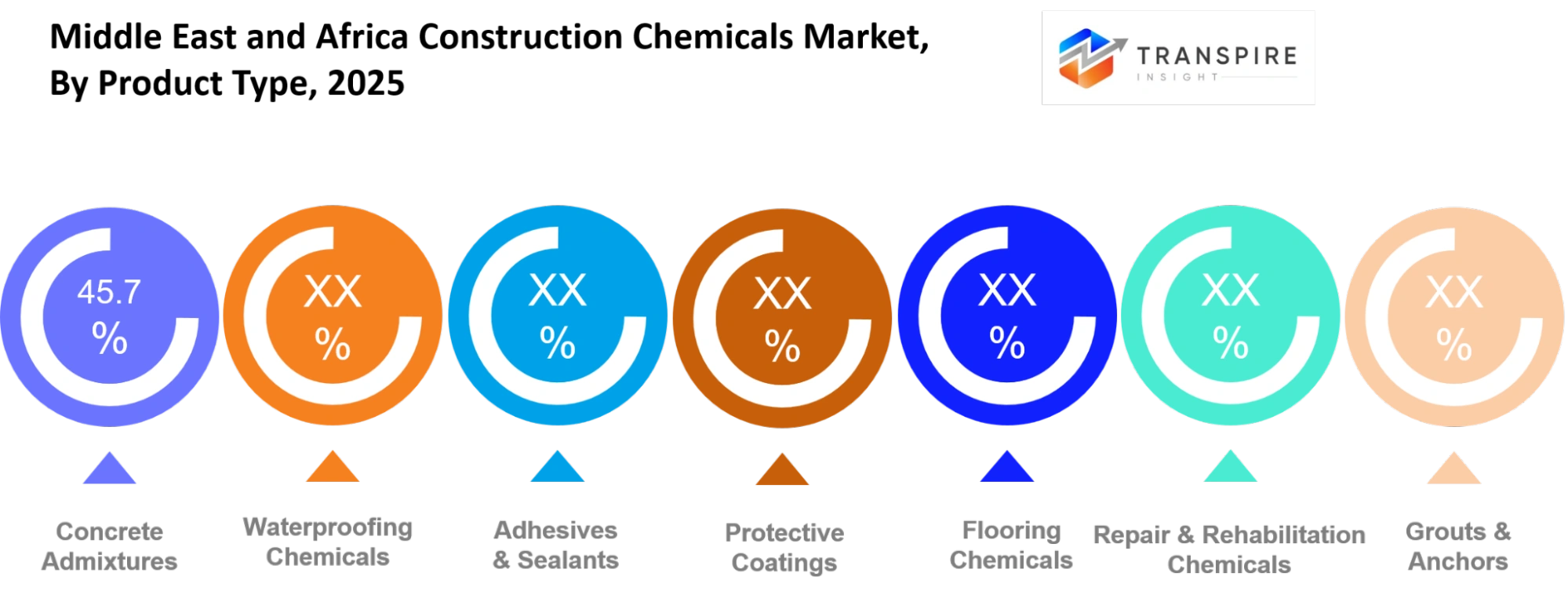
- Concrete admixtures remain the most dominant, with around 30–35% share, supported by the high-volume concrete consumption seen across infrastructure developments.
- Waterproofing chemicals sit as the second-largest segment, since investments in commercial, and also residential, buildings keep increasing.
- Repair and rehabilitation chemicals are projected to post the fastest growth through 2033, because aging infrastructure is now demanding structural upgrades.
- When it comes to usage, infrastructure applications contribute more than 35% of total revenue, so they stay the biggest application segment.
- Industrial construction is also among the quicker-growing application categories, helped by logistics hubs, manufacturing parks, and energy projects.
- Contractors continue to be the leading end-user group, with an estimated 40%+ market share, and this is tied to the rise in project outsourcing.
- Key players like Sika, BASF, Fosroc, Mapei, Saint-Gobain, and Master Builders Solutions keep pushing strategic expansion across both GCC and African markets.
- Overall product innovation, especially low-carbon admixtures, advanced waterproofing membranes and high-performance repair systems, is getting stronger day by day in terms of competitive positioning.
What are the Key Drivers, Restraints, and Opportunities in the Middle East and Africa Construction Chemicals Market?
The biggest growth catalyst comes from those big infrastructure funding waves spread through Saudi Arabia, the UAE, Egypt, and South Africa. Government backed projects, tied to economic diversification, have pushed demand upward for durable construction inputs that lower upkeep costs and extend how long assets actually last. New transport arteries, industrial zones, airports, and smart city initiatives need specialized chemical add ons , waterproofing solutions, surface coatings, and repair compounds that can keep up with strict specs. This movement feeds revenue growth pretty directly, because construction chemicals make projects more durable, while also helping contractors hit faster build timelines.
Raw material price swings are still the most stubborn structural issue. Main inputs like polymers, specialty resins, additives, and petrochemical derivatives stay exposed to global commodity cycles and sudden supply chain breaks. There is limited regional production capacity for a number of these specialized ingredients, so dependence on imports keeps growing. This limitation is not the kind that goes away quickly, since setting up local manufacturing lines demands heavy capital and strong technical know how . Therefore, project budgets can wobble , procurement plans become harder to manage, and uptake slows in places where buyers are more price sensitive.
Infrastructure rehabilitation is a major long term opportunity. Large sections of transportation assets, water systems, and industrial infrastructure across several African economies still need modernization. Advanced repair mortars, corrosion defense systems, crack injection approaches, and structural reinforcement solutions are getting more relevant , especially as maintenance backlogs rise.
What Has the Impact of Artificial Intelligence Been on the Middle East and Africa Construction Chemicals Market?
Artificial intelligence is increasingly reshaping manufacturing, quality checking, supply chain coordination, and the way projects get delivered in the construction chemicals sphere, you know, all of it. Companies leverage AI-enabled production setups to make sure formulation stays steadier, track raw material consumption more clearly, and lift overall output efficiency. Then machine learning systems digest the production records to estimate equipment failures earlier than the breakdown would show up, which cuts downtime and boosts plant utilization , generally speaking.
At the same time, digital tools are also supporting suppliers for forecasting demand in a more careful way over big infrastructure undertakings, and yes it kind of helps them handle things better. Predictive analytics models look at buying behavior, weather shifts, job timelines, and stock on hand, so supply chain performance turns steadier and material shortages are less often. On the quality side, AI-driven inspection systems can notice formulation variations faster than older, more manual testing approaches, which helps manufacturers keep their product performance targets on track.
In parallel, construction firms are gradually pairing digital project management platforms with construction chemical applications to reduce material overuse and minimize waste. These platforms improve the scheduling accuracy, back up compliance paperwork, and increase project visibility across multiple worksites, even when things are moving fast.
Still, adoption isn’t easy. The rollout is held back by expensive implementation effort, fragmented digital infrastructure, and a shortage of localized operational data. Smaller manufacturers and contractors in particular often struggle to weave advanced analytics tools into everyday workflows, so deployment spreads slower than expected, despite the operational upside being pretty obvious.
Key Market Trends
- Since 2021, demand for advanced concrete additives has been rising as mega-project developers push for quicker curing, and stronger concrete solutions, not just “good enough” .
- Between 2023 and 2026, regional manufacturing investments widened, so there is less reliance on imported specialty construction materials.
- Waterproofing uptake also sped up across GCC nations, because new cities are thinking more about long term asset shielding.
- Since 2022, spending on infrastructure restoration went up by more than 20% in multiple public programs, which in turn supports the need for repair chemicals.
- Digital quality monitoring systems got more attention among major producers, improving production efficiency, and also cutting down on mix inconsistency.
- In procurement choices, contractors are specifying lifecycle performance numbers more often, instead of chasing the lowest-cost materials.
- At the same time, low-carbon building drives are encouraging the use of admixtures that lower cement usage while still keeping structural performance steady.
- Big suppliers such as Sika, Mapei, and Fosroc expanded their regional production sites and technical service coverage from 2024 to 2026.
- Industrial construction tied to logistics, and manufacturing diversification became a bigger driver for specialty chemical consumption.
- And finally, strategic partnerships between chemical manufacturers, and project developers are increasing, to deliver tailored solutions for complicated infrastructure developments.
Middle East and Africa Construction Chemicals Market Segmentation
By Product Type
Concrete admixtures help with workability , better strength build up, control of setting time, and long term durability during construction. You often see these products in big infrastructure programs, transportation related jobs, and commercial buildings, mainly because the concrete needs to perform well even in harsh weather or tough site conditions. Their use keeps growing, contractors tend to choose them to gain faster site progress and shorter overall timelines .
Waterproofing chemicals, adhesives & sealants, plus protective coatings all play a role in staying protected over time, and that matters a lot for structures. Waterproofing products stop water migration through foundations , roofs, and below ground elements. Adhesives and sealants boost bonding performance, they basically make the connection more reliable, and help structural integrity remain steadier. Protective coatings then guard surfaces from corrosion, chemical attack, and normal weathering induced wear, so the appearance and function last longer.
Flooring chemicals, repair & rehabilitation chemicals, grouts & anchors, and other related items cover more specialized needs. Flooring solutions give durable surfaces with extra visual appeal in industrial and commercial spaces. Repair materials bring back older structures that have started to weaken, while grouts and anchors support load transfer, and keep structural stability in line. There are also a few other specialty products that fit niche situations across residential builds, industrial sites, and infrastructure projects.
By Application
Residential construction generates substantial demand for waterproofing systems, sealing compounds, flooring materials, and concrete enhancement products. Population growth , urban expansion, and housing development programs still back product consumption across major regional economies . In addition, performance expectations increasingly steer the selection of materials in new residential projects, depending on local climate considerations.
Commercial plus Industrial uses rely on construction chemicals to reinforce durability, safety, and maintenance performance . Office complexes, retail facilities, manufacturing plants and logistics hubs call for specialized coatings , resilient flooring systems and protective solutions that can handle intensive operating conditions without much downtime.
Infrastructure, Marine, and other sectors are also meaningful application areas . For infrastructure projects, engineers choose high performance admixtures and repair materials for transportation corridors, bridges, tunnels, and public utilities . Marine environments, meanwhile , demand advanced corrosion protection and waterproofing technologies, and the remaining use cases extend into energy, mining , and institutional developments
By End User
Contractors account for a pretty big chunk of product consumption, due to their direct involvement in construction execution and in material specification. In this part of the market, technical support services, application guidance, and overall performance reliability end up steering purchasing decisions, more often than not. Big contractors these days also seem to lean toward products that help with project productivity and also lifecycle performance, in a practical sense.
Builders are another meaningful user group, especially in residential and commercial developments. Construction chemicals allow builders to meet quality standards, while they keep the project timelines, and day to day operational efficiency under control. When it comes to choosing a product, they often weigh durability, application convenience, plus those long-term upkeep factors.
Infrastructure Developers, Government Projects, and other participants also bring substantial demand. With large public spending in transportation, utilities, and urban development programs, advanced material solutions are basically required. In government-backed initiatives, performance based standards are frequently written in, and this backs the adoption of higher value specialty construction chemicals, too.
By Form
Liquid products hold a major share mostly because they are easy to apply, mix in a uniform way, and they fit well with modern construction practices. Concrete admixtures, waterproofing compounds, and coating systems are usually supplied as liquids. Also, efficient dosing and application processes help their adoption everywhere, more then once you see them on site.
Powder formulations still matter a lot across cementitious repair materials, grouts, tile adhesives, and specialized mortars. Their storage stability and transportation efficiency make a real difference , especially for big projects. Product versatility also helps them work across many construction environments, even when conditions are a bit awkward.
Paste and Other forms cover specialized needs where controlled application is required, and specific performance traits have to be met. These products help with sealing, bonding, repair, and finishing tasks. With ongoing product innovation the usage keeps expanding across construction projects that are getting more and more complex .
What are the Key Use Cases Driving the Middle East and Africa Construction Chemicals Market?
Infrastructure development still, seems like the biggest use case for construction chemicals across the region, yes. Transportation networks, bridges, tunnels, airports, and utility projects lean on concrete admixtures, waterproofing systems and protective coatings to push durability up, and cut down maintenance needs across long running lifecycles.
Commercial buildings and industrial facilities are also getting more attention. Logistics hubs, manufacturing complexes, energy sites, and mixed-use developments increasingly go for improved flooring systems, sealants, and corrosion protection technologies… mostly because they want steadier operations, and better asset performance.
There are also newer opportunities forming around infrastructure rehabilitation and climate-resilient building. Asset owners are more often turning to structural repair materials, crack injection solutions and advanced waterproofing techniques, in order to stretch the service life of older facilities that face harsh environmental conditions every day.
|
Report Metrics |
Details |
|
Market size value in 2025 |
USD 5.74 Billion |
|
Market size value in 2026 |
USD 6.08 Billion |
|
Revenue forecast in 2033 |
USD 9.21 Billion |
|
Growth rate |
CAGR of 6.11% from 2026 to 2033 |
|
Base year |
2025 |
|
Historical data |
2021 - 2024 |
|
Forecast period |
2026 - 2033 |
|
Report coverage |
Revenue forecast, competitive landscape, growth factors, and trends |
|
Regional scope |
United States; Canada; Mexico; United Kingdom; Germany; France; Italy; Spain; Denmark; Sweden; Norway; China; Japan; India; Australia; South Korea; Thailand; Brazil; Argentina; South Africa; Saudi Arabia; United Arab Emirates |
|
Key company profiled |
Sika, BASF, Fosroc, Mapei, Saint-Gobain, Dow, Wacker Chemie, Ardex, Pidilite, Chryso, Bostik, Cemex, RPM International, Henkel, Master Builders Solutions. |
|
Customization scope |
Free report customization (country, regional & segment scope). Avail customized purchase options to meet your exact research needs. |
|
Report Segmentation |
By Product Type (Concrete Admixtures, Waterproofing Chemicals, Adhesives & Sealants, Protective Coatings, Flooring Chemicals, Repair & Rehabilitation Chemicals, Grouts & Anchors, Others); By Application (Residential, Commercial, Industrial, Infrastructure, Marine, Others); By End User (Contractors, Builders, Infrastructure Developers, Government Projects, Others); By Form (Liquid, Powder, Paste, Others). |
Which Regions are Driving the Middle East and Africa Construction Chemicals Market Growth?
The Gulf region stays as the main contributor of market revenue, you know, with a steady kind of momentum. Large scale infrastructure investments , smart city programs , transportation projects and industrial diversification initiatives keep pulling in real demand for specialty construction materials. Strong project pipelines, supportive government policies, and advanced construction practices hold the market leadership in place. On top of that, extensive technical service networks plus manufacturing facilities help lock in wider regional adoption, kind of like a quiet reinforcement effect.
South Africa is still an important secondary market but the growth profile is a bit different. Market activity is driven more by infrastructure maintenance, commercial development, and industrial modernization , not so much by mega-project construction. The demand coming from mining, manufacturing, and public infrastructure sectors is fairly stable, so revenue resilience remains there. And because distribution channels are already established, along with technical expertise, market performance stays consistent over time.
For the broader African region, the strongest growth momentum is expected through 2033. Investments in transportation corridors, urban housing, water infrastructure, and industrial facilities are ramping up quickly across multiple economies. International development funding, plus public private partnerships, is also speeding up project delivery. All these directions together create big opportunities for manufacturers, distributors, and investors looking for exposure to long term infrastructure development.
Who are the Key Players in the Middle East and Africa Construction Chemicals Market and How Do They Compete?
Yeah, competition is pretty moderately consolidated, and the multinational manufacturers kinda keep a strong hold thanks to technical expertise, decent product portfolios, and regional distribution abilities. But like, the way companies differentiate is shifting more toward performance innovation, localized manufacturing, project support services, and application- specific solutions, not just price.
Most firms also pour money into technical consulting, contractor training, and customized formulations to keep those customer ties strong. Sika, for example, is really oriented toward advanced admixture technologies, waterproofing systems, and infrastructure solutions. With regional manufacturing investments, and some project focused engineering support, they can push harder into big construction programs.
Fosroc differentiates by leaning on repair, protection, and waterproofing knowledge, and they do that with extensive technical service capabilities that are tailored to harsh climates. Meanwhile, Mapei competes using a broad mix of products plus specialized solutions for commercial, industrial, and infrastructure uses. Master Builders Solutions puts the spotlight on performance-driven admixture technologies and sustainable construction materials that help concrete work better.
Saint-Gobain basically benefits from integrated building solutions and solid distribution networks, so market reach is easier. Still, across the whole market, continued investment in manufacturing capacity, product innovation, and regional partnerships keeps showing up as central to the competitive play.
Company List
- Sika
- BASF
- Fosroc
- Mapei
- Saint-Gobain
- Dow
- Wacker Chemie
- Ardex
- Pidilite
- Chryso
- Bostik
- Cemex
- RPM International
- Henkel
- Master Builders Solutions
Recent Development News
In March 2026, Saint-Gobain partnered with ChangeNOW 2026 to showcase sustainable construction solutions and strengthen collaboration across the environmental innovation ecosystem. The initiative reinforced the company's focus on low-carbon building technologies and sustainable urban development.
Source: https://www.saint-gobain.com
In October 2025, Mapei showcased its Zero Line products, repair mortars, waterproofing systems, and sustainable construction technologies at SAIE 2025. The launch expanded Mapei's portfolio of low-carbon and infrastructure-focused construction solutions.
Source: https://www.mapei.com
What Strategic Insights Define the Future of the Middle East and Africa Construction Chemicals Market?
The market is moving toward performance-aimed construction ecosystems, where durability, lifecycle cost optimization, and asset resilience increasingly start to shape procurement choices. Infrastructure modernization programs, city expansion, and industrial diversification strategies will keep backing long-term demand for advanced construction materials . In the future, growth will probably lean toward suppliers who can deliver integrated solutions rather than offering only lone products.
There’s also a less obvious risk, continued reliance on imported specialty raw materials. If supply disruptions happen , or if commodity prices stay wildly volatile for longer than expected, margins may get squeezed and projects can slip in schedule even when construction activity looks healthy. Meanwhile, infrastructure rehabilitation is a real opportunity that is still underexploited compared with spend on new build. Older transport routes and utility assets are going to need advanced repair and protection approaches through out the coming decade.
Market actors should focus on local manufacturing capacity, technical support muscle, and digital quality management systems. Companies that mix regional production with high-performance product innovation should be in a stronger spot, because construction requirements are getting more demanding across the Middle East and Africa.
Middle East and Africa Construction Chemicals Market Report Segmentation
By Product Type
- Concrete Admixtures
- Waterproofing Chemicals
- Adhesives & Sealants
- Protective Coatings
- Flooring Chemicals
- Repair & Rehabilitation Chemicals
- Grouts & Anchors
- Others
By Application
- Residential
- Commercial
- Industrial
- Infrastructure
- Marine
- Others
By End User
- Contractors
- Builders
- Infrastructure Developers
- Government Projects
- Others
By Form
- Liquid
- Powder
- Paste
- Others
Frequently Asked Questions
Find quick answers to common questions.
The expected Middle East and Africa Construction Chemicals Market size for the market will be USD 9.21 Billion in 2033.
Key segments for the Middle East and Africa Construction Chemicals Market are By Product Type (Concrete Admixtures, Waterproofing Chemicals, Adhesives & Sealants, Protective Coatings, Flooring Chemicals, Repair & Rehabilitation Chemicals, Grouts & Anchors, Others); By Application (Residential, Commercial, Industrial, Infrastructure, Marine, Others); By End User (Contractors, Builders, Infrastructure Developers, Government Projects, Others); By Form (Liquid, Powder, Paste, Others).
Major Middle East and Africa Construction Chemicals Market players are Sika, BASF, Fosroc, Mapei, Saint-Gobain, Dow, Wacker Chemie, Ardex, Pidilite, Chryso, Bostik, Cemex, RPM International, Henkel, Master Builders Solutions.
The Middle East and Africa Construction Chemicals Market size is USD 5.74 Billion in 2025.
The Middle East and Africa Construction Chemicals Market CAGR is 6.11% from 2026 to 2033.
- Sika
- BASF
- Fosroc
- Mapei
- Saint-Gobain
- Dow
- Wacker Chemie
- Ardex
- Pidilite
- Chryso
- Bostik
- Cemex
- RPM International
- Henkel
- Master Builders Solutions
About the Authors

Pankaj Ghogare Patil
I am Pankaj Ghogare Patil, a Senior Research Analyst at Transpire Insight, specializing in the Pharmaceutical, Chemicals & Materials, Healthcare IT, and Biotechnology industry. My expertise lies in conducting comprehensive market research, analyzing industry trends, evaluating competitive landscapes, and translating complex data into actionable insights. At Transpire Insight, I closely follow emerging technologies, regulatory developments, and market innovations to create accurate, well-researched, and informative content that helps businesses and professionals make informed decisions. I am committed to producing credible, evidence-based articles that reflect industry best practices while making technical topics accessible and valuable for a broad audience.

Chakradhar Khansole
Chakradhar serves as the Research Director at Transpire Insight, bringing over 8 years of experience in technology, innovation, and strategic market intelligence. He specializes in transforming complex market data into actionable business insights that enable organizations to make informed, growth-oriented decisions. Recognized for his strategic vision and analytical expertise, Chakradhar leads high-impact research initiatives, delivering comprehensive market assessments, competitive intelligence, and forward-looking industry analysis.
Recently Published Reports
-
May 2026
Healthcare Polymer Packaging Market
Healthcare Polymer Packaging Market Size, Share & Analysis Report By Packaging Type (Syringes, IV Bottles and Pouches, Clamshells, Blisters, Bottles & Jars, Containers, Tubes, IV Parental Packaging, Others), By Type (Regulated, Non-regulated), By Polymer Type (LDPE (Low-Density Polyethylene), HDPE (High-Density Polyethylene), Homo-polymer (Homo), Random Copolymer (Random), Block Copolymer (Block), PET, Polystyrene, Polyvinyl Chloride, Polyamide/EVOH, Others), and Geography (North America, Europe, Asia-Pacific, Middle East and Africa, South and Central America), 2021 - 2031
-
Apr 2026
Hydrophilic Tape (Waterstop) Market
Hydrophilic Tape (Waterstop) Market Size, Share & Analysis Report By Type (Bentonite-Based Hydrophilic Tape, Rubber-Based Hydrophilic Tape), By Application (Residential Buildings, Commercial Buildings, Infrastructure Projects), and Geography (North America, Europe, Asia-Pacific, Middle East and Africa, South and Central America), 2021 - 2031
-
Apr 2026
Metalens Market
Metalens Market Size, Share & Analysis Report By Type (Visible Light Metalens, and Infrared Metalens), By Application (Consumer Electronics, Automotive Electronics, Industrial, Medical, and Others), and Geography (North America, Europe, Asia-Pacific, Middle East and Africa, South and Central America), 2021 - 2031
-
Apr 2026
PBT Resin Market
PBT Resin Market Size, Share & Analysis Report By Type (Reinforced PBT Resin, Unreinforced PBT Resin), By Processing Method (Injection Molding, Extrusion, Blow Molding, Others), By End-User (Automotive, Electrical & Electronics, Consumer Appliances, Industrial Machinery, Medical Devices, Packaging, Others), and Geography (North America, Europe, Asia-Pacific, Middle East and Africa, South and Central America), 2021 - 2031