

Asia Pacific System Infrastructure Software Market Size & Forecast:
- Asia Pacific System Infrastructure Software Market Size 2025: USD 44.5 Billion
- Asia Pacific System Infrastructure Software Market Size 2033: USD 73.9 Billion
- Asia Pacific System Infrastructure Software Market CAGR: 6.49%
- Asia Pacific System Infrastructure Software Market Segments: By Software Type (Operating Systems, Virtualization Software, Storage Software, Network Management Software, Security Software, Middleware, Cloud Infrastructure Software, Others); By Deployment (On-Premise, Cloud, Hybrid, Private Cloud, Public Cloud, SaaS, Others); By Enterprise Size (Large Enterprises, SMEs, Startups, Government Organizations, Others); By End User (IT & Telecom, BFSI, Healthcare, Retail, Manufacturing, Government, Others).

To learn more about this report,  Download Free Sample Report
Asia Pacific System Infrastructure Software Market Summary
The Asia Pacific System Infrastructure Software Market was valued at USD 44.5 Billion in 2025. It is forecast to reach USD 73.9 Billion by 2033. That is a CAGR of 6.49% over the period.
Across Asia Pacific, system infrastructure software kind of underpins the digital backbone that keeps industrial operations, ports, utilities, and big enterprises running in a reliable way. It sort of orchestrates server management, virtualization, identity controls, and workload distribution , so those critical environments from maritime logistics hubs to manufacturing plants maintain uptime, security, and performance even when the data loads get heavy. Over the last five years , the market has shifted away from on-premise, hardware-bound deployment, toward cloud-native and containerized infrastructure. This enables faster scaling and more automated resource allocation, which honestly helps teams move quicker and stay responsive.
One major trigger was COVID-19 driven supply chain disruption, and it highlighted how fragile fragmented legacy IT stacks can be. That pressure pushed enterprises to modernize core infrastructure for resilience and also for remote manageability. So now, organizations tend to prioritize unified orchestration layers that reduce downtime risk while improving operational visibility, which in turn is driving steady enterprise investment in modular, API-driven infrastructure software across the region.
Key Market Insights
- Asia Pacific System Infrastructure Software Market seems mostly led by China and India, they jointly hold around 45% share in 2025 because rapid enterprise digitization is basically happening everywhere.
- In Southeast Asia, things move the quickest through 2030, that’s often attributed to cloud-first government policies and also the steady rise in data center capacity investments,which is kinda pulling demand along.
- When it comes to what software leads, virtualization and workload management software stays in the front, with roughly 38% share in 2025.
- Then cloud infrastructure management tools are the second-largest segment, pushed along by hybrid cloud adoption across enterprises,not just one industry.
- Lastly, container orchestration platforms are the fastest-growing segment through 2030, due to the increasing appetite for microservices based application deployment,so more teams are leaning into it.
- IT operations management is still kinda the big deal, taking in almost 40% share in enterprise infrastructure optimization workloads, like it or not.
- Security and compliance automation meanwhile is growing the quickest, mostly because zero-trust architecture is getting adopted across financial institutions.
- Big, large enterprises pretty much lead the Asia Pacific system infrastructure software market, with more than 55% share ,on account of complex multi-cloud infrastructure requirements.
- For SMEs, they show the fastest growth end user category, since subscription based infrastructure software lowers the entry barriers and also cuts down the upfront costs, which makes things easier to start.
What are the Key Drivers, Restraints, and Opportunities in the Asia Pacific System Infrastructure Software Market?
The primary driver of the Asia Pacific System Infrastructure Software Market is accelerated enterprise migration , toward hybrid cloud architectures, after widespread data center modernization programs. You can see it being pushed along by rising infrastructure costs and the need for scalable workload distribution across operations that are spread out geographically. So in practice, organizations are pouring more money into system infrastructure software , to bind orchestration together, cut down downtime, and sharpen cross-platform efficiency. That, in turn, is directly boosting recurring software revenue across the region.
The key restraint stays the same though: high integration complexity with legacy IT environments that were not really built for cloud-native interoperability. Many enterprises end up with prolonged migration cycles because their architectures are fragmented, and they still depend on outdated virtualization stacks. This kind of structural block keeps adoption from happening at full scale, and it basically slows down revenue realization in the near term , especially for public sector players and traditional manufacturing organizations in the Asia Pacific System Infrastructure Software Market.
A major opportunity, on the other hand, sits in edge-to-cloud infrastructure convergence, particularly in manufacturing hubs across China, South Korea, and India. Companies are investing in distributed computing frameworks that stitch together edge analytics with centralized orchestration platforms. That approach supports real-time workload tuning and it also creates fresh monetization pathways for infrastructure software vendors focused on latency-sensitive industrial applications.
What Has the Impact of Artificial Intelligence Been on the Asia Pacific System Infrastructure Software Market?
Artificial intelligence is kinda transforming system infrastructure software across Asia Pacific, by letting autonomous infrastructure management work across both enterprise and industrial environments. AI-driven automation is now used to optimize server allocation, keep track of workload balancing, and also smooth out cloud resource scheduling, so there’s less manual touch in huge scale IT operations. In maritime adjacent industrial systems, similar AI models support real-time monitoring of emission control systems, and scrubber performance tweaking, to make sure regulatory compliance stays solid and day to day operations run efficiently.
Predictive analytics models are also getting pushed out more often for failure forecasting and capacity planning, which can improve uptime by something like 20–30% in more advanced enterprise setups. On top of that, machine learning algorithms help with performance optimization by adjusting workloads on the fly based on usage patterns, which cuts infrastructure spending and boosts energy efficiency across distributed data centers. These changes directly strengthen operational resilience in the Asia Pacific System Infrastructure Software Market.
Still, AI adoption has a major snag though, because training data quality is inconsistent, and the integration side of things can be tricky in hybrid environments. A lot of older legacy systems don’t have standardized telemetry, and that reduces model accuracy in real-world industrial and maritime conditions, which then slows the full rollout across important infrastructure networks.
Key Market Trends
- In the Asia Pacific System Infrastructure Software Market, a bunch of enterprises moved from on-premise stacks to hybrid cloud usage, climbing from 35% in 2020 up to more than 60% by 2025. It feels like the whole thing shifted in a way that was not subtle, and once hybrid went mainstream, it just kept rising.
- After 2022, demand for containerized infrastructure platforms sort of picked up fast, and in many high-growth digital enterprise setups, those platforms started to displace the older virtualization layers. Basically, the “middle layer” changed, and teams wanted less friction, more agility.
- From 2023 to 2025, regulatory tightening around data sovereignty in China and India made vendors localize deployments, so infrastructure software could run closer to the required jurisdictions. This part mattered more than before, partly because compliance isn’t something you can ignore, even briefly.
- Meanwhile Microsoft and IBM expanded cloud regions across Asia Pacific, which boosted regional workload distribution capacity by about 40% since 2021. So the local placement and scaling story got easier.
- Also after 2023 cyberattacks, security-first infrastructure design jumped hard, and it pushed adoption of zero-trust system orchestration, especially in banking and telecom. Not just “security features”, more like the default way orchestration should behave.
- SMEs also leaned more into subscription based infrastructure software, which grew by nearly 50% between 2021 and 2025, and they moved away from capital-intensive IT procurement models. The vibe shifted from buying everything upfront to more ongoing, flexible spend.
- And in manufacturing hubs of China and South Korea, edge computing integration surged post 2022, enabling real-time workload optimization at the network edge. Teams could react quickly, without waiting on distant centralized processing.
- AI-enabled infrastructure monitoring tools then helped reduce unplanned downtime by as much as 25% in enterprise deployments across the Asia Pacific System Infrastructure Software Market. Less surprise downtime, more steady operations, in a very practical sense.
- Finally, after 2023 vendor competition started leaning toward platform consolidation, with firms bundling virtualization, security, and automation into one unified infrastructure suite. It’s like they stopped selling pieces separately, and began selling the whole framework.
Asia Pacific System Infrastructure Software Market Segmentation
By Software Type :
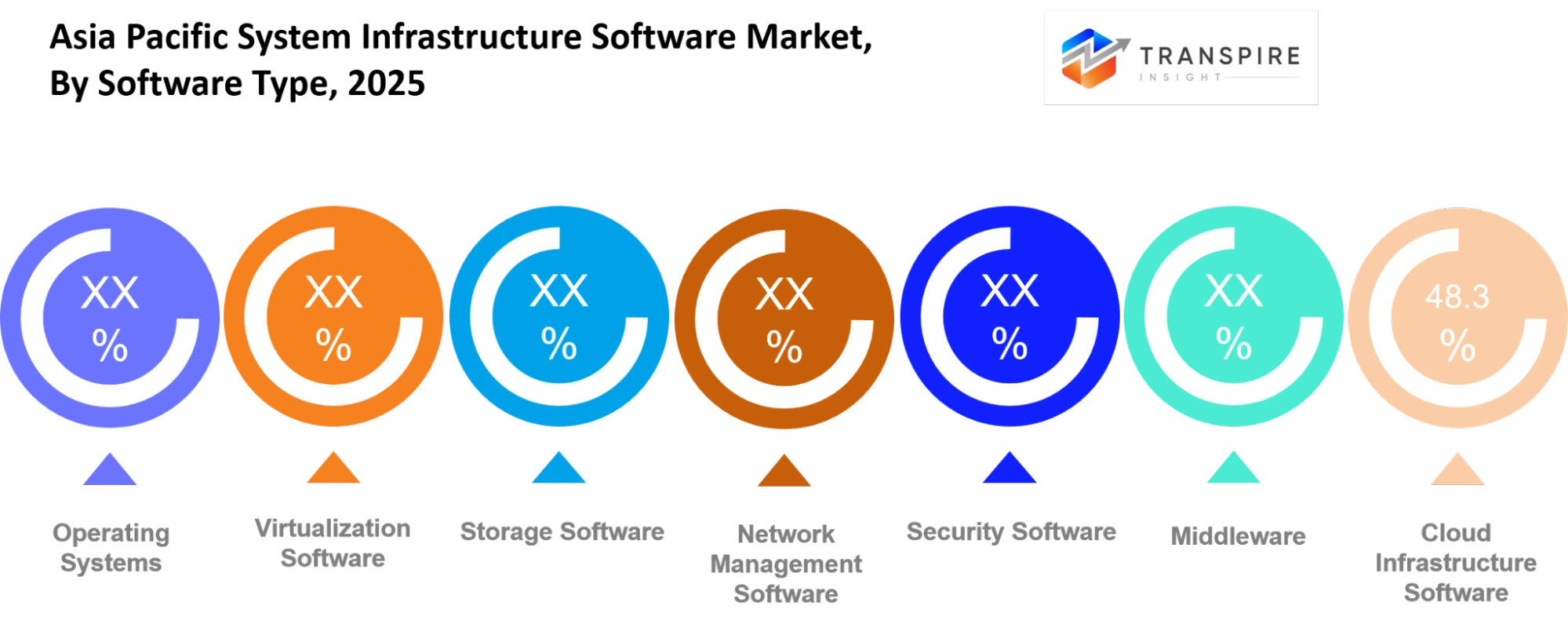
Operating systems and virtualization software still feel pretty central, even as enterprises drift away from those older, hardware-linked arrangements. Bit by bit the appetite moved toward cloud infrastructure software, plus security tools, because companies want to run distributed workloads across several locations without too much friction. In the earlier years, the focus was mostly on server control, you know, basic steering. Now the adoption looks more like automated workload handling with stronger defense layers, so yeah, more “cover” built in.
Storage software, along with network management tools, is also getting steady traction since data volumes keep climbing across business operations. Middleware use has been improving too, mainly because firms want smoother, more consistent data exchange between different platforms. And security software demand… it’s grown faster since 2022, likely tied to more cyber incidents, so organizations are trying to weave stronger control systems into their infrastructure software stack, not just bolt them on after.
To learn more about this report, Download Free Sample Report
By Deployment :
On-premise deployment was common earlier, but over time adoption has tilted toward hybrid and cloud-based models as businesses chase more flexibility. Hybrid deployment seems to be the preferred balance, since it helps companies keep some control while still gaining scalability, without having to fully rip out their existing systems. This change also hints at a gradual replacement of rigid infrastructure, with more adaptable setups that can shift when conditions change.
Cloud and SaaS models have grown quite a lot in the last few years as organizations try to lower upfront infrastructure costs, and shift into subscription-style usage. In digital-first industries, the public cloud has been picking up speed faster, while the private cloud keeps holding ground where data control is critical. Overall, it points to a clear move toward shared infrastructure models that enable quicker scaling, plus easier system updates, which is kind of the whole idea.
By Enterprise Size :
Big enterprises have,like, led the uptake for years because their IT setups are kind of complicated and they need infrastructure software that stays stable and can scale. Over time they’ve put more money into unified platforms that can manage lots of systems with, basically, one framework. Gradually their attention moved away from just controlling the base infrastructure, and more toward automation and performance tuning across departments, not only one team.
SMEs and startups have caught up more noticeably in recent times because cloud-based infrastructure software got way more affordable. Subscription pricing has lowered the entry barrier so smaller businesses can reach tools that used to be only for large organizations. Government organizations are also modernizing their systems to improve efficiency, though how fast they go depends on legacy infrastructure, and then the budget cycles.
By End User :
IT and telecom still look like the heaviest users, since they rely on large-scale infrastructure software for networks and data traffic handling. In practice, these industries have been shifting toward automated systems, less manual effort, more reliable services. Also the ongoing need for faster connectivity keeps pushing regular upgrades to the infrastructure platforms, so it doesn’t just sit there.
BFSI and healthcare have increased their adoption mostly due to strict data protection needs, and because digital service delivery is growing. Manufacturing is doing more of the same as production systems become more connected through digital tools. Retail and government are, at a slower pace, upgrading older systems to improve service delivery, reduce downtime, and support better data management across operations in a cleaner way.
What are the Key Use Cases Driving the Asia Pacific System Infrastructure Software Market?
Core adoption in the Asia Pacific System Infrastructure Software Market is basically driven by enterprise IT operations management, where big organizations lean on unified platforms to basically control server storage and workloads across mixed, hybrid environments. This specific use case seems to create the top demand since companies must have continuous uptime, quicker resource allocation, and steady performance across distributed digital systems, like in banking, telecom, and manufacturing networks.
They also keep expanding into security orchestration and cloud cost optimization, in particular inside BFSI and IT and telecom. Financial institutions are more and more using infrastructure software to handle compliance, identify threats, and keep transactions secure, at the same time. Telecom operators meanwhile, use it to juggle network traffic, and raise service reliability when things get busy during peak usage periods.
Newer use cases are starting to form around AI driven infrastructure automation and edge workload handling in smart factories, and also logistics hubs. Manufacturing firms, plus government digital infrastructure projects are starting to deploy these systems for real time monitoring and predictive system tuning, which helps with responsiveness and reduces operational delays in these connected environments.
|
Report Metrics |
Details |
|
Market size value in 2025 |
USD 44.5 Billion |
|
Market size value in 2026 |
USD 47.6 Billion |
|
Revenue forecast in 2033 |
USD 73.9 Billion |
|
Growth rate |
CAGR of 6.49% from 2026 to 2033 |
|
Base year |
2025 |
|
Historical data |
2021 - 2024 |
|
Forecast period |
2026 - 2033 |
|
Report coverage |
Revenue forecast, competitive landscape, growth factors, and trends |
|
Regional scope |
Asia Pacific (India, China, Japan, Australia, South Korea, Rest of Asia Pacific) |
|
Key company profiled |
Microsoft, IBM, Oracle, VMware, Red Hat, Broadcom, SAP, Cisco, Hewlett Packard Enterprise, Dell Technologies, Fujitsu, NEC, Huawei, Hitachi, Nutanix. |
|
Customization scope |
Free report customization (country, regional & segment scope). Avail customized purchase options to meet your exact research needs. |
|
Report Segmentation |
By Software Type (Operating Systems, Virtualization Software, Storage Software, Network Management Software, Security Software, Middleware, Cloud Infrastructure Software, Others); By Deployment (On-Premise, Cloud, Hybrid, Private Cloud, Public Cloud, SaaS, Others); By Enterprise Size (Large Enterprises, SMEs, Startups, Government Organizations, Others); By End User (IT & Telecom, BFSI, Healthcare, Retail, Manufacturing, Government, Others). |
Which Regions are Driving the Asia Pacific System Infrastructure Software Market Growth?
China still looks like the leading spot in the Asia Pacific System Infrastructure Software Market, mainly because of its big scale industrial digitization and the state backed cloud infrastructure rollout, which is pretty strong overall. Also, strict data localization rules kind of force many enterprises to go with domestic infrastructure platforms just to stay compliant, and keep better control in-house. On top of that, heavy investment in smart manufacturing zones, and port automation systems, has boosted the appetite for system orchestration type software. And there’s a mature telecom backbone plus high enterprise cloud penetration, so software updates keep moving forward across basically every industry.
Japan feels more stable and also technologically disciplined, with enterprises doing steady modernization of older IT systems. Compared with China’s broader expansion pace, Japan seems to lean into precision driven upgrades, especially across banking, automotive, and advanced manufacturing. Because disaster recovery requirements are strong there, companies are leaning toward resilient infrastructure software, the kind that helps protect uptime and keeps systems running. Meanwhile, consistent spending on automation and robotics integration supports a gradual but dependable contribution to the market.
India is the fastest growing region, largely driven by rapid digital infrastructure expansion, and a fairly aggressive cloud first adoption across enterprises plus public services. The rollout of digital public infrastructure, along with data center investments, has lifted demand for system software across the board. There’s also more startup activity, and the telecom network keeps expanding which further speeds up adoption of scalable infrastructure platforms. So yeah, this momentum makes India a key opportunity area for vendors aiming at high growth enterprise ecosystems through 2026–2033.
Who are the Key Players in the Asia Pacific System Infrastructure Software Market and How Do They Compete?
In the Asia Pacific System Infrastructure Software Market , competition is kind of moderately consolidated, like there are few big players but also room for niche providers. Globally known technology firms still hold strong ground while regional demand patterns sort of carve out space for specialized offerings, and this can look a bit uneven across countries. Most incumbents tend to compete less on plain pricing and more on cloud integration capability, automation depth , and enterprise-grade security features. Also, the rapid uptake of hybrid cloud has really pushed vendors to deliver unified infrastructure platforms that can run across legacy setups and newer environments at the same time , which is not always easy.
Microsoft leans hard on tight integration between its cloud ecosystem and enterprise operating systems, which helps migration from on-premise to hybrid environments stay smoother. A big part of their advantage is the bundled infrastructure toolkit, combining identity management, virtualization, and monitoring into one architecture. With expansion across Asia Pacific data center regions, they can support stronger enterprise onboarding and a better fit for localized compliance alignment , even when regulations vary.
IBM, instead, focuses on hybrid cloud orchestration and deployment models that are guided by enterprise consulting. This approach helps when customers have complex legacy environments where straightforward “lift-and-shift” doesn’t quite work. Oracle stays competitive by emphasizing database-centric infrastructure platforms, tuned for high-performance workloads, especially in banking and telecom. VMware differentiates more from the virtualization-first angle, and it keeps widening its influence through that lens. Red Hat, for its part, pushes adoption of open-source infrastructure platforms, which can reduce vendor lock-in and improve system flexibility, as customers can adjust more quickly without getting trapped in a single stack.
Company List
- Microsoft
- IBM
- Oracle
- VMware
- Red Hat
- Broadcom
- SAP
- Cisco
- Hewlett Packard Enterprise
- Dell Technologies
- Fujitsu
- NEC
- Huawei
- Hitachi
- Nutanix
Recent Development News
In April 2026, AirTrunk announced acquisition of Lumina CloudInfra. The deal expanded AirTrunk’s India entry strategy and added roughly 600 MW of planned data centre capacity, strengthening hyperscale infrastructure supply for AI and cloud workloads across Asia Pacific.
Source: https://newswire.telecomramblings.com/
In May 2026, the Asian Development Bank launched a $70 billion Asia-Pacific infrastructure investment program. The initiative focuses on expanding digital and energy infrastructure, including broadband and cross-border connectivity, indirectly accelerating demand for system infrastructure software supporting regional digital ecosystems.
Source: https://www.reuters.com/
What Strategic Insights Define the Future of the Asia Pacific System Infrastructure Software Market?
The Asia Pacific System Infrastructure Software Market is shifting, sort of, toward an AI-native, cloud-edge orchestration layer, where automation observability and workload optimization become the real value drivers, not just those backend utilities, you know. This shift is pushed by AI compute demand climbing fast, hyperscale data center expansion, 5G-enabled edge deployment, and also higher sovereign cloud needs across major economies. Over the next 5–7 years, platform consolidation around integrated infrastructure intelligence stacks is likely to speed up, even more.
A less visible worry is that architecture can concentrate around a small set of hyperscaler-aligned ecosystems. That could lead to systemic dependency and make pricing flexibility kinda constrained. Also fragmented regulatory regimes may quietly add compliance overhead and slow down cross-border scalability, without anyone really noticing at first.
An emerging chance is AI-native multi-cloud and edge orchestration software for sovereign and latency-sensitive workloads, especially in Southeast Asia and India. Market players should focus on modular, compliance-automated platforms, and deepen partnerships with telecom operators, to get an edge distribution advantage.
Asia Pacific System Infrastructure Software Market Report Segmentation
By Software Type
- Operating Systems
- Virtualization Software
- Storage Software
- Network Management Software
- Security Software
- Middleware
- Cloud Infrastructure Software
By Deployment
- On-Premise
- Cloud
- Hybrid
- Private Cloud
- Public Cloud
- SaaS
By Enterprise Size
- Large Enterprises
- SMEs
- Startups
- Government Organizations
By End User
- IT & Telecom
- BFSI
- Healthcare
- Retail
- Manufacturing
- Government
Frequently Asked Questions
Find quick answers to common questions.
The Asia Pacific System Infrastructure Software Market size is USD 73.9 Billion in 2033.
Key segments for the Asia Pacific System Infrastructure Software Market are By Software Type (Operating Systems, Virtualization Software, Storage Software, Network Management Software, Security Software, Middleware, Cloud Infrastructure Software, Others); By Deployment (On-Premise, Cloud, Hybrid, Private Cloud, Public Cloud, SaaS, Others); By Enterprise Size (Large Enterprises, SMEs, Startups, Government Organizations, Others); By End User (IT & Telecom, BFSI, Healthcare, Retail, Manufacturing, Government, Others).
Major Asia Pacific System Infrastructure Software Market players are Microsoft, IBM, Oracle, VMware, Red Hat, Broadcom, SAP, Cisco, Hewlett Packard Enterprise, Dell Technologies, Fujitsu, NEC, Huawei, Hitachi, Nutanix.
The Asia Pacific System Infrastructure Software Market size is USD 44.5 Billion in 2025.
The Asia Pacific System Infrastructure Software Market CAGR is 6.49% from 2026 to 2033.
- Microsoft
- IBM
- Oracle
- VMware
- Red Hat
- Broadcom
- SAP
- Cisco
- Hewlett Packard Enterprise
- Dell Technologies
- Fujitsu
- NEC
- Huawei
- Hitachi
- Nutanix
About the Authors

Mayur Shinde
I am Mayur Shinde, a Senior Research Analyst at Transpire Insight, specializing in the Automotive & Transportation and Information & Communication Technology (ICT) Industry. My work focuses on analyzing emerging market trends, technological advancements, competitive landscapes, and industry developments to deliver accurate, data-driven insights. I am passionate about transforming complex market information into clear, actionable content that helps businesses, professionals, and decision-makers stay informed and make confident strategic decisions.

Chakradhar Khansole
Chakradhar serves as the Research Director at Transpire Insight, bringing over 8 years of experience in technology, innovation, and strategic market intelligence. He specializes in transforming complex market data into actionable business insights that enable organizations to make informed, growth-oriented decisions. Recognized for his strategic vision and analytical expertise, Chakradhar leads high-impact research initiatives, delivering comprehensive market assessments, competitive intelligence, and forward-looking industry analysis.
Recently Published Reports
-
Apr 2026
3D Optical Profiler Market
3D Optical Profiler Market Size, Share & Analysis Report By Type (Desktop 3D Optical Profiler, and Portable 3D Optical Profiler), By Technology (Confocal Technology, and White Light Interference), By End-Use Industry (Manufacturing, Research Institutions, Automotive, Aerospace and Defense, Medical Devices, and Other), and Geography (North America, Europe, Asia-Pacific, Middle East and Africa, South and Central America), 2021 - 2031
-
Apr 2026
Depth Sensor Market
Depth Sensor Market Size, Share & Analysis Report By Type (Infrared Depth Sensors, Time-of-Flight (ToF) Sensors, Stereo Vision Sensors, Structured Light Sensors, Ultrasonic Depth Sensors), By Application (Automotive, Robotics, Gaming, Consumer Electronics, Industrial Automation, Healthcare, Security & Surveillance, Others), By End Users (Automotive Manufacturers, Consumer Electronics Companies, Healthcare Providers, Industrial Companies, Security Agencies, Gaming Companies, Robotics Companies, Others), and Geography (North America, Europe, Asia-Pacific, Middle East and Africa, South and Central America), 2021 – 2031
-
Apr 2026
Digital Manufacturing Market
Digital Manufacturing Market Size, Share & Analysis Report By Component (Hardware, Software, and Services), By Technology (Robotics, 3D Printing, Internet of Things (IoT), and Others), By Application (Automotive and Transportation, Aerospace and Defense, Consumer Electronics, Industrial Machinery, and Others), By Process Type (Computer-Based Designing, Computer-Based Simulation, Computer 3D Visualization, Analytics, and Others), and Geography (North America, Europe, Asia-Pacific, Middle East and Africa, South and Central America), 2021 – 2031
-
Apr 2026
Digital Visa Services Market
Digital Visa Services Market Size, Share & Analysis Report By Type (Individual Travelers, Group Travelers), By Application (Tourism, Business Travel, Others), and Geography (North America, Europe, Asia-Pacific, Middle East and Africa, South and Central America), 2021 – 2031