
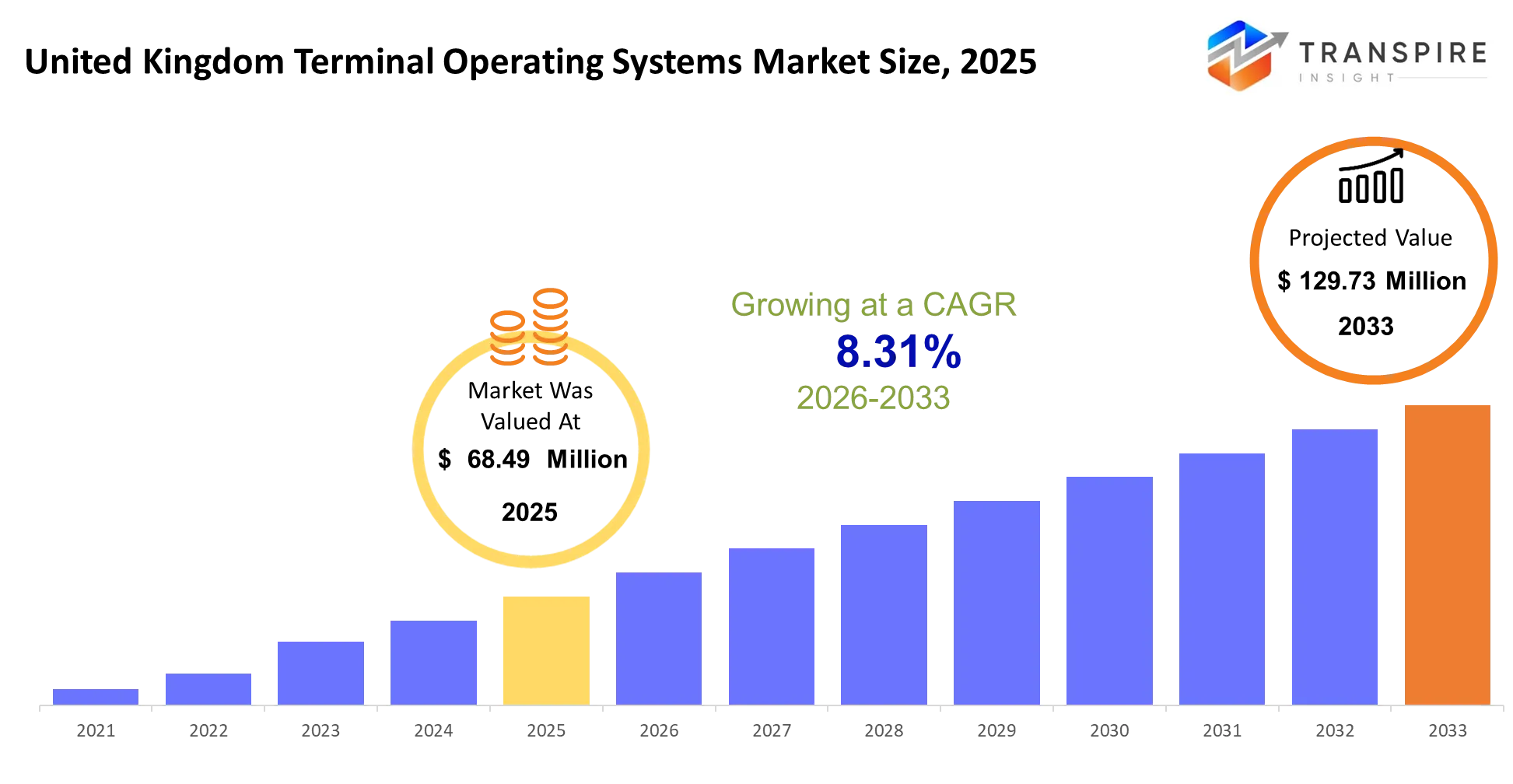
United Kingdom Terminal Operating Systems Market Size & Forecast:
- United Kingdom Terminal Operating Systems Market Size 2025: USD 68.49 Million
- United Kingdom Terminal Operating Systems Market Size 2033: USD 129.73 Million
- United Kingdom Terminal Operating Systems Market CAGR: 8.31%
- United Kingdom Terminal Operating Systems Market Segments: By Component (Software Platforms, Analytics Tools, Automation Systems, Cloud Services, Others); By Deployment (Cloud-based, On-premise, Hybrid Systems, Others); By Application (Container Terminal Operations, Cargo Management, Yard Management, Vessel Scheduling, Others); By End User (Ports, Shipping Companies, Logistics Providers, Terminal Operators, Others)
To learn more about this report,  Download Free Sample Report
United Kingdom Terminal Operating Systems Market Summary
The United Kingdom Terminal Operating Systems Market was valued at USD 68.49 Million in 2025. It is forecast to reach USD 129.73 Million by 2033. That is a CAGR of 8.31% over the period.
In the United Kingdom, terminal operating systems are basically coordinating container movement, yard planning, vessel scheduling, and gate operations across ports, which helps cut down on delays, and gives operators + shipping lines a clearer view, even if it sometimes feels a bit messy in practice. Over the last 3–5 years , there has been a structural shift toward cloud-based and AI-enabled yard optimization, swapping out legacy on-premise systems that were never really built for this kind of pace.
Brexit and COVID-19 supply chain disruptions kinda forced the timeline forward, and congestion at big ports like Felixstowe and Southampton showed where manual coordination breaks, and where older software just can’t keep up. So terminals digitized faster, spending more on real-time data integration, automation, and predictive scheduling. That has improved turnaround times and asset utilization, while also supporting recurring SaaS based revenue models, not just one-off licenses. Because of all that, ports and logistics operators are now prioritizing interoperable platforms that link stakeholders through the whole supply chain, and procurement decisions are shifting toward long-term digital infrastructure investments, instead of quick, short-term upgrades.
Key Market Insights
- Southern ports really do dominate the United Kingdom Terminal Operating Systems Market, with almost 55% share, because those high-capacity container throughput hubs stay busy and kinda keep pulling demand their way.
- London and the Southeast corridors still lead overall, mainly from deeper integration with multimodal logistics, plus the higher pull of high-value cargo handling infrastructure, that customers want like yesterday.
- Cloud based TOS platforms are taking the spotlight and are leading the market too, grabbing roughly 48% share in 2025 deployments, which tells a clear story.
- Meanwhile on-premise systems stay as the second-largest option, tied to legacy port infrastructure and those security driven procurement preferences you often see in critical terminals.
- AI driven predictive scheduling tools are the quickest moving segment, growing fast between 2024–2030, for congestion reduction efficiency and smoother movements through bottlenecks.
- For what it covers, container terminal operations dominate with nearly 60% share, reflecting how much UK trade depends on maritime freight flows, more than people sometimes assume.
- Yard management systems are showing the fastest growth too, since ports focus on real time container tracking and automation upgrade paths.
- Gate automation applications are also rising, because operators want shorter truck dwell time and quicker customs clearance cycles, that kind of pressure matters a lot.
- Large seaport operators remain the main end-users, holding over 50% share in the United Kingdom Terminal Operating Systems Market.
- And inland container depots look like the fastest-growing end-user category, helped by rail linked logistics expansion and the steady rise of e-commerce distribution demands.
What are the Key Drivers, Restraints, and Opportunities in the United Kingdom Terminal Operating Systems Market?
In the United Kingdom Terminal Operating Systems market , the main push is this fast move to cloud-native setups and automation led terminal management, and it got a bit faster after Brexit driven border complication and the COVID-19 port congestion stuff. Those shocks basically revealed how messy manual scheduling can be, plus how the legacy tools are split up and they dont talk well, so port operators are leaning toward more unified digital platforms. These platforms help with real-time vessel coordination, yard optimization, and even predictive berth planning. When terminals start using AI enabled optimization tools, they often cut vessel turnaround times, and they raise asset utilization too, so throughput capacity goes up in practice. That also keeps feeding the ongoing SaaS type revenue model for vendors , because everyone wants recurring income and steady contracts.
The biggest brake, though, is the stubborn staying power of older terminal infrastructure in most major UK ports. Quite a few sites run hybrid systems that werent really built for clean interoperability with newer cloud platforms, so the migration path becomes complex, expensive, and kind of operationally risky. This kind of structural limitation makes full modernization move slower, since ports usually can’t just pause operations during transition, especially not in high-volume places like Felixstowe and Southampton. On top of that, there are tough cybersecurity rules plus data sovereignty obligations, so compliance expenses grow, and that tends to delay adoption. In the end, it also mutes vendor revenue momentum in the short term.
A big chance sits in, the build out of inland container depots, along with AI- based digital twin rollout across the whole port ecosystem, sort of thing. Capital is flowing into rail connected logistics corridors and automation-ready inland terminals. This is fueling the need for systems that are scalable and easily swapped between stakeholders, not just tied to coastal harbors. Suppliers that combine predictive analytics with real-time cargo awareness over multimodal routes are already well placed to tap into the next growth phase in the United Kingdom Terminal Operating Systems Market.
What Has the Impact of Artificial Intelligence Been on the United Kingdom Terminal Operating Systems Market?
In the United Kingdom Terminal Operating Systems ecosystem, artificial intelligence is getting built into scrubber performance systems and exhaust gas cleaning technology management, where sensors and AI models constantly track emission compliance across vessels and port equipment. Terminal operators are now leaning on AI-enabled control systems to automate fleet compliance tracking, which cuts down those manual inspection cycles, and keeps everything lined up with IMO emission standards, via real-time monitoring dashboards.
Machine learning is also changing the predictive side inside marine emission control systems. The algorithms chew through historical equipment performance, weather conditions, and operational loads, then try to forecast scrubber degradation, so predictive maintenance scheduling can happen before failures even show up. In a number of UK port setups, this has pushed equipment uptime up by something like 10–15% , while also lowering unplanned maintenance costs and trimming fuel inefficiencies tied to less-than-ideal vessel servicing cycles. AI-based optimization tools further assist with emissions forecasting, and that helps operators shift when port activity happens, aiming to blunt peak pollution intensity, and improve regulatory reporting accuracy , at the same time.
Still, adoption is not completely smooth because there’s a big structural drag: fragmented, low-quality real-world maritime data. A lot of terminals and vessels don’t yet have consistent IoT integration, and offshore connectivity gaps mean continuous data streaming doesn’t really hold up. As a result model accuracy drops in fast-changing sea conditions, and teams end up relying on partially trained systems more often, which slows full-scale AI deployment across the United Kingdom Terminal Operating Systems Market.
Key Market Trends
- Since around 2021, UK ports kind of moved away from those patchwork legacy dispatch setups and into more integrated cloud platforms, and, as a result, real time cargo visibility has got better, even if adoption wasn’t exactly uniform.
- After the 2022 congestion episodes, the whole automation first terminal approach went further, with Felixstowe and Southampton ramping up digital berth allocation tooling , trying to squeeze out more vessel waiting time.
- Then from 2023 onward, AI enabled predictive maintenance became much more common, and it reportedly reduced unplanned equipment downtime by about 12% across the more digitally mature UK terminals.
- On the compliance side, cybersecurity expectations got stricter under the post Brexit frameworks, so vendors had to redo parts of their terminal operating architecture to keep secure cross border data exchange in place.
- Meanwhile, by 2024, inland container depots increased their digital interconnection too, transitioning from manual scheduling into more synchronized rail road container tracking systems.
- Vendor competition also heated up. Navis (Cargotec) along with several European software companies pushed more SaaS style deployments, basically across UK maritime hubs.
- And because IMO related pressure grew, ports expanded real time emissions monitoring systems, which in turn led to wider adoption of AI assisted fuel optimization and scrubber tracking tools.
- Cloud migration kept speeding up during 2022–2025, and nearly half of the upgrades in UK terminals leaned toward scalable subscription based software rather than the older licensing model.
- Lastly, data interoperability issues eased gradually as standardized API frameworks became more established , which helped terminal operators, shipping lines and logistics providers plug together more smoothly.
United Kingdom Terminal Operating Systems Market Segmentation
By Component :
Software platforms are basically the root of terminal work across UK ports, and they help with scheduling, cargo tracking, and gate coordination in the day to day running. Over time these platforms went from separate old school, mostly stand alone systems, to more integrated digital cores, that somehow link many port functions together, in near real time. At the same time analytics tools are now used to help people make operational choices, because they can process huge amounts of cargo and vessel data, which boosts planning accuracy, and it also helps cut down on delays
Automation systems are also getting wider use, as ports try to reduce manual handling in the yard and along the berth, so container movement stays more consistent. Cloud services are getting more traction too, since terminals are moving away from hardware heavy infrastructure toward setups that are easier to scale, and can be managed remotely. There are also a few other bits, like specialist integration tools that support interoperability between shipping lines, customs systems, and logistics networks, so the supply chain coordination is smoother, across multiple steps
By Deployment :
Cloud based deployment is now a leading pick for UK terminals, because operators want scalability and quicker software updates, without having to change major parts of their infrastructure, you know. At the same time it gives real time access to operational data, and it cuts down the need to rely so much on physical IT setups. Still, on premise deployment stays common in high security terminals, where having tighter control over data and systems is basically the whole point.
Hybrid systems are getting used more often as a way to keep operational flexibility, but also meet security needs, especially while places are doing a slow digital transition. With this approach, the most critical activities can stay local, while analytics and reporting, can run from cloud environments. Other options also exist, like customized deployments, built around specific port layouts where older systems cannot really be swapped out quickly.
By Application :
Container terminal operations are the core zone, basically supporting container handling, piling and movement coordination across ports in the UK. These systems help cut turnaround time by lining up vessel arrivals with what’s available in the yard, also making sure equipment allocation is consistent. Cargo management applications backtracking and the paperwork routines that normally reduce slip ups during freight handling.
Meanwhile yard management systems have become increasingly important because ports want better space use, and faster container retrieval through more digital planning tools. Vessel scheduling applications also matter, since they match berth availability with shipping line timetables, so congestion and idle time can drop. Other software also shows up like gate operations plus customs coordination systems, which together improve the full, end to end cargo flow efficiency.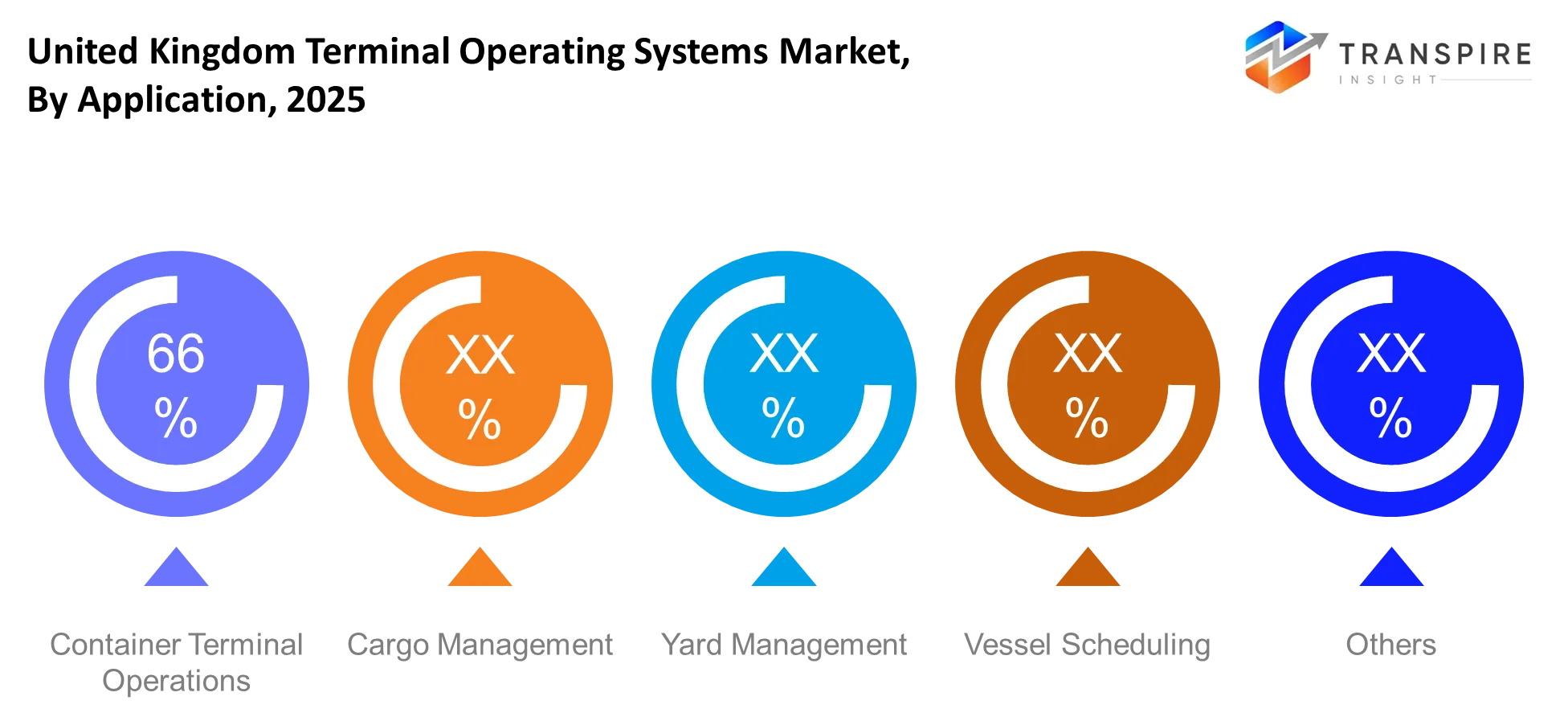
To learn more about this report, Download Free Sample Report
By End User :
Ports are still the main end users, they use terminal operating systems to handle big cargo flows and get better operational efficiency across several terminals. In practice these setups help coordinate things like vessels, yard equipment, and workforce allocation too, so delays can go down and throughput stays more consistent across the big UK maritime hubs.
Meanwhile, shipping companies are leaning more on integrated systems for schedule visibility that is less shaky and for cargo tracking during port calls, and logistics providers also tap into these tools to make inland distribution planning smoother, plus they aim to cut down container dwell time at terminals. Terminal operators meanwhile keep putting money into digital platforms, to push automation a bit further, make resource utilization more effective, and to support longer term infrastructure modernization across the United Kingdom, basically within the Terminal Operating Systems Market.
What are the Key Use Cases Driving the United Kingdom Terminal Operating Systems Market?
Container terminal operations still stay pretty much the main use case pushing demand in the United Kingdom Terminal Operating Systems Market, because big ports rely on somehow coordinated container handling, berth planning and yard optimization to move huge cargo volumes with less fuss. It’s the strongest demand generator too, since it messes directly with vessel turnaround time, the whole port congestion picture and the throughput revenue that ports actually care about.
Cargo tracking plus yard optimization keep growing, especially with logistics providers and inland container depots that want better situational awareness of container movement across those multimodal routes. On top of that, vessel scheduling tools are getting a lot more attention from shipping companies who want tighter timing between arrival windows and port capacity, to lower waiting penalties and avoid day to day operational lags.
Newer applications that are starting to show up include AI driven emissions monitoring tied into port compliance systems and digital twin models used for terminal simulation. These are being tested more often by terminal operators and ports that now work under stricter environmental rules, where predictive planning and near real time optimization will support long term efficiency , plus keep regulatory alignment less stressful.
|
Report Metrics |
Details |
|
Market size value in 2025 |
USD 68.49 Million |
|
Market size value in 2026 |
USD 74.18 Million |
|
Revenue forecast in 2033 |
USD 129.73 Million |
|
Growth rate |
CAGR of 8.31% from 2026 to 2033 |
|
Base year |
2025 |
|
Historical data |
2021 - 2024 |
|
Forecast period |
2026 - 2033 |
|
Report coverage |
Revenue forecast, competitive landscape, growth factors, and trends |
|
Regional scope |
Middle East and Africa (Saudi Arabia, United Arab Emirates, South Africa, Rest of Middle East and Africa) |
|
Key company profiled |
Navis, Tideworks Technology, Kaleris, SAP, Oracle, ABB, CyberLogitec, CMA CGM, DP World, INFORM GmbH, Zebra Technologies, TBA Group, Jade Logistics, Wipro, IBM |
|
Customization scope |
Free report customization (country, regional & segment scope). Avail customized purchase options to meet your exact research needs. |
|
Report Segmentation |
By Component (Software Platforms, Analytics Tools, Automation Systems, Cloud Services, Others); By Deployment (Cloud-based, On-premise, Hybrid Systems, Others); By Application (Container Terminal Operations, Cargo Management, Yard Management, Vessel Scheduling, Others); By End User (Ports, Shipping Companies, Logistics Providers, Terminal Operators, Others) |
Which Regions are Driving the United Kingdom Terminal Operating Systems Market Growth?
The South East England corridor kinda leads the United Kingdom Terminal Operating Systems Market mainly because it has a big pile of high-capacity ports ,like Felixstowe and Southampton. There are strong customs digitization policies plus newer port automation initiatives, so terminals keep putting money into their operating platforms. On top of that, the maritime traffic is dense and those routes to major European trade lanes are close by, which helps keep system utilization pretty high across container and logistics hubs. Also, there’s a mature ecosystem made up of logistics providers, shipping lines and port authorities, and that mix keeps long-term upgrades moving forward for digital infrastructure.
Meanwhile the North West region, with Liverpool and nearby industrial harbors, plays more of a steady supporting part in the market. It’s a bit different than the South East, growth here is less about raw scale and more about industrial export consistency plus long-term agreements with manufacturing teams and automotive shippers. Port operations tend to lean into reliability and more stable cargo movements instead of chasing high-frequency container throughput. So demand shows up for terminal systems that stress operational continuity and cost efficiency more than a rapid push toward full automation expansion.
Scotland is starting to look like the fastest-growing area, mostly tied to renewed investment in renewable energy logistics ports and modernization of offshore supply chains. Recent infrastructure improvements connected to offshore wind buildup have, since 2024, sped up adoption of digital terminal platforms. On top of that, public funding for port modernization boosts connectivity between coastal terminals and inland distribution networks. All of this hints at solid entry chances for technology providers, as Scotland positions itself as a strategic hub in the United Kingdom Terminal Operating Systems Market from 2026 to 2033.
Who are the Key Players in the United Kingdom Terminal Operating Systems Market and How Do They Compete?
Competition in the United Kingdom Terminal Operating Systems Market is kind of moderately consolidated, with a small set of big global vendors steering the core terminal deployments, while smaller niche providers tend to concentrate on specialized modules you know, the more specific pieces. In practice, what matters most is how well a vendor handles cloud integration, how accurate their AI based scheduling really is, and whether their systems play nicely with port equipment and related interfaces. Also, long term contracts with major ports keep incumbents sticky in a way that’s hard to break, but then SaaS focused entrants push pricing down, because they can roll out faster and they require less infrastructure dependence.
Navis (Cargotec) leans into AI driven terminal optimization, plus cloud enabled operating suites that aim to boost berth planning and yard efficiency at large ports. Their edge is tied to predictive analytics integration, which makes it possible for terminals to cut congestion and lift vessel turnaround performance, even when conditions change. Tideworks Technology shows up with a modular system setup for mid sized terminals, where the priority is flexible deployment without swapping out the whole infrastructure, and that “without replacement” part is a major selling angle. INFORM GmbH, in turn, differentiates by using algorithmic scheduling tools that improve yard allocation and vessel sequencing efficiency, especially where terminals have complicated operational flows, not just the simpler patterns.
ABB also strengthens its stance by pairing automation hardware with terminal software, so there is tighter coordination between control systems and physical port equipment. Konecranes, meanwhile, focuses on crane automation and digital equipment control systems that link directly with terminal platforms to improve operational precision, sometimes with less manual intervention. Together these players keep expanding through strategic partnerships with port authorities, and through incremental upgrades that try to align the digital layers with electrified and automated port infrastructure, even if that alignment happens in stages.
Company List
- Navis
- Tideworks Technology
- Kaleris
- SAP
- Oracle
- ABB
- CyberLogitec
- CMA CGM
- DP World
- INFORM GmbH
- Zebra Technologies
- TBA Group
- Jade Logistics
- Wipro
- IBM
Recent Development News
In April 2026, DP World accelerated the integration of advanced digital terminal operating system capabilities at its UK flagship London Gateway terminal as part of broader automation upgrades. The initiative focused on real-time cargo visibility and AI-based scheduling to improve container throughput efficiency. Source http://en.wikipedia.org/
In March 2026, Navis (a Kaleris company) reported continued deployment growth of its N4 terminal operating system across major European ports serving UK trade routes, with upgrades emphasizing cloud migration and predictive analytics for container handling optimization. Source https://theintechgroup.com/
What Strategic Insights Define the Future of the United Kingdom Terminal Operating Systems Market?
The United Kingdom Terminal Operating Systems Market is, sort of, moving toward fully integrated cloud native port ecosystems where decisions are being made more and more by automated AI orchestration layers. This whole shift is pushed by the need to cut vessel turnaround time, while also dealing with stricter environmental compliance , and the fact that cargo demand is a bit more volatile across European trade routes. In the next 5–7 years, terminal systems won’t just stay as operational tools anymore. They’re likely to become predictive control platforms, coordinating ports, logistics networks, and inland distribution in real time.
There’s also a less obvious risk, one that doesn’t get talked about enough, which is growing platform concentration among a small number of large global software providers. That situation could reduce procurement flexibility for UK ports, and also lock them into proprietary ecosystems for a long time. It might even make innovation cycles slower, if interoperability standards aren’t actually enforced in practice. Meanwhile, edge computing enabled terminal autonomy is starting to appear as an underrated opportunity, especially for secondary ports where cloud latency, plus connectivity limits , can be a persistent headache.
Market participants should focus on modular, interoperable system designs that let AI be added step by step, without forcing a full infrastructure replacement. That approach should support resilience, and at the same time help capture the longer-term demand tied to digital transformation.
United Kingdom Terminal Operating Systems Market Report Segmentation
By Component
- Software Platforms
- Analytics Tools
- Automation Systems
- Cloud Services
By Deployment
- Cloud-based
- On-premise
- Hybrid Systems
By Application
- Container Terminal Operations
- Cargo Management
- Yard Management
- Vessel Scheduling
By End User
- Ports
- Shipping Companies
- Logistics Providers
- Terminal Operators
Frequently Asked Questions
Find quick answers to common questions.
The United Kingdom Terminal Operating Systems Market size is USD 129.73 Million in 2033.
Key Segments for the United Kingdom Terminal Operating Systems Market are By Component (Software Platforms, Analytics Tools, Automation Systems, Cloud Services, Others); By Deployment (Cloud-based, On-premise, Hybrid Systems, Others); By Application (Container Terminal Operations, Cargo Management, Yard Management, Vessel Scheduling, Others); By End User (Ports, Shipping Companies, Logistics Providers, Terminal Operators, Others).
Major United Kingdom Terminal Operating Systems Market Players are Navis, Tideworks Technology, Kaleris, SAP, Oracle, ABB, CyberLogitec, CMA CGM, DP World, INFORM GmbH, Zebra Technologies, TBA Group, Jade Logistics, Wipro, IBM.
The Current United Kingdom Terminal Operating Systems Market size is USD 68.49 Million in 2025.
The United Kingdom Terminal Operating Systems Market CAGR is 8.31% from 2026 to 2033.
- Navis
- Tideworks Technology
- Kaleris
- SAP
- Oracle
- ABB
- CyberLogitec
- CMA CGM
- DP World
- INFORM GmbH
- Zebra Technologies
- TBA Group
- Jade Logistics
- Wipro
- IBM
Recently Published Reports
-
Apr 2026
3D Optical Profiler Market
3D Optical Profiler Market Size, Share & Analysis Report By Type (Desktop 3D Optical Profiler, and Portable 3D Optical Profiler), By Technology (Confocal Technology, and White Light Interference), By End-Use Industry (Manufacturing, Research Institutions, Automotive, Aerospace and Defense, Medical Devices, and Other), and Geography (North America, Europe, Asia-Pacific, Middle East and Africa, South and Central America), 2021 - 2031
-
Apr 2026
Depth Sensor Market
Depth Sensor Market Size, Share & Analysis Report By Type (Infrared Depth Sensors, Time-of-Flight (ToF) Sensors, Stereo Vision Sensors, Structured Light Sensors, Ultrasonic Depth Sensors), By Application (Automotive, Robotics, Gaming, Consumer Electronics, Industrial Automation, Healthcare, Security & Surveillance, Others), By End Users (Automotive Manufacturers, Consumer Electronics Companies, Healthcare Providers, Industrial Companies, Security Agencies, Gaming Companies, Robotics Companies, Others), and Geography (North America, Europe, Asia-Pacific, Middle East and Africa, South and Central America), 2021 – 2031
-
Apr 2026
Digital Manufacturing Market
Digital Manufacturing Market Size, Share & Analysis Report By Component (Hardware, Software, and Services), By Technology (Robotics, 3D Printing, Internet of Things (IoT), and Others), By Application (Automotive and Transportation, Aerospace and Defense, Consumer Electronics, Industrial Machinery, and Others), By Process Type (Computer-Based Designing, Computer-Based Simulation, Computer 3D Visualization, Analytics, and Others), and Geography (North America, Europe, Asia-Pacific, Middle East and Africa, South and Central America), 2021 – 2031
-
Apr 2026
Digital Visa Services Market
Digital Visa Services Market Size, Share & Analysis Report By Type (Individual Travelers, Group Travelers), By Application (Tourism, Business Travel, Others), and Geography (North America, Europe, Asia-Pacific, Middle East and Africa, South and Central America), 2021 – 2031