

Middle East and Africa Warehouse Automation Market Size & Forecast:
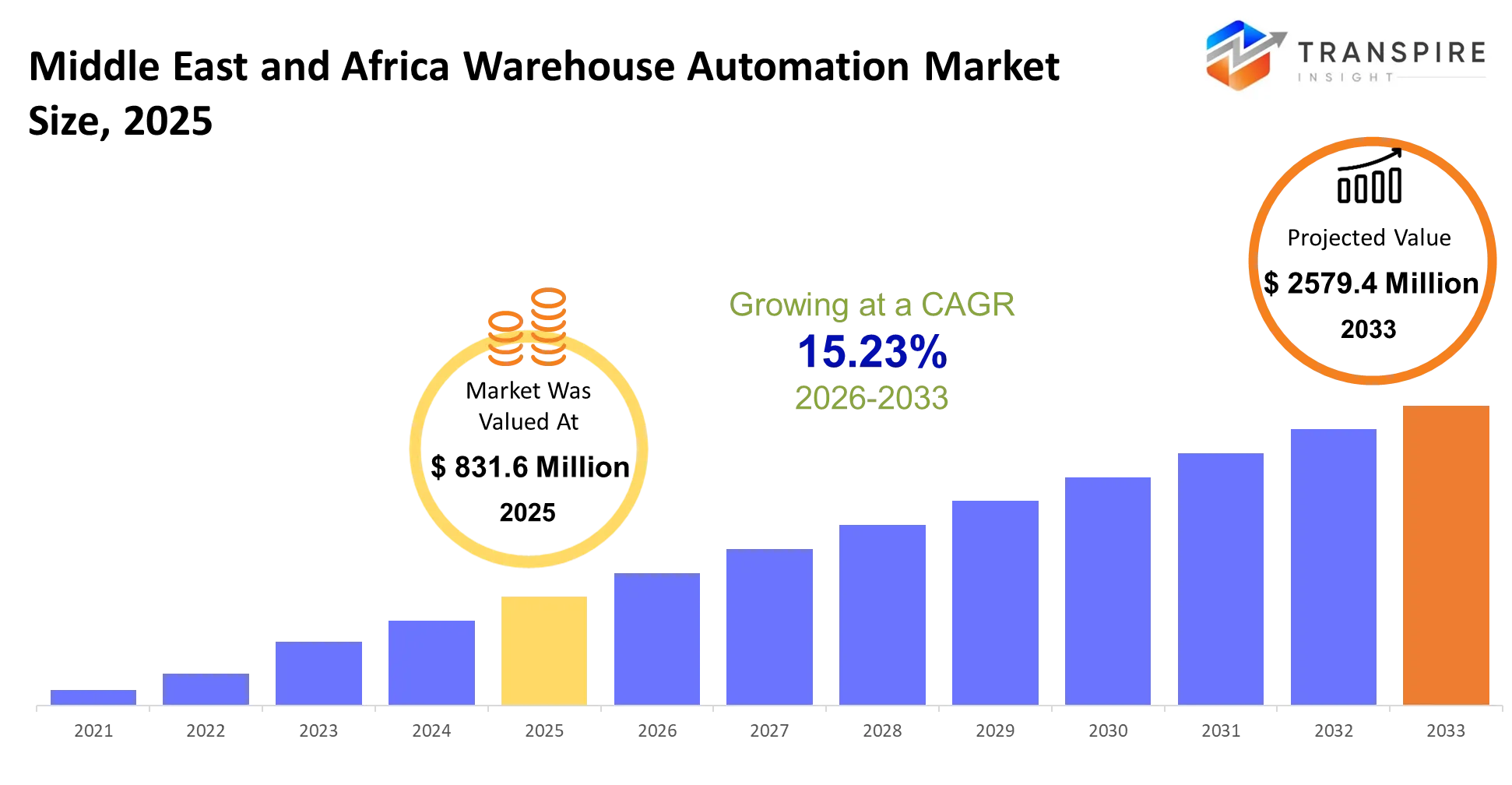
- Middle East and Africa Warehouse Automation Market Size 2025: USD 831.6 Million
- Middle East and Africa Warehouse Automation Market Size 2033: USD 2579.4 Million
- Middle East and Africa Warehouse Automation Market CAGR: 15.23%
- Middle East and Africa Warehouse Automation Market Segments: By Type (Robotics, Software, Conveyor Systems, Automated Storage Systems, Picking Systems, Others); By Application (Inventory Management, Order Fulfillment, Packaging, Sorting, Distribution, Returns Handling, Others); By End-User (E-commerce, Retail, Manufacturing, Logistics Companies, 3PL Providers, Warehousing Firms, Others); By Deployment (Cloud, On-premise, Hybrid, Others)
To learn more about this report,  Download Free Sample Report
Middle East and Africa Warehouse Automation Market Summary
The Middle East and Africa Warehouse Automation Market was valued at USD 831.6 Million in 2025. It is forecast to reach USD 2579.4 Million by 2033. That is a CAGR of 15.23% over the period.
The Middle East & Africa Warehouse Automation Market helps logistics operators, retailers, and manufacturers move, store, and dispatch goods with very little hand work by bringing together robotics, automated storage systems, and AI based warehouse control platforms. In real life, it tackles stubborn issues tied to order fulfillment speed, inventory correctness, and labor heavy warehouse routines across high-output distribution hubs, plus scattered African logistics networks. It also backs quicker last-mile drop offs, smoother port-to-warehouse transfers, and bigger, more flexible inventory management in economies that really depend on trade.
Over the past 3 to 5 years, the market kinda drifted from single mechanized units toward more complete digital warehouse ecosystems that mix robotics, cloud software, and predictive analytics, it just… feels more connected now. The push behind GCC logistics modernization projects,and the quick rise of online commerce, drove these wider automation roll outs, especially once COVID-19 showed how fragile supply chains can be and how labor constraints were becoming a real issue.That upheaval made firms lean into resilience and throughput improvements. So, investment levels increased for AI enabled fulfillment systems, and modular warehouse designs too. Now adoption is being pulled mainly by cost cutting pressure, throughput efficiency goals, and the requirement for live inventory awareness across multi location distribution networks.
Key Market Insights
- GCC kind of dominates the Middle East and Africa Warehouse Automation Market with around 48% share in 2025, because of advanced logistics infrastructure and pretty strong e-commerce penetration, yes.
- In the meantime, Africa is the fastest-growing region (2026–2033) , pushed by port modernization, retail digitization, and more and more 3PL warehouse investments.
- UAE and Saudi Arabia keep leading regional adoption, thanks to smart city logistics initiatives plus national supply chain transformation programs that are kind of everywhere now.
- At the same time, the emerging African corridors are expanding automation rollouts through public-private logistics infrastructure partnerships, gradually but consistently.
- When it comes to systems, automated storage systems take the largest share at above 35% in 2025, due to the high-density warehousing demand, it’s pretty clear.
- Robotics solutions are sitting as the second-largest segment, driven by labor optimization and high-volume fulfillment demands that are rising.
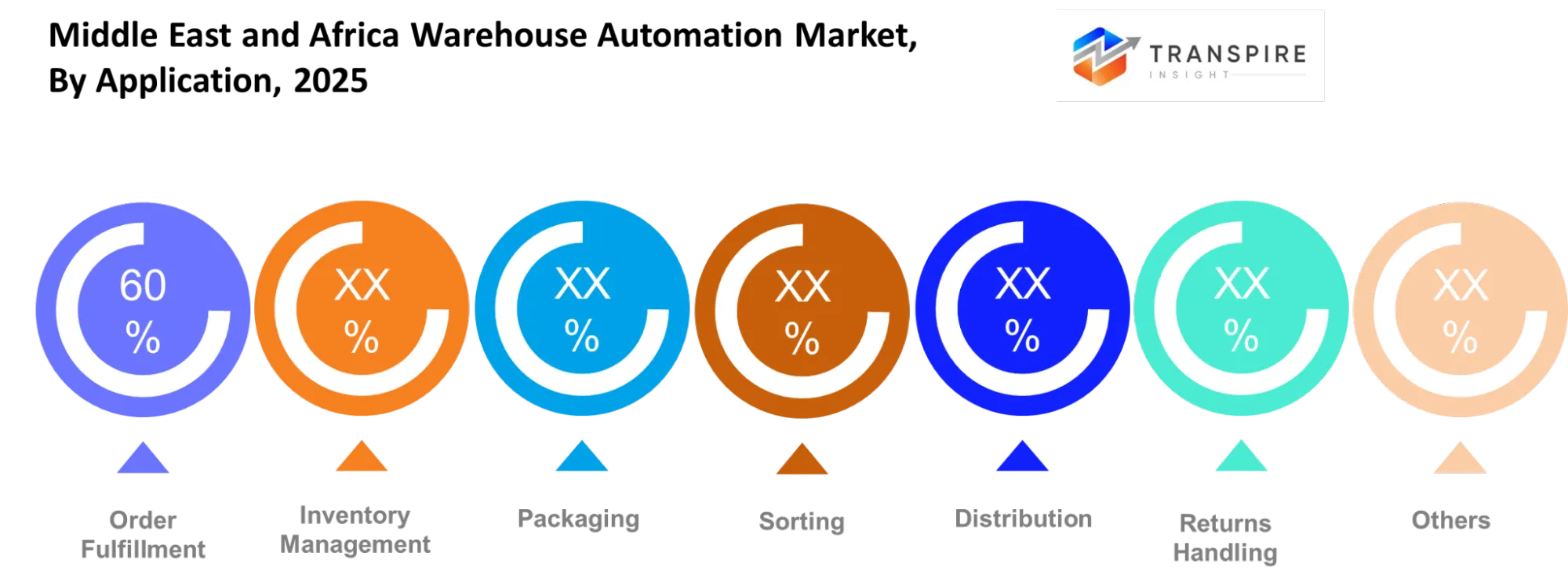
- For applications, AI-Order fulfillment leads with nearly 42% share, mostly because e-commerce keeps accelerating and same-day delivery expansion is widening.
- Inventory management is actually the fastest-growing application as retailers move toward real-time stock visibility systems, instead of older methods.
- Meanwhile, e-commerce companies lead adoption, holding over 40% share due to rapid online retail growth that doesn’t slow down.
- Lastly, 3PL providers represent the fastest-growing end-user group, driven by the shift toward outsourced logistics demand, more outsourcing, more automation.
What are the Key Drivers, Restraints, and Opportunities in the Middle East and Africa Warehouse Automation Market?
The primary driving force behind the Middle East and Africa Warehouse Automation Market is this rapid reworking of supply chains toward fast e-commerce fulfillment and that sort of distributed logistics setup. It really started to speed up once regional retailers and 3PL operators in the GCC began widening same-day delivery options, and then—without much pause—warehouses had to shift toward robotics, AI based sorting systems, and automated storage platforms. With order volumes climbing and labor availability tightening up, automation stopped being some “nice to have” efficiency add-on. Instead it became a core operational must, which then boosted deployment rates, and also pushed up software licensing revenues across big distribution centers.
One of the biggest blockers is the uneven digital maturity of mid-tier logistics operators, especially across African markets. In those places the warehouse infrastructure feels scattered, so full system integration gets limited. A lot of facilities still lean on partial manual workflows, and that makes it structurally hard to roll out end-to-end automation unless someone is willing to do a major capital revamp. Because of that, there’s this long replacement cycle, and it basically dampens short-term revenue growth for solution providers. It also delays the standardization of warehouse execution systems, across much of the region, even when demand is there.
A major new opportunity is modular micro-fulfillment automation, tied into urban retail plus cold-chain pharmaceutical distribution. Early pilots in Saudi Arabia and the United Arab Emirates suggest people are increasingly interested in smaller robotic units that can be fitted into current retail back rooms and hospital supply hubs. So this trend basically frames modular plug-and-play automation platforms as the next real investment focus, especially for vendors trying to serve dense urban logistics ecosystems through 2030.
What Has the Impact of Artificial Intelligence Been on the Middle East and Africa Warehouse Automation Market?
Artificial intelligence is kind of reshaping warehouse automation systems across the Middle East and Africa , by enabling real time orchestration of robotics , conveyors, and inventory workflows. AI-driven warehouse execution platforms now automate task allocation, optimize picking routes, and manage robotic fleets inside high volume distribution centers. These setups reduce the need for constant manual supervision , while also improving synchronization between automated storage sorting, and packaging units in e-commerce and 3PL facilities.
Machine learning models increasingly support predictive maintenance across robotic arms, shuttle systems and conveyor networks. Operators use sensor data to forecast equipment wear, spot obstacles in fulfillment cycles, and fine tune load balancing across multi zone warehouses. In several GCC logistics hubs , predictive systems have improved equipment uptime by an estimated 10–18 percent while also cutting unplanned downtime tied to mechanical failures, and software delays.
AI integration also boosts cost effectiveness and regulatory compliance, mostly because inventory exactness improves and order handling mistakes drop, by as much as 25 percent in automated facilities. Still, adoption has a key ceiling because integration expenses can be high when legacy warehouse infrastructure is already there , especially for mid sized African logistics firms that do not have standardized digital setups. That cost wall ends up delaying wider rollout, even if intelligent automation platforms deliver genuine efficiency gains.
Key Market Trends
- Since 2022, GCC logistics operators have been kinda swapping manual sorting lines out with AI robotics, to keep up with those rising same-day delivery demands.
- In 2024–2025, e-commerce players across Saudi Arabia and UAE expanded automated storage setups, aiming to cut warehouse footprints by almost 40 percent.
- Manufacturing firms also moved away from standalone conveyor systems, toward integrated warehouse execution platforms, after labor shortages started messing with production timelines, and honestly it showed.
- In 2023, 3PL providers started leaning into cloud based warehouse management systems a bit more, so they could sync multi client inventory across different regional hubs, more or less at once.
- Retail distributors dialed back their reliance on on premise legacy software after cybersecurity upgrades boosted confidence, in hybrid automation architecture .
- Then robotics vendors pushed harder partnerships with logistics integrators, because after 2024 there was stronger demand for modular , scalable fulfillment systems across Africa .
- Pharmaceutical warehouses introduced automated picking systems when traceability rules tightened up , and compliance enforcement became more strict across cold chain logistics.
Middle East and Africa Warehouse Automation Market Segmentation
By Type
Automated storage systems are currently holding the dominant position, partly because demand for high density warehousing is rising across e-commerce and retail logistics hubs. In many GCC distribution centers, operators focus on space optimization and quicker retrieval cycles , so adoption of shuttle based setups and AS/RS solutions keeps moving ahead compared with manual storage arrangements. Robotics and conveyor systems come next, more like supporting companion technologies, and they help boost throughput efficiency in those high volume fulfillment environments.
Meanwhile, software solutions and picking systems show faster growth momentum, because warehouse teams now care more about orchestration and accuracy than about simply expanding standalone hardware. AI enabled warehouse management platforms improve coordination between robotics, conveyors and inventory systems, which cuts down operational delays in multi node distribution networks. Also, rising labor costs and stricter accuracy expectations in last mile delivery push the shift toward intelligent automation layers, pretty consistently.
Looking ahead , future growth should concentrate on integrated automation ecosystems that blend robotics with software driven orchestration. Investors and developers will likely steer toward modular systems, so teams can scale upgrades without replacing the entire infrastructure , end to end. And demand is expected to rise for interoperable platforms that can handle multi tenant logistics plus rapid fulfillment cycles.
By Application
Order fulfillment basically leads the application landscape because e-commerce penetration keeps rising, and also omnichannel retail models are expanding, pretty fast across urban centers. Warehouses are going with automated picking and sorting systems to hit same-day delivery expectations and cut down on how much they rely on manual labor. Inventory management comes in right behind that, since retailers want real-time stock visibility and fewer losses.
Packaging and distribution applications are also picking up steam, especially in manufacturing and 3PL settings where efficiency and throughput decide how competitive a service feels. Returns handling grows too, with reverse logistics expanding as online retail keeps getting bigger. Logistics providers are starting to fold in automation more often, to reduce processing time and make warehouse turnaround cycles better, faster.
Looking ahead, demand will tilt toward end-to-end automated fulfillment ecosystems, not just standalone applications. Operators will invest in systems that tie inventory tracking, packaging, and distribution into one digital command layer. Overall, this shift is expected to boost demand for software-centric automation platforms.
To learn more about this report, Download Free Sample Report
By End-User
E-commerce firms take the lead in adoption because order volumes are rising quickly, and they face constant pressure to reduce delivery timelines across competitive city markets. Retail chains follow close behind, since omnichannel strategies basically need integrated inventory and fulfillment automation working together. Logistics companies and 3PL providers are expanding deployment as well, mostly to handle multi-client warehouse operations in a more efficient way.
Manufacturing industries are, well, leaning harder into automation adoption to streamline spare parts handling and production-linked warehousing, which in turn helps reduce that usual chaos. Warehousing firms also push into scalable systems, so they can squeeze better space utilization and tame operational bottlenecks. Industrial supply chains in mining and automotive, sort of keep tightening up, which strengthens demand for those high-throughput systems that can move fast.
In the near future, growth should lean toward 3PL providers and hybrid logistics operators as outsourcing trends speed up across regional supply chains. Buyers will, more and more, favor flexible automation systems that support multi-sector operations within shared facilities. Vendors that can deliver customizable and quickly deployable solutions will, I mean, gain stronger competitive footing.
By Deployment
Cloud-based deployment still takes the largest share, mostly because it scales easily, needs lower upfront costs, and gives real-time data accessibility across spread-out warehouse networks. Big logistics operators lean on cloud platforms to coordinate inventory and optimize across multiple sites. Hybrid models are also getting attention especially where enterprises want some degree of control but still need scalability on demand.
On-premise systems are still relevant in high-security manufacturing setups and government-linked logistics environments, where data control matters and system reliability comes first. These deployments can also support legacy infrastructure integration in older warehouses. Still, cost pressures tend to cap large-scale expansion for fully on-premise models.
Looking ahead, adoption will increasingly tilt toward hybrid architectures that mix cloud intelligence with local execution systems. Software vendors will keep focusing on cybersecurity and interoperability so distributed automation networks can work smoothly together. Demand should rise for deployment models that enable real-time optimization without giving up operational control.
What are the Key Use Cases Driving the Middle East and Africa Warehouse Automation Market?
E-commerce fulfillment and retail distribution centers, kinda drive the core demand for the Middle East and Africa Warehouse Automation Market, mainly because operators push for quicker order processing and less reliance on manual labor. When the SKU volume is high and customers expect same day delivery, retailers end up using automated storage, sorting, and picking setups so throughput stays steady across those dense urban logistics hubs… which is basically the whole point, right.
Cold-chain logistics plus industrial spare parts warehousing are also growing fast, especially around pharmaceutical distributors and automotive aftermarket networks. In these areas, companies adopt automated storage and retrieval systems, to keep temperature rules intact, lower inventory shrinkage, and speed up service for important maintenance supply chains spanning manufacturing sites and mining operations.
On top of that, pharmaceutical micro fulfillment and airport cargo automation are starting to show real momentum as stricter regulatory tracking rules roll in, and air freight volumes keep rising. Airlines and logistics operators increasingly trial AI enabled cargo sorting, along with real time inventory visibility systems. This helps with faster customs clearance and better accuracy for high value, time sensitive shipments, even when everything gets chaotic.
|
Report Metrics |
Details |
|
Market size value in 2025 |
USD 831.6 Million |
|
Market size value in 2026 |
USD 956.3 Million |
|
Revenue forecast in 2033 |
USD 2579.4 Million |
|
Growth rate |
CAGR of 15.23% from 2026 to 2033 |
|
Base year |
2025 |
|
Historical data |
2021 - 2024 |
|
Forecast period |
2026 - 2033 |
|
Report coverage |
Revenue forecast, competitive landscape, growth factors, and trends |
|
Regional scope |
Middle East and Africa (Saudi Arabia, United Arab Emirates, South Africa, Rest of Middle East and Africa) |
|
Key company profiled |
Amazon Robotics, Dematic, Honeywell, Siemens, ABB, KUKA, Daifuku, SSI Schaefer, Vanderlande, TGW Logistics, Murata, Knapp, Oracle, SAP, Manhattan Associates |
|
Customization scope |
Free report customization (country, regional & segment scope). Avail customized purchase options to meet your exact research needs. |
|
Report Segmentation |
By Type (Robotics, Software, Conveyor Systems, Automated Storage Systems, Picking Systems, Others); By Application (Inventory Management, Order Fulfillment, Packaging, Sorting, Distribution, Returns Handling, Others); By End-User (E-commerce, Retail, Manufacturing, Logistics Companies, 3PL Providers, Warehousing Firms, Others); By Deployment (Cloud, On-premise, Hybrid, Others) |
Which Regions are Driving the Middle East and Africa Warehouse Automation Market Growth?
The Gulf region keeps being the dominant force in the Middle East and Africa Fuels Lubes and Petrochemicals Market , mostly because it has vertically integrated energy infrastructure, policy-backed industrial diversification, and direct access to global maritime trade routes. Countries like Saudi Arabia and United Arab Emirates run some of the world’s biggest refining and petrochemical hubs , and those connect to advanced export terminals across the Arabian Gulf . Strong state investment in downstream expansion keeps building momentum, plus large storage capacity and pretty sophisticated logistics networks, helps the region keep tighter influence over fuel and petrochemical exports. Also, long-term feedstock security and coordinated industrial planning back faster commercialization of specialty chemicals and synthetic lubricant output.
Southern Africa takes on a more muted role, focusing on steady domestic demand instead of export scale . South Africa, in particular, leverages mature mining operations, well established transportation systems, and relatively stable industrial fuel consumption patterns, so it is less exposed to short-term commodity jolts. Regulatory rollout tends to move slower than in Gulf economies , which gives fleet operators and manufacturers more room to schedule capital spending with better certainty. Steady procurement from mining , logistics and manufacturing, supports resilient downstream fuel and lubricant markets even when global energy conditions get jumpy.
West and East Africa are showing the strongest growth momentum lately, though it kind of feels uneven, as governments speed up fuel infrastructure upgrades and industrial corridor plans. Countries like Nigeria and Kenya have recently expanded refining capacity , modernized ports, and rolled out transportation investment programs after supply disruptions made the reliance on imported refined fuels pretty clear. At the same time fleet modernization initiatives and more active manufacturing are pushing up demand for high-performance lubricants, petrochemical feedstocks, and cleaner transportation fuels, not just one of those, but all at once. This trajectory should, in theory, open up major openings for storage operators, specialty chemical suppliers and downstream infrastructure investors over the period 2026–2033.
Who are the Key Players in the Middle East and Africa Warehouse Automation Market and How Do They Compete?
Competition across the Warehouse Automation market in the Middle East and Africa still looks moderately fragmented, in the sense that global automation providers are in the same ring as regional system integrators and robotics specialists. Lately, the fight feels more and more about software intelligence, fulfillment speed , and how well systems actually get integrated end to end , not only about equipment pricing. The big incumbents keep trying to hold on to share by using long-term logistics contracts and full automation platforms, but newer players tend to push flexible robotics solutions that suit the kind of growth you see in e-commerce and retail distribution networks. Also, geographic customization together with after-sales service strength is now a big deal, because many warehouse operators across the GCC and several African markets typically need scalable setups that match different infrastructure maturity levels, sort of, on the ground.
Daifuku Co., Ltd. is focused on high-throughput automated storage and retrieval systems aimed at large retail locations and airport logistics hubs across the Gulf area. Its strong linkage between conveyor automation, a warehouse management software layer , and predictive maintenance tools helps enable faster order processing while reducing labor reliance. Honeywell International Inc. differentiates with AI-enabled warehouse execution software, and also with voice-directed picking technologies that raise fulfillment precision inside high-volume distribution centers. Their expansion partnerships with regional logistics operators plus participation in smart infrastructure initiatives are supporting deployment momentum across Saudi Arabia and the United Arab Emirates.
KUKA AG specializes in robotics powered palletizing and industrial automation systems, kinda tailored for manufacturing and automotive supply chains. With flexible robotic setups and digital twin simulation features the warehouse operators can cut commissioning time down, and they can also make warehouse layouts more or less optimal before anything is actually installed. SSI SCHAEFER keeps growing, via modular fulfillment platforms meant for rapidly expanding e commerce warehouses across Africa and the Gulf. Their edge is pretty clear in customized cold-chain automation plus scalable shuttle systems, which makes the whole deal more competitive for food distribution and pharmaceutical logistics operators, who want quicker inventory handling and precise temperature controlled storage.
Company List
- Amazon Robotics
- Dematic
- Honeywell
- Siemens
- ABB
- KUKA
- Daifuku
- SSI Schaefer
- Vanderlande
- TGW Logistics
- Murata
- Knapp
- Oracle
- SAP
- Manhattan Associates
Recent Development News
“In April 2026, Dematic entered a strategic partnership with GreyOrange to expand AI-powered warehouse orchestration capabilities. The collaboration integrates GreyMatter software into Dematic’s automation ecosystem to improve fulfillment speed, robotic coordination, and operational flexibility across distribution centers, including Middle East logistics operations.https://www.prnewswire.com
“In January 2026, Dematic entered a partnership with Mohamed Naser AL Sayer & Sons to deploy an AutoStore warehouse automation system in Kuwait. The project reduced warehouse footprint requirements by 90% and established a benchmark for automated spare-parts logistics in the Middle East automotive sector.https://www.dematic.com
What Strategic Insights Define the Future of the Middle East and Africa Warehouse Automation Market?
The Warehouse Automation market through the Middle East and Africa is kind of drifting toward AI coordinated fulfillment ecosystems, where robotics, warehouse software, and predictive analytics kinda act like one unified infrastructure—not just separate, standalone equipment buys. At the same time rapid e-commerce growth, pressure to optimize workforce usage, and government supported logistics corridor programs are pushing this change forward especially across GCC distribution nodes. In the next five to seven years, competitive edge will be less about raw hardware deployment volume, and more about software interoperability, a scalable automation setup, and localized service know how.
There is also a quiet risk, like leaning heavily on imported robotics parts and semiconductor based control systems. That reliance may expose operators in the region to supply chain hiccups, plus slower rollouts if global manufacturing bottlenecks happen. Still, micro-fulfillment automation tied to temperature managed pharmaceutical and grocery distribution is showing up as a pretty strong opportunity, particularly in Gulf cities where same day delivery expectations keep rising. Market players should put attention on modular automation platforms and regional maintenance arrangements, so they can customize sooner, cut integration costs, and scale more easily across the many types of warehouse environments.
Middle East and Africa Warehouse Automation Market Report Segmentation
By Type
- Robotics
- Software
- Conveyor Systems
- Automated Storage Systems
- Picking Systems
- Others
By Application
- Inventory Management
- Order Fulfillment
- Packaging
- Sorting
- Distribution
- Returns Handling
- Others
By End-User
- E-commerce
- Retail
- Manufacturing
- Logistics Companies
- 3PL Providers
- Warehousing Firms
- Others
By Deployment
- Cloud
- On-premise
- Hybrid
- Others
Frequently Asked Questions
Find quick answers to common questions.
The estimated Middle East and Africa Warehouse Automation Market size is USD 2579.4 Million in 2033.
Key segments for the Middle East and Africa Warehouse Automation Market are By Type (Robotics, Software, Conveyor Systems, Automated Storage Systems, Picking Systems, Others); By Application (Inventory Management, Order Fulfillment, Packaging, Sorting, Distribution, Returns Handling, Others); By End-User (E-commerce, Retail, Manufacturing, Logistics Companies, 3PL Providers, Warehousing Firms, Others); By Deployment (Cloud, On-premise, Hybrid, Others).
Major Middle East and Africa Warehouse Automation Market players are Amazon Robotics, Dematic, Honeywell, Siemens, ABB, KUKA, Daifuku, SSI Schaefer, Vanderlande, TGW Logistics, Murata, Knapp, Oracle, SAP, Manhattan Associates.
The Middle East and Africa Warehouse Automation Market size is USD 831.6 Million in 2025.
The Middle East and Africa Warehouse Automation Market CAGR is 15.23% from 2026 to 2033.
- Amazon Robotics
- Dematic
- Honeywell
- Siemens
- ABB
- KUKA
- Daifuku
- SSI Schaefer
- Vanderlande
- TGW Logistics
- Murata
- Knapp
- Oracle
- SAP
- Manhattan Associates
Recently Published Reports
-
Apr 2026
3D Optical Profiler Market
3D Optical Profiler Market Size, Share & Analysis Report By Type (Desktop 3D Optical Profiler, and Portable 3D Optical Profiler), By Technology (Confocal Technology, and White Light Interference), By End-Use Industry (Manufacturing, Research Institutions, Automotive, Aerospace and Defense, Medical Devices, and Other), and Geography (North America, Europe, Asia-Pacific, Middle East and Africa, South and Central America), 2021 - 2031
-
Apr 2026
Depth Sensor Market
Depth Sensor Market Size, Share & Analysis Report By Type (Infrared Depth Sensors, Time-of-Flight (ToF) Sensors, Stereo Vision Sensors, Structured Light Sensors, Ultrasonic Depth Sensors), By Application (Automotive, Robotics, Gaming, Consumer Electronics, Industrial Automation, Healthcare, Security & Surveillance, Others), By End Users (Automotive Manufacturers, Consumer Electronics Companies, Healthcare Providers, Industrial Companies, Security Agencies, Gaming Companies, Robotics Companies, Others), and Geography (North America, Europe, Asia-Pacific, Middle East and Africa, South and Central America), 2021 – 2031
-
Apr 2026
Digital Manufacturing Market
Digital Manufacturing Market Size, Share & Analysis Report By Component (Hardware, Software, and Services), By Technology (Robotics, 3D Printing, Internet of Things (IoT), and Others), By Application (Automotive and Transportation, Aerospace and Defense, Consumer Electronics, Industrial Machinery, and Others), By Process Type (Computer-Based Designing, Computer-Based Simulation, Computer 3D Visualization, Analytics, and Others), and Geography (North America, Europe, Asia-Pacific, Middle East and Africa, South and Central America), 2021 – 2031
-
Apr 2026
Digital Visa Services Market
Digital Visa Services Market Size, Share & Analysis Report By Type (Individual Travelers, Group Travelers), By Application (Tourism, Business Travel, Others), and Geography (North America, Europe, Asia-Pacific, Middle East and Africa, South and Central America), 2021 – 2031