

United Kingdom Paints and Coatings Market Size & Forecast:
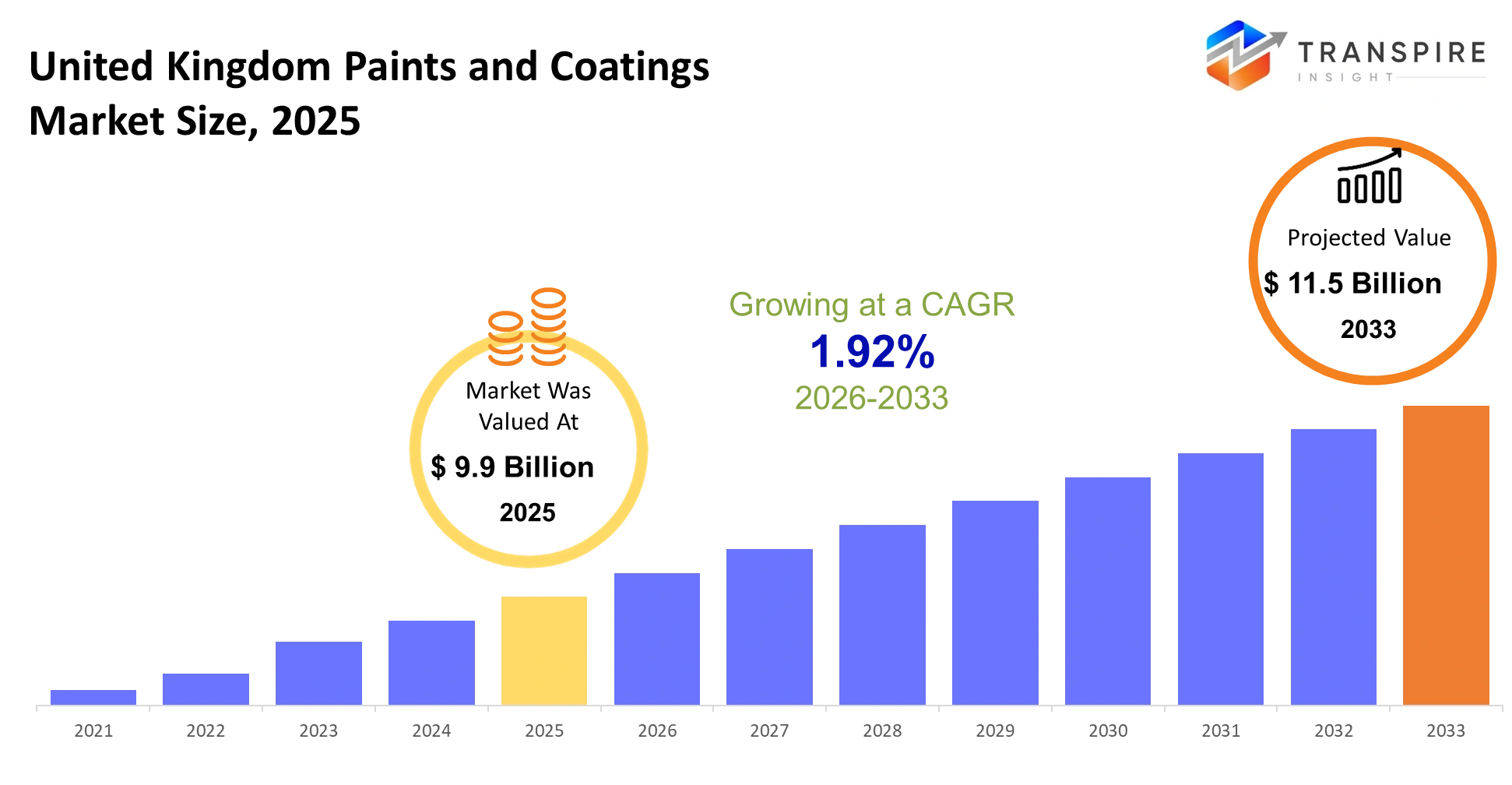
- United Kingdom Paints and Coatings Market Size 2025: USD 9.9 Billion
- United Kingdom Paints and Coatings Market Size 2033: USD 11.5 Billion
- United Kingdom Paints and Coatings Market CAGR: 1.92%
- United Kingdom Paints and Coatings Market Segments: By Product Type (Architectural Coatings, Industrial Coatings, Protective Coatings, Powder Coatings, Automotive Coatings, Marine Coatings, Wood Coatings, Others); By Resin Type (Acrylic Resins, Epoxy Resins, Polyurethane Resins, Alkyd Resins, Polyester Resins, Others); By Technology (Waterborne Coatings, Solvent-borne Coatings, UV-cured Coatings, High-solid Coatings, Others); By End User (Construction Industry, Automotive Industry, Industrial Manufacturing, Marine Industry, Furniture Industry, Others); By Application (Decorative Applications, Protective Applications, Corrosion Resistance, Heat Resistance, Others)
To learn more about this report,  Download Free Sample Report
United Kingdom Paints and Coatings Market Summary
The United Kingdom Paints and Coatings Market was valued at USD 9.9 Billion in 2025. It is forecast to reach USD 11.5 Billion by 2033. That is a CAGR of 1.92% over the period.
The United Kingdom paints and coatings market has a practical role in making buildings and transport equipment last longer, also helping offshore assets industrial machinery, and marine infrastructure endure moisture, corrosion, chemicals, and, well, harsh weather. In places like construction, ship repair, automotive manufacturing, and energy, coatings are now expected to bring durability, reduce maintenance cycles kind of and meet tougher environmental compliance standards all together.
Over the last five years, the direction kept getting moved toward water based, low VOC, and high performance protective coatings, because manufacturers are reacting to tighter UK and European environmental regulations. Then there was that energy shock, plus raw material shortages after the Russia Ukraine conflict, which kind of disturbed resin and pigment supply chains, so producers had to reformulate their products, rethink the sourcing, and push the prices upward, a bit faster than before.That whole pressure also sped up investment into advanced coatings that can deliver longer service intervals and better material efficiency. As industrial operators keep looking to cut lifecycle costs and still meet sustainability goals, suppliers with technically specialized, regulation-compliant products are landing more contract volume and higher-margin work.
Key Market Insights
- England was basically dominating the United Kingdom paints and coatings scene, taking almost 78% market share in 2025, mostly because construction and industrial activity stayed pretty concentrated there.
- Meanwhile Scotland looks like it’s starting to outpace everyone else as the quickest regional market through 2030, with offshore wind, marine coatings, and those energy infrastructure investments pushing demand along.
- In 2025, water-based coatings grabbed more than 46% share of the United Kingdom Paints and Coatings Market , largely because manufacturers leaned into low-emission compliance solutions and well, they had to.
- Powder coatings sat as the second-largest product segment, supported by automotive parts, industrial equipment production and also longer-term corrosion resistance requirements, which clients seem to really care about.
- High-performance protective coatings are expected to post the quickest growth pace from 2026 to 2030, mainly tied to offshore work and heavy-industry demand, yes.
- For applications, architectural coatings pretty much led the pack with nearly 52% market share in 2025, driven by residential renovation plus commercial refurbishment projects picking up across the country.
- Industrial coatings are also expected to gain the fastest application demand across the forecast period , because factories often like longer maintenance intervals and energy efficient surface finishes.
- For end users, construction stayed in front with around 48% revenue share in 2025, backed by urban redevelopment and public infrastructure upgrades.
- Also marine and energy infrastructure is emerging as a notably fast-growing end-user category , since offshore projects are multiplying and anti-corrosion coating systems are being called for more often.
- Overall, the United Kingdom paints and coatings market is leaning more heavily toward bio-based resin adoption and recyclable packaging, basically to match sustainability commitments.
What are the Key Drivers, Restraints, and Opportunities in the United Kingdom Paints and Coatings Market?
The strongest force pushing the United Kingdom paints and coatings market forward, is basically the tightening of VOC emission rules across construction, automotive, and industrial fabrication. The whole compliance pressure, from UK environmental standards, made contractors and manufacturers lean away from the older solvent-heavy coatings, and instead swap toward water-based and high-solid kinds. That change really picked up speed once big commercial developers started attaching procurement agreements to carbon reduction goals and lifecycle performance expectations. So suppliers who can actually deliver compliant, longer-lasting paint systems, have been landing the higher-value work, especially within infrastructure, transport, and marine programs. And in a kind of side effect, repeat maintenance has gone up too, since industrial operators now prefer coatings that cut stoppage time and help extend overall asset life.
Still, volatile raw material pricing is the market’s most stubborn structural obstacle, or at least that is what it feels like day to day.Important inputs like epoxy resins , titanium dioxide, and specialty additives still end up heavily tethered to imported chemical supply chains that are getting squeezed—mainly by energy costs, unexpected shipping disruptions, and those geopolitical swings that nobody can really forecast. Even if manufacturers want to adjust, they often cannot pivot fast enough, since setting up alternative, more local feedstock production means major capital outlays and long regulatory queues . In other words, the whole system kind of sits and waits, until the pressure eases.This ongoing instability ends up squeezing margins for mid-sized coating producers, and it also slows down procurement decisions among end users who are stuck with fixed project budgets, especially across construction and heavy industry.
The expansion of offshore wind is kinda a big growth opening for those advanced protective coatings, and it’s not subtle. In the UK, the quick build out of offshore energy infrastructure is pushing up the need for coatings that can resist corrosion in rough salt water, the kind where everything feels extra aggressive. Because of that, suppliers putting money into graphene enhanced solutions, and also into coatings with high endurance, are in a good spot to win long term maintenance plus refurbishment deals across North Sea energy projects.
What Has the Impact of Artificial Intelligence Been on the United Kingdom Paints and Coatings Market?
Artificial intelligence and other more advanced digital technologies are kinda reshaping how coating makers and industrial asset operators run production quality, plan maintenance cycles, and meet regulatory expectations across the United Kingdom paints and coatings sector. Lately, producers often lean on AI driven formulation tools to model coating behavior across a range of temperature, humidity, and corrosion scenarios, even before any physical testing begins. In practice this usually shortens the development clock, cuts down on raw material waste, and nudges niche coatings for marine, automotive, and infrastructure use, toward commercialization quicker.
At the same time, digital monitoring systems that connect to industrial coating lines are now taking care of viscosity control, spray precision, and curing temperature adjustments in real time, by themselves. Consequently, coating consistency usually gets better and the expense of rework linked to defects drops, in particular in high-volume manufacturing environments where small issues can snowball, if nobody catches them early.Machine learning is also being used more and more for predictive maintenance, by watching equipment vibration, tracking pressure shifts, and scanning production-line sensor signals to catch early warning signs—like pump failure risk or coating irregularities. Some industrial operators say that after adopting AI-enabled process monitoring, they have seen fewer unexpected stoppages, along with better material usage overall.
Beyond that, advanced analytics platforms are supporting suppliers in estimating raw material requirements and tightening inventory plans when supply chains get shaky or unstable. Still, broader AI adoption isn’t fully widespread, mainly due to high integration costs, plus the reality that many legacy systems are fragmented. This is especially true for mid-sized coating manufacturers that run older production facilities, with limited digital connectivity, or systems that don’t easily “talk” to newer software.
Key Market Trends
- Since 2021, UK contractors have increasingly swapped solvent based coatings for water based alternatives, to stay inside stricter VOC emission rules across commercial construction projects, more or less.
- After the Russia–Ukraine conflict, raw material volatility kinda forced manufacturers to rearrange their resin sourcing by region, and they started re negotiating long-term procurement contracts from 2022.
- Offshore wind spending in the North Sea really nudged demand upward for corrosion resistant marine coatings, the kind that can handle long saltwater contact and nasty weather swings for longer periods.
- Since 2023, industrial buyers moved toward high performance coatings, these help extend maintenance intervals, so there’s less operational shutdowns and lifecycle maintenance costs take a smaller hit, overall.
- Akzo Nobel N.V. together with PPG Industries, expanded low carbon product lines as big infrastructure customers connected purchasing choices to sustainability benchmarks.
- AI driven formulation platforms cut coating development timeframes by checking viscosity, curing, and durability behavior before broad physical testing ever kicked off.
- Powder coatings got stronger traction in automotive and industrial production, because makers aimed for lower material waste and better energy efficiency after 2022, and yeah it mattered. \
- Since 2024, manufacturers have been investing more in antimicrobial and self cleaning coatings for healthcare sites, public transport, and busy commercial infrastructure areas.
- Meanwhile, mid-sized UK coating suppliers took margin pressure as energy intensive production costs rose faster than what contract pricing adjustments managed to cover between 2022 and 2025.
- Digital color matching systems plus automated spray technologies improved application accuracy, which reduced coating defects, and also brought rework costs down at industrial production facilities.
United Kingdom Paints and Coatings Market Segmentation
By Product Type:
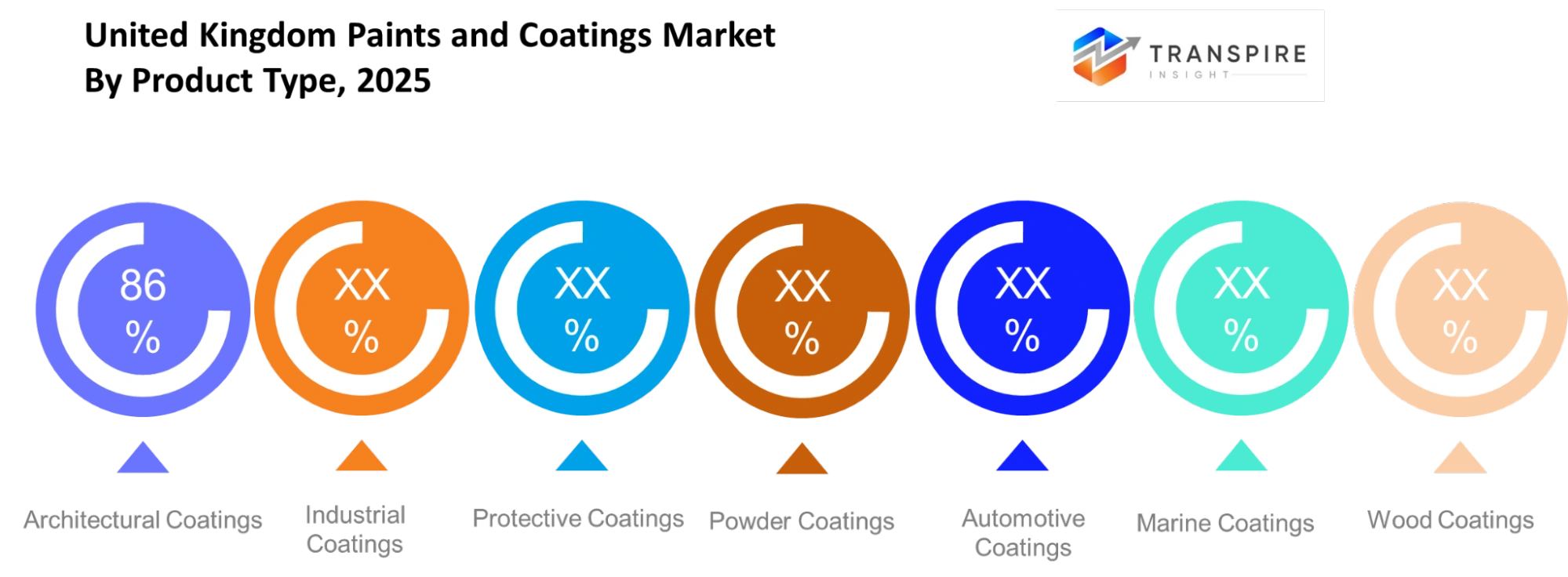
Architectural coatings take a big share in the United Kingdom paints and coatings market, mainly because they get used a lot in residential remodeling and commercial infrastructure work. Industrial and protective coatings also matter, especially for manufacturing plants, heavy equipment, and public infrastructure where long-term surface shielding is still, basically, essential to keep operations running smoothly and to reduce upkeep spending
Automotive , powder, marine, and wood coatings are also getting more attention, because producers now seem to care about endurance, surface look, and environmental compliance. Powder coatings should spread further in industrial settings too, since there is less material waste and the curing process uses energy more efficiently, which fits cost control plans. Marine coatings stay important for offshore installations and coastal infrastructure projects , where corrosion risks don’t really take a break
To learn more about this report, Download Free Sample Report
By Resin Type:
Acrylic resins still keep strong demand because construction plus decorative uses need weather resistance, steady color keeping, and a faster drying rhythm. Epoxy ,and polyurethane resins back industrial flooring and protective frames too, along with coatings for machinery, because chemical resistance combined with durability is needed for a longer service time in harsh rough industrial surroundings.
Alkyd and polyester resins carry on serving furniture, wood finishing, and industrial manufacturing because they are cost efficient and deliver a solid surface finish. Resin manufacturers will likely put money into updated formulations with lower VOC levels, because environmental requirements across the United Kingdom keep shaping purchasing choices and production scheduling strategies, even when budgets are tight
By Technology:
In the United Kingdom, waterborne coatings lead technology adoption in the Paints and Coatings Market, mainly because regulatory pressure kinda keeps pushing manufacturers toward lower-emission coating systems. Construction firms and industrial operators go for these coatings on indoor and commercial projects, where air quality expectations, and worker safety rules , directly affect what gets chosen.
Meanwhile high-solid and UV-cured coatings keep gaining ground across industrial manufacturing, since faster curing cycles boost production efficiency and cut down operational downtime. Solvent-borne coatings are still used in a fairly selective way in heavy-duty industrial environments, because solid adhesion, and reliable performance in difficult weather, are still needed for long-term protective uses
By End User:
The construction sector stays the largest end user, driven by infrastructure modernization, commercial renovation, and residential development across big urban centers. Industrial manufacturing really matters because factories are after corrosion resistance, equipment protection, and that tougher kind of surface finish, which helps them keep running continuously and also cuts down maintenance later on.
Automotive , marine, and furniture industries keep shifting toward more advanced coating technologies, partly for a better appearance but also for higher heat resistance and long lived durability. Especially in marine work, operators rely on high performance protective coatings for offshore energy structures, plus coastal facilities, where moisture and saltwater are always around and where the environment is kind of harsh for extended operating periods.
By Application:
Decorative applications make up a pretty big chunk of coating demand , because commercial buildings, residential areas, and retail developments all want those nice looking yet durable surface finishes. Protective applications also stay crucial, particularly for transportation, industrial machinery, and infrastructure jobs where coatings help stretch the service life and lower how often repairs are needed, over time.
At the same time, corrosion resistance and heat resistance use cases keep on growing. Industrial operators are leaning more into operational reliability , plus fewer maintenance interruptions. Newer coating systems built for extreme temperatures and rough environmental exposure should see broader uptake in manufacturing plants, energy infrastructure, and heavy industrial equipment, working under pretty demanding conditions day to day.
What are the Key Use Cases Driving the United Kingdom Paints and Coatings Market?
Architectural coatings still come out as the biggest use case in the United Kingdom paints and coatings market because commercial buildings , housing upgrades and public infrastructure projects really need durable, and weather resistant surface protection. Also the renovation momentum across offices, retail spaces, and residential properties keeps going so coating demand stays high volume.
Meanwhile industrial and marine applications are picking up more solid momentum, since manufacturers and offshore operators keep pushing corrosion control and longer upkeep cycles. Automotive production sites also rely on advanced coating systems to upgrade the overall finish look, cut down on repainting frequency, and meet tighter emission along with workplace safety rules across industrial zones.
On the newer side, antimicrobial coatings for hospitals and public transport networks are starting to matter more, and self cleaning coatings for smart commercial buildings are becoming common talking points. There’s also heat resistant coating developments for renewable energy infrastructure, including offshore wind installations, which keep showing longer term promise as energy investment programs expand along coastal areas.
|
Report Metrics |
Details |
|
Market size value in 2025 |
USD 9.9 Billion |
|
Market size value in 2026 |
USD 10.07 Billion |
|
Revenue forecast in 2033 |
USD 11.5 Billion |
|
Growth rate |
CAGR of 1.92% from 2026 to 2033 |
|
Base year |
2025 |
|
Historical data |
2021 - 2024 |
|
Forecast period |
2026 - 2033 |
|
Report coverage |
Revenue forecast, competitive landscape, growth factors, and trends |
|
Regional scope |
Middle East and Africa (Saudi Arabia, United Arab Emirates, South Africa, Rest of Middle East and Africa) |
|
Key company profiled |
Akzo Nobel, PPG Industries, Sherwin-Williams, BASF, Nippon Paint Holdings, Jotun, Axalta Coating Systems, Kansai Paint, RPM International, Hempel, Asian Paints, Berger Paints, Tikkurila, Beckers Group, DAW SE |
|
Customization scope |
Free report customization (country, regional & segment scope). Avail customized purchase options to meet your exact research needs. |
|
Report Segmentation |
By Product Type (Architectural Coatings, Industrial Coatings, Protective Coatings, Powder Coatings, Automotive Coatings, Marine Coatings, Wood Coatings, Others); By Resin Type (Acrylic Resins, Epoxy Resins, Polyurethane Resins, Alkyd Resins, Polyester Resins, Others); By Technology (Waterborne Coatings, Solvent-borne Coatings, UV-cured Coatings, High-solid Coatings, Others); By End User (Construction Industry, Automotive Industry, Industrial Manufacturing, Marine Industry, Furniture Industry, Others); By Application (Decorative Applications, Protective Applications, Corrosion Resistance, Heat Resistance, Others) |
Which Regions are Driving the United Kingdom Paints and Coatings Market Growth?
England still shows up as the main region inside the United Kingdom paints and coatings market , mainly because big construction work, industrial production hubs, plus ongoing redevelopment of infrastructure keep pushing coating demand in a pretty steady way. Tighter environmental rules across commercial building and transport , have pushed a faster move toward waterborne formulas and low-VOC coatings. Big cities like London, Birmingham,and Manchester help too, since there’s a thick web of contractors and suppliers, which usually makes distribution more efficient and also keeps products readily available. On top of that, advanced manufacturing plants, research groups,and major global coating producers, all add to keeping England in the dominant spot.
Scotland comes in as the second-largest regional contributor, but the growth levers aren’t exactly the same as what’s happening in England. Here the appetite stays tied more to offshore energy infrastructure, marine upkeep, and coastal industrial operations, rather than the more urban commercial construction cycle. Steady spending on offshore wind initiatives and port upgrades has created a dependable long-term pull for corrosion-resistant , marine-grade coatings. Ship repair yards , and energy operators across Aberdeen plus other coastal locations, keep focusing on robust protective systems , aiming to cut down on maintenance frequency when conditions are rough and the environment is harsh.
Wales is kinda emerging as the fastest-growing regional market, largely because of renewed industrial investment and those modernization programs for infrastructure that were introduced over the last few years. There have been manufacturing upgrades, transport corridor improvements , and even renewable energy projects, and all of that has pushed demand higher for industrial and protective coatings across several sectors. On top of that, regional authorities have also been encouraging energy-efficient construction standards, which in turn supports a wider use of advanced architectural coating technologies.
Who are the Key Players in the United Kingdom Paints and Coatings Market and How Do They Compete?
The competitive landscape in the United Kingdom paints and coatings market still looks kind of moderately consolidated, with multinational manufacturers taking a big chunk of both industrial and architectural coating revenue. Lately, the real fight feels more like formulation know-how, environmental compliance, and the long-term durability of the coating, not just pricing, alone. The well established players keep defending their place via low-VOC development, digital color technologies, and more solid contractor distribution networks. Meanwhile, the smaller specialist suppliers seem to be getting more traction in marine, protective, and high-performance industrial coatings where tailored formulations and technical support help lock in customers, sort of more steadily.
Akzo Nobel N.V. puts most attention on sustainability-led innovation, plus premium decorative coatings aimed at commercial construction and infrastructure work. They set themselves apart with low-carbon manufacturing initiatives and newer waterborne technologies, built to satisfy the tougher environmental expectations that exist across the United Kingdom. PPG Industries, on the other hand, strengthens its position through industrial focus, especially across aerospace, automotive, and heavy-duty protective coatings. They keep pushing forward by rolling out product improvements that boost corrosion resistance and also stretch the time between maintenance cycles for industrial customers, who are running large infrastructure assets.
Sherwin-Williams keeps the edge by relying on contractor driven service networks and fast product availability in each regional market. The company also expanded its premium architectural coating catalog, supporting big renovation and commercial refurbishment jobs, even when timelines get tight. Jotun still holds a solid niche spot in marine and offshore protective coatings where durability in rough saltwater conditions is really the make or break factor. Hempel A/S keeps strengthening its relationships inside offshore wind and renewable energy infrastructure projects, sort of helping secure long term coating upkeep agreements across coastal industrial sites.
Company List
- Akzo Nobel
- PPG Industries
- Sherwin-Williams
- BASF
- Nippon Paint Holdings
- Jotun
- Axalta Coating Systems
- Kansai Paint
- RPM International
- Hempel
- Asian Paints
- Berger Paints
- Tikkurila
- Beckers Group
- DAW SE
Recent Development News
In April 2026, Benjamin Moore & Co. announced the launch of two new United Kingdom subsidiaries, BM Prudhoe Ltd. and C&R Scotland Ltd. The expansion includes plans to acquire a production site in England and the Scotland-based heritage paint brand Craig & Rose, strengthening the company’s manufacturing and distribution footprint in the UK paints and coatings market. Source https://njbiz.com/
In April 2026, Nippon Paint Group and Sherwin-Williams confirmed a joint proposal to acquire AkzoNobel. The proposed transaction would divide AkzoNobel’s decorative paints and industrial coatings businesses between the two companies, signaling potential large-scale consolidation affecting the UK coatings sector through AkzoNobel’s Dulux operations.
Source https://www.prnewswire.com/
What Strategic Insights Define the Future of the United Kingdom Paints and Coatings Market?
The United Kingdom paints and coatings market is kind of shifting, toward more highly specialized, performance focused formulations meant to satisfy tighter environmental rules, longer asset life needs, and also reduced maintenance costs across industrial areas and infrastructure. In the next five to seven years, the sales growth should keep leaning toward suppliers that can mix sustainability compliance with technical durability, mainly for marine , renewable energy, and heavy industrial use. Because of that, manufacturers may start putting more money into advanced resin systems, digital formulation know-how, and local supply approaches, not just the usual bulk purchasing.
There is also a quieter worry that doesn’t get talked about much. It comes from the ongoing reliance on imported raw materials like titanium dioxide and specialty resins. Even if the end demand stays steady, longer supply interruptions or trade related price swings can end up squeezing margins and slowing down capital spending for mid sized manufacturers. Meanwhile, graphene enhanced protective coatings for offshore wind infrastructure are showing up as a meaningful future opportunity. Any company trying to get into this area should really focus on collaborations with renewable energy developers and also build stronger regional technical support, so they can lock in durable, long term industrial maintenance contracts.
United Kingdom Paints and Coatings Market Report Segmentation
By Product Type
- Architectural Coatings
- Industrial Coatings
- Protective Coatings
- Powder Coatings
- Automotive Coatings
- Marine Coatings
- Wood Coatings
By Resin Type
- Acrylic Resins
- Epoxy Resins
- Polyurethane Resins
- Alkyd Resins
- Polyester Resins
By Technology
- Waterborne Coatings
- Solvent-borne Coatings
- UV-cured Coatings
- High-solid Coatings
By End User
- Construction Industry
- Automotive Industry
- Industrial Manufacturing
- Marine Industry
- Furniture Industry
By Application
- Decorative Applications
- Protective Applications
- Corrosion Resistance
- Heat Resistance
Frequently Asked Questions
Find quick answers to common questions.
- Akzo Nobel
- PPG Industries
- Sherwin-Williams
- BASF
- Nippon Paint Holdings
- Jotun
- Axalta Coating Systems
- Kansai Paint
- RPM International
- Hempel
- Asian Paints
- Berger Paints
- Tikkurila
- Beckers Group
- DAW SE
About the Authors

Pankaj Ghogare Patil
I am Pankaj Ghogare Patil, a Senior Research Analyst at Transpire Insight, specializing in the Pharmaceutical, Chemicals & Materials, Healthcare IT, and Biotechnology industry. My expertise lies in conducting comprehensive market research, analyzing industry trends, evaluating competitive landscapes, and translating complex data into actionable insights. At Transpire Insight, I closely follow emerging technologies, regulatory developments, and market innovations to create accurate, well-researched, and informative content that helps businesses and professionals make informed decisions. I am committed to producing credible, evidence-based articles that reflect industry best practices while making technical topics accessible and valuable for a broad audience.

Chakradhar Khansole
Chakradhar serves as the Research Director at Transpire Insight, bringing over 8 years of experience in technology, innovation, and strategic market intelligence. He specializes in transforming complex market data into actionable business insights that enable organizations to make informed, growth-oriented decisions. Recognized for his strategic vision and analytical expertise, Chakradhar leads high-impact research initiatives, delivering comprehensive market assessments, competitive intelligence, and forward-looking industry analysis.
Recently Published Reports
-
May 2026
Healthcare Polymer Packaging Market
Healthcare Polymer Packaging Market Size, Share & Analysis Report By Packaging Type (Syringes, IV Bottles and Pouches, Clamshells, Blisters, Bottles & Jars, Containers, Tubes, IV Parental Packaging, Others), By Type (Regulated, Non-regulated), By Polymer Type (LDPE (Low-Density Polyethylene), HDPE (High-Density Polyethylene), Homo-polymer (Homo), Random Copolymer (Random), Block Copolymer (Block), PET, Polystyrene, Polyvinyl Chloride, Polyamide/EVOH, Others), and Geography (North America, Europe, Asia-Pacific, Middle East and Africa, South and Central America), 2021 - 2031
-
Apr 2026
Hydrophilic Tape (Waterstop) Market
Hydrophilic Tape (Waterstop) Market Size, Share & Analysis Report By Type (Bentonite-Based Hydrophilic Tape, Rubber-Based Hydrophilic Tape), By Application (Residential Buildings, Commercial Buildings, Infrastructure Projects), and Geography (North America, Europe, Asia-Pacific, Middle East and Africa, South and Central America), 2021 - 2031
-
Apr 2026
Metalens Market
Metalens Market Size, Share & Analysis Report By Type (Visible Light Metalens, and Infrared Metalens), By Application (Consumer Electronics, Automotive Electronics, Industrial, Medical, and Others), and Geography (North America, Europe, Asia-Pacific, Middle East and Africa, South and Central America), 2021 - 2031
-
Apr 2026
PBT Resin Market
PBT Resin Market Size, Share & Analysis Report By Type (Reinforced PBT Resin, Unreinforced PBT Resin), By Processing Method (Injection Molding, Extrusion, Blow Molding, Others), By End-User (Automotive, Electrical & Electronics, Consumer Appliances, Industrial Machinery, Medical Devices, Packaging, Others), and Geography (North America, Europe, Asia-Pacific, Middle East and Africa, South and Central America), 2021 - 2031