
South Korea Automotive HVAC Market Size & Forecast:
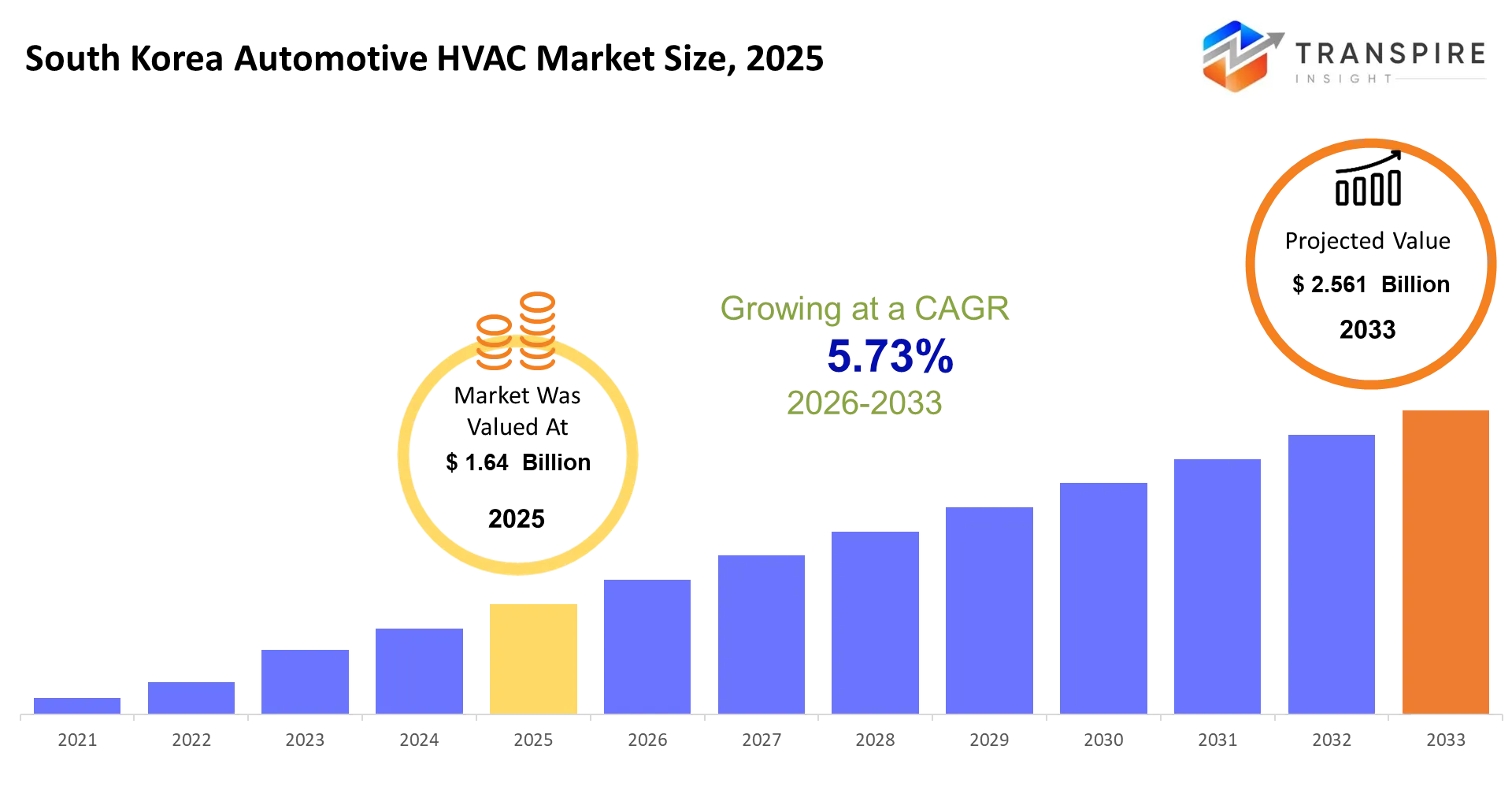
- South Korea Automotive HVAC Market Size 2025: USD 1.64 Billion
- South Korea Automotive HVAC Market Size 2033: USD 2.561 Billion
- South Korea Automotive HVAC Market CAGR: 5.73%
- South Korea Automotive HVAC Market Segments: By Component (Compressors, Condensers, Evaporators, HVAC Control Units, Blowers, Expansion Valves, Heater Cores, Sensors, Others); By Vehicle Type (Passenger Cars, Commercial Vehicles, Electric Vehicles, Hybrid Vehicles, Luxury Vehicles, Others); By Technology (Automatic Climate Control, Manual HVAC Systems, Multi-zone HVAC, Heat Pump Systems, Smart HVAC Systems, Others); By Application (Cabin Comfort, Battery Thermal Management, Defogging Systems, Air Purification, Others); By End User (OEMs, Aftermarket Suppliers, Fleet Operators, Others)
To learn more about this report,  Download Free Sample Report
South Korea Automotive HVAC Market Summary
The South Korea Automotive HVAC Market was valued at USD 1.64 Billion in 2025. It is forecast to reach USD 2.561 Billionby 2033. That is a CAGR of 5.73% over the period.
In passenger cars and commercial fleets across South Korea, automotive HVAC systems try to keep cabin comfort, air cleanliness, and thermal stability in a bunch of weather scenes that swing from muggy summers to literally freezing winters. Lately, the market has sort of moved away from conventional, engine-driven heating, and instead toward electric heat pump–based thermal management as vehicle electrification keeps speeding up. This shift kind of got extra momentum because EV output has been expanding quickly, and the pace is closely tied to Hyundai Motor Company and Kia Corporation, where cabin performance, and yes efficiency, can directly touch driving range.
At the same time , tougher local energy efficiency rules in Korea, plus international emission-linked compliance duties, have pushed automakers to revisit HVAC architectures in order to draw less power. Another important spark, kind of like a turning point that really accelerated the shift , showed up after the pandemic , when supply chains were reshaped in practice. That disruption made it more obvious how much some manufacturers depended on imported thermal parts, and it also nudged more localized , high-efficiency HVAC production. Now, suppliers are going beyond just selling a single standalone item, they instead compete via system integration and energy optimization, sort of a more complete thermal solution approach. So, overall revenue flows across the value chain are getting rearranged, in a more connected, systems-first way.
Key Market Insights
- South Korea Automotive HVAC Market is sort of shifting toward electric heat pump setups, which is boosting EV thermal efficiency by roughly 15–25% on 2025 vehicle platforms.
- EV adoption is reworking the South Korea Automotive HVAC Market, since electric vehicles are now taking more than 20% of new car sales in 2025, and that’s pushing HVAC redesign , at least from what OEMs are trying to do.
- AI-enabled smart HVAC systems are cutting cabin energy use by as much as 18% in premium electric vehicles. This also supports better driving range efficiency, a kind of knock-on benefit.
- On top of that, government emission and energy efficiency regulations have lifted demand for low-power HVAC systems by around 30% since 2022.
- Thermal management integration is also moving away from standalone HVAC units, in other words, it’s creating unified systems that help energy optimization, and system reliability tends to feel better too.
- Passenger vehicles still dominate the South Korea Automotive HVAC Market, largely because of tight OEM integration. That’s tied to high private vehicle ownership, plus EV penetration.
- Commercial EV fleets and logistics vehicles are growing faster, especially with urban delivery expansion and also cold-chain transport needs, which keep the thermal burden more intense.
- Heat pump-based HVAC systems lead the product demand, while compressor-based systems are still staying relevant in ICE and hybrid vehicles.
- As for channels, OEM integration stays dominant as the end-user route. It accounts for most of the share because installations are typically factory-fitted HVAC.
- Key players including Hyundai Mobis, Hanon Systems, Denso Corporation, Valeo, Mahle GmbH, and Sanden Holdings are putting money into AI-driven climate control, plus next generation refrigerants, to help solidify competitive positioning in the South Korea Automotive HVAC Market.
What are the Key Drivers, Restraints, and Opportunities in the South Korea Automotive HVAC Market?
The main driver behind the South Korea automotive HVAC market is, basically, the quick electrification of passenger and commercial vehicles , and it has changed a lot how thermal comfort is handled inside the cabin. Since electric cars can’t really depend on engine waste heat, manufacturers are putting in newer heat pump–based HVAC solutions so the vehicle range stays better but people still feel comfortable . This trend is also being pushed harder by government-supported EV adoption goals, plus OEM spending from Hyundai Motor Company and Kia Corporation, they both tend to focus on energy-efficient thermal platforms, you know the kind that runs smarter . So HVAC suppliers now can capture more value through integrated thermal management systems, not only stand alone units, which feels like the whole direction.
Now, one big restraint is the cost, or more precisely the “system integration expense” linked with next-gen HVAC platforms, especially the heat pump configurations built for EVs. Those setups need special compressors, refrigerant handling and then software calibration , and all of that bumps up the vehicle’s early production cost. Smaller players find it harder to scale the technology fast enough, so adoption slows down in the mid-range vehicle categories . This price pressure also keeps standardization from spreading widely across domestic OEM models.
On the opportunity side, there’s an opening around intelligent climate control, the kind that’s tied to vehicle connectivity and AI-driven energy optimization. Automakers are starting to insert predictive thermal management that can change cabin settings based on driving habits, local weather, and the battery state of charge. South Korea has a pretty strong semiconductor and software ecosystem, and it helps this movement, especially via cooperation between automakers and electronics companies like LG Electronics. In the end this enables new revenue streams in software-defined vehicle architectures , and it’s kind of a different business layer than the old HVAC parts model.
What Has the Impact of Artificial Intelligence Been on the South Korea Automotive HVAC Market?
In South Korea’s auto HVAC world, artificial intelligence is getting built-in more and more to vehicle thermal management, kind of like it’s driving the cabin temperature itself. The idea is that cabin climate control can run on its own and energy use can be dialed in on the fly, not just based on one fixed rule set. Lately, newer electric vehicles from Hyundai Motor Company and Kia Corporation, are using sensor-led AI approaches to steer heatin cooling and airflow, while also watching passenger presence, outside weather conditions, and even how hard the battery is being asked to work. So instead of wasting power on unnecessary adjustments, the system tries to reduce energy consumption, and that helps the driving range, because thermal efficiency is treated as the priority rather than static temperature targets. There’s also AI working inside centralized vehicle control units, which makes HVAC behavior shift more dynamically alongside what’s happening with the battery and the drivetrain, not in isolation.
On top of that, machine learning models are being used for HVAC predictive care, where they can spot early signs like compressor sluggishness or refrigerant leakage risks, before a full failure shows up. That tends to boost vehicle availability and it can lower warranty expenses for OEMs since servicing becomes condition-based rather than simple time-based replacements. Still, AI in real automotive HVAC has some rough edges. Sensor data quality can vary a lot across operating situations, and that inconsistency makes it harder for models to stay accurate. Plus the cost of adding advanced control software isn’t small, especially when it comes to mid tier vehicle platforms. On top of it, some older vehicle models have connectivity constraints, and that limits the steady data feedback loops that are usually needed to refine the models over time, and sometimes the learning just doesn’t keep up.
Key Market Trends
- Automotive HVAC systems kind of moved away from engine-driven heating toward more heat pump-based setups, and this helped EV range efficiency jump by about 20% since 2022, give or take.
- Hyundai Motor Company and Kia Corporation pushed faster on thermal system redesigns after 2023, basically focusing on integrated energy-efficient HVAC platforms for new EV launches.
- Regulatory pressure around vehicle emissions kept getting tighter, so OEMs have been swapping refrigerant-heavy designs for low-GWP alternatives across production lines since 2021.
- Hanon Systems also ramped up EV thermal management investments, and they increased production capacity for electric compressors plus integrated HVAC modules in 2024.
- At the same time, AI-based cabin climate control started showing up more often, and it enabled adaptive cooling strategies that cut energy usage by as much as 18% in 2025 model years.
- After the disruptions in 2022, supply chain localization picked up, with South Korean suppliers reducing how much they depend on imported HVAC components and strengthening domestic sourcing.
- Valeo and Denso Corporation came out with smart HVAC innovations too, including predictive temperature control, which improved responsiveness especially in higher-end vehicle segments.
- Passenger EV demand changed how OEMs think about design, shifting HVAC systems toward lightweight modular architectures across both compact and mid-size vehicles.
- Mahle GmbH advanced heat pump efficiency technologies, supporting the wider industry trend toward high-performance electrified thermal management systems.
- And overall the competition has shifted away from plain hardware supply toward software-integrated HVAC ecosystems, where manufacturers are competing on energy optimization, plus system intelligence, not just parts.
South Korea Automotive HVAC Market Segmentation
By Component
Compressors have the leading position in the South Korea Automotive HVAC Market , not just because they are “in the middle” of the system but because they really guide the refrigerant flow and keep thermal behavior efficient in both ICE and electric cars. On top of that, close OEM alignment with electric compressor systems has made them hard to dislodge, especially since EV platforms need high-efficiency thermal management to protect driving range. Condensers come next, basically as a second-largest piece of the mix, because electrification keeps pushing demand for smaller but high-performance heat rejection setups. Evaporators keep steady traction too, since cabin cooling still matters across almost every vehicle category. Meanwhile HVAC control units are getting more relevant, since climate regulation is increasingly handled by software, not just mechanical routines.
Still, compressors keep changing as electrification progresses, with OEMs moving toward variable-speed electric units that help curb energy use during rapidly changing driving conditions. Condensers are also improving, supported by lightweight material adoption , which boosts heat transfer while dialing down overall system mass for EV layouts. HVAC control units are gaining momentum as vehicles shift toward more centralized thermal management architectures that can merge battery cooling and cabin cooling. Sensors and expansion valves are also getting folded into smarter arrangements so the system can tune climate in real time, based on things like occupancy and outdoor conditions. Over the forecast, HVAC control units are expected to post the fastest growth , since software-defined vehicle platforms place integrated climate intelligence above purely mechanical control.
By Vehicle Type
Passenger Cars kind of hold the dominant position in the South Korea Automotive HVAC Market, mostly because private vehicle ownership stays high and EV adoption in urban areas keeps getting stronger. Commercial Vehicles land as the second-largest segment and it’s backed by logistics expansion, plus the rising need for better driver comfort and cargo temperature control, which sounds simple but it matters a lot. Electric Vehicles are also expanding fast since OEMs are redesigning thermal systems to deal with those annoying range limitations. Meanwhile hybrid vehicles still show steady adoption, basically as part of the transitional electrification playbook, and that pace doesn’t really drop off.
Passenger car HVAC systems keep moving toward energy-optimized architectures, in particular within compact EV sedans where efficiency directly affects driving range. Commercial vehicle demand comes from fleet operators adopting standardized HVAC platforms so they can reduce maintenance variability and keep operational costs under control. Electric vehicles are seeing faster adoption of heat pump systems, because they help lower energy consumption during extreme temperature conditions. Luxury vehicles, for their part, are leaning into multi-zone climate control systems, which improve cabin personalization and the overall user experience, even if different owners want different things. Over the forecast period, Electric Vehicles are expected to grow fastest as electrification deepens across both mass-market and premium segments, and yes that includes more OEM effort than before.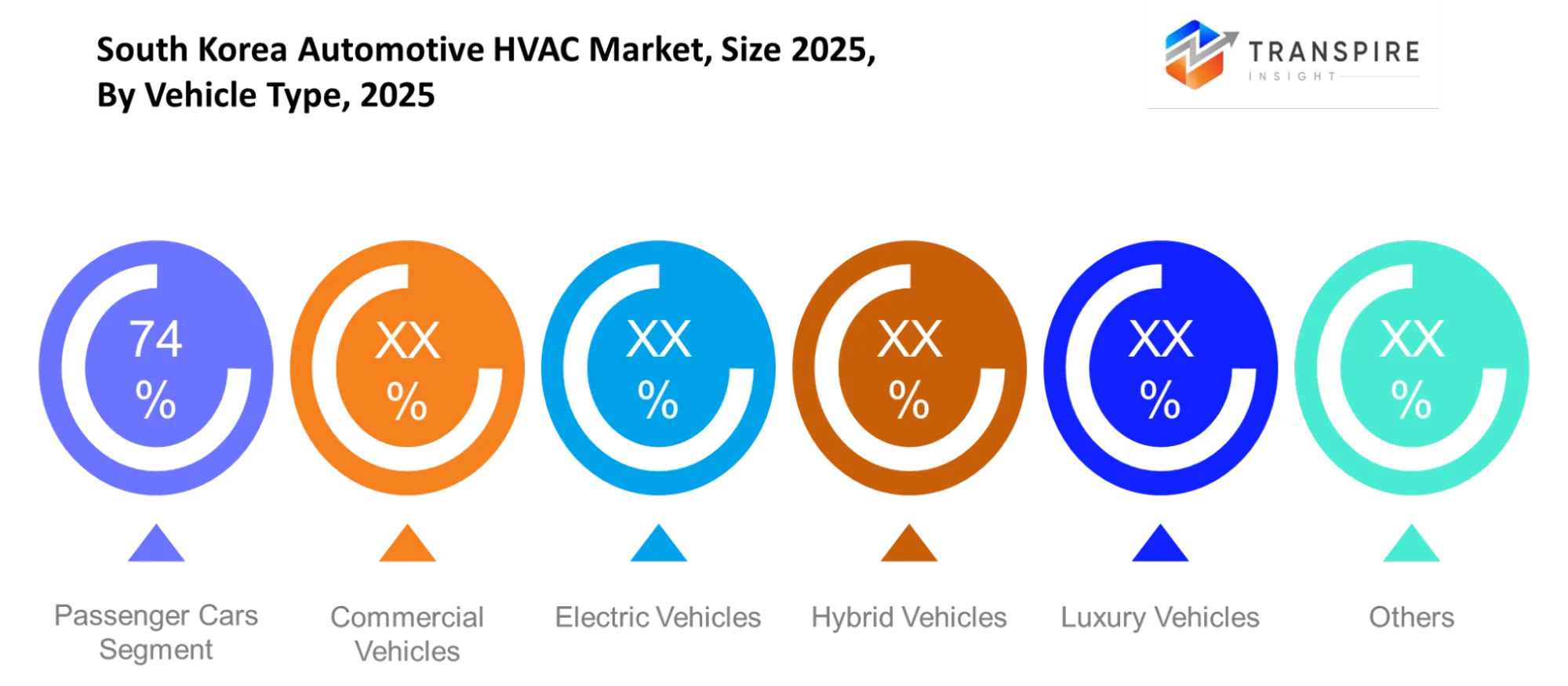
To learn more about this report, Download Free Sample Report
By Technology
Automatic Climate Control systems still seem to be in the lead because they are being adopted a lot in mid-range and premium cars, where comfort automation is pretty much a default now. The Manual HVAC systems stay in the second spot, mostly seen in entry-level vehicles and also in markets where people care a lot about price, so they choose less expensive setups. Heat pump systems are showing up much faster lately too, mainly because they’re more efficient, especially for electric vehicles. Then there are smart HVAC systems which are picking up momentum through software based climate optimization, like the car “thinks” a bit more before it regulates air.
Automatic setups keep expanding, because OEMs are making digital cabin environments standard, they adjust the temperature based on outside conditions and also on what the driver does. Meanwhile manual systems are slowly slipping down, as consumer expectations lean further toward automated comfort features, not “dial it yourself” kind of living. Heat pump tech adoption is speeding up due to regulatory demands for better energy efficiency and also EV range needs. Smart HVAC systems are getting more and more connected with the vehicle operating systems, so they can do predictive climate control, and also cut energy use. Over the forecast period, Smart HVAC Systems are expected to grow the fastest, as software defined mobility platforms reshape how thermal management actually works in practice.
By Application
Cabin Comfort still keeps the leading role in the South Korea Automotive HVAC Market, because passenger comfort stays as the main job across nearly every vehicle type. Battery Thermal Management comes in as the second-largest slice, pushed mostly by EV take up and the need to keep battery output near best levels even when temperatures swing around. Defogging systems and air purification use-cases are getting more attention too, mainly because vehicle design is leaning more toward safety and health oriented features.
Cabin comfort setups are still moving forward with things like multi zone temperature regulation and energy efficient airflow distribution methods, even if the exact layout changes by model. Battery thermal management is also climbing, since EV makers want steadier range and better battery longevity during rough hot or cold seasons. At the same time, air purification is expanding with consumers caring more about cabin air quality, especially in dense urban areas where air can feel harsher. Defogging stays essential, not just for comfort but for safety compliance and dependable visibility under different regulatory rules. Through the forecast window, Battery Thermal Management is expected to grow the fastest, as EV penetration keeps going up and thermal integration becomes a required design piece rather than a nice option.
By End User
OEMs keep the dominant position in the South Korea Automotive HVAC Market largely because of direct integration of HVAC units into how vehicles are made, so it stays kind of baked into the manufacturing cycle. The aftermarket suppliers sit as the second biggest segment, mainly from replacement needs and also upgrades, especially in older vehicle fleets that are already aging out. And then fleet operators , they’re getting more visibility now, since consistent vehicle use means maintenance can be standardized too and HVAC tuning can be made more repeatable, in a way.
OEM demand still keeps climbing as HVAC systems get more tightly tied to the vehicle’s electronics and the broader energy management platforms. Aftermarket expansion is being helped by longer vehicle lifespans and the growing need to retrofit older models with newer HVAC components. Fleet operators tend to benefit from centralized buying approaches, which helps keep HVAC performance fairly uniform across large groups of vehicles. Also, predictive maintenance technologies are being integrated into operations more and more, and that is lifting reliability while cutting down downtime at fleet level.Over the forecast timeframe, Fleet Operators are expected to grow the fastest, since commercial mobility is increasing and electrification in logistics keeps accelerating across city transport corridors.
What are the Key Use Cases Driving the South Korea Automotive HVAC Market?
In South Korea, the main use case for automotive HVAC is basically passenger vehicle cabin climate control, especially in electric SUVs and sedans where energy-efficient heating cooling really changes the driving range and the overall user comfort. This sort of thing drives most demand because EV penetration is staying high.
In commercial fleets and also public transport buses, HVAC systems are getting more and more common. The idea is simple: keep passengers comfortable and meet new in-cabin air quality rules that urban mobility operators keep tightening. At the same time logistics and refrigerated transport are using more advanced thermal systems so cargo temperature stays stable, even when conditions change.
Newer possibilities are showing up too, like AI enabled zonal HVAC where temperature is adjusted independently across different cabin seats, and some autonomous vehicle prototypes that tie HVAC to passenger detection. Then the system can distribute energy in a more optimized manner, in a way that still feels right for the occupants.
|
Report Metrics |
Details |
|
Market size value in 2025 |
USD 1.64 Billion |
|
Market size value in 2026 |
USD 1.734 Billion |
|
Revenue forecast in 2033 |
USD 2.561 Billion |
|
Growth rate |
CAGR of 5.73% from 2026 to 2033 |
|
Base year |
2025 |
|
Historical data |
2021 - 2024 |
|
Forecast period |
2026 - 2033 |
|
Report coverage |
Revenue forecast, competitive landscape, growth factors, and trends |
|
Regional scope |
South Korea |
|
Key company profiled |
Hanon Systems, Hyundai Mobis, Denso, Valeo, MAHLE, Sanden Corporation, Mitsubishi Heavy Industries, Johnson Electric, Eberspächer, Calsonic Kansei, Modine Manufacturing, BorgWarner, LG Electronics, Toyota Industries, Keihin Corporation |
|
Customization scope |
Free report customization (country, regional & segment scope). Avail customized purchase options to meet your exact research needs. |
|
Report Segmentation |
By Component (Compressors, Condensers, Evaporators, HVAC Control Units, Blowers, Expansion Valves, Heater Cores, Sensors, Others); By Vehicle Type (Passenger Cars, Commercial Vehicles, Electric Vehicles, Hybrid Vehicles, Luxury Vehicles, Others); By Technology (Automatic Climate Control, Manual HVAC Systems, Multi-zone HVAC, Heat Pump Systems, Smart HVAC Systems, Others); By Application (Cabin Comfort, Battery Thermal Management, Defogging Systems, Air Purification, Others); By End User (OEMs, Aftermarket Suppliers, Fleet Operators, Others) |
Which Regions are Driving the South Korea Automotive HVAC Market Growth?
The Seoul Capital Area pretty much leads the South Korea Automotive HVAC Market , because it has this heavy, kind of clustered presence of automotive headquarters , R&D hubs and advanced supplier connections. Hyundai Motor Company and Kia Corporation sort of anchor the whole ecosystem, so integration of HVAC systems into next-gen EV platforms happens faster . With policy enforcement that keeps tightening around vehicle emissions and energy efficiency requirements, low-power thermal solutions get pulled in sooner. Also there are a lot of semiconductor , software and electronics suppliers sitting across Gyeonggi and Incheon , and that helps system-level innovation move quicker , plus it shortens the product development cycle.
Meanwhile the Ulsan and Busan industrial belt acts as a steady production backbone, backed by large manufacturing sites and export-minded automotive output . Unlike the Seoul area which feels more research oriented, this stretch is more about high-volume vehicle assembly and consistent OEM execution. Hyundai’s Ulsan complex keeps HVAC demand steady, through ongoing passenger and commercial vehicle production. Busan’s port connectivity matters too, since exports depend on it , and it makes the region a dependable revenue driver for global HVAC suppliers.
Then there are the Chungcheong and Gwangju regions, which are showing up as the fastest-growing HVAC manufacturing cluster. A big reason is the recent EV centered industrial investments. Since 2023 , government supported mobility innovation zones have pulled in Tier-1 suppliers plus battery EV assembly expansion . They also benefit from lower production costs and the slow decentralization of the automotive supply chain away from Seoul . Over 2026–2033, this rebalancing should diversify production risk , and it should also open new entry points for mid-tier HVAC technology providers.
Who are the Key Players in the South Korea Automotive HVAC Market and How Do They Compete?
South Korea Automotive HVAC Market is kinda moderately consolidated, with global Tier-1 suppliers holding a clear lead , along with vertically integrated domestic companies. Lately the competition has moved away from old fashioned component pricing , more toward system-level efficiency, thermal integration ,and sort of software driven climate control. The established players are defending their share by weaving HVAC systems into EV platforms , while the newer entrants seem to push harder on AI thermal optimization and even refrigerant innovation.
Hanon Systems operates with heavy integration inside Hyundai Motor Company , focusing on electric compressor systems and EV tailored thermal modules that help improve range efficiency in practice. Hyundai Mobis also strengthens its stance via vertical integration , supplying complete mobility systems rather than selling HVAC units in isolation, so it can influence platform architecture decisions more directly. Denso differentiates using high-efficiency thermal management plus advanced climate control electronics, especially across hybrid and premium vehicle groups , backed by long term OEM commitments.
Valeo and MAHLE both lean on innovation-led expansion. Valeo is bringing smart HVAC software integration forward , while MAHLE leans into high-performance heat pump technology for EV platforms. Sanden Corporation goes for compact compressor systems, tuned for tight space electric vehicles. BorgWarner is expanding through electrified thermal management acquisitions. LG Electronics is getting more competitive too, using crossover know-how from consumer electronics and automotive climate intelligence systems, which helps it deliver AI based cabin optimization solutions .
Company List
- Hanon Systems
- Hyundai Mobis
- Denso
- Valeo
- MAHLE
- Sanden Corporation
- Mitsubishi Heavy Industries
- Johnson Electric
- Eberspächer
- Calsonic Kansei
- Modine Manufacturing
- BorgWarner
- LG Electronics
- Toyota Industries
- Keihin Corporation
Recent Development News
In April 2026, Hanon Systems launched a highly integrated cooling entity for electric vehicles. The new thermal management module combines eCompressor technology, sensors, condensers, and expansion valves into a compact system that improves EV energy efficiency and extends driving range.https://www.automotive-technology.com
In April 2026, MAHLE announced expanded investment in electrification and thermal management technologies under its MAHLE 2030+ strategy. The company accelerated development of integrated heat pump systems and advanced EV thermal modules to strengthen competitiveness in next-generation automotive HVAC solutions.https://newsroom.mahle.com
What Strategic Insights Define the Future of the South Korea Automotive HVAC Market?
The South Korea Automotive HVAC Market is kind of shifting, more or less, toward fully electrified plus software-defined thermal ecosystems, where HVAC performance gets linked to vehicle range optimization and energy management, in a pretty direct way. This change is being pushed by EV adoption that is ramping up fast, and by OEM platform consolidation that is being led by Hyundai Motor Company and Kia Corporation. But there is also a quieter risk that is less visible day to day: overdependence on complicated heat pump architectures, which can run into cost pressure and performance boundaries in really extreme weather. That situation might end up slowing mid-market uptake, even if the demand looks strong.
At the same time though, there is an emerging chance that feels more forward looking, AI integrated zonal HVAC systems. These systems can dynamically apportion thermal energy based on passenger behavior, and also battery state, not just on temperature alone. Market participants should therefore focus on modular HVAC platforms, with software that is upgradable, so they can plug into vehicle operating systems. In the long run this approach helps create ongoing service revenue, instead of relying only on one time component sales, or whatever you want to call that.
South Korea Automotive HVAC Market Report Segmentation
By Component
- Compressors
- Condensers
- Evaporators
- HVAC Control Units
- Blowers
- Expansion Valves
- Heater Cores
- Sensors
- Others
By Vehicle Type
- Passenger Cars
- Commercial Vehicles
- Electric Vehicles
- Hybrid Vehicles
- Luxury Vehicles
- Others
By Technology
- Automatic Climate Control
- Manual HVAC Systems
- Multi-zone HVAC
- Heat Pump Systems
- Smart HVAC Systems
- Others
By Application
- Cabin Comfort
- Battery Thermal Management
- Defogging Systems
- Air Purification
- Others
By End User
- OEMs
- Aftermarket Suppliers
- Fleet Operators
- Others
Frequently Asked Questions
Find quick answers to common questions.
The Expected South Korea Automotive HVAC Market size for the Market will be USD 2.561 Billion in 2033.
Key Segments for the South Korea Automotive HVAC Market are By Component (Compressors, Condensers, Evaporators, HVAC Control Units, Blowers, Expansion Valves, Heater Cores, Sensors, Others); By Vehicle Type (Passenger Cars, Commercial Vehicles, Electric Vehicles, Hybrid Vehicles, Luxury Vehicles, Others); By Technology (Automatic Climate Control, Manual HVAC Systems, Multi-zone HVAC, Heat Pump Systems, Smart HVAC Systems, Others); By Application (Cabin Comfort, Battery Thermal Management, Defogging Systems, Air Purification, Others); By End User (OEMs, Aftermarket Suppliers, Fleet Operators, Others).
Major South Korea Automotive HVAC Market Players are Hanon Systems, Hyundai Mobis, Denso, Valeo, MAHLE, Sanden Corporation, Mitsubishi Heavy Industries, Johnson Electric, Eberspächer, Calsonic Kansei, Modine Manufacturing, BorgWarner, LG Electronics, Toyota Industries, Keihin Corporation.
The Current South Korea Automotive HVAC Market size is USD 1.64 Billion in 2025.
The South Korea Automotive HVAC Market CAGR is 5.73% from 2026 to 2033.
- Hanon Systems
- Hyundai Mobis
- Denso
- Valeo
- MAHLE
- Sanden Corporation
- Mitsubishi Heavy Industries
- Johnson Electric
- Eberspächer
- Calsonic Kansei
- Modine Manufacturing
- BorgWarner
- LG Electronics
- Toyota Industries
- Keihin Corporation
Recently Published Reports
-
Apr 2026
ATV & UTV Market
ATV & UTV Market Size, Share & Analysis Report By Type (ATV, and UTV), By Variants (Less Than 400 CC, 400 CC To 800 CC, and More Than 800 CC), and Geography (North America, Europe, Asia-Pacific, Middle East and Africa, South and Central America), 2021 - 2031
-
Apr 2026
Automotive Central Gateway Module Market
Automotive Central Gateway Module Market Size, Share & Analysis Report By Type (Ethernet Central Gateway Module, CAN Central Gateway Module, LIN Central Gateway Module, and FlexRay), By Application (Powertrain Control, Body Control, Infotainment System, Advanced Driver Assistance Systems (ADAS), and Others), By End User (Passenger Vehicles, and Commercial Vehicles), and Geography (North America, Europe, Asia-Pacific, Middle East and Africa, South and Central America), 2021 - 2031
-
Apr 2026
Automotive Engine Oil Filter Market
Automotive Engine Oil Filter Market Size, Share & Analysis Report By Filter Type (Fuel Filter, Engine Oil Filter, Hydraulic Oil Filter, and Others), By Filter Media (Cellulose, Synthetic, and Micro), By Sales Channel (OEMs, and Aftermarket), By Vehicle Type (Passenger Cars, Light Commercial Vehicles, Heavy Duty Trucks, Buses and Coaches, and Off-road Vehicles), and Geography (North America, Europe, Asia-Pacific, Middle East and Africa, South and Central America), 2021 - 2031
-
Apr 2026
Automotive Parts Aluminium Die Casting Market
Automotive Parts Aluminium Die Casting Market Size, Share & Analysis Report By Production Process (Pressure Die Casting, Vacuum Die Casting, Squeeze Die Casting, Gravity Die Casting), By Application (Body Parts, Engine Parts, Transmission Parts, Battery And Related Components, Other Application Types), and Geography (North America, Europe, Asia-Pacific, Middle East and Africa, South and Central America), 2021 - 2031
Our Clients