Middle East and Africa Electric Car Market Size & Forecast:
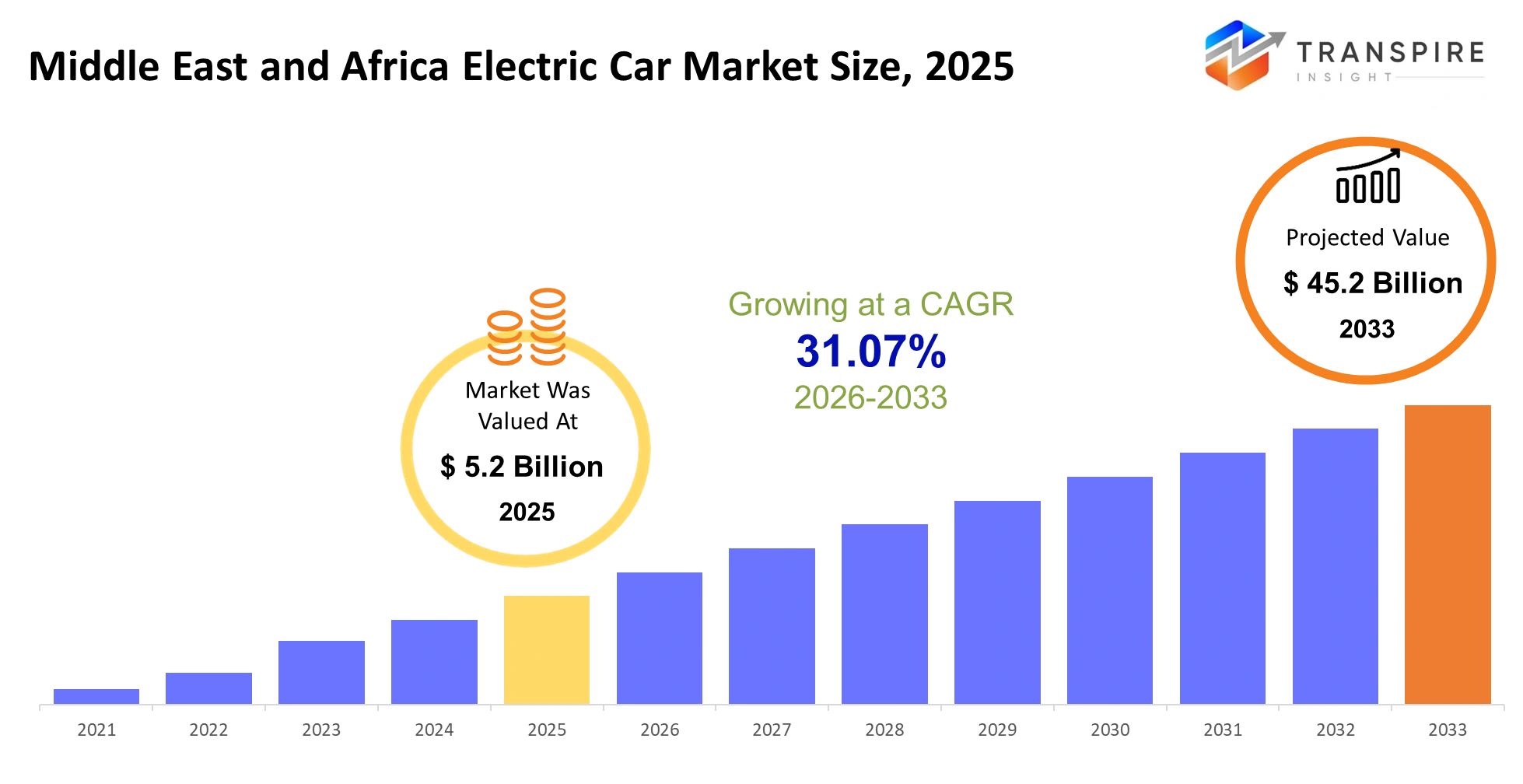
- Middle East and Africa Electric Car Market Size 2025: USD 5.2 Billion
- Middle East and Africa Electric Car Market Size 2033: USD 45.2 Billion
- Middle East and Africa Electric Car Market CAGR: 31.07%
- Middle East and Africa Electric Car Market Segments: By Type (Battery Electric Vehicles, Plug-in Hybrid, Hybrid Electric, Others); By Application (Passenger Vehicles, Commercial Vehicles, Fleet Vehicles, Ride-sharing, Others); By End-User (Consumers, Fleet Operators, Government, Corporate Buyers, Automotive Firms, Others); By Battery (Lithium-ion, Solid-state, Others).
To learn more about this report,  Download Free Sample Report
Middle East and Africa Electric Car Market Summary
The Middle East and Africa Electric Car Market was valued at USD 5.2 Billion in 2025. It is forecast to reach USD 45.2 Billion by 2033. That is a CAGR of 31.07% over the period.
The Middle East and Africa electric car market kind of works in practice like a kind of transition system , where fuel dependent urban mobility and fleet transport are gradually replaced by electricity powered vehicles. This lowers operating costs and emissions, especially inside dense cities and within government controlled transport networks. It also tackles the big issue of high fuel import dependence, plus the urban fleet economics that tend to be not very efficient. You notice this most in taxis, logistics vans and public service vehicles, where utilization rates can be pretty high.
In the last 3–5 years the market moved in a more structural way , from small pilot EV deployments to early scale fleet electrification. That shift is being supported by government procurement programs across Gulf economies, and a more steady infrastructure rollout along African urban corridors. A major trigger behind this change has been aggressive national decarbonization efforts, especially Saudi Arabia’s mobility diversification tied to Vision 2030 and the UAE net zero commitments. Those policies basically redirected capital toward charging infrastructure , and toward EV adoption incentives as well.
Because of this, adoption dynamics are different now. It’s less about consumer led experimentation and more about institution led deployment. So OEMs and mobility operators increasingly prioritize fleet partnerships , and localized charging ecosystems. That directly boosts utilization rates and it also helps generate more predictable revenue streams across the value chain, somehow.
Key Market Insights
- Gulf region sort of dominates the Middle East and Africa Electric Car Market, taking nearly 45% share in 2025, mostly because Saudi Arabia and UAE keep pushing fleet electrification programs, even when rollouts feel uneven.
- Sub-Saharan Africa also emerges as the fastest-growing area from 2026 to 2033, driven by two and three-wheeler electrification , plus a battery swapping adoption wave that’s getting more common.
- Passenger electric vehicles are still the leading segment, roughly 52% share, supported by import availability and a pretty clear urban consumer uptake.
- Fleet vehicles look like the fastest-growing segment as ride-hailing and logistics operators switch toward cost-efficient electric mobility models, maybe faster than expected.
- Ride-sharing applications expand quickly, especially across the UAE and South Africa, with platform-led EV integration and operational cost savings pulling them forward.
- Government and fleet operators remain the dominant end-user group, holding over 40% share , since centralized procurement and policy mandates stay in place.
- Consumers are showing more adoption, but charging gaps and higher upfront costs still slow things down in the Middle East and Africa Electric Car Market.
- Battery Electric Vehicles dominate the product mix, while plug-in hybrids stay relevant in infrastructure-limited African and North African markets.
- Tesla, BYD, Toyota, Hyundai, Mercedes-Benz, and BMW end up strengthening competition via regional partnerships , localized assembly and software-led EV innovation.
- BYD and Tesla get an advantage through cost leadership and charging ecosystem expansion , whereas European brands lean into premium positioning and regulatory compliance.
What are the Key Drivers, Restraints, and Opportunities in the Middle East and Africa Electric Car Market?
A main growth driver in the electric car market across the Middle East and Africa is really state led fleet electrification, mixed together with fairly aggressive mandates for urban decarbonization in Gulf economies. Saudi Arabia, the UAE, and a handful of governments in North Africa have effectively linked their mobility shift goals to sovereign investment programs. That in turn accelerates the buying cycle for electric taxis, buses, and government fleets, pretty directly. Because of this policy pivot, manufacturers face less demand uncertainty, and it creates something like stable, “known” volume pipelines, which helps with revenue visibility for OEMs and also for charging infrastructure providers. On top of that, the transition gets a further nudge from falling lithium-ion battery costs, so the total cost of ownership gap with internal combustion vehicles is getting smaller especially in high utilization fleet niches.
The biggest structural restraint is more like fragmented and still underdeveloped charging infrastructure, mainly outside Gulf urban centers. There’s grid instability in some places, limited high capacity fast charging networks, and also inconsistent regulatory standards between countries, which becomes a real scaling bottleneck, and it cannot be untangled quickly. This limitation dulls private ownership appetite too, since day to day range reliability feels uncertain for longer distance travel. It also pushes up capex for operators, because they end up investing in depot based charging setups instead of just leaning on shared public charging, and that slows the broader market entry overall.
A notable emerging opportunity is around solar integrated charging corridors and battery swapping ecosystems, especially for two-wheeler and three-wheeler segments across Sub-Saharan Africa. Kenya’s ramping renewable energy base, along with Rwanda’s more organized e-mobility policies, shows how decentralized clean power can back high volume urban transport electrification.These models reduce the reliance on central grids and open up scalable entry points for mobility as a service providers, which unlocks fresh revenue streams beyond only traditional vehicle sales, and somehow it just feels more flexible, like you’re not stuck.
What Has the Impact of Artificial Intelligence Been on the Middle East and Africa Electric Car Market?
Artificial intelligence is more and more tucked into electric mobility operations across the Middle East and Africa, mostly in fleet management systems that automate charging coordination, route allotment, and regulatory compliance tracking. Logistics operators and ride-hailing platforms use AI-driven telematics to keep an eye on vehicle utilization in real time , improve charging sequences using grid pricing cues, and cut idle time across busy urban arteries. At the same time, advanced digital control setups in charging networks try to juggle load distribution so the grid does not get stressed, while still keeping service steady during peak demand windows.
Predictive analytics now also acts like a backbone for battery health observation and maintenance timing. Here machine learning models estimate state-of-health decline and tag failure risks before breakdowns happen. These approaches raise vehicle uptime by trimming off unscheduled service calls and supporting better battery lifecycle efficiency, and in some controlled fleet settings they even lift operational availability by double-digit percentage points. Emission and energy tracking platforms further help corporate and government fleets satisfy reporting obligations tied to sustainability mandates.
Still, take-up is limited by expensive integration work, plus uneven data availability across fragmented charging plus telecom infrastructure. In remote zones, weak real-time connectivity also trims model precision, which in turn slows down full deployment of these advanced optimization tools.
Key Market Trends
- Gulf countries moved faster on EV charging build out after 2024, and that made it easier for fleets to go electric at higher rates, especially in city taxi work and government mobility programs, sometimes with less friction than before.
- BYD also pushed bigger regional shipments during 2025, which kinda shifts the fight more toward cost leadership than that premium only EV vibe.
- Toyota got into EV sales in South Africa in 2025 , and that feels like a clear shift away from hybrid strength, toward full battery electric competition in Africa’s biggest auto hub.
- Then Saudi Arabia’s Ceer project kept advancing in 2026, basically pointing at more localized EV manufacturing rather than relying on import dependent vehicle supply lines.
- Also ride hailing electrification jumped hard after 2024, because Uber and other regional platforms started folding EV fleets into operations, aiming to cut day to day costs and avoid emissions related penalties.
- In North Africa, some OEM plants increased EV component integration in 2025, and this was tied to stricter EU export compliance requirements , plus emissions linked trade conditions that became harder to ignore.
- By 2025 models lithium ion LFP battery adoption broadened, and it started replacing higher priced chemistries in entry level EVs aimed at price sensitive buyers.
- Meanwhile in 2025 charging partnerships between utilities and automakers intensified, which helped reduce those infrastructure logjams, using shared investment plans and grid integration models that are more cooperative than before.
Middle East and Africa Electric Car Market Segmentation
By Type
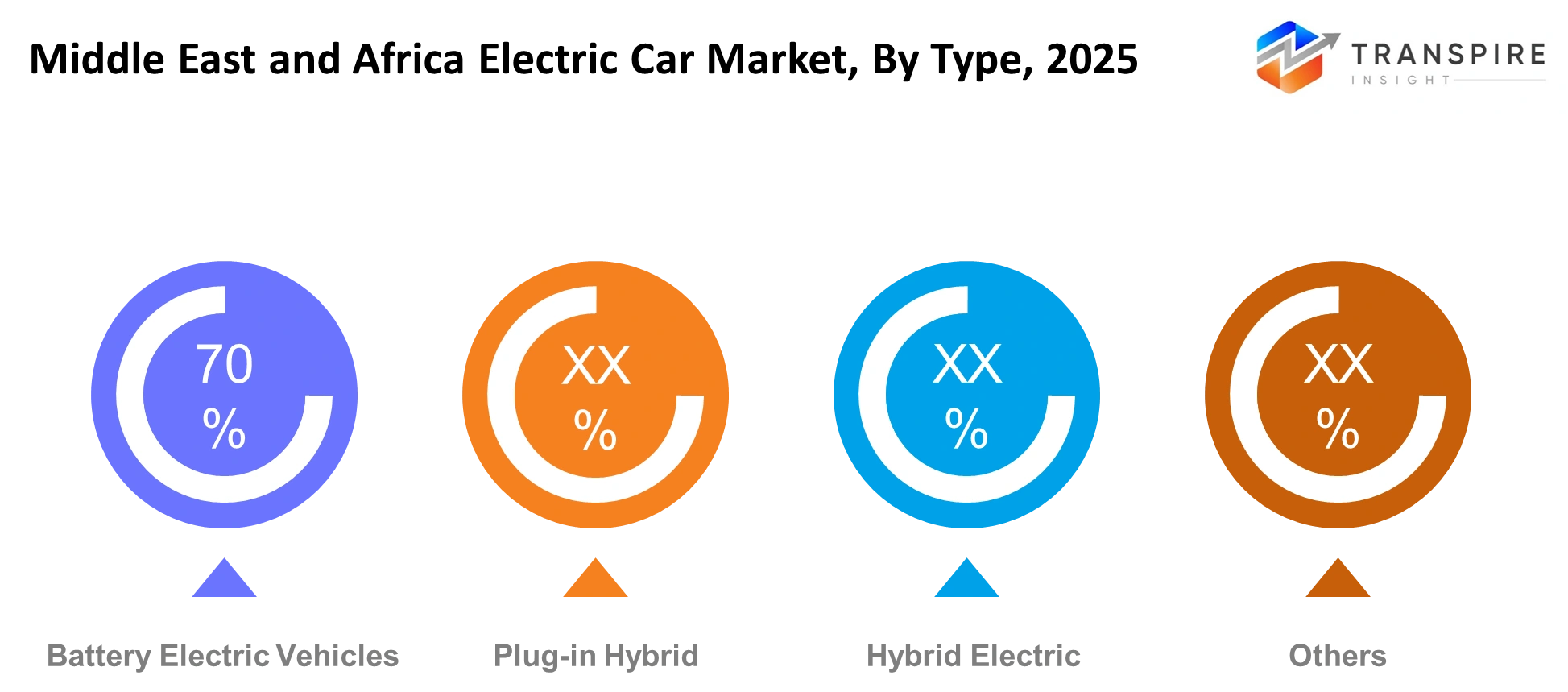
Battery Electric Vehicles keep getting traction, but the share is still kinda limited because charging infrastructure is uneven and the upfront cost can be bit more sensitive. Hybrid Electric Vehicles, and Plug-in Hybrids, stay more visible because they cut down range anxiety and match better in areas with limited public charging access. Others remain pretty marginal, mostly from niche adoption and because OEM attention doesn’t really follow through
Growth dynamics can look very different depending on the technology. Battery Electric Vehicles start speeding up in Gulf countries where state-backed charging rollout, and fleet electrification programs, reduce these infrastructure barriers. Hybrid systems hold on well in North African and Sub-Saharan markets where affordability matters and fuel flexibility is still sort of the main deal. During the forecast period Battery Electric Vehicles will likely take more share as charging networks scale, while hybrids slowly fade in dominance. Product developers should probably focus on modular platforms that can support both powertrains during those transition phases , not just one.
To learn more about this report, Download Free Sample Report
By Application
Passenger vehicles grab the biggest share, mainly because EV supply is arriving via imports and early consumer uptake is happening in high-income urban areas. Fleet vehicles and ride-sharing applications show quicker adoption since operators care a lot about utilization efficiency and also predictable operating expenses. Commercial vehicles stay smaller but they keep edging up, driven by logistics expansion and growing urban delivery demand.
Fleet and ride-sharing adoption is kinda growing faster than private ownership, because high daily mileage boosts return on investment, and it also kind of makes the charging infrastructure deployment feel worth it. Commercial use cases gain steam alongside e-commerce growth and municipal delivery contracts, which often lean toward low emission vehicles. Over time, this fleet led demand tends to run ahead of passenger led demand, and that nudges manufacturers toward service based sales models, plus depot charging integration strategies.
By End-User
Fleet operators, and also government entities, seem to keep the strongest footing, mainly from centralized procurement power, and policy driven electrification mandates. Consumers are still a bit constrained by vehicle cost, financing limitations, and uneven access to charging stations, and it feels slower. Corporate buyers and automotive firms stay in a supporting role, mostly via pilot programs and compliance driven procurement.
Growth is largely tied to government procurement frameworks and fleet operator cost optimization, where fuel savings, plus maintenance reduction, deliver a measurable financial edge. Corporate adoption also rises with sustainability reporting pressures and cross-border trade requirements. Through the forecast window, institutional buyers will anchor demand, while consumer uptake stays gradual, until infrastructure density becomes more solid and vehicle pricing declines further.
By Battery
Lithium-ion batteries still rule the scene, mainly because the supply chains are already mature, costs keep dropping, and there is that established manufacturing scale running through global OEM networks. Solid-state batteries are, kind of, still in an early commercialization phase , while other chemistries like nickel-metal hydride have very little real weight in today’s EV rollouts. In the end, market concentration is strongly linked to lithium based technologies, almost all the time.
Cost reduction inside lithium-ion systems, especially LFP variants, keeps supporting the ongoing dominance even when performance is only getting better in small steps. Solid-state tech gets extra attention too, due to higher energy density plus the safety promise, yet commercial bottlenecks keep delaying large scale adoption. Recycling constraints , plus raw material dependence, quietly steer strategic sourcing decisions. Through the forecast period, lithium-ion stays in the leading role, while solid-state drifts from pilot efforts toward a smaller set of premium uses after the early 2030s.
What are the Key Use Cases Driving the Middle East and Africa Electric Car Market?
Fleet based urban mobility is kinda the dominant use case in the Middle East and Africa electric car market, more or less especially taxis, ride hailing, and government vehicle fleets around Gulf cities. These apps tend to create the highest demand because operators lean into lower day to day running costs, more predictable charging routines, and a better fit with municipal decarbonization goals. With high daily utilization rates total cost of ownership savings become really easy to see and that seems to speed up buying decisions.
Corporate fleets and logistics delivery vehicles are growing too, as e commerce keeps pushing last mile efficiency across urban areas in South Africa , the UAE , and Egypt. Utility companies and municipal service operators are also moving toward electric light commercial vehicles, mainly to cut fuel reliance and make service planning more consistent. In these areas depot charging works well and that reduces infrastructure headaches compared with private ownership.
On the newer side we’re seeing electric minibuses for informal transit systems, and then electrified tourism transport across heritage, and resort zones. Battery swapping for two wheel and three wheel vehicles is gaining momentum as well in dense African cities where grid access is still uneven. These early stage use cases hint at a wider electrification push beyond the more premium passenger categories.
|
Report Metrics |
Details |
|
Market size value in 2025 |
USD 5.2 Billion |
|
Market size value in 2026 |
USD 6.8 Billion |
|
Revenue forecast in 2033 |
USD 45.2 Billion |
|
Growth rate |
CAGR of 31.07% from 2026 to 2033 |
|
Base year |
2025 |
|
Historical data |
2021 - 2024 |
|
Forecast period |
2026 - 2033 |
|
Report coverage |
Revenue forecast, competitive landscape, growth factors, and trends |
|
Regional scope |
Middle East and Africa (Saudi Arabia, United Arab Emirates, South Africa, Rest of Middle East and Africa) |
|
Key company profiled |
Tesla, BYD, Nissan, Hyundai, Kia, Volkswagen, BMW, Mercedes-Benz, Ford, General Motors, Toyota, Honda, SAIC, Geely, Rivian. |
|
Customization scope |
Free report customization (country, regional & segment scope). Avail customized purchase options to meet your exact research needs. |
|
Report Segmentation |
By Type (Battery Electric Vehicles, Plug-in Hybrid, Hybrid Electric, Others); By Application (Passenger Vehicles, Commercial Vehicles, Fleet Vehicles, Ride-sharing, Others); By End-User (Consumers, Fleet Operators, Government, Corporate Buyers, Automotive Firms, Others); By Battery (Lithium-ion, Solid-state, Others). |
Which Regions are Driving the Middle East and Africa Electric Car Market Growth?
In the Gulf Cooperation Council region, the Middle East and Africa electric car market kind of leads, because there are solid state-backed electrification programs and the purchasing power is pretty concentrated. Saudi Arabia and the UAE push demand by using sovereign wealth investment for charging infrastructure and they do large-scale fleet electrification, for government services , and taxis as well. Dense urban corridors plus modern highway networks help with early deployment of fast-charging systems, which lowers range anxiety quicker than in other corners of the region. Regulatory direction also stays mostly aligned with long-term diversification strategies, and it leans toward clean mobility as part of national economic transformation agendas.
North Africa is a bit more stable, but structurally it behaves different, it’s anchored in industrial capacity rather than pure consumption thirst. Morocco and Egypt gain from automotive manufacturing bases that already integrate EV components into export-focused production, which then feeds European supply chains. This part of the map grows via gradual regulatory alignment with EU emissions standards, so it pulls steady OEM investment in, instead of sudden domestic adoption spikes. Currency swings and infrastructure gaps slow things down, but steady foreign direct investment keeps production-linked EV activity resilient , even when conditions get messy.
Sub-Saharan Africa, on the other hand, is the fastest-growing segment, mostly due to mobility substitution rather than passenger car ownership expanding rapidly. Places like Kenya and Rwanda are moving electric two- and three-wheelers forward through battery swapping models, plus urban clean transport policies that actually stick. Ride-hailing electrification and decentralized renewable energy systems are reshaping last-mile transport economics in ways that feel practical. For entrants and investors, this area reads as a long-term volume chance from 2026 to 2033, but success will depend on flexible business models rather than traditional dealership-driven expansion.
Who are the Key Players in the Middle East and Africa Electric Car Market and How Do They Compete?
Competition in the Middle East and Africa electric car market is a bit fragmented, shaped by heavy import reliance, inconsistent charging infrastructure and a policy-led take up in some Gulf economies. Chinese players and other global incumbents go at it mainly with price competitiveness, localized assembly plans, and arrangements tied to state-backed mobility initiatives. In practice, tech efficiency and the whole financing setup start to weigh more than “staying loyal” to any single brand.
Tesla leans into a higher tech premium approach, depending on software-led drive character and Supercharger ecosystem partnerships to lock in early interest in Gulf cities. BYD leans hard on cost leadership, supported by vertically integrated battery production and quick model localization for African import routes. Toyota tries to stage the shift from hybrid to BEV, using dealer networks and careful pilot launches, especially in South Africa.
Hyundai works through mid-priced EVs and pushes fast-charging compatibility, showing up with fleet pilots along urban African corridors. BMW differentiates with premium EV engineering and an emphasis on regulatory compliance, especially in Gulf luxury segments. Mercedes-Benz expands with higher-end electric SUVs and leans on partnerships with regional distributors to strengthen charging options and the aftersales support network too.
Company List
- Tesla
- BYD
- Nissan
- Hyundai
- Kia
- Volkswagen
- BMW
- Mercedes-Benz
- Ford
- General Motors
- Toyota
- Honda
- SAIC
- Geely
- Rivian
Recent Development News
In August 2025, Toyota announced plans to enter the South African electric vehicle market with three fully electric models. The launch marks Toyota’s first BEV rollout in South Africa, intensifying competition in a market increasingly shaped by European and Chinese EV brands and accelerating early-stage electrification in the region.
Source: https://www.reuters.com
In October 2025, Nissan entered a regulatory emissions-credit partnership with BYD in Europe, forming part of broader automaker pooling strategies that influence global EV economics, including spillover effects into Middle East and African markets where these OEMs operate. The collaboration reflects increasing strategic interdependence between legacy automakers and Chinese EV leaders.
Source: https://www.reuters.com
What Strategic Insights Define the Future of the Middle East and Africa Electric Car Market?
Over the next 5–7 years, the Middle East and Africa electric car market will likely sort of slide from policy-led pilot adoption to an infrastructure constrained but still steadily accelerating penetration, with growth mostly showing up in Gulf states and in a few select urban corridors across Africa. The real structural pull is not just consumer demand by itself, it’s more like a convergence of energy diversification strategies, stricter city emissions targets, falling battery costs, and subsidy realignment away from fossil fuels.
A quieter risk though, is fragmented charging standards along with grid capacity that’s getting stretched, and that could end up slowing utilization even if there are big headline investment announcements. Meanwhile, a non-mainstream opportunity is also slowly forming: solar-integrated ultra-fast charging corridors, plus fleet-centric electrification for logistics operators running across those rapidly urbanizing cities.
Strategically, the players in this space should emphasize vertically integrated partnerships with utilities and logistics fleets, so they can lock in demand anchor tenants before they scale the infrastructure buildout.
Middle East and Africa Electric Car Market Report Segmentation
By Type
- Battery Electric Vehicles
- Plug-in Hybrid
- Hybrid Electric
- Others
By Application
- Passenger Vehicles
- Commercial Vehicles
- Fleet Vehicles
- Ride-sharing
- Others
By End-User
- Consumers
- Fleet Operators
- Government
- Corporate Buyers
- Automotive Firms
- Others
By Battery
- Lithium-ion
- Solid-state
- Others
Frequently Asked Questions
Find quick answers to common questions.
The estimated Middle East and Africa Electric Car Market size is USD 45.2 Billion in 2033.
Key segments for the Middle East and Africa Electric Car Market are By Type (Battery Electric Vehicles, Plug-in Hybrid, Hybrid Electric, Others); By Application (Passenger Vehicles, Commercial Vehicles, Fleet Vehicles, Ride-sharing, Others); By End-User (Consumers, Fleet Operators, Government, Corporate Buyers, Automotive Firms, Others); By Battery (Lithium-ion, Solid-state, Others).
Major Middle East and Africa Electric Car Market players are Tesla, BYD, Nissan, Hyundai, Kia, Volkswagen, BMW, Mercedes-Benz, Ford, General Motors, Toyota, Honda, SAIC, Geely, Rivian.
The Middle East and Africa Electric Car Market size is USD 5.2 Billion in 2025.
The Middle East and Africa Electric Car Market CAGR is 31.07% from 2026 to 2033.
- Tesla
- BYD
- Nissan
- Hyundai
- Kia
- Volkswagen
- BMW
- Mercedes-Benz
- Ford
- General Motors
- Toyota
- Honda
- SAIC
- Geely
- Rivian
Recently Published Reports
-
Apr 2026
ATV & UTV Market
ATV & UTV Market Size, Share & Analysis Report By Type (ATV, and UTV), By Variants (Less Than 400 CC, 400 CC To 800 CC, and More Than 800 CC), and Geography (North America, Europe, Asia-Pacific, Middle East and Africa, South and Central America), 2021 - 2031
-
Apr 2026
Automotive Central Gateway Module Market
Automotive Central Gateway Module Market Size, Share & Analysis Report By Type (Ethernet Central Gateway Module, CAN Central Gateway Module, LIN Central Gateway Module, and FlexRay), By Application (Powertrain Control, Body Control, Infotainment System, Advanced Driver Assistance Systems (ADAS), and Others), By End User (Passenger Vehicles, and Commercial Vehicles), and Geography (North America, Europe, Asia-Pacific, Middle East and Africa, South and Central America), 2021 - 2031
-
Apr 2026
Automotive Engine Oil Filter Market
Automotive Engine Oil Filter Market Size, Share & Analysis Report By Filter Type (Fuel Filter, Engine Oil Filter, Hydraulic Oil Filter, and Others), By Filter Media (Cellulose, Synthetic, and Micro), By Sales Channel (OEMs, and Aftermarket), By Vehicle Type (Passenger Cars, Light Commercial Vehicles, Heavy Duty Trucks, Buses and Coaches, and Off-road Vehicles), and Geography (North America, Europe, Asia-Pacific, Middle East and Africa, South and Central America), 2021 - 2031
-
Apr 2026
Automotive Parts Aluminium Die Casting Market
Automotive Parts Aluminium Die Casting Market Size, Share & Analysis Report By Production Process (Pressure Die Casting, Vacuum Die Casting, Squeeze Die Casting, Gravity Die Casting), By Application (Body Parts, Engine Parts, Transmission Parts, Battery And Related Components, Other Application Types), and Geography (North America, Europe, Asia-Pacific, Middle East and Africa, South and Central America), 2021 - 2031
Our Clients