

South Korea Gas Hydrates Market Size & Forecast:
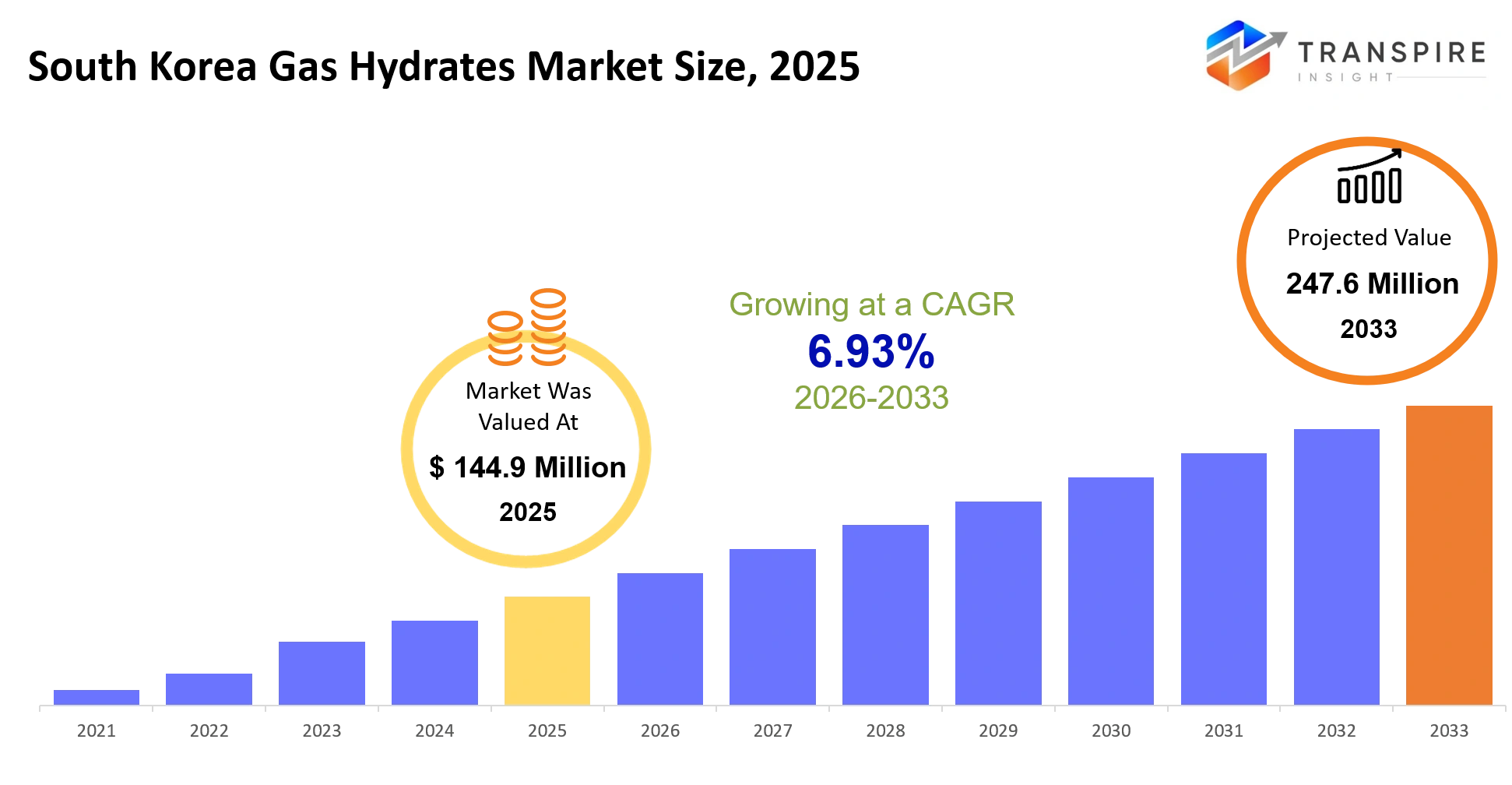
- South Korea Gas Hydrates Market Size 2025: USD 144.9 Million
- South Korea Gas Hydrates Market Size 2033: USD 247.6 Million
- South Korea Gas Hydrates Market CAGR: 6.93%
- South Korea Gas Hydrates Market Segments: By Resource Type (Methane Hydrates, Marine Hydrates, Permafrost Hydrates, Natural Gas Hydrates, Deepwater Hydrates, Offshore Reserves, Energy Hydrates, Others); By Application (Power Generation, Industrial Fuel, Chemical Feedstock, Residential Energy, LNG Blending, Hydrogen Production, Energy Storage, Others); By Extraction Method (Depressurization, Thermal Stimulation, Chemical Injection, CO2 Exchange, Hybrid Extraction, Offshore Drilling, Pilot Projects, Others); By End User (Energy Companies, Utilities, Research Institutes, Government Agencies, Industrial Users, Petrochemical Firms, Universities, Others).
South Korea Gas Hydrates Market Summary
The South Korea Gas Hydrates Market was valued at USD 144.9 Million in 2025. It is forecast to reach USD 247.6 Million by 2033. That is a CAGR of 6.93% over the period.
The Korean gas hydrates gas market revolves around finding a way to recover gas from hydrates under the ocean as a domestic source of energy in order to increase the security of South Korean reliance on LNG imports and price-sensitive global energy markets. The Korean market actually aims to secure the energy interests through promotion of offshore exploration technology and of methodologies in assessing the reservoir properties and demonstrating the viability of commercial extraction processes at the deepwater. This is because the market for hydrates in the Republic of Korea is now transitioning from finding resources to making sure that the resources are to be commercialized. This implies that over the last five years of market development there has been a general move away from purely assessing potential resources in the South Korean waters towards development, application and optimization of technologies needed for commercial exploitation of hydrate gas in the deep water regime.
Key Market Insights
- South Korea Gas Hydrates Market Is Moving to Commercial viability Due to enhanced recovery and decreased uncertainties in the operation.
- The growth in the South Korea Gas Hydrates Market is driven by energy security as it imports over 90 percent of its energy demand in fossil fuel, driving the need for the development of domestic energy resources.
- Government-funded offshore exploration projects have represented more than 70 percent of total industry investment currently, ensuring future security and long-term technology development.
- The East Sea is forecast to account for almost 80 percent of the South Korea Gas Hydrates Market in 2025, driven by the presence of known gas hydrate resources and active pilot programs in the area.
- East Sea is expected to be the fastest growing regional cluster in the forecast period of 2020-2032 owing to increasing reservoir appraisals and technology developments in drilling techniques.
- Offshore exploration accounts for the largest market share in South Korea Gas Hydrates Market in 2025 with over 60 percent, which is driven by continuous investment in characterization activities.
- Pilot-scale production projects represent the second-largest market share, driven by an increasing move from exploration to production testing for commercial operations.
- Extraction and production technology will be the fastest growing market segment in the forecast period, attributed to rapid developments in depressurization and thermal stimulation techniques.
- Resources assessment is forecast to represent a major share in 2025 with almost 45 percent of total South Korea Gas Hydrates Market in 2025 due to increasing investment in the survey for the gas hydrates reserves.
- The fastest growing application segment is expected to be Commercial Methane Production, attributed to increase in technological feasibility in extracting, and growing concerns over energy security.
What are the Key Drivers, Restraints, and Opportunities in the South Korea Gas Hydrates Market?
The most potent force is the drivers from energy security to increase the South Korea Gas Hydrates Market size. This increased traction followed recurring global energy supply shortages, as well as violent gyrations in LNG costs from 2021 onwards. Given South Korea's strong reliance on imported fossil fuels, South Korea's significant methane hydrate deposits in the East Sea are becoming strategically important; driving greater government investment in offshore exploration, pilot production and development of technologies for extraction and production. With investments spilling over from drilling services and reservoir analysis to extraction technologies, the revenue landscape is slowly but steadily shifting from academic to commercial energy players.
Key challenges are the inherent technical and economic complexity associated with recovering and monetizing methane hydrates in a safe manner. The fundamental challenge comes from the deep water, unstable geological nature of hydrate deposits, the currently prohibitively expensive nature of commercial extraction technology and the lengthy validation times required for those technologies to gain acceptance, the result of all of this is very limited current commercial revenue generation from the various elements of the supply chain, and significant difficulty securing project financing and private sector participation.
The next wave of growth could be represented by advanced extraction technologies and digital reservoir management capabilities. The integration of AI and simulation tools with proven, or well developed depressurization based technology represents a direct opportunity to increase production while simultaneously lowering risk, if pilot programmes in the East Sea prove to be successful in validation then commercialisation may follow relatively quickly with wider industry involvement.
What Has the Impact of Artificial Intelligence Been on the South Korea Gas Hydrates Market?
The use of artificial intelligence and other sophisticated digital technologies is transforming South Korea Gas Hydrates Market as it enhances exploration precision, facilitates automation of offshore operations and mitigates operational risk. Reservoir models created with artificial intelligence analyze seismic surveys, geological information and borehole data to more accurately determine hydrate-saturated structures relative to traditional interpretive techniques. Production operators are applying classifier-based algorithms and systems to plan depressurization techniques and evaluate how the reservoir responds to different production parameters.
Automation systems further enable remote condition monitoring of drilling equipment, subsea systems and offshore production facilities. Condition monitoring and predictive maintenance techniques use data on vibration signatures, pressure anomalies, and equipment health to predict equipment failure before it occurs. This increases uptime and safety, and lowers maintenance costs.
Our digital twins are becoming more sophisticated in this field. They allow operators to do virtual tests of scenarios of extraction before it is done in the field. However, there is still one considerable obstacle to the use of AI. The diffusion of commercial hydrate projects is too low, thus the amount of huge and high quality training datasets is still insufficient. This prevents an automatic broad use of certain predictive models, which can be used with homogeneity in complex operational conditions.
Key Market Trends
- Research efforts from reserve assessment to commerciality between 2020 and 2025 with governments increasing focus on energy security. Higher global LNG prices post 2021 encouraged policymakers to speed up methane hydrate pilots and enhance offshore exploration tool investments.
- AI based reservoir simulation became more popular for operators from 2022 onward with better hydrate characteristics evaluation and drilling decision-making confidence.
- Depressurization extraction method began to be preferred over thermal stimulation method with focus on the reduction of operating cost and higher methane recovery.
- The joint working efforts among the government institute and oil and gas companies was more emphasized, with more than 70% significant projects operating under the joint research frame.
- Offshore exploration expenditures were focused on the East Sea as the hydrate proven reservoir with mature infrastructure offered limited geological and operating risk.
- Companies began focusing more investment on digital twin and offshore remote sensing to enhance the speed of reservoir assessment and maximize offshore asset efficiency.
- More and more international oilfield services firms started to cooperate with Korean institutes, to accelerate the drilling capability development and commercial operation of hydrate production.
- Enhanced requirements on environmental monitoring systems since 2022 drove the investment in technologies assessing methane emission leak and seafloor stability.
- Competitive approach is changing from solo research project development towards integrated project development on exploration, production technology, digital operation and optimization.
South Korea Gas Hydrates Market Segmentation
By Resource Type:
Major Place of Hydrates Research Gas hydrate development is dominated by Methane hydrates due to the massive reserves of methane that have been concentrated and trapped in these crystalline and icelike structures underneath the seabeds and in the frigid areas. Research into Marine hydrates and deep water hydrates are widely explored in the research and the availability of hydrate in Offshore areas makes their investigation all the more focused. Offshore Reserves have also been exploring investment in their vast deposits, the security of domestic energy supply being the priority.
Permafrost hydrates situated in perennially frozen ground, however promise a long term solution, commercially they still have to make inroads, the permafrost hydrates are a natural occurring hydrate, hence natural gas hydrates (NHG) and energy hydrates as they can produce high energy yields per unit of volume are under constant observation. Others include unconventional hydrates & new hydrates which are at present at various stages of testing to analyze their economic viability.
By Application:
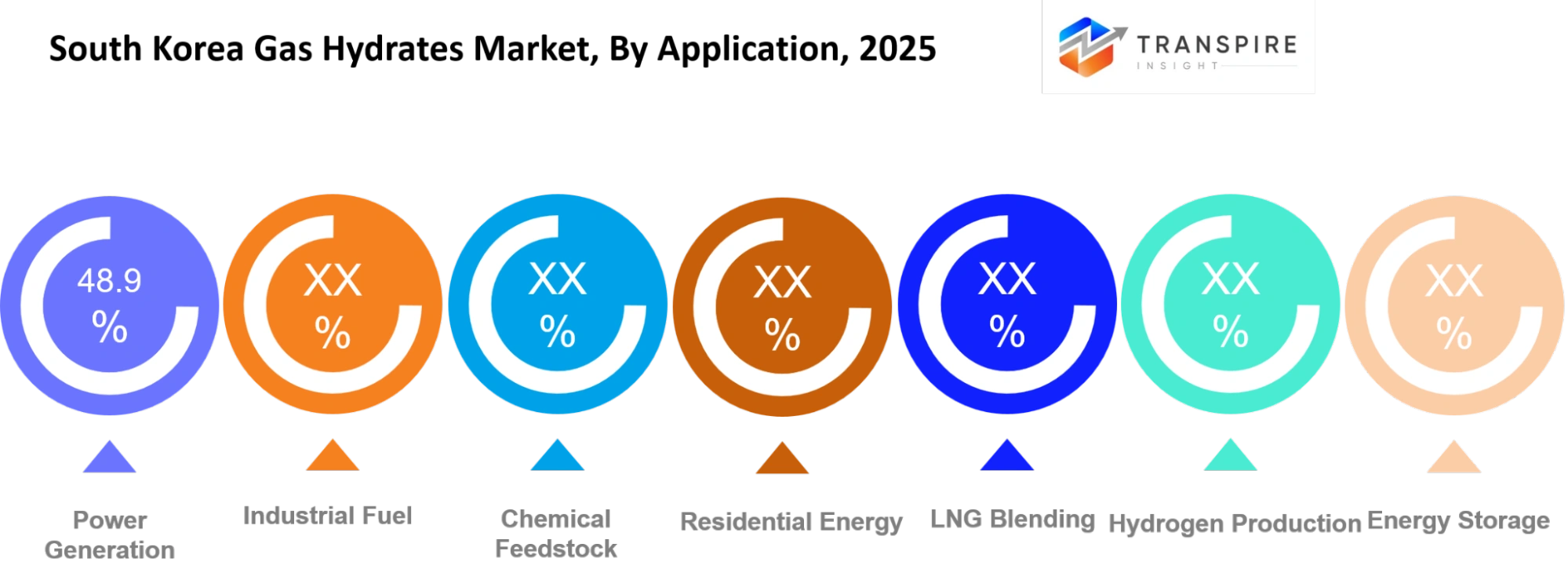
Top applications for hydrates Power generation are among the important applications, due to the enormous scope of Methane supply which in turn could power generation to meet the demand of nation by reducing reliance on the imported sources.Industrial fuel - are becoming increasingly attractive especially for industrial powers looking to secure reliable domestic sources of fuel.
Chemicals feedstock use of Methane - Methane derived from hydrates is used in the manufacturing process for producing a variety of industrial products and chemicals.Residential Energy will in due course be among the applications as the development infrastructure & the extraction technology progress. LNGBlending is also an interesting prospect.Hydrogen generation, energy storage and others are other applications which are developing and testing.
By Extraction Method:
Depressurization is the most investigated extraction technique; due to reduced operating cost by using lower reservoir pressure. Thermal Stimulation uses heat for the liberation of gas from hydrate structures; while chemical injection still under research by additives can affect recovery rate for specific reservoir conditions. CO2 Exchange is gaining interest by the displacement of methane molecules in hydrates, thus permitting gas recovery while CO2 is stored.
Hybrid Extraction by utilizing a combination of extraction techniques is intended for enhanced production efficiency. Offshore drilling and pilot projects are primarily carried out to ascertain the economic feasibility, whereas Other methods may involve some unique experimental techniques intended for the long term.
By End User:
Energy companies serve as the biggest end users of this gas, in that commercial development is part of long-term diversification for the sector. Utilities would be key as on-going supply security can provide fuel for electricity generation. Research Institutes conduct research into reservoirs, the extraction technology and monitor the environmental impacts of any work. Government agencies provide financing, policy guidance and regulation of any work Government Agencies provide funding, policy guidance and regulation of any exploration or pilot projects.
Industrial end users view methane as another potential fuel to supplement conventional fuels for manufacturing purposes, while chemical producers and petrochemical industries view it as a feed gas for the chemical sector. Universities and others provide opportunities for research and collaboration and commercialise and develop new technologies.
What are the Key Use Cases Driving the South Korea Gas Hydrates Market?
South Korea’s main use for gas hydrates is a domestic fuel resource. Methane from offshore hydrate resources is an important fuel to reduce the country’s dependence on liquefied natural gas (LNG) imports to feed its electricity production, which remains an area for increased investment as South Korea’s utility companies look to secure energy supplies that are insulated from international pricing fluctuations.
In addition to generating electricity, methane from hydrates is also being considered for use in industry as a fuel and as a feedstock for petrochemical production. Oil refiners in the country are interested in methane as feed to manufacture ammonia, while large industrial consumers are examining other potential fuels to enhance long-term cost stability and supply security.
Further potential uses of hydrates and their produced methane, though further in the future, include hydrogen generation and energy storage. One approach involves using the methane to contribute to clean hydrogen supply chains and to the operation of energy storage devices to help mitigate the variability of clean energy output in a forecast period.
|
Report Metrics |
Details |
|
Market size value in 2025 |
USD 144.9 Million |
|
Market size value in 2026 |
USD 154.9 Million |
|
Revenue forecast in 2033 |
USD 247.6 Million |
|
Growth rate |
CAGR of 6.93% from 2026 to 2033 |
|
Base year |
2025 |
|
Historical data |
2021 - 2024 |
|
Forecast period |
2026 - 2033 |
|
Report coverage |
Revenue forecast, competitive landscape, growth factors, and trends |
|
Country scope |
South Korea |
|
Key company profiled |
KOGAS, KNOC, Mitsubishi Corporation, JOGMEC, Shell, ExxonMobil, Chevron, PetroChina, Sinopec, ONGC, Equinor, TotalEnergies, BP, Woodside Energy, Inpex. |
|
Customization scope |
Free report customization (country, regional & segment scope). Avail customized purchase options to meet your exact research needs. |
|
Report Segmentation |
By Resource Type (Methane Hydrates, Marine Hydrates, Permafrost Hydrates, Natural Gas Hydrates, Deepwater Hydrates, Offshore Reserves, Energy Hydrates, Others); By Application (Power Generation, Industrial Fuel, Chemical Feedstock, Residential Energy, LNG Blending, Hydrogen Production, Energy Storage, Others); By Extraction Method (Depressurization, Thermal Stimulation, Chemical Injection, CO2 Exchange, Hybrid Extraction, Offshore Drilling, Pilot Projects, Others); By End User (Energy Companies, Utilities, Research Institutes, Government Agencies, Industrial Users, Petrochemical Firms, Universities, Others). |
Which Regions are Driving the South Korea Gas Hydrates Market Growth?
The leading gas hydrate region in the market is the East Sea as it contains the most confirmed gas hydrate deposits in offshore basins lining South Korea’s east coast. Government initiatives aimed to boost domestic fuel production continue to favor long term investment in the region’s energy resources in order to develop drilling technology, seismic surveys, and early stage extraction activities. Domestic national institutes provide steady research support and collaborate with existing energy firms to produce an environment suited for both technological development and resource evaluation. These factors combined-resource presence, policy, and expertise-place the East Sea region at the forefront of this market.
South Coast In terms of its contribution, the South Coast is not defined by abundant resources but rather the industrial framework ready to incorporate them into its existing systems. LNG terminal locations, multiple energy infrastructure sites, and huge petrochemical plants on the south coast allow for a stable future as gas hydrates become ready for commercial production. In this respect, industry is investing steadily in new methane supplies as a buffer against potential future fuel price fluctuations. Due to their consistent presence in the market this provides reliable long-term revenue, albeit less extensive than in the East Sea with regard to exploration activity.
West Coast The West Coast is the fastest-expanding region of the gas hydrates market in the country as exploration investments shift toward its offshore zones and its utilization of digital exploration technologies to improve identification processes and reduce costs. There is increasing evidence of research funding and feasibility studies along the coast, owing to improvements in marine seismic surveying and the rising necessity to find new fuel options. Infrastructure has been updated in many areas with more facilities at their disposal, therefore providing more infrastructure for oil rigs as well as pilot projects. Investment will surge along this region between the years 2026 and 2033 due to increased technology adoption, drilling contractor utilization, and new investment opportunities.
Who are the Key Players in the South Korea Gas Hydrates Market and How Do They Compete?
Competitive Landscape Competition within the South Korea Gas Hydrates market tends to remain moderately consolidated due to the lack of widespread commercial production. Rather than price, this market is heavily influenced by technological readiness, expertise in offshore exploration, and access to government backed research funding, with the leading players leveraging significant research investment to maintain their strategic dominance. Private sector energy companies are increasingly investing in the market as Commercial opportunities become clearer and private entities attempt to capitalize on technological advancements.
Korea Institute of Geoscience and Mineral Resources is primarily engaged in research and reservoir characterization and, owing to the institute's vast geological knowledge base and sophisticated seismic processing techniques, it has been able to assess hydrate reserves more effectively than its peers. Korea National Oil Corporation offers a unique selling proposition with regards to its offshore exploration and production experience from traditional energy projects, coupled with continuous investment in its pilot production technologies to improve technical competence.
POSCO International is looking at future growth through the use of new energy sources in cooperation with major international energy companies and by leveraging existing relationships in traditional energy sources. With its comprehensive experience of international energy trading and well-established ties in key industrial sectors, the company is positioned well to gain ground in this market. SK Innovation’s innovation and technology leadership strategies allow for greater optimization through integrated application of digital modeling and real-time data analytics, advanced seismic data and deep offshore energy research. By combining the latter three approaches, it plans to greatly improve exploration effectiveness.
Company List
- KOGAS
- KNOC
- Mitsubishi Corporation
- JOGMEC
- Shell
- ExxonMobil
- Chevron
- PetroChina
- Sinopec
- ONGC
- Equinor
- TotalEnergies
- BP
- Woodside Energy
- Inpex
Recent Development News
In June 2026, industry analysis showed growing investment in depressurization-based gas hydrate extraction technologies, with new patents and engineering programs focusing on production efficiency. The advancement strengthened the commercial outlook for offshore methane hydrate projects and supported technology development efforts across Asia, including South Korea.
Source: https://www.patsnap.com/
In June 2026, researchers participating in the international gas hydrate research community highlighted advances in gas hydrate exploration, production, and environmental monitoring technologies. The development accelerated progress toward safer extraction methods and reinforced collaboration opportunities for South Korean institutions engaged in offshore hydrate commercialization.
Source: https://www.gfz.de/en/
What Strategic Insights Define the Future of the South Korea Gas Hydrates Market?
Over the next five to seven years, the South Korean gas hydrates market will transition into a ‘discreet commercialization’ phase where technology maturity will take precedence over resource volume size. The primary driver is South Korea’s continued quest for energy security and insulation from fuel imports. Investment will shift away from pure exploration to focus more on extraction technology, smart reservoirs and environmental protection, rather than the prospect of huge resource discovery.
A less obvious but material risk is technological substitution. The continued rapid development in hydrogen, the future role of advanced nuclear and scaled-up energy storage could steal attention away from methane hydrates if extraction prices remain too high and/or the commercial timeline gets significantly pushed out. Whilst the risk would not immediately impact current research work, it could well impact the appetite for further private capital investment going forward.
A new, emerging opportunity is in leveraging CO2-for-CH4 (carbon dioxide-exchange-for-methane) in deep water fields. Partners which combine gas hydrates extraction experience with carbon mitigation/storage will see continued policy support and be best positioned for long-term advantage, regardless of where investments are allocated.
South Korea Gas Hydrates Market Report Segmentation
By Resource Type
- Methane Hydrates
- Marine Hydrates
- Permafrost Hydrates
- Natural Gas Hydrates
- Deepwater Hydrates
- Offshore Reserves
- Energy Hydrates
By Application
- Power Generation
- Industrial Fuel
- Chemical Feedstock
- Residential Energy
- LNG Blending
- Hydrogen Production
- Energy Storage
By Extraction Method
- Depressurization
- Thermal Stimulation
- Chemical Injection
- CO2 Exchange
- Hybrid Extraction
- Offshore Drilling
- Pilot Projects
By End User
- Energy Companies
- Utilities
- Research Institutes
- Government Agencies
- Industrial Users
- Petrochemical Firms
- Universities
Frequently Asked Questions
Find quick answers to common questions.
The South Korea Gas Hydrates Market size is USD 247.6 Million in 2033.
Key segments for the South Korea Gas Hydrates Market are By Resource Type (Methane Hydrates, Marine Hydrates, Permafrost Hydrates, Natural Gas Hydrates, Deepwater Hydrates, Offshore Reserves, Energy Hydrates, Others); By Application (Power Generation, Industrial Fuel, Chemical Feedstock, Residential Energy, LNG Blending, Hydrogen Production, Energy Storage, Others); By Extraction Method (Depressurization, Thermal Stimulation, Chemical Injection, CO2 Exchange, Hybrid Extraction, Offshore Drilling, Pilot Projects, Others); By End User (Energy Companies, Utilities, Research Institutes, Government Agencies, Industrial Users, Petrochemical Firms, Universities, Others).
Major South Korea Gas Hydrates Market players are KOGAS, KNOC, Mitsubishi Corporation, JOGMEC, Shell, ExxonMobil, Chevron, PetroChina, Sinopec, ONGC, Equinor, TotalEnergies, BP, Woodside Energy, Inpex.
The South Korea Gas Hydrates Market size is USD 144.9 Million in 2025.
The South Korea Gas Hydrates Market CAGR is 6.93% from 2026 to 2033.
- KOGAS
- KNOC
- Mitsubishi Corporation
- JOGMEC
- Shell
- ExxonMobil
- Chevron
- PetroChina
- Sinopec
- ONGC
- Equinor
- TotalEnergies
- BP
- Woodside Energy
- Inpex
About the Authors

Avinash Kumar
I’m Avinash Kumar, a Senior Research Analyst at Transpire Insight, with expertise in the Electronics and Semiconductor and Energy & Power industry. My work focuses on analyzing emerging technologies, market trends, industry developments, and innovation across these sectors. I specialize in transforming complex technical and market insights into clear, research-backed content that helps professionals, businesses, and decision-makers stay informed. Through continuous industry research and data-driven analysis, I strive to deliver accurate, reliable, and practical perspectives on the latest advancements shaping the semiconductor and energy landscape.

Chakradhar Khansole
Chakradhar serves as the Research Director at Transpire Insight, bringing over 8 years of experience in technology, innovation, and strategic market intelligence. He specializes in transforming complex market data into actionable business insights that enable organizations to make informed, growth-oriented decisions. Recognized for his strategic vision and analytical expertise, Chakradhar leads high-impact research initiatives, delivering comprehensive market assessments, competitive intelligence, and forward-looking industry analysis.
Recently Published Reports
-
Apr 2026
Active Power Filter Market
Active Power Filter Market Size, Share & Analysis Report By Type (Shunt Active Power Filters, Series Active Power Filter, Hybrid Active Power Filter), By Application (Harmonics Mitigation, Reactive Power Compensation, Voltage Regulation, Power Factor Correction), By Phase (Single Phase, Three Phase), By End-User Industry (Manufacturing, Healthcare, Commercial, Automotive, Oil and Gas, Others), and Geography (North America, Europe, Asia-Pacific, Middle East and Africa, South and Central America), 2021 - 2031
-
Apr 2026
Electrical Transformer Market
Electrical Transformer Market Size, Share & Analysis Report By Core (Closed, Shell, and Berry), By Insulation (Gas, Oil, Solid, Air, and Other), By Phase (Single, and Three), By Rating (100 MVA to 500 MVA, 501 MVA to 800 MVA, and 801 MVA to 1200 MVA), and Geography (North America, Europe, Asia-Pacific, Middle East and Africa, South and Central America), 2021 – 2031
-
Apr 2026
Hydraulic Piston Pumps Market
Hydraulic Piston Pumps Market Size, Share & Analysis Report By Type (Axial Piston Pumps, Radial Piston Pumps), By Operating Pressure (Low Pressure, Medium Pressure, High Pressure), By Application (Construction, Mining, Agriculture, Automotive, Oil & Gas, Industrial Machinery, Others), By End-User (OEMs, Aftermarket), and Geography (North America, Europe, Asia-Pacific, Middle East and Africa, South and Central America), 2021 – 2031
-
Apr 2026
Laboratory Gas Generators Market
Laboratory Gas Generators Market Size, Share & Analysis Report By Product (Nitrogen Gas Generator, Hydrogen Gas Generator, Zero Air Gas Generator, Purge Gas Generator, TOC Gas Generators, Others), By Application (Gas Chromatography, Liquid Chromatography-mass Spectrometry (LC-MS), Gas Analyzers, Others), By End-user (Life Science, Chemical & Petrochemical, Food & Beverage, Others), and Geography (North America, Europe, Asia-Pacific, Middle East and Africa, South and Central America), 2021 – 2031