

United States Solar Tracker For Power Generation Market Size & Forecast:
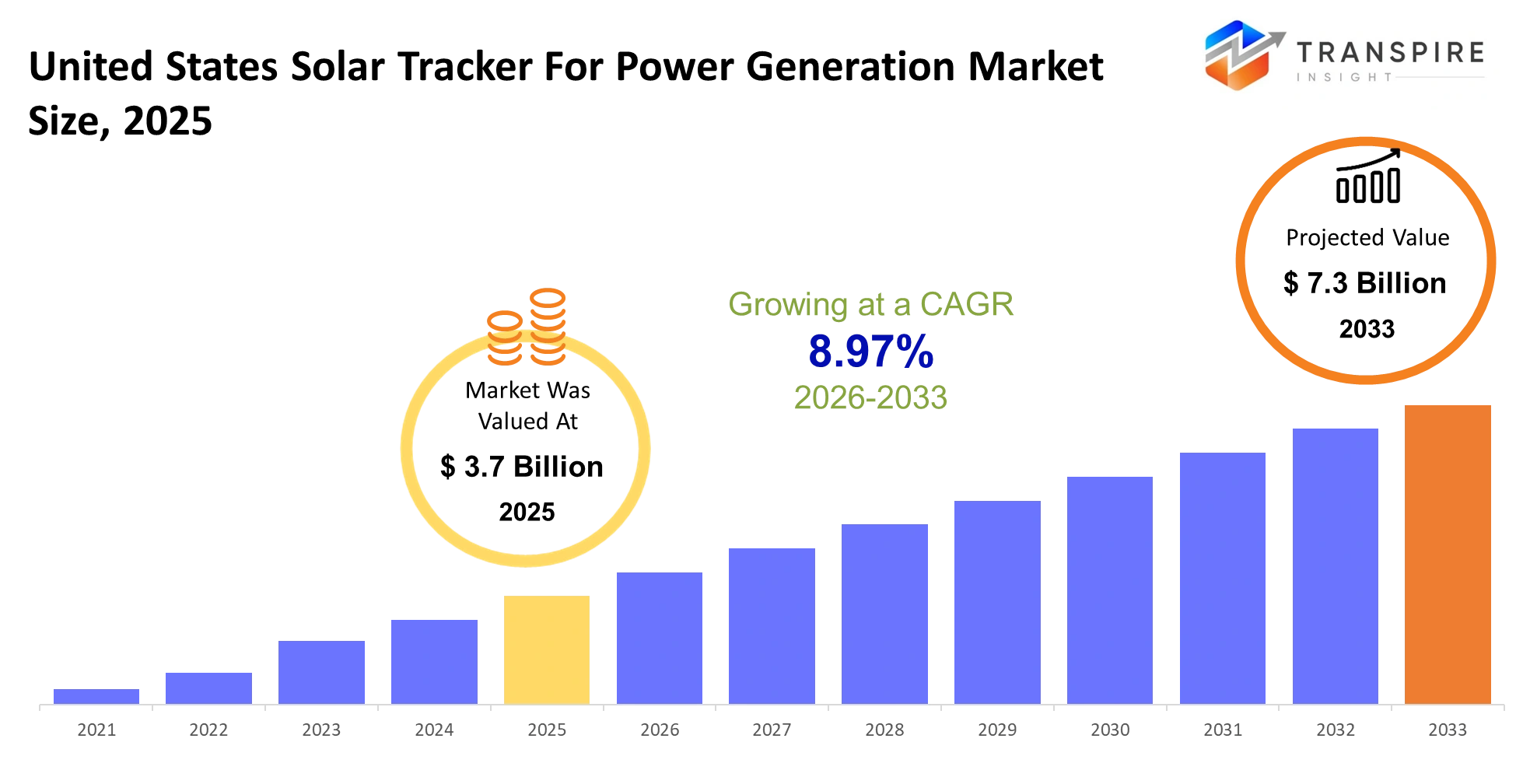
- United States Solar Tracker For Power Generation Market Size 2025: USD 3.7 Billion
- United States Solar Tracker For Power Generation Market Size 2033: USD 7.3 Billion
- United States Solar Tracker For Power Generation Market CAGR: 8.97%
- United States Solar Tracker For Power Generation Market Segments: By Tracker Type (Single-axis Trackers, Dual-axis Trackers, Manual Trackers, Active Trackers, Passive Trackers, Others); By Technology (Photovoltaic Systems, Concentrated Solar Power Systems, Hybrid Solar Systems, Others); By Application (Utility-scale Projects, Commercial Installations, Industrial Installations, Residential Installations, Others); By End User (Utilities, Independent Power Producers, Commercial Sector, Industrial Sector, Others).
To learn more about this report,  Download Free Sample Report
United States Solar Tracker For Power Generation Market Summary
The United States Solar Tracker For Power Generation Market was valued at USD 3.7 Billion in 2025. It is forecast to reach USD 7.3 Billion by 2033. That is a CAGR of 8.97% over the period.
Solar trackers, in the United States utility-scale power generation space, are electromechanical things used in big solar farms to keep photovoltaic panels turning, basically orienting toward the sun, so energy yield goes up for the same piece of land. Yeah, in real life they let developers squeeze more output per acre and it ends up supporting project economics, especially now that land is getting tighter, interconnection capacity is limited, and financing constraints feel more intense.
Over the last five years, the market really sort of flipped in a structural way , from fixed-tilt installations toward single-axis tracking systems. That happened as bifacial modules and software driven control approaches became normal, and that combination made it easier to reach higher lifetime generation efficiency. One of the biggest “start pushing it faster” moments was the Inflation Reduction Act of 2022, which broadened tax credits and gave momentum to domestic solar manufacturing as well as deployment pipelines.
With that policy support behind it, the economics looked better , so utilities leaned into trackers. The goal was to cut the levelized cost of electricity and still hit the big scale capacity additions, which then improved revenue predictability for tracker suppliers and EPC contractors too.
Key Market Insights
- In the Southwest region, the United States Solar Tracker For Power Generation Market seemed to be leading with almost 42% share in 2025 , mainly because of big solar farms rolling out at scale.
- Texas stayed the top state for utility- scale solar tracker deployments, backed by solid renewable spending and bigger grid infrastructure projects that keep expanding.
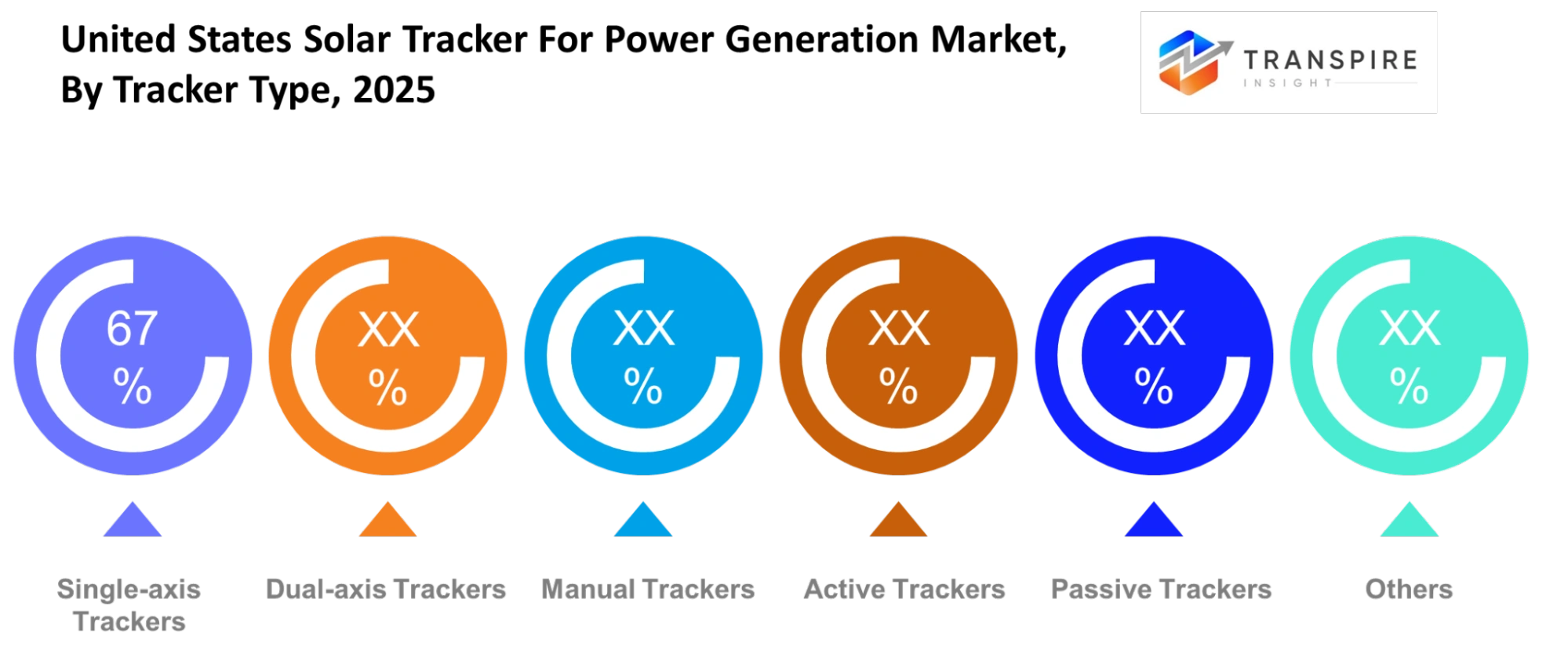
- In terms of industry size, single-axis solar trackers took the biggest portion with more than 78% of revenue share in 2025, partly from cost efficiency plus stronger energy output.
- Meanwhile, dual-axis trackers showed up as the second-largest segment as developers leaned into better sun-tracking accuracy for high- radiation utility setups.
- AI integrated smart trackers are projected to grow the quickest across the forecast period, because predictive maintenance features make operations more, I guess, resilient and planned.
- Utility-scale solar tracker systems, basically held the biggest market share as large photovoltaic plants spread across high-irradiance regions. You could say the majority share was there for most of the time, even as expansion kept going.
- Wireless monitoring and IoT-enabled tracking technologies are showing up as emerging trends, helping boost operational efficiency and better real-time performance analytics, in a practical way.
- In terms of use, Utility-scale power generation looked like it dominated applications with nearly a 70% share in 2025, mostly because renewable electricity generation capacity is still expanding across the country.
- Commercial and industrial solar installations also grew quite a lot, as companies aimed for reduced energy costs and sustainability commitments.
- Meanwhile, floating solar projects are starting to create new demand for specialized tracker solutions, which is kind of becoming a thing now.
What are the Key Drivers, Restraints, and Opportunities in the United States Solar Tracker For the Power Generation Market?
The main force that’s really speeding up the United States Solar Tracker For Power Generation Market is the fast growth of utility scale solar capacity, backed by federal policy incentives under the Inflation Reduction Act. With the extension of investment tax credits plus domestic manufacturing incentives, a lot of the numbers improved for big photovoltaic developers. In practice, solar trackers became sort of a go to option, because they boost energy output efficiency roughly 15% to 25% versus fixed tilt systems. That improvement, in a very direct way, lifts project returns and makes payback periods shorter, especially in high irradiance regions like Texas, Arizona, and Nevada. And as more utilities keep swapping out older fossil fuel infrastructure, solar farms that use trackers are ending up grabbing a larger share of new power generation spending.
One major restraint though is the structural reliance on imported steel components actuators, and electronic control systems, all of which are used when tracker units get manufactured. Supply chain swings, tariff exposure, and the fact that domestic production capacity is still limited are steadily pushing procurement costs higher while also dragging out project schedules. These issues can’t get fixed overnight, since building local manufacturing facilities needs serious capital outlay plus long regulatory approvals, and even then it can take time. When equipment deliveries slip, and raw material costs stay elevated, revenue growth gets squeezed too, because utility scale projects get commissioned slower than planned.
A big chance is kind of showing up as AI driven tracking software gets mixed with energy storage systems. Lately, developers in California, and also the Southeast are adopting smart trackers that can handle weather variations, do predictive maintenance, and support real-time optimization. It's not just a neat upgrade though, because these tools help keep the grid steady and make energy dispatch more efficient. In turn, it builds a stronger value proposition for big renewable energy operators, especially the ones managing lots of assets at once.
What Has the Impact of Artificial Intelligence Been on the United States Solar Tracker For the Power Generation Market?
Artificial intelligence and more advanced digital technologies are starting to shift the United States Solar Tracker For Power Generation Market, basically by boosting energy yield, doing field operations in an automated way, and cutting down on maintenance downtime that feels like it never ends. Utility scale solar operators are leaning harder into AI enabled tracker control systems, those that adjust panel positioning on their own, based on irradiance levels, wind speed, cloud movement, and also what the grid is demanding at the time. With these automated optimization setups, solar generation efficiency tends to go up, while the need for manual interference drops across big photovoltaic locations.
At the same time, machine learning models are quietly giving predictive maintenance a stronger backbone inside the solar tracking infrastructure. Operators rely on sensor driven analytics to watch actuator behavior, motor temperature, torque swings, and alignment accuracy in real time. The predictive routines spot early mechanical problems before a breakdown actually happens, so developers can lower unexpected service calls and protect equipment uptime. In fact, several larger solar plants in Texas and California have shared results showing reduced operational costs and better energy output after they integrated AI monitoring platforms into their tracker fleets.
Digital twin technology is also getting more attention for performance forecasting and site optimization. Developers try out simulations that reflect weather patterns, land gradients, and shading characteristics before installation, so tracker placement can be smarter, and long term electricity generation can be maximized. Still, the costs to integrate everything remains a big hurdle for AI adoption. A lot of older solar facilities keep running on legacy infrastructure, and that legacy setup often doesn’t include compatible sensors, communication networks, or centralized data platforms that advanced automation systems typically require.
Key Market Trends
- Since 2022, utility developers have been swapping out fixed-tilt systems for single-axis trackers more often, just to squeeze better energy output, like nearly 20% more in high-radiation states or so.
- Nextracker and Array Technologies also started expanding domestic manufacturing after the Inflation Reduction Act incentives kicked in, because procurement priorities got pushed toward the U.S.-based supply chains, which honestly reshaped a lot.
- In 2024 solar project developers leaned further into AI-enabled tracker software to handle wind protection, shading response, and those real time positioning adjustments, all in one go.
- Meanwhile tracker manufacturers, since 2023, have been picking up terrain-following designs more frequently, which cuts down land grading expenses and basically speeds up deployment across uneven utility-scale sites.
- Independent power producers moved away from short term procurement arrangements and toward long-term service agreements, mainly to smooth out maintenance costs and keep equipment availability steady.
- Also, since 2021, Texas has been ahead of California in new utility-scale tracker deployments, helped by grid expansion, and by lower land costs, so the economics look better.
- Manufacturers increasingly rolled predictive maintenance sensors into tracker motors and actuators, which lets operators reduce unexpected downtime and keep operational reliability stronger.
- After 2022, trade restrictions on imported steel and electronic components forced developers to broaden their supplier networks and ramp up domestic sourcing partnerships, even when timelines got tight.
- By 2025, hybrid solar-plus-storage projects gained a bunch of momentum, since utilities have been prioritizing dispatchable renewable generation and overall grid reliability during the peak electricity demand periods, yeah.
United States Solar Tracker For Power Generation Market Segmentation
By Tracker Type :
Single-axis trackers actually hold a major share in the United States Solar Tracker For Power Generation Market because big utility projects prefer systems that raise energy yield without putting in too much installation cost. In general, solar farms across the sunnier states keep pushing demand for these trackers , since plant operators are trying to use land more smartly and keep electricity output fairly steady. Dual-axis trackers are also getting a lot more attention where maximum solar capture is still a must, especially when operators want stronger exposure during most of the day.
Manual trackers still stay in the smaller corner of the market, mostly because many large-scale operators now lean toward automated arrangements , they cut down on labor needs and they help keep performance consistent. Active and passive tracker types keep moving forward across commercial and industrial sites where energy efficiency expectations keep getting stricter. There are also other tracker systems entering the market as companies work on lighter frames and better monitoring tools, for long-term solar operations across varying climate conditions.
To learn more about this report, Download Free Sample Report
By Technology :
Photovoltaic systems are basically leading the United States Solar Tracker For Power Generation Market, mostly because solar panel rollout is ramping up across utility, commercial, and industrial spaces. Solar developers keep putting money into photovoltaic projects since the whole setup process feels more straightforward, and the project timelines are quicker, than with other alternatives. Also, rising electricity demand plus federal clean energy programs are giving a real push toward broader adoption of tracker-supported photovoltaic setups for big, large-scale power production.
Meanwhile, concentrated solar power systems still hold a smaller but meaningful presence, especially where strong solar radiation can reliably drive thermal energy generation. Hybrid solar systems are quietly growing too, since businesses and utilities are looking for more steady output by mixing solar methods with storage, or other renewable sources. And other technologies keep moving forward through research, with an emphasis on boosting operational efficiency, reducing maintenance costs, and backing long-term renewable targets across the country.
By Application :
Utility-scale projects really count as the largest part of the United States Solar Tracker For Power Generation Market, mainly because power firms keep putting up big solar farms to chase the higher renewable electricity targets. Tracker systems tend to boost energy output over broad spans of land, so utility projects become more financially appealing. On top of that, government incentives and fresh private investment are keeping the roll out going, across multiple states, without much pause.
Meanwhile commercial and industrial setups are climbing at a steady rate, since companies want to reduce electricity costs and also strengthen their sustainability outcomes. Residential installations are still growing too but at a more moderate pace, driven by stronger awareness about solar energy savings and home energy self reliance. There are also other uses appearing, like remote operations and niche energy endeavors, where tracker systems help sustain better power reliability and day to day efficiency when weather conditions keep shifting, which matters more than people think.
By End User :
Utilities still sit at the front of the end user group in the United States Solar Tracker For Power Generation Market, mostly because big electricity providers keep putting serious funding behind renewable energy expansion plans. Solar trackers enable more electricity output, so utilities can bolster their grid delivery while also staying aligned with environmental rules. Ongoing clean power commitments, plus consumers asking for more renewable electricity, keeps pushing investment momentum, especially inside the utility segment.
Meanwhile, independent power producers are also moving toward solar trackers, as energy competition pushes them to use more efficient generation approaches. On the commercial side, companies continue deploying tracker supported solar systems to cut day to day operating energy costs and to reinforce sustainability objectives. The industrial sector demand is moving up too, because factories , processing plants , and similar sites need consistent power delivery while trying to reduce carbon emissions and keep long term energy expenses under control.
What are the Key Use Cases Driving the United States Solar Tracker For the Power Generation Market?
Utility-scale photovoltaic plants still seem to be the main reason people are adopting the United States Solar Tracker for the Power Generation market, at least in practice. A lot of independent power producers and utility companies go with single-axis trackers, because they can squeeze out more electricity production efficiency across huge solar farms. You see it a lot in Texas, Arizona, and California, where the sun is steady-ish and the economics make sense.
On the commercial and industrial side, more energy users are moving toward tracker-supported solar setups. Their idea is to lower their long-term electricity procurement costs, kind of like a slow-burn savings plan. Data centers, manufacturing sites, and logistics operators are also putting money into higher efficiency solar systems, and pairing those with energy storage so power reliability improves and peak demand exposure stays under control.
Then there are the newer things too. Agrivoltaic projects and floating solar installations are showing up more often, and those need adaptive tracking solutions for shifting weather or other environmental conditions. Community solar programs, plus hybrid renewable microgrids, are starting to open doors for smarter tracking systems, especially those tied into AI based performance optimization platforms, which basically try to tune output in near real time.
|
Report Metrics |
Details |
|
Market size value in 2025 |
USD 3.7 Billion |
|
Market size value in 2026 |
USD 4.0 Billion |
|
Revenue forecast in 2033 |
USD 7.3 Billion |
|
Growth rate |
CAGR of 8.97% from 2026 to 2033 |
|
Base year |
2025 |
|
Historical data |
2021 - 2024 |
|
Forecast period |
2026 - 2033 |
|
Report coverage |
Revenue forecast, competitive landscape, growth factors, and trends |
|
Geographic scope |
United States of America |
|
Key company profiled |
Nextracker, Array Technologies, Soltec, PV Hardware, Arctech Solar, GameChange Solar, STI Norland, First Solar, Trina Solar, Canadian Solar, SunPower, FTC Solar, Ideematec, Solar Steel, Valmont Industries. |
|
Customization scope |
Free report customization (country, regional & segment scope). Avail customized purchase options to meet your exact research needs. |
|
Report Segmentation |
By Tracker Type (Single-axis Trackers, Dual-axis Trackers, Manual Trackers, Active Trackers, Passive Trackers, Others); By Technology (Photovoltaic Systems, Concentrated Solar Power Systems, Hybrid Solar Systems, Others); By Application (Utility-scale Projects, Commercial Installations, Industrial Installations, Residential Installations, Others); By End User (Utilities, Independent Power Producers, Commercial Sector, Industrial Sector, Others). |
Which Regions are Driving the United States Solar Tracker For Power Generation Market Growth?
The Southwest region kinda leads the United States Solar Tracker For Power Generation Market, mostly because solar irradiance is high , there’s plenty of land to work with and the state level renewable energy mandates are strong too. Texas Arizona and Nevada still keep pulling in a lot of utility-scale photovoltaic investments, since developers can get better electricity yields when they use advanced single-axis tracker systems. Also federal tax incentives plus faster, less tangled permitting processes helped speed up deployments across the region, especially after 2022. There’s also this already mature network of EPC contractors, domestic tracker manufacturers, transmission infrastructure providers, and utility procurement programs, and together they keep the region in front for large scale solar projects
Then you have the Western region, which is led by California and parts of Colorado. It brings in steady market revenue thanks to long term decarbonization policies and pretty consistent clean energy procurement frameworks. But unlike the Southwest, the growth here doesn’t lean as much on raw land scale, and instead it leans more on grid modernization, storage integration, and performance optimization. Utilities and corporate energy buyers keep putting money into tracker equipped solar installations, mainly to support grid reliability when peak demand shows up. Strong financing networks, faster adoption of newer technology, and well established renewable project developers make the region a dependable contributor to national tracker deployment, even when conditions vary.
The Southeast region seems to be showing up as the fastest growing market, kind of, because of rapid utility buildup and this steady rise in electricity needs from industrial facilities ,and also data centers. In places like Florida, Georgia, and the Carolinas, companies boosted renewable infrastructure spending soon after utilities talked about long term coal reduction and more grid diversification. At the same time, developers sped up solar tracker adoption, since the lower equipment costs are making the project case a bit better in some of the markets that used to be less penetrated. Overall this regional push should translate into real openings for manufacturers, software providers, and infrastructure investors aiming for expansion between 2026 and 2033.
Who are the Key Players in the United States Solar Tracker For the Power Generation Market and How Do They Compete?
The United States Solar Tracker For Power Generation market seems to have this kind of moderate consolidation, where a smaller group of big manufacturers control a large portion of utility scale deployments. Lately the competition isn’t only about hardware pricing, it’s more about tracker durability, software intelligence, terrain adaptability, and also supply chain localization, which feels like the real battleground now. Some established companies are holding on to share by pushing broader domestic manufacturing and adding predictive analytics right into their tracker platforms. Meanwhile newer, technology-driven entrants are hunting for smaller or niche opportunities like agrivoltaics, storage integrated projects, and AI enabled performance optimization systems.
Nextracker kind of differentiates itself via terrain-following tracker systems that reduce grading requirements, and they lower installation costs on uneven project sites too. Nextracker also improved its position by folding in machine learning software for wind-response automation and predictive maintenance analytics, which is not just a feature it’s a whole approach. Their expansion plan leans heavily on domestic manufacturing partnerships and long-term supply agreements with major utility developers across Texas and the Southwest. Array Technologies, on the other hand, competes through simplified mechanical designs that reduce operational complexity, and they also cut maintenance frequency for big utility scale projects. Array Technologies expanded its manufacturing capacity inside the United States after federal clean energy incentives drove more demand for components sourced domestically.
FTC Solar kind of leans into software driven optimization, plus quicker installation systems, so the whole commissioning clock is shorter for EPC contractors. Their tracker setup is made to handle different kinds of site layouts, which can be a real advantage when the land is tight or the project is irregular, you know not “square grid” typical. GameChange Solar, on the other hand, differentiates with cost efficient tracker systems that are built for rough weather and high wind scenarios. They also widened their regional footprint by working through partnerships with independent power producers, aiming for tracker deployments that can scale across several up and coming Southeastern solar markets.
Company List
- Nextracker
- Array Technologies
- Soltec
- PV Hardware
- Arctech Solar
- GameChange Solar
- STI Norland
- First Solar
- Trina Solar
- Canadian Solar
- SunPower
- FTC Solar
- Ideematec
- Solar Steel
- Valmont Industries
Recent Development News
In May 2025, Nextracker announced acquisition of Bentek Corporation. The approximately $78 million all-cash deal expanded Nextracker’s solar tracker platform into electrical balance-of-system (eBOS) solutions, strengthening integrated infrastructure offerings for utility-scale solar projects in the United States.
Source: https://nextpower.com/
In June 2025, ARRAY Technologies entered into an agreement to acquire APA Solar. The acquisition added engineered foundation and fixed-tilt mounting systems to ARRAY’s tracker portfolio, expanding its domestic manufacturing footprint and supporting integrated solar deployment solutions for challenging soil conditions.
Source: https://arraytechinc.com/
What Strategic Insights Define the Future of the United States Solar Tracker For the Power Generation Market?
The United States Solar Tracker For Power Generation Market is gradually shifting, like, toward fully automated software-centric energy infrastructure over the next five to seven years. The main driver is that utilities are steering toward dispatchable renewable power, grid flexibility, and higher generation efficiency, not just stacking more solar capacity. Tracker systems that sit alongside AI-driven forecasting, storage optimization, and real-time grid response are likely to show up as “standard” needs inside utility procurement contracts.
One not-that-obvious risk is the rising concentration of tracker component sourcing among a small set of steel fabricators , actuator suppliers , and control system providers. If there are supply disruptions , or if trade policy changes in a serious way, it can trigger pricing volatility and push back big project commissioning even when the project pipelines look healthy. At the same time, agrivoltaic deployments and solar-plus-storage microgrids across the Southeast and Midwest are becoming a notable emerging opportunity, mainly because land-use efficiency and localized energy resilience get more policy momentum lately. Market participants should, basically, lean into vertically integrated supply partnerships and start early with predictive software platforms because future competitive edge will lean more on lifecycle performance analytics , not hardware pricing by itself.
United States Solar Tracker For Power Generation Market Report Segmentation
By Tracker Type
- Single-axis Trackers
- Dual-axis Trackers
- Manual Trackers
- Active Trackers
- Passive Trackers
By Technology
- Photovoltaic Systems
- Concentrated Solar Power Systems
- Hybrid Solar Systems
By Application
- Utility-scale Projects
- Commercial Installations
- Industrial Installations
- Residential Installations
By End User
- Utilities
- Independent Power Producers
- Commercial Sector
- Industrial Sector
Frequently Asked Questions
Find quick answers to common questions.
The United States Solar Tracker For Power Generation Market size is USD 7.3 Billion in 2033.
Key segments for the United States Solar Tracker For Power Generation Market are By Tracker Type (Single-axis Trackers, Dual-axis Trackers, Manual Trackers, Active Trackers, Passive Trackers, Others); By Technology (Photovoltaic Systems, Concentrated Solar Power Systems, Hybrid Solar Systems, Others); By Application (Utility-scale Projects, Commercial Installations, Industrial Installations, Residential Installations, Others); By End User (Utilities, Independent Power Producers, Commercial Sector, Industrial Sector, Others).
Major United States Solar Tracker For Power Generation Market players are Nextracker, Array Technologies, Soltec, PV Hardware, Arctech Solar, GameChange Solar, STI Norland, First Solar, Trina Solar, Canadian Solar, SunPower, FTC Solar, Ideematec, Solar Steel, Valmont Industries.
The United States Solar Tracker For Power Generation Market size is USD 3.7 Billion in 2025.
The United States Solar Tracker For Power Generation Market CAGR is 8.97% from 2026 to 2033.
- Nextracker
- Array Technologies
- Soltec
- PV Hardware
- Arctech Solar
- GameChange Solar
- STI Norland
- First Solar
- Trina Solar
- Canadian Solar
- SunPower
- FTC Solar
- Ideematec
- Solar Steel
- Valmont Industries
Recently Published Reports
-
Apr 2026
Active Power Filter Market
Active Power Filter Market Size, Share & Analysis Report By Type (Shunt Active Power Filters, Series Active Power Filter, Hybrid Active Power Filter), By Application (Harmonics Mitigation, Reactive Power Compensation, Voltage Regulation, Power Factor Correction), By Phase (Single Phase, Three Phase), By End-User Industry (Manufacturing, Healthcare, Commercial, Automotive, Oil and Gas, Others), and Geography (North America, Europe, Asia-Pacific, Middle East and Africa, South and Central America), 2021 - 2031
-
Apr 2026
Electrical Transformer Market
Electrical Transformer Market Size, Share & Analysis Report By Core (Closed, Shell, and Berry), By Insulation (Gas, Oil, Solid, Air, and Other), By Phase (Single, and Three), By Rating (100 MVA to 500 MVA, 501 MVA to 800 MVA, and 801 MVA to 1200 MVA), and Geography (North America, Europe, Asia-Pacific, Middle East and Africa, South and Central America), 2021 – 2031
-
Apr 2026
Hydraulic Piston Pumps Market
Hydraulic Piston Pumps Market Size, Share & Analysis Report By Type (Axial Piston Pumps, Radial Piston Pumps), By Operating Pressure (Low Pressure, Medium Pressure, High Pressure), By Application (Construction, Mining, Agriculture, Automotive, Oil & Gas, Industrial Machinery, Others), By End-User (OEMs, Aftermarket), and Geography (North America, Europe, Asia-Pacific, Middle East and Africa, South and Central America), 2021 – 2031
-
Apr 2026
Laboratory Gas Generators Market
Laboratory Gas Generators Market Size, Share & Analysis Report By Product (Nitrogen Gas Generator, Hydrogen Gas Generator, Zero Air Gas Generator, Purge Gas Generator, TOC Gas Generators, Others), By Application (Gas Chromatography, Liquid Chromatography-mass Spectrometry (LC-MS), Gas Analyzers, Others), By End-user (Life Science, Chemical & Petrochemical, Food & Beverage, Others), and Geography (North America, Europe, Asia-Pacific, Middle East and Africa, South and Central America), 2021 – 2031