Japan Soldier Systems Market Size & Forecast:
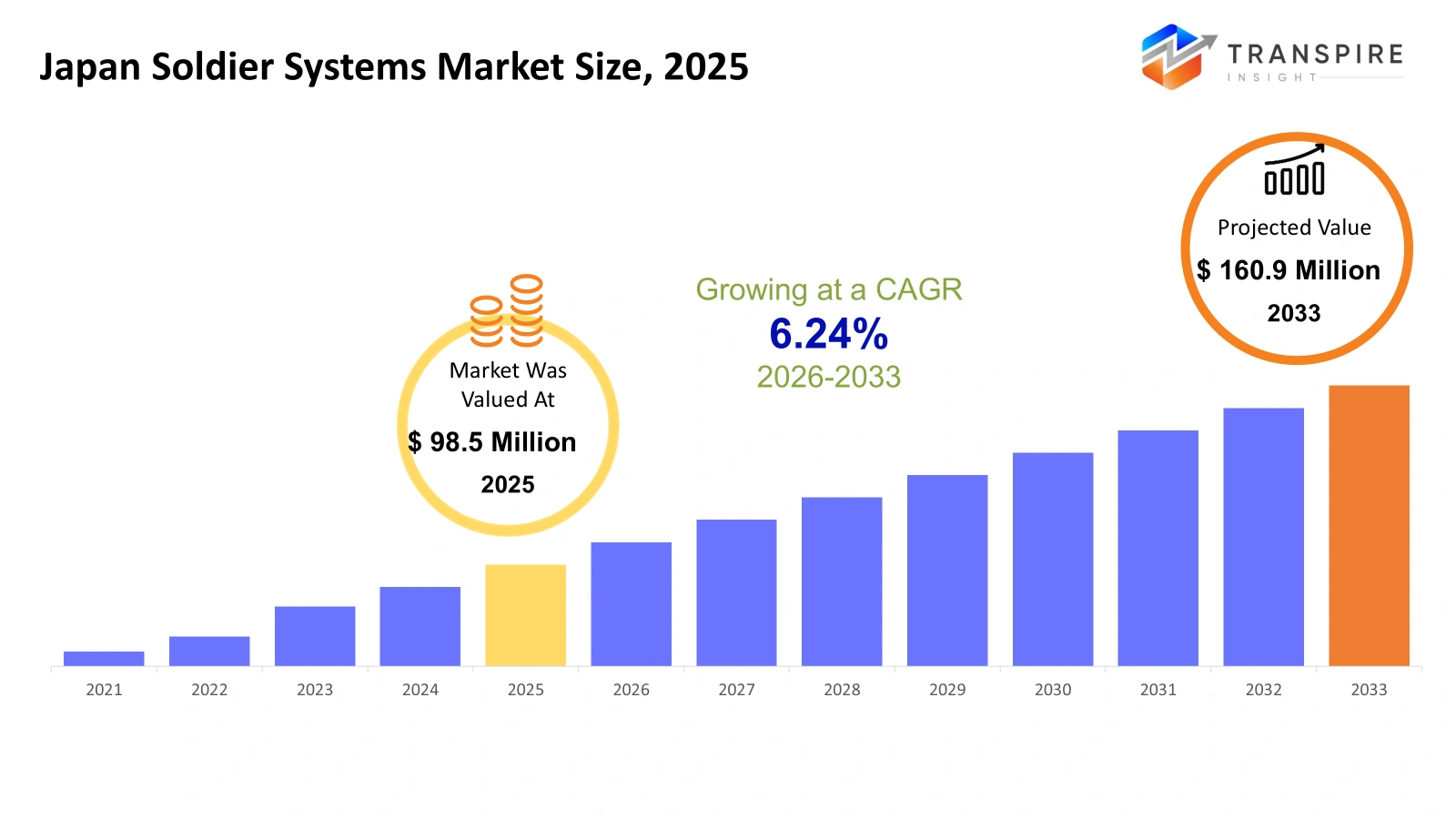
- Japan Soldier Systems Market Size 2025: USD 98.5 Million
- Japan Soldier Systems Market Size 2033: USD 160.9 Million
- Japan Soldier Systems Market CAGR: 6.24%
- Japan Soldier Systems Market Segments:By Component (Communication Systems, Protection Systems, Surveillance Systems, Weapon Systems), By End User (Infantry, Special Forces).
To learn more about this report,  Download Free Sample Report
Japan Soldier Systems Market Summary:
The Japan Soldier Systems Market size is estimated at USD 98.5 Million in 2025 and is anticipated to reach USD 160.9 Million by 2033, growing at a CAGR of 6.24% from 2026 to 2033. The Japan Soldier Systems Market is constantly developing because the country works to make its defence forces safer and more mobile and effective. Japanese soldier systems presently use advanced communication technology and protective equipment and wearable devices and unified battle management systems. The ongoing security threats combined with increasing demand for high-tech defence solutions drive permanent development work. The market expansion is supported by research investments and modernisation efforts and partnerships between technology firms. The developments target the creation of advanced soldier systems which provide intelligent and lightweight and efficient equipment for current combat situations.
Key Market Trends & Insights:
- The Japanese government is working to update its defence capabilities because security threats continue to develop. The military defence forces of Japan will receive advanced soldier systems that include better protective equipment and digital communication systems to raise their operational efficiency and battlefield tactics.
- The use of wearable sensors and smart helmets and integrated communication systems has become more common. Soldiers receive real-time data through these innovations, which enables them to improve their mission coordination and situational awareness and decision-making abilities.
- The Japanese government maintains its commitment to funding research activities which create future defence technologies. The funding enables researchers to build soldier systems which are both lightweight and durable and use modern technological features.
- All modern military systems require design elements which enable soldiers to work at their maximum capacity while delivering effective protection. Soldiers can operate better because their lightweight materials and ergonomic designs create comfortable conditions which support their work.
- Defence agencies are forming partnerships with local technology companies that specialise in electronics. The military works with local technology firms to develop advanced military equipment while building up Japan's defence manufacturing capabilities.
- The development of military systems which provide real-time battlefield data has become an essential requirement. Soldiers can operate successfully in difficult military situations through improved navigation systems and communication systems and data-sharing systems.
Japan Soldier Systems Market Segmentation
By Component
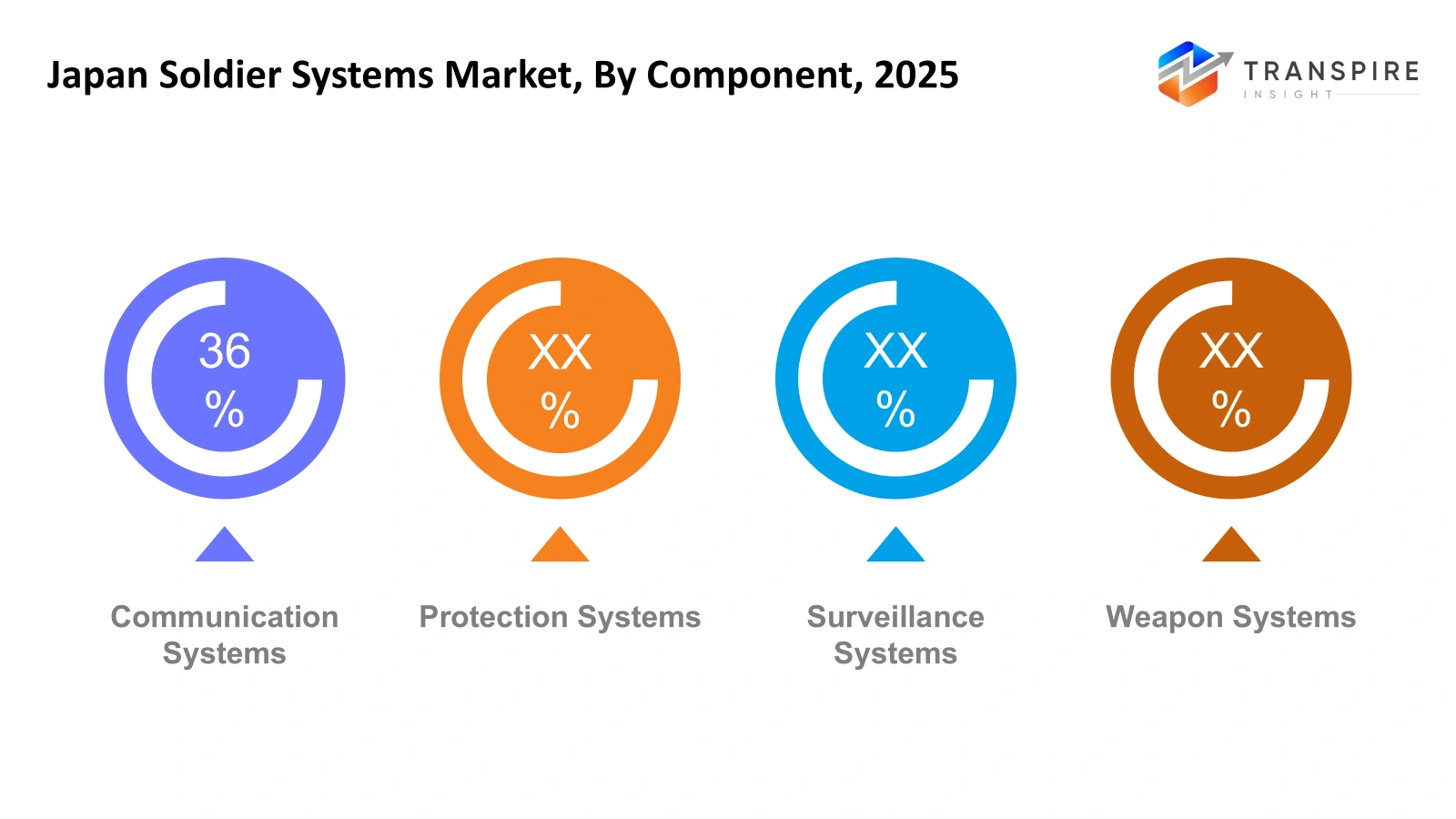
- Communication Systems: Modern soldier operations depend on communication systems because they provide secure real-time information exchange capabilities required for battlefield communication. The defence forces of Japan are implementing advanced radios together with tactical networks and digital communication systems to enhance their operational capabilities during complex military missions.
- Protection Systems: Protection systems establish safe environments for soldiers through their implementation of body armour units which include helmets and ballistic protective equipment together with advanced shielding technologies that protect soldiers in dangerous situations. Japanese research on lightweight material development together with enhanced durability testing has resulted in protective equipment design which enables soldiers to maintain their defence capabilities while enjoying comfortable movement.
- Surveillance Systems: Modern soldier systems require surveillance systems which provide troops with the ability to observe their environment while detecting threats at the earliest possible moment. The Japanese military uses wearable sensors together with night-vision technology and compact surveillance systems to enable soldiers to acquire essential battlefield intelligence, which enhances their operational understanding and enables better strategic planning.
- Weapon Systems: Soldier platforms use weapon systems to boost both combat capabilities and operational success. Japan is developing modern firearms and smart targeting systems together with advanced weapon accessories which enable soldiers to improve their accuracy and weapon reliability and operational efficiency during various mission conditions.
To learn more about this report, Download Free Sample Report
By End User
- Infantry: The Japanese army fields most of its soldier systems through infantry units. The modern soldier systems enable soldiers to operate military operations through their advanced equipment, which includes communication devices and protective gear and surveillance technologies.
- Special Forces: Special forces need advanced soldier systems because their missions require specialised equipment to handle their sensitive operations. The elite units in Japan operate their advanced military equipment, which includes lightweight protective gear and modern communication systems, to enable stealth missions and precise targeting and improved tactical operations.
Country Insights
The Japan Soldier Systems Market is experiencing consistent growth because the country expands its defence capabilities while it upgrades its military forces. Japan invests in advanced technologies which enhance soldier performance and protection and situational awareness because national security and regional stability have become increasingly important. The modern soldier systems of the country use communication systems and protective gear and surveillance equipment and combat systems to enable successful military operations.
The defence sector of Japan emphasises research and development together with high-quality engineering, which drives the creation of more efficient military devices that weigh less and operate with greater intelligence. Government initiatives which seek to modernise military facilities together with next-generation technology adoption are driving market expansion. The defence sector establishes partnerships with national technology firms, which results in faster development of new technologies. The partnerships between these organisations allow defence personnel in Japan to receive advanced soldier gear that features electronics and sensors and digital systems for contemporary operational scenarios.
Recent Development News
Japan Deploys First Domestically Developed Long-Range Missiles to Strengthen Defence Capabilities.
Japan Criticises Delay in $6.9 Billion U.S. Military Equipment Deliveries.
|
Report Metrics |
Details |
|
Market size value in 2025 |
USD 98.5 Million |
|
Market size value in 2026 |
USD 105.3 Million |
|
Revenue forecast in 2033 |
USD 160.9 Million |
|
Growth rate |
CAGR of 6.24% from 2026 to 2033 |
|
Base year |
2025 |
|
Historical data |
2021 – 2024 |
|
Forecast period |
2026 – 2033 |
|
Report coverage |
Revenue forecast, competitive landscape, growth factors, and trends |
|
Country scope |
Japan |
|
Key company profiled |
BAE Systems PLC, Thales Group, Rheinmetall AG, Elbit Systems Ltd., Saab AB, General Dynamics Corporation, L3Harris Technologies, Lockheed Martin Corporation, Northrop Grumman Corporation, Raytheon Technologies, Leonardo SpA, Honeywell International Inc., Harris Corporation, Oshkosh Defense, Kongsberg Gruppen ASA. |
|
Customization scope |
Free report customization (country, regional & segment scope). Avail customized purchase options to meet your exact research needs. |
|
Report Segmentation |
By Component (Communication Systems, Protection Systems, Surveillance Systems, Weapon Systems), By End User (Infantry, Special Forces). |
Key Japan Soldier Systems Company Insights
The Japan Soldier Systems Market features a mix of established defence manufacturers and technology-driven companies that develop modern military equipment. The organisations develop advanced solutions through their work on integrated communication devices and protective equipment, and intelligent surveillance systems, which improve soldier performance and protection. Companies focus their research efforts on developing systems that meet modern combat needs while remaining lightweight and strong, and dependable. The defence firms need to establish partnerships with both defence organisations and technology suppliers to develop advanced military systems that will aid Japan in its defence modernisation efforts.
Company List
- BAE Systems PLC
- Thales Group
- Rheinmetall AG
- Elbit Systems Ltd.
- Saab AB
- General Dynamics Corporation
- L3Harris Technologies
- Lockheed Martin Corporation
- Northrop Grumman Corporation
- Raytheon Technologies
- Leonardo SpA
- Honeywell International Inc.
- Harris Corporation
- Oshkosh Defense
- Kongsberg Gruppen ASA.
Japan Soldier Systems Market Report Segmentation
By Component
- Communication Systems
- Protection Systems
- Surveillance Systems
- Weapon Systems
By End User
- Infantry
- Special Forces
Frequently Asked Questions
Find quick answers to common questions.
The approximate Japan Soldier Systems Market size for the market will be USD 160.9 Million in 2033.
The key segments of the Japan Soldier Systems Market are By Component (Communication Systems, Protection Systems, Surveillance Systems, Weapon Systems), By End User (Infantry, Special Forces).
Major players in the Japan Soldier Systems Market are BAE Systems PLC, Thales Group, Rheinmetall AG, Elbit Systems Ltd., Saab AB, General Dynamics Corporation, L3Harris Technologies, Lockheed Martin Corporation, Northrop Grumman Corporation, Raytheon Technologies, Leonardo SpA, Honeywell International Inc., Harris Corporation, Oshkosh Defense, Kongsberg Gruppen ASA.
The current market size of the Japan Soldier Systems market is USD 98.5 Million in 2025.
The Japan Soldier Systems Market CAGR is 6.24%.
- BAE Systems PLC
- Thales Group
- Rheinmetall AG
- Elbit Systems Ltd.
- Saab AB
- General Dynamics Corporation
- L3Harris Technologies
- Lockheed Martin Corporation
- Northrop Grumman Corporation
- Raytheon Technologies
- Leonardo SpA
- Honeywell International Inc.
- Harris Corporation
- Oshkosh Defense
- Kongsberg Gruppen ASA.
Recently Published Reports
-
Apr 2026
Aerospace Fluoropolymers Market
Aerospace Fluoropolymers Market Size, Share & Analysis Report By Type (PTFE, FEP, PFA, ETFE, and Others), By Application (Electrical Insulation, Seals & Gaskets, Coatings, and Others), By End User (Commercial Aviation, Military Aviation, General Aviation, and Others), and Geography (North America, Europe, Asia-Pacific, Middle East and Africa, South and Central America), 2021 - 2031
-
Apr 2026
Airborne SATCOM System Market
Airborne SATCOM System Market Size, Share & Analysis Report By Type (SATCOM Terminals, Transceivers, Airborne Radio, Modems and Routers, SATCOM Radomes, and Other), By Application (Government and Defense and Commercial), and Geography (North America, Europe, Asia-Pacific, Middle East and Africa, South and Central America), 2021 – 2031
-
Apr 2026
Ship Leasing Market
Ship Leasing Market Size, Share & Analysis Report By Vessel Type (Container Ships, Bulk Carriers, Tankers, and Specialized Vessels), By Lease Duration (Short-Term Lease (Less than 1 year), Medium-Term Lease (1-5 years), and Long-Term Lease (More than 5 years)), By Lease Type (Bareboat Charter, Time Charter, Financial Lease, and Others), By End-User Industry (Oil and Gas, Manufacturing and Industrial, Automotive, Agriculture and Food, Retail and Consumer Goods, and Others), and Geography (North America, Europe, Asia-Pacific, Middle East and Africa, South and Central America), 2021 – 2031
-
Apr 2026
Thread Rolling Dies Market
Thread Rolling Dies Market Size, Share & Analysis Report By Type (Flat Thread Rolling Dies, Circular (Cylindrical) Dies, Tangential Thread Rolling Dies, Planetary Thread Rolling Dies, and Other Types), By Material Type (High-Speed Steel (HSS), Carbide, Tool Steel, Alloy Steel, and Other Specialized Alloys), By Distribution Channel (Direct Sales, Distributors and Dealers, and Online Platforms), By Application (Automotive Industry, Aerospace and Defense, Construction and Infrastructure, Industrial Machinery, Electronics and Electrical Components, Medical Devices, and Fastener Production), and Geography (North America, Europe, Asia-Pacific, Middle East and Africa, South and Central America), 2021 – 2031
Our Clients