Japan Melanoma Cancer Diagnostics Market Size & Forecast:
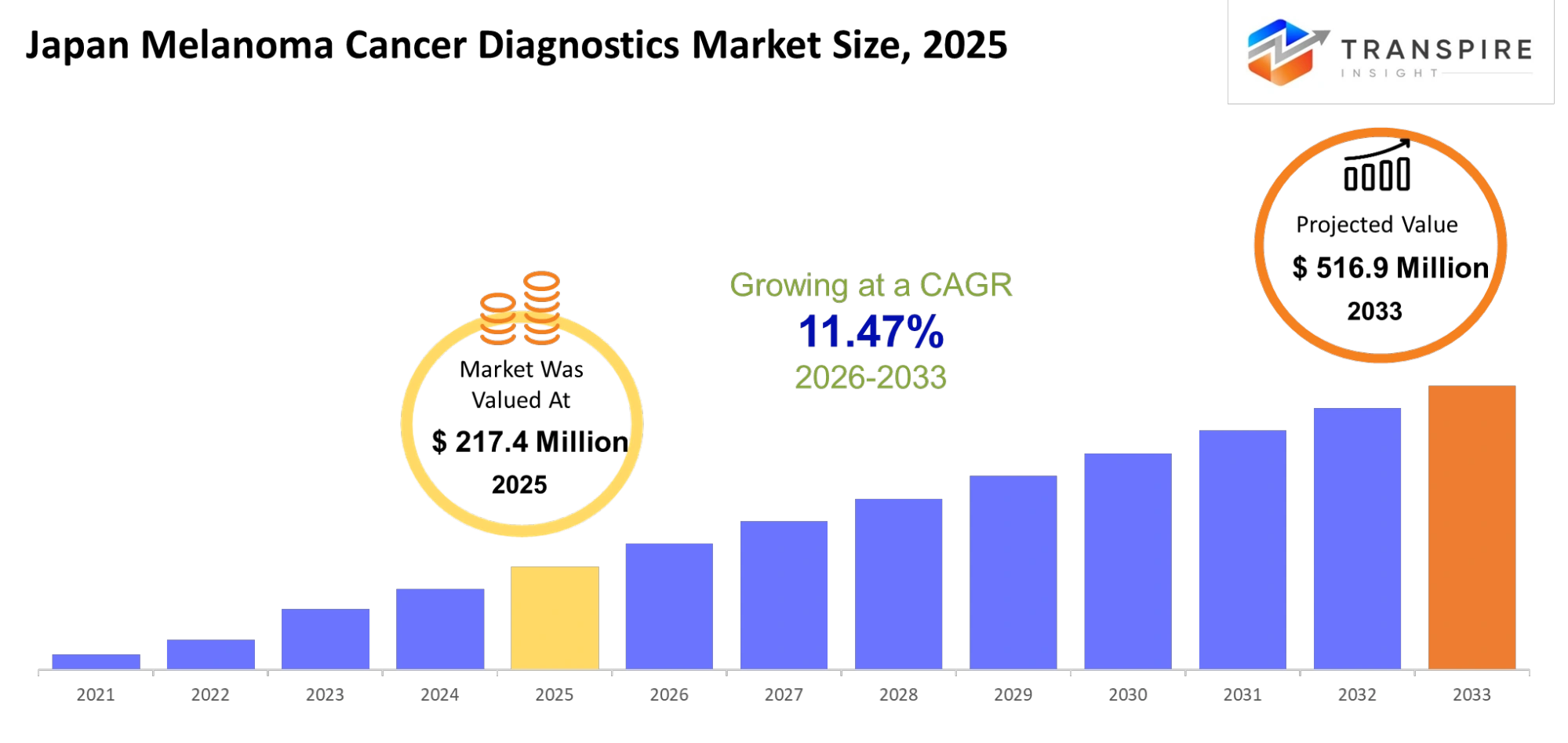
- Japan Melanoma Cancer Diagnostics Market Size 2025: USD 217.4 Million
- Japan Melanoma Cancer Diagnostics Market Size 2033: USD 516.9 Million
- Japan Melanoma Cancer Diagnostics Market CAGR: 11.47%
- Japan Melanoma Cancer Diagnostics Market Segments: By Type (Biopsy, Imaging, Blood Tests, Molecular Diagnostics), By Application (Skin Cancer Detection, Monitoring, Screening, Research), By End-User (Hospitals, Diagnostic Labs, Clinics, Research Institutes)
To learn more about this report,  Download Free Sample Report
Japan Melanoma Cancer Diagnostics Market Summary:
The Japan Melanoma Cancer Diagnostics Market size is estimated at USD 217.4 Million in 2025 and is anticipated to reach USD 516.9 Million by 2033, growing at a CAGR of 11.47% from 2026 to 2033.
The oncology diagnostics market in Japan will show two competing forces which will determine its future development between precise clinical results and what patients want from advanced Japanese medical services. Doctors and patients now prefer early detection through less invasive methods which provide precise results without causing discomfort. Public awareness campaigns and routine skin examinations will gradually influence testing patterns while hospitals will continue integrating diagnostic services with personalized treatment planning.
Digital dermoscopy and AI-assisted imaging and molecular testing will become standard tools for melanoma identification and monitoring because technological progress will make these methods more accessible to medical professionals. The Japanese regulatory authorities will maintain their existing evaluation procedures which test safety and reliability of diagnostic equipment while they also create obstacles for new technology to receive permission. The combination of an aging population and need for quicker test results will drive laboratories to implement automated systems which use data analysis, thus transforming standard medical procedures.
What Has the Impact of Artificial Intelligence Been on the Japan Melanoma Cancer Diagnostics Market?
Artificial intelligence is transforming the Japan melanoma cancer diagnostics market by delivering better diagnostic results which occur more quickly and can be implemented on a wider scale. The evaluation of dermoscopic images, pathology slides, and patient data now makes use of advanced machine learning algorithms which enable earlier and more accurate detection of melanoma. The Japanese market for melanoma cancer diagnostics uses AI to enhance clinical decision-making while improving market research and data analysis operations. The Japan melanoma cancer diagnostics market becomes more data-driven and adaptable to changing healthcare needs through predictive analytics which enables stakeholders to discover new market developments and evaluate patient demographics and develop better investment plans.
The Japanese melanoma cancer diagnostics market uses artificial intelligence to enhance its demand forecasting capabilities and improve its operational processes. AI-powered tools enable healthcare providers and diagnostic companies to anticipate patient volumes while they enhance laboratory operations and decrease the time needed for diagnostic results.The technologies help companies achieve better supply chain management because they can accurately forecast inventory requirements and decrease waste and operational expenses. Companies that operate in the Japan melanoma cancer diagnostics market can achieve competitive advantages through better service delivery which they combine with effective cost management.
AI is creating new innovations while making personalized solutions available for the Japan melanoma cancer diagnostics market. Organizations create customized diagnostic systems which match actual patient data by using deep learning models and real-time data integration technology. The transition to precision diagnostics creates better patient results while enabling organizations to stand out in their competitive environments. The implementation of AI technology in the Japan melanoma cancer diagnostics market creates digital transformation which empowers more intelligent decision-making and creates additional business growth possibilities throughout the sector.
Key Market Trends & Insights:
- The Kanto region dominates the Japanese melanoma cancer diagnostics market because it provides advanced healthcare facilities which give it almost 40% of the market share in 2024.
- The Kansai region leads all other areas because it shows the highest growth rate which will exceed 8% annual growth rate until 2030 because of the increasing spending on diagnostic equipment and the rising number of elderly people.
- The imaging diagnostics segment holds the leading position in the market because it controls more than 45% of the market share which is driven by the use of dermoscopy and AI-powered imaging tools.
- The second largest group of diagnostic methods includes biopsy and histopathology which provides about 30% of the diagnostic tests because these methods deliver accurate results and dependable medical information.
- The molecular diagnostics segment shows the highest growth rate which will reach 9% annual growth rate until 2030 because of increasing demand for precise medical treatment.
- Hospitals dominate applications because they possess advanced diagnostic capabilities which enable them to control 55% of the Japan melanoma cancer diagnostics market.
- The dermatology clinics show the highest growth rate because their market is expected to grow at more than 8.5% annual rate between now and the future.
- The end-user market consists of hospitals which will capture approximately 50% market share during 2024 through their specialized diagnostic systems and medical expert resources.
- The diagnostic laboratories experience rapid progress which will continue at an 8% annual growth rate because outsourcing practices and affordable testing methods become more popular.
- Fujifilm Holdings Corporation, Olympus Corporation, Sysmex Corporation, Roche Holding AG, and Siemens Healthineers AG are the main companies which operate in this industry.
Japan Melanoma Cancer Diagnostics Market Segmentation
By Type :
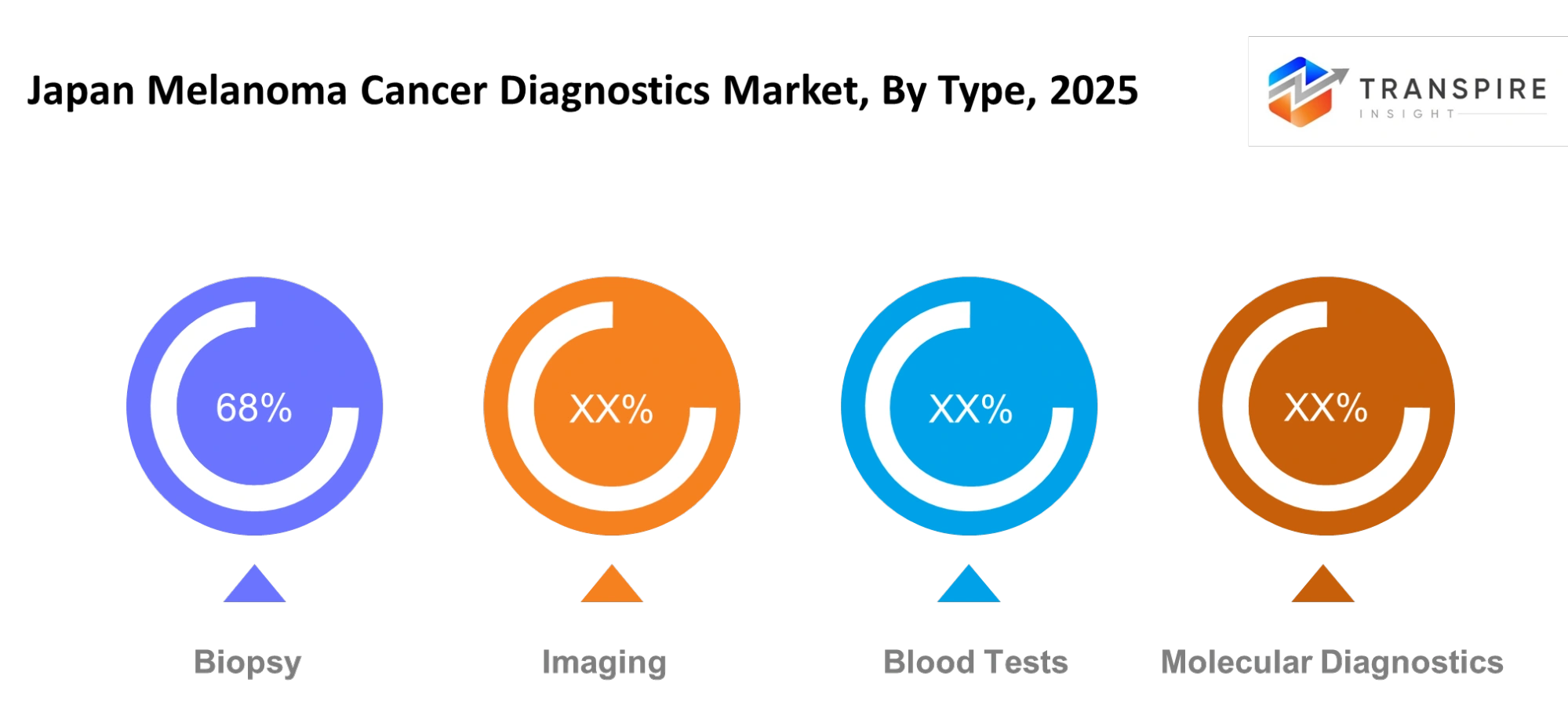
The Japan Melanoma Cancer Diagnostics Market employs traditional diagnostic methods together with advanced diagnostic techniques which enable accurate early disease detection. The primary diagnostic method remains biopsy which enables direct examination of tissue samples but imaging techniques will help track disease progression. Blood tests are gaining attention for non-invasive screening, and molecular diagnostics will improve precision by identifying genetic changes linked to melanoma.
The Japan Melanoma Cancer Diagnostics Market demonstrates an increasing adoption of molecular diagnostics which healthcare providers use to develop customized treatment plans. Patients who prefer procedures that cause less discomfort will drive research into imaging and blood-based diagnostic methods. The entire field will experience growth because of technological advancements and increased public understanding about the advantages of early disease detection.
To learn more about this report, Download Free Sample Report
By Application :
The Japan Melanoma Cancer Diagnostics Market demonstrates high demand for skin cancer detection because this application will continue its growth as skin cancer cases increase and people become more aware of the disease. The need for monitoring applications will increase because healthcare providers require ongoing patient care for extended periods. The government will fund screening initiatives to expand their reach while research activities will drive the creation of new diagnostic technologies.
Healthcare providers in Japan will use more monitoring and screening tools because they want to prevent diseases and detect them at their earliest stages.The research efforts will improve testing accuracy and assist in creating novel diagnostic approaches. The complete application range will move toward ongoing patient monitoring instead of using single diagnostic tests.
By End-User
Japan Melanoma Cancer Diagnostics Market by end-user indicates hospitals as key contributors due to access to advanced infrastructure and skilled professionals. The diagnostic labs will maintain major testing service operations because they possess effective processing capabilities. Clinics will provide initial medical advice through their referral system which research institutes will use to advance melanoma diagnostic research through clinical studies.
The Japan Melanoma Cancer Diagnostics Market will maintain steady demand from all end-user groups because integrated healthcare delivery systems are becoming more prevalent. The diagnostic labs and clinics will increase testing access while research institutes work on developing better testing procedures. Hospitals will serve as the main healthcare centers which provide complete medical services through their state-of-the-art diagnostic facilities.
What are the Main Challenges for the Japan Melanoma Cancer Diagnostics Market Growth?
The Japan melanoma cancer diagnostics market faces multiple technical and operational challenges which hinder its ability to scale and maintain operational efficiency. The different diagnostic accuracy levels between imaging systems and AI-based tools create ongoing difficulties in detecting early-stage melanoma cases.
Hospitals face difficulties when they try to combine machine learning models with their current IT systems which results in operational interruptions. The supply chain limitations for advanced diagnostic equipment and reagents create testing delays which result in operational problems that restrict the japan melanoma cancer diagnostics market from reaching its full growth potential.
The market growth process encounters obstacles because of the existing manufacturing and commercialization challenges. The combination of high production costs for precision diagnostic tools and the need to meet strict regulatory requirements which include quality standards and clinical validation protocols results in delayed product approval processes.
The companies that operate in the japan melanoma cancer diagnostics market face commercial launch delays because they must complete prolonged approval processes and present substantial clinical data. The factors mentioned above create cost challenges for businesses while decreasing their profit ability which creates major obstacles to expansion within the japan melanoma cancer diagnostics market.
The dual challenges of adoption barriers and infrastructure deficiencies serve as major factors which restrict demand. The implementation of advanced diagnostic technologies faces obstacles because smaller healthcare facilities lack access to these technologies and because there exists a shortage of qualified dermatologists and skilled technicians.
The distribution of funding together with budget limitations creates obstacles which prevent organizations from adopting new technologies. The japan melanoma cancer diagnostics market faces increasing difficulties because its diagnostic methods face strong competition while its regulatory framework keeps changing.
Country Insights
The Japan Melanoma Cancer Diagnostics Market demonstrates steady growth because of its established healthcare system,its existing culture of preliminary medical screenings, and its advanced diagnostic systems. Increased public knowledge about skin cancer detection methods will create a need for precise testing solutions which people will use in both urban and semi-urban regions. The combination of state-funded health initiatives and systematic health assessments will create a pathway for initial health problems to get better identified which will result in better patient results and increased diagnostic testing usage.
Japanese medical institutions will keep implementing contemporary imaging systems and dermoscopy methods and molecular diagnostic technologies to improve their capacity to find diseases. Cancer treatment facilities and hospitals will purchase new technologies which will help them discover melanoma more quickly and accurately during its initial stage. The strong partnership between research organizations and medical equipment manufacturers will drive new discoveries while making advanced diagnostic solutions available throughout the nation.
Japan's rising elderly population will boost demand for standard cancer examinations which will include melanoma tests because older adults experience increased healthcare requirements. The market will expand because insurance programs and reimbursement systems will create better access to diagnostic tests. Public health campaigns together with educational programs will motivate people to undergo medical tests at appropriate times which will help decrease the number of advanced cancer cases while increasing overall demand for medical testing in the Japan Melanoma Cancer Diagnostics Market.
Recent Development News
In March 2026, Fujifilm Holdings Corporation launched an upgraded diagnostic imaging solution which uses artificial intelligence to analyze skin lesions. The system improves melanoma detection precision through its combination of dermoscopic imaging and machine learning tools which medical professionals can use in Japan.Source https://holdings.fujifilm.com/
In April 2026, Thermo Fisher Scientific announced expansion of its companion diagnostics partnerships in Japan for oncology testing. The initiative enables greater access to molecular diagnostic tools which are essential for melanoma biomarker testing and targeted therapy selection.Source https://www.thermofisher.com/
|
Report Metrics |
Details |
|
Market size value in 2025 |
USD 217.4 Million |
|
Market size value in 2026 |
USD 241.7 Million |
|
Revenue forecast in 2033 |
USD 516.9 Million |
|
Growth rate |
CAGR of 11.47% from 2026 to 2033 |
|
Base year |
2025 |
|
Historical data |
2021 - 2024 |
|
Forecast period |
2026 - 2033 |
|
Report coverage |
Revenue forecast, competitive landscape, growth factors, and trends |
|
Country scope |
Japan |
|
Key company profiled |
Roche, Abbott, Siemens Healthineers, GE Healthcare, Philips, Thermo Fisher, Illumina, Qiagen, Agilent, Bio-Rad, Danaher, Hologic, PerkinElmer, Becton Dickinson, Sysmex |
|
Customization scope |
Free report customization (country, regional & segment scope). Avail customized purchase options to meet your exact research needs. |
|
Report Segmentation |
By Type (Biopsy, Imaging, Blood Tests, Molecular Diagnostics), By Application (Skin Cancer Detection, Monitoring, Screening, Research), By End-User (Hospitals, Diagnostic Labs, Clinics, Research Institutes) |
How Can New Companies Establish a Strong Foothold in the Japan Melanoma Cancer Diagnostics Market?
New entrants can establish a strong foothold in the japan melanoma cancer diagnostics market by focusing on niche targeting and unmet clinical needs. Companies should concentrate their efforts on three specific fields which include early-stage melanoma detection and AI-assisted dermoscopy and molecular diagnostics because these areas still need improvement in their accuracy levels.
Emerging players can achieve market differentiation by developing solutions that match existing industry trends which include predictive analytics and personalized medicine. Startups can establish themselves as value-driven innovators in the japan melanoma cancer diagnostics market by solving two major challenges which include delayed diagnosis and restricted screening availability.
The japan melanoma cancer diagnostics market requires innovation and technology differentiation because these factors determine long-term market success. Companies should invest in artificial intelligence and cloud-based diagnostic platforms and automated image analysis tools to achieve better operational speed and diagnostic accuracy.
Startups such as SkinVision and DermTech illustrate how their non-invasive testing and mobile-based diagnostic solutions create new paths for patient care. The implementation of these innovation strategies improves diagnostic work efficiency while meeting the increasing demand for healthcare solutions that provide both remote and easily available services.
Market entry capabilities become stronger through strategic partnerships and local collaborative efforts. Japanese companies establish their credibility through partnerships with hospitals and research institutions and diagnostic laboratories which help them understand regulatory requirements.
The process of bringing products to market becomes faster through the use of distribution networks and co-development agreements. Japanese melanoma cancer diagnostics market emerging companies with innovative solutions and strong local partnerships and expandable business operations and affordable products will achieve market share growth and continuous business development.
Key Japan Melanoma Cancer Diagnostics Market Company Insights
The melanoma cancer diagnostics market in Japan will experience ongoing growth because people are becoming more aware of skin cancer detection methods and screening procedures are becoming better. The rising elderly population together with changing lifestyle patterns has resulted in increased melanoma risk. The healthcare sector will increasingly rely on diagnostic technologies which include dermoscopy and molecular testing to support healthcare professionals in their patient assessment and treatment selection processes.
Japan's healthcare system enables hospitals to adopt modern diagnostic equipment which includes advanced imaging technologies and biopsy methods. Medical facilities will prioritize both precise diagnosis and rapid testing procedures. The government promotes cancer screening programs which increase public demand while patients who want early disease detection help improve diagnostic success rates.
Market trends will depend on technological advancements because artificial intelligence and digital imaging technologies will enhance diagnostic precision. Dermatologists can better identify hidden skin alterations when they combine data-driven techniques with their clinical expertise. Japanese research institutions drive technological developments which maintain diagnostic methods at the forefront of medical needs through ongoing research.
The melanoma cancer diagnostics market in Japan faces strong competition from established healthcare organizations and diagnostic solution providers who prioritize developing new products through their alliance partnerships. Companies will invest in advanced imaging systems and testing methods to strengthen their position. The organization develops partnerships with hospitals and research institutions to enhance service delivery capabilities while expanding operational reach which helps them maintain their competitive advantage.
Company List
- Roche
- Abbott
- Siemens Healthineers
- GE Healthcare
- Philips
- Thermo Fisher
- Illumina
- Qiagen
- Agilent
- Bio-Rad
- Danaher
- Hologic
- PerkinElmer
- Becton Dickinson
- Sysmex
What are the Key Use-Cases Driving the Growth of Japan Melanoma Cancer Diagnostics Market?
The Japan melanoma cancer diagnostics market experiences its primary growth drivers from the essential need for early detection combined with clinical diagnostic testing. Hospitals and dermatology clinics increasingly rely on advanced dermoscopy, digital imaging, and AI-assisted screening tools to identify melanoma at earlier stages. The technologies enable better patient results because they decrease diagnostic errors, which leads to higher usage rates among medical professionals. AI implementation in
The Japanese melanoma cancer diagnostics market identifies non-invasive and molecular diagnostic methods as its most important application area. The medical field uses liquid biopsy and gene expression profiling because these methods enable exact tumor identification through non-invasive testing. Genetic insights enable clinicians to develop specialized treatment approaches in personalized treatment planning because these applications provide essential information. The Japanese melanoma cancer diagnostics market experiences rising demand and emerging opportunities for new developments because the industry moves toward precision medicine.
The market experiences strong growth because remote diagnostics and teledermatology services gain popularity among medical professionals. Mobile-based skin analysis applications and cloud-connected platforms allow patients to access preliminary assessments without visiting healthcare facilities. This use-case is especially relevant in addressing accessibility gaps and supporting preventive care. The Japanese melanoma cancer diagnostics market will experience sustained growth because digital health infrastructure development enables more people to use scalable health solutions.
Japan Melanoma Cancer Diagnostics Market Report Segmentation
By Type
- Biopsy
- Imaging
- Blood Tests
- Molecular Diagnostics
By Application
- Skin Cancer Detection
- Monitoring
- Screening
- Research
By End-User
- Hospitals
- Diagnostic Labs
- Clinics
- Research Institutes
Frequently Asked Questions
Find quick answers to common questions.
The approximate Japan Melanoma Cancer Diagnostics Market size for the market will be USD 516.9 Million in 2033.
Key segments for the Japan Melanoma Cancer Diagnostics Market are By Type (Biopsy, Imaging, Blood Tests, Molecular Diagnostics), By Application (Skin Cancer Detection, Monitoring, Screening, Research), By End-User (Hospitals, Diagnostic Labs, Clinics, Research Institutes).
Major Japan Melanoma Cancer Diagnostics Market players are Roche, Abbott, Siemens Healthineers, GE Healthcare, Philips, Thermo Fisher, Illumina, Qiagen, Agilent, Bio-Rad, Danaher, Hologic, PerkinElmer, Becton Dickinson, Sysmex.
The Japan Melanoma Cancer Diagnostics Market size is USD 217.4 Million in 2025.
The Japan Melanoma Cancer Diagnostics Market CAGR is 11.47%.
- Roche
- Abbott
- Siemens Healthineers
- GE Healthcare
- Philips
- Thermo Fisher
- Illumina
- Qiagen
- Agilent
- Bio-Rad
- Danaher
- Hologic
- PerkinElmer
- Becton Dickinson
- Sysmex
Recently Published Reports
-
Apr 2026
AI in Diabetic Retinopathy Market
AI in Diabetic Retinopathy Market Size, Share & Analysis Report By Type (Screening AI Systems, Diagnostic AI Systems, and Predictive AI Models), By Application Segment (Hospitals, Ophthalmology Clinics, Diagnostic Centers, and Research and Development), and Geography (North America, Europe, Asia-Pacific, Middle East and Africa, South and Central America), 2021 - 2031
-
Apr 2026
Psychometric Tests Market
Psychometric Tests Market Size, Share & Analysis Report By Type (Personality Tests, Ability/Aptitude Tests, Skill/Knowledge Tests, and Others), By Application (Talent Acquisition and Talent Management), and Geography (North America, Europe, Asia-Pacific, Middle East and Africa, South and Central America), 2021 – 2031
-
Apr 2026
Rare Biological Sample Collection Market
Rare Biological Sample Collection Market Size, Share & Analysis Report By Type (Isolation Kits & Reagent, Blood Collection Tubes, and Others), By Application (Oncology, Transcriptomics, Pharmacogenomics, and Others), and Geography (North America, Europe, Asia-Pacific, Middle East and Africa, South and Central America), 2021 – 2031
-
Apr 2026
Patient Lift Pendant Market
Patient Lift Pendant Market By Product Type (Wired Pendants, Wireless, Programmable), By Operation Type(Manual, Electric), By End-Users (Healthcare Professionals, Patients), By Application (Hospitals, Homecare, Rehabilitation Centers, Others), By Industry Analysis, Size, Share, Growth, Trends, and Forecasts 2021-2033
Our Clients
.jpg)