Middle East and Africa Kidney Cancer Diagnostics Market Size & Forecast:
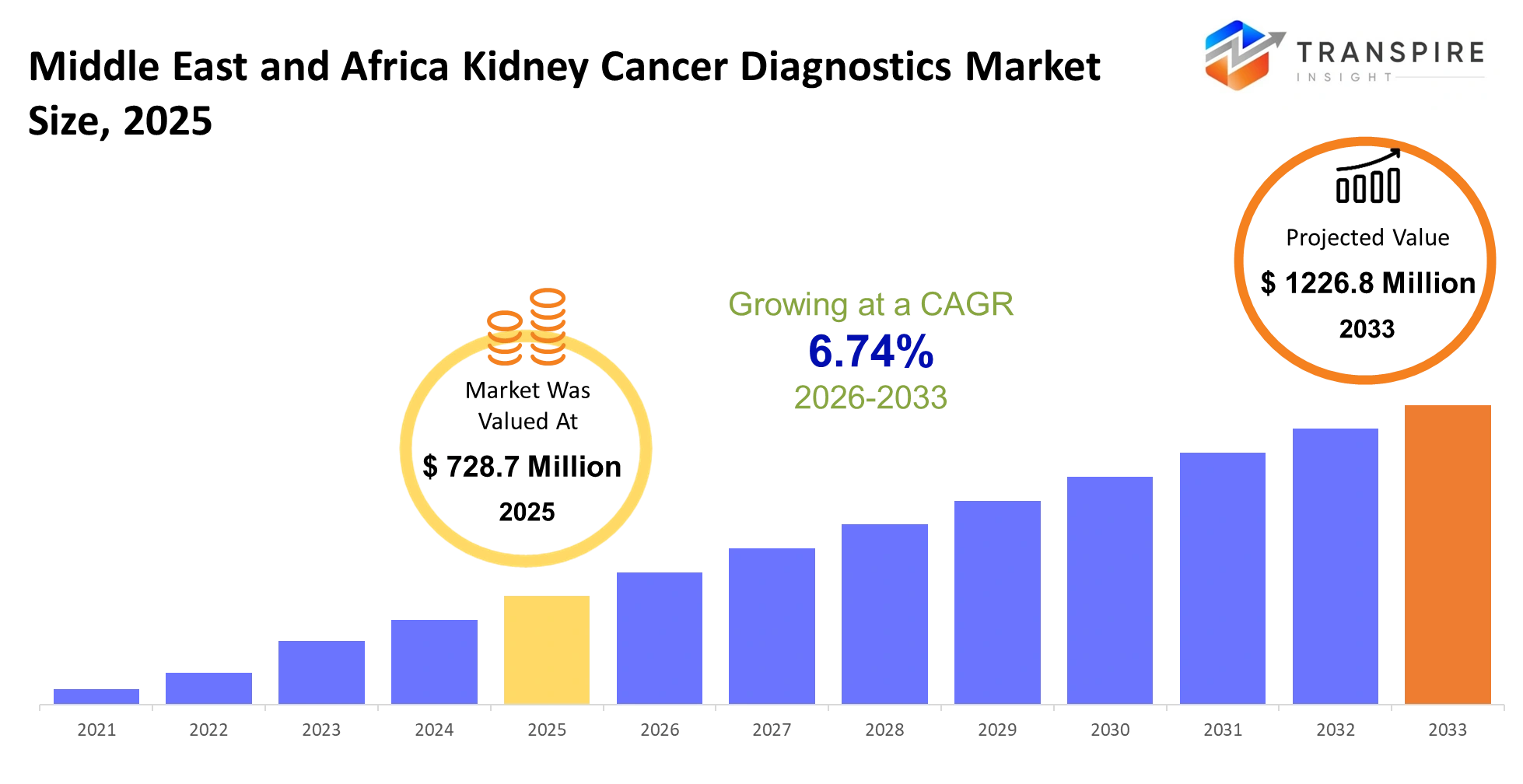
- Middle East and Africa Kidney Cancer Diagnostics Market Size 2025: USD 728.7 Million
- Middle East and Africa Kidney Cancer Diagnostics Market Size 2033: USD 1226.8 Million
- Middle East and Africa Kidney Cancer Diagnostics Market CAGR: 6.74%
- Middle East and Africa Kidney Cancer Diagnostics Market Segments: By Type (Imaging, Biopsy, Biomarkers), By Tech (CT, MRI, Ultrasound), By Cancer (RCC, TCC), By Stage (I-IV), By Application (Hospitals, Labs), By End-User (Hospitals, Diagnostic Laboratories, Cancer Research Centers).
To learn more about this report,  Download Free Sample Report
Middle East and Africa Kidney Cancer Diagnostics Market Summary:
The Middle East and Africa Kidney Cancer Diagnostics Market size is estimated at USD 728.7 Million in 2025 and is anticipated to reach USD 1226.8 Million by 2033, growing at a CAGR of 6.74% from 2026 to 2033. Middle East and Africa (Saudi Arabia, UAE, South Africa, remaining Middle East and Africa) kidney cancer diagnostics market is part of the regional diagnostics industry for healthcare that relies on accurate clinical tests in order to offer efficient diagnostic services. The patients will require rapid and easy treatment procedures that will necessitate the adoption of less invasive imaging and liquid biopsy panel tests along with artificial intelligence enabled radiology. Saudi Arabia and UAE will adopt more stringent quality standards, whereas South Africa will enhance its public-private laboratory cooperation and digital reporting system. The manufacturers will localize their tests and deploy cloud computing while ensuring affordable prices for their tests.
What Has the Impact of Artificial Intelligence Been on the Middle East and Africa Kidney Cancer Diagnostics Market?
The artificial intelligence technology currently advances data interpretation methods together with decision-making processes throughout the Middle East and African kidney cancer diagnostics market by providing clinicians with deeper understanding and enhanced analytical capabilities.
The implementation of artificial intelligence technology in Middle East and Africa kidney cancer diagnostics market operations will enhance laboratory operations through intelligent automation which decreases human errors while accelerating the time needed to complete testing procedures. AI-driven tools will enhance production efficiency in diagnostic kits and imaging solutions, while optimizing supply chains by forecasting inventory needs and minimizing operational costs. These advancements will enable healthcare providers and diagnostic companies to expand their service offerings while maintaining service standards in areas where healthcare facilities are not evenly distributed.
The Middle East and Africa kidney cancer diagnostics market will use artificial intelligence to develop new diagnostic methods while providing customized patient diagnostic solutions. The algorithms will create customized screening processes which match patient risk profiles, thus enabling healthcare providers to develop better treatment methods. The use of artificial intelligence by companies will provide them with a market edge because they can produce quicker results which are supported by data while meeting current market requirements, thus enhancing their standing within the technology-based diagnostic sector.
Key Market Trends & Insights:
- The United Arab Emirates will become the fastest-growing market because digital diagnostics will gain wider acceptance throughout the projection period which will produce an annual growth rate above 8 percent.
- The imaging diagnostics segment leads the market because it holds about 45 percent of market share which results from people depending mostly on CT and MRI equipment.
- The second-largest market share belongs to biopsy and pathology testing because clinical validation requirements continue to increase.
- The liquid biopsy segment represents the most rapid growth segment which will experience fast expansion until 2030 because of rising non-invasive diagnostic needs.
- The Early-stage cancer detection method currently holds the largest market share which exceeds 50 percent because people show higher awareness through screening programs.
- The application for advanced-stage monitoring has become the fastest expanding field because doctors use personalized treatment methods while predictive analytics develops.
- The Middle East and Africa kidney cancer diagnostics market shows 60 percent demand from hospitals because they operate comprehensive diagnostic centers.
Middle East and Africa Kidney Cancer Diagnostics Market Segmentation
By Type
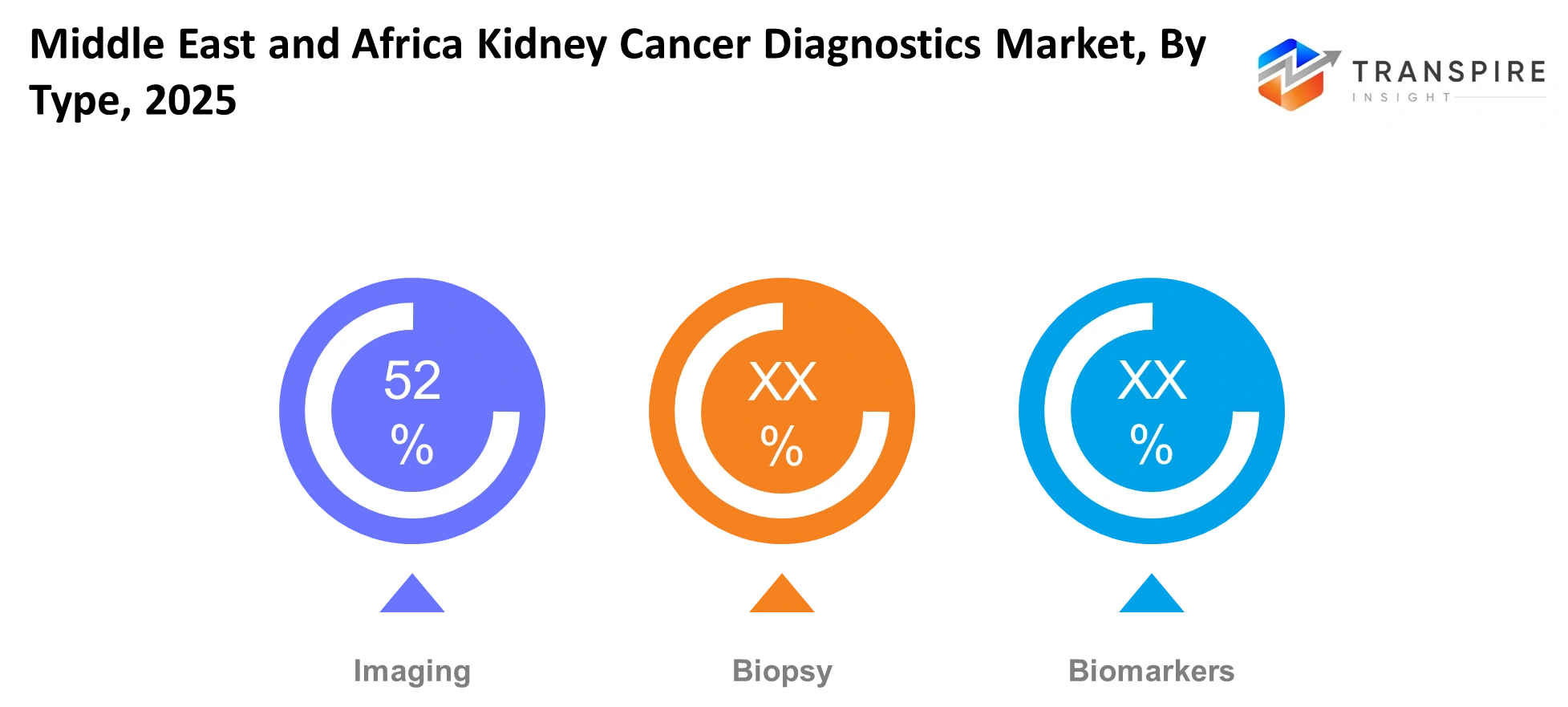
The medical field will rely on imaging because doctors use CT scans and MRI scans and ultrasound to conduct their first tests and follow-up assessments. The imaging tools will enable doctors to see internal body structures without performing surgery which helps them find abnormal tissue growths at an early stage. The medical field requires biopsy procedures because they provide tissue samples that enable doctors to make accurate clinical assessments through diagnostic tests. Blood and urine tests will introduce new screening methods through which researchers will study biomarkers.
Molecular diagnostics and genetic profiling will drive the ongoing expansion of biomarkers. The healthcare industry will increase its adoption of these methods because medical professionals need testing solutions that provide results promptly and with minimal discomfort. Medical facilities will use imaging and biopsy as their main diagnostic procedures while they use biomarkers to support their decision-making. The combined application of these techniques will enhance both diagnostic accuracy and patient treatment results.
To learn more about this report, Download Free Sample Report
By Tech
CT scan technology will become the way of the future owing to the high vitality of tumor size, architectural plan, and spread. CT imaging shall always be available widely at hospitals and diagnostic centers thus becoming widely accessible. MRI will be required for the detailed detailed imaging of soft tissues in complex cases. Ultrasound will establish itself as the choice in screening because it is cheaper and least demanding as a test in places where resources are limited.
Later establishments are being made in many places where MRI extra-specialization in imaging. Ultrasound has been compassed in the more basic settings of rural and semi-urban health units, outfitted accordingly conversely. CT will remain to keep up its hold as the Stager and Monitorer of diagnostic patterns. Selection of technology depends upon availability, cost, and clinical indication.
By Cancer
The adult population's increased incidence of renal cell carcinoma will make it the most common type of cancer. The diagnostic process will use imaging techniques and biomarker analysis to identify diseases during their initial stages. Transitional cell carcinoma (TCC) will account for a smaller share but will require specialized diagnostic attention. The detection of TCC will typically use imaging studies together with urine testing methods.
The medical field will use CT and MRI for all RCC cases because these tools provide precise disease staging. TCC will require additional laboratory analysis due to involvement of urinary pathways. Doctors need immediate and precise diagnosis results for both types of cancer to develop their treatment strategies. The public will learn to recognize both conditions which will help doctors to identify patients with these diseases at earlier stages.
By Stage
The examination of Stage I and II will concentrate on early detection through imaging which will help to find localized tumors. The implementation of early-stage diagnosis will lead to higher treatment success rates which will also result in fewer medical complications. The third stage of the process will require advanced imaging techniques and biopsy confirmation to assess regional cancer spread. Stage IV will include metastatic cancer which requires ongoing observation and intricate diagnostic testing.
Healthcare systems will need multiple diagnostic tools to create treatment plans when patients receive late-stage diagnoses. Healthcare systems will prioritize early-stage identification because it helps them achieve better survival outcomes. The frequency of diagnostic tests will rise as patients experience more severe health conditions. The medical team will use stage-based segmentation to decide on patient care and distribution of hospital resources.
By Application
Your training material contains data which extends until the month of October in the year 2023. The hospitals will function as main diagnostic centers because they possess both imaging equipment and specialist medical professionals. Hospitals will handle complex cases, including biopsy procedures and advanced imaging. The laboratories will conduct diagnostic testing through their pathology services and biomarker assessment capabilities. The laboratories will experience increased responsibilities because they need to test more common medical conditions through their diagnostic work.
The laboratory services will undergo growth because of the implementation of automated systems together with digital reporting technologies. The hospitals will maintain their position as the foremost providers of complete diagnostic services. The partnership between hospitals and laboratories will lead to better operational performance and faster result delivery. The patient management system will use application-based segmentation to organize service delivery together with patient handling procedures.
By End-User
The comprehensive diagnostic capacities of hospitals together with their ability to handle patient volumes will make them the primary end-user. The diagnostic laboratory market will experience rapid growth because testing services will be increasingly outsourced. Laboratories will implement automation solutions to manage their increasing need for diagnostic tests. Cancer research centers will create new diagnostic methods while they work on innovative solutions through their clinical trials activities.
Research centers will support advancements in biomarkers and precision diagnostics. The presence of hospitals which have strong infrastructure together with specialized medical staff will continue to operate as the main healthcare provider. Diagnostic laboratories will become essential testing facilities because they provide affordable testing solutions and flexible testing capacity. The end-user segmentation will show how clinical care and testing efficiency and research-driven progress exist as interconnected elements.
What are the Main Challenges for the Middle East and Africa Kidney Cancer Diagnostics Market Growth?
Issues with technical inefficiencies and operational inefficiencies shall continue to be a concern in the performance of the middle east and africa kidney cancer diagnostics market, especially where there is reliance on advanced imaging and molecular tests that require proper diagnosis to be made. Variations in equipment calibration, inadequate use of AI system technology, and delay in processing results shall pose limitations for achieving accurate diagnoses, especially in remote areas. Supply chain issues involving procurement of reagents and imaging products shall lead to delays.
There will also be manufacturing and commercialization barriers for the middle east and africa kidney cancer diagnostics market. Manufacturing processes for the diagnostics kits and imaging technologies are characterized by the need for adherence to high standards and require substantial capital to manufacture them. Quality standard issues, such as those associated with good manufacturing practices, shall pose cost issues. Regulatory approval issues shall also slow down commercialization. Cost pressure shall also continue to be high.
The healthcare system lacks essential infrastructure and trained professionals who can operate advanced diagnostic equipment which will create ongoing adoption problems. The treatment facilities in multiple regions will lack contemporary medical imaging equipment and laboratory resources which will lead to decreased capacity for early detection of illnesses. The adoption process will face obstacles because of funding shortages and unequal distribution of healthcare resources. The kidney cancer diagnostics market in the Middle East and Africa will face ongoing market challenges because of these fundamental market restrictions.
The market will face competitive challenges which will create future uncertainties because of different diagnostic methods and vendors from throughout the world. The Middle East and Africa kidney cancer diagnostics market needs manufacturers and providers to continuously invest in response to rapid technological changes while they deal with uncertainty from regulatory alterations.
Regional Insights
The market for kidney cancer diagnostics in the Middle East and Africa will experience a gradual shift towards early detection methods that rely on improved imaging techniques and laboratory developments.
The field of diagnostic services will progress through the adoption of digital technologies and data-based decision-making systems. The development of healthcare facilities will enhance diagnostic capabilities whereas the involvement of private organizations will increase the scope of available services. The market performance depends on three factors which include regulatory compliance and pricing strategies and the adoption of technology throughout various healthcare systems in different regions.
Saudi Arabia will take the lead because of its substantial investment in healthcare and its provision of modern diagnostic tools. The United Arab Emirates will follow through its quick implementation of digital health technologies together with AI-based imaging systems. The South African healthcare system will make consistent advancements through partnerships between public and private organizations which will enhance diagnostic capabilities and healthcare service standards.
The rest of Middle Eastern and African countries will develop at a slow pace because of their existing infrastructure deficiencies and financial constraints. Urban regions will adopt new technologies more quickly than rural areas which will face ongoing challenges in accessing these advancements. The different regions in the world will impact how diagnostic tests are available and how much they cost and how fast the market will grow in different nations.
Recent Development News
In April 2026, Roche Diagnostics announced a preferred partnership with HNL Lab Medicine to enhance laboratory performance and diagnostic accuracy using advanced diagnostic solutions and workflow technologies.
Source: https://clpmag.com/
|
Report Metrics |
Details |
|
Market size value in 2025 |
USD 728.7 Million |
|
Market size value in 2026 |
USD 777.2 Million |
|
Revenue forecast in 2033 |
USD 1226.8 Million |
|
Growth rate |
CAGR of 6.74% from 2026 to 2033 |
|
Base year |
2025 |
|
Historical data |
2021 - 2024 |
|
Forecast period |
2026 - 2033 |
|
Report coverage |
Revenue forecast, competitive landscape, growth factors, and trends |
|
Regional scope |
Middle East and Africa (Saudi Arabia, United Arab Emirates, South Africa, Rest of Middle East and Africa) |
|
Key company profiled |
Roche, Abbott, Siemens Healthineers, GE HealthCare, Thermo Fisher, Becton Dickinson, Danaher, Bio-Rad, Qiagen, Illumina, PerkinElmer, Agilent, Fujifilm, Canon Medical, Philips. |
|
Customization scope |
Free report customization (country, regional & segment scope). Avail customized purchase options to meet your exact research needs. |
|
Report Segmentation |
By Type (Imaging, Biopsy, Biomarkers), By Tech (CT, MRI, Ultrasound), By Cancer (RCC, TCC), By Stage (I-IV), By Application (Hospitals, Labs), By End-User (Hospitals, Diagnostic Laboratories, Cancer Research Centers). |
How Can New Companies Establish a Strong Foothold in the Middle East and Africa Kidney Cancer Diagnostics Market?
New entrants can build a strong position in the middle east and africa kidney cancer diagnostics market by focusing on unmet clinical needs and region-specific gaps in diagnostic access. The implementation of cost-effective imaging and biomarker-based solutions should target underserved areas because it will produce immediate benefits. The Middle East and Africa kidney cancer diagnostics market requires companies to establish scalable models which improve testing accessibility and expedite patient diagnosis while creating easier operational procedures according to current industry growth and healthcare requirements.
Companies will use innovation as their main competitive advantage through artificial intelligence-based diagnostics and mobile imaging solutions. The startups PathAI and Freenome show that machine learning together with predictive analytics improve both early disease detection and medical decision processes. The adoption of similar innovative methods will enable new businesses in the Middle East and Africa kidney cancer diagnostics market to create distinct identities while achieving measurable success.
The organization establishes partnerships with hospitals and diagnostic laboratories and regional health authorities to achieve faster market entry processes while developing trust with their partners. The organization uses its collaborative efforts to overcome obstacles related to regulatory requirements and distribution needs. The implementation of technology-based solutions between companies and their local partners will enable businesses to establish market leadership in the kidney cancer diagnostics sector across the Middle East and Africa while they work to solve industry-related problems stemming from insufficient infrastructure and workforce shortages.
Key Middle East and Africa Kidney Cancer Diagnostics Market Company Insights
The Middle East and Africa kidney cancer diagnostics market will experience growth because of increased efforts to identify cancer at earlier stages and to develop more precise diagnostic methods. Healthcare providers will make investments in equipment for medical imaging together with laboratory testing capabilities and digital diagnostic systems which will help them to achieve faster patient diagnostic results. The demand for services will grow throughout metropolitan areas because advanced medical facilities will provide better access and dependable services.
Healthcare systems in the region will enhance their diagnostic procedures through improved collaboration between their hospital networks and laboratory facilities. Healthcare organizations will achieve better operational performance and faster service delivery through their implementation of AI-driven solutions together with automated processes. The market will progress depending on three factors which include product pricing and development of necessary infrastructure and existence of skilled personnel in various regions.
Diagnostic firms from around the world will continue to compete with one another as they build their presence through business collaborations and technological progress. The companies will improve their control over market share through product development which will enhance their existing product quality and testing precision and production expenses.
The companies will dedicate their resources to create cutting-edge AI-powered diagnostic systems and next-generation imaging technologies. Local market participants will battle for market share through provision of budget-friendly products and tailored customer solutions. Businesses will assess their competitive strength based on three factors: their technology adoption rate, their pricing tactics, and their capacity to fulfill healthcare requirements specific to their area.
Company List
- Roche
- Abbott
- Siemens Healthineers
- GE HealthCare
- Thermo Fisher
- Becton Dickinson
- Danaher
- Bio-Rad
- Qiagen
- Illumina
- PerkinElmer
- Agilent
- Fujifilm
- Canon Medical
- Philips
What are the Key Use-Cases Driving the Growth of the Middle East and Africa Kidney Cancer Diagnostics Market?
The Middle East and Africa kidney cancer diagnostics market uses clinical screening and early detection programs as essential tools for healthcare systems that need to decrease their rates of late-stage diagnoses. Hospitals use CT and MRI imaging methods as their standard procedures to detect tumors earlier which results in better patient treatment results. The market expansion needs reliable imaging and biomarker-based solutions because preventive diagnostics have become the main focus of healthcare organizations.
Treatment monitoring and disease progression tracking represent another essential function for the Middle East and Africa kidney cancer diagnostics market. Oncologists use imaging tests and laboratory tests to monitor how well therapies work so they can modify their treatment strategies. The ongoing requirement for diagnostics drives the market for advanced systems which include AI-powered imaging and digital pathology technologies that enhance clinical decision-making through improved accuracy and faster results.
Personalized medicine is driving market growth for kidney cancer diagnostics in the Middle East and Africa because doctors can use biomarker testing and genetic profiling to create specific treatment plans. Diagnostic providers create customized solutions which match the unique risk profiles of individual patients to achieve both competitive advantage and new product development. The implementation of advanced diagnostic tools throughout the region will increase their use cases as healthcare systems modernize which will lead to sustained growth and deeper system integration.
Middle East and Africa Kidney Cancer Diagnostics Market Report Segmentation
By Type
- Imaging
- Biopsy
- Biomarkers
By Tech
- CT
- MRI
- Ultrasound
By Cancer
- RCC
- TCC
By Stage
- I-IV
By Application
- Hospitals
- Labs
By End-User
- Hospitals
- Diagnostic Laboratories
- Cancer Research Centers
Frequently Asked Questions
Find quick answers to common questions.
The approximate Middle East and Africa Kidney Cancer Diagnostics Market size for the market will be USD 1226.8 Million in 2033.
Key segments for the Middle East and Africa Kidney Cancer Diagnostics Market are By Type (Imaging, Biopsy, Biomarkers), By Tech (CT, MRI, Ultrasound), By Cancer (RCC, TCC), By Stage (I-IV), By Application (Hospitals, Labs), By End-User (Hospitals, Diagnostic Laboratories, Cancer Research Centers).
Major Middle East and Africa Kidney Cancer Diagnostics Market players are Roche, Abbott, Siemens Healthineers, GE HealthCare, Thermo Fisher, Becton Dickinson, Danaher, Bio-Rad, Qiagen, Illumina, PerkinElmer, Agilent, Fujifilm, Canon Medical, Philips.
The Middle East and Africa Kidney Cancer Diagnostics Market size is USD 728.7 Million in 2025.
The Middle East and Africa Kidney Cancer Diagnostics Market CAGR is 6.74%.
- Roche
- Abbott
- Siemens Healthineers
- GE HealthCare
- Thermo Fisher
- Becton Dickinson
- Danaher
- Bio-Rad
- Qiagen
- Illumina
- PerkinElmer
- Agilent
- Fujifilm
- Canon Medical
- Philips
Recently Published Reports
-
Dec 2024
AI in Diabetic Retinopathy Market
AI in Diabetic Retinopathy Market Size, Share & Analysis Report By Type (Screening AI Systems, Diagnostic AI Systems, and Predictive AI Models), By Application Segment (Hospitals, Ophthalmology Clinics, Diagnostic Centers, and Research and Development), and Geography (North America, Europe, Asia-Pacific, Middle East and Africa, South and Central America), 2021 - 2031
-
Feb 2025
Psychometric Tests Market
Psychometric Tests Market Size, Share & Analysis Report By Type (Personality Tests, Ability/Aptitude Tests, Skill/Knowledge Tests, and Others), By Application (Talent Acquisition and Talent Management), and Geography (North America, Europe, Asia-Pacific, Middle East and Africa, South and Central America), 2021 – 2031
-
Feb 2025
Rare Biological Sample Collection Market
Rare Biological Sample Collection Market Size, Share & Analysis Report By Type (Isolation Kits & Reagent, Blood Collection Tubes, and Others), By Application (Oncology, Transcriptomics, Pharmacogenomics, and Others), and Geography (North America, Europe, Asia-Pacific, Middle East and Africa, South and Central America), 2021 – 2031
-
Dec 2025
Patient Lift Pendant Market
Patient Lift Pendant Market By Product Type (Wired Pendants, Wireless, Programmable), By Operation Type(Manual, Electric), By End-Users (Healthcare Professionals, Patients), By Application (Hospitals, Homecare, Rehabilitation Centers, Others), By Industry Analysis, Size, Share, Growth, Trends, and Forecasts 2021-2033
Our Clients
.jpg)