
North America Clinical Laboratory Services Market Size & Forecast:
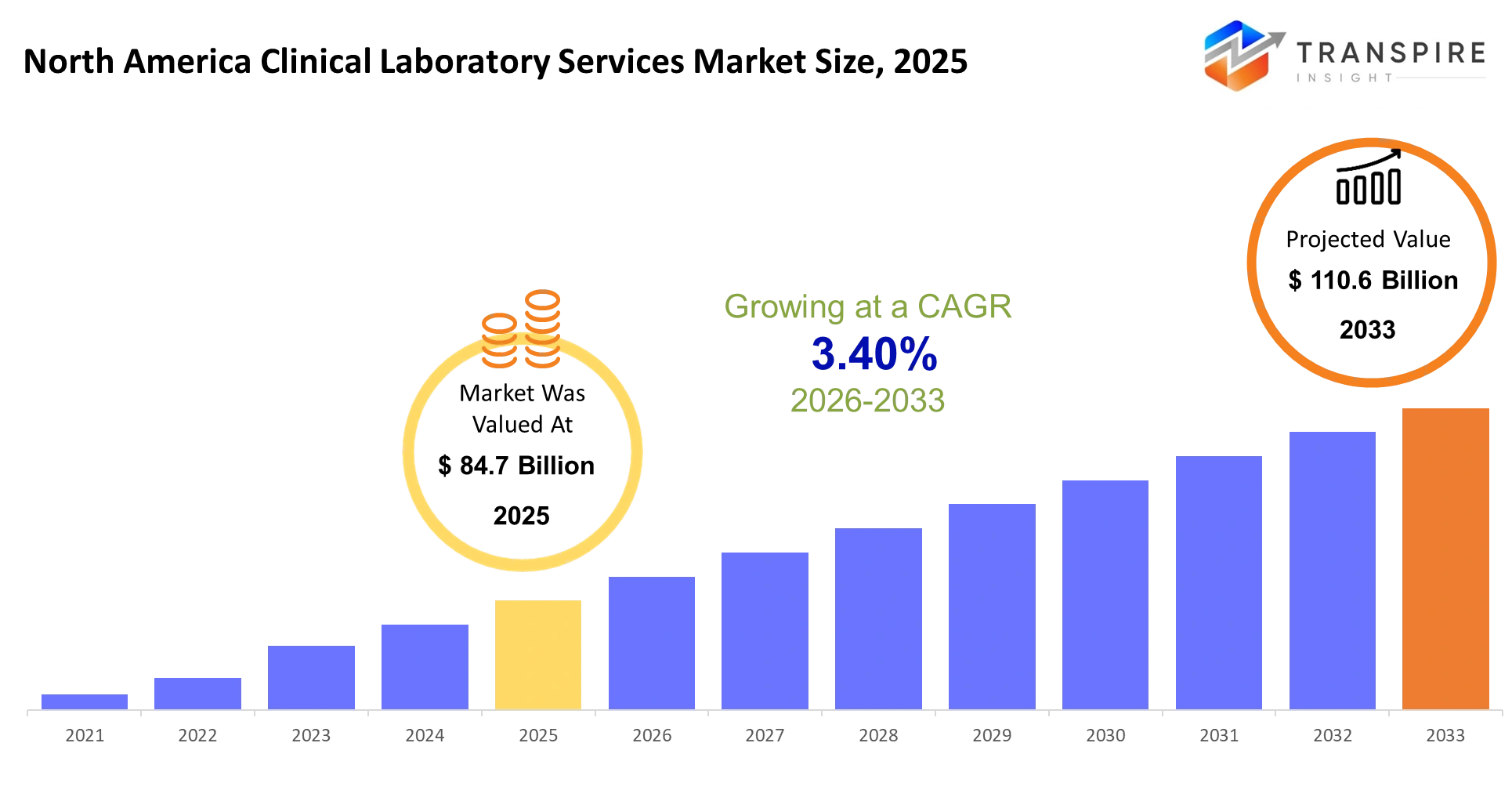
- North America Clinical Laboratory Services Market Size 2025: USD 84.7 Billion
- North America Clinical Laboratory Services Market Size 2033: USD 110.6 Billion
- North America Clinical Laboratory Services Market CAGR: 3.40%
- North America Clinical Laboratory Services Market Segments: By Test Type (Clinical Chemistry, Microbiology, Hematology, Immunology, Genetic Testing, Others); By Service Provider (Hospital Labs, Independent Labs, Specialty Labs, Research Labs, Clinics, Others); By Application (Diagnostics, Drug Testing, Research, Screening, Monitoring, Others); By End-User (Hospitals, Clinics, Pharma, Patients, Research, Others)
To learn more about this report,  Download Free Sample Report
North America Clinical Laboratory Services Market Summary:
The North America Clinical Laboratory Services Market size is estimated at USD 84.7 Billion in 2025 and is anticipated to reach USD 110.6 Billion by 2033, growing at a CAGR of 3.40% from 2026 to 2033.
The North America Clinical Laboratory Services Market will operate as an integrated system which links independent laboratories with hospital testing facilities and specialized medical testing centers to perform all types of medical testing including routine blood tests and advanced molecular diagnostics.The market will grow according to how patient awareness increases because people will demand more rapid testing results and digital report access and complete pricing information. The laboratory industry will have to adapt its operations according to consumer demands for convenient services which will lead to laboratories adopting home sample collection services and real-time tracking systems for their daily work.
Testing procedures and their delivery methods will undergo continuous changes through technological advancements. The combination of automation technologies with artificial intelligence diagnostic systems and high-throughput sequencing will help laboratories achieve faster testing results while they increase their testing accuracy. Laboratories will operate under stricter quality requirements and enhanced data protection protocols which will determine their methods for safeguarding patient data and conducting test authentication according to the new United States and Canada regulatory standards. The market will experience a gradual movement towards preventive healthcare which includes routine early screening and tailored diagnostic tests as standard practices in clinical decision-making.
What Has the Impact of Artificial Intelligence Been on the North America Clinical Laboratory Services Market?
Artificial intelligence has created substantial transformations in North American clinical laboratory services which lead to improved operational efficiency and precise results along with better judgement capacity. The AI applications throughout the North American clinical laboratory services market develop their capacity to handle extensive data through their ability to analyze intricate diagnostic information at both high speed and exact accuracy.
Advanced machine learning models enable laboratories to extract actionable insights from patient records, which enhance clinical interpretations and support market research and operational benchmarking. Laboratories throughout the North American clinical laboratory services market use predictive analytics to discover disease patterns while testing volume optimization and service capacity alignment with changing healthcare requirements.
The North American clinical laboratory services market has experienced an efficiency boost because smart automation systems now operate workflow processes for revenue generation purposes. The AI-driven robotic systems together with automated diagnostic systems decrease the requirement for human operators, which leads to decreased mistakes and faster processing times that boost overall operational efficiency.
Machine learning-based demand forecasting systems enable service providers to predict testing requirements while they improve inventory management and supply chain processes. These operational functions help businesses reduce their expenses while they deliver reliable services throughout facilities that handle large amounts of work.
The North American clinical laboratory services market ecosystem uses artificial intelligence technology to create new innovations which help companies establish their unique market positions. The laboratory sector now uses personalized diagnostic solutions which combine artificial intelligence technology with customized treatment pathways and precision medicine programs. Organizations which implement artificial intelligence into their North American clinical laboratory operations will achieve better service quality and patient results while creating sustainable growth in a market that becomes more competitive over time according to current market trends.
Key Market Trends & Insights:
- The United States clinical laboratory services market in North America reaches 80% market share because of its superior healthcare infrastructure which will extend until 2025.
- Canada shows the highest growth rate among countries because its diagnostic services expand and its government spends more on healthcare through 2030.
- Clinical chemistry testing dominates the north america clinical laboratory services market with a significant share of over 35% in 2025 due to high testing volumes.
- Immunoassay services hold the second-largest share, supported by increasing demand for infectious disease and hormone testing.
- The molecular diagnostics field represents the most rapidly advancing industry because it will experience substantial growth until 2030 driven by increased adoption of precision medicine and genetic testing technologies.
- Chronic disease diagnostics dominate the North America clinical laboratory services market because they account for more than 40 percent market share, which increases with the rising diabetes and cancer and cardiovascular disease rates.
- The application of infectious disease testing shows the fastest growth because new pathogens emerge and organizations require ongoing monitoring.
- The North America clinical laboratory services market shows hospitals as the leading sector which holds about 50 percent market share because they offer integrated diagnostic systems and receive patient admissions.
- The market for diagnostic laboratories and physician offices shows rapid growth because medical facilities increasingly choose to outsource testing services and patients demand testing at multiple locations.
- The major market players include Quest Diagnostics and Laboratory Corporation of America Holdings and Sonic Healthcare and Eurofins Scientific and Abbott Laboratories.
North America Clinical Laboratory Services Market Segmentation
By Test Type :
The field of clinical chemistry depends on body fluid analysis to measure glucose and enzymes and electrolytes which helps doctors identify medical conditions. Microbiology identifies infectious agents such as bacteria and viruses. Hematology examines blood components while immunology studies how the body defends itself against diseases. Genetic testing detects inherited conditions and other tests support specialized diagnostic needs.
The health practice of clinical chemistry remains common because people need regular health assessments and doctors must track chronic health conditions. The microbiology field experiences growth because more hospitals need to control infectious diseases. Hematology and immunology provide essential insights for systemic conditions, while genetic testing supports precision medicine. The healthcare sector uses diagnostic methods from other categories because they improve early disease detection and treatment planning according to medical guidelines.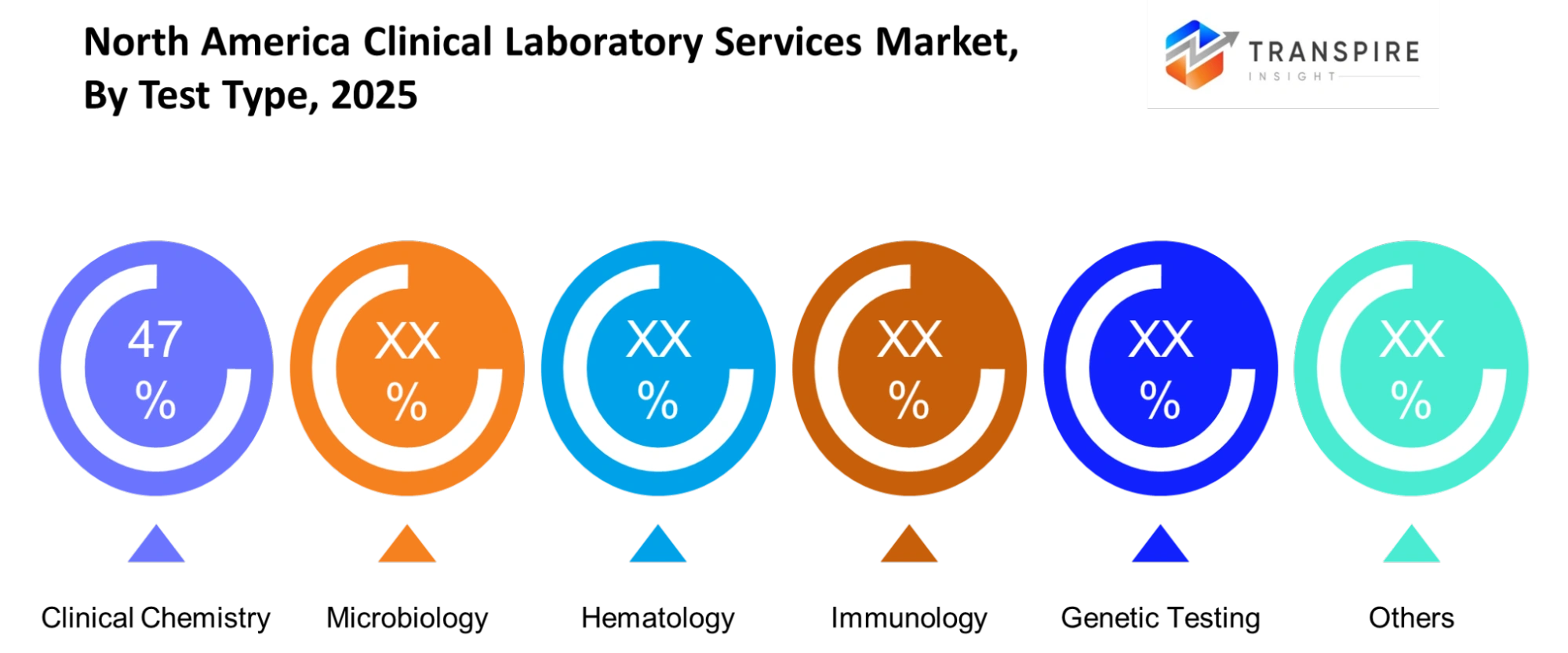
To learn more about this report, Download Free Sample Report
By Service Provider :
Hospital laboratories work inside medical centers to process extensive patient traffic through their complete service offerings. Independent laboratories operate as separate testing facilities which provide multiple testing services. Specialty laboratories dedicate their resources to conducting tests for difficult-to-diagnose medical conditions. Research laboratories assist clinical trial processes while clinics deliver essential testing services. Mobile testing services and specialized healthcare providers complete the range of testing facilities available.
The majority of hospital laboratories function as the primary testing centers because they provide direct contact to patients through their medical facilities. Independent laboratories use their affordable testing solutions to extend their operational territory. Advanced diagnostic procedures generate interest in specialty laboratories. Research laboratories drive innovation development while clinics provide access to standard testing procedures. The service area of other providers who work in remote and underserved areas helps to enhance overall service delivery.
By Application :
Diagnostics present a process to identify diseases through laboratory testing procedures. Drug testing serves two purposes which include establishing compliance and discovering instances of substance abuse. Research activities contribute to creating new medical treatments and expanding medical understanding. Screening methods detect diseases during their initial development stage while monitoring methods assess patient health changes throughout their treatment period. The process of testing serves two purposes which include preventive health assessment and occupational health evaluation. Hospitals require diagnostic services because growing disease cases demand precise test outcomes.
The need for drug testing has increased across both workplace environments and judicial proceedings. The scope of research applications has grown together with the development of clinical research studies. Screening programs increase the identification of diseases during their initial stages while monitoring methods help manage ongoing health conditions. The other applications work to strengthen preventive healthcare systems while they help organizations manage population health approaches.
By End-User :
Hospitals depend on laboratory services to make their diagnostic and treatment decisions. Testing serves as a fundamental requirement which clinics need to provide their standard medical services and their services for outpatients. Pharmaceutical companies require laboratories to conduct their research and testing of new drugs. The public can access testing through direct services which research institutions study and public health organizations operate.
Hospitals create significant service needs because they provide treatment for both inpatients and emergency patients. Clinics provide their testing requirements through their need for regular testing. The pharmaceutical industry expansion results in increased laboratory requirements which support drug testing and research validation processes. Patients show a growing trend to request direct testing services. Research institutions develop scientific knowledge while other users support regional health surveillance and public health programs.
What are the Main Challenges for the North America Clinical Laboratory Services Market Growth?
The technical and operational difficulties present in North America clinical laboratory services market operations lead to decreased operational efficiency and limited scalability capabilities. The testing operations of laboratories must handle high volumes of tests while ensuring accurate results but many laboratories continue using outdated systems which restrict their ability to share data with other systems. The testing process encounters delays because of multiple operational requirements which need testing equipment to be calibrated and because results from tests show different performance levels. The ongoing supply chain problems which affect both reagents and consumables and specialized instruments create operational disruptions which act as continuous obstacles that impede market growth within North America clinical laboratory services sector.
The North America clinical laboratory services market faces two major barriers which restrict its ability to manufacture and sell products. The strict regulatory framework requires organizations to follow multiple quality standards including GMP and CLIA which increases their operational burden and results in longer time periods required to receive approval for new diagnostic tests. The need for advanced technologies requires organizations to devote significant capital resources which combined with increased labor costs and maintenance expenses will reduce their profit margins. The existing factors create delays in the innovation process which results in extended time periods until new products become available to the market which creates additional problems for North America clinical laboratory services market growth.
Adoption challenges also play a critical role in limiting growth in the north america clinical laboratory services market. The operational challenges of smaller laboratories stem from their missing infrastructure requirements which they need to implement advanced automation systems and AI-based diagnostic tools. The staff shortages which affect them because they lack qualified personnel who can perform molecular diagnostics and data analysis create difficulties for their operations. The combination of funding gaps and limited access to contemporary laboratory networks creates obstacles that prevent areas with insufficient resources from achieving widespread adoption of modern technologies.
Country Insights
The North America Clinical Laboratory Services Market will experience consistent growth because of increasing diagnostic needs and the growing senior citizen population and the rising number of people with chronic diseases. Healthcare providers will use laboratory testing more frequently to find health problems early and develop treatment strategies. Laboratory operations will achieve greater operational efficiency and precise results through technological advancements in automation and data systems which deliver faster performance results.
North America will remain a leading contributor due to strong healthcare infrastructure, high healthcare spending, and widespread access to advanced diagnostic services. The United States will dominate due to large testing volumes and strong presence of key service providers. Canada will also contribute steadily with public healthcare support and growing focus on preventive diagnostics.
People will begin to use personalized medicine and molecular diagnostics which will result in economic growth for the region. People will require both standard medical checkups and additional medical testing because they will learn to recognize the advantages of early health condition diagnosis. The combination of regulatory backing and laboratory network funding will drive service growth to urban and semi-urban regions.
Recent Development News
In April 2026, Quest Diagnostics achieved significant revenue growth through its first quarter 2026 financial results. The company generated adjusted earnings that exceeded market predictions while its revenue reached $2.9 billion because of increased diagnostic testing activities throughout North America.
Sourcehttps://www.investors.com/
In April 2026, Abbott Laboratories updated its 2026 profit forecast after acquiring Exact Sciences. The company reduced its earnings forecast because of costs associated with the acquisition while also showing its future growth potential through expanded cancer diagnostic capabilities.Source https://www.reuters.com/
|
Report Metrics |
Details |
|
Market size value in 2025 |
USD 84.7 Billion |
|
Market size value in 2026 |
USD 87.5 Billion |
|
Revenue forecast in 2033 |
USD 110.6 Billion |
|
Growth rate |
CAGR of 3.40% from 2026 to 2033 |
|
Base year |
2025 |
|
Historical data |
2021 - 2024 |
|
Forecast period |
2026 - 2033 |
|
Report coverage |
Revenue forecast, competitive landscape, growth factors, and trends |
|
Regional scope |
North America (Canada, The United States, and Mexico) |
|
Key company profiled |
LabCorp, Quest Diagnostics, Sonic Healthcare, Mayo Clinic Labs, BioReference, ARUP Laboratories, Eurofins, SYNLAB, Charles River, Exact Sciences, Thermo Fisher, Danaher, Abbott, Roche, Siemens Healthineers |
|
Customization scope |
Free report customization (country, regional & segment scope). Avail customized purchase options to meet your exact research needs. |
|
Report Segmentation |
By Test Type (Clinical Chemistry, Microbiology, Hematology, Immunology, Genetic Testing, Others); By Service Provider (Hospital Labs, Independent Labs, Specialty Labs, Research Labs, Clinics, Others); By Application (Diagnostics, Drug Testing, Research, Screening, Monitoring, Others); By End-User (Hospitals, Clinics, Pharma, Patients, Research, Others) |
How Can New Companies Establish a Strong Foothold in the North America Clinical Laboratory Services Market?
New businesses that want to succeed in the North American clinical laboratory services market need to start their efforts by selecting specific market segments to serve and showing their distinct service value. Companies should focus on their business needs by developing solutions for specific market needs that include rare disease diagnostics and home testing and rapid molecular screening. The North American clinical laboratory services market allows new companies to develop their business through market expansion when they provide products that match current demand for personalized medicine and preventive healthcare solutions.
The North American clinical laboratory services market requires both new technologies and innovation-based business models for organizations to achieve successful market entry. Startups that use AI-powered diagnostic technologies together with cloud data systems and automated systems can achieve faster results with better precision at a lower operational cost. PathAI uses machine learning to improve diagnosis accuracy while Color Health provides genetic testing and preventive screening services that anyone can access.
The north america clinical laboratory services market is better served through strategic partnerships which enhance existing market presence. The new company establishes its service network through partnerships with hospitals and research institutions and biotech companies which provide access to clinical data and help speed up the process of bringing products to market. The implementation of decentralized labs and mobile diagnostics as scalable business models allows organizations to overcome their infrastructure constraints while expanding their patient reach.
Key North America Clinical Laboratory Services Market Company Insights
The North America Clinical Laboratory Services Market demonstrates steady growth because of increased diagnostic testing needs and the growing elderly population and the rising number of people with chronic illnesses. The development of molecular diagnostic technologies together with automation systems brings benefits through improved operational efficiency and precise testing results. The combination of strong healthcare infrastructure and insurance coverage enables hospitals and independent laboratories and research institutions to expand their operations.
The competitive environment displays major companies that concentrate on expanding their services through partnerships and developing advanced testing methods. The large diagnostic companies establish extensive networks which they use to fund their development of automation and digital solutions that enhance their testing operations. The smaller laboratories establish their market position through their specialized testing services and their regional operational reach while ongoing consolidation processes reshape the market structure and enhance their testing capabilities.
Company List
- LabCorp
- Quest Diagnostics
- Sonic Healthcare
- Mayo Clinic Labs
- BioReference
- ARUP Laboratories
- Eurofins
- SYNLAB
- Charles River
- Exact Sciences
- Thermo Fisher
- Danaher
- Abbott
- Roche
- Siemens Healthineers
What are the Key Use-Cases Driving the Growth of North America Clinical Laboratory Services Market?
The north america clinical laboratory services market experiences its main growth driver from increasing applications of its services in both chronic disease management and preventive healthcare. Clinical laboratories play a critical role in early detection and continuous monitoring of conditions such as diabetes, cancer, and cardiovascular diseases.The north america clinical laboratory services market experiences continuous growth because people increasingly depend on standard blood examinations and biomarker testing and genetic tests. Testing volumes increase because healthcare providers and insurers implement preventive testing programs which also contribute to better patient results that last over time.
The infectious disease diagnostics and public health surveillance functions of north america clinical laboratory services market operations. Laboratories enable quick pathogen detection which allows doctors to make swift treatment choices and manage disease outbreaks. The increasing use of molecular diagnostics and PCR testing has improved laboratories because they now deliver better accuracy and faster results which help to control both seasonal diseases and new health emergencies.The operational capabilities of clinical laboratory services continue to expand while their market importance keeps growing.
The north america clinical laboratory services market experiences major expansion through its pharmaceutical and biotechnology applications. Laboratories handle clinical trials and drug development processes while they conduct companion diagnostics to verify their regulatory compliance and maintain their data integrity. The growing demand for personalized medicine together with precision healthcare services creates fresh business opportunities for dedicated testing laboratories which develop customized treatment programs.
North America Clinical Laboratory Services Market Report Segmentation
By Test Type
- Clinical Chemistry
- Microbiology
- Hematology
- Immunology
- Genetic Testing
By Service Provider
- Hospital Labs
- Independent Labs
- Specialty Labs
- Research Labs
- Clinics
By Application
- Diagnostics
- Drug Testing
- Research
- Screening
- Monitoring
By End-User
- Hospitals
- Clinics
- Pharma
- Patients
- Research
Frequently Asked Questions
Find quick answers to common questions.
The Approximate North America Clinical Laboratory Services Market size for the Market will be USD 110.6 Billion in 2033.
Key Segments for the North America Clinical Laboratory Services Market are By Test Type (Clinical Chemistry, Microbiology, Hematology, Immunology, Genetic Testing, Others); By Service Provider (Hospital Labs, Independent Labs, Specialty Labs, Research Labs, Clinics, Others); By Application (Diagnostics, Drug Testing, Research, Screening, Monitoring, Others); By End-User (Hospitals, Clinics, Pharma, Patients, Research, Others).
Major North America Clinical Laboratory Services Market Players are LabCorp, Quest Diagnostics, Sonic Healthcare, Mayo Clinic Labs, BioReference, ARUP Laboratories, Eurofins, SYNLAB, Charles River, Exact Sciences, Thermo Fisher, Danaher, Abbott, Roche, Siemens Healthineers.
The Current North America Clinical Laboratory Services Market size is USD 84.7 Billion in 2025.
The North America Clinical Laboratory Services Market CAGR is 3.40%.
- LabCorp
- Quest Diagnostics
- Sonic Healthcare
- Mayo Clinic Labs
- BioReference
- ARUP Laboratories
- Eurofins
- SYNLAB
- Charles River
- Exact Sciences
- Thermo Fisher
- Danaher
- Abbott
- Roche
- Siemens Healthineers
Recently Published Reports
-
Apr 2026
Biosimilars Market
Biosimilars Market By Product Type (Monoclonal Antibodies, Recombinant Hormones, Erythropoietin, G-CSF, Others), By Indication (Oncology, Autoimmune Diseases, Blood Disorders, Diabetes, Others), By Manufacturing Type (In-House Manufacturing, Contract Manufacturing), By Distribution Channel (Hospital Pharmacies, Retail Pharmacies, Online Pharmacies), By Industry Analysis, Size, Share, Growth, Trends, and Forecasts 2021-2033
-
Apr 2026
Gastrointestinal Endoscopy Market
Gastrointestinal Endoscopy Market By Type (Rigid Gastrointestinal Endoscope, Flexible Gastrointestinal Endoscopes, Disposable Gastrointestinal Endoscope), By Procedure Type (Colonoscopy, Gastroscopy, Duodenoscopy, Enteroscopy, Flexible Sigmoidoscopy, Others), By Application (Diagnosis, Treatment), By End-Users (Hospitals, Ambulatory Surgical Centers, Specialty Clinics, Laboratories, Others), By Industry Analysis, Size, Share, Growth, Trends, and Forecasts 2021-2033
-
Apr 2026
Rare Inherited Metabolic Disorder Drug Market
Rare Inherited Metabolic Disorder Drug Market By Drug Class (Enzyme Replacement Drugs, Gene Therapy Drugs, Substrate Reduction Drugs, Small Module Drugs, Protein Drugs), By Route of Administration(Parenteral, Oral, Intrathecal), By Clinical Development (Marketed Drugs, Late Stage Clinical Phase III, Early Stage Clinical Phase I-II, Preclinical Candidates), By Indication (Lysosomal Storage Disorders, Urea Cycle Disorders, Amino Acid Metabolic Disorders, organic Acidemias, Peroximal Disorders), By Industry Analysis, Size, Share, Growth, Trends, and Forecasts 2021-2033
-
Jan 2026
Pharmaceutical Cleanroom Technology Market
Pharmaceutical Cleanroom Technology Market By Product (Equipment, Consumables, Services); By Cleanroom Type (Standard Cleanrooms, Modular Cleanrooms); By End Use (Pharmaceutical Companies, Biotechnology Companies), By Industry Analysis, Size, Share, Growth, Trends, and Forecasts 2021-2033