

Asia Pacific Credit Insurance Market Size & Forecast:
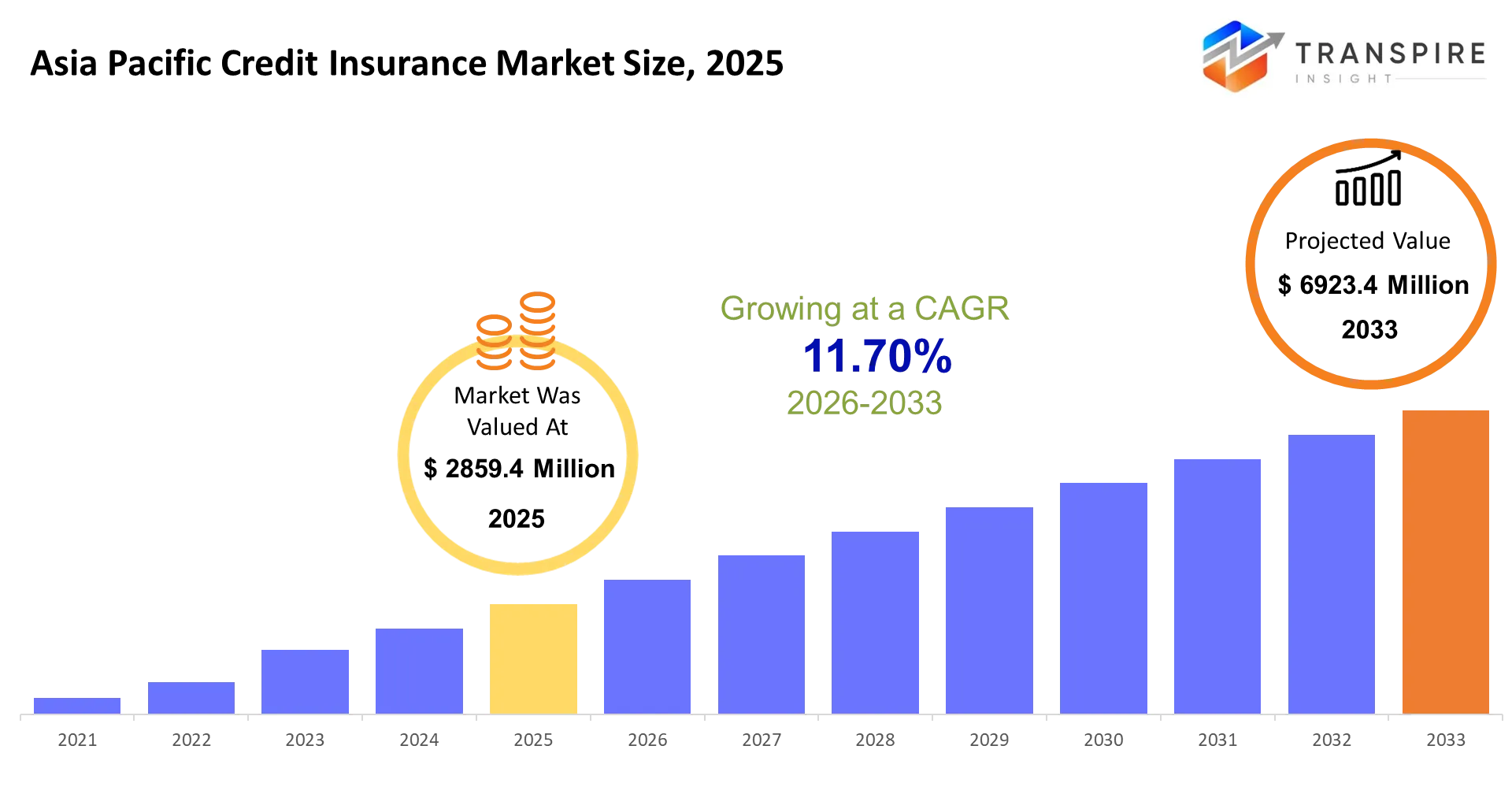
- Asia Pacific Credit Insurance Market Size 2025: USD 2859.4 Million
- Asia Pacific Credit Insurance Market Size 2033: USD 6923.4 Million
- Asia Pacific Credit Insurance Market CAGR: 11.70%
- Asia Pacific Credit Insurance Market Segments: By Type (Trade Credit Insurance, Export Credit Insurance, Domestic Credit Insurance, Others); By Application (SMEs, Large Enterprises, International Trade, Domestic Trade, Others); By End-User (Businesses, Exporters, Financial Institutions, Government, Others); By Coverage (Short-term, Medium-term, Long-term, Others)
To learn more about this report,  Download Free Sample Report
Asia Pacific Credit Insurance Market Summary
The Asia Pacific Credit Insurance Market was valued at USD 2859.4 Million in 2025. It is forecast to reach USD 6923.4 Million by 2033. That is a CAGR of 11.70% over the period.
The Asia Pacific credit insurance market protects businesses from financial losses which result from customer payment delays and customer payment defaults. The protection helps exporters and manufacturers and suppliers who operate in multiple countries because their businesses face immediate payment threats which can impact their financial operations and production schedules. The market has developed into a strategic risk management tool which financial institutions use for trade finance and credit evaluation through digital underwriting and real-time data analytics.
The pandemic caused supply chain problems and payment problems which became the main reason for this transition between 2020 and 2021. The events revealed flaws in traditional credit assessment methods which made businesses need to implement more flexible protection systems. Insurers are experiencing increased premium income from Asian Pacific cross-border trading companies because businesses use credit insurance to decrease default risk and obtain better loan terms which helps their business growth.
Key Market Insights
- The Asia Pacific Credit Insurance Market in 2026 will reach its peak when China holds 34% of market share backed by its extensive export financing and government-supported credit systems.
- The Indian market represents the fastest expansion among regional markets because it will achieve more than 9% growth until 2030 through its export diversification efforts and increased participation from small and medium-sized enterprises in international trade.
- The Southeast Asia market experiences substantial growth while Singapore and Vietnam enjoy advantages from the increasing adoption of regional trade finance solutions.
- Whole turnover credit insurance leads the market with approximately 48% market share in the Asia Pacific Credit Insurance Market which will reach its peak size in 2026 because it provides protection against portfolio risks.
- Single-buyer credit insurance holds the second-largest share, favored by exporters managing concentrated customer exposure.
- Excess-of-loss insurance is the fastest-growing segment through 2030, supported by large corporate demand for customized risk retention structures.
- The export trade protection application dominates the market because it accounts for almost 57% market share which shows businesses depend on international payment security.
- Domestic trade credit coverage is the fastest-growing application because B2B commerce and supplier financing requirements continue to expand.
- Manufacturing and industrial exporters lead because they provide 42% of Asia Pacific Credit Insurance Market demand which will occur in 2026.
- The end-user category for SMEs shows the fastest growth because businesses now can access digital policies more easily and their financing needs have increased.
What are the Key Drivers, Restraints, and Opportunities in the Asia Pacific Credit Insurance Market?
The Asia Pacific credit insurance market experiences its strongest growth through increasing intra-regional trade which trade liberalization frameworks,including the Regional Comprehensive Economic Partnership, enable. The new market structure enables higher transaction volumes between manufacturers and suppliers and distributors, who operate throughout China and India and Japan and Southeast Asia. The financial institutions have established stricter lending requirements after the pandemic caused credit disruptions, which increased the value of insured receivables as collateral. The business credit insurance policy adoption has increased because companies use this coverage to protect themselves against payment defaults while obtaining needed working capital, which generates higher premium revenue for insurers.
The most significant barrier exists because different emerging Asia Pacific economies have different levels of access to dependable commercial credit information. The developing markets face challenges in evaluating buyer risk because their financial disclosure methods and corporate reporting standards, which differ from each other, create confusion. The current system functions as a structural problem because it needs system-wide regulatory improvements and better institutional disclosure practices, which require many years to develop. The result of this process produces conservative underwriting combined with elevated premium costs, which creates obstacles for small enterprises to obtain policies, resulting in lower market revenue and delayed industry growth.
AI-driven underwriting together with predictive credit analytics presents insurers with major growth opportunities. Insurers who spend money on machine learning platforms gain the ability to monitor customer purchasing habits in real time which speeds up their policy distribution process and improves their ability to assess risks. Next-generation credit insurance solutions are being tested successfully in markets like India and Singapore which have advanced digital trade systems.
What Has the Impact of Artificial Intelligence Been on the Asia Pacific Credit Insurance Market?
The Asia Pacific credit insurance market undergoes transformation through artificial intelligence together with advanced digital technologies which create new methods for insurers to assess risk and track their exposure and assess their policy performance in extensive trade portfolio operations. The advanced underwriting systems which use AI technology enable automatic credit assessment and buyer surveillance and claims assessment through their ability to analyze financial records and payment patterns and trade activities and economic data in real-time. The automatic system now enables commercial account policy issuance to complete within a few hours instead of the previous duration of several days which allows insurers to handle shifting buyer risk levels with greater speed and operational effectiveness.
The trade credit protection systems use machine learning models to enhance their predictive abilities. The models enable insurers to predict payment defaults and identify signs of buyer distress and determine premium rates based on specific industry price fluctuations. The use of predictive analytics enables better accuracy in portfolio loss predictions because it uncovers hidden connections that exist between different industries and geographic areas which allows underwriters to decrease their claim risks and boost their profit margins after adjusting for risk. The systems enhance compliance monitoring because they detect exposure levels which exceed internal risk limits.
The operational impact is significant. The customer retention rate improves through faster risk assessment processes while dynamic portfolio monitoring systems decrease unplanned claims expenses and enable superior capital distribution. The financial sector in emerging Asia Pacific markets faces one major challenge because of its inconsistent data quality and payment information standards. Insurers must depend on manual underwriting assessment because incomplete datasets and inconsistent reporting standards decrease model performance when dealing with high-risk segments.
Key Market Trends
- Insurers improved their policy issuance processat least 40% since 2022through the deployment of AI underwriting systems which Coface and Allianz Trade developed.
- Asian banks established stronger connections with insured receivables after post-pandemic payment disruptions forced them to adopt lender-linked policies between 2023 and 2025.
- Exporters now use cross-border portfolio protection methods instead of single-buyer coverage since the Regional Comprehensive Economic Partnership started.
- Digital onboarding tools established after 2023 SMESmall and Medium-sized Enterprises gained capacity to operate through digital channels because these tools reduced administrative burdens that typically stopped small exporters from entering the market.
- Insurers from Singapore and China raised their spending on predictive default monitoring by over 25% since 2024 to enhance their exposure detection activities.
- The claims assessment process underwent major changes after 2022 because automated document verification took over from manual checks during lower-risk transactions between major regional insurers.
- Global companies developed new competitive strategies through their partnerships with regional banks which enabled them to provide credit protection within trade finance operations.
- Underwriting models increasingly incorporate geopolitical risk scoring after supply chain disruptions in 2022 exposed weaknesses in traditional buyer-credit evaluation systems.
- Insurers established more rigorous electronics and manufacturing exporter pricing rules because regional payment performance now shows stronger price fluctuations.
Asia Pacific Credit Insurance Market Segmentation
By Type:
The trade credit insurance segment holds a strong place in the Asia Pacific Credit Insurance Market as businesses continue to focus on reducing payment risks in business-to-business transactions. This type of coverage protects companies when customers fail to meet their payment obligations by the established payment dates. The growing demand for trade activities across manufacturing, electronics, and consumer goods sectors drives market demand. Many companies now view this coverage as a practical tool for maintaining financial balance and securing working capital.
Export credit insurance is gaining wider attention due to rising cross-border trade across Asian economies. International businesses face risks that stem from buyer defaults and political changes and foreign market uncertainty. Domestic credit insurance also continues to expand as local trade networks become more complex and payment cycles stretch longer. The others category includes specialized solutions designed for specific business needs, offering flexibility as industries continue adjusting to changing commercial conditions.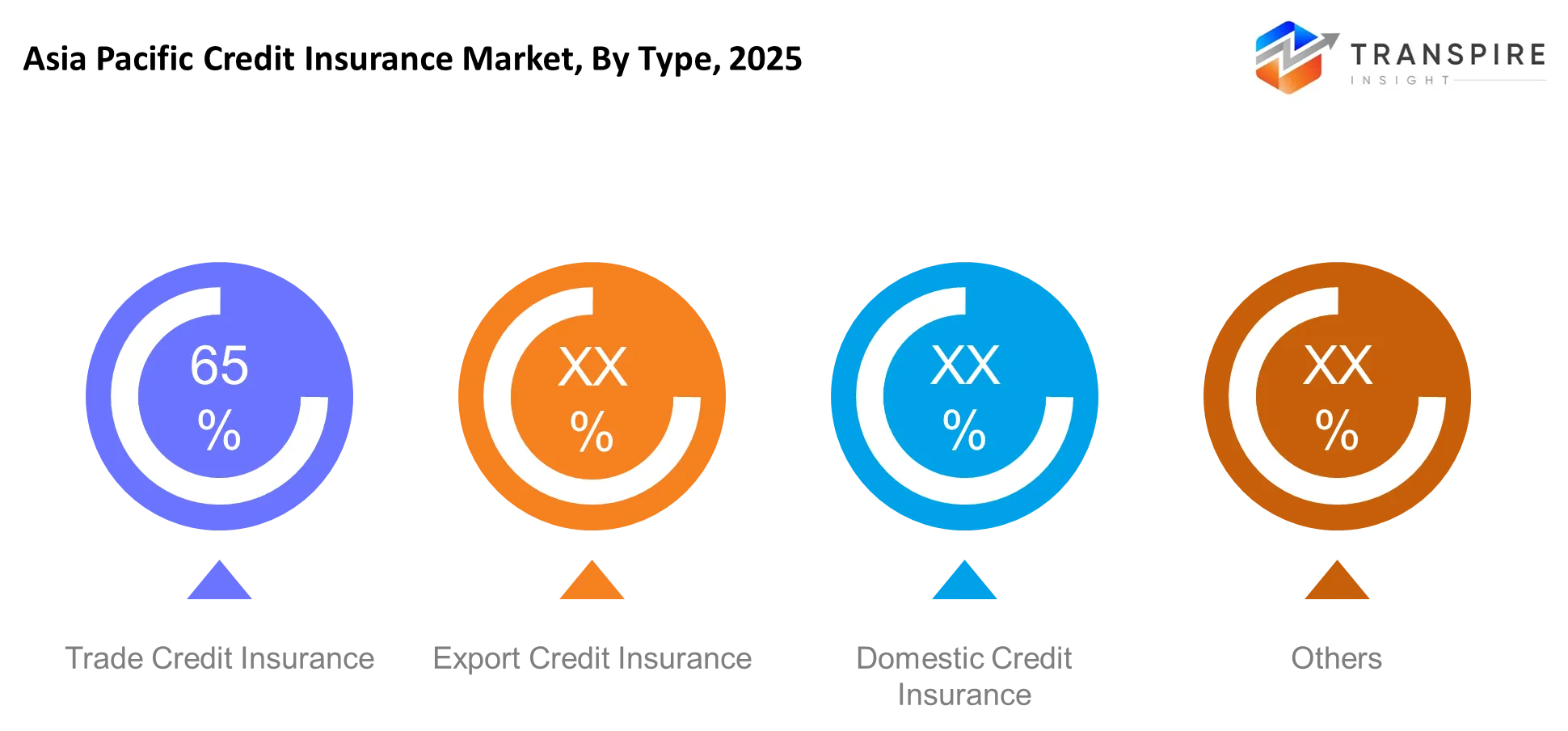
To learn more about this report, Download Free Sample Report
By Application:
The SMEs segment is seeing significant growth because smaller businesses experience greater difficulties when they deal with payment delays and unexpected payment defaults. Credit insurance provides these companies with increased financial protection which enables them to extend credit to their customers with greater security. The protection allows businesses to enter new markets because they can expand their customer base without high risks of payment defaults.
Large enterprises remain major users because their extensive supply chains and high transaction volumes create needs for detailed risk assessment. The international trade applications are increasing because regional exports are rising while domestic trade applications receive support from developing economies that experience growing internal commerce. The other segment reflects niche business uses where customized credit protection supports unique operational models and strengthens financial planning.
By End-User:
The payment protection needs of businesses serve as their primary reason to secure credit insurance, which helps them maintain consistent cash flow. Companies across sectors such as manufacturing, retail, and wholesale depend on credit insurance to secure receivables and reduce financial exposure. The support enables businesses to operate efficiently even when market conditions remain unpredictable.
Exporters form another key group because overseas transactions often involve additional commercial and political risks. Financial institutions also use credit insurance to strengthen lending security and manage portfolio exposure. The government shows its presence through export support programs and policy-based initiatives that promote secure trade operations. Organizations use custom coverage from this category to protect their specific transaction needs.
By Coverage:
The Asia Pacific Credit Insurance Market shows strong preference for short-term coverage because most commercial transactions have payment cycles that last three months. This protection type provides essential support for businesses that conduct normal trade activities because they can quickly verify non-payment risks. The demand for products continues to grow because companies need to sustain their cash flow while minimizing operational interruptions.
Medium-term coverage supports transactions that involve longer repayment periods, which typically occur with industrial equipment and project-based contracts and structured trade agreements. Organizations use long-term coverage to finance their major infrastructure projects and capital-heavy agreements, which create financial obligations that last multiple years. Companies choose coverage durations, which become more complex because trade relationships require them to prepare for both operational needs and financial objectives.
What are the Key Use Cases Driving the Asia Pacific Credit Insurance Market?
The primary use case which drives growth in the Asia Pacific credit insurance sector protects export transactions for large manufacturing companies and industrial supply chain operations. Electronics manufacturers, automotive part producers, and heavy equipment exporters need coverage to protect their overseas customer payments which they receive through open-account trading. This application generates the strongest demand because it directly protects working capital while helping exporters access bank financing against insured invoices.
Domestic B2B trade and supply chain financing now can use their expanded applications to support consumer goods distributors and mid-sized industrial suppliers. Retail wholesalers and pharmaceutical distributors increasingly use coverage to manage delayed payments from fragmented buyer networks, while financial institutions use insured receivables to structure lower-risk lending products.
Digital trade platforms now offer embedded credit insurance as a new use case which protects cross-border e-commerce suppliers. These applications are gaining traction in markets such as India and Southeast Asia, where digital procurement ecosystems are maturing and regional trade compliance frameworks are becoming more standardized.
|
Report Metrics |
Details |
|
Market size value in 2025 |
USD 2859.4 Million |
|
Market size value in 2026 |
USD 3191.2 Million |
|
Revenue forecast in 2033 |
USD 6923.4 Million |
|
Growth rate |
CAGR of 11.70% from 2026 to 2033 |
|
Base year |
2025 |
|
Historical data |
2021 - 2024 |
|
Forecast period |
2026 - 2033 |
|
Report coverage |
Revenue forecast, competitive landscape, growth factors, and trends |
|
Regional scope |
Asia Pacific (China, India, Japan, South Korea, Australia, Rest of Asia Pacific) |
|
Key company profiled |
Allianz Trade, Atradius, Coface, Euler Hermes, Zurich, AIG, Marsh, Willis Towers Watson, Chubb, Tokio Marine, QBE, AXA, Munich Re, Swiss Re, ICICI Lombard |
|
Customization scope |
Free report customization (country, regional & segment scope). Avail customized purchase options to meet your exact research needs. |
|
Report Segmentation |
By Type (Trade Credit Insurance, Export Credit Insurance, Domestic Credit Insurance, Others); By Application (SMEs, Large Enterprises, International Trade, Domestic Trade, Others); By End-User (Businesses, Exporters, Financial Institutions, Government, Others); By Coverage (Short-term, Medium-term, Long-term, Others) |
Which Regions are Driving the Asia Pacific Credit Insurance Market Growth?
The credit insurance market of the Asia Pacific region depends on East Asia because its developed export systems and established financial institutions and trade risk management policies support international commerce. The three countries of China, Japan and South Korea represent the highest volume of insured trade because they possess extensive manufacturing capabilities and complete participation in global supply chains. Export credit agencies that receive government funding particularly in China establish an institutional system which helps private credit insurers and promotes wider use of their policies. The organization maintains its leadership position through its modern financial data system and advanced banking network and extensive insurance coverage which reaches major industrial exporters.
Oceania presents its unique impact on regional market performance through its ability to maintain stability without achieving high market share. The insurance market in Australia and New Zealand experiences ongoing demand because their financial systems remain strong and their corporate reporting standards are clear and their businesses use responsible lending methods. The market develops through permanent insurer-client connections which create stable underwriting conditions unlike the East Asian market which depends on volume for development. Businesses in the region consider trade credit protection as a fundamental financial requirement which creates a stable revenue source for the area.
The strongest growth momentum between trade digitization and export diversification extends across South and Southeast Asia through their economic activities in India, Vietnam, Indonesia and Thailand. The recent government-backed manufacturing incentives together with logistics corridor investments and regional trade integration measures have created cross-border supplier networks while increasing payment risk exposure. The implementation of structured receivables protection has become necessary for mid-sized exporters and domestic suppliers as a result of these developments. Insurers together with investors will find between 2026 and 2033 multiple opportunities to reach underserved clients by using digital underwriting systems and local distribution networks.
Who are the Key Players in the Asia Pacific Credit Insurance Market and How Do They Compete?
The credit insurance market in Asia Pacific shows moderate consolidation because multinational insurers control most premium trade portfolios while local insurers use their specialized underwriting skills to compete. Technology integration and data analytics capabilities and rapid policy customization create new competition paths which extend beyond traditional pricing methods. Insurers who have established operations protect their market share by digitizing their risk assessment processes and creating embedded services that integrate with trade finance systems. New market players deliver basic coverage solutions through online digital channels which target small and medium-sized businesses operating in international markets.
Allianz Trade uses predictive risk analytics to create a unique value proposition which monitors buyer payment patterns throughout different trade networks operating in various regions. The company achieves its competitive advantage through its integration of policy management systems together with business intelligence solutions which enable exporters to manage their credit risks instantly. The company has expanded its Asia Pacific operations through banking partnerships and digital platform investments which reduce underwriting time.
Coface competes through proprietary commercial risk databases built from decades of cross-border payment intelligence. This allows more granular sector-level underwriting, particularly in electronics and manufacturing exports. Atradius offers flexible multinational account structures to support large exporters while Sinosure uses state-backed support to control the Chinese export protection market. AIG develops its business through customized solutions which target mid-market customers, while using partnerships with regional brokers to enhance its distribution capacity across Southeast Asia.
Company List
- Allianz Trade
- Atradius
- Coface
- Euler Hermes
- Zurich
- AIG
- Marsh
- Willis Towers Watson
- Chubb
- Tokio Marine
- QBE
- AXA
- Munich Re
- Swiss Re
- ICICI Lombard
Recent Development News
In May 2025, Asian Development Bank entered a partnership with ten global insurers including Coface and Allianz Trade. The Master Framework Agreement for Sustainable Infrastructure will mobilize up to $2.75 billion in private capital for sustainable infrastructure lending across Asia-Pacific, expanding regional trade credit insurance deployment through innovative credit-risk transfer mechanisms. Source https://www.adb.org/news/
In April 2026, Coface entered a strategic partnership with LSEG Risk Intelligence. The integration of World-Check One into Coface’s Urba360 platform enhances compliance screening and credit-risk intelligence capabilities, strengthening digital trade credit insurance underwriting and monitoring for Asia-Pacific corporations. Source https://www.coface.com/
What Strategic Insights Define the Future of the Asia Pacific Credit Insurance Market?
The Asia Pacific credit insurance market will undergo structural changes during the next five to seven years because embedded data-driven risk intelligence systems will become standard elements of trade finance systems. Three factors including the digitization of cross-border commerce and the need for lenders to improve capital efficiency and the preference for continuous exposure assessment over traditional credit assessments drive this industry transformation. Credit insurance will develop into a fundamental operational element that enables automated financing decisions through its protection functions.
The insurance market faces a hidden danger because it depends on a small number of global insurance companies and data providers to sustain its operations. When underwriting models rely too heavily on identical data sets and risk models, financial markets lose their ability to respond flexibly, which results in limited insurance coverage during times when businesses need it the most.
Digital B2B procurement and trade platforms in India, Southeast Asia, currently present a significant opportunity to implement credit insurance as an integrated solution. The development of these ecosystems will lead to higher SME adoption rates through the introduction of built-in protection solutions. Market participants should invest now in API-based underwriting infrastructure and localized data partnerships to secure early distribution advantages before platform-based insurance delivery becomes standard practice.
Asia Pacific Credit Insurance Market Report Segmentation
By Type
- Trade Credit Insurance
- Export Credit Insurance
- Domestic Credit Insurance
By Application
- SMEs
- Large Enterprises
- International Trade
- Domestic Trade
By End-User
- Businesses
- Exporters
- Financial Institutions
- Government
By Coverage
- Short-term
- Medium-term
- Long-term
Frequently Asked Questions
Find quick answers to common questions.
The Asia Pacific Credit Insurance Market size is USD 6923.4 Million in 2033.
Key Segments for the Asia Pacific Credit Insurance Market are By Type (Trade Credit Insurance, Export Credit Insurance, Domestic Credit Insurance, Others); By Application (SMEs, Large Enterprises, International Trade, Domestic Trade, Others); By End-User (Businesses, Exporters, Financial Institutions, Government, Others); By Coverage (Short-term, Medium-term, Long-term, Others).
Major Asia Pacific Credit Insurance Market Players are Allianz Trade, Atradius, Coface, Euler Hermes, Zurich, AIG, Marsh, Willis Towers Watson, Chubb, Tokio Marine, QBE, AXA, Munich Re, Swiss Re, ICICI Lombard.
The Current Asia Pacific Credit Insurance Market size is USD 2859.4 Million in 2025.
The Asia Pacific Credit Insurance Market CAGR is 11.70% from 2026 to 2033.
- Allianz Trade
- Atradius
- Coface
- Euler Hermes
- Zurich
- AIG
- Marsh
- Willis Towers Watson
- Chubb
- Tokio Marine
- QBE
- AXA
- Munich Re
- Swiss Re
- ICICI Lombard
Recently Published Reports
-
Apr 2026
3D Optical Profiler Market
3D Optical Profiler Market Size, Share & Analysis Report By Type (Desktop 3D Optical Profiler, and Portable 3D Optical Profiler), By Technology (Confocal Technology, and White Light Interference), By End-Use Industry (Manufacturing, Research Institutions, Automotive, Aerospace and Defense, Medical Devices, and Other), and Geography (North America, Europe, Asia-Pacific, Middle East and Africa, South and Central America), 2021 - 2031
-
Apr 2026
Depth Sensor Market
Depth Sensor Market Size, Share & Analysis Report By Type (Infrared Depth Sensors, Time-of-Flight (ToF) Sensors, Stereo Vision Sensors, Structured Light Sensors, Ultrasonic Depth Sensors), By Application (Automotive, Robotics, Gaming, Consumer Electronics, Industrial Automation, Healthcare, Security & Surveillance, Others), By End Users (Automotive Manufacturers, Consumer Electronics Companies, Healthcare Providers, Industrial Companies, Security Agencies, Gaming Companies, Robotics Companies, Others), and Geography (North America, Europe, Asia-Pacific, Middle East and Africa, South and Central America), 2021 – 2031
-
Apr 2026
Digital Manufacturing Market
Digital Manufacturing Market Size, Share & Analysis Report By Component (Hardware, Software, and Services), By Technology (Robotics, 3D Printing, Internet of Things (IoT), and Others), By Application (Automotive and Transportation, Aerospace and Defense, Consumer Electronics, Industrial Machinery, and Others), By Process Type (Computer-Based Designing, Computer-Based Simulation, Computer 3D Visualization, Analytics, and Others), and Geography (North America, Europe, Asia-Pacific, Middle East and Africa, South and Central America), 2021 – 2031
-
Apr 2026
Digital Visa Services Market
Digital Visa Services Market Size, Share & Analysis Report By Type (Individual Travelers, Group Travelers), By Application (Tourism, Business Travel, Others), and Geography (North America, Europe, Asia-Pacific, Middle East and Africa, South and Central America), 2021 – 2031