
Europe Credit Card Payments Market Size & Forecast:
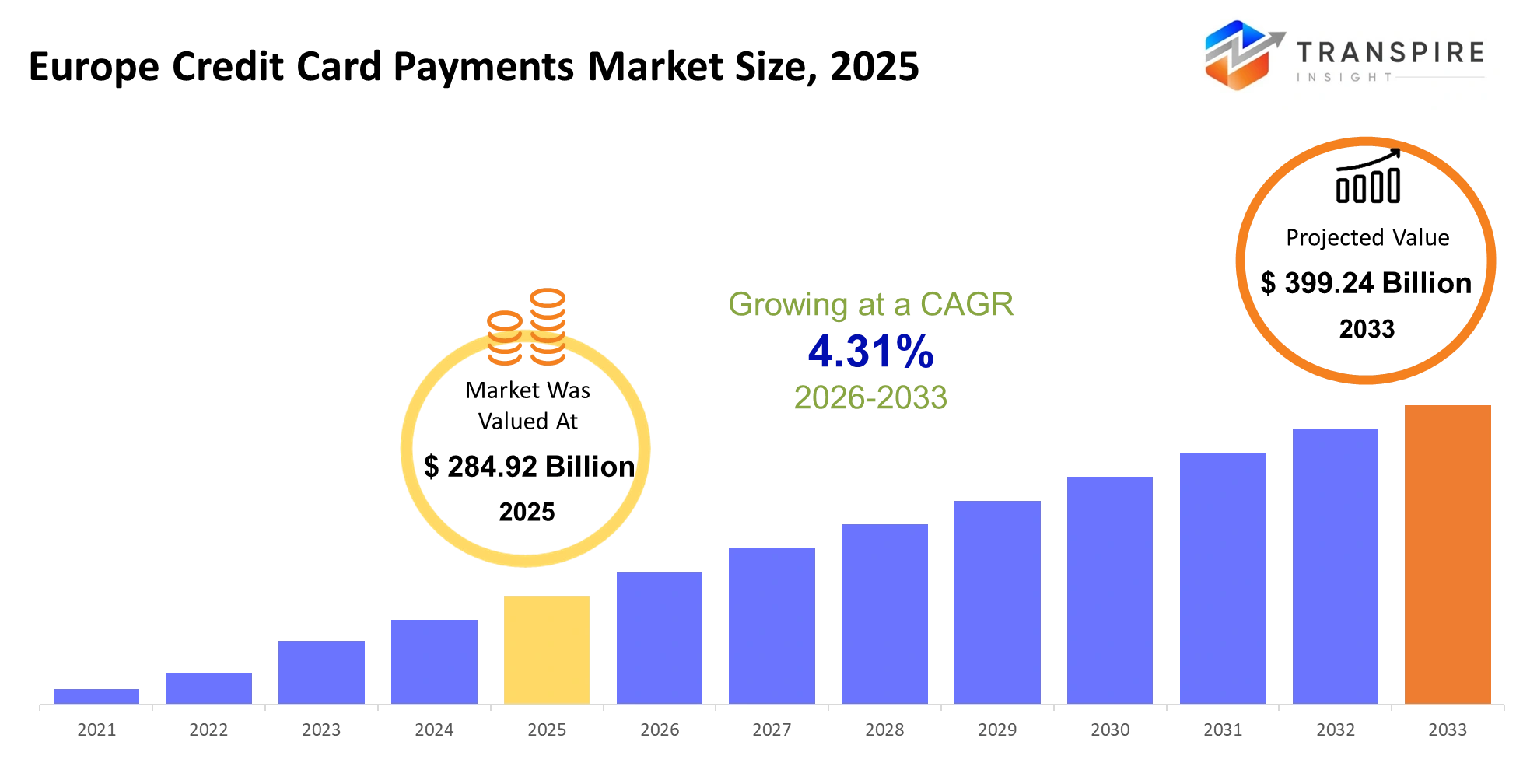
- Europe Credit Card Payments Market Size 2025: USD 284.92 Billion
- Europe Credit Card Payments Market Size 2033: USD 399.24 Billion
- Europe Credit Card Payments Market CAGR: 4.31%
- Europe Credit Card Payments Market Segments: By Type (Contactless Cards, Chip Cards, Magnetic Stripe, Others), By Application (Retail Payments, Online Payments, Travel & Hospitality, Others), By End-User (Consumers, Merchants, SMEs, Enterprises, Others), By Provider (Banks, Fintech Companies, Payment Networks, Others).
To learn more about this report,  Download Free Sample Report
Europe Credit Card Payments Market Summary:
The Europe Credit Card Payments Market size is estimated at USD 284.92 Billion in 2025 and is anticipated to reach USD 399.24 Billion by 2033, growing at a CAGR of 4.31% from 2026 to 2033. The Europe credit card payments market enables consumers and businesses to move money instantly across physical and digital channels, which decreases their need for cash and enables them to conduct international business and subscription services and instant retail transactions. The system provides essential support for all online payment processes which require fast transaction times and full tracking capabilities and safe transaction methods.
The market has experienced a complete transition during the last 3 to 5 years because customers now prefer contactless and tokenized payment methods which mobile wallets provide together with the improved security measures that PSD2 regulations require. The COVID-19 pandemic became the primary force that drove people to start making online purchases because it made cash transactions less appealing. Merchants needed to modernize their payment systems by switching to digital-first payment methods.
The current growth pattern shows increased transaction rates together with higher user spending, which allows issuers and networks to earn income through interchange fees and data services and their additional fraud protection features.
Key Market Insights
- The European Credit Card Payments Market in 2024 sees its main share in Western Europe which holds more than 65% of the market because of its established banking systems.
- Northern Europe establishes itself as the most rapidly developing area until 2030 because it shows strong digital technology adoption together with its nearly cashless financial system.
- The market for contactless credit cards achieved a 70% market share during 2024 because retailers upgraded their point-of-sale systems and customers preferred contactless payment methods.
- People use traditional chip-and-PIN cards for high-value transactions which require secure access because this card type holds the second-largest market share.
- The market for tokenized and virtual credit cards expects to grow between 2025 and 2030 because of e-commerce and mobile wallet connections.
- Consumers make retail payments which account for more than 60% of total transactions in 2024 because they shop through multiple channels while making regular purchases.
- E-commerce payments show the highest growth among application segments because they depend on international trade and digital subscription services.
- People who use personal credit cards control more than 75% of the market during 2024 because more people start using credit cards while their spending on personal needs increases.
- SME businesses will become the most rapidly developing customer segment until 2030 because they implement credit solutions to manage their operational expenses and digital payment systems.
What are the Key Drivers, Restraints, and Opportunities in the Europe Credit Card Payments Market?
The regulatory push from PSD2, which required strong customer authentication and provided third-party access to banking systems, serves as the main factor driving growth in the Europe Credit Card Payments Market. The combination of this policy change and the fast increase in mobile wallet usage has resulted in merchants and online stores treating contactless payments and tokenized transactions as standard payment methods. The combination of security measures and user-friendly designs by payment networks and issuers results in more people using payments while organizations experience fewer payment fraud-related losses. The organization increases its fee-based revenue streams through more frequent card use and international transactions and its fraud protection service.
The most significant structural barrier remains interchange fee caps imposed by EU regulation, which limit the revenue issuers can earn per transaction. The caps serve to protect merchants from fraud but they create financial challenges for banks which find their credit card portfolio growth prospects reduced. The impact is long term, as pricing structures are regulated and cannot adjust freely with inflation or technology investment costs. The organization faces time limitations because its premium card development process needs to work faster while its lower-margin customer market entry efforts need more time.
Eastern Europe presents a major growth opportunity because digital platforms increasingly adopt embedded finance solutions. The use of fintech partnerships allows e-commerce and mobility applications to provide direct credit card issuance to their users which helps businesses reach new customer groups. The implementation of instant credit lines at checkout results in higher conversion rates because it creates new transaction flows which issuers and networks can use.
What Has the Impact of Artificial Intelligence Been on the Europe Credit Card Payments Market?
Artificial intelligence and advanced digital technologies are actively transforming payment processing infrastructure across Europe by automating decision layers that were previously manual. Issuers and networks now use AI-powered systems to supervise real-time transactions while identifying suspicious activities and conducting automatic fraud checks without needing human assistance. The system improves transaction throughput by decreasing the time required for authorization and making it easier to get approval from payment processors. Machine learning models generate predictive risk scoring which uses historical spending data to identify potential fraud and credit default risks before they happen. The system uses these models to create dynamic credit limit changes together with tailored customer offerings that boost both portfolio success and customer loyalty.
AI implementation has produced operational improvements which include more than 20% better fraud detection results and reduced chargeback expenses. The process of automation enables organizations to handle digital payment systems more effectively since their operational costs do not rise as their processing volume increases. Advanced analytics at the network level enhance routing decision-making processes which leads to better success rates for international transaction processing.
The process of implementing systems encounters main challenges because different banks and fintech platforms and national systems have separate data management systems. The combination of inconsistent data standards and GDPR privacy regulations creates obstacles for model training which decreases predictive capabilities and hinders complete AI implementation within the European payments industry.
Key Market Trends
- From 2020 onward, contactless payments experienced rapid growth throughout Europe where British and Swedish markets reached 75% contactless payment adoption after merchants upgraded their point of sale systems and consumers prioritized safety.
- The 2021 PSD2 mandate led banks to construct API-based systems which enabled them to form partnerships with fintech companies while they expanded their third-party payment capabilities across online platforms.
- The share of e-commerce transactions increased substantially after the pandemic ended because cross-border credit card transactions grew alongside Amazon and Shopify's European business expansion.
- Visa and Mastercard integrated secure digital credentials into mobile wallets through their tokenization technology which became widely adopted after 2022 to decrease fraud and enhance transaction approval rates.
- European Union fee caps created revenue challenges for traditional interchange revenue models which compelled issuers such as Barclays and BNP Paribas to explore value-added services and data monetization as new business opportunities.
- Between 2021 and 2024 Buy Now Pay Later solutions changed how consumers used credit cards which particularly affected young people who stopped using revolving credit products.
- The implementation of AI-based fraud detection systems has created more than 20 percent improvement in detection accuracy since 2022 which has made issuers adopt these systems to decrease chargeback costs and operational expenses.
- Eastern Europe became a high-growth market after 2023 because digital banking services expanded and card usage increased which created new opportunities for underserved markets and generated additional transaction volumes.
- After 2021 banks and fintech companies formed more partnerships which included HSBC collaborating with payment startups to develop faster digital issuance and onboarding procedures.
Europe Credit Card Payments Market Segmentation
By Type
The market shows contactless cards as the leading payment method because both terminal upgrades and customer demand for quick secure transactions have made this option popular. Chip cards maintain their market share because they provide security for high-value transactions while magnetic stripe technology has experienced a steep decline after European authorities and network operators completed their prohibition of the system.
The mobile wallet market is driving the growth of tokenized and virtual cards because e-commerce websites now accept secure payment credentials. The growth of this market segment shows how customers prefer secure payment methods that comply with PSD2 regulations. The future development will involve companies adopting biometric authentication systems together with device credential verification methods, which will require manufacturers and issuers to develop secure digital card issuance systems while they decrease their dependence on physical card systems.
By Application
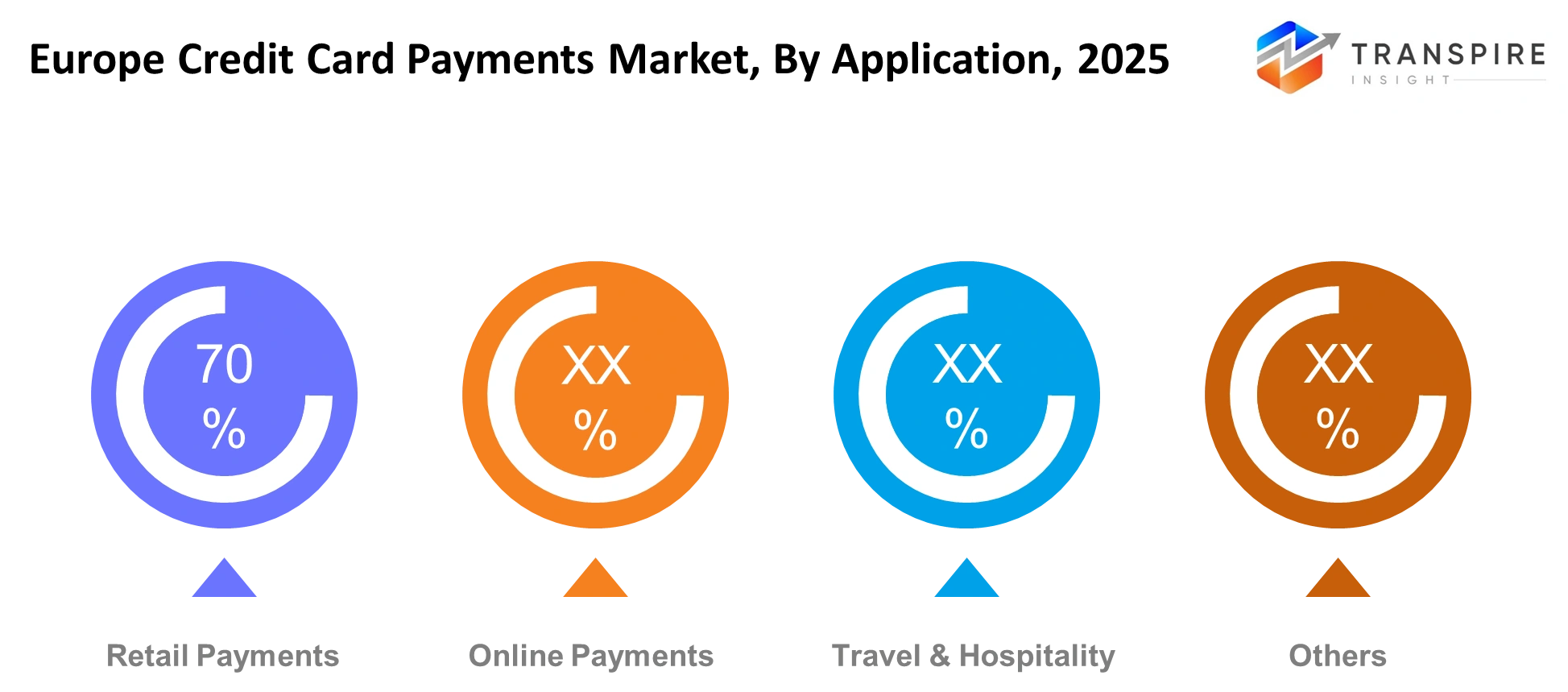
Retail payments hold the largest market share because credit cards serve as the primary payment method for consumers who shop at physical stores and use multiple retail channels. Online payment methods have experienced faster growth because cross-border e-commerce and subscription services that use stored card credentials continue to expand. The travel and hospitality industry experienced operational instability during the pandemic but has recovered to create higher transaction values per user.
The different applications exhibit unique patterns of demand because retail requires more frequent transactions while online platforms expect users to complete their purchases without interruptions and detect fraudulent activities. Payment providers need to improve their authorization rates and decrease digital payment process obstacles because merchants require these improvements to increase their customer conversion rates and decrease shopping cart abandonment rates.
To learn more about this report, Download Free Sample Report
By End-User
The end-user group includes individual consumers who dominate market share because Europeans use credit cards widely and spend according to their lifestyle choices. Merchants and SMEs represent a growing segment as digital acceptance infrastructure becomes more accessible and affordable through fintech solutions. Enterprises use credit cards to support their travel and expense management activities which enables them to maintain centralized financial control.
The different growth patterns between these groups show that consumers drive main volume while SMEs create slight expansion through their digital onboarding process. The next phase will likely see stronger engagement from small businesses as embedded finance solutions simplify access to credit and payment tools which create new revenue streams for issuers while enhancing transaction density in underserved segments.
By Provider
Traditional banks maintain their market dominance for credit underwriting and issuance activities because they have established customer relationships and their ability to follow regulatory requirements. The payment networks of Visa and Mastercard enable both transaction routing and worldwide payment acceptance, which results in them receiving a substantial portion of transaction value. Fintech companies achieve rapid growth through their digital-first issuance and embedded credit solutions and seamless onboarding experiences, which disrupt traditional business methods.
The competitive environment is changing because banks and fintech companies are forming strategic partnerships to combine their operational strengths. Providers will focus on creating market advantages through technology in their upcoming projects which will involve spending on current processing systems and sophisticated fraud detection methods and systems that connect different platforms to their business needs.
What are the Key Use Cases Driving the Europe Credit Card Payments Market?
The primary reason European countries adopt technology is to support their retail and daily consumer spending activities. Supermarkets and fuel stations together with urban mobility services use credit card payments because it enables them to process transactions rapidly while maintaining consistent payment approval which results in increased payment processing activity.
Online commerce and travel bookings represent new applications for business use. E-commerce platforms and subscription-based digital services depend on stored card credentials for recurring billing while airlines and hotels use credit cards to manage cross-border payments and higher-value transactions.
Ride-hailing apps and digital marketplaces use embedded credit as a new application, which allows instant checkout financing to boost conversion rates. Open banking-linked card solutions are becoming more popular in regulated environments which require advanced authentication methods and complete visibility of transaction activities.
|
Report Metrics |
Details |
|
Market size value in 2025 |
USD 284.92 Billion |
|
Market size value in 2026 |
USD 297.19 Billion |
|
Revenue forecast in 2033 |
USD 399.24 Billion |
|
Growth rate |
CAGR of 4.31% from 2026 to 2033 |
|
Base year |
2025 |
|
Historical data |
2021 - 2024 |
|
Forecast period |
2026 - 2033 |
|
Report coverage |
Revenue forecast, competitive landscape, growth factors, and trends |
|
Regional scope |
Europe (Germany, United Kingdom, France, Italy, Spain and Rest of Europe) |
|
Key company profiled |
Visa, Mastercard, American Express, PayPal, Stripe, Adyen, Worldline, Square, Barclays, HSBC, BNP Paribas, Deutsche Bank, Revolut, Klarna, Ingenico. |
|
Customization scope |
Free report customization (country, regional & segment scope). Avail customized purchase options to meet your exact research needs. |
|
Report Segmentation |
By Type (Contactless Cards, Chip Cards, Magnetic Stripe, Others), By Application (Retail Payments, Online Payments, Travel & Hospitality, Others), By End-User (Consumers, Merchants, SMEs, Enterprises, Others), By Provider (Banks, Fintech Companies, Payment Networks, Others). |
Which Regions are Driving the Europe Credit Card Payments Market Growth?
The market in Western Europe shows its leading position because the region established a strong regulatory system that implements PSD2 together with its secure digital payment methods. The advanced banking systems of Germany France and the UK together with their high consumer and business card usage enable both countries to achieve advantages. The combination of extensive merchant networks with efficient POS systems enables businesses to process substantial transaction volume through their physical stores and online platforms. The established banking ecosystem together with payment networks and fintech companies creates an environment for continuous innovation that leads to widespread technology adoption in various business sectors.
Northern Europe represents a stable and highly efficient contributor who operates through cashless economies that dominate Sweden and Denmark. This growing region does not expand as Western Europe does because its growth stems from operational improvements and technological advancements. Consumers demonstrate high confidence in digital systems while governments use policy measures to boost electronic payment adoption. Organizations maintain their financial stability through continuous investment in secure authentication systems together with their development of real-time payment networks.
Eastern Europe has become the fastest developing area because of its quick digital transformation and its growing access to financial services. The recent banking infrastructure developments together with mobile payment system enhancements have produced higher rates of card issuance and acceptance among users. The governments and financial institutions of various countries drive cashless programs which result in consumers and small to medium enterprises embracing new payment behaviors. The period from 2026 to 2033 will establish strong market entry opportunities for fintech companies and payment solutions which will focus on markets that need services.
Who are the Key Players in the Europe Credit Card Payments Market and How Do They Compete?
The European credit card payments market experiences moderate competition because global networks and major banks control essential transaction processes while fintech companies innovate their customer service methods. The existing market players use their business size and their ability to follow laws and their ability to work with merchants to protect their market position while new companies take on the challenge of developing new methods for onboarding and issuing and designing user interfaces. Companies now compete mainly through their capacity to combine technological systems with their capability to process data in real time and their ability to prevent fraudulent activities. Companies that maintain control over both their infrastructure base and their data analysis tools achieve greater competitive strengths because transaction data analysis has become essential for driving business growth and mitigating operational risks.
Visa and Mastercard develop their competitive edge through their worldwide acceptance networks and their ongoing dedication to developing tokenization and real-time payment verification technologies. The two companies grow their business through their collaborations with fintech companies and digital wallet services which enable them to integrate payment functionalities into different platforms. American Express targets high-end customers through its closed-loop network system that provides comprehensive spending data and customized rewards programs. This business model enables the company to achieve strong profits while retaining customers who spend money on travel and corporate expenses.
Barclays and BNP Paribas compete by leveraging their banking relationships to create regional market advantages together with their expertise in understanding local regulations. The two organizations develop digital issuance systems while they establish partnerships with fintech companies to create better mobile-first solutions and simplified customer onboarding processes. The expansion efforts aim to integrate credit solutions with online shopping and small business solutions so banks can obtain additional payment streams while improving their ability to connect with customers.
Company List
- Visa
- Mastercard
- American Express
- PayPal
- Stripe
- Adyen
- Worldline
- Square
- Barclays
- HSBC
- BNP Paribas
- Deutsche Bank
- Revolut
- Klarna
- Ingenico
Recent Development News
In April 2026, Visa Raises 2026 Outlook After Strong European Cross-Border Spending: Visa Inc. reported stronger-than-expected quarterly earnings in April 2026, supported by resilient consumer spending and increased cross-border payment volumes across Europe. The company also expanded its stablecoin-linked card initiatives and approved a new $20 billion share repurchase plan, signaling confidence in long-term digital payments growth in the European market.
Source: https://www.reuters.com
In April 2026, Mastercard Posts Strong Q1 2026 Results Driven by Payment Network Growth: Mastercard Incorporated announced robust first-quarter 2026 financial results in April, fueled by rising transaction volumes and strong cross-border card spending in Europe. The company highlighted rapid growth in fraud prevention, authentication, and digital payment services as European merchants continued accelerating digital payment adoption.
Source: https://www.wsj.com
What Strategic Insights Define the Future of the Europe Credit Card Payments Market?
The credit card payments market in Europe is establishing a new framework which uses integrated payment systems that operate without user visibility to enable credit functions to work with digital platforms. API-based banking together with real-time data processing and platform-based commerce models enable users to make payments without interrupting their online activities. Over the next 5 to 7 years organizations will create value through data ownership which includes transaction intelligence rather than through their ability to process payment transactions.
The adoption of account-to-account payments and open banking solutions which receive regulatory approval presents hidden dangers because it reduces the importance of conventional credit cards. These alternatives provide a different payment method which decreases their dependence on card networks and thus threatens to reduce interchange-based revenue streams in the future.
The development of contextual credit systems presents new business opportunities for mobility and travel and B2B procurement platforms which are expanding in Eastern Europe because digital ecosystems there are in their early stages of development. Market participants should invest in embedded finance capabilities and form partnerships with platform operators to secure early access to high-growth transaction environments and diversify beyond traditional card issuance models.
Europe Credit Card Payments Market Report Segmentation
By Type
- Contactless Cards
- ChipCards
- Magnetic Stripe
- Others
By Application
- Retail Payments
- Online Payments
- Travel & Hospitality
- Others
By End-User
- Consumers
- Merchants
- SMEs
- Enterprises
- Others
By Provider
- Banks
- Fintech Companies
- Payment Networks
- Others
Frequently Asked Questions
Find quick answers to common questions.
The approximate Europe Credit Card Payments Market size for the market will be USD 399.24 Billion in 2033.
The key segments of the Europe Credit Card Payments Market are By Type (Contactless Cards, Chip Cards, Magnetic Stripe, Others), By Application (Retail Payments, Online Payments, Travel & Hospitality, Others), By End-User (Consumers, Merchants, SMEs, Enterprises, Others), By Provider (Banks, Fintech Companies, Payment Networks, Others).
Major players in the Europe Credit Card Payments Market are Visa, Mastercard, American Express, PayPal, Stripe, Adyen, Worldline, Square, Barclays, HSBC, BNP Paribas, Deutsche Bank, Revolut, Klarna, Ingenico.
The current market size of the Europe Credit Card Payments Market is USD 284.92 Billion in 2025.
The Europe Credit Card Payments Market CAGR is 4.31%.
- Visa
- Mastercard
- American Express
- PayPal
- Stripe
- Adyen
- Worldline
- Square
- Barclays
- HSBC
- BNP Paribas
- Deutsche Bank
- Revolut
- Klarna
- Ingenico
Recently Published Reports
-
Apr 2026
3D Optical Profiler Market
3D Optical Profiler Market Size, Share & Analysis Report By Type (Desktop 3D Optical Profiler, and Portable 3D Optical Profiler), By Technology (Confocal Technology, and White Light Interference), By End-Use Industry (Manufacturing, Research Institutions, Automotive, Aerospace and Defense, Medical Devices, and Other), and Geography (North America, Europe, Asia-Pacific, Middle East and Africa, South and Central America), 2021 - 2031
-
Apr 2026
Depth Sensor Market
Depth Sensor Market Size, Share & Analysis Report By Type (Infrared Depth Sensors, Time-of-Flight (ToF) Sensors, Stereo Vision Sensors, Structured Light Sensors, Ultrasonic Depth Sensors), By Application (Automotive, Robotics, Gaming, Consumer Electronics, Industrial Automation, Healthcare, Security & Surveillance, Others), By End Users (Automotive Manufacturers, Consumer Electronics Companies, Healthcare Providers, Industrial Companies, Security Agencies, Gaming Companies, Robotics Companies, Others), and Geography (North America, Europe, Asia-Pacific, Middle East and Africa, South and Central America), 2021 – 2031
-
Apr 2026
Digital Manufacturing Market
Digital Manufacturing Market Size, Share & Analysis Report By Component (Hardware, Software, and Services), By Technology (Robotics, 3D Printing, Internet of Things (IoT), and Others), By Application (Automotive and Transportation, Aerospace and Defense, Consumer Electronics, Industrial Machinery, and Others), By Process Type (Computer-Based Designing, Computer-Based Simulation, Computer 3D Visualization, Analytics, and Others), and Geography (North America, Europe, Asia-Pacific, Middle East and Africa, South and Central America), 2021 – 2031
-
Apr 2026
Digital Visa Services Market
Digital Visa Services Market Size, Share & Analysis Report By Type (Individual Travelers, Group Travelers), By Application (Tourism, Business Travel, Others), and Geography (North America, Europe, Asia-Pacific, Middle East and Africa, South and Central America), 2021 – 2031