

Market Summary
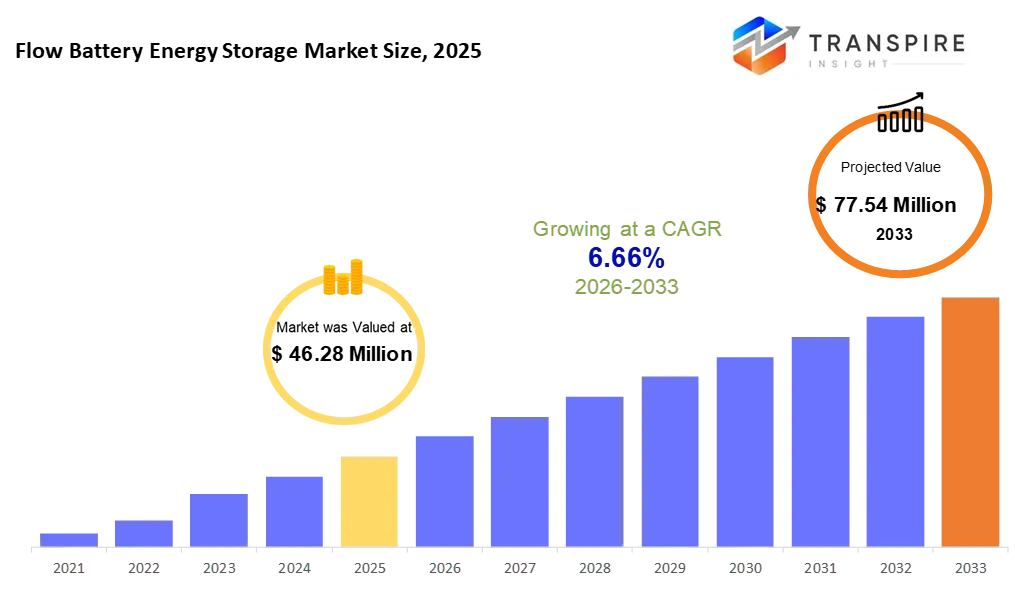
The global Flow Battery Energy Storage market size was valued at USD 46.28 million in 2025 and is projected to reach USD 77.54 million by 2033, growing at a CAGR of 6.66% from 2026 to 2033. The flow battery energy storage market is expanding as power grids require reliable, long-duration storage to support rising renewable penetration. Utilities favor flow batteries for their scalability, long operational life, and low fire risk. Growing investments in grid resilience, peak load management, and decentralized energy systems across industrial and commercial sectors are further accelerating adoption.
Market Size & Forecast
- 2025 Market Size: USD 46.28 Million
- 2033 Projected Market Size: USD 77.54 Million
- CAGR (2026-2033): 6.66%
- North America: Largest Market in 2026
- Asia Pacific: Fastest Growing Market
To learn more about this report,  Download Free Sample Report
Key Market Trends Analysis
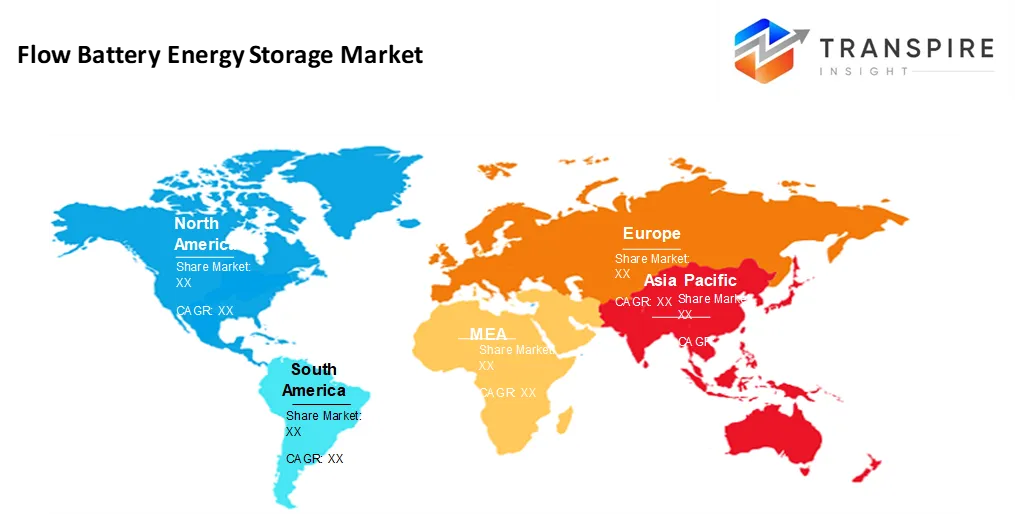
- North America market share estimated to be approximately 45% in 2026. Clear rules favoring clean power, steady upgrades to electricity networks, plus a habit of trying new tech in big energy setups. That mix shows up clearly on the map; this region stays ahead. Not every place moves at this pace, but here it sticks.
- Across North America, it is the United States leading the way in adopting flow batteries. Support from both federal and local governments pushes larger energy storage projects forward. Microgrids are also seeing growth thanks to these policies.
- Fueled by a surge in solar and wind power, the Asia Pacific area sees rising demand for flow batteries. Big power initiatives in China shift momentum toward longer-lasting storage. Japan moves forward with backing from national policies. In South Korea, infrastructure upgrades open doors for new battery systems. Government incentives play a role behind the scenes. Growth here outpaces other regions quietly but steadily.
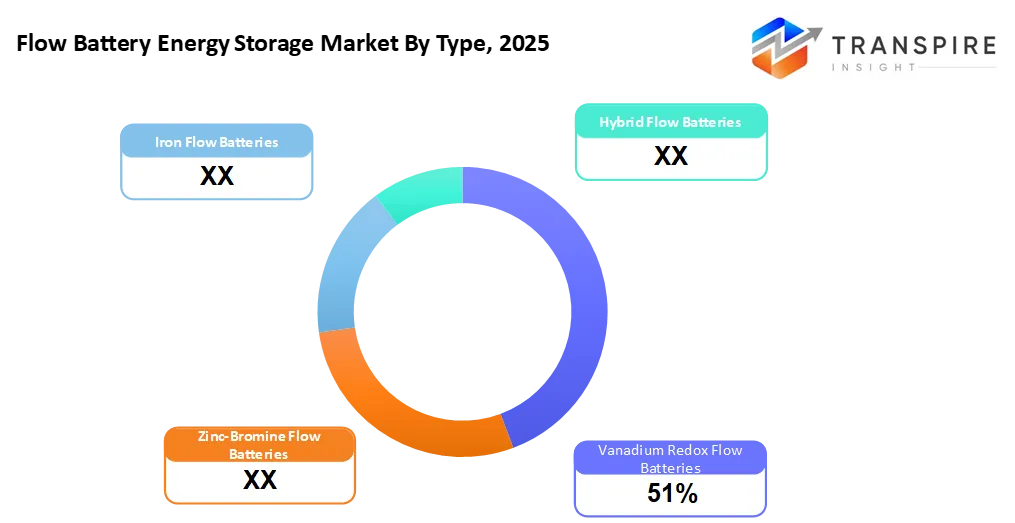
- Vanadium Redox Flow Batteries share approximately 54% in 2026. Vanadium redox flow batteries. Their tech is not new; it works reliably. These units handle thousands of cycles without failing. Utilities lean on them often. Big installations favor this type. Grid storage projects pick them regularly. Years of real-world use back their position.
- Redox flow types beat hybrids due to room to grow, steady performance, plus fitting well into massive green power systems.
- When it comes to who uses flow batteries most, utilities take the lead. These systems help manage power peaks while keeping grids stable. Instead of short bursts, they store energy over extended periods. Renewables gain a stronger backup because of this setup. Long runs matter more than quick hits here.
Liquids hold the charge in a type of battery built for big jobs. Flow batteries run on chemical soups pumped through cells. One kind uses vanadium, another mixes zinc with bromine, while some rely on iron-based formulas floating in tanks. Not everyone picks these, yet they shine when power must last many hours across industrial sites or city grids. Companies make them, test new blends, link them to solar farms, and hook them into buildings needing steady juice. Safety matters more now, and space efficiency; these units stack neatly without overheating risks. Grid operators lean on such tech to smooth out surges, balance windless nights, and keep lights on after blackouts strike. Long-term storage is not just about size; it is about how well it lasts, day after day.
A surge in renewable power pushes more places to choose flow battery storage. As cities grow, so does the push to upgrade aging grids. Flow batteries fit right into that shift. Instead of relying on old methods, utilities now lean on these systems to handle uneven solar and wind output. During high-use hours, they help stabilize supply without strain. Businesses see value, too, not just in steady electricity but in cutting long-term expenses. Factories and warehouses begin using them to smooth voltage dips and avoid disruptions. Sustainability goals matter more today; companies reach for cleaner options like these. Where policy supports change, adoption climbs faster. In nations pushing for lower emissions, projects gain speed due to funding and rules favoring clean tech. Across regions, momentum builds quietly but steadily.
What keeps vanadium redox flow batteries ahead is their durability over many cycles, ability to scale up easily, and solid track record. Still, newer types such as zinc-bromine and iron-based flow cells draw interest because they cost less and fit certain areas better. Some researchers mix different chemical setups into hybrid versions simply to get more from each charge, allowing varied uses. Progress in how systems manage charging, keep fluids stable, and build units in pieces helps companies adapt to what grids or factories need. All of this pushes wider use across countries without slowing down.
Right now, North America holds the top spot, thanks mainly to the United States pushing forward with clean power rules and big solar-plus-storage setups. Not far behind, Asia Pacific moves quickest, with China, Japan, and South Korea pouring money into battery systems that handle bursts of wind and solar power. Over in Europe, progress hums along quietly, backed by efforts to cut emissions and smarter electricity networks. Elsewhere, new economies show promise; so do mix-style batteries and solutions built for storing power over many hours. All these pieces fit together, pointing toward ongoing movement ahead.
Flow Battery Energy Storage Market Segmentation
By Type
- Vanadium Redox Flow Batteries
Fueled by lasting performance, these batteries handle heavy use over time. Their size can shift to fit different needs, making them flexible. Big operations choose them often because they work well at scale.
- Zinc-bromine flow batteries
These systems work well for big buildings and factories. Price helps make them easier to adopt. Movement toward larger setups favors their design. Not flashy, just steady progress in real-world use.
- Iron Flow Batteries
Battery tech using iron is gaining ground. These systems store energy for extended periods. Cost stays low thanks to abundant materials. Sustainability becomes easier with fewer rare elements. Long-term storage becomes a practical option. Iron plays a key role in scaling solutions. New designs favor durability over complexity. Performance improves without relying on expensive components.
- Hybrid Flow Batteries
A mix of different battery types works together, efficiency stays high, while costs come down. Performance finds a middle ground through blended materials.
To learn more about this report, Download Free Sample Report
By Battery Type
- Redox Flow Batteries
Redox flow batteries lead the pack when it comes to big setups needing lengthy power hold times. These systems fit well where solar or wind feeds into the grid, simply because they last longer between charges.
- Hybrid Flow Batteries
Battery systems that mix redox with different chemical types bring more options plus better results. These hybrid setups adapt easily while boosting how well they work.
By End-Users
- Utility
Utilities make up the biggest group of users, relying on it to balance the grid, reduce high demand periods, while also supporting solar and wind power use.
- Industrial
Factories often rely on microgrids to keep operations running smoothly when the main grid fails. Equipment that runs constantly needs steady electricity, making reliable sources essential. Some sites generate their own power instead of depending solely on outside supply.
- Residential & Commercial
Homes and businesses alike now lean on backup systems where energy gets stored close to use, supporting greener goals without relying solely on distant grids.
Regional Insights
Across North America, the United States leads the way in adopting flow battery systems because of strict green power rules and upgrades to aging infrastructure. Long-term storage needs are pushing interest in vanadium and iron-based models. Instead of falling behind, Canada is stepping up with funding for clean tech and off-grid solutions in isolated regions. Meanwhile, progress in Mexico moves at a steady pace due to large solar and wind installations feeding into public grids.
Across Europe, progress moves at a steady pace. Leading nations like Germany and the UK push forward by expanding renewables alongside robust storage networks. Grid stability, localized power setups, and factory demands now rely more on flow battery technology. Meanwhile, areas in Southern Europe and Nordic countries turn to these systems not just for cleaner energy but also for resilience and decentralized grids. Growth here ties closely to cutting emissions and keeping supply lines strong.
China and Japan lead the charge across Asia Pacific, where growth outpaces other regions thanks to massive vanadium flow battery installations boosting clean power and stable grids. Government-driven storage programs push South Korea forward at a steady pace. Elsewhere, nations like India, Australia, and parts of Southeast Asia gain momentum fast, fueled by climbing energy needs plus expanding renewables. In contrast, early moves in the Middle East and Latin America stem from big-grid shifts toward sustainable sources.
To learn more about this report, Download Free Sample Report
Recent Development News
- April 11, 2025 – Startup XL Batteries commissions first organic flow battery pilot project in Texas.
|
Report Metrics |
Details |
|
Market size value in 2025 |
USD 46.28 Million |
|
Market size value in 2026 |
USD 49.36 Million |
|
Revenue forecast in 2033 |
USD 77.54 Million |
|
Growth rate |
CAGR of 6.66% from 2026 to 2033 |
|
Base year |
2025 |
|
Historical data |
2021 – 2024 |
|
Forecast period |
2026 – 2033 |
|
Report coverage |
Revenue forecast, competitive landscape, growth factors, and trends |
|
Regional scope |
North America; Europe; Asia Pacific; Latin America; Middle East & Africa |
|
Country scope |
United States; Canada; Mexico; United Kingdom; Germany; France; Italy; Spain; Denmark; Sweden; Norway; China; Japan; India; Australia; South Korea; Thailand; Brazil; Argentina; South Africa; Saudi Arabia; United Arab Emirates |
|
Key company profiled |
Invinity Energy System Plc., RKP Storage, Sumitomo Electric, Vizn Energy Energy Systems, Cellcube, VRB Energy, Enel Group, Kemiwatt, Stryten Energy, Everflow, Primus Power, Lockheed Martin, Honeywell, Invinity, C&R Technologies, ESS Tech, Inc. |
|
Customization scope |
Free report customization (country, regional & segment scope). Avail customized purchase options to meet your exact research needs. |
|
Report Segmentation |
By Type (Vanadium Redox Flow Batteries, Zinc-Bromine Flow Batteries, Iron Flow Batteries, Hybrid Flow Batteries) By Battery Type (Redox, Hybrid) By End-Users (Utility, Industrial, Residential & Commercial) |
Key Flow Battery Energy Storage Company Insights
One name stands out when talking about flow batteries: Invinity Energy Systems. Built through the joining of redT Energy and Avalon Battery, it now ranks among the biggest firms focused solely on this tech. Their VRFB units pop up where steady power matters most: factories, cities, and solar farms. These setups last many cycles without degrading fast, handle stress safely, and grow to fit demand. Projects stretch from Canada to Scotland to Singapore, showing reach and real-world trust. Designs like the VS3 and ENDURIUM let users pick how much power they store and for how long. Trading under a public ticker, the firm pulls strength from alliances and funding aimed at scaling clean storage worldwide.
Key Flow Battery Energy Storage Companies:
- Amagen Inc.
- Invinity Energy System Plc.
- RKP Storage
- Sumitomo Electric
- Vizn Energy Systems
- Cellcube
- VRB Energy
- Enel Group
- Kemiwatt
- Stryten Energy
- Everflow
- Primus Power
- Lockheed Martin
- Honeywell
- Invinity
- C&R Technologies
- ESS Tech, Inc.
Global Flow Battery Energy Storage Market Report Segmentation
By Type
- Vanadium Redox Flow Batteries
- Zinc-Bromine Flow Batteries
- Iron Flow Batteries
- Hybrid Flow Batteries
By Battery Type
- Redox
- Hybrid
By End-Users
- Utility
- Industrial
- Residential & Commercial
Regional Outlook
- North America
- United States
- Canada
- Europe
- Germany
- United Kingdom
- France
- Spain
- Italy
- Rest of Europe
- Asia Pacific
- Japan
- China
- Australia & New Zealand
- South Korea
- India
- Rest of Asia Pacific
- Latin America
- Brazil
- Mexico
- Rest of Latin America
- Middle East & Africa
- GCC
- South Africa
- Rest of the Middle East & Africa
Frequently Asked Questions
Find quick answers to common questions.
The approximate Flow Battery Energy Storage Market size for the market will be USD 77.54 million in 2033.
Key segments for the Flow Battery Energy Storage Market are By Type (Vanadium Redox Flow Batteries, Zinc-Bromine Flow Batteries, Iron Flow Batteries, Hybrid Flow Batteries), By Battery Type (Redox, Hybrid), By End-Users (Utility, Industrial, Residential & Commercial.
Major Flow Battery Energy Storage Market players are Invinity Energy System Plc., RKP Storage, and Sumitomo Electric.
The North America region is leading the Flow Battery Energy Storage Market.
The Flow Battery Energy Storage Market is 6.66%
- Amagen Inc.
- Invinity Energy System Plc.
- RKP Storage
- Sumitomo Electric
- Vizn Energy Systems
- Cellcube
- VRB Energy
- Enel Group
- Kemiwatt
- Stryten Energy
- Everflow
- Primus Power
- Lockheed Martin
- Honeywell
- Invinity
- C&R Technologies
- ESS Tech, Inc.
Recently Published Reports
-
Apr 2026
Active Power Filter Market
Active Power Filter Market Size, Share & Analysis Report By Type (Shunt Active Power Filters, Series Active Power Filter, Hybrid Active Power Filter), By Application (Harmonics Mitigation, Reactive Power Compensation, Voltage Regulation, Power Factor Correction), By Phase (Single Phase, Three Phase), By End-User Industry (Manufacturing, Healthcare, Commercial, Automotive, Oil and Gas, Others), and Geography (North America, Europe, Asia-Pacific, Middle East and Africa, South and Central America), 2021 - 2031
-
Apr 2026
Electrical Transformer Market
Electrical Transformer Market Size, Share & Analysis Report By Core (Closed, Shell, and Berry), By Insulation (Gas, Oil, Solid, Air, and Other), By Phase (Single, and Three), By Rating (100 MVA to 500 MVA, 501 MVA to 800 MVA, and 801 MVA to 1200 MVA), and Geography (North America, Europe, Asia-Pacific, Middle East and Africa, South and Central America), 2021 – 2031
-
Apr 2026
Hydraulic Piston Pumps Market
Hydraulic Piston Pumps Market Size, Share & Analysis Report By Type (Axial Piston Pumps, Radial Piston Pumps), By Operating Pressure (Low Pressure, Medium Pressure, High Pressure), By Application (Construction, Mining, Agriculture, Automotive, Oil & Gas, Industrial Machinery, Others), By End-User (OEMs, Aftermarket), and Geography (North America, Europe, Asia-Pacific, Middle East and Africa, South and Central America), 2021 – 2031
-
Apr 2026
Laboratory Gas Generators Market
Laboratory Gas Generators Market Size, Share & Analysis Report By Product (Nitrogen Gas Generator, Hydrogen Gas Generator, Zero Air Gas Generator, Purge Gas Generator, TOC Gas Generators, Others), By Application (Gas Chromatography, Liquid Chromatography-mass Spectrometry (LC-MS), Gas Analyzers, Others), By End-user (Life Science, Chemical & Petrochemical, Food & Beverage, Others), and Geography (North America, Europe, Asia-Pacific, Middle East and Africa, South and Central America), 2021 – 2031