

Europe Psychological Distress Market Size & Forecast:
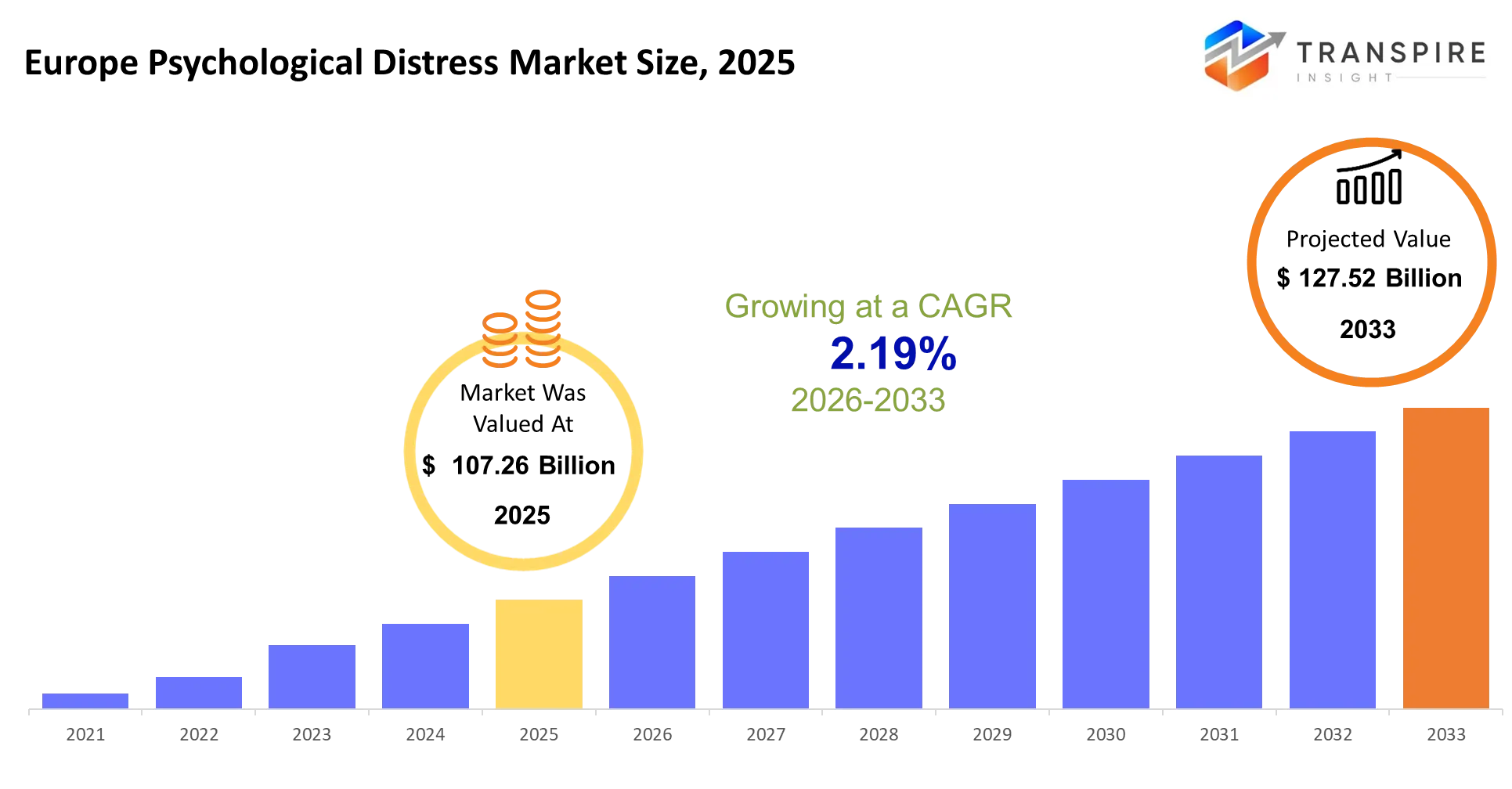
- Europe Psychological Distress Market Size 2025: USD 107.26 Billion
- Europe Psychological Distress Market Size 2033: USD 127.52 Billion
- Europe Psychological Distress Market CAGR: 2.19%
- Europe Psychological Distress Market Segments: By Type (Pharmacotherapy, Psychotherapy, Digital Therapeutics, Counseling Services, Others); By Application (Depression, Anxiety, Stress Management, PTSD, Behavioral Disorders, Others); By End-User (Hospitals, Clinics, Mental Health Centers, Online Platforms, Employers, Others); By Delivery Mode (In-person, Telehealth, Hybrid, Others)
To learn more about this report,  Download Free Sample Report
Europe Psychological Distress Market Summary
The Europe Psychological Distress Market was valued at USD 107.26 Billion in 2025. It is forecast to reach USD 127.52 Billion by 2033. That is a CAGR of 2.19% over the period.
The Europe Psychological Distress Market exists to fulfill the essential requirement of detecting and handling mental health disorders which decrease employee efficiency and increase healthcare system demands and create negative effects on economic growth. The organization provides various services which include clinical therapy and medication management and employer-sponsored counseling services and digital mental health platforms that enable constant patient observation and prompt treatment.
During the last three to five years, the market transitioned from providing treatment through episodic clinic visits to delivering treatment through integrated hybrid care systems which utilize both face-to-face therapy and telehealth services and AI-powered solutions. The COVID-19 pandemic served as the primary catalyst because it revealed mental healthcare system capacity deficiencies and it compelled healthcare systems to rapidly accept remote therapy solutions and digital therapeutic products. The modification created easier entry points for people who required mental health assistance while establishing mental health treatment as a standard practice in both workplace environments and primary healthcare facilities.
The present expansion receives its impetus from two factors: the first factor involves the growth of reimbursement practices and the second factor pertains to company implementation of organized mental health treatment systems which transform single-session treatments into continuous care operations. The shift enables healthcare organizations to achieve higher value from patients while healthcare providers receive incentives to develop healthcare solutions which utilize advanced technology for patient treatment.
Key Market Insights
- Western Europe leads the Europe Psychological Distress Market because it holds more than 40% of market share which will reach 2025 due to its effective mental health treatment support systems and business-sponsored mental health treatment programs.
- Eastern Europe is the fastest-growing region because its digital health infrastructure develops at a rate higher than 12% compound annual growth rate until 2030.
- Psychotherapy occupies the largest market segment with its 35 to 40 percent market share which received support from clinical proof and national healthcare system adoption.
- Pharmacotherapy serves as the second biggest market segment because it holds approximately 30 percent market share which results from steady prescriptions of antidepressants and anxiolytics.
- Digital therapeutics show the highest growth rate among market segments because AI-based therapy platforms will drive their expansion at more than 15% compound annual growth rate between 2025 and 2030.
- Depression represents the primary reason for application usage which accounts for more than 30% of applications to be used in 2025 because many patients need treatment and established medical procedures.
- Stress management has become the most rapidly growing application because it grows fast in both corporate wellness programs and preventive care systems.
- Hospitals hold the largest share of end users with their 45% share because of their psychiatric facilities and their need for urgent medical services throughout Europe.
- The end-user segment which includes employers shows the fastest growth rate because companies have started to implement workplace mental health programs since 2024.
- Teladoc Health and Headspace and Calm and Spring Health and Roche work as major market players who use AI technology and business partnerships and health insurer relationship models to expand their businesses.
What are the Key Drivers, Restraints, and Opportunities in the Europe Psychological Distress Market?
The Europe Psychological Distress market experiences growth because employers and insurers rapidly establish mental health programs for their workers who suffered from ongoing productivity challenges after the pandemic. German and UK and Nordic companies now require their employees to access digital therapy and participate in organized stress management programs instead of providing optional wellness programs. The European Union healthcare systems now offer teletherapy and hybrid counseling services as reimbursable treatments because insurers have adopted new reimbursement policies which support these methods. The provider cash flow system has become stable because subscription-based care models have taken over and generated higher lifetime patient value compared to traditional clinical visit systems.
The most significant restraint remains fragmented regulatory and clinical validation standards across Europe, particularly for digital therapeutics and AI-enabled mental health tools. The platforms experience two major obstacles because GDPR restrictions and the different approval systems used by national health authorities create challenges for international market expansion while increasing operational costs for service providers. The existing organizational structure creates obstacles which extend product development times while requiring businesses to conduct multiple clinical studies in various markets, which reduces their profit margins and slows their growth despite high market demand.
Digital infrastructure development in France and Central and Eastern Europe has created a major business opportunity which health insurance companies use to establish preventive mental health programs. AI-based early screening which is part of employer health programs and primary care systems in the United Kingdom, starts to detect mental distress before it reaches the stage of traditional clinical assessment. The dual-platform solution developed by Spring Health and Teladoc Health enables the companies to establish operational methods that allow them to deliver predictive and preventive healthcare services throughout disconnected medical facilities.
What Has the Impact of Artificial Intelligence Been on the Europe Psychological Distress Market?
The implementation of artificial intelligence in Europe creates an automated system which handles patient intake procedures and medical examination processes and continuous patient surveillance through digital platforms which connect to insurance-based healthcare systems. Chatbots together with AI-based screening systems perform initial patient evaluations which decrease the amount of work required from doctors while they handle patient referrals to psychotherapy and pharmacotherapy and combined treatment options. Healthcare providers increasingly use automated documentation systems which help them maintain compliance with EU medical standards and data protection requirements through simplified documentation processes.
Machine learning models now use behavioral indicators and sleep patterns and therapy participation metrics to determine the probability of relapses in patients who suffer from depression and anxiety disorders. The systems enable clinics and online platforms to anticipate demand fluctuations which occur during seasonal stress periods and workplace burnout cycles. The initial implementations of the system show administrative work reductions between 20 and 30 percent along with increased speed of patient assessment in digitally advanced medical systems throughout Northern Europe.
The limited access to high-quality mental health datasets together with the strict data protection regulations of GDPR creates an obstacle which prevents organizations from implementing mental health technologies. The constraints create delays in model development while they limit the ability of AI tools to operate across different countries. The AI-driven mental health platforms in Europe continue to grow because healthcare providers choose hybrid care solutions which enhance patient treatment compliance and develop personalized treatment methods across different European healthcare systems.
Key Market Trends
- Workplace mental health programs expanded between 2023 and 2023, because employers began using digital stress monitoring tools which provided permanent support instead of basic counseling services.
- The post-pandemic period saw telehealth adoption increase but in 2025 hybrid care delivery models emerged because regulators introduced stricter clinical validation standards.
- Since 2024 German and Nordic insurance providers have started to include digital therapeutics in their reimbursement systems which has changed the way providers compete in the market.
- In 2025 AI-powered psychological assessment tools started to replace manual evaluation methods which were used to identify early signs of anxiety and depression in people.
- Psychopharmacological treatment methods reached their peak when doctors started to use medication together with psychotherapy and digital behavioral health solutions for patient treatment.
- The healthcare sector shifted its attention from direct-to-consumer business models to insurer-integrated healthcare services because Spring Health and Teladoc expanded their platforms which linked with payers.
- After the European Union expanded its digital health funding program in 2025 Eastern Europe experienced a rapid increase in mobile-based mental health platform usage because of improved infrastructure.
- The healthcare industry has moved away from traditional hospital systems because outpatient services and employer-based treatment options now handle a larger portion of initial patient interactions.
- The European Union introduced stricter digital health regulations in 2026 which limited the growth of unverified applications while supporting the development of platforms with clinical validation.
Europe Psychological Distress Market Segmentation
By Type:
The European psychological distress treatment market shows its largest share to psychotherapy because clinical reimbursement systems exist for this treatment and psychiatric doctors use this method for their practice. The primary care system supports pharmacotherapy through its ongoing use of antidepressant and anxiolytic medications. Digital therapeutics exist as a smaller market segment which experiences fast development because AI-based solutions and app-based cognitive behavioral therapy achieve recognition. The distinct development of growth arises from organizations that combine digital technology with traditional therapeutic approaches. The adoption of digital therapeutics which base their treatment on scientific evidence receives support from regulatory bodies in Germany and Nordic countries. Employer sponsored wellness programs create additional counseling services which allow employees to access mental health support without the need for clinical treatment. The future of treatment development will lead to psychotherapy and digital therapeutic systems creating combined treatment methods. The software developers focus on developing products which medical professionals will test for clinical use with complete medical supervision. Investors show growing interest in platforms which can expand their operations while meeting the reimbursement requirements of different national healthcare systems.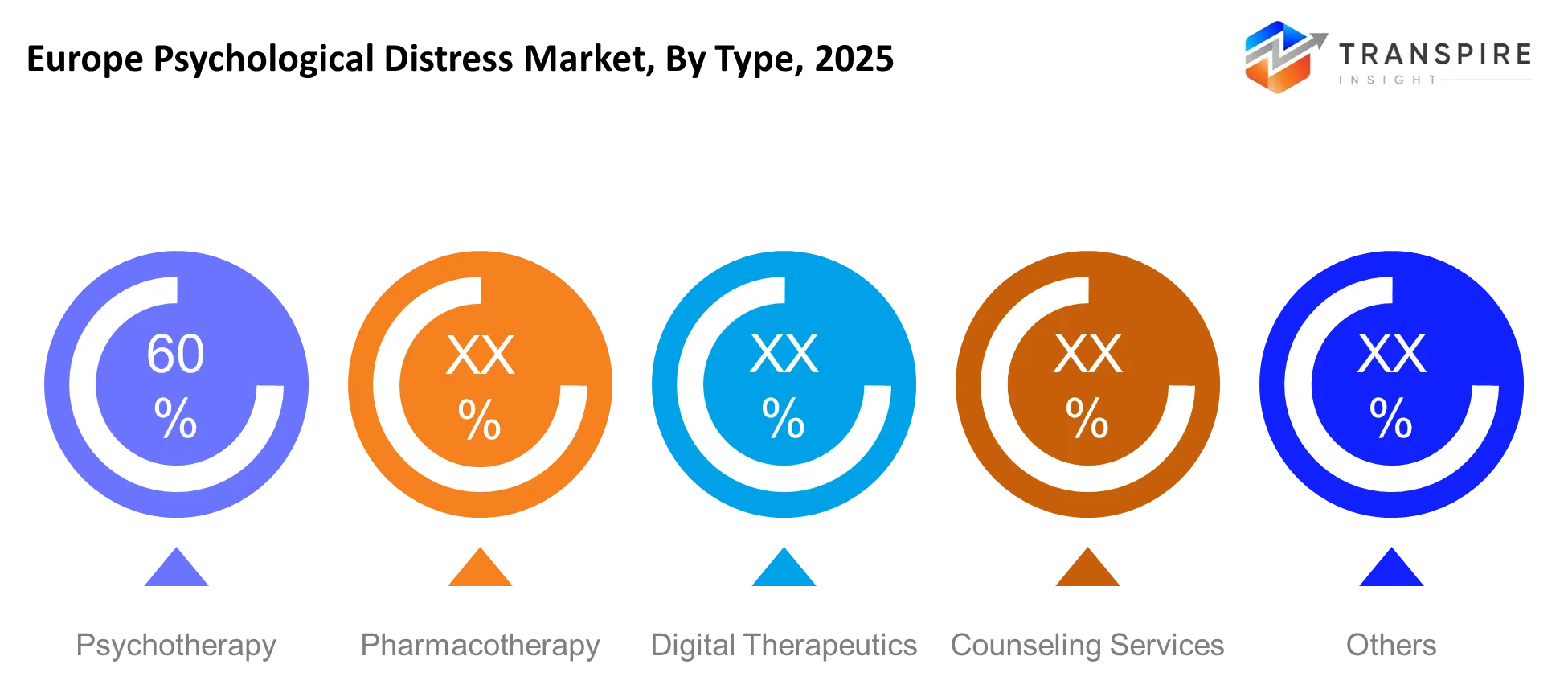
To learn more about this report, Download Free Sample Report
By Application:
The European psychological distress treatment market shows its highest demand for depression treatment because depression has high occurrence rates and established clinical diagnostic procedures. The second largest segment of the market which drives its growth comes from anxiety disorders because primary care facilities now diagnose these disorders more effectively through advanced screening methods. Stress management applications now experience rapid growth throughout workplace wellness programs and preventive healthcare initiatives. Workplace burnout trends drive strong demand for stress management solutions across corporate sectors. People now recognize anxiety and depression disorders more effectively because improved awareness and reduced stigma help them to identify these disorders at earlier stages. The expansion of insurance coverage for outpatient mental health services improves accessibility to treatment options. Future growth indicates stronger shift toward preventive stress and anxiety management solutions integrated into employer systems. Digital screening tools enable earlier identification of depressive symptoms across populations. Product developers create scalable interventions, which align with preventive care reimbursement models.
By End-User:
The psychiatric treatment facilities in European hospitals possess dominant market share because their existing psychiatric systems and emergency medical facilities enable them to deliver effective psychological distress care. Mental health clinics provide specialized outpatient services which operate through their extensive network of referral partners. The online platforms of the company experience rapid growth because consumers prefer digital solutions and the business establishes partnerships with employers. Structured employee assistance programs which employers develop function as the primary method through which the end-user market for their services grows. The demand for severe case treatment together with regulatory funding creates financial advantages for hospitals. Online platforms expand their operations through two factors which include their ability to deliver services at low costs and their capacity to serve customers from different countries. Mental health programs which employers develop see rising adoption because companies want to improve employee productivity and maintain their workforce. The upcoming system design will distribute resources between digital health solutions and employer-sponsored treatment programs. Hospital systems treat patients who have both acute conditions and complex psychiatric needs. Investors show strong interest in online platforms which can grow their business while using clinical referral systems to connect with other organizations.
By Delivery Mode:
The direct method of delivering training needs to maintain its current operational capacity because hospitals require urgent psychiatric treatment and their existing procedures require direct hospital admission. The use of telehealth services has been rapidly growing because digital technology enables people to access medical services from remote locations. The implementation of hybrid care models has become increasingly popular because they enable healthcare providers to supervise clinical operations while delivering remote therapy services. Blended care pathways have become standard practice in public health systems because they enable better resource management through improved service delivery. Telehealth usage has increased because of two factors which include the expansion of reimbursement programs and the development of digital systems. The process of acute psychiatric stabilization needs in-person treatment. Hybrid treatment models enhance patient involvement and treatment consistency by enabling patients to maintain contact with their healthcare providers throughout their entire treatment process. The healthcare systems of Europe will adopt hybrid delivery as their primary operational model in the future.Telehealth services extend their reach to remote areas and underserved communities. Developers create unified systems which enable users to switch between physical locations and virtual spaces without interruption.
What are the Key Use Cases Driving the Europe Psychological Distress Market?
The main application in Europe Psychological Distress market exists to support workplace mental health treatment because businesses experience increasing employee burnout problems which cause productivity decline and raise employer liability issues. Organizations develop structured therapy access systems together with stress monitoring tools and counseling services to decrease employee absenteeism while increasing employee retention rates. The most significant demand from customers arises in finance and healthcare and technology industries which maintain high cognitive demands throughout their operations.
The developing applications of outpatient therapy funding from insurers and psychological screening through primary care clinics now include both these treatments. Public healthcare systems and private insurers are embedding early detection tools into routine checkups, while employee assistance programs are evolving into continuous care platforms. The mental health coverage models of these organizations serve mid-sized enterprises which want to establish price-efficient scalable mental health coverage systems.
The field now explores AI-based predictive distress monitoring together with school-based early intervention programs as new applications. Researchers are testing wearable devices with digital behavioral tracking systems to detect risk patterns which occur before clinical symptoms start to show. EU-funded preventive healthcare pilots are currently adopting these applications which will grow in usage when regulations enable data-based mental health prevention methods.
|
Report Metrics |
Details |
|
Market size value in 2025 |
USD 107.26 Billion |
|
Market size value in 2026 |
USD 109.61 Billion |
|
Revenue forecast in 2033 |
USD 127.52 Billion |
|
Growth rate |
CAGR of 2.19% from 2026 to 2033 |
|
Base year |
2025 |
|
Historical data |
2021 - 2024 |
|
Forecast period |
2026 - 2033 |
|
Report coverage |
Revenue forecast, competitive landscape, growth factors, and trends |
|
Regional scope |
Europe (Germany, United Kingdom, France, Italy, Spain, Rest of Europe) |
|
Key company profiled |
Pfizer, Eli Lilly, GSK, Johnson & Johnson, Novartis, Roche, Teladoc, BetterHelp, Talkspace, Headspace, Calm, Lyra Health, Spring Health, Mindler, Wysa |
|
Customization scope |
Free report customization (country, regional & segment scope). Avail customized purchase options to meet your exact research needs. |
|
Report Segmentation |
By Type (Pharmacotherapy, Psychotherapy, Digital Therapeutics, Counseling Services, Others); By Application (Depression, Anxiety, Stress Management, PTSD, Behavioral Disorders, Others); By End-User (Hospitals, Clinics, Mental Health Centers, Online Platforms, Employers, Others); By Delivery Mode (In-person, Telehealth, Hybrid, Others) |
Which Regions are Driving the Europe Psychological Distress Market Growth?
Western and Northwestern Europe represents the leading region in the Psychological Distress market, driven by deep integration of mental health into formal healthcare systems. The countries of Germany, the UK, and the Nordics establish strong insurance reimbursement structures together with their existing clinical guidelines for psychological care. The region's employers provide funding for digital therapy and workplace mental health programs, which results in increased service availability beyond traditional hospital settings. The ecosystem operates through established connections among clinicians, digital health platforms, and insurers to create ongoing demand for new innovations.
The market receives stabilizing support from Southern Europe, which includes Italy, Spain, and Portugal as its main secondary market. The region experiences growth because public healthcare systems modernize their facilities while government policies gradually adopt European Union mental health regulations. Digital technology adoption in the north experiences slower progress because cultural norms still require family members to provide care for their relatives. National health systems and EU recovery funding provide consistent financial support, which leads to gradual growth in psychological service capabilities.
Poland, Romania, and the Baltic states establish Eastern Europe as the region that experiences the fastest growth rate. The latest improvements in digital infrastructure, together with increasing workplace stress awareness, have created better conditions for tele-mental health service adoption. The European Union supports healthcare digitization initiatives through programs that promote mobile-first care delivery systems, which help lower access barriers to healthcare services. The region provides investors and new market entrants with opportunities to achieve high-volume growth, yet their success relies on developing affordable business models that utilize digital solutions at scale.
Who are the Key Players in the Europe Psychological Distress Market and How Do They Compete?
The European Psychological Distress market exhibits moderate market fragmentation because three overlapping competitive groups which include pharmaceutical companies and digital mental health platforms and employer healthcare networks compete in the market. The competition has shifted from evaluating clinical effectiveness to assessing how well services connect with insurer payment systems and workplace benefits. The most effective way to differentiate products now depends on hybrid delivery systems which provide clinical validation through digital access and measurable results.
Teladoc Health operates its virtual care system through a unified model which connects therapy services to psychiatric care and employer insurance programs. The company establishes its competitive edge by merging consumer platforms with healthcare services that receive reimbursement because this setup enables them to expand their operations from direct-to-consumer counseling services into European payer-funded markets. Headspace Health operates its business model through enterprise contracts which combine mindfulness training with structured coaching programs and clinical escalation processes to provide preventive mental health solutions for employers.
Spring Health creates its unique value proposition through precise mental health assessment methods which establish specific treatment paths to enhance patient outcomes while enabling better result measurement for insurance companies. Calm maintains its focus on consumers through its subscription model which provides access to mindfulness content while establishing partnerships with brands instead of using clinical methods. The companies Roche and Johnson & Johnson establish indirect competition through their development of drug and neuropsychiatric treatment options which they support through their deep clinical trial capabilities and hospital partnerships instead of their digital distribution systems.
Company List
- Pfizer
- Eli Lilly
- GSK
- Johnson & Johnson
- Novartis
- Roche
- Teladoc
- BetterHelp
- Talkspace
- Headspace
- Calm
- Lyra Health
- Spring Health
- Mindler
- Wysa
Recent Development News
In January 2026, Spring Health announced its acquisition of Alma to strengthen AI-enabled mental healthcare navigation and expand employer- and health plan-linked access across Europe, signaling accelerating consolidation in digitally delivered psychological care. The integration is expected to deepen platform-based treatment routing for psychological distress across hybrid provider networks. https://www.mobihealthnews.com
In April 2025, Teladoc Health announced the acquisition of UpLift, a virtual mental health provider with strong insurance network integration across Europe-linked operations. The deal strengthens Teladoc’s ability to shift BetterHelp users from cash-pay therapy toward reimbursed, insurer-covered mental health services, signaling a broader structural move toward payor-integrated digital therapy models in Europe. https://www.teladochealth.com
What Strategic Insights Define the Future of the Europe Psychological Distress Market?
The Europe Psychological Distress market will transition to its new prevention-based care system during the next 5 to 7 years because workplace burnout problems and aging population and post-pandemic mental health treatment trends continue to grow. The market will begin to move away from using short-term clinical treatments toward using digital systems for ongoing patient monitoring which will provide early health assessments through primary care and workplace health programs. The digital therapeutics market faces hidden dangers because of increasing regulatory and clinical resistance which creates uneven evidence requirements and new EU artificial intelligence and medical device standards which will reduce market adoption despite strong customer demand. Insurers who establish mental health screening programs for workplace benefits create new market opportunities especially in Central and Eastern Europe which currently has low program adoption but experiences rapid digital access growth. Market participants should choose hybrid care models which medical studies have proven effective because they need to work with insurers and employers to achieve reimbursement and develop early detection systems that meet regulatory requirements.
Europe Psychological Distress Market Report Segmentation
By Type
- Pharmacotherapy
- Psychotherapy
- Digital Therapeutics
- Counseling Services
- Others
By Application
- Depression
- Anxiety
- Stress Management
- PTSD
- Behavioral Disorders
- Others
By End-User
- Hospitals
- Clinics
- Mental Health Centers
- Online Platforms
- Employers
- Others
By Delivery Mode
- In-person
- Telehealth
- Hybrid
- Others
Frequently Asked Questions
Find quick answers to common questions.
The Europe Psychological Distress Market size is USD 127.52 Billion in 2033.
Key Segments for the Europe Psychological Distress Market are By Type (Pharmacotherapy, Psychotherapy, Digital Therapeutics, Counseling Services, Others); By Application (Depression, Anxiety, Stress Management, PTSD, Behavioral Disorders, Others); By End-User (Hospitals, Clinics, Mental Health Centers, Online Platforms, Employers, Others); By Delivery Mode (In-person, Telehealth, Hybrid, Others).
Major Europe Psychological Distress Market Players are Pfizer, Eli Lilly, GSK, Johnson & Johnson, Novartis, Roche, Teladoc, BetterHelp, Talkspace, Headspace, Calm, Lyra Health, Spring Health, Mindler, Wysa.
The Europe Psychological Distress Market size is USD 107.26 Billion in 2025.
The Europe Psychological Distress Market CAGR is 2.19% from 2026 to 2033.
- Pfizer
- Eli Lilly
- GSK
- Johnson & Johnson
- Novartis
- Roche
- Teladoc
- BetterHelp
- Talkspace
- Headspace
- Calm
- Lyra Health
- Spring Health
- Mindler
- Wysa
Recently Published Reports
-
Apr 2026
Biosimilars Market
Biosimilars Market By Product Type (Monoclonal Antibodies, Recombinant Hormones, Erythropoietin, G-CSF, Others), By Indication (Oncology, Autoimmune Diseases, Blood Disorders, Diabetes, Others), By Manufacturing Type (In-House Manufacturing, Contract Manufacturing), By Distribution Channel (Hospital Pharmacies, Retail Pharmacies, Online Pharmacies), By Industry Analysis, Size, Share, Growth, Trends, and Forecasts 2021-2033
-
Apr 2026
Gastrointestinal Endoscopy Market
Gastrointestinal Endoscopy Market By Type (Rigid Gastrointestinal Endoscope, Flexible Gastrointestinal Endoscopes, Disposable Gastrointestinal Endoscope), By Procedure Type (Colonoscopy, Gastroscopy, Duodenoscopy, Enteroscopy, Flexible Sigmoidoscopy, Others), By Application (Diagnosis, Treatment), By End-Users (Hospitals, Ambulatory Surgical Centers, Specialty Clinics, Laboratories, Others), By Industry Analysis, Size, Share, Growth, Trends, and Forecasts 2021-2033
-
Apr 2026
Rare Inherited Metabolic Disorder Drug Market
Rare Inherited Metabolic Disorder Drug Market By Drug Class (Enzyme Replacement Drugs, Gene Therapy Drugs, Substrate Reduction Drugs, Small Module Drugs, Protein Drugs), By Route of Administration(Parenteral, Oral, Intrathecal), By Clinical Development (Marketed Drugs, Late Stage Clinical Phase III, Early Stage Clinical Phase I-II, Preclinical Candidates), By Indication (Lysosomal Storage Disorders, Urea Cycle Disorders, Amino Acid Metabolic Disorders, organic Acidemias, Peroximal Disorders), By Industry Analysis, Size, Share, Growth, Trends, and Forecasts 2021-2033
-
Jan 2026
Pharmaceutical Cleanroom Technology Market
Pharmaceutical Cleanroom Technology Market By Product (Equipment, Consumables, Services); By Cleanroom Type (Standard Cleanrooms, Modular Cleanrooms); By End Use (Pharmaceutical Companies, Biotechnology Companies), By Industry Analysis, Size, Share, Growth, Trends, and Forecasts 2021-2033