

Europe Nutraceutical Contract Manufacturing Services Market Size & Forecast:
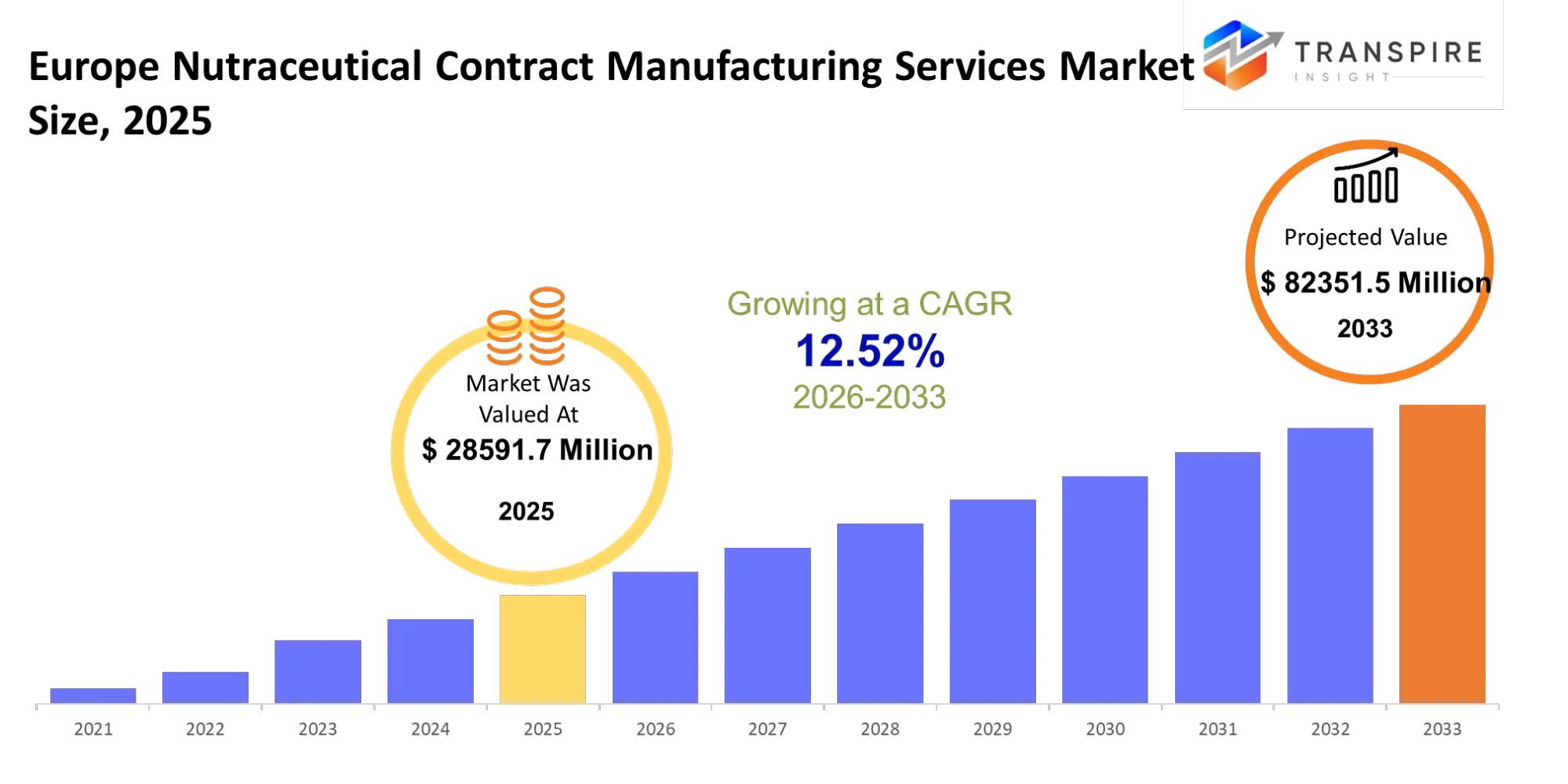
- Europe Nutraceutical Contract Manufacturing Services Market Size 2025: USD 28591.7 Million
- Europe Nutraceutical Contract Manufacturing Services Market Size 2033: USD 82351.5 Million
- Europe Nutraceutical Contract Manufacturing Services Market CAGR: 12.52%
- Europe Nutraceutical Contract Manufacturing Services Market Segments: By Type (Dietary Supplements Manufacturing, Functional Food Manufacturing, Others); By Application (Immunity, Digestive Health, Sports Nutrition, Others); By End-User (Nutraceutical Companies, Pharma Companies, Others); By Form (Tablets, Capsules, Powders, Others)
To learn more about this report,  Download Free Sample Report
Europe Nutraceutical Contract Manufacturing Services Market Summary
The Europe Nutraceutical Contract Manufacturing Services Market was valued at USD 28591.7 Million in 2025. It is forecast to reach USD 82351.5 Million by 2033. That is a CAGR of 12.52% over the period.
The Europe Nutraceutical Contract Manufacturing Services Market serves as the production base which supports dietary supplement brands that do not possess their own capabilities for product development and manufacturing and product packaging. Contract manufacturers use their facilities to transform raw botanical extracts and vitamins and functional ingredients into finished products which include capsules and gummies and powders and softgels for distribution through retail and e-commerce channels after they obtain EU labeling and safety certification.
The market has experienced a permanent change during the past three to five years which has resulted in the replacement of small independent production facilities by large contract development and manufacturing organizations that provide complete solution packages which include formulation and testing and packaging services. The EU Novel Food regulations have become more stringent while EFSA health claim validation requirements have become more demanding which has created additional compliance challenges for brand owners.
The main cause of this situation emerged when COVID-19 disrupted supply chains which showed how businesses depended on imported raw materials. Companies in Europe began to source materials from local markets while they established production facilities to make products within their own countries. Organizations in the nutraceutical industry now choose to contract out their manufacturing work because it helps them decrease their equipment costs while they speed up their product development process and maintain necessary legal standards. The agreement has caused specialized manufacturers who focus on high-growth wellness and preventive health markets to use their services more frequently which results in better financial performance through their sustained revenue streams.
Key Market Insights
- The Europe Nutraceutical Contract Manufacturing Services Market Western Europe operates overall through its advanced manufacturing systems and its strict enforcement of regulations, which enables it to maintain control over 52% of market share.
- Germany and Switzerland and Italy operate as the main production centers which maintain high pharmaceutical-grade manufacturing standards.
- Eastern Europe operates as the most rapidly expanding area between 2025 and 2032 because Western European nutraceutical brands now outsource their operations to countries with cheaper production expenses.
- European supplement users prefer capsule and tablet products which give manufacturers approximately 45% market control because these products are cost-effective.
- The second largest market share belongs to powder formulation services because of the growing demand for sports nutrition products and functional food items.
- Between 2026 and 2033, gummies and softgel manufacturing will experience the highest growth rate because customers choose these enjoyable dietary supplements.
- The Europe Nutraceutical Contract Manufacturing Services Market shows dietary supplements as the most common product category which occupies approximately 60% of market share because people choose preventive health solutions.
- The biggest market growth occurs in sports nutrition because people now follow fitness trends and use dietary products that contain protein.
- Nutraceutical brands stay as the main end-user group which holds approximately 55% market share because they depend on outsourced GMP-certified production.
- E-commerce wellness startups, which depend on contract manufacturers, represent the highest growth category because they use contract manufacturers to introduce new products and create customized solutions.
What are the Key Drivers, Restraints, and Opportunities in the Europe Nutraceutical Contract Manufacturing Services Market?
Driver:
The rapid growth of preventive health consumption, which includes rising demand for vitamins and probiotics and sports nutrition products, serves as the primary factor that drives business expansion. The shift occurred because consumer behavior changed after the pandemic while EU Novel Food and EFSA health claim regulation requirements increased product development difficulties. The nutraceutical brands now prefer to use GMP-certified contract manufacturers for their manufacturing needs because these manufacturers enable them to meet compliance standards and accelerate product development and organizational growth.
Restraint:
The high regulatory fragmentation that exists throughout European markets operates as a main structural constraint because different countries establish their own product approval processes and labeling requirements and ingredient restrictions. The process requires time because different countries implement EU food supplement rules according to their own understanding. The result for brands that operate in multiple markets through distributed networks produces longer product launch timelines with increased compliance expenses while their international business growth becomes obstructed.
Opportunity:
The future opportunity for personalized nutrition manufacturing through AI-based formulation and data-led consumer profiling presents a major business potential. German and Nordic countries have emerging platforms which now start to combine health information with custom supplement manufacturing at large production capacities. The subscription-based nutraceutical model which this business model creates will enable contract manufacturers with small-batch production capabilities to achieve their next growth phase through higher-margin products.
What Has the Impact of Artificial Intelligence Been on the Europe Nutraceutical Contract Manufacturing Services Market?
European nutraceutical contract manufacturing operations implement artificial intelligence and advanced digital systems to achieve better product accuracy and regulatory compliance and increased production capacity throughout their formulation and packaging operations. AI-driven manufacturing execution systems now automate batch tracking, ingredient dosing validation, and quality control checks, which leads to decreased need for manual tasks within GMP-certified facilities. The systems provide production scheduling optimization through their ability to match raw material supply with actual customer requests from nutraceutical companies.
Machine learning models are increasingly used for predictive maintenance of blending, encapsulation, and bottling equipment, which enables identification of early mechanical wear signs before equipment fails. The system provides unplanned downtime reduction, which leads to consistent production output for all high-volume supplement products including capsules and powders. Advanced facilities use predictive analytics to enhance energy efficiency because they modify their temperature and mixing processes based on historical production information.
Manufacturers experience operational gains of 10 to 18 percent across their equipment uptime, while their batch rejection rates decrease through better process control and immediate deviation measurement. AI streamlines compliance workflows by handling all documentation needed to meet EU food supplement and GMP certification standards.
Mid-sized manufacturers face obstacles to implementation because of expensive integration requirements and their existing scattered legacy production systems. Facilities require standardized data infrastructure because their current setup hinders AI performance, which depends on complete and consistent production information.
Key Market Trends
- Since 2020, nutraceutical brands have increased their outsourcing activities, which resulted in their decision to move manufacturing work from in-house operations to dedicated contract manufacturing facilities.
- The EU Novel Food regulation updates which took place between 2021 and 2024 required manufacturers to improve their compliance systems and their processes for validating ingredients.
- Consumer demand started to favor gummies and softgels after 2022, which led to a decline in popularity for traditional tablets because people wanted more convenient ways to take supplements.
- The European market for sports nutrition products experienced rapid growth after 2023 because more people started going to gyms and consuming protein-rich diets.
- The introduction of AI production scheduling systems in 2024 replaced manual planning methods which resulted in improved batch efficiency and decreased manufacturing bottlenecks.
- Mid-sized manufacturers established long-term supply contracts with global nutraceutical brands after 2021 to decrease their risks of capacity utilization problems.
- Businesses expanded Eastern European manufacturing hubs since 2022 because they wanted to reduce labor costs while establishing EU-compliant manufacturing operations.
- Contract manufacturers started using clean-label formulation technologies after 2023, which they adopted because regulators increased their demands for ingredient disclosure.
- The period between 2022 and 2025 saw packaging innovation choose sustainable and recyclable packaging solutions that matched corporate ESG commitments.
- The competitive environment became more intense because Lonza and Catalent expanded their complete R&D-to-production service solutions across the European market.
Europe Nutraceutical Contract Manufacturing Services Market Segmentation
By Type:
The European nutraceutical outsourcing market identifies dietary supplements manufacturing as its primary operational segment because companies produce vitamins and minerals and probiotic products at high production levels. The company maintains its market leadership position because its products achieve widespread distribution through pharmacies and e-commerce sites and wellness chains which sell standardized dosage forms. The functional food manufacturing industry operates with its minor market share which gains importance through the ongoing development of food and nutritional products between European countries.
The dietary supplement market expansion receives support from European Union regulations which require manufacturing facilities to obtain Good Manufacturing Practice certification and from consumers who follow preventive health practices. Urban consumers show increasing demand for fortified beverages and protein-enriched products which drive the growth of functional food production. Health claim regulations create a complex system that prevents fast category growth for most products because it specifically impacts new product formulations.
The dietary supplement market will remain the main market segment throughout the forecast period while functional foods will grow in popularity because people start to include nutritional products into their everyday meals. To meet the rising demand for both standardized and hybrid nutrition products, investors and manufacturers design production systems which enable them to switch between different product formats.

To learn more about this report, Download Free Sample Report
By Application:
The primary application segment of nutraceutical manufacturing focuses on immunity-based products which continue to experience high post-pandemic market demand for immune-supporting vitamins and herbal formulations. The segment maintains its strong market position because customers purchase its products repeatedly which enables pharmacies and online platforms to achieve high sales volume.Probiotic products and gut health supplements have become common among European elderly people, which helps their digestive health.
The field of sports nutrition develops at its fastest pace because more young people start exercising while they increasingly use protein supplements. Fitness centers and e-commerce brands require customized protein blends and recovery formulas, which manufacturers have developed to meet their needs. The market for cognitive health supplements has remained small, yet it continues to experience gradual growth.
As consumers seek specific functional advantages, the industry will develop sports nutrition products and personalized health solutions. The segment will generate higher profits for businesses that use contract manufacturers, which specialize in quick product development and compact production runs.
By End-User:
Nutraceutical companies dominate outsourcing demand, holding the largest share due to their reliance on third-party GMP-certified production for scalability and regulatory compliance. These companies use contract manufacturers to bring new products to market, while they develop various supplements. Pharma companies maintain a consistent market presence through their medically related products and their development of prescription-based supplements.
Nutraceutical brands experience growth because wellness retail competition increases and they must introduce new products on a regular basis. Pharma companies use contract manufacturing to develop their preventive health product lines without needing to build their own manufacturing facilities. The fast product testing activity of smaller wellness startups results in higher demand for testing services.
The period of time from now until the end of the forecast period will show that nutraceutical firms will maintain their position as primary demand generators while pharmaceutical companies start to enter the preventive nutrition market. The contract manufacturers who provide both research and development services together with regulatory compliance assistance will achieve better market position with two different customer segments.
By Form :
The product distribution of the market shows three main categories which include tablets, capsules, and powders and other products. The European market for nutraceuticals considers tablet manufacturing to be the most important production method because it provides cost-effective solutions which can be expanded and produces products that customers already know. Capsules follow closely because their better bioavailability and their ability to combine various ingredients for complex formulas. Sports nutrition together with functional beverage applications have created a major market for powder products.
The market for capsules will grow because brands start making products which combine advanced absorption methods with better product value. The market for powder-based products is expanding quickly within the fitness and lifestyle nutrition segments which young consumers particularly drive. Other formats, including gummies, are emerging but still represent a smaller base.
The future growth projections show that consumer preferences will start to favor capsules and powders because people want products that provide easy-to-use performance-based dietary solutions. The production systems which manufacturers develop to create different product formats will provide them with better market position in the changing nutraceutical outsourcing market.
What are the Key Use Cases Driving the Europe Nutraceutical Contract Manufacturing Services Market?
The European Nutraceutical Contract Manufacturing Services Market uses dietary supplement production as its main application because brands utilize GMP-certified manufacturing facilities to create vitamins minerals and probiotics through their contract manufacturing operations. The EU Novel Food and labeling regulations establish strict requirements which make in-house manufacturing unprofitable for companies, so they choose to work with contract manufacturers who provide specialized services for compliance and accelerate their product launch process.
The market for sports nutrition and immunity solutions is experiencing rapid growth because fitness brands, pharmacy chains, and e-commerce wellness companies are supporting these products. The end-users of this market require production flexibility to manufacture protein powders and capsules and fortified blends because European consumers increasingly prefer performance-based and preventive health products.
The market now supports personalized nutrition manufacturing and gut-health supplements, which use microbiome testing to create tailored products. Wellness brands that use subscription models are starting to combine consumer health information with their custom formulation systems, which results in small-batch production that operates on an on-demand basis. The industry will move toward data-based nutraceutical production systems during the forecast period.
|
Report Metrics |
Details |
|
Market size value in 2025 |
USD 28591.7 Million |
|
Market size value in 2026 |
USD 36054.8 Million |
|
Revenue forecast in 2033 |
USD 82351.5 Million |
|
Growth rate |
CAGR of 12.52% from 2026 to 2033 |
|
Base year |
2025 |
|
Historical data |
2021 - 2024 |
|
Forecast period |
2026 - 2033 |
|
Report coverage |
Revenue forecast, competitive landscape, growth factors, and trends |
|
Regional scope |
Europe (Germany, United Kingdom, France, Italy, Spain, Rest of Europe) |
|
Key company profiled |
Lonza, Catalent, Thermo Fisher, DSM, BASF, Nutraceutix, Sirio Pharma, Aenova, Piramal Pharma, Alkem Labs, Glanbia, Arla Foods, Kerry Group, Vit-Best, Softigel |
|
Customization scope |
Free report customization (country, regional & segment scope). Avail customized purchase options to meet your exact research needs. |
|
Report Segmentation |
By Type (Dietary Supplements Manufacturing, Functional Food Manufacturing, Others); By Application (Immunity, Digestive Health, Sports Nutrition, Others); By End-User (Nutraceutical Companies, Pharma Companies, Others); By Form (Tablets, Capsules, Powders, Others) |
Which Regions are Driving the Europe Nutraceutical Contract Manufacturing Services Market Growth?
Western Europe leads the Europe Nutraceutical Contract Manufacturing Services Market because of its pharmaceutical-grade manufacturing facilities and European Union Novel Food and Good Manufacturing Practice regulations. Germany Italy and Switzerland operate numerous certified manufacturing facilities which produce high-quality dietary supplements in large volumes. The established retail networks and existing nutraceutical companies and developed research and development facilities in this area create a strong competitive advantage. The region achieves efficient product development because its formulation laboratories work closely with its large-scale manufacturing facilities to develop innovative products.
The manufacturing activities in Spain and Italy create a stable and vital territory which Southern Europe maintains as its strategic component. This region depends on manufacturing activities that meet demand through cost-effective production and continuous supply chain operations which focus on exports. The industrial manufacturing areas of the economy demonstrate resilience while businesses gradually implement European Union regulatory requirements which result in stable production rates. The local manufacturers in the region enter into extended agreements with European nutraceutical brands which creates reliable revenue streams that establish the area as a trustworthy manufacturing location.
Eastern Europe is the most rapidly expanding area because it has developed GMP-compliant facilities whose operational expenses remain cost-effective. The nutraceutical production capacity in Poland Hungary and Romania has expanded since 2022 because Western European companies started outsourcing their production needs. The EU provides funding to modernize industrial facilities and improve logistics systems which has accelerated the development of new production sites. Investors and contract manufacturers will find significant opportunities through this transition which enables them to establish production hubs and expand their operations through cost-effective methods.
Who are the Key Players in the Europe Nutraceutical Contract Manufacturing Services Market and How Do They Compete?
The Europe Nutraceutical Contract Manufacturing Services Market displays moderate competition which merges top-tier companies into one group while mid-tier companies face competition from numerous regional manufacturers who use cost and operational flexibility to compete. Incumbents protect their market position by providing complete service solutions which include formulation development and regulatory guidance and packaging design under a single contract. The main market competition centers on three factors which include regulatory knowledge and production capacity and the ability to deliver products quickly to customers because new companies must comply with EU Novel Food and GMP regulations which create significant market entry obstacles.
Lonza drives its research through technology development which creates high-strength nutraceutical supplements and sophisticated delivery systems. The company distinguishes itself through its implementation of strict pharmaceutical manufacturing standards to produce nutraceutical products which enables it to deliver high-complexity formulations that maintain consistent product quality. The company expands its operations through targeted investments in European GMP production facilities and joint ventures with wellness companies that require advanced product development resources.
Catalent provides its clients with complete development and production solutions which focus on capsule and softgel delivery systems. The company maintains its market position through its unique drug delivery technology which has been modified for use in nutraceutical products to enhance their bioavailability and effectiveness. The company expands its operations through production facility enhancements in Europe and partnerships with emerging supplement companies that focus on sports nutrition and customized wellness solutions.
Aenova Group and Eurofins Scientific built their market positions through their specialized expertise in specific industry niches. Aenova specializes in contract manufacturing services which enable customers to produce both tablets and capsules at scale, while Eurofins uses its testing and quality assurance capabilities to help clients enter markets with regulatory compliance. The two companies expand their operations by acquiring local production sites and implementing digital quality control systems which enhance their manufacturing dependability and compliance with regulations.
Company List
- Lonza
- Catalent
- Thermo Fisher
- DSM
- BASF
- Nutraceutix
- Sirio Pharma
- Aenova
- Piramal Pharma
- Alkem Labs
- Glanbia
- Arla Foods
- Kerry Group
- Vit-Best
- Softigel
Recent Development News
In October 2025, Aenova Group announced major investment in sterile manufacturing and advanced fill-and-finish capacity across its European facilities. The expansion strengthens its ability to produce high-quality dosage forms for nutraceutical and pharmaceutical clients under strict GMP compliance standards.https://www.aenova-group.com
In January 2024, Catalent announced completion of its acquisition by Novo Holdings, marking a major consolidation move in pharmaceutical and nutraceutical contract manufacturing capacity across Europe. The transaction strengthened integrated manufacturing capabilities for both healthcare and wellness product pipelines and expanded access to high-capacity GMP production networks.https://www.catalent.com
What Strategic Insights Define the Future of the Europe Nutraceutical Contract Manufacturing Services Market?
The Europe Nutraceutical Contract Manufacturing Services Market is developing into production systems which require integrated operations and compliance standards and advanced technologies which produce value for companies that can merge formulation expertise with their knowledge of regulatory requirements and their ability to create different production methods. The demand between 2023 and 2028 will increase because personalized nutrition becomes more popular and EU health claim regulations become more stringent, which will force brands to rely on contract manufacturing partners instead of their internal production facilities.
The industry faces hidden danger because companies depend too much on small number of GMP-certified manufacturers, which will result in supply shortages and higher costs when demand exceeds their production limits. The risk of concentration danger increases because mid-sized businesses experience difficulties with their growing regulatory needs and automation expenses.
AI-based supplement manufacturing which uses consumer health data and microbiome diagnostics presents a new business opportunity for the Northern European market, which has developed advanced digital health solutions. The business model supports production of small product batches through subscription services which enable the company to sell products at higher profit margins.
The market requires its participants to make expenditures toward developing modular manufacturing systems together with digital formulation platforms, which enable quick product adjustments while ensuring compliance with multiple European Union regulatory frameworks.
Europe Nutraceutical Contract Manufacturing Services Market Report Segmentation
By Type
- Dietary Supplements Manufacturing
- Functional Food Manufacturing
- Others
By Application
- Immunity
- Digestive Health
- Sports Nutrition
- Others
By End-User
- Nutraceutical Companies
- Pharma Companies
- Others
By Form
- Tablets
- Capsules
- Powders
- Others
Frequently Asked Questions
Find quick answers to common questions.
The Europe Nutraceutical Contract Manufacturing Services Market size is USD 82351.5 Million in 2033.
Key segments for the Europe Nutraceutical Contract Manufacturing Services Market are By Type (Dietary Supplements Manufacturing, Functional Food Manufacturing, Others); By Application (Immunity, Digestive Health, Sports Nutrition, Others); By End-User (Nutraceutical Companies, Pharma Companies, Others); By Form (Tablets, Capsules, Powders, Others).
Major Europe Nutraceutical Contract Manufacturing Services Market players are Lonza, Catalent, Thermo Fisher, DSM, BASF, Nutraceutix, Sirio Pharma, Aenova, Piramal Pharma, Alkem Labs, Glanbia, Arla Foods, Kerry Group, Vit-Best, Softigel
The Europe Nutraceutical Contract Manufacturing Services Market size is USD 28591.7 Million in 2025.
The Europe Nutraceutical Contract Manufacturing Services Market CAGR is 12.52% from 2026 to 2033.
- Lonza
- Catalent
- Thermo Fisher
- DSM
- BASF
- Nutraceutix
- Sirio Pharma
- Aenova
- Piramal Pharma
- Alkem Labs
- Glanbia
- Arla Foods
- Kerry Group
- Vit-Best
- Softigel
Recently Published Reports
-
Apr 2026
Biosimilars Market
Biosimilars Market By Product Type (Monoclonal Antibodies, Recombinant Hormones, Erythropoietin, G-CSF, Others), By Indication (Oncology, Autoimmune Diseases, Blood Disorders, Diabetes, Others), By Manufacturing Type (In-House Manufacturing, Contract Manufacturing), By Distribution Channel (Hospital Pharmacies, Retail Pharmacies, Online Pharmacies), By Industry Analysis, Size, Share, Growth, Trends, and Forecasts 2021-2033
-
Apr 2026
Gastrointestinal Endoscopy Market
Gastrointestinal Endoscopy Market By Type (Rigid Gastrointestinal Endoscope, Flexible Gastrointestinal Endoscopes, Disposable Gastrointestinal Endoscope), By Procedure Type (Colonoscopy, Gastroscopy, Duodenoscopy, Enteroscopy, Flexible Sigmoidoscopy, Others), By Application (Diagnosis, Treatment), By End-Users (Hospitals, Ambulatory Surgical Centers, Specialty Clinics, Laboratories, Others), By Industry Analysis, Size, Share, Growth, Trends, and Forecasts 2021-2033
-
Apr 2026
Rare Inherited Metabolic Disorder Drug Market
Rare Inherited Metabolic Disorder Drug Market By Drug Class (Enzyme Replacement Drugs, Gene Therapy Drugs, Substrate Reduction Drugs, Small Module Drugs, Protein Drugs), By Route of Administration(Parenteral, Oral, Intrathecal), By Clinical Development (Marketed Drugs, Late Stage Clinical Phase III, Early Stage Clinical Phase I-II, Preclinical Candidates), By Indication (Lysosomal Storage Disorders, Urea Cycle Disorders, Amino Acid Metabolic Disorders, organic Acidemias, Peroximal Disorders), By Industry Analysis, Size, Share, Growth, Trends, and Forecasts 2021-2033
-
Jan 2026
Pharmaceutical Cleanroom Technology Market
Pharmaceutical Cleanroom Technology Market By Product (Equipment, Consumables, Services); By Cleanroom Type (Standard Cleanrooms, Modular Cleanrooms); By End Use (Pharmaceutical Companies, Biotechnology Companies), By Industry Analysis, Size, Share, Growth, Trends, and Forecasts 2021-2033