
Europe Imaging Agents Market Size & Forecast:
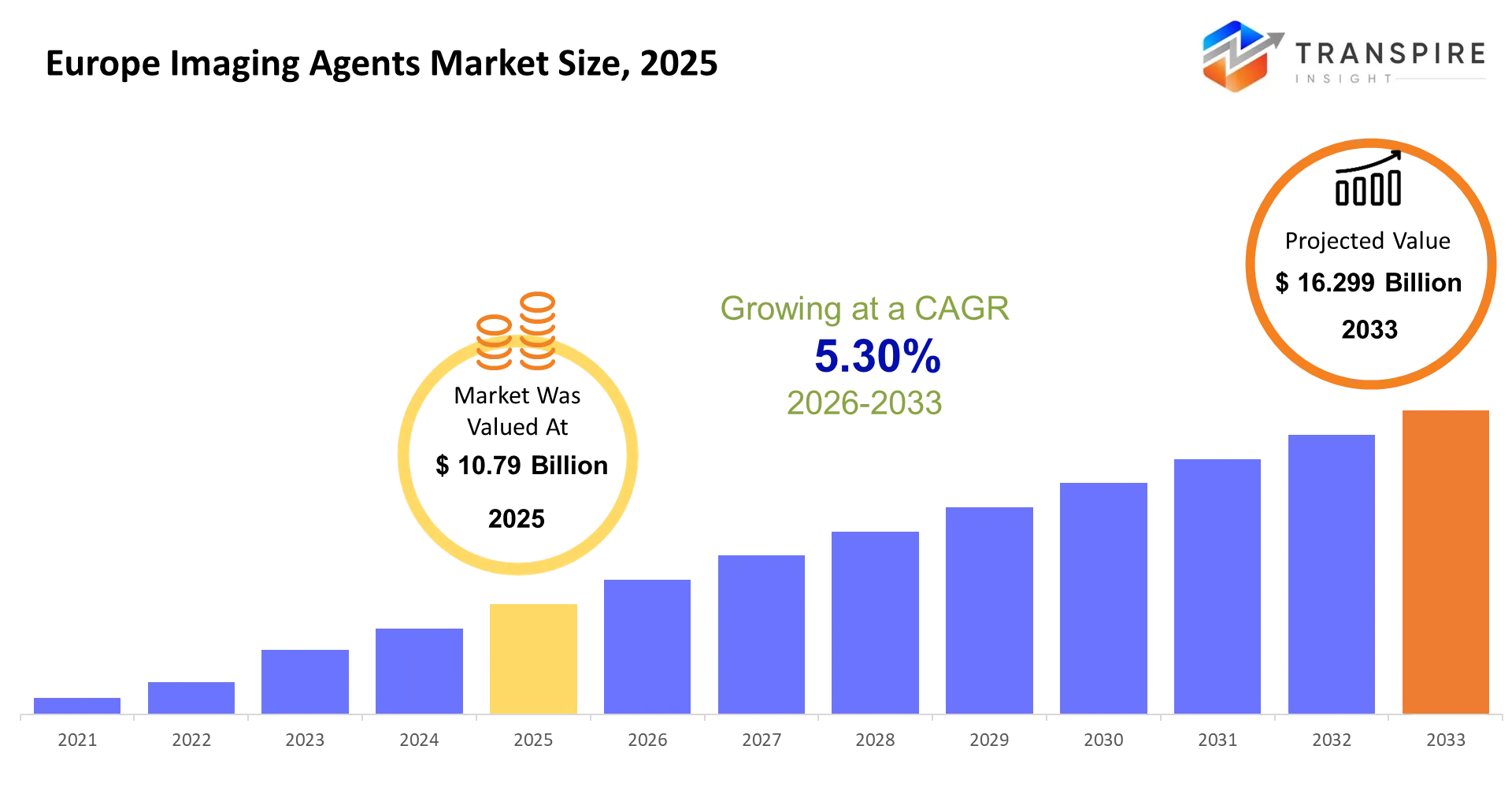
- Europe Imaging Agents Market Size 2025: USD 10.79 Billion
- Europe Imaging Agents Market Size 2033: USD 16.299 Billion
- Europe Imaging Agents Market CAGR: 5.30%
- Europe Imaging Agents Market Segments: By Type (Contrast Agents, Nuclear Imaging Agents, Optical Imaging Agents, Ultrasound Agents, Others), By Application (Oncology, Cardiology, Neurology, Gastroenterology, Others), By End-User (Hospitals, Diagnostic Centers, Research Institutes, Others), By Modality (MRI, CT, X-ray, Ultrasound, Others).
To learn more about this report,  Download Free Sample Report
Europe Imaging Agents Market Summary:
The Europe Imaging Agents Market size is estimated at USD 10.79 Billion in 2025 and is anticipated to reach USD 16.299 Billion by 2033, growing at a CAGR of 5.30% from 2026 to 2033. Hospitals and diagnostic centers rely on Europe Imaging Agents Market to achieve better cancer detection and cardiovascular disorder identification and neurological disease diagnosis and inflammatory disease detection at earlier stages. The agents enable doctors to conduct rapid treatment evaluations through their ability to enhance organ and tissue and molecular visibility during MRI and CT and PET and ultrasound examinations.
In the past 3 to 5 years the market has transitioned from traditional contrast agents into targeted molecular imaging products which enable personalized medicine through hybrid imaging systems that include PET and MRI. The pandemic showed European countries their diagnostic delays which healthcare systems used to speed up their development of better diagnostic tools.
European authorities initiated tighter regulations which mandated stricter controls on gadolinium retention and radiopharmaceuticals that resulted in changes to procurement procedures and product design methods. Imaging agents now play a central role in treatment development as oncology screening programs grow and precision therapies need biomarker-based evaluation.
Key Market Insights
- The Europe Imaging Agents Market in 2025 which Western Europe controlled through a 48% market share operated because of its diagnostic system capabilities and medical expenses coverage.
- Germany generates the most revenue in the region through its extensive use of nuclear medicine and its high utilization rates of MRI and CT scanning technologies.
- The Northern European market during 2026 through 2032 shows rapid expansion because of investments in digital healthcare and execution of precision oncology initiatives.
- Public healthcare modernization projects across Central and Eastern Europe are driving new interest in contrast-enhanced imaging systems.
- The Europe Imaging Agents Market in 2025 saw contrast agents achieve dominance through their 56% market share because MRI and CT scans function as essential diagnostic equipment.
- Nuclear imaging agents captured the second largest market share because of the increasing use of PET imaging for cancer and heart disease diagnostic purposes.
- The market for molecular imaging agents will experience its highest growth rate until 2032 because Europe will increase its use of precision medicine.
- Clinicians prefer to use MRI imaging agents which show better soft tissue details because it enables them to conduct neurological and cancer assessments.
- The oncology imaging field generated the most revenue in 2025 which reached 42% because of rising demand for cancer screening and treatment monitoring.
- The neurology imaging field grew the fastest because more patients receive Alzheimer's and neurodegenerative disorder evaluations.
- The healthcare sector needs more cardiovascular imaging tests because it wants to detect and treat cardiac risks during the early stages.
What are the Key Drivers, Restraints, and Opportunities in the Europe Imaging Agents Market?
The primary factor driving the Europe Imaging Agents Market forward operates through the development of precision oncology which becomes integrated into standard medical practices. European healthcare systems now establish treatment pathways which depend on specific biomarker results to determine their reimbursement policies, which has led to increased utilization of PET tracers and targeted contrast agents and molecular imaging diagnostics. Hospitals achieved this shift after their substantial investment in advanced imaging systems which allowed them to address post-pandemic diagnostic needs and enhance their early disease detection capabilities. The introduction of new targeted cancer treatments by pharmaceutical companies has created a demand for imaging agents which enable clinicians to track treatment progress through real-time monitoring. Hospitals have experienced increased scan volumes which resulted in increased radiopharmaceutical revenue while their procurement contracts with major networks expanded over time.
The market faces its most significant obstacle through the regulatory requirements that control gadolinium-based contrast agents and radiopharmaceutical handling procedures. European regulators keep introducing stricter requirements for safety procedures and disposal methods and manufacturing compliance which compel suppliers to spend substantial amounts on their production process enhancements and their clinical authentication needs. The requirements involve multi-year approval processes and limited isotope availability and specialized manufacturing facilities which create difficulties for quick solution development. The result causes extended product market entry times, increased business expenses, and postponed technology use in mid-sized medical centers which have restricted nuclear medicine resources.
The upcoming development stage will begin from the implementation of AI-based molecular imaging systems throughout Central and Eastern Europe. Digital diagnostic systems need development in both government facilities and private hospital networks to attract funding for their oncology-based imaging systems. The combination of AI-based imaging analysis with Hybrid PET/MRI systems enables enhanced diagnostic precision and decreases the need for additional tests while enabling doctors to design customized treatment plans, which presents imaging agent manufacturers with a valuable market growth opportunity.
What Has the Impact of Artificial Intelligence Been on the Europe Imaging Agents Market?
The European Imaging Agents Market experiences transformation through artificial intelligence and advanced digital technologies which enhance diagnostic accuracy and enable automated scanning procedures and efficient management of radiopharmaceuticals in hospitals and imaging facilities. AI-powered imaging systems currently handle the complete process of image reconstruction and contrast level adjustment and scanning performance evaluation which decreases the need for human work during MRI and PET and CT imaging operations. European healthcare organizations implement machine learning algorithms to determine optimal imaging agent dosages based on individual patient characteristics which helps decrease harmful effects while minimizing unneeded repeat imaging procedures.
The application of predictive analytics brings operational efficiency improvements to molecular imaging networks. AI systems evaluate scanner usage patterns together with radiotracer decay schedules and patient appointment information in order to reduce isotope waste and enhance equipment availability. The introduction of automated imaging workflows at major oncology centers has resulted in a scan interpretation time decrease between 20 and 30 percent which allows for quicker diagnosis and increased patient capacity. Real-time performance tracking and multi-site imaging partnerships benefit from digital twin technologies and cloud-based imaging systems.
The European diagnostic imaging sector faces major constraints that hinder its ability to implement artificial intelligence solutions. The majority of hospitals maintain separate legacy IT systems which do not support seamless integration with AI-powered imaging software solutions. The combination of high implementation expenses and variable imaging data and stringent European data protection laws has created obstacles that prevent widespread implementation of mid-sized healthcare facilities.
Key Market Trends
- European hospitals have increased their PET/CT system investments since 2021 to help solve the oncology screening backlogs which developed during the late post-pandemic period when diagnostic tests became available again.
- The safety issues linked to gadolinium led regulators and imaging companies to use macrocyclic contrast agents which transformed how German French and Nordic healthcare systems purchase medical equipment.
- Clinicians needed two types of imaging systems which could show both body structure and cellular activity to support their work in precision oncology between 2022 and 2025.
- GE HealthCare and Siemens Healthineers developed their AI-powered imaging systems to help medical professionals finish their scan evaluations more quickly while streamlining their operational processes.
- Radiopharmaceutical suppliers shifted their production facilities to locations near European treatment centers because their isotope distribution networks failed during 2022 which revealed weaknesses in their international supply routes.
- After Alzheimer’s drug approvals brought greater interest in early neurodegenerative disease detection physicians began using amyloid-targeting tracers for neurology imaging protocols.
- European diagnostic centers improved their imaging efficiency through AI-powered dose optimization software which they applied to MRI and CT contrast administration processes.
- Central European private oncology networks have built molecular imaging facilities since 2023 through partnerships with radiopharmaceutical companies and hospital systems.
- The new waste disposal and radiopharmaceutical handling regulations from regulatory agencies lead to higher operational costs for small imaging agent manufacturers and independent diagnostic facilities.
Europe Imaging Agents Market Segmentation
By Type
The type segment maintains its top position because European healthcare systems use MRI and CT imaging as their primary diagnostic methods. Hospitals and diagnostic facilities depend on gadolinium-based and iodine-based products for their ongoing needs in oncology and cardiovascular and neurological assessments. The second-largest nuclear imaging agents category exists because PET scans are now used to stage cancer and monitor treatment progress. The market for optical imaging agents and ultrasound agents remains limited but requires specialized equipment for use in minimally invasive procedures and real-time imaging tasks.
The ongoing review process for contrast safety and radiopharmaceutical handling regulations continues to shape how suppliers manage their operations and make their manufacturing choices. The pharmaceutical industry now focuses on developing targeted molecular imaging agents which enable biomarker-based treatment decision-making. The forthcoming product development changes will drive companies to establish alliances between imaging organizations and biotech firms while they gain increased control over pricing for their diagnostic solutions.
By Application
Oncology remains the dominant application segment because cancer screening programs, precision therapies, and treatment monitoring protocols require high-frequency imaging procedures. The combination of PET tracers with MRI contrast agents and hybrid imaging technologies enables effective tumor localization and response assessment, which leads to greater imaging expenditures for oncology. The rising need for cardiovascular testing among older European citizens drives the expansion of cardiology services. The development of Alzheimer’s disease detection programs and neurodegenerative disorder assessment services has made neurology the fastest-growing area of application development.
Academic institutions and tertiary healthcare facilities continue to use gastroenterology and other specialized applications which maintain their stable presence in these settings. The different reimbursement systems together with the diverse availability of advanced imaging systems establish distinct patterns of demand for medical services within European nations. Future investment will focus on developing disease-specific imaging biomarkers together with AI-based diagnostic systems that enhance clinical precision and decrease the need for additional imaging tests.
By End-User
Hospitals produce the highest end-user demand because their healthcare networks execute more MRI, CT, PET, and hybrid imaging tests than any other facility. Hospitals benefit from their strong purchasing power and integrated oncology departments and centralized procurement systems which enable them to establish permanent contracts for imaging agents. Diagnostic centers represent the fastest-growing end-user segment as outpatient imaging volumes increase and healthcare systems attempt to reduce hospital congestion. Private imaging chains in urban European markets expand their molecular imaging capabilities because of faster scan turnaround times and lower operational expenses.
Research institutes maintain their demand for experimental radiopharmaceuticals and targeted tracers and clinical trial imaging protocols. The availability of funding together with academic partnerships determines the buying decisions which people make in this particular market. Future growth will benefit end users who can implement AI-powered imaging systems and cloud-based diagnostic tools and precision medicine solutions. The change will create more competition among imaging service providers while it boosts the need for specific imaging products.
By Modality
The primary imaging method for Europe exists because MRI technology enables complete soft tissue analysis and handles both neurological assessments and cancer research respectively. The medical field maintains high usage of contrast-enhanced MRI systems at its tertiary hospitals and specialty imaging facilities because these systems deliver accurate diagnostic results. The widespread use of CT scanning in emergency and cardiovascular diagnostics enables this technique to become the second most utilized medical imaging method because it provides quick access to scanning services. The demand for X-ray imaging remains constant in standard diagnostic tests although its growth rate has decreased because advanced imaging methods now better handle complicated disease evaluations.
The use of ultrasound imaging has increased in outpatient facilities and minimally invasive procedures because it offers affordable options that do not involve radiation exposure. Healthcare organizations presently adopt hybrid imaging systems, which include PET/CT and PET/MRI, to enhance their capacity for molecular imaging and personalized treatment development. The upcoming competition among different imaging methods will focus on their ability to improve work processes and their potential for AI-powered image analysis and their ability to work with specific medical imaging agents. The equipment manufacturers and pharmaceutical suppliers will work toward developing complete diagnostic systems.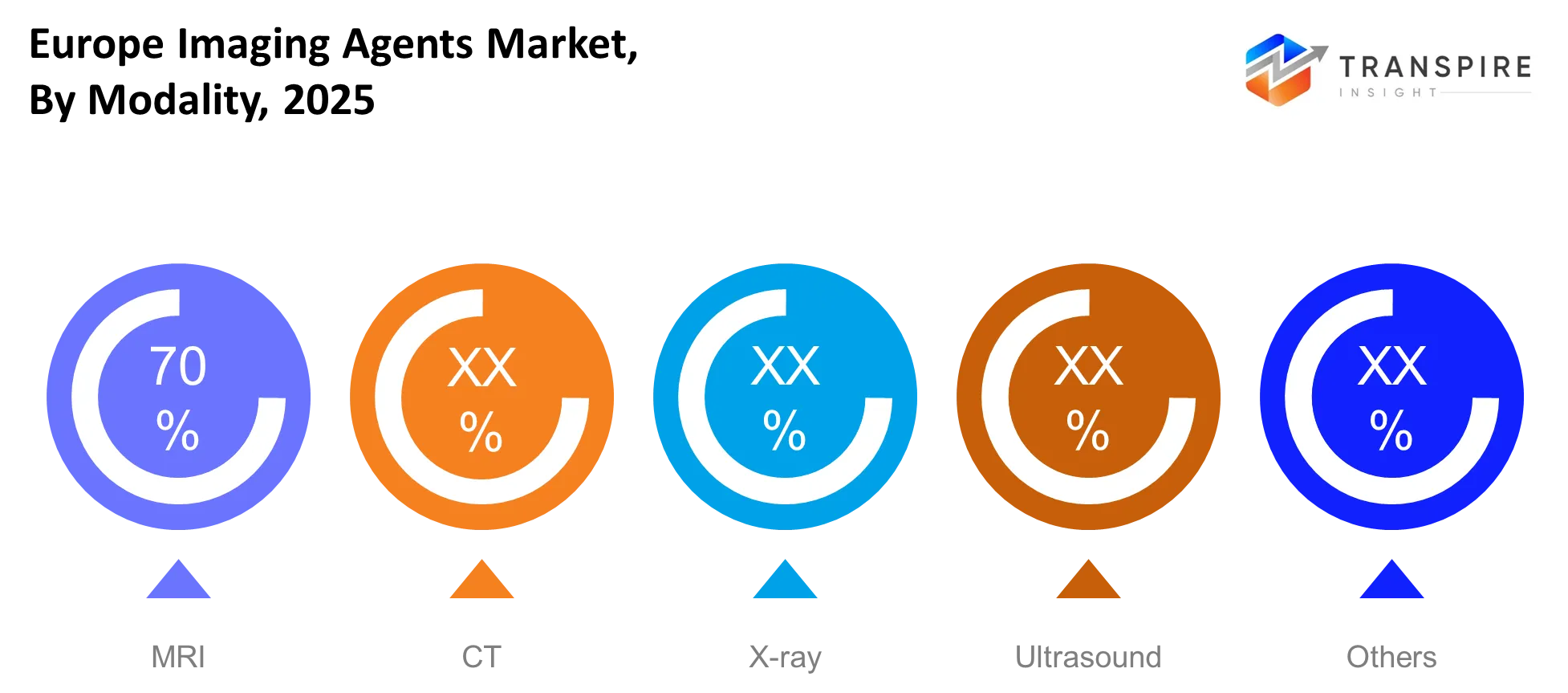
To learn more about this report, Download Free Sample Report
What are the Key Use Cases Driving the Europe Imaging Agents Market?
The primary application of oncology imaging drives the entire European market for imaging agents. Hospitals and cancer centers depend on PET tracers and MRI contrast agents for their needs in tumor detection and staging and therapy monitoring. The implementation of precision oncology programs together with biomarker-based treatment planning systems drives increased requirements for medical imaging and permanent imaging system acquisition.
The use of cardiology and neurology services is experiencing consistent growth throughout diagnostic centers and advanced medical facilities. The use of cardiac imaging agents enables healthcare professionals to identify vascular disease at an early stage and develop treatment strategies, while neurological imaging technologies support professionals in diagnosing Alzheimer’s disease and assessing stroke conditions. The expansion of outpatient imaging facilities is driving private diagnostic chains to implement testing services at increased rates.
New possibilities for medical treatment research have emerged through developments in theranostic imaging and AI-driven molecular diagnostic techniques. Research institutes and specialized oncology facilities are testing targeted radiopharmaceuticals that combine imaging and therapy in a single workflow. Hybrid PET/MRI systems together with digital imaging analytics platforms present strong potential to develop personalized medicine programs throughout Europe.
|
Report Metrics |
Details |
|
Market size value in 2025 |
USD 10.79 Billion |
|
Market size value in 2026 |
USD 11.354 Billion |
|
Revenue forecast in 2033 |
USD 16.299 Billion |
|
Growth rate |
CAGR of 5.30% from 2026 to 2033 |
|
Base year |
2025 |
|
Historical data |
2021 - 2024 |
|
Forecast period |
2026 - 2033 |
|
Report coverage |
Revenue forecast, competitive landscape, growth factors, and trends |
|
Regional scope |
Europe (Germany, United Kingdom, France, Italy, Spain and Rest of Europe) |
|
Key company profiled |
Bayer, GE Healthcare, Bracco Imaging, Guerbet, Lantheus, Siemens Healthineers, Philips, Fujifilm, Novartis, Roche, Merck, Eli Lilly, Jubilant Pharma, Curium, NanoScan Imaging |
|
Customization scope |
Free report customization (country, regional & segment scope). Avail customized purchase options to meet your exact research needs. |
|
Report Segmentation |
By Type (Contrast Agents, Nuclear Imaging Agents, Optical Imaging Agents, Ultrasound Agents, Others), By Application (Oncology, Cardiology, Neurology, Gastroenterology, Others), By End-User (Hospitals, Diagnostic Centers, Research Institutes, Others), By Modality (MRI, CT, X-ray, Ultrasound, Others) |
Which Regions are Driving the Europe Imaging Agents Market Growth?
Western Europe maintains its position as the primary regional market because its advanced healthcare facilities and effective reimbursement systems and its high volume diagnostic imaging operations enable medical facilities to use imaging agents at a higher rate. The German and French and United Kingdom healthcare systems operate extensive networks of oncology centers and nuclear medicine facilities and university hospitals which provide PET/CT and MRI services. The existence of strict regulatory controls has driven healthcare facilities to start using safer contrast materials and high-value molecular imaging products at an earlier stage. The current pharmaceutical manufacturing ecosystem together with radiopharmaceutical distribution networks and imaging equipment manufacturing activities establishes permanent regional market dominance through ongoing procurement contracts and research partnerships.
Northern Europe stands as the second biggest contributor to overall healthcare funding because its healthcare system development needs operational efficiency and digital diagnostic solutions and complete patient data integration. The Swedish and Danish governments maintain their commitment to AI-based imaging technology and cloud diagnostic solutions through continuous financial support for these fields. Public healthcare funding remains stable while regulatory systems develop structured processes which lead to consistent purchasing patterns for medical imaging products and hybrid imaging technologies. The region shows high demand for recurring imaging services because people use preventive diagnostics and neurological imaging programs despite having a smaller population size.
The healthcare sector in Central and Eastern Europe experiences its most rapid development because it adopts advanced diagnostic imaging technologies together with ongoing healthcare system upgrades.
Who are the Key Players in the Europe Imaging Agents Market and How Do They Compete?
The Europe Imaging Agents Market shows moderate consolidation because international imaging companies and pharmaceutical firms control most advanced diagnostic imaging supply networks. The competition now focuses on developing molecular imaging technologies and building radiopharmaceutical production facilities and meeting regulatory requirements and creating AI-based imaging solutions. Established suppliers maintain their market dominance by using their hospital contracts and isotope distribution systems and proprietary imaging products. Specialized radiopharmaceutical developers and biotechnology companies focus on developing precise diagnostic solutions for oncology and neurology imaging markets through their theranostic technology development.
GE HealthCare establishes its market position through comprehensive imaging systems which link multiple imaging agents and diagnostic scanners and AI workflow software into one medical platform. This approach increases customer loyalty from major European hospital organizations which want to enhance their operational performance through centralized imaging systems. Bayer AG dedicates most of its resources to developing new contrast agents and enhancing product safety through regulatory requirements for MRI systems.
Bayer uses its strong manufacturing base in Europe and its extensive relationships with hospitals to achieve constant supply during times when radiopharmaceutical shipments are disrupted. Bracco Imaging uses its unique imaging solutions and its strong relationships with radiology networks to compete in Southern and Western European markets. The company pursues growth through research partnerships that focus on precision oncology imaging and contrast-enhanced ultrasound development.
Company List
- Bayer
- GE Healthcare
- Bracco Imaging
- Guerbet
- Lantheus
- Siemens Healthineers
- Philips
- Fujifilm
- Novartis
- Roche
- Merck
- Eli Lilly
- Jubilant Pharma
- Curium
- NanoScan Imaging
Recent Development News
In March 2026, Bracco launches an AI-powered MRI imaging agent solution in EU: Bracco Imaging expanded its European imaging portfolio with the launch of AiMIFY®, an AI-driven MRI contrast enhancement software. The solution improves brain lesion detection using gadolinium-based imaging workflows. The company also announced new AI partnerships to strengthen its diagnostic imaging pipeline in Europe.
Source: https://www.bracco.com
In March 2026, Bayer presents Phase III results for next-gen low-dose MRI contrast agent: At ECR 2026 in Vienna, Bayer presented new clinical data for its investigational MRI contrast agent gadoquatrane, showing strong diagnostic performance while significantly reducing gadolinium dose exposure. The development reinforces Bayer’s shift toward safer, low-dose imaging agents.
Source: https://dieurope.com
What Strategic Insights Define the Future of the Europe Imaging Agents Market?
The Europe Imaging Agents Market is undergoing a fundamental change that leads to the development of precision-guided diagnostic systems which will use imaging agents to help doctors choose treatments and track their effectiveness instead of using such agents as independent diagnostic tools. European healthcare systems are experiencing this transformation because biomarker-driven oncology and neurology care pathways continue to gain rapid momentum throughout their medical facilities. Suppliers who possess the ability to merge molecular imaging with AI-powered diagnostic tools and radiopharmaceuticals manufacturing capabilities will gain market advantages throughout the next 5 to 7 years.
The existing situation presents a hidden danger because European countries depend on a small number of reactors for their isotope supply and their production of radiopharmaceuticals. The hospital imaging process will experience disruptions for an extended period because of isotope shortages which will result in increased costs and delays in product availability.
The theranostic imaging platforms present a significant emerging chance in Central and Eastern Europe because governments in the region are modernizing their oncology facilities and private companies are investing in diagnostic technologies. Market participants should establish manufacturing relationships with regional partners while developing systems for local isotope distribution to establish protection against supply risks and meet future needs in precision medicine.
Europe Imaging Agents Market Report Segmentation
By Type
- Contrast Agents
- Nuclear Imaging Agents
- Optical Imaging Agents
- Ultrasound Agents
- Others
By Application
- Oncology
- Cardiology
- Neurology
- Gastroenterology
- Others
By End-User
- Hospitals
- Diagnostic Centers
- Research Institutes
- Others
By Modality
- MRI
- CT
- X-ray
- Ultrasound
- Others
Frequently Asked Questions
Find quick answers to common questions.
The Approximate Europe Imaging Agents Market size for the Market will be USD 16.299 Billion in 2033.
The key Segments of the Europe Imaging Agents Market are By Type (Contrast Agents, Nuclear Imaging Agents, Optical Imaging Agents, Ultrasound Agents, Others), By Application (Oncology, Cardiology, Neurology, Gastroenterology, Others), By End-User (Hospitals, Diagnostic Centers, Research Institutes, Others), By Modality (MRI, CT, X-ray, Ultrasound, Others).
Major Players in the Europe Imaging Agents Market are Bayer, GE Healthcare, Bracco Imaging, Guerbet, Lantheus, Siemens Healthineers, Philips, Fujifilm, Novartis, Roche, Merck, Eli Lilly, Jubilant Pharma, Curium, NanoScan Imaging.
The Current Market size of the Europe Imaging Agents Market is USD 10.79 Billion in 2025.
The Europe Imaging Agents Market CAGR is 5.30%.
- Bayer
- GE Healthcare
- Bracco Imaging
- Guerbet
- Lantheus
- Siemens Healthineers
- Philips
- Fujifilm
- Novartis
- Roche
- Merck
- Eli Lilly
- Jubilant Pharma
- Curium
- NanoScan Imaging
Recently Published Reports
-
Apr 2026
Biosimilars Market
Biosimilars Market By Product Type (Monoclonal Antibodies, Recombinant Hormones, Erythropoietin, G-CSF, Others), By Indication (Oncology, Autoimmune Diseases, Blood Disorders, Diabetes, Others), By Manufacturing Type (In-House Manufacturing, Contract Manufacturing), By Distribution Channel (Hospital Pharmacies, Retail Pharmacies, Online Pharmacies), By Industry Analysis, Size, Share, Growth, Trends, and Forecasts 2021-2033
-
Apr 2026
Gastrointestinal Endoscopy Market
Gastrointestinal Endoscopy Market By Type (Rigid Gastrointestinal Endoscope, Flexible Gastrointestinal Endoscopes, Disposable Gastrointestinal Endoscope), By Procedure Type (Colonoscopy, Gastroscopy, Duodenoscopy, Enteroscopy, Flexible Sigmoidoscopy, Others), By Application (Diagnosis, Treatment), By End-Users (Hospitals, Ambulatory Surgical Centers, Specialty Clinics, Laboratories, Others), By Industry Analysis, Size, Share, Growth, Trends, and Forecasts 2021-2033
-
Apr 2026
Rare Inherited Metabolic Disorder Drug Market
Rare Inherited Metabolic Disorder Drug Market By Drug Class (Enzyme Replacement Drugs, Gene Therapy Drugs, Substrate Reduction Drugs, Small Module Drugs, Protein Drugs), By Route of Administration(Parenteral, Oral, Intrathecal), By Clinical Development (Marketed Drugs, Late Stage Clinical Phase III, Early Stage Clinical Phase I-II, Preclinical Candidates), By Indication (Lysosomal Storage Disorders, Urea Cycle Disorders, Amino Acid Metabolic Disorders, organic Acidemias, Peroximal Disorders), By Industry Analysis, Size, Share, Growth, Trends, and Forecasts 2021-2033
-
Jan 2026
Pharmaceutical Cleanroom Technology Market
Pharmaceutical Cleanroom Technology Market By Product (Equipment, Consumables, Services); By Cleanroom Type (Standard Cleanrooms, Modular Cleanrooms); By End Use (Pharmaceutical Companies, Biotechnology Companies), By Industry Analysis, Size, Share, Growth, Trends, and Forecasts 2021-2033