
Europe Exoskeleton Market Size & Forecast:
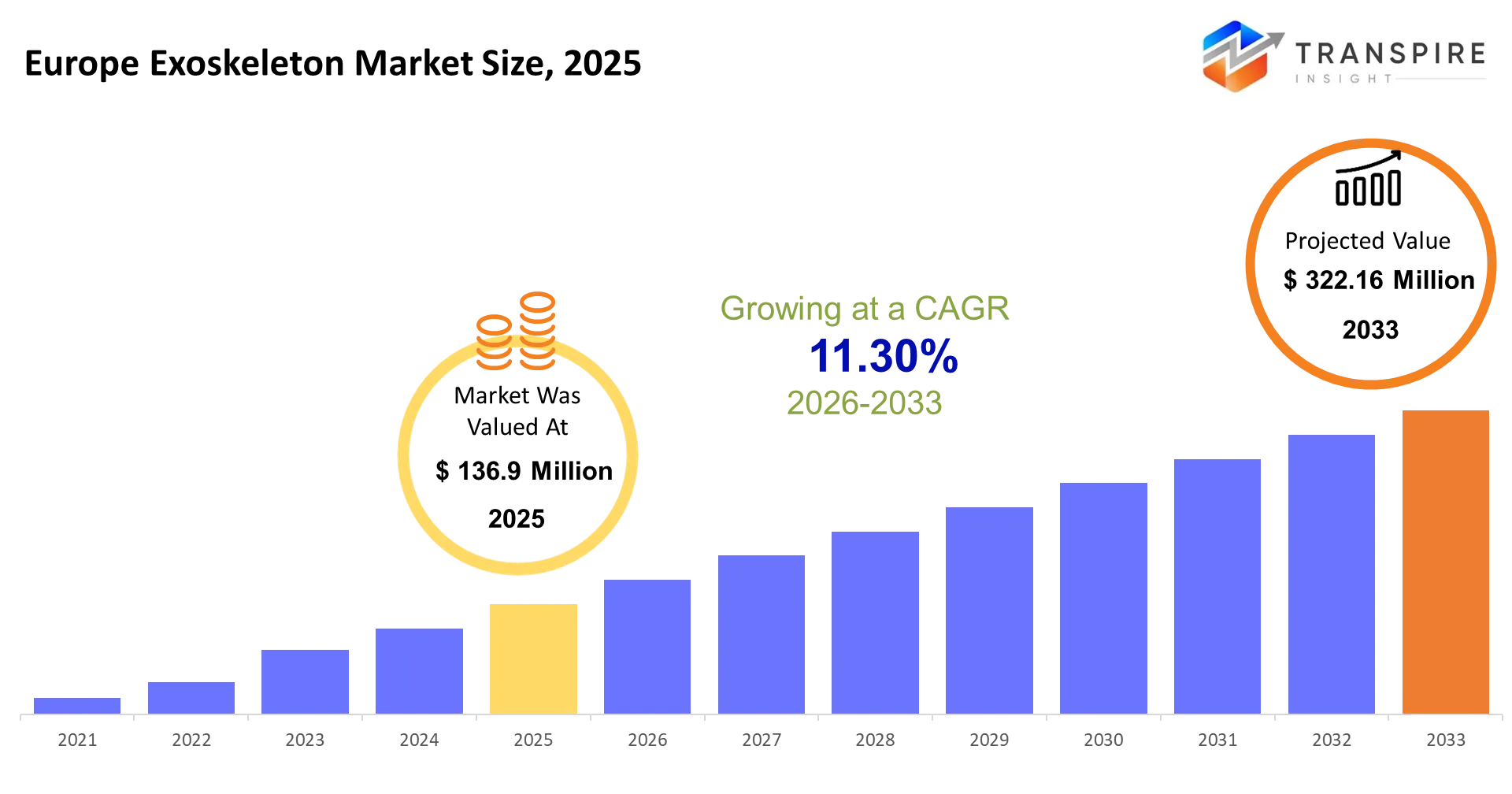
- Europe Exoskeleton Market Size 2025: USD 136.9 Million
- Europe Exoskeleton Market Size 2033: USD 322.16 Million
- Europe Exoskeleton Market CAGR: 11.30%
- Europe Exoskeleton Market Segments: By Type (Powered Exoskeletons, Passive Exoskeletons, Soft Exosuits, Others); By Application (Healthcare Rehabilitation, Industrial Support, Military, Others); By End-User (Hospitals, Industrial Workers, Defense, Research Institutes, Others); By Mobility (Lower Body, Upper Body, Full Body, Others)
To learn more about this report,  Download Free Sample Report
Europe Exoskeleton Market Summary
The Europe Exoskeleton Market was valued at USD 136.9 Million in 2025. It is forecast to reach USD 322.16 Million by 2033. That is a CAGR of 11.30% over the period.
The European exoskeleton market concentrates on industrial existing factories logistic centers and rehabilitation facilities which employ wearable robotic technologies to enhance human mobility while protecting workers from physical stress and helping patients recover their ability to move after suffering from injuries or neurological disorders. The sector has advanced beyond its initial clinical testing and pilot program stage to establish operational commercial systems which now function as essential components of workplace safety and rehabilitation programs because of enhanced powered and sensor technology solutions. Post-pandemic labor shortages which European Union countries face because of their aging workforce combined with the EU regulations which impose stricter safety rules on workplaces have created the need for employers and healthcare organizations to implement measures that decrease musculoskeletal injuries and permanent disability expenses. Organizations now recognize exoskeletons as essential cost-saving systems which enhance productivity while decreasing recovery periods and absenteeism rates in industrial environments and clinical facilities.
Key Market Insights
- Western Europe leads the Europe Exoskeleton Market because it controls 55% of the market share in 2025 which results from Germany and France leading industrial automation.
- Germany leads all countries because its manufacturing sector and workplace safety laws create the strongest national economic output.
- Eastern Europe will experience its highest growth rate during the period from 2026 until 2030 because of increased industrial modernization spending and European Union funding initiatives.
- The Europe Exoskeleton Market receives its main market share from passive exoskeletons which currently achieve a 45% market share because they provide cost-effective solutions that businesses can implement without difficulty.
- The second-largest market share belongs to powered exoskeletons which medical facilities and manufacturing businesses commonly use for both rehabilitation treatment and heavy-duty industrial purposes.
- The soft exosuit segment will experience the highest growth rate until 2030 because of two factors which include ergonomic technology advancements and the increased demand for lightweight wearable products.
- Industrial applications control approximately 40% market share with manufacturing and logistics operations and automotive assembly activities as the primary sectors.
- Healthcare and rehabilitation services experienced the fastest growth because there are more stroke recovery programs and mobility disorder treatment options now available.
- The manufacturing sector controls approximately 38% of the Europe Exoskeleton Market because companies need exoskeletons to protect workers from repetitive strain injuries.
- Healthcare providers represent the fastest-growing end-user category, driven by rehabilitation robotics adoption and aging population trends.
What are the Key Drivers, Restraints, and Opportunities in the Europe Exoskeleton Market?
Three main elements determine how quickly the Europe Exoskeleton Market grows in both industrial and healthcare environments.The primary driver is the region's aging workforce which faces EU occupational safety regulations that protect against musculoskeletal disorders. Manufacturing and automotive and logistics employers now use wearable robotics to decrease both worker injuries and associated expenses for their businesses. The combination of regulatory requirements and better actuator performance and cheaper unit prices has made exoskeletons into essential workplace equipment which results in higher purchase rates and ongoing service income.
European healthcare systems in multiple countries face two major challenges which include high initial expenses and insufficient reimbursement options. Hospitals and SMEs encounter budget limitations which make it difficult to implement rehabilitation benefits that doctors have proven effective. The structural financing gap prevents organizations from expanding their operations while it limits their ability to generate immediate revenue especially in Southern and Eastern Europe where government spending needs approval.
The primary opportunity exists through establishing connections between AI-based motion analysis systems and lightweight soft exosuits. The company Wandercraft develops adaptive gait systems which provide personalized real-time support to users in various environments. The EU Industrial Automation program supports funding in Germany and France which enables organizations to move from pilot testing to full operation. This development brings the Europe Exoskeleton Market closer to reaching its full market potential through expansion into factories and rehabilitation facilities.
What Has the Impact of Artificial Intelligence Been on the Europe Exoskeleton Market?
The Europe Exoskeleton Market experiences transformation through artificial intelligence and advanced digital technologies which enable wearable robotic systems to function as adaptive data-driven assistance platforms instead of fixed mechanical devices. AI-enabled control systems now use real-time sensor data from muscle activation and gait patterns to continuously adjust torque and posture alignment and movement assistance systems in industrial and healthcare settings.
Machine learning provides predictive capabilities for exoskeleton platforms which use this technology to predict device fatigue and joint stress and component wear. The system enables predictive maintenance to be scheduled which decreases unplanned downtime while increasing equipment lifespan through its use in high-demand manufacturing sites that need to maintain continuous operations for their production process. The algorithm-based motion tracking system used in rehabilitation allows therapists to create customized treatment plans which result in better patient outcomes and decreased need for clinician time.
The systems provide measurable operational benefits through their capacity to decrease industrial musculoskeletal strain by 20 to 30 percent during testing which enables logistics personnel to work longer without fatigue thus increasing their production output per shift. The high costs involved with AI module integration and the unavailability of standard biomechanical training datasets create problems because they prevent accurate model development for different body types and work environments. European countries show strong interest in automation-driven exoskeleton optimization but this process faces delays because of obstacles which hinder large-scale implementation.
Key Market Trends
- Industrial buyers shifted from trial-based exoskeleton use in 2020 to full shift-level deployment across automotive and logistics operations by 2025.
- The European Union strengthened its workplace safety enforcement after 2022 which led manufacturers to adopt robotic systems that assist workers with lifting duties instead of manual labor.
- The adoption of passive exoskeletons grew from its initial niche use to achieve a 45 percent market share because small and medium enterprises chose budget-friendly solutions to prevent workplace injuries.
- The use of powered exoskeletons extended beyond rehabilitation purposes to industrial applications which became popular in heavy assembly line work since the 2023 technological breakthroughs.
- Healthcare providers expanded robotic rehabilitation programs after post-pandemic demand spikes increased stroke recovery and mobility disorder treatment cases across Europe.
- AI-based motion control systems evolved from experimental prototypes in 2021 to embedded standard features in advanced exoskeleton models by 2025.
- European manufacturers used supply chain localization efforts to decrease their dependence on imported robotic components which became necessary after disruptions occurred in 2022.
- Military applications became organized through EU-funded pilot programs which tested soldier endurance and load-bearing enhancement systems after military operations completed their experimental phase.
- The companies of Ekso Bionics established clinical partnerships with European hospitals to create faster reimbursement approval processes which would help them enter the market.
Europe Exoskeleton Market Segmentation
By Type:
The European Exoskeleton Market shows strong support for powered exoskeletons which fulfill rehabilitation needs and industrial work requirements. The system provides accurate movement control through its advanced motorized technology which medical and industrial users utilize for their operational needs. The main reason small and mid-sized industrial users choose to use passive exoskeletons is because they cost less and require less effort to implement specifically for their workplace programs which aim to reduce employee injuries.
Soft exosuits are gaining traction as material science improvements reduce weight while maintaining ergonomic support. This segment benefits from growing demand for wearable comfort in long-duration use cases. People now prefer to use flexible designs which provide less disturbance when they work instead of using inflexible designs.
The forecast period will show growing powered system usage in clinical settings while soft exosuits become more common in industrial applications. The development process will depend on hybrid design systems which need to combine movement flexibility with artificial intelligence control operations. The development team will create solutions which need less work to implement while maintaining their lightweight characteristics.
By Application:
European exoskeletons market shows healthcare rehabilitation as the most important application because of increasing stroke and neurological disorder cases which need mobility help. Hospitals adopt robotic-assisted therapy systems because they enable therapists to work less while helping patients recover more effectively. The industrial support applications sector shows strong growth because companies want to decrease worker injuries which occur during repetitive lifting tasks.
The EU defense modernization programs which focus on developing soldier endurance through load-bearing improvements support military applications which maintain important strategic value despite their lesser operational size. The process of adoption proceeds at a slow pace because testing requirements and procurement cycles impose strict restrictions. The research field together with niche mobility assistance applications develops multiple innovative solutions.
The industry sector together with rehabilitation will experience growth during future years because reimbursement systems will become better and workplace safety rules will become more stringent. Exoskeleton technology developers will create custom solutions for specific tasks while investors will support healthcare systems that can expand to multiple locations.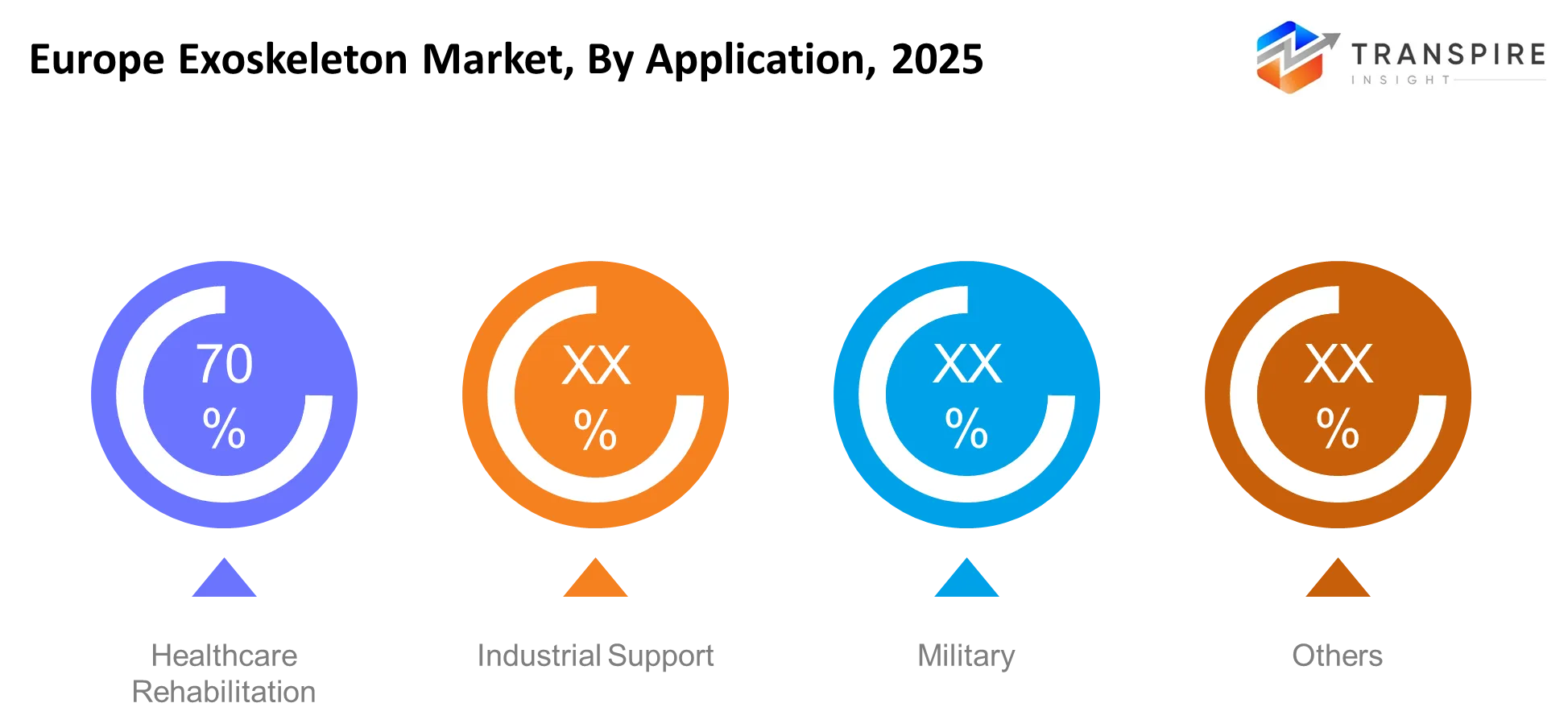
To learn more about this report, Download Free Sample Report
By End-User:
Industrial workers represent the largest end-user group in the Europe Exoskeleton Market due to widespread deployment in manufacturing and logistics sectors. Regulatory requirements which mandate organizations to decrease musculoskeletal injuries drive operational productivity improvements through their adoption. Hospitals represent the second major user group which utilizes exoskeletons to develop structured rehabilitation programs and support post-surgical recovery processes.
Defense organizations maintain a steady demand for exoskeleton systems which they use to test pilot programs and develop specialized mobility systems. Research institutes maintain a vital position in early-stage innovation development although their research work does not generate substantial commercial output. Organizations that use mobility assistance solutions between different market segments have not yet established themselves as operational entities.
The industrial and healthcare sectors will drive future expansion because they achieve cost efficiency through increased clinical validation. Equipment manufacturers will choose to develop modular systems which customers can use in various operational settings because those systems provide better capacity to grow and buy assets.
By Mobility:
The Europe Exoskeleton Market shows strong demand for lower-body exoskeletons which provide support during walking and rehabilitation therapy and industrial work that requires load-bearing. These systems provide essential support to people with mobility disabilities who need to walk or stand for extended periods while doing their jobs.Upper-body exoskeletons share a moderate market presence because they support industrial workers who need to perform overhead tasks while protecting their shoulders from injuries.
Organizations continue to use full-body exoskeletons because they cost too much and provide limited movement options which restrict their use to particular defense and industrial sectors. Research institutions currently test most mobility configurations which exist as experimental systems that have not yet reached full operational status.
Industries will prefer to use lower-body and modular hybrid systems because they want to improve ergonomic performance while healthcare providers need solutions that can grow with their rehabilitation programs. The developers aim to enhance user comfort by creating lighter products which support AI-based movement adjustments to boost operational efficiency.
What are the Key Use Cases Driving the Europe Exoskeleton Market?
European exoskeletons develop their primary market through the application of industrial ergonomics together with injury prevention methods in manufacturing and logistics operations. Companies deploy wearable robotic systems to reduce musculoskeletal strain during repetitive lifting, overhead assembly, and prolonged standing tasks. Industrial sites experience continuous demand for this application because strict EU workplace safety regulations together with increasing occupational injury compensation costs create the most reliable requirement for industrial sites.
The hospital rehabilitation system together with post-surgical recovery centers establish an increasing capacity to treat stroke patients who need rehabilitation services. Healthcare providers use robotic-assisted therapy to improve mobility outcomes and reduce physiotherapist workload. Exoskeletons now receive increasing adoption from logistics warehouses because they help workers maintain their stamina during peak order processing periods.
The military develops new systems to assist soldiers who need to carry heavy loads while military operations. The two use cases which currently exist as test projects or initial deployment phases demonstrate strong market potential because lightweight AI-based designs make their usage easier and decrease their cost for all applications outside industrial environments.
|
Report Metrics |
Details |
|
Market size value in 2025 |
USD 136.9 Million |
|
Market size value in 2026 |
USD 152.23 Million |
|
Revenue forecast in 2033 |
USD 322.16 Million |
|
Growth rate |
CAGR of 11.30% from 2026 to 2033 |
|
Base year |
2025 |
|
Historical data |
2021 - 2024 |
|
Forecast period |
2026 - 2033 |
|
Report coverage |
Revenue forecast, competitive landscape, growth factors, and trends |
|
Regional scope |
Europe (Germany, United Kingdom, France, Italy, Spain, Rest of Europe) |
|
Key company profiled |
Ekso Bionics, ReWalk Robotics, CYBERDYNE, Ottobock, Sarcos Robotics, Lockheed Martin, Bionik Laboratories, SuitX, Rex Bionics, Hyundai Robotics, Panasonic, Honda, Wandercraft, Gogoa Mobility, Fourier Intelligence |
|
Customization scope |
Free report customization (country, regional & segment scope). Avail customized purchase options to meet your exact research needs. |
|
Report Segmentation |
By Type (Powered Exoskeletons, Passive Exoskeletons, Soft Exosuits, Others); By Application (Healthcare Rehabilitation, Industrial Support, Military, Others); By End-User (Hospitals, Industrial Workers, Defense, Research Institutes, Others); By Mobility (Lower Body, Upper Body, Full Body, Others) |
Which Regions are Driving the Europe Exoskeleton Market Growth?
The Europe Exoskeleton Market finds its leading position in Western Europe because of its developed industrial sector and its effective enforcement of workplace safety regulations. The operational requirements of Germany and France depend on their manufacturing capabilities which include their automotive industry and their logistics automation systems. The European Union has established strict regulations that require employers to prevent musculoskeletal injuries through the mandatory use of robotics-based wearable systems which serve as compliance requirements. The established network of robotics developers and rehabilitation facilities and industrial automation companies creates an environment which supports initial technology adoption and business growth. Companies seek to implement assisted mobility systems which enable fast replacement of physically demanding work because of their expensive labor expenses.
The Nordic countries of Northern Europe establish a continuous demand pattern which demonstrates strength throughout all economic periods because these countries maintain established workplace safety practices and provide complete healthcare services to their citizens. The public sector maintains consistent operations throughout this area which exists in contrast to Western Europe because it serves both rehabilitation hospitals and elderly care facilities. Sweden, Denmark, and the Netherlands show stable procurement patterns supported by long-term healthcare funding and structured innovation programs. The shipbuilding and offshore sectors create a narrow market for ergonomic injury prevention solutions which ensures steady income streams that continue during periods of slow business growth.
The European Union supports industrial modernization and manufacturing reshoring initiatives which position Eastern Europe as its fastest-growing region. The Czech Republic and Poland are expanding their investments in automated production systems and worker safety solutions to achieve Western European standards.The increase in foreign direct investment which occurred after 2023 resulted from supply chain diversification efforts which enabled faster technology transfer to industrial facilities. The quick implementation of this system establishes a major opportunity for manufacturers who want to enter markets which require low pricing, establishing Eastern Europe as their primary market for expansion from 2026 to 2033.
Who are the Key Players in the Europe Exoskeleton Market and How Do They Compete?
The Europe Exoskeleton Market exhibits moderate market fragmentation because medical robotics companies and industrial automation manufacturers and new wearable technology startups compete through their technological capabilities instead of their pricing strategies. Hospitals and factories use AI-powered motion control systems combined with clinical validation methods and workplace ergonomics standards to achieve wider customer acceptance. New companies in the market introduce advanced lightweight soft exosuits which enable quick implementation procedures that simplify both training and installation processes.
Ottobock develops clinical-grade rehabilitation systems which hospital networks use to access its orthopedic knowledge and reimbursement systems established in Germany and France. The company uses its certified medical exoskeletons together with its extended service contracts to create a competitive edge. Ekso Bionics uses its ergonomic strain reduction data to develop manufacturing deployments through its industrial and rehabilitation product applications. Ekso Bionics develops its business through safety partnerships with European factories. ReWalk Robotics develops solutions for stroke and spinal injury patients who need lower-body mobility. The company achieves scaling through its partnership with clinics throughout Europe.
Cyberdyne Inc developed HAL exoskeletons which use bioelectric signals to convert muscle intent into assisted motion. The product creates strong differentiation in neurorehabilitation environments. Cyberdyne Inc expands its business through European hospitals which use pilot programs to test its validation methods. Wandercraft develops Atalante self-balancing exoskeletons which enable users to walk without crutches through their autonomous gait stabilization system. Wandercraft expands its user base through rehabilitation trials which take place in both France and European healthcare systems.
Company List
- Ekso Bionics
- ReWalk Robotics
- CYBERDYNE
- Ottobock
- Sarcos Robotics
- Lockheed Martin
- Bionik Laboratories
- SuitX
- Rex Bionics
- Hyundai Robotics
- Panasonic
- Honda
- Wandercraft
- Gogoa Mobility
- Fourier Intelligence
Recent Development News
“In 2025, Ottobock expanded its European exoskeleton footprint by integrating SuitX technologies and scaling industrial wearable robotics across automotive and logistics applications. The move strengthened its position in rehabilitation and workplace support systems by combining orthopedic expertise with sensor-based gait assistance.https://en.wikipedia.org/wiki/Ottobock (Wikipedia).”
“In January 2026, Wandercraft advanced AI-driven self-balancing exoskeleton deployment through expanded clinical partnerships across European hospitals. The development improved rehabilitation access for spinal injury patients and accelerated reimbursement-backed adoption in France and other EU healthcare systems.https://nypost.com/2025/07/31/business/wandercraft-collaborates-with-nvidia-aws-to-build-ai-exoskeleton-for-wheelchair-uses/ (New York Post).”
What Strategic Insights Define the Future of the Europe Exoskeleton Market?
The Europe Exoskeleton Market is structurally moving toward software-defined wearable robotics where AI-driven motion control and biomechanical data integration become more valuable than hardware alone. Demand will increasingly shift from isolated industrial deployments to ecosystem-based adoption across manufacturing, healthcare, and assisted mobility, driven by labor shortages and stricter safety compliance across EU workplaces. Over the next 5–7 years, scalability will depend on interoperability with digital health and industrial automation platforms rather than standalone device performance.
A less visible risk lies in overdependence on reimbursement-driven healthcare adoption. If European cost-containment policies tighten or reimbursement codes for robotic rehabilitation are delayed, clinical adoption could slow despite strong technological readiness, creating revenue volatility for manufacturers heavily exposed to hospitals. This risk is compounded by long certification cycles that delay commercialization timelines.
A growing opportunity is the integration of exoskeletons into predictive workforce analytics systems in large-scale logistics hubs across Germany and the Netherlands. This shift enables real-time injury prevention and productivity optimization rather than reactive support. Market participants should prioritize modular, AI-compatible platforms and secure early partnerships with industrial automation leaders to lock in long-term enterprise contracts before standardization consolidates vendor competition.
Europe Exoskeleton Market Report Segmentation
By Type
- Powered Exoskeletons
- Passive Exoskeletons
- Soft Exosuits
- Others
By Application
- Healthcare Rehabilitation
- Industrial Support
- Military
- Others
By End-User
- Hospitals
- Industrial Workers
- Defense
- Research Institutes
- Others
By Mobility
- Lower Body
- Upper Body
- Full Body
- Others
Frequently Asked Questions
Find quick answers to common questions.
The Europe Exoskeleton Market size is USD 322.16 Million in 2033.
Key Segments for the Europe Exoskeleton Market are By Type (Powered Exoskeletons, Passive Exoskeletons, Soft Exosuits, Others); By Application (Healthcare Rehabilitation, Industrial Support, Military, Others); By End-User (Hospitals, Industrial Workers, Defense, Research Institutes, Others); By Mobility (Lower Body, Upper Body, Full Body, Others).
Major Europe Exoskeleton Market players are Ekso Bionics, ReWalk Robotics, CYBERDYNE, Ottobock, Sarcos Robotics, Lockheed Martin, Bionik Laboratories, SuitX, Rex Bionics, Hyundai Robotics, Panasonic, Honda, Wandercraft, Gogoa Mobility, Fourier Intelligence.
The Europe Exoskeleton Market size is USD 136.9 Million in 2025.
The Europe Exoskeleton Market CAGR is 11.30% from 2026 to 2033.
- Ekso Bionics
- ReWalk Robotics
- CYBERDYNE
- Ottobock
- Sarcos Robotics
- Lockheed Martin
- Bionik Laboratories
- SuitX
- Rex Bionics
- Hyundai Robotics
- Panasonic
- Honda
- Wandercraft
- Gogoa Mobility
- Fourier Intelligence
Recently Published Reports
-
Apr 2026
Biosimilars Market
Biosimilars Market By Product Type (Monoclonal Antibodies, Recombinant Hormones, Erythropoietin, G-CSF, Others), By Indication (Oncology, Autoimmune Diseases, Blood Disorders, Diabetes, Others), By Manufacturing Type (In-House Manufacturing, Contract Manufacturing), By Distribution Channel (Hospital Pharmacies, Retail Pharmacies, Online Pharmacies), By Industry Analysis, Size, Share, Growth, Trends, and Forecasts 2021-2033
-
Apr 2026
Gastrointestinal Endoscopy Market
Gastrointestinal Endoscopy Market By Type (Rigid Gastrointestinal Endoscope, Flexible Gastrointestinal Endoscopes, Disposable Gastrointestinal Endoscope), By Procedure Type (Colonoscopy, Gastroscopy, Duodenoscopy, Enteroscopy, Flexible Sigmoidoscopy, Others), By Application (Diagnosis, Treatment), By End-Users (Hospitals, Ambulatory Surgical Centers, Specialty Clinics, Laboratories, Others), By Industry Analysis, Size, Share, Growth, Trends, and Forecasts 2021-2033
-
Apr 2026
Rare Inherited Metabolic Disorder Drug Market
Rare Inherited Metabolic Disorder Drug Market By Drug Class (Enzyme Replacement Drugs, Gene Therapy Drugs, Substrate Reduction Drugs, Small Module Drugs, Protein Drugs), By Route of Administration(Parenteral, Oral, Intrathecal), By Clinical Development (Marketed Drugs, Late Stage Clinical Phase III, Early Stage Clinical Phase I-II, Preclinical Candidates), By Indication (Lysosomal Storage Disorders, Urea Cycle Disorders, Amino Acid Metabolic Disorders, organic Acidemias, Peroximal Disorders), By Industry Analysis, Size, Share, Growth, Trends, and Forecasts 2021-2033
-
Jan 2026
Pharmaceutical Cleanroom Technology Market
Pharmaceutical Cleanroom Technology Market By Product (Equipment, Consumables, Services); By Cleanroom Type (Standard Cleanrooms, Modular Cleanrooms); By End Use (Pharmaceutical Companies, Biotechnology Companies), By Industry Analysis, Size, Share, Growth, Trends, and Forecasts 2021-2033