
Europe Military Thermal Imaging Market Size & Forecast:
- Europe Military Thermal Imaging Market Size 2025: USD 1457.5 Million
- Europe Military Thermal Imaging Market Size 2033: USD 2635.4 Million
- Europe Military Thermal Imaging Market CAGR: 7.69%
- Europe Military Thermal Imaging Market Segments: By Type (Cooled Thermal Imaging, Uncooled Thermal Imaging, Handheld Devices, Mounted Systems, Others); By Application (Surveillance, Targeting, Navigation, Search & Rescue, Border Security, Others); By End-User (Defense Forces, Government, Homeland Security, Aerospace Firms, Others); By Technology (Infrared Sensors, LWIR, MWIR, SWIR, Others)
To learn more about this report,  Download Free Sample Report
Europe Military Thermal Imaging Market Summary
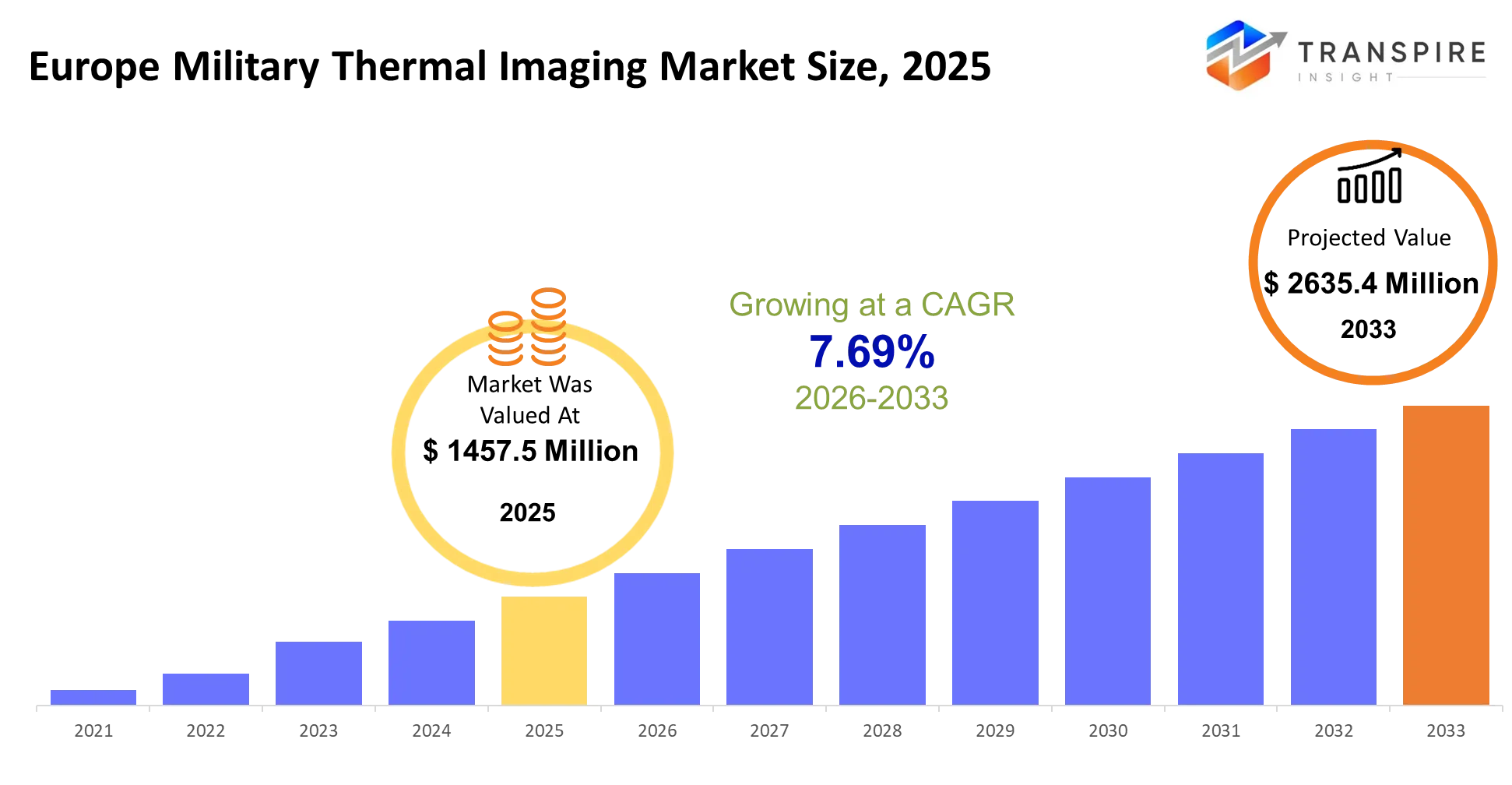
The Europe Military Thermal Imaging Market was valued at USD 1457.5 Million in 2025. It is forecast to reach USD 2635.4 Million by 2033. That is a CAGR of 7.69% over the period.
The Europe Military Thermal Imaging Market provides armed forces with equipment that enables them to detect and track targets while identifying targets during times of low visibility which allows them to operate continuously through night time and foggy conditions and areas with restricted visibility. The systems transform heat signatures into visual data which soldiers and vehicles and unmanned platforms can use for surveillance and targeting and navigation purposes.
The market has undergone a fundamental transformation during the last three to five years because customers now prefer complete integrated systems which connect multiple sensors through their digital command systems instead of using single imaging solutions. The Ukraine-Russia conflict demonstrated how essential it is for operational forces to maintain continuous real-time situation understanding and enable multi-domain operational collaboration. Defense programs now focus on developing thermal imaging systems which software-based thermal imaging solutions that provide platform compatibility across different systems. The transition has resulted in organizations pursuing larger contract agreements which require extended time frames to complete and they focus on developing complete systems instead of making minor hardware enhancements.
Key Market Insights
- Western Europe held the major share of the Europe Military Thermal Imaging Market in 2025, which amounted to 45�cause Germany, France, and the United Kingdom invested in their defense programs.
- The region of Eastern Europe will experience its highest growth rate until 2033 because Poland and NATO-coupled countries in its vicinity are increasing their military capabilities.
- The product segmentation of the market shows that cooled thermal imaging systems lead with a market share of approximately 55�cause they provide better performance for long-range detection and targeting.
- The mounted systems segment holds the second-largest position in the market because armored vehicles and UAV platforms use modern imaging payloads to grow their adoption rate.
- The market will see uncooled and handheld thermal devices become its fastest-growing segment from 2026 onward because infantry forces need affordable equipment for their modern operations.
- The market sees surveillance applications reach a share of more than 40% in 2025 because there is a strong need for continuous monitoring and direct observation of military operations.
- The execution of border security operations together with the use of UAV-based reconnaissance systems has become an important growth trend because of changing international relations and new security challenges.
- Defense forces operate as the primary end-user segment because they hold more than 60% market share which results from their extensive equipment purchasing and upgrading initiatives.
- The group of homeland security agencies has become the fastest-growing user group because they are increasing their spending on technologies that support border monitoring and emergency response operations.
- The main companies in the market, which include HENSOLDT, Thales Group, Leonardo S.p.A., Safran, and Teledyne FLIR, use AI technology and multi-sensor fusion systems and their partnerships to create competitive advantages in their market operations.
What are the Key Drivers, Restraints, and Opportunities in the Europe Military Thermal Imaging Market?
The European Military Thermal Imaging Market reaches its highest growth point because defense spending increased after the Russia-Ukraine conflict which created a demand for network-centric warfare capabilities. European governments need thermal imaging systems which can operate together with their digital command and control networks to achieve their goals of providing real-time situational awareness. The military now requires soldiers and their accompanying systems to acquire complete sensor systems which operate within armored vehicles and unmanned aerial vehicles. The increase in revenue occurs because organizations use their modernization programs to create major changes instead of making small equipment improvements.
The organization faces a major limitation because it needs specialized infrared detectors and semiconductor components which depend on specific supply chains that operate worldwide. The components require advanced manufacturing capabilities along with export restrictions which create obstacles for companies that want to expand their production capacity during times of high demand. The main defense contract delivery periods face delays because the system requires extended development times and additional expenses which create obstacles for smaller European countries that lack sufficient funding. The problem continues because companies need to invest large amounts of money to develop homegrown production capabilities which require extended periods to obtain necessary certifications.
AI-enabled thermal imaging analytics create a major opportunity for autonomous surveillance and drone-based reconnaissance technologies. European defense programs are starting to invest in software layers which improve target recognition capabilities while decreasing operator workload. For instance machine learning integration with thermal sensors enables faster decision-making abilities for unmanned systems in intricate operational settings.The software industry gains new revenue streams through this evolution which specializes in software development and upgrade operations across Eastern European markets that require rapid system implementation.
What Has the Impact of Artificial Intelligence Been on the Europe Military Thermal Imaging Market?
European defense systems now use AI technology to develop thermal imaging equipment which performs automatic detection and tracking and system calibration without needing human evaluation. The AI algorithms process infrared data streams to detect targets and eliminate background interference while determining the most important threats, which helps operators by decreasing their duties and making emergency responses faster. The systems in integrated combat platforms enable better sensor placement and power consumption management, which results in higher operational effectiveness during surveillance operations while decreasing unnecessary workload on the system.
Electro-optical payloads now utilize machine learning models for both predictive maintenance and performance enhancement. The models use temperature variation and sensor deterioration patterns together with operational time data to predict equipment failures, which leads to improved system availability and reduced operational expenses. The programs achieve significant improvements to mission readiness because their predictive maintenance system decreases unexpected system failures while maintaining precise imaging results throughout vital missions.
The digital improvements lead to enhanced target acquisition success rates, better command system interoperability, and faster mission planning processes. The defense industry faces a major obstacle with AI implementation because existing defense systems have difficult requirements for AI system integration. The European fleets operate systems that use different generations of technology, which creates challenges for organizations to integrate new AI imaging capabilities with their current hardware and data standards through expensive validation processes.
Key Market Trends
- The defense programs in Germany and Poland since 2022 have redirected their funding toward integrated thermal imaging systems for armored and unmanned platforms instead of funding independent optical systems.
- The period between 2024 and 2026 saw HENSOLDT and Thales Group increase their funding for multi-sensor fusion technology which now competes in developing software-based battlefield awareness systems.
- The procurement behavior of NATO-aligned countries has changed because they now require interoperability certifications which compel vendors to create standard thermal imaging systems for joint operations.
- The manufacturing industry at Safran has developed vertical production methods since 2025 because infrared detector supply chain problems have disrupted their operations.
- The use of AI technology became more advanced during 2025 and 2026 because thermal imaging systems now include automated target recognition which helps operators finish their tasks quicker during ISR operations.
- The demand for thermal imaging systems has expanded to cover all types of combat vehicles because UAG thermal imaging systems became more common in Eastern Europe after border security needs increased.
- Teledyne FLIR now controls competitive market conditions in Europe through its distribution partnerships which focus on developing imaging systems that can be used in multiple different deployment situations.
- The procurement processes of smaller European nations have faced delays since 2023 due to rising system costs which show how component shortages hinder their ability to implement new technologies.
- The buyers of products in 2026 will focus on product lifecycle performance and upgradeability which leads vendors to offer thermal imaging systems together with extended software and analytics services.
Europe Military Thermal Imaging Market Segmentation
By Type:
Cooled thermal imaging systems hold a strong position in high-end military applications because they can detect targets at extended distances through their advanced sensitivity capabilities. Mounted systems also command significant share as armored vehicles, naval vessels, and UAVs increasingly integrate thermal imaging into core operational platforms. The market for handheld devices and uncooled systems has started to grow because these systems receive support from both infantry modernization programs and cost-sensitive deployments. The distribution of demand shows two distinct market segments which require both high-performance solutions and products that can be used in actual field conditions.
Platform integration and specific mission requirements drive the growth of this market segment. Cooled systems benefit from demand for precision targeting in complex combat environments while uncooled systems and handheld devices gain market share because of their lightweight design and reduced price point. The defense industry requires mounted systems to expand their operations because defense programs need to implement networked sensor suites across multiple platforms. Manufacturers will concentrate on three main objectives during the forecast period to achieve their goals which involve decreasing size weight and power needs while strengthening product durability and system integration capabilities to handle new battlefield demands.
By Application:
The primary usage of thermal imaging technology currently exists in surveillance operations which require continuous observation to monitor activities in terrestrial and aerial and naval operations. The second most important application after surveillance exists in border security and targeting systems which received more funding after countries started to experience greater geopolitical conflicts. The functions of navigation and search and rescue operations maintain their existence as secondary activities which specialize in conducting missions that require their usage during situations of restricted visual contact. The different applications of thermal imaging technology demonstrate its growing capacity to operate in both military and civilian situations.
Each application area develops according to its own distinct factors which create growth patterns. Surveillance demand is reinforced by persistent intelligence gathering requirements, while targeting benefits from advancements in precision engagement systems. Border security applications are expanding rapidly in Eastern Europe due to increased funding for territorial protection. Future growth will center on multi-role systems capable of supporting several applications within a single platform, encouraging developers to design adaptable and software-driven imaging solutions.
By End-User:
The Defense forces function as the biggest end-user group because their need for military equipment drives their ongoing modernization efforts through large procurement programs. Government agencies and homeland security organizations sustain their operations through investments which they make in border control systems and surveillance systems and emergency response systems. Aerospace companies establish their business model through their development of thermal imaging systems for both advanced aircraft and unmanned aerial vehicles. The military sector maintains its primary position in the distribution system which shows increased use of military equipment in adjacent security markets.
The different user groups experience growth because their budget systems and operational needs determine their development requirements. Defense forces drive innovation through high-performance requirements and long-term contracts, while homeland security emphasizes reliability and cost efficiency. The government maintains consistent demand for services which regulatory authorities enforce to protect public safety needs. The dual-use technology development process will benefit from increased defense and civilian agency collaboration which will create vendors with multiple product options and revenue potential.
By Technology:
Infrared sensor technologies dominate the market, with long-wave infrared systems holding the largest share due to effectiveness in diverse environmental conditions. Mid-wave infrared technologies maintain a strong presence in high-resolution targeting and airborne applications, while short-wave infrared occupies niche roles in specialized imaging scenarios. System performance adoption requires operators to match their operational performance needs with their system operational performance needs. The development of new sensor designs enables military forces to fulfill their mission requirements across different platforms.
The segment experiences growth because detection accuracy improvements and image processing enhancements and environmental adaptability advancements. Long-wave systems expand through broad applicability, while mid-wave solutions gain traction in precision-driven operations. The emergence of sensor miniaturization and digital processing system integration investments is transforming the competitive landscape. Future development will focus on hybrid sensor architectures and enhanced spectral capabilities, enabling manufacturers to deliver more versatile and resilient imaging solutions.
What are the Key Use Cases Driving the Europe Military Thermal Imaging Market?
The main purpose of the system establishes battlefield surveillance and target acquisition as its primary function which uses thermal imaging to provide constant visibility during low-light and obstructed visibility conditions. Defense forces use these systems in their armored vehicles and fixed observation posts to achieve operational status through continuous situational awareness. The need to detect movement and identify threats together with supporting precision engagement under all weather conditions creates high demand for this capability.
Border monitoring and unmanned aerial surveillance systems find increasing applications among homeland security agencies and governmental operators. Thermal payloads on UAVs now support persistent perimeter control and rapid-response reconnaissance along sensitive regions in countries such as Poland. Search and rescue missions also increasingly rely on handheld thermal devices to locate individuals in low-visibility terrain.
Autonomous ground systems and AI-assisted reconnaissance platforms currently develop new use cases for their operations. The applications seek to achieve two objectives which include enhancing detection accuracy through machine learning and decreasing human presence in dangerous environments. The current operational scope of such deployments remains restricted yet they demonstrate considerable possibilities because European defense programs currently expand their automation development programs.
|
Report Metrics |
Details |
|
Market size value in 2025 |
USD 1457.5 Million |
|
Market size value in 2026 |
USD 1568.7 Million |
|
Revenue forecast in 2033 |
USD 2635.4 Million |
|
Growth rate |
CAGR of 7.69% from 2026 to 2033 |
|
Base year |
2025 |
|
Historical data |
2021 - 2024 |
|
Forecast period |
2026 - 2033 |
|
Report coverage |
Revenue forecast, competitive landscape, growth factors, and trends |
|
Regional scope |
Europe (Germany, United Kingdom, France, Italy, Spain, Rest of Europe) |
|
Key company profiled |
FLIR Systems, L3Harris, BAE Systems, Thales, Leonardo, Raytheon, Safran, Elbit Systems, Rheinmetall, Hensoldt, Lockheed Martin, Northrop Grumman, Teledyne, Axis Communications, Bosch |
|
Customization scope |
Free report customization (country, regional & segment scope). Avail customized purchase options to meet your exact research needs. |
|
Report Segmentation |
By Type (Cooled Thermal Imaging, Uncooled Thermal Imaging, Handheld Devices, Mounted Systems, Others); By Application (Surveillance, Targeting, Navigation, Search & Rescue, Border Security, Others); By End-User (Defense Forces, Government, Homeland Security, Aerospace Firms, Others); By Technology (Infrared Sensors, LWIR, MWIR, SWIR, Others) |
Which Regions are Driving the Europe Military Thermal Imaging Market Growth?
The Western European region dominates the Military Thermal Imaging Market throughout Europe because of its substantial defense spending and complete participation in NATO military modernization initiatives. The military forces of Germany and France and the United Kingdom maintain their operational demand for advanced thermal imaging systems which detect military activities throughout battlefield areas. The region maintains operational industrial capacity because defense contractors and component manufacturers create dependable manufacturing and innovative development processes. The combined defense procurement systems and international defense partnerships create an ecosystem that delivers ongoing program transparency to suppliers throughout extended periods.
Northern Europe acts as a steady contributor which operates independently because it concentrates on developing surveillance systems and maintaining border security instead of creating extensive expeditionary forces. Sweden and Finland allocate consistent funding towards thermal imaging technologies which operate in extreme weather conditions because they consider performance reliability under such conditions to be essential. The local market shows different purchasing behavior because it focuses on buying detached sensor systems and homeland security systems instead of making large platform purchases which are common in Western Europe. The government establishes a stable purchasing framework which depends on its routine budget allocations and its ongoing defense strategies for extended periods.
Eastern Europe has become the fastest developing area because countries are modernizing their military forces while tensions increase between Russia and Ukraine. Poland and Romania plan to boost their defense spending by acquiring armored vehicles and drones and thermal imaging border surveillance systems.The current defense budget expansions together with the requirement for immediate military equipment purchases have created a need for imaging systems which can be deployed and scaled. The period from 2026 to 2033 will provide a market entry opportunity for new companies because existing business growth creates demand for partnerships and local manufacturing operations.
Who are the Key Players in the Europe Military Thermal Imaging Market and How Do They Compete?
The Europe Military Thermal Imaging Market has moderate competition which exists because defense electronics specialists dominate major contracts while smaller companies focus on particular subsystem markets. The existing companies maintain their market dominance through their enduring relationships with government agencies and their ability to integrate different technological platforms instead of competing on pricing. The main area of competition between companies centers on developing better sensor capabilities through multi-spectral fusion technology and software-based image processing systems. The competition landscape develops through procurement policies that favor regional suppliers which align with European defense programs and their efforts to build sovereign capabilities.
HENSOLDT develops new technologies which relate to digital optronics and platform integration through its technology innovation efforts. The company achieves its market leadership position because it implements thermal imaging technology into defense systems used by armored vehicles and ISR operations. Thales Group uses multi-sensor fusion together with its NATO-certified systems to create interoperability solutions which enable it to win contracts that require systems to operate on different platforms. The company Leonardo S.p.A. concentrates on developing specialized airborne and naval electro-optical systems which it markets to European helicopter and naval programs through its strong industry connections.
Teledyne FLIR expands its business through distribution partnerships while its modular product lines enable it to adapt to different mission requirements which lets the company operate in all European markets. Safran develops its vertically integrated sensor production system to enhance supply security and performance control during an industrial environment that faces increasing component shortages.
Company List
- FLIR Systems
- L3Harris
- BAE Systems
- Thales
- Leonardo
- Raytheon
- Safran
- Elbit Systems
- Rheinmetall
- Hensoldt
- Lockheed Martin
- Northrop Grumman
- Teledyne
- Axis Communications
- Bosch
Recent Development News
“In February 2026, HENSOLDT secured major orders from KNDS exceeding €400 million. The contracts involve supplying digital optronics and thermal imaging systems for BOXER and Leopard 2 platforms, reinforcing Europe’s shift toward software-defined, sensor-integrated battlefield systems. https://www.joint-forces.com
What Strategic Insights Define the Future of the Europe Military Thermal Imaging Market?
The Europe Military Thermal Imaging Market now shifts its fundamental structure towards integrated multi-sensor systems which function within network-centric warfare frameworks because military forces demand real-time situational awareness capabilities and interoperability with allied forces. The market now depends on system-level integration and software-defined capabilities more than it depends on standalone device sales. The supply chain shows hidden dangers because it relies on specialized semiconductors and infrared detector materials which create production delays for manufacturing despite existing high market demand. Eastern Europe now experiences an emerging business opportunity which develops thermal platforms that serve both border security and critical infrastructure protection purposes during current geopolitical conflicts. Market participants should establish vertical integration through their component manufacturing processes while forming strategic partnerships to handle supply risks they should develop AI-enabled imaging analytics to gain a competitive edge in an environment that values advanced capabilities during procurement processes.
Europe Military Thermal Imaging Market Report Segmentation
By Type
- Cooled Thermal Imaging
- Uncooled Thermal Imaging
- Handheld Devices
- Mounted Systems
- Others
By Application
- Surveillance
- Targeting
- Navigation
- Search & Rescue
- Border Security
- Others
By End-User
- Defense Forces
- Government
- Homeland Security
- Aerospace Firms
- Others
By Technology
- Infrared Sensors
- LWIR
- MWIR
- SWIR
- Others
Frequently Asked Questions
Find quick answers to common questions.
The Europe Military Thermal Imaging Market size is USD 2635.4 Million in 2033.
Key segments for the Europe Military Thermal Imaging Market are By Type (Cooled Thermal Imaging, Uncooled Thermal Imaging, Handheld Devices, Mounted Systems, Others); By Application (Surveillance, Targeting, Navigation, Search & Rescue, Border Security, Others); By End-User (Defense Forces, Government, Homeland Security, Aerospace Firms, Others); By Technology (Infrared Sensors, LWIR, MWIR, SWIR, Others).
Major Europe Military Thermal Imaging Market players are FLIR Systems, L3Harris, BAE Systems, Thales, Leonardo, Raytheon, Safran, Elbit Systems, Rheinmetall, Hensoldt, Lockheed Martin, Northrop Grumman, Teledyne, Axis Communications, Bosch.
The Europe Military Thermal Imaging Market size is USD 1457.5 Million in 2025.
The Europe Military Thermal Imaging Market CAGR is 7.69% from 2026 to 2033.
The Europe Military Thermal Imaging Market size is USD 2635.4 Million in 2033.
Key segments for the Europe Military Thermal Imaging Market are By Type (Cooled Thermal Imaging, Uncooled Thermal Imaging, Handheld Devices, Mounted Systems, Others); By Application (Surveillance, Targeting, Navigation, Search & Rescue, Border Security, Others); By End-User (Defense Forces, Government, Homeland Security, Aerospace Firms, Others); By Technology (Infrared Sensors, LWIR, MWIR, SWIR, Others).
Major Europe Military Thermal Imaging Market players are FLIR Systems, L3Harris, BAE Systems, Thales, Leonardo, Raytheon, Safran, Elbit Systems, Rheinmetall, Hensoldt, Lockheed Martin, Northrop Grumman, Teledyne, Axis Communications, Bosch.
The Europe Military Thermal Imaging Market size is USD 1457.5 Million in 2025.
The Europe Military Thermal Imaging Market CAGR is 7.69% from 2026 to 2033.
- FLIR Systems
- L3Harris
- BAE Systems
- Thales
- Leonardo
- Raytheon
- Safran
- Elbit Systems
- Rheinmetall
- Hensoldt
- Lockheed Martin
- Northrop Grumman
- Teledyne
- Axis Communications
- Bosch
Recently Published Reports
-
Apr 2026
Fiber Optic Faceplates Market
Fiber Optic Faceplates Market Size, Share & Analysis Report By Type (< 300 mm2, 300-350 mm2, and > 350 mm2, By Application (Night Vision, Holographic Imaging, Medical, and Others), and Geography (North America, Europe, Asia-Pacific, Middle East and Africa, South and Central America), 2021 - 2031
-
Apr 2026
High Temperature Superconductors Market
High Temperature Superconductors Market Size, Share & Analysis Report By Type (1G HTS, and 2G HTS), By Application (Power Cable, Fault Current Limiter, and Transformer), and Geography (North America, Europe, Asia-Pacific, Middle East and Africa, South and Central America), 2021 - 2031
-
Apr 2026
Industrial Plugs and Socket Market
Industrial Plugs and Socket Market Size, Share & Analysis Report By Type (Industrial Plugs, Industrial Sockets), By Current (Up to 32 A, 32 to 125 A, Above 125 A), By Protection (Dustproof and Splash Proof, Waterproof, Explosion Proof), By End User (Heavy Industries, Oil and Gas, Chemicals and Pharmaceuticals, Power Generation, Others), and Geography (North America, Europe, Asia-Pacific, Middle East and Africa, South and Central America), 2021 - 2031
-
Apr 2026
InGaAs Avalanche Photodiodes Market
InGaAs Avalanche Photodiodes Market Size, Share & Analysis Report By Type (1100 - 1700 nm, and 1000 - 1600 nm), By Application (Missile Warning System, Muzzle Flash Detection, Wafer Defect Inspection, Laser Rangefinders, and Others), and Geography (North America, Europe, Asia-Pacific, Middle East and Africa, South and Central America), 2021 - 2031