
Europe Clinical Trial Supplies Market Size & Forecast:
- Europe Clinical Trial Supplies Market Size 2025: USD 1.58 Billion
- Europe Clinical Trial Supplies Market Size 2033: USD 2.98 Billion
- Europe Clinical Trial Supplies Market CAGR: 8.26%
- Europe Clinical Trial Supplies Market Segments: By Product Type (Manufacturing Supplies, Packaging Supplies, Labeling Supplies, Logistics Supplies, Ancillary Supplies, Others); By Phase (Phase I, Phase II, Phase III, Phase IV, Bioequivalence Studies, Others); By Service Type (Storage, Distribution, Packaging, Comparator Sourcing, Return & Destruction, Others); By Therapeutic Area (Oncology, Cardiovascular, Neurology, Infectious Diseases, Rare Diseases, Others); By End User (Pharmaceutical Companies, Biotechnology Companies, CROs, Research Institutes, Hospitals, Others); By Distribution Channel (Direct Sales, Third-Party Logistics, Specialty Suppliers, Distributors, Others).
Europe Clinical Trial Supplies Market Summary
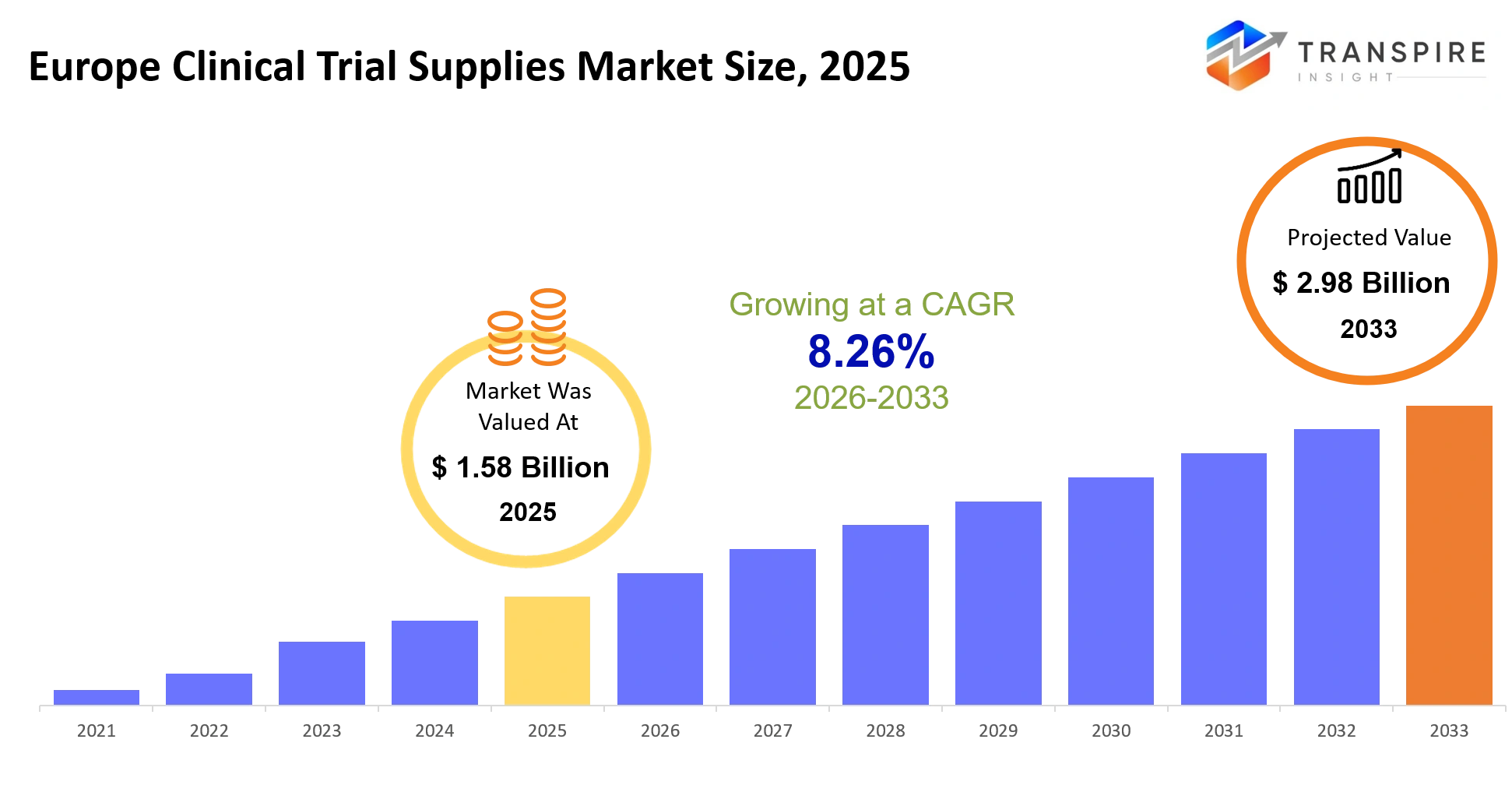
The Europe Clinical Trial Supplies Market was valued at USD USD 1.58 Billion in 2025. It is forecast to reach USD 2.98 Billion by 2033. That is a CAGR of 8.26% over the period.
The Europe Clinical Trial Supplies Market helps make sure that experimental medicines, biological products and medical supplies are packed, labeled, stored and delivered to trial locations on time. This way clinical studies can run smoothly. In reality it solves the problem of keeping temperature control following rules and coordinating across many countries, hospitals, research centers and contract research organizations during medicine development programs.
Over the few years around 3 to 5 the Clinical Trial Supplies Market has changed. It now focuses on hybrid clinical trials. This means supplies must be delivered to patients' homes and smaller regional sites, not big hospital centers. The COVID-19 pandemic sped up this change. It messed up global delivery networks so sponsors had to rethink their supply chain plans. Now there's a demand for flexible cold storage, tracking and adaptable packaging.
This change has directly helped keep trials on track. It has reduced delays in finding patients and collecting data. This supports faster medicine development. Makes operations more efficient for pharmaceutical companies and CROs. The growth in revenue is driven by logistics providers that can manage the process. They ensure that clinical supplies are visible and follow rules across European areas. Clinical Trial Supplies are crucial in this process. They help ensure that Clinical Trials run smoothly.The Europe Clinical Trial Supplies Market is growing. Clinical Trial Supplies help make medicine development more efficient. They ensure that Clinical Trials are done on time.The shift to hybrid trials has benefits. Clinical Trial Supplies are delivered to patients homes. This helps patients participate in trials. Clinical Trials can now reach people.
Key Market Insights
- The Europe Clinical Trial Supplies Market is mostly controlled by Western Europe with 52 percent share in 2025. This is because Germany and the United Kingdom and Switzerland have good facilities for pharmaceutical research and development.
- Eastern Europe is growing fast from 2025 to 2030. This is happening because it is cheaper to set up trial sites and they can recruit more patients.
- Southern Europe is also. At a slower pace. This is because more companies are outsourcing trials and contract research organizations are expanding.
- When it comes to the Europe Clinical Trial Supplies Market cold chain logistics is the segment with about 45 percent share. This is because more trials are being done on biologics and temperature-sensitive drugs.
- The biggest segment is packaging and labeling services. This is because the European Union has strict rules for clinical trials.
- The fastest growing segment is to-patient supply models. This is because clinical trials are now being done in a decentralized way.
- Most clinical trials in Europe are for cancer treatment with 40 percent share. This is because there is a lot of research being done on cancer and new drugs are being developed.
- The growing area for clinical trials is for rare diseases. This is because of medicine and targeted therapies.
- Pharmaceutical companies are the users of clinical trial supplies with about 55 percent share. This is because they do a lot of trials and develop new drugs.
- Contract research organizations are the growing users of clinical trial supplies. This is because pharmaceutical companies are outsourcing work to them.
What are the Key Drivers, Restraints, and Opportunities in the Europe Clinical Trial Supplies Market?
Drivers
The Europe Clinical Trial Supplies Market is growing fast because of clinical research in areas like oncology, rare diseases and personalized medicine. This growth happened because pharmaceutical companies have drug development projects and they are outsourcing more to contract research organizations. As there are trials in many European countries there is a higher demand for packaging, labeling and cold-chain distribution systems that meet regulatory requirements and ensure patients get their medication on time. This directly benefits logistics providers and clinical supply service firms.
Restraints
A big challenge is that regulatory requirements differ across countries. Each country has its rules for approving clinical trials, importing supplies and labeling products. This creates a compliance environment that causes delays and increases costs for sponsors and logistics providers. It also limits scalability because supply strategies must be tailored to each country, which slows down trial timelines and reduces efficiency in studies.
Opportunity
There is an opportunity in decentralized and hybrid clinical trials that use direct-to-patient supply models and digital tracking systems. Countries, like Germany, the Netherlands and Switzerland are adopting health infrastructure that allows patients to participate in trials from home. Using real-time temperature monitoring, AI-driven inventory forecasting and automated resupply systems will improve trial continuity. Reduce dropout rates. Clinical Trial Supplies Market players that invest in clinical supply platforms will have an advantage as decentralized trials become more common in Europe.
What Has the Impact of Artificial Intelligence Been on the Europe Clinical Trial Supplies Market?
Artificial intelligence is changing the way clinical supply chains work in Europe. It is making it better to plan and deliver medicines to people in many countries. This is done by using computers to track the medicines and make sure they are sent to the places.
Artificial intelligence can also track the temperature of the medicines when they are being sent. This is important because some medicines need to be kept cool. The computers can see when the medicines are running low and send more. This means that people do not have to call each other to check on the medicines.Computers are getting better at guessing how many medicines will be needed. They look at how many people're joining the trials and how many are leaving. They also look at how it takes to get the medicines to the people. This helps make sure that there are medicines and not too many.
When computers can see what is happening in time they can help find the best way to send the medicines. This means that the medicines are more likely to arrive on time.Using intelligence makes the trials work better. The medicines arrive on time. There are fewer problems. However it is expensive to set up the computer systems. Some places do not have the right technology. This makes it hard to share information.Also some places in Europe are not as good at using computers as others. This means that the computers do not have information to make good guesses. This is a problem because it means that the trials are not as efficient as they could be. Intelligence and clinical supply chains are connected and artificial intelligence is helping clinical supply chains in Europe.
Key Market Trends
- Since 2023 the way clinical trial supplies are delivered has changed. Now they are sent directly to patients being delivered to hospitals. This is happening over Europe.
- Between 2024 and 2026 companies like Thermo Fisher and Catalent made their cold storage bigger. This is because more people are using biologics and special medicines that need to be kept cold.
- After 2024 more people started using systems that track things in time. This helps us see where everything is when we are sending things to countries. It also helps reduce mistakes when we are shipping things.
- The European Union made rules for clinical trials in 2023. Now companies have to use labels and automated systems to keep track of things.
- DHL Life Sciences made their systems better after 2025. This helps them send things across borders easily and reduces delays when sending clinical supplies.
- After 2024 more companies started working with partners to handle their supply chains. This is because it is simpler and cheaper for pharmaceutical companies to do it this way.
- Clinical trials that are not in hospitals are becoming more popular since 2023. This means that more people need packaging that can be sent directly to patients and more people are taking their medicines at home.
- After 2025 more companies started using tools that use artificial intelligence to predict what they will need. This helps reduce waste and makes sure they have the supplies.
- More clinical trials are being done in Eastern Europe after 2024. This is because it is cheaper and easier to find patients
- Now there is competition between companies that help with clinical trials. They are not just transporting things they are helping with the process from start, to finish with clinical trial supplies and clinical supplies.
Europe Clinical Trial Supplies Market Segmentation
By Product Type:
There are a lot of products that are used to support clinical trials. Manufacturing supplies are necessary to make sure that new medicines are made correctly and safely. Packaging supplies are also very important to keep the medicines safe and make sure they are not damaged during transport. Labeling supplies help to make sure that the medicines are labeled correctly so that they can be used safely. Logistics supplies are used to get the medicines to the place at the right time. Ancillary supplies are used to help patients and to support the people who are running the trials. As clinical trials get more complicated the demand for these products is increasing. It is helpful if the supplies are standardized so that they can be used easily and do not cause any mistakes. New and innovative products are also being developed to help make clinical trials run smoothly.
By Phase:
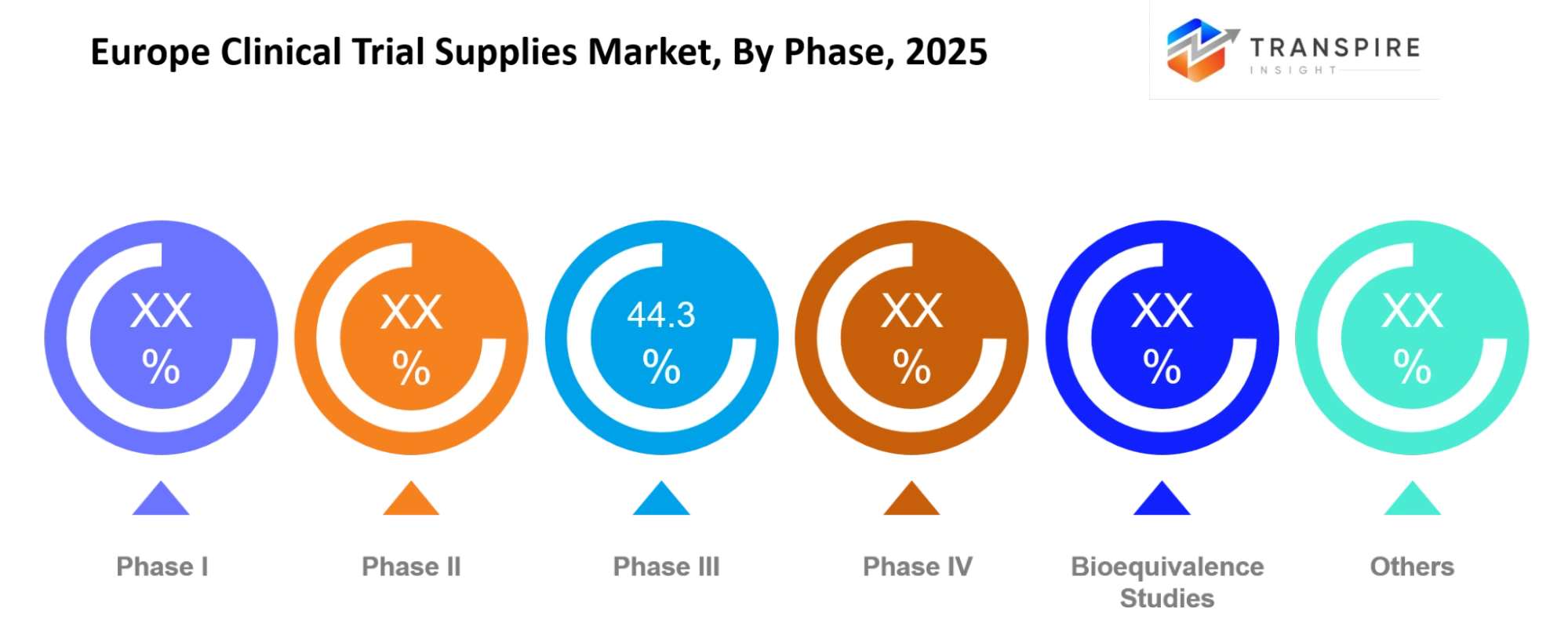
The Europe Clinical Trial Supplies Market is divided into phases. Phase III trials are part of the market because they involve a lot of patients and need a lot of supplies. Phase II trials are also important because they help to show if a new medicine is effective. Phase I trials are smaller. Need to be managed very carefully. Bioequivalence studies are also important because they help to show if a new medicine is as good as an existing one. Phase IV studies are done after a medicine has been approved to make sure it is safe and effective in the term. The supplies that are needed can vary depending on the phase of the trial and the regulations that need to be followed. It is very important to get the packaging and labeling right in the early stages of a trial. As the trials get bigger and more complicated it is necessary to have logistics in place.
By Service Type:
There are a lot of services that are used to support clinical trials. Storage services are necessary to keep the medicines safe and at the temperature. Distribution services are used to get the medicines to the place at the right time. Packaging services help to make sure that the medicines are packaged correctly and safely. Comparator sourcing services are used to get the medicines that are needed for comparison in a trial. Return and destruction services are used to get rid of any medicines that are not needed or are expired. It is helpful if all of these services are integrated so that they can work together smoothly. The demand for companies that can provide all of these services is increasing. It is also helpful if the companies can provide a range of services so that they can support the trials in the best way possible.
By Therapeutic Area:
The Europe Clinical Trial Supplies Market is divided into areas of medicine. Oncology is the area because there is a lot of research being done into new cancer medicines. Cardiovascular trials are also important because they help to show if new medicines are effective in treating heart disease. Neurology trials need to be managed carefully because they involve sensitive medicines. Infectious disease studies are important because they help to show if new medicines are effective in treating infections. Rare disease trials are becoming more common because there is a growing interest in medicine. Each area of medicine has its specific needs and requirements and the supplies and services need to be tailored to meet these needs. As the trials become more specialized it is necessary to have companies that can provide the services and support.
By End User:
The Europe Clinical Trial Supplies Market is used by a lot of people and organizations. Pharmaceutical companies are the users because they are developing new medicines. Biotechnology companies are also important because they are developing biological medicines. CROs (Contract Research Organizations) are used by companies to run their clinical trials. Research institutes are also important because they are doing a lot of the early-stage research. Hospitals are involved in trials because they are where the patients are treated. The demand for the Europe Clinical Trial Supplies Market is strong because there are many different people and organizations involved. It is helpful if all of these people and organizations can work together smoothly so that the clinical trials can run effectively.
By Distribution Channel:
The Europe Clinical Trial Supplies Market is supported by a lot of distribution channels. Direct sales are the common way that medicines are sold because the manufacturers have strong relationships with the sponsors of the clinical trials. Third-party logistics providers are used to support the distribution of medicines across borders. Specialty suppliers are used to provide medicines that are not commonly used. Distributors are used to make sure that the medicines are widely available. Digital platforms are being used more and more to make it easier to buy and sell medicines. The distribution networks are expanding across Europe to make it easier to get medicines to the place at the right time. Integrated logistics systems are being used to reduce delays and improve compliance. It is helpful if there are a lot of distribution channels so that the medicines can be delivered safely and efficiently.
What are the Key Use Cases Driving the Europe Clinical Trial Supplies Market?
The core use case in Europe Clinical Trial Supplies Market is about getting drugs to patients in Phase II and Phase III trials. These trials have patients across multiple countries. So drugs must be delivered quickly, correctly and on time. This creates a need for special cold storage, packaging and labeling. These services ensure that rules are followed and patients get their treatment without interruption.
Clinical trials are changing. Now some trials are decentralized. This means drugs are sent directly to patients at home. Pharmaceutical companies and CROs use tracking and packaging to manage complex supply chains across countries. They also need comparator drugs. These are reference drugs used in trials. They must be the same across areas.
New ways of working with Clinical Trial Supplies are being developed. Some companies are using AI to predict supply needs. This helps them manage inventory better. They can see how many patients are enrolled and plan accordingly. Another new approach is using twins. This is like a simulation. It helps plan supply routes and reduces risk in trials that happen in countries.
|
Report Metrics |
Details |
|
Market size value in 2025 |
USD 1.58 Billion |
|
Market size value in 2026 |
USD 1.71 Billion |
|
Revenue forecast in 2033 |
USD 2.98 Billion |
|
Growth rate |
CAGR of 8.26% from 2026 to 2033 |
|
Base year |
2025 |
|
Historical data |
2021 - 2024 |
|
Forecast period |
2026 - 2033 |
|
Report coverage |
Revenue forecast, competitive landscape, growth factors, and trends |
|
Regional scope |
Europe |
|
Key company profiled |
Thermo Fisher Scientific, Catalent, Almac Group, Sharp Services, PCI Pharma Services, Parexel, DHL, Marken, UPS Healthcare, Cencora, Lonza, Fisher Clinical Services, Bilcare, Movianto, Piramal Pharma Solutions. |
|
Customization scope |
Free report customization (country, regional & segment scope). Avail customized purchase options to meet your exact research needs. |
|
Report Segmentation |
By Product Type (Manufacturing Supplies, Packaging Supplies, Labeling Supplies, Logistics Supplies, Ancillary Supplies, Others); By Phase (Phase I, Phase II, Phase III, Phase IV, Bioequivalence Studies, Others); By Service Type (Storage, Distribution, Packaging, Comparator Sourcing, Return & Destruction, Others); By Therapeutic Area (Oncology, Cardiovascular, Neurology, Infectious Diseases, Rare Diseases, Others); By End User (Pharmaceutical Companies, Biotechnology Companies, CROs, Research Institutes, Hospitals, Others); By Distribution Channel (Direct Sales, Third-Party Logistics, Specialty Suppliers, Distributors, Others). |
Which Regions are Driving the Europe Clinical Trial Supplies Market Growth?
The Europe Clinical Trial Supplies Market is doing well in Western Europe. This is because Western Europe has a lot of pharmaceutical research going on and it has rules in place to make sure clinical trials are done correctly. Countries like Germany, the United Kingdom and Switzerland are places for clinical research because they have good hospitals and organizations that help with research. The European Union has guidelines for trials that everyone has to follow which means companies need special ways to package and deliver the medicines being tested. This also means they need to keep the medicines cold during transport. Western Europe has roads and transportation systems which help get these medicines to where they need to go on time and safely.
Northern Europe is also a place for clinical trials. It is a region with good healthcare and technology. Countries like Sweden, Denmark and Finland have hospitals and get a lot of money for research. They are always trying to find ways to make clinical trials better and more efficient. This means they need a supply of clinical trial supplies for all the research they are doing.
The Europe Clinical Trial Supplies Market is growing fast in Eastern Europe. This is because it is cheaper to do trials there and it is easier to find people to participate in the trials. Eastern Europe has been improving its healthcare system. Is now following the same rules as the European Union. Countries like Poland, Hungary and Romania are becoming places to do clinical trials because they are cheaper than other places. Over the few years from 2026, to 2033 more companies will be investing in Eastern Europe and working with organizations that help with clinical trials. This will help Eastern Europe become a part of the global clinical research community and the Europe Clinical Trial Supplies Market.
Who are the Key Players in the Europe Clinical Trial Supplies Market and How Do They Compete?
The Europe Clinical Trial Supplies Market shows a moderately consolidated structure where a few global logistics providers and specialized clinical supply firms control large portions of high-value trial distribution, while regional players compete through niche services and cost efficiency. Competition is mainly driven by service reliability, cold-chain capability, and regulatory compliance expertise rather than pricing alone. Established players are strengthening integrated end-to-end supply chain platforms, while newer entrants focus on decentralized trial support and digital tracking solutions to gain market access.
Thermo Fisher Scientific focuses on technology-driven clinical supply solutions, offering advanced cold-chain packaging and integrated clinical trial logistics systems. Its advantage lies in combining manufacturing, packaging, and distribution within a single global network, ensuring consistent compliance across multi-country trials. The company expands through investments in digital supply chain visibility tools and partnerships with pharmaceutical sponsors conducting large-scale oncology and biologics trials in Europe.Catalent strengthens its position through specialized drug packaging and clinical supply management services tailored for biologics and personalized medicine trials. Its differentiation comes from expertise in temperature-sensitive formulations and high-complexity clinical packaging solutions. Expansion strategies include capacity expansion in European facilities and partnerships with biotech firms focusing on advanced therapies.
DHL Life Sciences competes through logistics excellence, focusing on global clinical trial distribution networks with strong cold-chain infrastructure. Its advantage lies in real-time tracking systems and integrated global shipping capabilities that support multi-country clinical studies. The company expands by investing in digital logistics platforms and strengthening partnerships with CROs managing decentralized trials across Europe.Almac Group builds its strategy around precision clinical supply services, particularly comparator sourcing and complex packaging solutions for late-stage trials. Its differentiation comes from strong regulatory compliance expertise and tailored supply chain design for individualized trial protocols. Expansion includes regional facility development in Europe and closer collaboration with pharmaceutical companies conducting rare disease and oncology research programs.
Company List
- PCI Pharma Services
- Parexel
- DHL
- Marken
- United Parcel Service
- Cencora
- Lonza
- Fisher Clinical Services
- Bilcare
- Movianto
- Piramal Pharma Solutions
Recent Development News
In March 2024, Thermo Fisher Scientific expanded its clinical supply chain capabilities through enhanced cold-chain logistics infrastructure for biologics and advanced therapies in Europe. This strengthened end-to-end clinical trial distribution capacity and improved supply reliability for multi-country studies.
Source: https://www.thermofisher.com
In February 2024, Catalent expanded its clinical supply and biologics packaging operations in Europe to support growing demand for complex clinical trial materials. The expansion improved capacity for temperature-sensitive drug handling and decentralized trial support.
Source: https://www.catalent.com
In January 2024, DHL Life Sciences strengthened its clinical trial logistics network by enhancing real-time tracking and cold-chain distribution systems across European routes. This improved shipment visibility and reduced delays in cross-border clinical supply movement.
Source: https://www.dhl.com
What Strategic Insights Define the Future of the Europe Clinical Trial Supplies Market?
The Europe Clinical Trial Supplies Market is moving toward a digitally coordinated and decentralized supply ecosystem where real-time visibility and patient-centric distribution will define operational success. Over the next 5–7 years, growth will be shaped by increasing clinical trial complexity in biologics, oncology, and rare diseases, pushing demand for highly responsive cold-chain and multi-site logistics networks. This structural shift is being driven by the expansion of cross-border trials under harmonized EU regulations and the growing reliance on outsourced clinical supply management models.
A less obvious risk lies in overdependence on a small group of integrated logistics and pharmaceutical service providers, creating concentration risk across critical trial supply infrastructure. Any disruption in these networks could significantly impact trial timelines and data integrity. Additionally, fragmented digital adoption across smaller clinical sites may slow full-scale supply chain integration.
A key emerging opportunity is the integration of AI-enabled predictive supply planning with decentralized clinical trial models, especially in Eastern Europe where trial site expansion is accelerating. This will enable more precise demand forecasting and reduce wastage of investigational products. Market participants should prioritize investment in end-to-end digital supply platforms and regional logistics partnerships to improve resilience and capture long-term outsourcing demand growth.
Europe Clinical Trial Supplies Market Report Segmentation
By Product Type
- Clinical Trial Packaging
- Labeling Services
- Comparator Drugs
- Ancillary Supplies
- Storage & Logistics Supplies
- Others
By Phase
- Phase I
- Phase II
- Phase III
- Phase IV
- Others
By Therapeutic Area
- Oncology
- Cardiovascular Diseases
- CNS Disorders
- Infectious Diseases
- Rare Diseases
- Others
By End User
- Pharmaceutical Companies
- Biotechnology Companies
- Contract Research Organizations (CROs)
- Academic & Research Institutes
- Others
By Service Type
- Supply Chain Management
- Storage & Distribution
- Packaging & Labeling
- Forecasting & Demand Planning
- Returns & Reconciliation
- Others
Frequently Asked Questions
Find quick answers to common questions.
The expected Europe Clinical Trial Supplies Market size for the market will be USD 2.98 Billion in 2033.
Key segments for the Europe Clinical Trial Supplies Market are By Product Type (Manufacturing Supplies, Packaging Supplies, Labeling Supplies, Logistics Supplies, Ancillary Supplies, Others); By Phase (Phase I, Phase II, Phase III, Phase IV, Bioequivalence Studies, Others); By Service Type (Storage, Distribution, Packaging, Comparator Sourcing, Return & Destruction, Others); By Therapeutic Area (Oncology, Cardiovascular, Neurology, Infectious Diseases, Rare Diseases, Others); By End User (Pharmaceutical Companies, Biotechnology Companies, CROs, Research Institutes, Hospitals, Others); By Distribution Channel (Direct Sales, Third-Party Logistics, Specialty Suppliers, Distributors, Others).
Major Europe Clinical Trial Supplies Market players are Thermo Fisher Scientific, Catalent, Almac Group, Sharp Services, PCI Pharma Services, Parexel, DHL, Marken, UPS Healthcare, Cencora, Lonza, Fisher Clinical Services, Bilcare, Movianto, Piramal Pharma Solutions.
The Europe Clinical Trial Supplies Market size is USD 1.58 Billion in 2025.
The Europe Clinical Trial Supplies Market CAGR is 8.26% from 2026 to 2033.
- Thermo Fisher Scientific
- Catalent
- Almac Group
- Sharp Services
- PCI Pharma Services
- Parexel
- DHL
- Marken
- United Parcel Service
- Cencora
- Lonza
- Fisher Clinical Services
- Bilcare
- Movianto
- Piramal Pharma Solutions
About the Authors

Pankaj Ghogare Patil
I am Pankaj Ghogare Patil, a Senior Research Analyst at Transpire Insight, specializing in the Pharmaceutical, Chemicals & Materials, Healthcare IT, and Biotechnology industry. My expertise lies in conducting comprehensive market research, analyzing industry trends, evaluating competitive landscapes, and translating complex data into actionable insights. At Transpire Insight, I closely follow emerging technologies, regulatory developments, and market innovations to create accurate, well-researched, and informative content that helps businesses and professionals make informed decisions. I am committed to producing credible, evidence-based articles that reflect industry best practices while making technical topics accessible and valuable for a broad audience.

Chakradhar Khansole
Chakradhar serves as the Research Director at Transpire Insight, bringing over 8 years of experience in technology, innovation, and strategic market intelligence. He specializes in transforming complex market data into actionable business insights that enable organizations to make informed, growth-oriented decisions. Recognized for his strategic vision and analytical expertise, Chakradhar leads high-impact research initiatives, delivering comprehensive market assessments, competitive intelligence, and forward-looking industry analysis.
Recently Published Reports
-
Jul 2026
Alopecia Treatment Market
Alopecia Treatment Market Size, Share & Analysis Report By Disease Type (Alopecia Areata, Cicatricial Alopecia, Traction Alopecia, Alopecia Totalis, Androgenetic Alopecia, Alopecia Universalis, and Other Disease Types), By Treatment Type (Topical Treatments, Oral Medications, Injectable Therapies, and Hair Transplantation), By Gender (Male, and Female), By Distribution Channel (Hospitals and Clinics, Retail Pharmacies, and Online Retailers), and Geography (North America, Europe, Asia-Pacific, Middle East and Africa, South and Central America), 2021 - 2031
-
Jul 2026
Medical Ultrasound Probe Market
Medical Ultrasound Probe Market Size, Share & Analysis Report By Type (Linear Type, Convex Type, Endocavitary Probe, Phased Array/Cardiac Probe, Transesophageal (TEE) Probe, and Others), By Application (Ophthalmology, Cardiology, Musculoskeletal, Oncology, Obstetrics & Gynecology, General Imaging, and Others), By End User (Hospitals & Clinics, Diagnostic Centers, Ambulatory Surgical Centers, and Others), and Geography (North America, Europe, Asia-Pacific, Middle East and Africa, South and Central America), 2021 – 2031
-
May 2026
Biosimilars Market
Biosimilars Market By Product Type (Monoclonal Antibodies, Recombinant Hormones, Erythropoietin, G-CSF, Others), By Indication (Oncology, Autoimmune Diseases, Blood Disorders, Diabetes, Others), By Manufacturing Type (In-House Manufacturing, Contract Manufacturing), By Distribution Channel (Hospital Pharmacies, Retail Pharmacies, Online Pharmacies), By Industry Analysis, Size, Share, Growth, Trends, and Forecasts 2021-2033
-
Apr 2026
Gastrointestinal Endoscopy Market
Gastrointestinal Endoscopy Market By Type (Rigid Gastrointestinal Endoscope, Flexible Gastrointestinal Endoscopes, Disposable Gastrointestinal Endoscope), By Procedure Type (Colonoscopy, Gastroscopy, Duodenoscopy, Enteroscopy, Flexible Sigmoidoscopy, Others), By Application (Diagnosis, Treatment), By End-Users (Hospitals, Ambulatory Surgical Centers, Specialty Clinics, Laboratories, Others), By Industry Analysis, Size, Share, Growth, Trends, and Forecasts 2021-2033